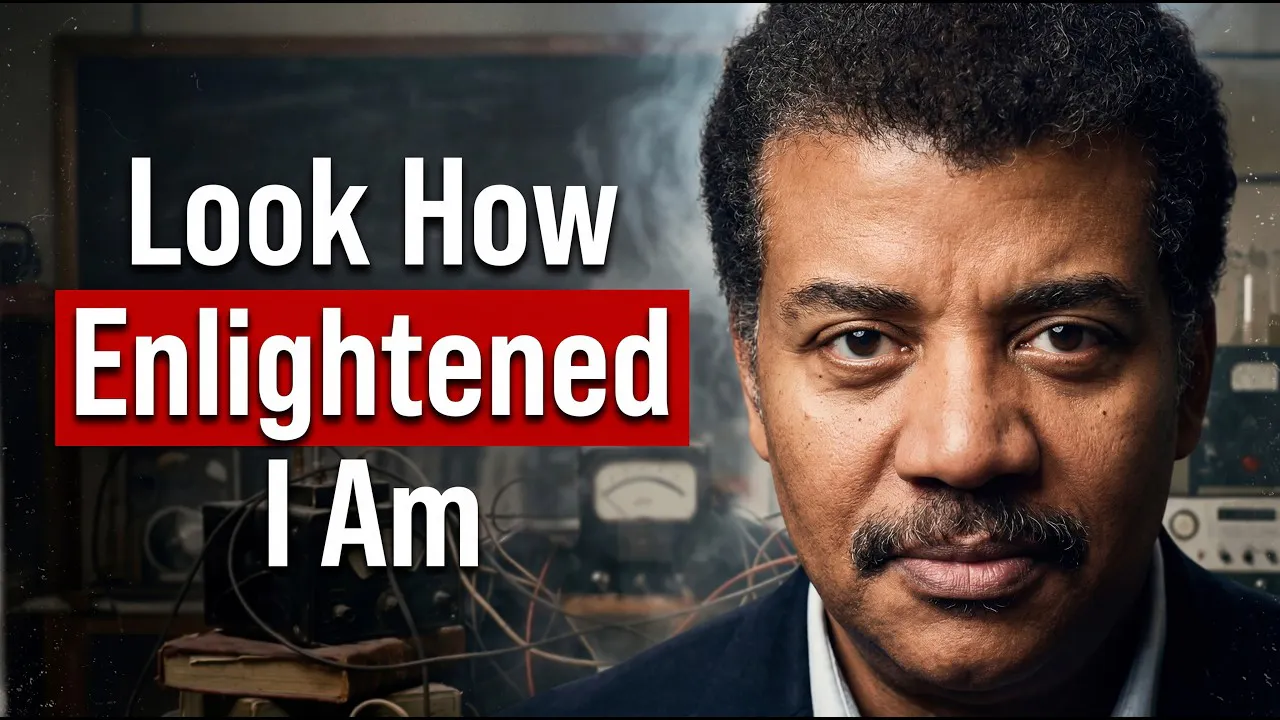
Curt Jaimungal: Why Neil deGrasse Tyson Gets "Belief" Wrong
About this episode
Get every episode summarized
Each time Theories of Everything with Curt Jaimungal publishes, we email you a written briefing from the transcript — the topics, who appeared, and any specific claims, with the ad reads skipped.
Email me new episodesFree for 3 shows. No card needed.
Hosts & guests

Transcript ready
307 searchable segments. Every word is indexed and playable.
Full transcript
Theories of Everything with Curt Jaimungal — Curt Jaimungal: Why Neil deGrasse Tyson Gets "Belief" Wrong. Machine-transcribed; use the interactive transcript above to jump the player to any line.
This episode is brought to you by Indeed. Stop waiting around for the perfect candidate. Instead, use Indeed Sponsored Jobs to find the right people with the right skills fast. It's a simple way to make sure your listing is the first candidate to see. According to Indeed Data, Sponsored Jobs have four times more applicants than non-sponsored jobs. So go build your dream team today. With Indeed, get a $75 Sponsored Job Credit at Indeed.com slash podcast, Terms and auditions apply. When Neil deGrasse Tyson says that I don't believe anything, I know that you believe that there is fear mongering over anything. I don't believe anything. It's not, I don't say I believe anything. Your wincing is indeed justified. Now, it's not just the scientist. The insidious disdain for the usage of the word belief is echoed even here in this infamous Deepak Chopra exchange. Now, you stated before that, all belief is a cover-up for insecurity, right? Who? Do you believe that? Yes. Thank you. The statement that I don't believe anything is said so self-assuredly, so swiftly, so
loudly, and with a tinge of condescension that you know something else is going on. It's a semaphore for, hey, look how enlightened I am. Aren't I so rational, unlike those poor, unsound, religious folk? So the phrase, I don't have beliefs is either trivially true, which you can read as empty. It's semantically confused, which is equivocating between belief and faith, or it's completely demonstrably false. Now, let's work through this rigorously. In analytic epistemology, belief is a propositional attitude. It's a mental state with a proposition as its content, and then to believe X just means that you hold that proposition to be true. Now it doesn't mean that I hold this proposition true to be true, no matter what. It doesn't mean that you can't update your belief subject to new evidence. In fact, there's an entire field called Bayesian epistemology about belief updating. So when you say you have beliefs, it doesn't mean that you're a member of the Westboro
Baptist Church. The Stanford Encyclopedia of Philosophy is unambiguous. Contemporary philosophers characterize belief as a propositional attitude. The key point is that belief doesn't have to imply faith nor certainty. You can believe you have a head. You can believe 2 plus 2 equals 4. You can believe that Neil is more logical than the person that he's speaking to. I think he does. So those who say when you ask him, hey, well, what is it that you believe about so-and-so? They say, oh, me, I don't hold beliefs. Ask me a different question. I'm a scientist. They think that the word belief is some confession of irrationality. No. It's just a basic piece of furniture in your mind. If the scientist wants to say, I don't have beliefs, it would require a nonstandard definition of belief and thus muddle the conversation with uncharitable and unstated redefinitions, which is actually itself unscientific. So one of the more charitable interpretations of the no belief claim that this rational
person is using is to say that belief means something like faith and faith to them means belief without adequate evidence or perhaps belief has some property of obstinate resistance to updating when encountering new evidence. But this is semantic equivocation. Standardly when people say and philosophers use belief at faith, they distinguish belief that. So that's a proposition. I'm holding p to be true. Or they can mean faith in, I can attitude, a trust-based, a trust-relation that could, although it doesn't have to involve resistance to change due to counter-evidence. By the way, Kierkegaard is important here because Kierkegaard has a similar sort of A rational or extra rational, whatever we want to call it, type of faith. There's a video here that I made about Kierkegaard that went quite viral, I'll link it on screen and in the description. Now the no belief rationalist can look up these words in the dictionary and I want to just take it a tad further by going to the Stanford encyclopedia. Richard Swinburne labels this the Thomas view of faith. The person of religious faith is the person who has the theoretical conviction that
there is a God. However, even Aquinas distinguished faith from ordinary belief. In theology, faith means one of these. So belief in propositions that are not fully seen or demonstrable, it could mean that, or it could also mean volition, a type of trust beyond mere ascent, and it could also mean that resilience to a certain kind of counter-evidence. When a philosopher hears someone that says, I don't believe I follow the evidence, the immediate responses, okay, following the evidence is just forming beliefs proportioned to that evidence. That's precisely what belief is. Most of my best ideas don't happen during interviews, they come spontaneously, most of the time in the shower, actually, or while I'm walking, until I had flawed, I would frequently lose them because by the time I write down half of it, it's gone. I tried voice capture before, like Google Home, and it just cuts me off in the middle. It's so frustrating. Most of my ideas aren't these 10-second sound bites, they're ponderous, they're long-winded,
and I wind around, they're discursive, they're five minutes long, Apple notes, even Google keep the transcription there's horrible. But plot, let's me talk for as long as I want, and there's no interruptions, it's accurate captured, organizes everything into clear summaries, key takeaways, action items, I can even come back later and say, hey, what was that thread I was talking about regarding consciousness and information? In fact, this episode itself has a plot summary below, and I'm using it right now over here. My personal workflow is that I have an auto-flow feature enabled, so it sends me an email anytime I take a note. Look, the fact that I can just press it and it turns on instantly, like right now, starting to record without a delay is extremely underrated. This by the way is the note pro, and then this is the note pin. I have both. Over 1.5 million people use plot around the world, if your work depends on conversations or the ideas that come after them, it's worth checking out. That's plot.ai-toe, use code TOE for 10% off at checkout.
To assert, scientists don't use the word belief, and I'm a scientist, is itself to express a belief. The belief norm assertion, which is the view that's widely held in philosophy of language, says one must assert P only if one believes P. I spoke to a scientist on NPR, where she said something like consciousness is a universal principle, and then my question was, can you explain what you mean when you said that you believe consciousness is a universal principle? That NASA scientist retorted to me. So first you have to stop saying belief when you're talking to scientists. The only belief we put is in the hypotheses, we're formulating hypotheses. The problem is, just because you don't use the word belief, it doesn't mean you don't have one. Consider this. You're speaking to your friend, you tell your friend, look, friend. You have some idea of what truth is. They say, look, I don't even need to use the word truth. It is raining outside. I didn't use the word truth. You'd be absolutely correct to say to your friend, okay, but the fact that you've managed to say a sentence without some particular word doesn't mean that concept isn't implicitly
embedded in it. It is raining outside is shorthand for it is true that it is raining outside. In the same manner, when Natalie Cabral said, I hypothesize that consciousness may be a universal principle, that's shorthand for I believe there's a non-zero chance that consciousness may be a universal principle. Of course, this avoids the question of what it even means to be a universal principle, but that's besides the point. When the scientists says something like, they think this is true or they think so and so is possible, they're committing to the truth or at least to the possibility of truth of a proposition. That's what assertion is, assertion presupposes belief or at minimum something functionally equivalent. And as Thomas Campbell, who goes further and pathologizes belief. Belief is a problem. Belief gets in the way. Beliefs are always a problem. He then spends three hours defending to me that consciousness is fundamental, that fear produces ego, etc. Those are beliefs, dozens of them. My ears tend to go back when the scientist shares something in common with the guru.
If you're sensing something contradictory here, I think you're right. To say, I don't have beliefs is itself an assertion, therefore asserting I don't have beliefs presupposes a belief, the belief that one doesn't have beliefs, it's like an undermining act. Now, an also note, there is an alternate view of truth, which is deflationary by saying truth is nothing more than some utterance of a statement. Crispin Wright, for instance, noticed you could flip this though, since the equivalence doesn't privilege a direction, but this is something for a future video, so subscribe if you like. Now, a counter may be to reach for boss Von Frost's distinction between belief and acceptance. In the early 1980s, Von Frost and argued that science aims to give us theories which are empirically adequate, and acceptance of a theory involves as belief only that it is empirically adequate. The constructive empiricists accept theories, they commit to using them, they base further research on them and so on, but they may be agnostic as to what the theory is true about unobservables, but even Von Frost and doesn't eliminate belief, acceptance of a theory
involves belief that is empirically adequate. The scientist still has beliefs. In fact, I spoke directly to Boss Von Frost and about this, it's a fantastic podcast, you should check it out, he's one of the most cited philosophers of science. He says, I believe many things, I believe that I had a father, I believe I wrote a book, could I be wrong, certainly, my beliefs could be false. Boss's point is more about the scope of rational belief in science, and it's not decidedly not about the elimination of belief from a scientist. Scientists can be epistemologically modest, maybe they should be, but they're not actually belief free. When I'm deep in research, reading papers on, say, the philosophy of mind or quantum gravity, it may seem sterile, but I still don't want my ISP logging every single page that I visit. Express VPN prevents exactly that. Your internet service provider, your ISP, can see, they can log, and they can, in the US, legally sell a record of everything you do online.
Express VPN encrypts all your traffic and reroutes it through secure servers, so your browsing history stays entirely yours. I travel for interviews and conferences constantly and connecting to a hotel airport Wi-Fi without protection is something I often kick myself for afterward. Express VPN's encryption makes those public networks safe. They can be used to totally unlock geo-restricted lectures and content by changing online location to any of 105 countries. There's no compromise on speed, either. It's consistently among the fastest VPNs out there. The fribility of hunting for work around just banishes. Find out how you can get up to four extra months by clicking the link in the description box below, expressvpn.com slash theories of everything yt. That's expressvpn.com slash theories of everything yt. Of course you can use a vernacular synonym for belief, like I'm going to call it credence. And I should be careful here because belief and credence are only semantic synonyms,
but they do remain distinct concepts in philosophy, particularly in basingism. Credence is a probability valued attitude, so a measure of confidence in some proposition ranging from zero. I fully disbelieve this to number 100% say or number one, which is complete certainty. So the difference here is that you could say that I'm only going to say that I believe in X once my credence has passed some threshold. A scientist who says something like, let's say, I have extremely high confidence based on evidence in the theory of evolution, but I don't believe the theory of evolution. They're speaking incoherently. If we take belief in the standard sense, high credence is just belief. And by the way, you may have noticed, of course, the scientific methodology itself reflects beliefs, belief that the scientific method is reliable, belief that evidence constrains a theory, belief in modus ponens, etc. Quine actually had a concept of holism in his two dogmas of empiricism, where he places
beliefs at the center of the, quote, web of belief. Now, counter example to the last few minutes is that you could take the fourth option. I gave for a few in the beginning, but let's say option one is I believe in X. OK, well, that's not a counter example, because I believe X is the case is exactly what we're discussing. How about option two, where you say, I don't believe in X? Now, this one's a bit tricky, because some people would say that this is a stand-in for I believe that X isn't the case, at least that's how we use the word in this option then isn't actually a counter example. Another option is you can be agnostic. You could say, I don't know, my mind isn't made up, whether that's because I don't think there's enough evidence to reach such a conclusion in either direction or what have you, but that still remains an attitude of belief. Now the last option here is the most interesting to me option for you could say that the matter at hand is independent of belief that belief has nothing to do with this, but then you could ask, well, what do you mean that belief has nothing to do with this? It seems like the first three options exhaust possibilities.
However, consider a cup of water. You could ask, what's the electric charge of the cup of water? That's a sensible question. You could also ask, what's the total electric charge of the universe? Or you could ask, what's the electric charge of $55? Now, in that case, that latter case, it would be wrong to say that the electric charge of $55 is zero, or that it's 10 EV or 250 TEV or something like that. As dollars have nothing to do with electric charge, assigning them an arbitrary number would just be a category error. My present deliberation is that the only way someone could say that they hold no beliefs and be accurate is in this option for a sense. Now, some more objections that naturally come to mind is perhaps one could remain radically uncertain about everything, treating all propositions as guesses. Even this doesn't eliminate belief. It's just describing fallabalism, so fallabalist belief. And even if you say something like 99.9% credence is required in order for me to say I believe in this, well, then to act in the world, such as crossing the street, eating food, does
require something like 99.9% credence that you're not going to get hit by a car or poisoned. So I think that the charitable reading is that the scientist is saying, look, I'm not dogmatic. I update. That's why I don't hold beliefs. But the best way to communicate that isn't to deny beliefs is instead to model epistemic virtues explicitly, saying I have no beliefs doesn't signal rationality. To me, it signals confusion about one's own cognition, worse, it gives ammunition to those who claim scientists are in denial about their own presuppositions. Now one could counter, hey, Kurt, historically speaking, faith meant trust or fidelity. It's not exactly a propositional ascent. Now this is true. However, it does commit this etymological fallacy, confusing a word's current meaning with its origin. To me, what matters is how belief functions in contemporary discourse. How do we use it? And also if we want to be a bit more technical, what does it mean in philosophy? No one thinks Neil deGrasse Tyson is channeling Aquinas.
So what do I think is going on? Why do so many scientists almost boastfully state I don't use the word belief. I don't like beliefs. Some whole beliefs, beliefs are no part of me as a scientist. I think it's because there's an impulse to communicate, I'm not dogmatic. I update, I could be wrong. To me, the way to communicate that again is not by denying to have beliefs. You just state fallibleism. That's fine. You're open to counter evidence. You're willing to update and you have precision about your confidence levels, perhaps. You do this with belief. I think it's like a demonstration of beacon of how rational they are by ostentatiously rejecting this term that they think has something to do with irrationality. When actually it's the opposite, it's more irrational to claim you have no beliefs by any standard definition. In fact, by most accounts, you can't even use the word no, like knowledge, without believing in whatever you're knowing. It's necessary for you to believe you have a mother in order for you to say you know you have a mother. So my concise verdict is that scientists have beliefs.
Everyone does. It's not innately irrational to have them pretending otherwise is linguistic posturing. It's entirely fine to say I believe electrons exist and I'm willing to change my belief if the evidence shows me that I'm wrong. That's entirely honorable. That statement itself is not creatinous. The scientist who says I hold no beliefs is confused about their own mind. I believe. The economist covers math, physics, philosophy and AI in a manner that shows how different countries perceive developments and how they impact markets. They recently published a piece on China's new neutrino detector. They cover extending life via mitochondrial transplants, creating an entirely new field of medicine. But it's also not just science. They analyze culture. They analyze finance, economics, business, international affairs across every region. I'm particularly liking their new insider feature. It was just launched this month. It gives you, it gives me, a front row access to the economist's internal editorial debates
where senior editors argue through the news with world leaders and policymakers in twice weekly long format shows, basically an extremely high quality podcast. Something else you should know about is that if you go to their app, they not only have daily articles, but they also have long form podcasts with their editors and writers. This is also available online. Whether it's scientific innovation or shifting global politics, the economist provides comprehensive coverage beyond headlines. As a toll listener, you get a special discount, head over to economist.com slash T-O-E to subscribe. That's economist.com slash T-O-E for your discount.
More episodes
More from Theories of Everything with Curt Jaimungal

She Says Spacetime Points Are Just Where Fields Meet
Theories of Everything with Curt Jaimungal
Tanya Luhrmann: The Experience Is Real. But Is God?
Theories of Everything with Curt Jaimungal
Tim Maudlin: Quantum Nonlocality Explained FROM SCRATCH
Theories of Everything with Curt Jaimungal
Adrian Owen: Awake. Aware. Unable to Move.
Theories of Everything with Curt Jaimungal