newsJul 23, 202613:20pending
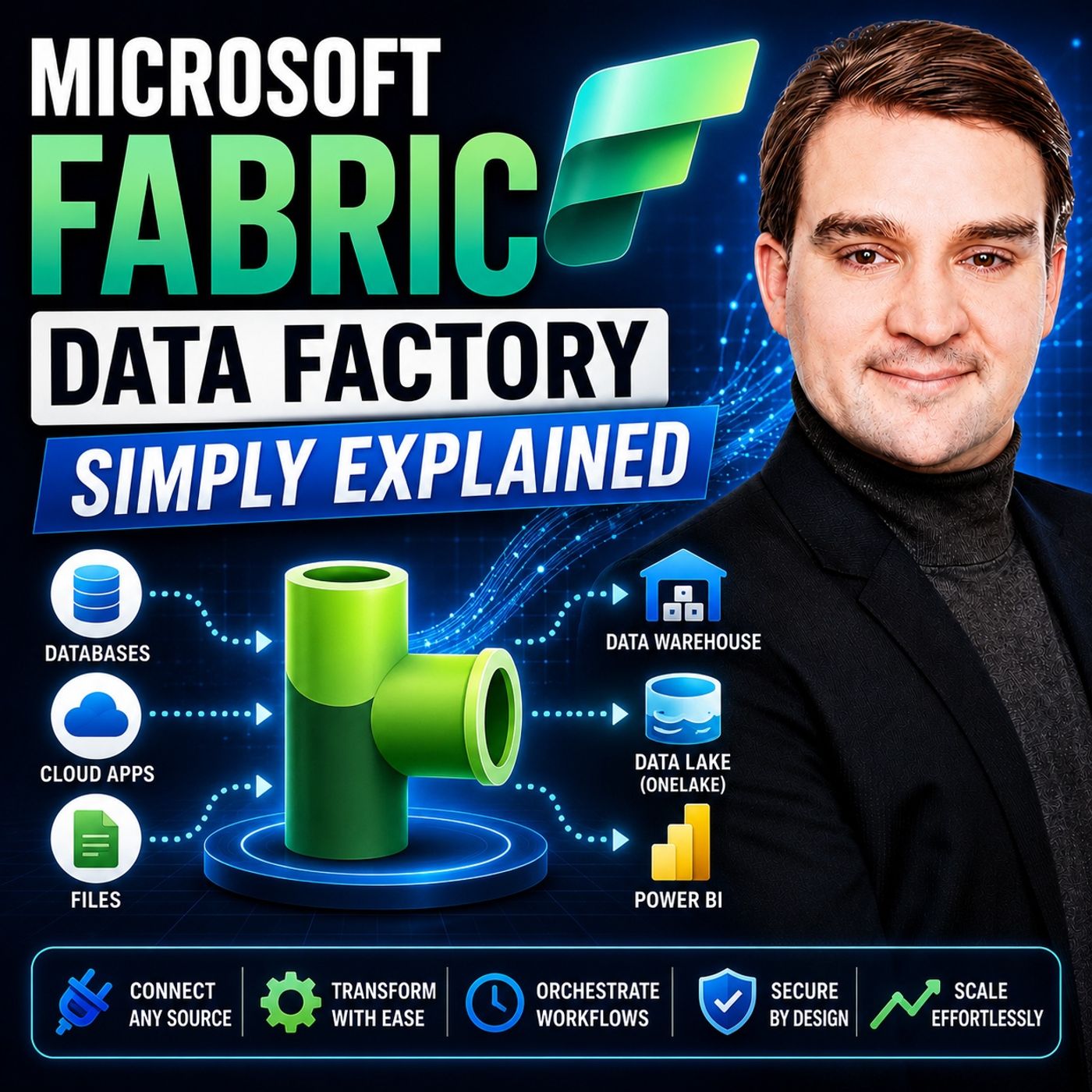
Microsoft Fabric Data Factory - Simply Explained
About this episode
Moving data has always been one of the most complex parts of building a modern analytics platform. Organizations need to collect information from databases, cloud applications, APIs, files, and enterprise systems before they can generate valuable business insights. Microsoft Fabric Data Factory simplifies this entire process by providing a unified, cloud-native data integration experience directly inside Microsoft Fabric. In this episode of Microsoft Knowledge Nuggets, we explain what Microsoft Fabric Data Factory is, how it differs from Azure Data Factory, and how its core building blocks help organizations move, transform, and orchestrate data more efficiently than ever before.
WHAT MICROSOFT FABRIC DATA FACTORY ACTUALLY IS
Microsoft Fabric Data Factory is the built-in data integration engine that powers Microsoft Fabric. Instead of deploying separate infrastructure or configuring multiple Azure services, organizations can create pipelines, connect to hundreds of data sources, transform information, and load it directly into OneLake using a fully managed Software-as-a-Service platform. Data Factory becomes the engine that connects every part of the Microsoft Fabric ecosystem, making enterprise data movement significantly easier to manage.
HOW FABRIC DATA FACTORY DIFFERS FROM AZURE DATA FACTORY
Although Fabric Data Factory shares many concepts with Azure Data Factory, it introduces a much simpler experience. Storage is automatically provided through OneLake, eliminating much of the infrastructure configuration required in traditional Azure Data Factory environments. Capacity-based pricing replaces activity-based billing, deployment pipelines are integrated directly into Fabric workspaces, and modern capabilities such as built-in Microsoft Teams notifications and simplified connections reduce the complexity of enterprise data integration projects.
DATA PIPELINES, DATAFLOW GEN2, COPY JOBS, AND MIRRORING
This episode explores the four core building blocks of Fabric Data Factory. Data Pipelines orchestrate complex workflows and automate business processes using low-code drag-and-drop experiences. Dataflow Gen2 enables users to clean, transform, and prepare data visually with familiar Power Query functionality. Copy Jobs simplify continuous ingestion with built-in Change Data Capture and Slowly Changing Dimension support, while Mirroring continuously replicates operational databases into OneLake with minimal configuration. Together, these capabilities allow organizations to ingest, transform, synchronize, and serve enterprise data using a single integrated platform.
HOW EVERYTHING WORKS TOGETHER INSIDE MICROSOFT FABRIC
The real power of Fabric Data Factory comes from its deep integration with the broader Microsoft Fabric platform. Data flows directly into OneLake, where Lakehouses, Warehouses, Power BI, notebooks, AI workloads, and Real-Time Intelligence can immediately access the same information without duplication. Organizations can implement modern Medallion Architectures with Bronze, Silver, and Gold layers while reducing traditional ETL complexity and maintaining a single source of truth across the business.
WHEN SHOULD YOU USE FABRIC DATA FACTORY?
Fabric Data Factory is ideal for data engineers, analytics engineers, BI developers, Microsoft Fabric consultants, and organizations already investing in the Microsoft data platform. Whether you're building enterprise ETL pipelines, synchronizing operational databases, transforming data with Power Query, or orchestrating complete analytics workflows, Data Factory provides a unified low-code platform that dramatically reduces development effort while improving scalability, governance, and maintainability.
Become a supporter of this podcast: https://www.spreaker.com/podcast/m365-fm-a-microsoft-mvp-podcast-by-mirko-peters--6704921/support.
WHAT MICROSOFT FABRIC DATA FACTORY ACTUALLY IS
Microsoft Fabric Data Factory is the built-in data integration engine that powers Microsoft Fabric. Instead of deploying separate infrastructure or configuring multiple Azure services, organizations can create pipelines, connect to hundreds of data sources, transform information, and load it directly into OneLake using a fully managed Software-as-a-Service platform. Data Factory becomes the engine that connects every part of the Microsoft Fabric ecosystem, making enterprise data movement significantly easier to manage.
HOW FABRIC DATA FACTORY DIFFERS FROM AZURE DATA FACTORY
Although Fabric Data Factory shares many concepts with Azure Data Factory, it introduces a much simpler experience. Storage is automatically provided through OneLake, eliminating much of the infrastructure configuration required in traditional Azure Data Factory environments. Capacity-based pricing replaces activity-based billing, deployment pipelines are integrated directly into Fabric workspaces, and modern capabilities such as built-in Microsoft Teams notifications and simplified connections reduce the complexity of enterprise data integration projects.
DATA PIPELINES, DATAFLOW GEN2, COPY JOBS, AND MIRRORING
This episode explores the four core building blocks of Fabric Data Factory. Data Pipelines orchestrate complex workflows and automate business processes using low-code drag-and-drop experiences. Dataflow Gen2 enables users to clean, transform, and prepare data visually with familiar Power Query functionality. Copy Jobs simplify continuous ingestion with built-in Change Data Capture and Slowly Changing Dimension support, while Mirroring continuously replicates operational databases into OneLake with minimal configuration. Together, these capabilities allow organizations to ingest, transform, synchronize, and serve enterprise data using a single integrated platform.
HOW EVERYTHING WORKS TOGETHER INSIDE MICROSOFT FABRIC
The real power of Fabric Data Factory comes from its deep integration with the broader Microsoft Fabric platform. Data flows directly into OneLake, where Lakehouses, Warehouses, Power BI, notebooks, AI workloads, and Real-Time Intelligence can immediately access the same information without duplication. Organizations can implement modern Medallion Architectures with Bronze, Silver, and Gold layers while reducing traditional ETL complexity and maintaining a single source of truth across the business.
WHEN SHOULD YOU USE FABRIC DATA FACTORY?
Fabric Data Factory is ideal for data engineers, analytics engineers, BI developers, Microsoft Fabric consultants, and organizations already investing in the Microsoft data platform. Whether you're building enterprise ETL pipelines, synchronizing operational databases, transforming data with Power Query, or orchestrating complete analytics workflows, Data Factory provides a unified low-code platform that dramatically reduces development effort while improving scalability, governance, and maintainability.
Become a supporter of this podcast: https://www.spreaker.com/podcast/m365-fm-a-microsoft-mvp-podcast-by-mirko-peters--6704921/support.
Get every episode summarized
Each time M365.FM - Modern work, security, and productivity with Microsoft 365 publishes, we email you a written briefing from the transcript — the topics, who appeared, and any specific claims, with the ad reads skipped.
Email me new episodesFree for 3 shows. No card needed.
Hosts & guests
No transcript yet
This episode has not been transcribed. Request it and it moves to the front of the queue.
More episodes
More from M365.FM - Modern work, security, and productivity with Microsoft 365

How Finite Capacity Scheduling Actually Works in Manufacturing
M365.FM - Modern work, security, and productivity with Microsoft 365
Sep 14, 20261:54:54completed

Why Your Critical Path Changes When Production Changes
M365.FM - Modern work, security, and productivity with Microsoft 365
Sep 14, 20261:51:17pending

How AI Changed Software Development Forever — Building the Agentic Future with A...
M365.FM - Modern work, security, and productivity with Microsoft 365
Sep 3, 20261:11:37completed

Architecting Power Platform for Complex Enterprise Solutions with Ian Tweedie [M...
M365.FM - Modern work, security, and productivity with Microsoft 365
Sep 2, 20261:01:31completed