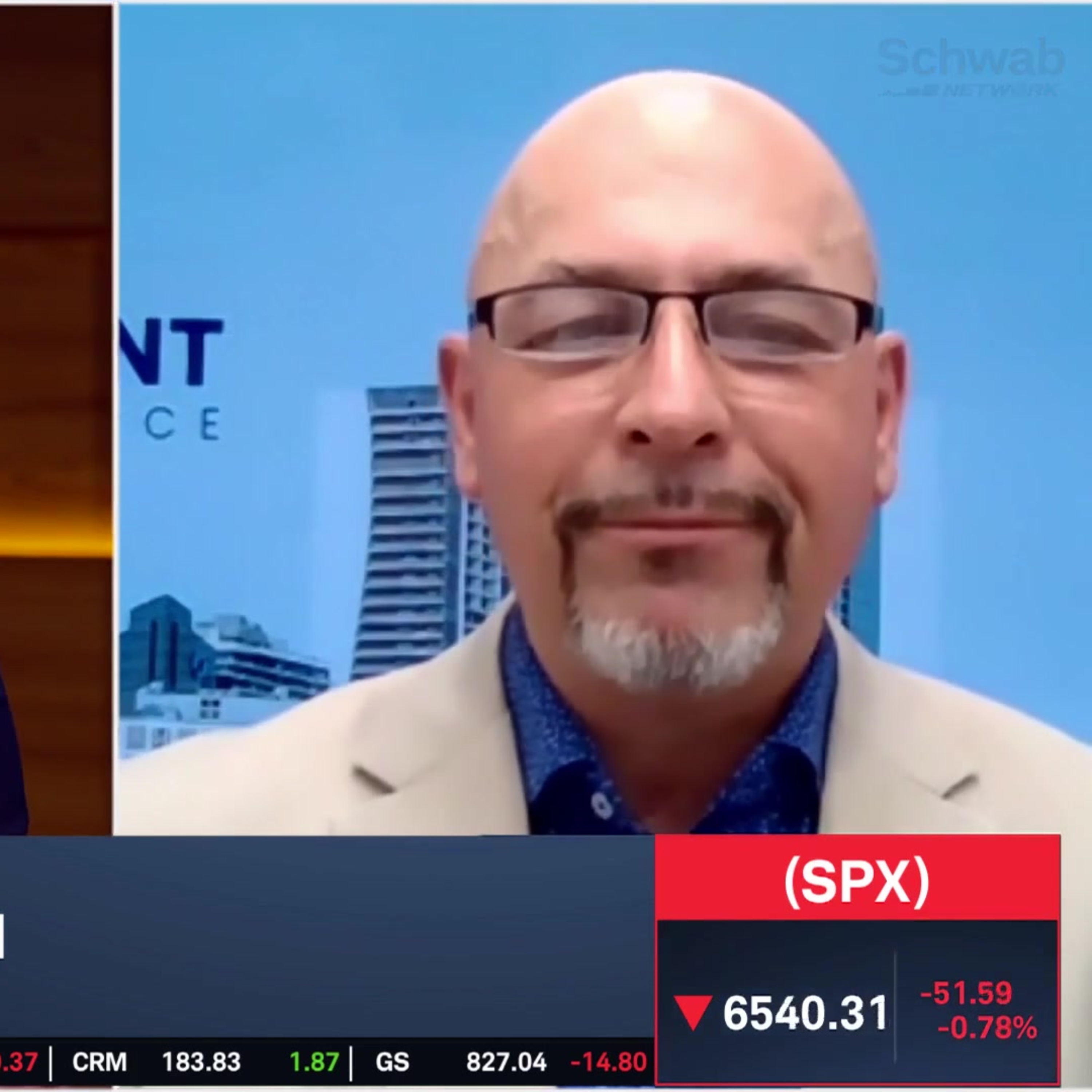
About this episode
We are in a “more sensitive, more disciplined market,” argues Jeffrey Small, with investors more interested in tangible earnings than future promises. “We’re just starting to see the potential” for selling as institutions put money to the side rather than allocating to equities, he notes. The midterm elections were driving markets before the conflict, he believes, with the market typically pulling back in midterm years. “Tech is providing the floor for now,” and we’re “lucky” markets haven’t fallen further.
======== Schwab Network ========
Empowering every investor and trader, every market day.
Options involve risks and are not suitable for all investors. Before trading, read the Options Disclosure Document. http://bit.ly/2v9tH6D
Subscribe to the Market Minute newsletter - https://schwabnetwork.com/subscribe
Download the iOS app - https://apps.apple.com/us/app/schwab-network/id1460719185
Download the Amazon Fire Tv App - https://www.amazon.com/TD-Ameritrade-Network/dp/B07KRD76C7
Watch on Sling - https://watch.sling.com/1/asset/191928615bd8d47686f94682aefaa007/watch
Watch on Vizio - https://www.vizio.com/en/watchfreeplus-explore
Watch on DistroTV - https://www.distro.tv/live/schwab-network/
Follow us on X – https://twitter.com/schwabnetwork
Follow us on Facebook – https://www.facebook.com/schwabnetwork
Follow us on LinkedIn - https://www.linkedin.com/company/schwab-network/
About Schwab Network - https://schwabnetwork.com/about
Get every episode summarized
Each time Schwab Network publishes, we email you a written briefing from the transcript — the topics, who appeared, and any specific claims, with the ad reads skipped.
Email me new episodesFree for 3 shows. No card needed.
Hosts & guests
Transcript ready
139 searchable segments. Every word is indexed and playable.
Full transcript
Schwab Network — Market Could See Further Downside as Institutions Sit Out. Machine-transcribed; use the interactive transcript above to jump the player to any line.
It's time to take a look at some investing positions to consider amid the market volatility that we're seeing. Joining us now to take a closer look, Jeffrey Small, the managing partner at the retirement income source. Jeffrey, great to have you back with us. You know, very interesting week of trading we've had so far, very headline driven. I've used a lot of the roller coaster analogy, one of my co-workers likes to liken it to looking into a kaleidoscope and just picking your favorite angle or color and that seems to be what's successful. What are some of your thoughts on the action that we've seen so far? Well, we're not in the market that we were in last year, Marley. So where liquidity was really driving everything last year, you know, in stocks, we're all going up no matter what, as long as they had the AI name around them, that phase is really clearly behind us. What we're now is a more sensitive, more disciplined market. Interest rates are still very elevated. The cost of capital is becoming a big issue. Interest rates are demanding real earnings and not just future promises and so we're transitioning from a momentum driven market to more of an inner earnings drive in market and that's
kind of where we are today. But what's changed are, you know, higher rates for longer, compressing valuations, less tolerance for speculation, weak tech getting sold, you know, earnings dispersion, widening, winners versus losers, losers clearly separating, institutional focus shifting, you know, more towards durability, not just growth. And so we can say the environment landscape for investing has really changed quite a bit. It certainly has it and we've got a much more volatile backdrop this year. But we're also still looking at earnings expectations for the first quarter, still calling for double digit growth, you know, and we are seeing quite a bit of resilience still in the markets, even though it is a bit of up and down journey that we're on on a near daily basis, not huge swings in either direction. So as you look at that, what's giving the markets this level of resilience that we're still seeing despite all of these other issues at play? Well, I think it's got to be earnings earnings have been stellar projections for earnings this year are still very, very strong despite all of the headwinds we just mentioned.
And technology stocks in particular are providing a floor for the market and providing a key role for the market falling off even more, even though a lot of our favorites have fallen quite a bit. The NASDAQ recently has outperformed with tech and consumer sectors also leading in gains. And so, you know, this comes after a very meaningful pullback. In other words, the market has been flat since September of last year, there's been no growth. And things like inverse ETFs that short the market or short the VIX are up 30, 40% this year. So could this be the start of a slow online? It remains to be seen. I think we're just starting to see the potential for wholesale selling where institutions are starting to put cash on the sidelines and not reinvest. And there's many reasons for that, but I'll let you ask me my next question and we'll become more elaborate about that more. Yeah, and as we're looking at that, it's not the first time I've heard that, it's a lot of people saying it's not the time to put more money and it's time to reallocate your positions and potentially even time to trim some positions. Tech continuing to come up in that conversation. We're seeing a lot of rotation, a lot of churn under the surface there away from some
of these software names with the SaaS apocalypse and into more of the semi and infrastructure plays from your perspective, what's driving that shift right now? Well, I think what was originally driving the shift was the midterm. The midterm congressional elections historically have a very nice correction into them. And so there's been lots of gyrations between should we sell the market short, should we stay long, should we buy the dip. And then we have these very vast movements every day based on the news driven market based on what's happening geopolitically and with energy. And so all of these things have become major issues in terms of where the market values are. And we're very fortunate that the market has a sold off more than three and a half percent year to date. Where it's at right now. And so, but tech is providing the floor for now. And so Jeffrey, as we start to see people potentially sidelineing and not putting more money into the markets, where are you seeing opportunity in specific names or in sectors or themes? Well, I think tech, big tech and AI related tech companies that are doing very well on their
earnings are companies that you want to put on your on your board to watch. Have we hit bottom yet? I don't think so. I think we're going to see a 10 to 15 percent more movement to the south side of the equation here. And the question is, when are we going to be at the low? The low was April 7th of last year. That was a great time to buy. I think I was on one of the show shows and I said, we're not at the market bottoms. It's time to get back into the market. And the VIX was still pretty high at that point. So, but we haven't really had the real earth shock of volatility yet. We've had a very slow and steady unwind. So it's a confusing market on when you should enter and what you should trim and how much. And so if we're in this by the dip scenario, you're saying we have to potentially wait to enter correction territory. We have to see at least a 10 percent pullback before you'd want to enter. How do you play it? All this geopolitical uncertainty, and we have fed uncertainty on top of that with everything happening overseas in the potential upticket inflation, how do you know when to enter? Well, you really don't. It's a guess, but we know that the market will take off if the Iran thing gets fixed
very quickly here and they capitulate. The chances of that happening, I think everybody's expecting a much longer time frame for a solution there. And then we're optimistic in the short term. It's probably going to lease go on for another two or three months. So there's going to be some more pain in the markets. Will earnings keep doing well? Yes. Will energy stay high? Yes. We'll inflation probably go up a tick because of energy? Yes. And so we kind of wait for those things to settle, subside, get more gravity. But for those that want to play the momentum game, it's now a trader's market. Get in with the markets up, you know, buy one of the markets, falling and fall energy. Energy goes up, market down, energy goes down, market up. And that's the path we're going to be in until this gets resolved. If troops get deployed and we take the energy island over there, cart island over there in Iran, because we're looking for more negotiable leverage, then that won't be good. Energy will rise, but the straits got to get open. And so we need, you know, a global concert of effort to try and keep oil flowing, keep the energy prices, you know, obviously below $85, so it doesn't put so much pressure on
the markets. So in the 90s, upper 90s, potentially going to, you know, in the low 100s to teens, it's not a good environment for the markets. All right, Jeffrey. And if we're not in a good environment, what's the greatest risk right now? Is it geopolitics? Is it sticky inflation? Is it more negative headlines? AI hype doesn't translate into earnings. What's the potential downside catalyst, the biggest one? I think in the short term, the biggest catalyst, of course, is a massive spike in energy. And if Iran had some type of secret weapon that they didn't tell us about us, a new rocket or something that they could hit the refineries in the Middle East and the Middle Eastern States and maybe hit a tanker or two, that would be a problem. That would cause massive disruption and energy flow. And we would see, you know, energy spike to over $150 to maybe $200 of barrel. But I don't see that happening, but in the short term, you know, we're all kind of spectators in this event. All right, Jeffrey. We really appreciate you being with us this morning. Sadly, we have to leave it there, but we really appreciate the insight, Jeffrey Small
partner at the retirement income source. Thanks again for being with us today.
More episodes
More from Schwab Network

Stock Market Today: ORCL & ADBE Earnings, AEO Plunges Near 52-Week Low
Schwab Network

Thursday's Final Takeaways: Crude Taps $103 & PPI Hotter than Expected
Schwab Network

Balancing High-Conviction AI With High-Dividend Diversification
Schwab Network

EARNINGS PANEL: ORCL, ADBE
Schwab Network