About this episode
Art of Darkness is made possible by:
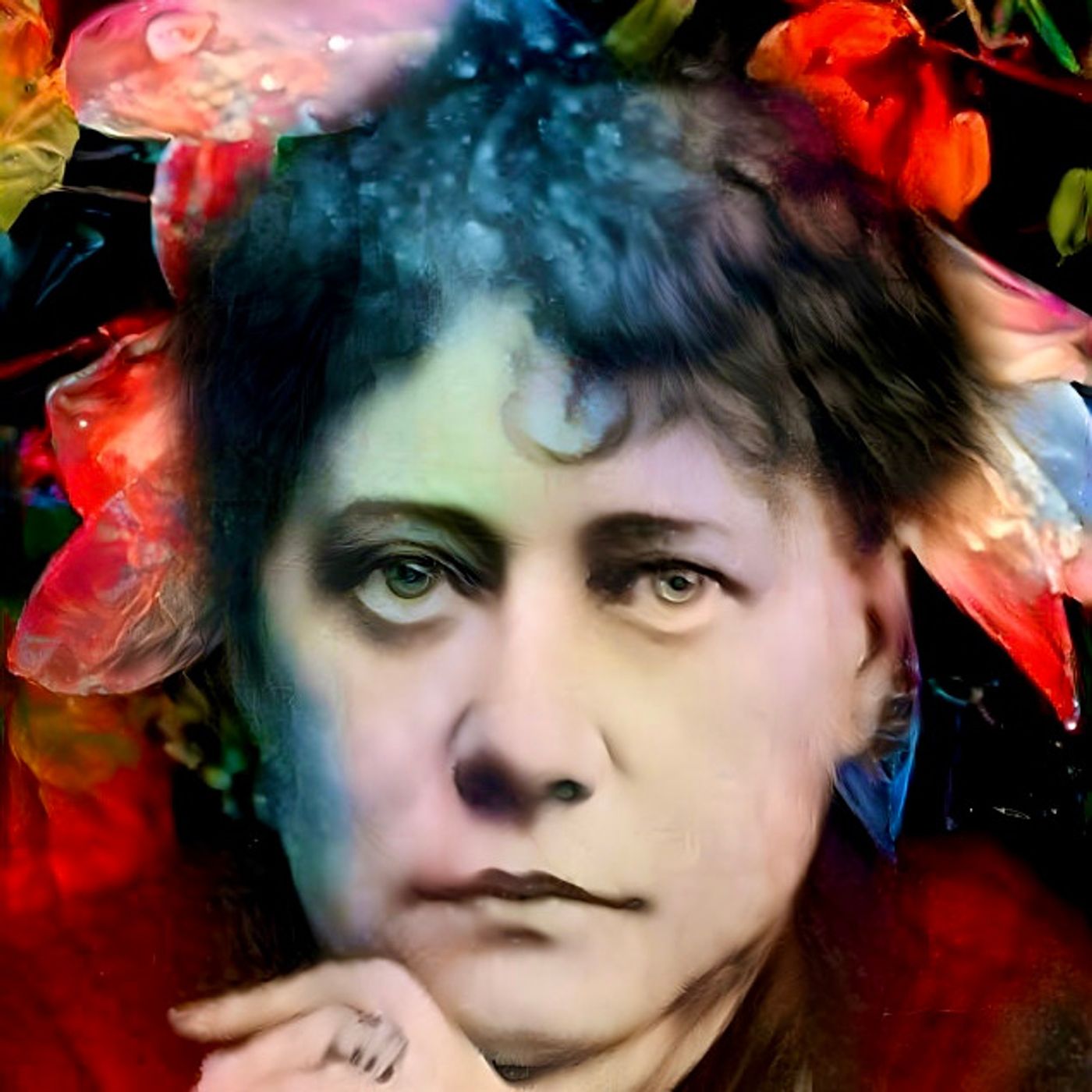
We cover the wonderfully woo-woo life and work of the chain-smoking, foul-talking, table-knocking mother of modern spirituality: Madame Blavatsky, the OG White Lotus.
Get ad-free Core Episodes, the After Dark episode, and more at patreon.com/artofdarkpod or substack.com/@artofdarkpod.x.com/artofdarkpod
x.com/therewillbbooks
x.com/kautzmania
Hosted by Simplecast, an AdsWizz company. See pcm.adswizz.com for information about our collection and use of personal data for advertising.
Get every episode summarized
Each time Art of Darkness publishes, we email you a written briefing from the transcript — the topics, who appeared, and any specific claims, with the ad reads skipped.
Email me new episodesFree for 3 shows. No card needed.
Hosts & guests
Transcript ready
2,760 searchable segments. Every word is indexed and playable.
Full transcript
Art of Darkness — Madame Blavatsky: The Original White Lotus. Machine-transcribed; use the interactive transcript above to jump the player to any line.
It's fall in Jeep country and during the drive into fall sales event get a great deal on 4x4s that refuse to be contained like Jeep Wrangler. Confidence built into every drive with the most awarded SUV ever, Jeep Grand Cherokee, and freedom that can't be denied with the open air freedom in Jeep Gladiator. After 85 years, it's no surprise that Jeep became America's SUV brand, get a great deal during the Jeep Drive into fall sales event. Jeep is one more awards over its lifetime than any other SUV brand, Jeep and the Jeep Grille Registered trademarts of FCA US LLC. This is Belie, one network, every topic, everywhere. This is the Art of Darkness podcast with Kevin Koutsman, and Matt Taylor. We're a couple of very online writers interested in the dark side of creativity. This show is about art and the people who make it, what it costs them, and what it takes to bring something unique and impactful into the world. On each episode we examine the life and work of an artist you might think you know. Don't worry, they're all safely dead. We aren't, find us online at artofdarkpod.com, and please support the show through Patreon or Substacks.
You get tons of bonus content and now add free core episodes. Thank you, enjoy the pod. Hey, we're back. This is a core episode. The heart of what we do at Art of Darkness, I'm Kevin Koutsman. This is the great. Wait. Can you hear that? What is that? What is that? That table wrapping? What's going on? What's going on? What are we going to go really woo here? Okay. And of all the episodes I've ever done, yeah, we're table knocking today. We're covering the life and work of HPB herself, the queen of a gartha, a very mysterious figure, and the mother of the world. The mother of modern spirituality, per our friend of the pod, who I hope we can get on. Gary Lockman, that's one of the biographies I'm using.
Madame Blavotsky, okay. What do you know? Let's start with the opening question, Matt Taylor. What do you know about Madame Blavotsky? Just a little bit. I know a little bit more about Steiner and Gurgif and all these people and she always comes up. Comes up like Yates was a follower until he wasn't, you know, like these people dabble in theosophy. But I don't know. I don't know if I could pin her era. You could tell me she was active in the 1860s and I'd be like, okay, you could tell me she was a contemporary of Gurgif in the 1900s. I'd be okay. So I can't quite, I don't know the era. Have this key to the theosophy. I haven't read. I just excellent thought it looked cool. So it's been on my shelves for a bit. Okay. So her philosophy is either interesting but kind of antiquated or if you're like J.Dyer or some people, her accolades and their descendants are in charge of everything right now.
And it's so well one of the two. I'm hoping. Yes. Yes. And of all the subjects I've covered on art of darkness coming up on 100 core episodes, by the way, I think you're going to get the hundredth here with Vidal, I believe. Let's talk about that. This is the one where there's a lot of ink. There's maybe the most ink has been spilled over this woman. But instead of clarifying things, it only serves to obscure what is real and what is true. Is it kind of occulted? There you go. That's a good word. Yeah. It's sort of opaque or maybe translucent is the better word. It's like a little foggy. What's true? What's frankly bull? We're very, it's very woo. I'm excited. And I'm going to flag that. And so Matt listeners, friends of the pod, everybody listening. Just if you've got received opinions about Blavotsky, right?
If you aren't an accolade, if you aren't a hidden master. Okay. I want you to listen to this episode and what we say and sort of make up your own mind. Okay. About how much you're willing to believe. I want to get right into it. And then we'll do a little bit of housekeeping. But as I said, today we are talking about the life of Helena Petrovna Blavotsky. There's going to be some Russian words. Okay. Okay. She is one of the strangest and most consequential figures in the history of modern occultism. Now, we want to talk about the influence of this woman. Have you ever heard of a little television show called The White Lotus? Matt. Uh-huh. Yeah, have you watched The White Lotus? I have it. Okay. Well, I discovered while doing prep for this show that her, her, how to say this. The people who are still theosivists and they are out there. And if, and if, if Koot Hume is out there, if any of the hidden masters are out there,
who's going to want to remind you, Matt and Kevin from the Art of Darkness podcast will fly business class. We, we will do a live show in Bombay. You name it. We'll go. You could even put us in, you could pack us in your luggage. Okay. We're willing to go. Um, they celebrate White Lotus Day on the anniversary of her death. And we're going to come to that. So there is a little key to what that show is maybe angling at and to its continued influence. This is one of those things. It's like, uh, like a band like, like Pixies. Everybody, Pixies went on and influenced every other, or, you know, every other band for a generation. And then only got there. Do a little later. Right. And thank goodness they did. Blavatsky is a bit like that though in her time she was a big deal. But would ultimately be disgraced as we will, we will come to find out. Um, she's one of these people who, like, as you do her biography, it's a problem to tell it, responsibly, because you risk, um, accenting the, the horse shit, frankly, and the nonsense.
Uh, you know, and I, I think about our cast and Ada episode that, that the great Brad Kelly of the method in madness podcasted, uh, where I was really maybe a little bit harsh on cast and Ada. And I still, uh, get a load of, a lot of trouble from that from his Devotays. Cause of course I didn't understand. So I want to avoid that. I don't, I don't want the theosifists coming after me. In fact, I really don't, because they seem to have special powers, Matt. I don't think we, we don't need the heat. Okay. So I, I'd say we're, we're theosificurious on this podcast. Is, is that, okay. Yeah. We're gonna treat it. Yeah. Treat it generously. A lot of the people who are writers, who I like. And I think our, our popular like yates and whatnot are influenced by, by theosifia went through a theosophis phase. So we're, I'm open. Yeah. Yeah. So it's just really important to understand that Blavatsky spent a lot of her life telling stories about Blavatsky.
And there's a figure we're going to meet named Olkot. And Olkot wrote 2,000 pages about his time with Blavatsky. So she is extraordinarily well documented. And as I said, it's, it's difficult to sort of parse truth from, from lies. But we're going to do our best. And, uh, yeah. Blavatsky was a big deal. So whatever you're going to end up thinking about her psychic phenomenon telepathy, I really enjoy reading Gary Lockman, the great Gary Lockman. And I think we should try to get him back on in the fall or get him on in the fall. I saw him speak on Crowley in London. He's great. Of course, in the Rock and Roll Hall of Fame too. It was very cool. But he, he comes to a point in his book, which I would recommend, Menamblavatsky, the mother of modern spirituality, where he starts to read. Where he starts talking about telepathy and he just goes, well, I, I think there's enough evidence to suggest that telepathy is real.
And he's almost like glib about it. And I, I really like that. If you're going to cover this stuff and you believe telepathy is real, just, just treat it as a matter of fact. And there are footnotes and references. And what do you think? And we're going to get into the biography. We're going to start in the middle. And then we're going to come back to her childhood. We're going to start in Vermont, to all places. Of all the people we've covered, maybe especially the women, she's by far the most well-traveled, even though some of the travels might have been who we were going to talk about that too. I've never lied about taking a trip that. Like literally, like just, I was in Paris when I did. I was in Tibet. I was in Tibet. Okay, that sort of thing. I know that when you could, yeah. It was more open, you could say. Oh, you get away. You're journeyed to the east. I would wonder if you're talking about like, to the astral plane. And you know, I think. Yeah, no, no. So, yeah. So we're going to start in Vermont.
But, you know, it's going to be fun. I'm really excited for this. She, she's a fascinating figure. So we're going to start with, we're going to be in the early 1870s. Okay. So, after the American Civil War, all right, about a decade later. And we're going to start in October. Oh, October, it's a spooky season, right? She's in Chittenden, Vermont. And there's a fellow who's going to figure heavily in this biography. He's named Henry Steel Alcott. He's 42 years old, a Civil War veteran, a lawyer, and a journalist who'd also performed investigative work for the federal government. At this point, he is deeply interested in spiritualism.
Matt, what, what do you know about spiritualism? Just a little, what I picked up here and there. Is that more sayances and contacting spirits and read and whatnot? Yeah. I mean, I'm just going to read the Wiki because it's important. And it's spiritualism is a social religious movement popular in the 19th and early 20th centuries, according to which individuals awareness persists after death and maybe contacted by the living. Okay. And yes, it's spirit guides, it's table knocking, it's medium ship, and this was big in the Northeast. And so it's no surprise, she finds herself in the Northeast. And you look at the Wiki and it's Swedenborg and it's Mesmer. And it had links to reform movements and women's rights and all kinds of things. There's a really good documentary if you want to see kind of a living example of spiritualism.
And it's set in upstate New York, it's called American Mystic. And it's a documentary about three, really four American mystics. And one of them is this black fellow in upstate New York who is a spiritualist. He's laying hands and seeing auras. And that's the milieu that that Belvotsky kind of comes into. Okay. Okay. Okay. Good background to half. We got to do Swedenborg at some point. You're doing Blake later this year too. Blake, yeah. Yeah. It's all in that season has been kind of like the people like that pop up. Like young did say ounces with his cousins when he was growing up. And he took a more scientific or you know, clinical approach, but it's there. I am also just book more. I'm interested that she wound up in America because she's Russian originally right. Correct. And we're going to come back to her early life after I'm setting this up. Yeah. Okay. So that's interesting to me. A lot of these guys, Gerjif wound up in America.
A lot of these guys blinded up. Yeah, even Crowleyer. Crowley, yeah. Yeah. Typically in the in the Northeast. All right. So this Henry Olcott fellow. He goes to Rural Vermont to investigate William and Aratio Eddie. Two brothers whose farmhouses become famous for alleged materializations of spirits and other paranormal phenomena. Maybe they maybe they had a toe ghost there. And and Aratio's old timers are ultra is no all about the toe ghost. But we'll leave that. Okay. I don't know if the toe ghost is going to show up in this episode. Okay. So here comes a Russian woman. And Olcott clocks her immediately. She's 43 years old. Dressed in a really unconventional way. She had a bright, garabaldian style garment. What does that mean? Garabaldian style. Let's look that up. Okay. Yeah.
So imagine it scarves and maybe a wrap around your forehead. Dashing. It's like Italian folk hero. Yeah, exactly. Okay. And so this is a recurring theme in her in her life. Is that she would really and purposefully flaunt the Victorian conventions of the day. Okay. And we're going to come to that further. So she speaks fluent French. At some point after dinner, she rolls herself a cigarette. All right. She's smoking is a woman in the 1870s. And she would smoke 100 cigarettes a day. She was a chain smoker. Yeah. Yeah. And Olcott looks for an excuse to talk to her. So he offers her a light. And in his retrospect, retrospective on this, he would say the relationship began in smoke. All right. And within a few years, Olcott and Blavatsky, HPB, created together with help, the Theosophical Society.
And they will go on to work on the major, one of the major pieces of writing, which I have here. We'll read from some of it called ISIS Unveiled. They take the movement from New York to India. And Olcott becomes its evangelist and administrator. And Blavatsky is the intellectual heart and the charismatic engine of the movement. Ah. So by the time we meet her in this Vermont farmhouse, she's already lived like five different biographies. And it's worth saying the books I have are Lockmans, the mother of modern spirituality, that I have this door stopper by the extraordinary life and influence of Helena Blavatsky, Sylvia Cranston. This is the academic one. And it forced me, I would have gotten it anyway, but it really forced my hand to get the more readable and accessible Lockman version or biography because Lockman is just so easy to read. This is like, look at this.
This is a monster. It's just huge. I mean, you know, we're talking about what? 700 pages and any of it. So she lives, she lives, she's in a Russian aristocrat, a runaway wife, a traveler, a spiritualist, an occultist. And already at this point in Vermont, she's claimed she's cross-continent, survived disasters, studied with adepts and entered Tibet. She also says she's learned to manipulate forces. Most people do not even think exist. Ooh, it's going to be some fun stuff. Now, is she famous at this point? No. She will know. It takes this alkyt guy right. I don't think she's famous. It's not the way she would become because it's a founding of theosophy and then the writing that really becomes a big deal. So from this moment forward, once they start theosophy, she becomes an historical figure.
We get a paper trail, we get more clarity. And like I said, alkyt would write 2,000 pages about her in a book called Old Diary Leaves. And I'm going to read a little bit of this and I'm going to do some housekeeping then we'll start at the beginning. But I think this is a great character's sketch. I'm only going to read a bit of this, but this is from Olcott describing a middle-aged, Helena Blavotsky. A few words more to complete the character's sketch of HPB. She was, even in her youth, to judge from her early portraits, a plump person. And later in life became very corpulant. It seems to have been a family peculiarity. In her case, the tendency was aggravated by the manner of life she led, taking next to no physical exercise, whatever, and eating much, eating much, unless seriously out of health. Even then, she put, she took largely, I got to close this thing, it's annoying me.
She, she, particularly a fatty meats and used to pour melted butter by the quantity over her fried egg, that breakfast, yum. Wines and spirits, she never touched. Well, she touched spirits, but not liquor. Her beverage is being teased. Yeah, tea and coffee. We're going to come back to tea because there's a tea pot that, or a tea cup that materializes in India. Like, magically, it's a very fun story. Yeah. Tea and coffee, preferably the latter. Hey, art of darkness is brought to you by Larry's coffee. Larry's coffee.com slash darkness. Get some. It's the best. We both have some right now. Mmm. We love coffee. Gurgif was a big coffee guy too. Her appetite, well, I knew her, and this is all cut speaking, was extremely capricious. And she was most rebellious to all fixed hours for meals, hence a terror to all cooks and the despair of her colleague.
I remember an instance at Philadelphia, which shows this peculiarity in a special degree. She had one made of all work, and on this particular day a leg of mutton was boiling for dinner. Suddenly, HPB be thought her to write a note to a lady friend who lived on the other end of the city, and hours journey each way, as there were no trams or other public conveyances going direct from the one house to the other. Man, American public transportation. It's always been a nightmare. She called in trumpet tones for the maid, and ordered her to set off instantly with the note and bring the answer. The poor girl told her that the dinner would be spoiled, and she could not possibly get back until an hour beyond the usual time. HPB would not listen to her, and told her to be gone at once. Three quarters of an hour later, HPB began complaining that the stupid idiot of a girl had not returned. She was hungry and wanted her dinner, and sent all Philadelphia servants to the devil and mass.
In another quarter of an hour, she had grown desperate, and so we went down to the kitchen for a look. Of course, the pots of meat and vegetables were set back on the range. The fire was banked, and the prospect of dinner was extremely small. HPB's wrath was vehement, and so there was nothing for us, but to turn to and cook for ourselves, oh how scandalous. When the maid returned, she comes from aristocracy, by the way. We'll get to it. When the maid returned, she was scolded so roundly that she burst into tears and gave warning. A few more, because I find this amusing. At New York, if any nice visitor chance to be there, either the dinner would have to wait indefinitely, or she or they, they for it made no difference, would be asked to come in and dine, and the portions provided for us to be divided and subdivided for perhaps four people. That's a brighter side to her character. If somebody's hanging around, she's not going to have dinner without them or send them away.
A couple more here. At Bombay, they did go to India, will come to it. It was worse. One day, the dinner would be put off two hours, and another HPB would demand to be served an hour before the time, and then frighten the wretched Goenazze servants into fits, because the vegetables were half boiled and the meat half cooked. When we removed to Adyar, which is looms important in the story, I determined to put a stop to this bother and built a kitchen on the terrace near her bedroom, gave her a set of servants to herself and let her eat or go without as she pleased. In fairness, this woman was busy. She was writing, writing, writing. She's such an eccentric. She must have had enough charisma to get away with it. A little more here. He says all of this verifies the old proverb, what is one man's meat is another man's poison.
I think that neither blame is warranted in one case nor praising the other because of the regimen one chooses by preference. It is not what goes into the mouth that defiles a man, but what lies in his heart. HPB was all the world knows an inveterate smoker. She consumed an immense number of cigarettes daily for the rolling of which she possessed the greatest deafness. She could even roll them with her left hand while she was writing copy with her right. I love it. And this goes on further. We'll leave it for now because we are going to do a little quick little bit of housekeeping. Then we're going to start at the beginning of the story. Matt, do you have any impressions of Blavatsky so far middle age Blavatsky? What do you think we're in for? It's interesting. I can place the the era now. So she does kind of precede some of these later guys because in 1870 so she's kind of the original. Lockman's subtitle for his book, the mother of modern spirituality is not inaccurate. Right. It kind of starts with her.
And it's a big deal. All right. So again, drink Larry's coffee. I got a bag. Oh no, I put the bag over there, but they sent me a two pound bag of dark roast. It's outstanding. I promise you I assure you if you can't tell I will be drinking Larry's coffee every episode we do. Go to Larry's coffee.com slash darkness. There's the you get a free gift and you support the pod and you support a cool small business American tasty bird friendly organic crunchy. Absolutely. I got the cowboy blend this last time. My re up. Yeah, I want you to tell the streets that we back up with Larry's coffee. That's right. It delicious. And thank you to Larry's coffee for the keep on us jacked up. Support the pod. If you're not subscribed to patreon or sub stack, you are not listening to the entirety of art of darkness starting in 2027 season seven. We're going to do 27 club episodes with some great co host is going to be a bang in year. There are whispers of a live show. I have an idea for where that's going to be when it's going to be all right stay tuned for that.
After dark. That's the big thing. Okay. So every episode we do whether it's a dark room with a guest and we just had some bang and guests great work Matt book in. Yeah, book in book and guests and I I've brought on some heavies. It's been fantastic. We love to hear from people you got something going on art of dark pot at gmail.com every episode we do whether it's a core episode or a dark room. There's bonus content and starting in 2027 the dark rooms are going to be added to the feeds the patron feeds ad free. So if you want to get every episode of art of darkness ad free starting in January of 2027 subscribe to the show. It is a big deal for us obviously we want to grow the show. We love our listeners we love our patrons we love doing the show it is a work of passion and and you got two history majors fumbling our way through the biography of some of the most eccentric and strange people who've ever lived what could be better. And you are not going to want to miss this after dark it's probably going to go for a full hour. All right. And here are the things that we're going to talk about on today's after dark in depth. Patreon.com slash art of dark pod sub stack dot com slash at art of dark pod numbers have been good. I like to see I like to see if we can get a sub a day be awesome. What do you think? Why not? Yeah, I was doing a subset to yeah, yeah, sub stack sub stack has been been good. It's smaller than patreon. But that's because patreon was kind of the original platform and use. But again.
You get exactly the same content on sub stack or patreon. So you kind of pick your poison which site do you prefer sub stack may actually be the cheaper option because I know patreon if you do it through the Apple store app. It's like extra. I don't know apple whatever they're the richest company in the world for a reason. But anyway support support pod please. Here's what we're going to talk about on the after dark we're going to talk about her sex life. All right, she had a weird one she married twice. But apparently resisted ordinary marital sexuality whatever that means I don't know what that means, but you understand. And all caught insisted that their relationship was platonic. So all caught was in in the Fred and zone with the corpulent HPB. Okay, I kind of assume she didn't have kids is that she did not have children. I think we are all her children her children and grandchildren. We are the podcasters of the the the office. You couldn't get to shut up.
Yeah, good nail it nail it. But she's there is a rumor that she had a son who died in infancy, but it's sort of one of these again foggy things. We're going to talk about the cigarettes. Okay, and they're everywhere in the account of her life. I think her Jeff was a smoker too. And I have some sources directly from the theosophists themselves about like is smoking okay and the ossophy are our drugs okay, the awesome we're going to talk about that. That'll be fun. There are allegations of a sheesh and opium. Okay, we'll talk about that on the after dark. We're going to go deeper into her rough habits. She would swear she wore sort of strange clothes at night. And where she would receive mixed company while lying in bed with her her her nightie. Kind of like a proto john lent john and yoko doing the bed in. She would lounge in this was be would have been unthinkable in the period for a while.
I mean this really does scream eccentric aristocrat. Yeah, 100% yeah, yeah, yeah, a real trust one kid real provocations, which I which I like. I mean even today. I mean if you were having you know, you know, some friends over and somebody was bringing a new acquaintance, you know, maybe you haven't met and you're like lounging in your bed and your underwear right smoking a cigarette. Yeah, yeah, it's sort of screams diner goth, which you know, this is a pro diner goth podcast by the way. If you haven't engaged in the diner goth discourse. I strongly urge you to delete your account. All right, let's keep going. And I want to talk about her obsessive daily routine. She she's one of these workers and of course dinner needs to be delayed. Of course, I'm in the middle of channeling kutumi, the hidden master who's helping me write about the one true religion.
No, not Catholicism. The one I've started. All right, so we're going to start at the beginning. And so this section is called Born into motion aristocracy, cholera, and nomadic childhood. I want to read a little bit from the great lockman biography. All right, oh, the lights a little dim here. Let me see. Madame Blvetsky was born Helena Petrovna von Han on August the 12th 1831 Leo season, baby in a Katerina Slav now, didn't pro petrovsk in the Ukraine, which was then part of Russia. Surely nothing is going on there, although the area had been settled much earlier, the modern city was built less than a century before for the glory of Catherine the Great and free thinking the free thinking monarch and friend of Voltaire who readers of esoteric history may recall refused to be initiated into the Egyptian free masonry of the Sicilian magician, Cagliostro.
This is why this is why reading lockman is so fun. He just throws these things off. Surely you know, you know, you know, Cagliostro. I didn't know. Whether this has any bearing on HPV's later careers, debatable in the old Julian calendar, August 12 was July 30th, and legend had it that those born at this time would acquire a power over evil spirits. Tourinat from the start, Helena caused trouble arriving prematurely during the cholera epidemic that had already taken its toll on her grandparents household. So many had died so quickly that coffins had been left to pile up waiting their turn to be buried. Helena's teenage mother, Helena Von Hahn, I'm not going to try that name, Andre Evna, Von Hahn got it nailed it. Ne fediev never robust had come down with the disease and neither she nor her child who was born frail were expected to survive.
Povatsky herself would be plagued with a variety of illnesses for much of her life and more than once would find herself close to death. Her entry into this veil of tears seemed to have set the tone for the rest of her career. With the godparents and the household in attendance, a priest was called in to perform the baptism quickly, no doubt a orthodox priest. Less the child should die and her soul be forced to spend eternity in limbo. It may have some bearing on HPV's later attitude to the church that as the priest performed the sacrament, Povatsky's child and Nadia, a central figure in her story accidentally set fire to his robes with a candle. It's not generally not good when you light fire to the priest. The infant Helena would not have been aware of it, but I'm sure she would have appreciated that from early on. She made her mark on the world as a firebrand. When Helena was brought into the world, her father wasn't on hand and he wouldn't meet his daughter until six months later.
Some say a year. A captain in the royal horse artillery and later a colonel. And a descendant of German nobility that would be the von Han. The von always suggests an aristocratic background. Unless it's a fake name, which happens. Peter von Han was one of the many troops that Tsar Nicholas, the first, had sent into Poland, then under Russian rule to stop a nationalist rebellion. I think that ties into our namesake, Conrad, of course, who wrote Heart of Darkness. I'd have to confirm that, but I think that relates to the Conrad episode. Okay. Always be learning on art of darkness. So Nicholas I was perhaps the most reactionary of the Russian monarchs. And a few years earlier, he had successfully put down the Decemberist revolt of 1825, essentially his first act of office. The Polish uprising would be suppressed just as quickly.
Russia under Nicholas I was a repressive police state rife with spies, censorship, and rigid control of education, publishing and public life. He believed in the unlimited authority of the Tsar and the centrality of the Orthodox Church. And his motto, Orthodoxy, autocracy, and nationality was a bulwark against any fantasy of modernizing Russia. HPP seemed to have taken this conservative credo, and as Karl Marx would soon do to the philosopher Hegel, stood it on its head. She would become in every way unorthodox, subversive, and cosmopolitan. For all her advocacy of an ancient wisdom and lost tradition, she was very much for the modern world. Let's read a little bit about Russia at the time. I like getting the background of the period. To get an idea of Russia at this time, we should realize that its first railway wasn't open until Helena was seven years old.
It was a primitive barbaric land, a feudal state still stuck in the Middle Ages, at least according to Western Europeans. And there's still that tension between the West and Russia to the east, of course. It was the Russia of Warren Peace and Dead Souls, Tolstoy and Gogol, War her contemporaries along with Pushkin, Turgainiev and Dostoevsky. It was a Russia of Serf's, the vast majority, and aristocrats, and Helena's family were of the minor nobility. Fun fact, my family was in Ukraine at the time as Germans. What's your name? A Catherine the Great opened up the frontier to German farmers. Yeah, a lot of Germans. Yep, yep, yep. We were not minor nobility, though we are now, because we have a niche, popular niche podcast. We're getting weird people in the, not weird people, we're getting people for all over in the discord now. Strange islands. International. International. And get in the discord, it's a lot of fun, it's very fun. Everybody has a nice time, there's no nonsense.
Just go to artadarkpod.com, sign in, it's fun. At the time when women were denied education, Helena taught herself enough Greek classical literature, art, botany, and archaeology to be lauded by celebrated contemporaries, such as Alexander von Humboldt, and to have Sir Roderick Merchison, one of the founders of the Royal Geographic Society, name a fossil after her, and I believe that's her mother. HPB2 wouldn't receive a formal education, and the stunning area edition and auto-diadactic powers she later displayed, no doubt had their roots in her maternal grandmother's efforts at self-educations, that was her maternal grandmother. Her mother, Helena, is a lot of Helena's mother grandmother, okay fine. Would also educate herself and produce highly regarded creative work. Not long after she gave birth to her first child at the age of 17, and they survived obviously, her mother, HPB's mother, became a famous novelist, writing under the pen, pen name Zennida Rva, R-VA, okay and on.
Her work is said to explore the fate of women in unhappy marriages. She's writing under a student, yeah, maybe the kernels away again. There was some talk, well you know what, I'm gonna leave it. Her work is said to explore the fate of women in unhappy marriages as well as other social issues, and it could be argued that her fiction provided a foundation for a nascent women's movement. Nick named the Russian George Sand by her by the literary critic Balinsky and acknowledged the equal of Lehrmontov who I've never heard of. Do you know who is George Sand? That's a woman writer. I think so, I don't know if I should say proto-feminist, but it's vaguely familiar from that. Yeah, okay. George would be a beautiful name for a girl. You don't hear that much anymore. And her mother, H.P.B.'s mother was a sensitive poetic artistic soul who seems to have chosen for a husband someone of a radically different temperament, many such cases.
H.P.B.'s father had a cutting ironic sense of humor, probably a military sense of humor, right? And a no-nonsense attitude that regarded his wife's literary pretensions with a muse scorn, standard procedure one would imagine among captains of the horse artillery. I got to remember two novels at the time were considered, and they still kind of are. There was a moral panic around the novel. These young ladies are reading too many novel, it's wasted time. I remember back in the 80s and the 90s, they'd see you playing video games, and it's like, ah, you're wasting your time. Yes, trash. You feel like you're playing with her. It's leading to school shootings. These video games are very similar, but it was more directed at women in any of it. Let's see here. H.P.B., who with her sister Vera, when inherit her mother's and grandmother's pawnshaunt nailed it. For writing and learning, also seems to have followed her mother in choosing an unsuitable mate, as well as one who is much older than she.
We will come to Helena's misaliance with her first husband, nick of four, Blavatsky soon. So, Helena kind of follows in her HPB, follows in her mother's footsteps, and Mary's an older man reluctantly, and it's all very weird. So, let's see here. Peter was twice her age, this is the mother. And although the fact that HPB also married a much older man is often commented on, that her mother did the same suggests that the practice wasn't unusual, and I highly doubt it was. So, I'm going to read maybe one other pair of here. This stuff is very good. Reading stories of HPB's early life, one soon comes to feel that Helena would have liked to cut her ties, and as her daughter would take off for points unknown. So, her mother stayed in this kind of unhappy marriage. It may have only been for her children, and ill-health that prevented her. A passage from one of her novels, The World's Judgment, gives some idea of her feelings about her marriage, and this again is her mother.
A fine, sharpened mind of my husband as a rule accompanied by a cutting irony, smashed every day one of my brightest, most innocent, and pure aspirations and feelings. All that was sacred to my heart was either laughed at, or was shown me in the pitalous and cynical light of his cold and cruel reasoning. Is it reading too much into HPB's later career, which championed a magical view of the world over that of a deadening rationalism to suggest that with it she was in some way defending her mother's poetic, idealistic temperament against the dismissive, reductive cynicism of her father? Alright, so that's a good intro from the Blavotsky book from Gary Lockman. So, the point here is that she didn't emerge from an isolated village environment. Okay, this is not like folk occultism that she's coming out of. She had a privileged childhood, and it was full of books, languages, military officers, modern.
Right? Her father's military career meant that they moved repeatedly through different parts of the empire, and she received the kind of education expected of an aristocratic girl. Languages, they would have learned French, of course, as we've heard, music and art. But accounts of her youth consistently emphasized how much she read and how much intellectual material she absorbed. So this is one of, from one of the theosophical sites, and this is her early life, and I want to talk a little about this. Newer stories are told of HPV's childhood and how, from the earliest age, she would not submit to control. According to her sister, Helena was a percusious child, and from her earliest youth attracted the attention of all with whom she came in contact. Her nature was quite intractable to the routine demanded by her instructors. She rebelled against all discipline, recognized no master but her own goodwill, and her personal tastes. She was exclusive, original, and at times bold even to rudeness. In another place, she sounds like an absolute terror, and like a perfect combination of her military father and her sensitive artistic mother.
You imagine being a military colonel and like the horse cavalry and your wife is like publishing novels, bitching about her man. Honey, I swear, it's not about you. Yeah, fun. Yeah. It's fiction, it's fiction. In another place, she was just, HPV was described as the strangest girl one has ever seen, one with a distinct dual nature, mischievous, combative, and obstinate. In every way, graceless, the other as mystical and metaphysically inclined. No schoolboy was ever more uncontrollable or full of the most unimaginable pranks, and this is a great word, espaglaries. Then she was, that is a word I don't know. I know it comes from German probably spiel. Let me see, ash, big, larry. Oh, it's a French word, playful, impish behavior. Mischief. Or harmless pranks. I love it. Espaglaries, then she was. At the same time, when the paroxysm of mischief making had run its course, no old scholar could be more ascidious in his study.
And she could not be prevailed upon to give up her books, which she would devour, night and day, as long as the impulse lasted. The enormous library of her grandparents seemed then hardly large enough to satisfy her craving. Again, her grandparents had an enormous library. So that's what she comes from. And I'm going to finish this, and then I'm going to ask you where you are, Matt, and I'm going to stand up real quick. Her influence on the other children was truly amazing. It was her delight to gather around herself a party of us younger children at twilight, and after taking us into the large dark museum to hold us there, spellbound with her weird stories, then she narrated to us the most inconceivable tales about herself, the most unheard of adventures of which she was the heroine, every night, as she was. Every night, as she explained, each of the stuffed animals in the museum had taken her in turn into its confidence, had divulged to her the history of its life in previous incarnations or existences.
At that time, no one knew where she had got the idea of reincarnation. And the stories go on, go on. There's another one illustrating her indomitable will when she was a teenager, she was being made to go to a ball to which she did not want to go. The story goes that her protests were not being listened to. She was supposed to be dressing for the occasion. She deliberately plunged her foot and leg into a kettle of boiling water and held it there till nearly boiled raw, scalding it. Horribly, she had her or made it home for six months. I don't want to go to the dance. That's the next level stubbornness. That absolutely is. Matt just give me give me 30 seconds. Tell me where that with her childhood so far. And then if you want to tease your upcoming Vidal episode behind the paywall, I'd love to hear a little bit about that. Oh, sure. All right. Well, it's all blue. That's because I'm making sense. Things are kind of coming together from what I know of her reputation later in life.
And it sounds like the perfect cauldron of like literate mother. This is the writing comes from an access to a huge library in the 1830s, but also maybe the tension between mother and father kind of provides enough. I want to say juice for later in life for becoming who should became weird mix of ambition and charisma, which just dropped the top of my head, the kind of gorgher of a doll parallels. He had an interesting home life kind of privilege, but auto didactic as well. His grandfather, his mother was kind of absentee, alcoholic. He was not his grandparents. His grandfather was a senator. And so he would, and at blind senator. And so he would read, he's a little kid he's reading to his blind grandpa, like a stuff way above his head.
So it gives him a little edge. He's always been a reader. And so he's just like that far that much far ahead, which having access to a huge library in Ukraine in the 1830s would also give you a huge step up. So it's going to become a storyteller self promoter, you know what I mean? Yeah, it would have been like having high speed internet in the early 90s, where even like in the, you know, in the 80s having a modem and being connected to the internet, knowing how to code before, right before everybody else. Yeah, exactly. Do you consider yourself an auto-died act, Matt Taylor? Sort of. Yeah. And I suspect my admiration for a Vidal, especially as younger came from like, oh, yeah, he didn't go to college. Yeah, he could have he could have gone to Harvard, but he's like, I'm just going to be a writer. That was so you know, I like. Yeah. I admire people like that myself. Great. So that's a little tease of the upcoming Vidal episode. That is going to be slapped behind the paywall. He want to hear a next record episode this year. Support the pod. All right. Here we go. We got another big moment for Blavatsky.
Her mother died of tuberculosis in 1842 when HPB was only 10. It's a very Russian novelist thing to do. We have a, this is either there's a new bingo card being made for 2027. Yeah. I think maybe blibberg is making it one of our friends in the discord. I have to see who it is. One of the, I don't want to misattribute it. We will certainly give credit when it's done. But one of the things on the bingo card for our darkness episodes is dead parent at a young age. So here we go. So her young, slender, frail, artistic mother dies when she's 10. The children then spent substantial time with their maternal grandparents. This family line connected Helena to the dole go go, go, Rukov aristocratic family and the grandparents household gave her access to books and the sort of world of the intellect.
One biographer places these family relationships, her education and the early death of her mother as the defining. You know factors of her early life, how do you produce an HPB you know and I was going to say this earlier. You know the spiritualism especially the way it took hold in the United States. Was a direct answer to the civil war. You had hundreds of thousands of young men dead and then I think it would continue on through world war one. Now we're talking about millions of people dead from from war and then from the flu. There's a caller epidemic we already talked about earlier in the 18th. This death was just so much a part of life. Then you know that I just don't think it's a surprise people wanted to talk to their dead loved ones. They wanted to believe that they could reach out and talk to them in a direct way not an a.o.
Hey, the saints are present at mass. They can intercede for you. No, I want to talk to my dead uncle died at Gettysburg. Yeah, this is his chair. Is his spirit somehow still in the chair? Really? It's a very common. I think it's a very common. Very human need. Any event. Later family reminiscences remember her as an imaginative difficult headstrong gifted girl. She was a storyteller. And so this is that's an important detail. Whatever interpretation of her you you prefer. She's clearly charismatic. If you want to be a skeptic, you can say she was clearly predisposed to storytelling and that's sort of what she did her her whole life. So all right, there were also some real early exposures to religion and culture beyond Russian orthodoxy her extended families administrative work brought them into contact with calm your communities whose religious culture included to beton Buddhism.
And the comics were the are the only traditional. Let me see only I want to get this right traditionally Buddhist ethnic group who are located inside Europe. In that interesting. So they're. Oh, and there it looks like they're their flag maybe a white lotus. Are they in Russia somewhere out on the skies? Is that where they find a comic location? Let me find this out. Republic of comica. It's on the European plane. It is north of Georgia. Yeah, you learn something every day. It's situated in southern Russia and it's the easternmost part of the European plane. It shares borders with Dagestan. And then a vulgar a variety, but it is in it is in greater Russia. It's sort of like in this weird. It's like west of Kazakhstan north of Georgia. It is east of the Ukraine, not bordering Ukraine, but a little further east.
It's not very interesting you learn something every day. I wonder if that is a white lotus on their flag. Let's see here. Yeah, it is. I like this fascinating. It's all coming together. Absolutely. Did you see that thing that went around with where there is the flag artist who was is able to guess this like the most obscure flags in the news. I just see that. Oh, that was so impressive. Yeah. Yeah. The flag of Kalmakia consists of a yellow field with the sky blue circle in the center containing a lotus and it's a white lotus. Okay. Cool. So, you know, we don't want to think of Helena as like an early Buddhist initiate, but Asian religions were not abstract to her before she claimed to have hidden Tibetan teachers. So an extraordinarily cosmopolitan, mobile, death-stroke imaginative childhood for Helena. All right. So we're going to get into some more stories about her childhood and the library.
Okay. So one of the stories she would later tell about her childhood involves the library of her maternal great grandfather, Prince Pavel Dogeko, Dogeko, Rukov. He had Masonic associations. And she would later remember discovering esoteric and occult material among the family books. There are later traditions that connect the families Masonic background with the wider European occult world. But again, this is sort of where it's like this is going to be lost to time and sort of hard to say the whole point is what does occult mean? It means hidden, right? Yeah. But it is easy to believe that in a risk or a risk of credit child like Blavotsky had a had maybe some special access to some weird stuff that maybe wasn't in your standard library with Homer and whatever else in in Greek with translate, you know, we're not just the classics here.
She's not reading in the city's. Yeah. Well, she's reading those among, but not all. Yeah. Right. It's that period that becomes a starting point for one of the central mythic figures in her life, the hidden masters. Now, we're going to talk more about the hidden masters and we're going to talk more about the Tibet period and how true or false or phony it is. With a guest tomorrow on the dark room. America's greatest newsman, very excited for that. People who know timeline earth will know our guest. America's greatest bird watcher. It's going to be fun. What do you know about the hidden masters, Matt? Have you ever heard of this? Bagley. Yeah. I've heard other people of other schools talk about how there's 12. 9 to 12. It kind of depends people in the background who kind of every time the earth is almost falling apart with war or nuclear war, whatever they kind of string at their powerful enough to string it together.
That sounds nice. I'd like to believe I'd like to believe in something like that. And so did Helena. So she would claim later that as a child, she sometimes saw, sensed or dreamed of a tall Indian or Eastern looking man. Of course, we're talking about India from the east who appeared to protect her years afterwards. She said she met this same figure physically. She recognized him as the man who had appeared in those childhood experiences. She would eventually call him Moria. All right. And I'm at theosophy world. And I'm going to leave it for now. I'm going to come back to this because she she would claim to meet him in the flesh in 1851. So Moria would become one of the two great hidden teachers behind mature theosophy together with kut humi. I love it.
That sounds like an American backwards name. Just here. It's from Kentucky. Yeah. Yeah. But I know. Yeah, it's time to watch deliverance again. Yeah. Kut humi is everybody's cousin. So we're this is this is a retrospective testimony. There's nothing in a diary from that period where she's talking about meeting some strange man. The the movement as it would become in its maturity depends heavily on the claim that these hidden masters are not symbolic or dead spirits, but living adept existing somewhere in Asia, who also apparently make pit stops. And London to specifically visit a late obivotsky. And if you want to be punitive and skeptical, you can say, well, this woman had imaginary friends, which most of us put a put aside. But if you want to believe where will we'll see young had filiman, but it was an inner. He never claimed to have met the outer it was just like an inner when he went inwards.
He had a guide and old almost a guy and tore named filanet. Yeah. Like so. I think it was like a part of he had it is all part of the collective unconscious and it was his own personal guide, but an inner guide. I don't think he ever sure. Met him in the outer world, but it's not as like sounds like along those sort of lines. Have you ever met the hat man met? Mm-hmm. Is that like a thin man? You've never been in the woods long and tender. And then we'll come to people. Yeah, similar. Hat man will come to people when they take too much banner drill. Oh, yeah. I've heard of this thing with people who do I wasca see somebody. I don't know if it's Hat man or somebody in like a dark coat or something who out of the corner of their eye or behind them and stuff. Yeah. So I don't know, but these were not malevolent figures, not at all. So she would, she was full of stories. She would tell later that she had traveled to Britain as a girl studied piano with famous musicians and moved through European artistic circles.
These are difficult to corroborate, but relatives didn't consistently remember these things happening. So it's sort of like maybe, maybe not. She reaches her late teens. Her mother's gone, but it's all there. A mobile modern aristocratic family, voracious reader, presumably in multiple languages. There's free masonry in the family background. She's encountered non-Christian religious groups. And she is already telling these extraordinary stories and having weird experiences. And she's beginning to construct a personal mythology involving hidden forces and an Eastern protector in Moria. Then she gets married. Then she gets married. All right. So in 1849, at 17 years old, she married Nicophor Vladimirovich Blavatsky.
An official more than 20 years older than she was. He was the vice governor of Aeroven province. Let's see where the Aeroven province is. We're going to learn a lot about Russia today. Let's see. It was a, ooh, it's a province of Iran. Oh, sure. You crained in Iran in the story here. Surely, surely not linch pins of history in any event. So she married someone sort of of her station, right? It is unclear why she agreed to marry him. She would later have several explanations and biographers have to sort of deal with that problem again. What's true? What's not true? What's the Lena protecting her reputation? The marriage took place in July of 1849 and it seems to have gone badly right away. She tried to escape. The later tradition insists that the marriage was not consummated. Always be consummating. Marriages need to be consummated and re-consumated for them to remain married. That's a personal theory I have. Certainly it has to be consummated the one time.
That's amusing. We're going to talk more about her sex life in the after dark. That's what I was saying. Oh, this doesn't sound like a love match and you kind of assume going in. Yeah. Who knows? It may have been a case of your mother's dead. Your father's, you know, you're with your grandparents most of the time now. Right. Probably don't relate to your father very much. It's like, ah, we just, you got to remember too. I'll put till not that long ago women were just in thralls of the men, the man. And for someone like Helena, I don't think that's going to work. You could, you could definitely read her as an early example of feminism in action. Oh, yeah. How are you feel about that? Yeah. The marriage did not become a conventional married life. She was trying to return to her family. According to her herself, she did something even more dramatic. Her relatives arranged for her to travel under supervision. Okay. See, this is the period. You need a shaperone. Young married lady going away from her husband, you need a shaperone.
With the expectation that she would eventually be returned to her father. Okay. It's a period. She claimed that she escaped the arrangement and made her way toward Constantinople instead. As you do. And we have to sort of now call these the veiled years. Okay. She rejects the any typical social path. She bandens an older husband and she goes out into the world on her own. That is remarkable. All right. And if she hadn't gone on to become the creative cultic, a cult leader. It would still be an extraordinary life. Like if she had sat down and written novels, we like her mother, we'd probably still be talking to her. Although her Wikipedia wouldn't be as substantial. She might be somebody you read if you're interested in the period. But instead, there's like a theological building in Chicago that you can look up. So she went hard.
And you can see if I can, there's something from encyclopedia.com about the veiled years. Let me see if I can find it. Veiled years. No, it just goes to ice and sunbailed. That's fine. All right. So let's read a little bit of this. And we're talking about 1849 into the late 1860s. So all cut isn't on the scene yet. So there's not a but there's not a ton of historical. Like it's fact that we can draw. And we can just deal with her storytelling and what she would say about the period. There's no reliable diary. We can't follow her from city to city. She did later give an enormous itinerary. A lot of people repeated it. That's not history. Some of it is plausible. Some have corroboration. And a lot of the story totally relies on her word. According to her accounts, she traveled through Constantinople, Greece, and Egypt.
She associated with a Hungarian opera singer named a guardian Metrovitch. She claimed to have had encounters with magicians, mesmerists, and occultists. In Cairo, she later said she met a coptic magician, generally identified as Paulus Metaman. In Paris, she connected herself with the world of mesmerism. She repeatedly places herself at the crossroads of the period's alternative spiritual culture. And one wonders, I didn't read anything about this, but one wonders where this was where this was all coming from. Is she able to just tap into some international banking since system? I mean, is she just have gold and jewel? This is not cheap at the time, but she's definitely a trust fund kid. So is she writing letters back and forth to her grandparents to her father? How is she getting away with all this one wonders? How would you fund it or yeah?
Yeah, absolutely. It's just like those mysterious people on Instagram who suddenly are in 20 different places and you go, what do you do? Surely your email job isn't paying for that new Vitton bag. Something's going on. And then the map gets bigger as she would later claim to travel through Europe, North America, the Caribbean, Mexico, South America, India, and parts of Asia. And this is a lone woman doing this in the period. So if you have skepticism, I think it's not unreasonable. Okay. In one version, she goes to Canada because of because the novels of James Tendom or Cooper have given her romantic ideas about indigenous spiritual traditions. She says she's in New Orleans, Texas, Mexico and the Andes. And she goes toward India and say, Lawn, she goes back across the Atlantic across North America, across the Pacific through Japan and back toward India.
Okay. If this is true, she's one of the greatest travelers of that century. You know, I mean, I mean, I was she'd need a, I don't know. In the, if you're writing a novel, her screenplay about someone like this, you'd need a little cat like to explain the funding, you know, she has something on her husband, she found some of her grandfather's Masonic gold in the backyard. You need a something counter money. Yeah, you know, you have to have a, yeah, you'd have to have some sort of moment where she goes into a bank and just there's just a just a track waiting for her or you know, or if you're being cynical about it, she's at a grandparents place in back in Russia, fabric writing and reading or just danger, you know, not maliciously, just kind of hears my dream life or whatever. This woman had lore. Yeah.
It's impressive. Either way, I think. And that's kind of where, yeah, we're pretty generous skies from the American Midwest, right? So we'll, we're like, yeah, you can spit a good yarn. That's, it is. You're right. It's if she made even a fraction of those travels impressive. Right. It doesn't have to all be, you know, if you don't go to Canada, but you're really in Constantinople, there's a little more plot. You know what I mean? Let's still. Sure. The, the mysteries of Toronto. Yeah. And don't people wonder about how much of meetings with a remarkable man, the Gurgif is true. You know, there's always. The Gurgif stuff has a little more remarkable men is interesting because it is Gurgif's word, but his stuff is so fascinating because it was always or so often corroborated by his, by his students. The, the fellow who wrote the music, collaborated with him on the music was the court composer to the finals are and had to flee and Gurgif got him and his wife out to master a department.
And one of the things about the Gurgif literature that's so interesting is that you can get as much if not more out of Gurgif by just reading accounts of him. Not everybody is built to read bezel-bubbs tales to his grandson three times. It's a bit of a slog. So yeah, but we're still in a period where we're relying on Blavatsky's word. We don't have a counter party or a second part, you know, a figure sort of, you know, journaling her life. We're going to come to it. Okay. So here, here we come to the masters. Master master. So the Metallica for you there master, Moria. Master, yeah, master of Blavatsky. Moria, it sounds like a Tolkien word, right? It's the mind's a Moria. Yeah, minds of Moria. But this precedes Tolkien. It does. It does. Maybe there's, there's a, there's some etymological source, shared source. Okay. So she said, Blavatsky says that in 1851, well in Britain, the mysterious Eastern figure she had supposedly encountered in visions during childhood appeared to her physically.
So this is supposed to have happened in London. The details around it are sort of shifty, but the man is Moria and he comes to her and what do you think he tells her, Matt? Her name, even though they never met bigger than that. What is, what is she have to go do her destiny, a mission. Okay. She's got a mission. So she's being sent to us through history into the failure of our Lord 2026, because she's on a mission. Okay. And in a way, our darkness were furthering her mission. We are, we are through secondary effects. We are the children of Blavatsky and and Moria. Okay. I want you to own that. We say every episode of Art of Darkness is a say ounce. This one especially. All right. So I love it. And where does she have to go?
Do you think on her mission? What's the money into that India? To bet you nailed it. Yeah. Matt Matt Taylor coming in hot. That's very good. Where you go. Right. Absolutely. It's like the forbidden place. And this woman, a strange woman eccentric woman has to go to bet, which famously, it's the top of the world. It's inaccessible. But there's something there. Okay. So it's worth pausing to talk about what the masters are in mature philosophy, because people will often just sort of consider them to be ghosts or spirit guides. But they are actually in her teaching the Mahatmas, the masters are living human beings. They're extraordinary adepts who've developed spiritual and psychic capacities far beyond ordinary humanity like Joe Rogan.
They are custodians of ancient wisdom tradition that exists beyond public religion and philosophy. And we will talk about her opinions of the world's great religions. If you want to understand the philosophy and her ideas, just think of it as like syncretic religion. There is a phrase for this. I think they call it the perennial religion. You heard of this book, the perennial philosophy philosophy. And that's just mysticism throughout the threat through every the Sufis to Orthodox Christianity. Right. That's it. It's sort of the idea that really basically all major world religions share a single universal metaphysical truth and originate from the same divine sources. Now that is a, that seems to point towards sort of a relativism that is not what's being suggested there. But what it to be the esoteric and the mystical or the truth is a vein or is possible in every orthodoxy. There's a truth that runs through it. The Sufis I think have a, they're the ivy that grows over the building.
The building is is long or whatever the orthodoxy is, but there's a living thread through it. Yes. And we only have so much time in this show, but that's sort of what what she's on about. And a Gergief even called his system esoteric Christianity. That's what he called it. Yeah. So she's not the only person to have sort of established that. So there's no way to establish that she actually met Moria in London in 1851. But it's the foundational story. She doesn't arrive at the party saying she's just a woman who's read a lot of books. Okay. She shows up and says, I've got lore. I was trained and contacted by hidden masters who sent me and somebody higher up in the chain is following my actions. She puts herself almost as like a priestess.
It would be a good comparable sort of thing. She's in a line of masters and in contact with hidden masters. Oh, basically she's enacting her does a little the journey of a chosen one. Absolutely. Yeah. Yeah. No doubt. Yeah. She's she is a chubby Luke Skywalker. So this next section is called around the world. Maybe India to better and the impossible. Itinerary. Yeah. Did you have something that I think that's funny around the world. Maybe. Maybe. Maybe. So her travel stories. Seas being so frenetic and they start to focus on India and Tibet. And she would claim she spent lots of time in India. Restreaving instructions connected with Moria, the first of the two hidden masters. She described more than one attempt to enter Tibet. Some unsuccessful and at least one allegedly successful in versions of that story.
She moves through Kashmir and Ladakh and associates herself with Asian travelers who help her get closer to Tibetan territory. Now the fact that that that a journey was possible. It's not a very established anything like in theory this could have happened. Okay. It's entirely possible that a Russian traveler might have moved through northern India and into the Himalayas. But it doesn't really prove anything that it doesn't prove that she spent years studying telepathy and occult science. You know, it would be like it would be like Obi-Wan Kenobi was never on the screen in the first Star Wars movie. But Luke is going on about. Yeah. Yeah. Actually, yeah. That's a. That's a little reddit of me, but I mean, that's kind of what's going on here. There's this thing called the force. Obi-Wan Kenobi. Sky told me, but it's all in. Yeah. Yeah. Right. Yeah. Again, it's plausible if she has money. It's it's plausible.
If there were some sort of proof that she had her own inheritance or something, this all becomes a lot more like, all right. Yeah. Absolutely. You know, and if she speaks multiple languages, maybe she's already a little portulent. Kind of capable of it. You know. Yeah. I mean, I it would be a case of in every place you go, she would have to buy help. Exactly. You'd have to hire local guides and a caravan and. And you'd have to be paying off, you know, functionaries and bribes and there'd be, but if you had, let's just say she has unlimited money. By the standards of the day, it's not impossible. Yeah. So this is really important because the Tibet business becomes the foundation of everything after. So she would go on to say that the system she teaches in the secret doctrine, which we will read from a little bit when we come to it, was it was not her own.
It's not hers. It was connected to the masters, secret Tibetan material. And in ancient language called senzar. All right. The primordial wisdom religion. Okay. And a primordial wisdom religion that lies behind the public religions of humanity. Okay. And that idea I was just glancing at some of what perennialism is perennial philosophy goes back to sort of neoplatonism and the rent Renaissance. You know, there's this idea and it is almost kind of a platonic idea in a sense that there's this one true thing. And in India, it projects as Hinduism in the Middle East, it projects as Islam in the the Near East and the West, it projects as Judaism, Christianity, Buddhism in the, you see what I'm saying. It's like, yeah, it's like, it's like that great pink Floyd poster, you know, that the one light and then the prism sort of the idea, right dark side of the moon.
So, all right. So we don't have an answer here either she went to Tibet, like she said, or she never went anywhere near Tibet. Her impact, it's almost kind of irrelevant. So there you go. She will she comes back to Russia, if you believe she left. Okay. And we're coming up to the the period where we have a lot more biographical detail. Um, so back to black back to Russia. And I'm gonna I'm skipping over this stuff right now, but I am going to devote some time to the crazy shit she got up to. It comes later when she's with all cotton, it starts getting documented. She could do weird things, apparently. It would end up causing some controversy in India later. There was a huge scandal because of course the government at a certain point said, we gotta stop this crap. People are just driving people away from the church. These people are hucksters.
We need people reading the Bible, not the secret doctrine. Like you can see why. You know, they might start doing inquiries into this kind of thing to try to prove these people to be charlatans. There's even a bit, and I'm not gonna dwell on it, but there's even a bit where the British thought she was a spy. This comes up a lot. Somebody claims to travel everywhere gets by everywhere is from Russia. Right? Yeah. And we've had spies on the show before. Crowley almost certainly was engaged in spying. You get recruited if you're that. Yeah. Yeah. You get recruited. It's good cover. The B side of this is like, oh, the way she didn't go to Tibet or India, but she's learning like she's hanging out in London with stage magicians and learning mesbrism in Paris. You know what I mean? Like, or from an aristocratic military family. Yeah. You know, she's an American. She would have gone to Georgetown. You know, that kind of thing. You still there, Matt? I say glitch. Okay. There we go. All right.
So now in 1858, we can sort of have we have a little more reliable biographical information. Because she's back among her family in Russia. And according to later family accounts, strange physical phenomena now began following her around. There were rapings. Yo, I'm Helena Blavatska. And I'm here to not that kind of rapping. Okay. Rapping noises and stories of objects moving. Whether these were paranoia paranormal misperceived, exaggerated or produced by ordinary means we don't know. The key point here is that she's now being remembered. It's not some eccentric girl, right, who has visions, but somebody around whom physical spiritualist style manifestations occur. All right. My family believes that my mother from the dead plants dimes for people to find.
Okay. Because after she passed away, everybody started finding dimes everywhere, very strange. And my family believes that I don't know what that means. It actually kind of annoys me sometimes. Because I'm like, I don't want to think about my dead mother every time I find it dime. But people are like this. You're family. You're a good, you're a good Protestant boy. You're a good, you know, Baptist. Does your family have any weird, whoo, traditions like that? No, no, nothing paranormal or anything like that. That was, yeah, not look down upon. Yeah, not yet. Yeah, not yet. You keep hanging around art of darkness. 2027 club. Well, growing up in Baptist, we don't have, we don't, we don't cut into that. No, that occult stuff. No, absolutely not. Yeah, yeah. Catholics get away with a little more because we can go and confess. It's a, it's a spookier. As a Baptist going into a Catholic church, spookier place.
I love that. I love that. I love that for you. I'm glad it's spooky to us too. It's spooky to us too. That's why it's why it works. I like it now. The temple in St. Paul is amazing. I'm saying as a kid. Yes. Sorry. Yeah. Yeah. But as a kid, you know, yeah, I like it. I'm actually trying to get something there. Yeah, what is going on? Yeah, and I go to I go to a Protestant church and I just, I just like, I feel like I'm being just jabbed by needles. You know, I, you know, so, it's so plain and it's so plain and, and you know, where's the idolatry? I need, I need idols. I need filigree. As just wearing a suit. Sure. Yeah. And is a layered. Yeah. So yeah. Yeah. But that's all right. I mean, you know, I always say anybody baptized in the Trinity as a brother or a sister. At the end of the day, we're all, we're all practitioners of the perennial tradition.
Just some of us go to church and a strip mall. That's okay. I don't judge. Yeah. I really don't. I mean, I'd rather, I'd rather somebody be going there than not at all. Okay. Here we go. So, yeah. So, stuff is happening around her. So she would return to Tiffless, which I, I encourage it was there too. Tiffless is in, it's the capital of Georgia. And she reconnects with the fellow we talked about earlier, the, I think the husband. Let me, let me make sure I get this right. Metrovitch Blavotsky. Dude, of all the subjects we covered. No, this is the opera singer. So she's definitely not dealing with her marriage. Like this is often a, seems like that's a little married on paper. But yeah, yeah, she's not a husband gal. And he's not a way to kept his, kept his name though. That's true. But now, now the next pair I have here is she also appears to have had some degree of reconciliation with Nick a four.
The husband. And this is interesting. This goes back to a question you asked earlier. A child named Yuri became associated with the household. And the child's parents later became deeply controversial. Again, there's contradictory evidence. And we're going to talk more about the dispute, the maternity dispute and her sex life on the after dark. But it's not helpful to think of Blavotsky as like a mother, except the mother of modern spirituality. She wasn't toding around a child, you know, to Vermont later. Okay, okay, we'll come back to it on the after dark for patrons. Okay, there's also a big thing that happens in the biographies during the mid 19 or 19 1860s, right around the time of the American Civil War. And they describe her as being badly injured and incapacitated by a serious riding accident from a horse.
For her own story about this is that after recovering from that accident, her relationship with psychic phenomena changed. She claimed that powers that had previously occurred around her unpredictability were now increasing, increasingly under her conscious control. And this is a pattern she repeats, something physical happens and then her initiation is furthered. And who knows what that's about. It could be something like she's convalescing in her head all the time. And her ego, but you know, who knows who knows how much truth there is to it. And so here, here we're coming to a point where this is the, and we're talking about a garabaldy here. So do you know anything about Giuseppe Garabaldy? He's like the Italian unified Italy. Here he was the military guy who helped you, unified Italy. Yeah, Garabaldy was an Italian general revolutionary and Republican.
He contributed the unification of Italy and the creation of the kingdom of Italy. He's considered to be one of Italy's fathers of the fatherland. Let me find out more about their connection. That would explain why she had the garb. Yeah, this is fascinating. So I've got, and this is from the Theosophical Society. So these people are, you know, biased, but this is from Cynthia over Veg. Okay, so let's listen to this. As an early morning rainstorm pounded the ancient walls of Rome, thousands of soldiers from two opposing armies were preparing for a ferocious battle over the fate of the eternal city and the future of Italy. In November, on the 3rd of 1867, they were marching to Mntana, a small and quaint town located 16 miles northeast of Rome. Mntana was an important battleground. It had decades-long struggle by Italian revolutionaries to unify Italy and overthrow a thousand years of a papal theocracy in Rome and in much of the Italian peninsula.
On one side of the battle stood the army of Pope Pius IX, who firmly believed in a church-state form of government. Not only was the Pope the temporal ruler and bishop of Rome, he was also the ruler of a patchwork of Italian provinces known as the papal states. And he had no intention of giving them up. On the other side of the confrontation was the all-volunteer army of General Giuseppe Garibaldi, a charismatic, world-famous advocate of universal human rights and the separation of church and state. Garibaldi's army was known as the red shirts because the troop shirts were made from an inexpensive red flannel. The reds, right? There to witness or participate in the battle were a few journalists, sketch artists, volunteers and supporters of one side or the other who were brave or foolish enough to be at the front line. And it goes on. Let's see here. By the time the battle was over that afternoon, the dead, the dying, and the wounded were strewn on the blood-soaked ground.
Among them was a young and perhaps idealistic, Helena Petrovna Blavotsky, who laid bleeding and unconscious. In a ditch, she was wearing a red shirt, like an enlightenment Joan of Arc here, like a secular modernist Joan of Arc. She was fighting. Yeah. She was wearing a red shirt. Left for dead, she was rescued by Italian civilians who helped the wounded and took loved ones home for burial. She was 36 years old and living in Italy at the time. So this does give a little more color to the like, maybe she isn't full of it. Like this other people corroborating the yeah, like she was there. Yeah. There's, you know, there are suggested connections between her, the Girobelle Dean and Masonic circles. She does seem to have been living in Italy, but there's no independent verification that she actually fought.
And so we have to acknowledge that again, this could be a hoey, but it's a story and the, and the, and the, you know, well, and if you go with, yeah, no, you go or true, right, you know, like, yeah, yeah. You know, and it's being repeated on, you know, theosophical.org. So she was 36 at the time. So let me see here. The, the, the, the, the, the Girobelle Deans, they suffered heavy losses. And her biographers have found her presence at Montana to be a source of fascination, disbelief and awe. And they've got to accept that she was there. Others are skeptical. At her first meeting with Olcott in 1874, she, she reported that she was wearing a Girobelle Dean red shirt. That's got his attention. She would tell Olcott about being wounded at Montana, in proof of her story, he would write in old diary leaves that 2000, multi set volume of his life with her.
She showed me where her left arm had been broken in two places by a saber stroke and made me feel in her right shoulder a musket bullet still embedded in the muscle and another in her leg. As veteran of the American Civil War, he could recognize authentic battle wounds and he not only believed her, he wondered what impact the experience might have had on her. I suspect that none of us ever knew the normal HPB. We just dealt with a perpetual psychic mystery. So there you go. It was sort of interesting. So that's a fun little detour. All right. So who knows? It's not like it's not like air ball, the wroteness journal. There was a strange woman from so again. Yeah. Yeah. Now we're going to talk a little bit about Tibet. Now we're going to save some of this for the darkroom episode with our friend from timeline earth tomorrow. But I got to touch on it a little bit. In the late 1860s.
She was again summoned east and claimed to have more time into it. It might have been the one trip. I'm going to be complaining here. But this is where she claimed to have intensive occult training. This is where I think this is where she meets Koot Hume. So no, she this is this is I'm jumping around here. But this is this is the Tibet trip that she claims. And this weird language called senzar. And this is where the business from the secret doctrine comes up. I want to read a little bit about Koot Hume here. Yeah, excuse me. This is all there's a lot on back here. Okay. And I love I love this name. He looks kind of like a like a Brahman Jesus. If you if you look at there's a portrait on the wiki that's very interesting. The logo for for the ossophy is a little bit gnarly. If you want to check that out, it's got like a roborist. It's got a like a reverse swastika thing going, which of course we know is a very complicated figure.
It's got a kind of star of David, but it's like white pointing up and then black pointing down. And then there's an onk at the center all of it surrounded by the roborists. And the motto is there is no religion higher than truth. So truth is a religion truth. So there we go. Yeah, yeah. Yeah, it's a funky symbol. Yeah, I posted it on on Twitter. And I saw that. Yeah, yeah, it's funky. It's funky. And Koot Hume is faced. I know what you mean. Yeah, yeah, yeah. Yeah, yeah. So the name of Rishi Koot Hume is mentioned in more than one piranha and his code is among the 18 codes written by the various Rishis and preserved at Kolkata in the Library of the Ageatic Society. But we have not been told whether there is any connection between our Mahatma of that name and the Rishi. And we do not feel justified. This is her speaking and speculating upon the subject. All we know is that both are northern Brahmins. Well, the Morias are in Chattrius.
So he would write two, some of the figures associated with the Asefi. And he would sign his name Koot Hume Lalsing. In later correspondence, he says the Lalsing was an addition. It just goes on. And this fellow, there's a fellow named Synet who's going to come up again. He described the handwriting of Master K H in the following way. Evidently a man, a very gentle and even character, but of tremendous strong will, logical, easygoing and taking endless pains to make his meaning clear. It was all together, the handwriting of a cultivated and very sympathetic man. It used to matter, your handwriting used to matter a lot. How's your handwriting, Matt? Well, terrible. Yeah, awful. Just the worst. I don't even want a snite to check. I look like somebody who's keeping human remains in my fridge.
It's just not good. There's some, there's some corroboration. All cut would write to someone. I have also personally known Master Koot Hume since 1875. He is of quite a different, a gentler type. Yet the bosom friend of the other master, Moria. They live near each other with a small Buddhist temple about midway between their houses. In New York, I had, Dada Dada, and a colored sketch on China silk of the landscape near Koot Hume's and my Kohan residences with the glimpse of the latter's house and of part of the little temple. Blavatsky would write in the letter. Moria lives generally with Kohumi, who has his house in the direction of the Kara Korum mountains beyond Ladakh, which is the little in little Tibet and belongs now to Kashmir. It is a large wooden building in the Chinese fashion, but go to lake, between a lake and a beautiful mountain. And it goes on and on, okay?
All right. But, you know, this is the second master that she claimed to have met. And there seems to be some corroboration, but again, who knows how much of this is like shared psychosis or people just sort of like trying to create a story. It's like the Catholic Church. In a sense, in that the Catholic Church will very proudly say, priest in the Catholic Church will tell you, I can draw my direct pastoral lineage back historically documented to Jesus Christ. They will say that in Catechism. You know, you may disagree, you may not believe it. But there is something to that. It's like a martial art where, oh, I studied under this fellow who studied under this fellow who studied under so and so gracey. Or you name it. And so whether it's real or not, they're establishing that credibility through through these calls to these these strange hits. And this guy existed. So it's like her, yeah, her teacher. Yeah, maybe, maybe.
Yeah. It is. It is up for debate. Whether he existed or not. I think so. Only through her. Let me see. What is that? This is education, university of Oxford. Okay. Said to be okay. Yeah. Said to be okay. So maybe she just made it right. Yeah, you could look up. Did who me exist? No credible historical evidence. Yeah. So I was so originally I spelled it. With the CCO T H U M I E. Oh, yeah. K O T. Who I was. Who me sounds like a guy who played linebacker for Oklahoma in the 80s. Yeah, yeah. Short for Kudor. Yeah. Yeah. But this is we're going to talk. We're going to talk a little bit about college football on the after dark two because it's our show. We'll spare you on the main though. Yeah. I mean, and like, you know, a quick search. If you look it up, the robot comes back and says he claimed to be an Indian who had studied in Germany. His letters revealed he did not speak German Hindi or Punjabi.
He wrote exclusively in English in French. But he utilized the distinctive grammars and text underlying habits of a native Russian speaker. So is he writing these. These who he letters. To create this character. She's almost like, again, and maybe there's a way to say this in like the least punitive way possible. But it's almost like she's role playing. She's playing some sort of like role playing metagame. Well, I'm a vampire and you're a werewolf. Yeah. And I have hidden masters who are telling me you're going to write you a letter. Check your letter box. You know, and low and behold, you have a letter from Kudumi. Well, I'm backer for the, you know, a good COOT. Yeah, yeah. Kudumi. Yeah. Kudumi. Man, that Kudumi, he's good on the edge there. I think he's going to get a sack today. I think he might get two before the half. A little down pro, a little bit for that knee injury. That's right.
That's right. Kudumi would be a beautiful name for a girl. Okay. So what, what the hell is Senzar? What is the language Senzar? It's just like how is that spell? That sounds a little S-E-N-Z-A-R. A little sci-fi. A little legendary. Senzar. Sacred language that she came up. And she claimed that the archaic stanzas forming her work, the secret doctrine, were originally recorded in Senzar. She described it as a prehistoric mystery language made up of symbols, glyphs, and etiographs rather than a conventional spoken tongue. It's just emojis. It's just emojis. Yeah. That's it. Prozim. If I say to you not to use specifically, okay, in this moment, but if I were to send a text to someone and it was just peach, peach, squirt, squirt, frowny face, you would know exactly
what I was saying. Yeah. I'd be like, why is he doing it? Why is he sending it? The frowny face would throw it all off. Yeah. That's my favorite emoji, though, is just the frown. The deep, deep frown. I think it's hilarious. I always laugh at the deep, deep frown. It's the funniest emoji. There's a new restaurant here in St. Paul. It's very good. It's a little too shishy for me, but it's called Obergine. It just means eggplant. Of course, we know what the eggplant is. I don't know how ripe all of it is trying to be, but anyway, so this is amusing. She believed that it was like a universal language, symbolic, etc. Okay. Fine. Fins are. Fins are. Yeah. All right. Back to the outline here. Boy, we've got a lot to cover. I'm going to try to keep the main part of here down to four hours and then we'll take a break and come back for the aftertalk. Okay. So, we're coming up to the Vermont period and where our fellow Alcat appears.
So, in 1871, she is in Egypt as you do. And the relationship she has with spiritualism becomes a lot more clear. She forms a small organization in Cairo named the Societe Spiritay. Okay. So, she's already sort of, let me find it. She's already sort of sort of starting that thing to create a group. Right? Yeah. And I'm just going to go right into the wiki here. The Plovotsky alleged that she departed Tibet with the mission of proving to the world that the phenomena identified by spiritualists were objectively real, thus defending spiritualism against accusations of fraud. However, she also stated that the entities being contacted by spiritualist mediums were not the spirits of the dead as the spiritualist movement typically alleged, but instead either
mischievous elementals or the shells left behind the deceased, behind by the deceased. She proceeded via the Suez Canal to Greece where she met with another of the masters. There's another one. Master Hilarion. Hilarion. Okay. So, I'm going to read a little bit about Master Hilarion. He's considered to be a saint within the I.M. movement. What of the ancient masters of wisdom? The I.M. activity also referred to as the I.M. temple is a neo-theosophical religious movement founded in the early 1830s by Guy Ballard and his wife Edna Ann Wheeler Ballard. In Chicago, Illinois, the cradle of popes. Based on the purported teachings of ascended masters, it's an offshoot of theosophy and a major precursor to several new age religions, including the Church Universal Entry Amphent.
The movement, and I think we've talked about these folks before, go to their website. It's funny. We're definitely getting to like L.R.H. territory here. It add up to a million followers in 1938, and it's still active today on a smaller scale. Now listen, if you are an I.M. practitioner, we want to hear from you. Get in the discord. I genuinely want to hear from you. I don't mean it in a glib way. I find this stuff fascinating, and I would love to know what this is all about and how maybe it deviates from theosophy. But in any case, Master Hilarion, he is one of the ascended masters, also collectively called the Great White Brotherhood. He is considered to be the Chohon Lord of the Fifth Ray. There are seven rays. It's a concept in theosophy, and it appears in several religious and esoteric philosophies.
It's a perennialist reading of world religions. In theosophy, syncretism is one of the core beliefs, and she talks about this stuff in the secret doctrine. She writes in the secret doctrine, which we'll come to, that the seven rays of the Caldien Heptochus, or I. Yiao, on the Nostyxstones, represent the seven large stars of the Egyptian Great Bear Constellation, the seven elemental powers and the Hindu Seven Rishis. She states that the seven rays of the Vedic Sundae-Divishnu represent the same concept of the astral fluid or light of the cobaltists. You could call it the force if you want to come back to the Star Wars business. At the seven emanations of the lower seven Sephiroth in Kabbalah are the Promeval Seven rays and will be found and recognized in every religion. There's that number seven. That's a very... Let me look up the dark side of the moon cover.
How many different colors are on the cover of the dark seed? How many colors on the cover? Seven? There's seven medieval planets. You know, there's seven. Yeah, the seven is a big deal. Yeah, they're saying there are six colors, but in any event, you get what I'm saying. Okay, I think you're following. So she forms that society, and I just click it through links here, having a blast. I'm having fun. I think this stuff is fascinating. She would summarize the synchronistic principle of her doctrine as it relates to the seven rays. It's a key, which reveals to us an indisputable grounds of comparative analogy, the Indian Phoenix, the emblem of cyclic and periodical time, the man lion's singha of whose representations to the so-called Gnostic Gems are so full. Over the seven rays of the lion's crown, and corresponding to their points stand in many cases the seven vowels of the Greek alphabet, testifying to the seven heavens.
This is the solar lion and the emblem of the solar cycle. As Geruda is that of the great cycle, the Mahakapa, co-aturnal with Vishnu, and also, of course, the emblem of the sun, the solar cycle, as well remarked by CW King, whatever the primary meaning of the gem with the solar lion and vowels, it was probably imported in its present shape from India, that true fountainhead of Gnostic iconography. She would describe in the secret doctrine the seven-promeval rays as a group of celestial beings, also known as gods or angels or powers. She states that the symbolism was later adapted by the Christian religion as the seven angels of the Presence. In the philosophy that the seven rays are said to be seven major types of light substance that composed the created universes and they are supposed to convey divine qualities.
Okay, fun. She forms the society, spiritet with a woman named Emma Cutting, based on spiritualism. She sort of varies it and she's doing this in Egypt and there you go. I'm going to read some more of her writing. Maybe you see why I'm not spending too much time with her writing. You can certainly read it. The reason she sort of remained obscure to me and it's because the writing is just like, it's very of that period. Yeah. And also just kind of out there and old fashioned and yeah. Yeah, it's a lot and there you go. Okay, it's not a fun read. Reading Velotsky is not a hoot. It's not fun. It's more fun to read about Velotsky, it is to read the work itself. Although if you want to take yourself seriously as a contemporary student of the occult or an occultist, it is mandatory reading. You have to be aware of it because so many different ideas came to popularity through
her writing. The society does not last that long and she complained that the mediums around her were cheating and then she'd sort of become disgusted with the whole thing. So the society lasted only a couple of weeks. They started a podcast, did four episodes and you never heard from them again. Pod fate is real. So that's interesting though because she believes so wholeheartedly in this but she sees that other people are sort of like cheating. She claims that other people are cheating. So now we are finally maybe at the midway ish of the episode. We finally get to a place where we can really actually start corroborating and as we go, it's just really important to start to shape your opinions about the other figures who are writing her story and how much they were kind of under her spell and running cover for
her and her eccentricities. Matt I'm going to give you a chance to jump in here and spout off. I'm just going to stand up, have a little water. We're about halfway through. I hope you're having fun. Are you having fun Matt? Do you like Blavotsky? What do you think it's going to happen next? Either way, I like her either way. True or totally false, I think it's impressive. I think I don't know. I like her. I think it's interesting to even if this is all kind of made up and embellished that's still a pretty impressive treat in your life as an adventure novel, like the stories or what not. I don't know. I was actually thinking earlier with the hoot cooter guy. There's kind of a youngian interpretation of all this. Like, hooter could be like Philemon was with young, right?
Like an inner and inner presence and she externalizes them. Like some of this could be embellished and not real in the external world, but it doesn't make her a phony as far as being a teacher, like a genuine teacher. There's a lot of she's she predates young, but young thing was he kind of took this esoteric stuff and turned it in words and psychological. So I think there's a lot of overlap there. But this is entertaining. This is fascinating. Yeah. And if if Jung had been born a hundred years earlier, his man or thinking may have looked a lot more like this. What a run along these lines. He happened to be with Freud in the explosion of the scientific approach to psychology. Yeah. Yeah. And with the technology in the 20th century, it would have been a lot harder to get away with this kind of stuff. You could confirm like, oh, no, you weren't there.
You make a phone call. You know, right. And be caught out. So you can't convince people your imaginary friends are real. But yeah, she's what a wacky, fascinating woman. So now she's going to come to the new world. She comes to New York in July of 1873. And now we can have a little more clarity. Okay. Here forward, the public life is surrounded by contemporary writing newspapers, records from the, you know, theosophical group, correspondence and witnesses. So her ironically, her real history starts in the greatest history Shredder of all time the United States of America. She's no longer a weird, mysterious traveler appearing and disappearing across a map that might be a figment or imagination. She's a public personality now.
At that point, she's not living the high life. She supports herself through regular work, including sewing and design. Then an inheritance following her father's death improves the circumstances. So as you... Why for a month? Well, that was where we're going to come to it. But that was the hotbed of spiritualism. They went, remember for this born, remember the born the brothers had, we're going to come to that where all these incidents were happening. And you know, even in that documentary, I recommended American Mystic, that happens in the Northeast. Oh, so there's a scene there. She's drawn to the scene. She's drawn to the scene. Okay. How real is this? Yeah, exactly. Exactly. So, after the inheritance, she starts talking more publicly about her travels and a cult writing. Right? It's, you know, I come into, you know, $4 million and now I'm an influencer. It's easy to do when you don't need anyone.
You can just slowly grind your way up, right? Yeah, exactly. She would... Blavatsky, today, we always do this at the end, but she definitely have a ringlight. For sure. She gets married again here. And in April of 1875, she marries a Georgian immigrant that would be Georgia from the, from the old... Dollens, Georgia. Yeah, yeah, exactly. The Zars, Georgia, whatever I don't know. I've businessmen named Michael C. Betnell, Betnell, I don't think it's the Zars, Georgia, you know what I mean? Stalin's Georgia is right. In Philadelphia, this is the second marriage and it's almost as weird as the first one. Olcott would devote an entire chapter of his memoir to it because he was astonished that she agreed to marry anyone at all. She intended to preserve her name, which like, even now, you know, now much less, but
people that'd be weird. Why are you keeping your first husband name? Your first husband name, yeah. And it wasn't going to be like a normal marriage and it didn't survive long. He sought a divorce. It was granted in 1878. And there's... You'll just... This is sometimes described as big of me on the theory that Nicophora was still alive. It's not clear. Chronology now suggests that Nicophora, her first husband, was living. And others per her claim suggests that she'd received word of his death before she remarried. Okay. Fine. Yeah. I mean, people make a big deal. This stuff happened back in the day. Like Andrew Jackson's had a big scandal because his wife was technically married. But to my... People make a big deal of it. But to like... I have a hard time getting worked up.
Or like, big of me to me means like they're both alive and you're trying to pursue relationships simultaneously. Tamey married. Yeah, married. Yeah. But maintaining a married relationship simultaneously. That's like, oh, that's big of me. But like, a person you haven't seen in 20 years, you're technically being married to him and starting a new relationship, isn't I'm not, you know, fanning myself over that. No. No. Yeah. The professor weighs in. That's Matt's nickname on the show now. It was the professor who was... Oh, yeah. That's right. Yeah. Bigamies and has a statute of limitations. Bigamies is okay. Says the professor. That's right. You heard it here. You heard it here on Art of Darkness and not. Yeah. You know, it's ironic or weird because she wouldn't even be like polyamorous today because it seems like she was almost kind of asexual. So who knows why she decided to... So yeah, why try again? Her weird. Very hard. You know, and it knows it could have been about a visa. It could have been about all kinds of crap.
But yeah, there you go. So within a few months of this second wedding, which would not last, she meets Henry Steele Alcott. And now, at the midpoint of the episode, we return to Bernie Sanders country, Vermont, mysterious Vermont. We've been into Bet. We've been in Cairo. We've been into Blesi, St. Petersburg, all around the right now we're in Vermont. Abandoned Vermont. All right, Chittenden. Chittenden. Where is... You know, I've never been to Vermont. I haven't even been to... Yeah, one of my favorite professors in grad school taught at one of the fancy colleges out there and she would always say she preferred to teach us public school losers. Although, please, state school. Let's see here. It's just right in the middle of Vermont, like smack in the middle. All right, so let's see here.
We're back in Chittenden. It's the autumn of 1874 and autumn is a beautiful time to be in the Northeast. So he's investigating the Eddie Brothers and they're barn. So she arrives, rolls a cigarette, he lights it, and they start talking. And he is fascinated by spiritualism, but she has something bigger to offer. Okay? She doesn't just tell him about the dead people communicating at the St. Aces. She unloads her expanding occult worldview in which the psychic phenomena are one part of a much larger system involving hidden laws of nature, ancient wisdom, adepts, and the esoteric meanings buried inside world religions. I hope you again, not to, I don't want to sound reddit or whatever, but I hope you see how this is Star Wars. Like, at her influence, cascades directly into your childhood.
It's right from here to there. And it still, that story still pulls us, doesn't it? This idea of this energy, this chi, this force, this light that underpins everything. It's a very romantic notion. It still has, and in terms of storytelling, it just comes up again and again. So, yeah, any thoughts about why that is? If you were reading this as a novel and the Bavatsky was a character in the novel, you could see what the author of the novel was driving at. There's a constant theme and her actions and the things she discovers are there to try to tell you something. So, I'm kind of like, I've been thinking about that as you've been going to your life story as a novel and real or fake. It's like, well, what is this all pointing to? It underpins, you know, an esoteric, this is esoteric.
And she's getting at it from a certain angle. Right, right. And if you were writing a novel of your own life to sell yourself as what she sold herself as, you couldn't have constructed anything better. It's about as good as it gets. All right. Now we're going to get to the wraps. And I don't mean Hamilton. I mean, wraps on the table. Okay. I listed Bavatsky, the musical, bro, bro. I would go to that. I'd go to that. We'd have the koothoomi. Koothoomi. I think Linman Well Miranda would make a great koothoomi. Yeah. Hell yeah, dude. We'd sell some tickets. Art of Dark Pot at gmail.com. We're willing to collaborate. All right. Excellent. Yeah. Yeah, absolutely. The earliest phenomena associated directly with Bavatsky in America were comparatively conventional, a conventional spiritualist effects.
After meeting her in Vermont in 1874, all caught visitor lodgings at 16 Irving Place in New York. Let's look that up. Where is Irving Place? I feel like it must be downtown. And I see. Let's see. Oh yeah, it's right by Irving's union square. Oh, that's crazy, dude. That's just so crazy. I love that. Where Kubrick would play chess and make money playing chess. He was a ranger at chess. And he would like, it's how he paid to live. So he ate, was beating people up in chess. According to Olkuts later account, they held informal stances in which tables moved or tipped and wrapping sounds appeared to answer questions. The supposed communicating intelligence identified itself as John King, a familiar figure in 19th century spiritualist circles, whom Olkut initially accepted as the surviving personality
of the pirate Henry Morgan. And I have to, we have to remind people in an every radio, they didn't have television. They couldn't Netflix and chill. But you sure as hell could get, you could say on it and chill. This was entertaining. This was role playing. Even if you just want to read it as like a totally unrealistic, they never happened. It was all nonsense. Well, they're still getting themselves titillated. People, it gets the people going. You're talking a ghost and using different voices. Yeah. Yeah. It's kind of theater. You know, and actually people, people will maybe, you know, I think one of the great American art forms that is slept on. We have jazz, musical theater. Film and television. The mirror, I mean, you film is international, but America really is film in a lot of ways. Television. And honest to God,
I really actually think podcasting is primarily an American phenomenon. It started as an American phenomenon. But I think, I think, tabletop role playing. Tabletop role playing is the kind of thing that for some people, it's the closest they'll ever get to doing theater. And just because it's sitting around a table pretending to be an elf doesn't mean that it isn't a kind of theatrics that you put on for your fellows and yourself and your friends. It's an imaginative play. And I think it's an art form. I mean, hell, there are podcasts that are unfortunately bigger than ours. Where all they do is just play out their D&D, whatever stories or campaigns. It's an art form. And I think these sayances were almost like kind of proto tabletop role playing in a way. I think they were kind of, you know, they weren't rolling dice or whatever, but they were playing. It's a play. Yeah, I'm in. I'm in. I'll buy that.
Yeah. All right. All right. All right. So much later after adopting Blavatsky's occult interpretation, Olkut stopped regarding John King as the spirit of a dead man and then instead called him an elemental, I like it. The theological explanation changed. Olkut continued insisting that the physical effects themselves had occurred. So he was just like, no, this is real, this is happening. At this point, she was still aligned with spiritual, spiritualism and she had not introduced Olkut to the whole Mahatma system that was sort of simmering in her brain. So all this stuff is tables, table wrapping, invisible intelligences, messages, but according to Olkut, she soon began demonstrating effects that convinced him she was not merely functioning as a passive medium. So we have something. One of his strangest early stories takes place during a cold New York winter.
Blavatsky was entertaining an Italian artist who Olkut identifies only as senior B, a forber carbonaro with interest in magic and occultism. Carbonaro would be like a rifleman. What is it? Thanks. It must be from Italy. No, a charcoal burner or cellar in Italy. And it historically references to a member of a 19th century secret revolutionary society. So that I could believe that. The poor form carbonary refers to members of an informal network of secret revolutionary societies. Yeah, okay. Yeah, and this is that republicanism that that garabaldi business again. Okay. It sounds like a tasty sub like a hogey. I'll take carbonaro. Carbonaro. Dr. Pepper, yeah. Yeah, with extra carbs. Um, during the conversation, the visitor opened one of the French windows and made beckoning
movements toward the freezing air outside. Olkut said that a white butterfly then flew into the room and circled near the ceiling. Blavatsky apparently regarded this as a challenge. She laughed, opened the window herself and told them that she could do the same thing. According to Olkut, so they're having like a wizard off. They're having like magic off. Yeah. Second, it's like yates and croley, you know, yates kicking croley down the stairs, right? According to Olkut, a second white butterfly came into the room. The two insects flew around one another near the ceiling and then while he was watching both seem to disappear. Kiss already, all right. Blavatsky's explanation was that neither was an ordinary butterfly. She claimed that senior B had caused an elemental to assume the appearance of a butterfly. And that she had duplicated his feet. Olkut emphasized that this occurred on a bitterly cold, snowy night, when ordinary butterflies would not have been flying outside.
Huh. All right. What do you think? You buy it? Why not? Yeah. Yeah. It's good for the show. It's good people love this stuff. Is Olkut just making it up? I don't know. Yeah. We got to remind people that art of darkness is a true crime podcast. Go and tell the ladies. We're a true crime art is crime. Blavatsky definitely committed some crime. Okay. There is some fraud and who we hear. Okay. I don't think you can live an interesting life without at one point crossing some lines. Well, she's not. Yeah. Her life is a performance art. All art is steel. And therefore art of darkness is true crime podcast. It's true crime podcast. Okay. But you know, I don't know what alcohol just make up an anecdote to sell. Is it true enough to leave her to like I'm fiving but it sells the truth. Yeah. Did he see the button? I don't know. I don't know. Here's another one.
And this is from the old leaves diary. Talking about the Philadelphia phenomena. It's always woo-woo in Philadelphia. April 1875, Alcatte describes a phenomena that impressed him much more deeply because he believed he had controlled the object involved. He'd purchased a reporter's notebook so that he could begin preserving the messages that Blavatsky's wraps supposedly spelled out instead of scribbling them on scraps of paper and throwing them away. When he showed the new notebook to Blavatsky, Alcatte said she did not touch it. She told him to put it inside his clothing against his chest. He did so. After a short pause, she told him to take it back out and look inside. According to Alcatte, writing and a drawing had appeared on the inside cover. The inscription identified John King and Henry De Morgan, carried the date of April 4th, 1875 and was accompanied by an elaborate symbolic design involving a crown compasses,
names, initials and other markings. He retained the notebook and still had it in his possession when he wrote old diary leaves years later. Apparently nobody beside himself had touched the notebook. She had apparently only seen it from a few feet away before he put it into his waistcoat. And he interpreted this as an example of precipitation, and alleged occult production of visible writing or images without normal writing implements. I'm going to read a couple more because these are fascinating. In the Lockman book, he tells a story when he's talking about telepathy of a guy who could apparently hold a blank Polaroid photo or maybe the camera up to his head and produce like effects on the Polaroid somehow. He was better at it when he was drunk somehow, which was apparently maybe verified.
That's the kind of stuff that Lockman takes you down, going, yeah, maybe there's some truth to this. It's possible. All right, so a couple of more here. Photograph that became John King, he records another Philadelphia incident involving several witnesses. During one of the gatherings at her house, a photograph was hanged on the wall. Ocat says that while somebody present was actually looking at it, the photograph suddenly disappeared from its frame and was replaced by a drawn portrait representing John King. Okay, here's a good one. Bovatsky makes herself invisible. This is a, yeah, this is interesting. Now, he would later offer a non-spiritual mechanism for it. So this is one where he maybe contradicts himself. But during the Philadelphia time, he said Bovatsky left the room where they had been sitting and walked into her bedroom. He watched her go through the doorway, which remained open. After she failed to return, he called to her.
And again, these two are not romantic at all, right? There's no romance here. There was no answer, concerned that she might have fainted. He went into her bedroom. He could not see her. Ocat says he looked around the room, including inside the closet and under the bed. There was no second exit through which Bovatsky could normally have left. He returned the sitting room, waited, and eventually she simply reemerged from the bedroom. When he demanded to know where she had been, she laughed and told him that she had made herself invisible because she had a cult business to attend to. Take my wife, please. But the older Ocat did not conclude that her physical body had literally vanished. By the time he wrote his memoir, he knew about 19th century research into hypnosis and suggestion. So his final explanation later would be that she had somehow prevented him from consciously perceiving her while she was physically present in the room.
So he thought that she had hypnotized him. Yeah, which is, I was going to say, have you, you know, who Ricky Jay is? Yeah, Ricky Jay, he was in, he was like a bit actor or character actor in a lot of movies. He's in, um, uh, Boogie Nights. Yep, he's in a lot of mammoth stuff. Heist and house of games. He was a magician. There's a fascinating documentary about Ricky Jay. But he would do stuff like this, like make, you'd be sitting at a restaurant on a hot day and the elevator menu and there's a huge block of ice. And it's like, how did he do that? Right. And there's the, the Oz O's the mentalist guy. Like there's people who can do stuff, like put it in an envelope and then like think of a historic figure and you open it and it's like, Abraham Lee. Or what? You know what I mean? Like this sort of, uh, ledger domain. That's my thing. The, the thing I mentioned earlier, she maybe she'd go to Constantinople and to bat.
She was learning stage magic. It's not a reparsible, right? But is that sort of thing? So it's like this stuff did happen, but it's, you know, it's like a, like magic tricks and stuff. Yeah, I was just as interesting. Yep. And I'm going to tell the last one of those around that happens in India with a teacup. I'm going to read one more of these because I, I think they're important and they're fun. Uh, so this is in AP Senate. And I want to introduce who AP Senate is. He's an author and Alfred Percy Senate. I was an English author and the Osservist. He was born in London. His father died when he was young. And he would, he moved to India at one point and he would, where in 1880, they were visited in Simla and we're going to come to that. That's that tea, that teacup story. So that's who this fellow is just to give you some context. He's an Englishman.
One of the most elaborate American claims involved the sudden production of a portrait. All cut had brought home stationery from New York's low, low toast club, not Lotus Lotus Club. The hell is the Lotus Club? Let's look this up. Uh, it's still there. Welcome. I live, I've got nobody ever invited me to the low toast club. It's on the upper east side. Oh God, it's got a, it's got a kind of an Epstein doorway. It's the Lotus Club, one of the oldest literary clubs in the United States. Lotus was founded in 1870 by a group of young, this is for New York Times Americans, obviously. This is for the New Yorker Americans, right? I'm shocked they have a sans serif font for their primary font. They do have a serif font for their header, so ever. Their idea was that the low toast club should be different, more inclusive, more comfortable, more active and more enjoyable. Then other clubs available in New York City at the time.
This is a philosophy that has guided Lotus ever since. In a world of swift and unsettling change, the elites need a place to escape from the state school rabble. The Lotus Club hopes to, that's not what it says. The Lotus Club hopes to retain a small treasured aisle of tranquility and civility. Wow, that is cool. Listen, again, we will travel. There are reciprocal clubs, domestic clubs, international clubs. This is fantastic. I like this a lot. This is how the other side lives. The other half, Matt Taylor. I, international club, wonderful, wonderful. Like a little literary fiction. That's a little bit of a story. I don't know what they do. What are they private events? Dining? It looks like a lot of weddings are held there. Caviar. Listen, we need more patriots.
Port. I want to live this lifestyle. I want to have oysters. Damn it. All right. Fun. I had any of it. So we're talking about a stationery from the Lotus Club at dinner with Blavatsky, William Quan Judge, who represented her in her divorce. And someone named Dr. Marquette. The conversation turned to the alleged precipitation of pictures. Judge asked whether Blavatsky could produce the portrait of a particular yogi known to their circle. According to Olcott, Blavatsky took one sheet of his club stationery, torrent and half, and used the half without the printed club mark. She placed it on her blotting paper, scraped a tiny amount of graphite from a pencil onto it, and rubbed the paper with the palm of her hand for roughly a minute. When she handed it back, Olcott said there was now a finished portrait of a yogi in meditation on the sheet. He later showed the picture to artists and was extremely impressed by its execution.
The point for Orcott was not merely that she could draw. He claimed that he had supplied identifiable paper immediately beforehand and watched the image emerge under her hand without seeing her conventionally sketched the portrait. The precipitated images are a really important part of their mythology. Okay, so that's the last one of these that I'm going to go over. He reminds me of that scene in Lebowski, where he's in the pornography place, and he scraps off the sort of pre-apic figure underneath. Yeah, Jackie Trihorn. Yeah, yeah, maybe, maybe Volvatsky or Lebowski is a hidden master. The dude abides. Or is Sam Elliott? Sam Elliott is the hidden master in that movie. It's the western version. I think they might both be hidden masters. Because of course, Lebowski is a film about the end of the West and the new man emerging
at where the West ends. What is one of the high points of that fine film is when they try to put Donnie's ashes into the ocean and the wind blows back east. There's we can go no further. And so you get the cowboy and then you have the dude. The dude is the last man in the American West. Lots of theories about Lebowski. Wonderful, wonderful movie. Not taken seriously enough. I like this idea. I like this idea of the dude as a kind of hidden master. I like that. I like that. I, yeah. There's a book in there somewhere. That's right. Yeah, I'm sure it's already been written. Yeah, it was in the dude. Yeah, absolutely. Yeah, it was in the music industry for a while. Oh, Rodi from Metallica, Speed of Sound Tour. A bunch of assholes.
Oh, we have fun. All right. Yeah, it's worth noting that like Harvard has theosophical collection. Okay. There is a well-established connection between sort of elite society in these kind of like fringier, weirder, woo-woo, because they can afford it. You know, these beliefs, you know, don't really serve somebody who has a felony and is trying to build their life back up. And is best they can get his assistant manager at Des Moines Chipotle. They're not, they're not spending their Fridays knocking on tables and trying to convince each other that they have hidden masters in India. They might be playing D&D though. They might be playing D&D. Yeah. Because they, because they got the felony by throwing an ninja star at somebody, at another D&D game. They're not invited to that game anymore. Okay. Yeah. But that landed them a six-month stint
because it was free-meditated. Now the D&D guy do in prison. Absolutely. I think there's a lot of D&D chud who've landed themselves a sentence for sure. Yeah. They got to have a prison yard and a rank time and you're playing D&D in the corner. Should have gone over with the other inmates. Yeah. Listen, that would be a very, very funny movie. Would be a movie about an inmate who's like known as the greatest dungeon master in Missouri. Or Iowa. I would. I would. I would. I would. I would. I would. I would. Yeah. And all the felons get into tabletop role-playing in the yard. That's a good idea for a movie. Did you know that I write screenplays with Abbey Lucas and plays? I do. You can email us, artadarkpot.gmail.com. We're always looking for producers. That would be really funny. You could call up the dungeon. And I do it really like a lifetime movie. It's very uplifting and touchy-feely. Like he teaches the president.
I think it's what they're feeling. So yeah. Yeah, yeah, yeah. Tiny. Like, tiny wants to play like a slender lady elf. And he does. Yeah. And he finds his inner. He heals. It's it's the mighty ducks with D&D in a prison yard. The rag tag group. Brought together. Yep. By and unlikely. Yeah. What's bigger? And they start, they become their own gang. And maybe they become the mediators between you know, like the the the Aryan group and the you know, and some other group and the ethnic, you know, yeah. Yeah, that's great. They bring the days to the prison. Yeah, they bring peace to the prison yard and bring everybody together through the power of tabletop role-playing. A uniquely American art form. I don't know how like the Hollywood world works, but we'd we'd write it. For a small advance. Yeah. I would have like half a million. I'd take half a million just enough to live on. A piece. Yeah. Just to still do.
Right. Art of darkness while we work on. I really like the idea too that they start like they take it from the table and they start doing live action role-playing the yard. That's very funny. I like the idea. And it could be it could be like a white collar prison environment. Like maybe the dungeon master goes away because he's an accountant. And he's he commits fraud. So he goes away club fed. That might work better. But if it's like hard time, that may even be funnier. That's probably the better choice. It's like hard time. It's more unlike it's a more rag tag unlikely story. Yeah. If it's like serious. Right. Well, it's like what is it? It's called the longest yard, right? I think Joey Diaz is in that one. It's the Adam Sandler movie. Yeah, the remake of the Burrino. Yeah. Yeah. Yeah. It's that but you're rolling natural 20s. And tiny and tiny wants to be a sexy lady elf. Dude, that writes itself. This is how the imagination works people.
This is and in contemporary, this is what Blavatsky would be doing now, right? She'd be coming up with ideas like this. Like a D&D. Yeah. That was a little that was a little D tour, but we have fun on Art of Darkness, don't we? All right. So we're moving forward here and we're going to talk about a cult New York, something called the Lama-Serie and other things. So back in New York, they really get involved with the occult. They're the residents that this is happening in and becomes known as the Lama-Serie. Contemporary descriptions emphasize the cluttered eccentric atmosphere around her. She becomes like a Grutruz Stein figure for sort of the occult there. Right. Everybody's coming through. You'll have to meet Madame Blavatsky. Books, religious images and weird decorative objects, visitors and endless conversations accumulate around her. It were not quite yet into the movement, the worldwide global movement of philosophy, but this is like an occult salon. So they organize discussion groups.
There's one called the Miracle Club. And they're trying to create a more permanent structure for looking into the occult. It's through this milieu that that fellow William Kwan judge becomes one of the crucial figures around them. He's Irish born a lawyer. He represented her in the divorce. And he's interested in spiritualism. He becomes the third great founder of the early theosophical movement. So I'm going to just read a little bit about him. He was an American Miss- Oh, I'm going to read it from the Theosophy Wiki. There's the Theosophy.wiki. I love it. Let me find it. Three is a powerful number. Holy man, these articles. They just go on and on. He was a major leader of the movement. And he would die early. He would die before the the turn of the century. But according to this, he left a body of writings that are among the clearest explanations
of the principles of the theosophy. Because let's be real. Medea Amblevac, you've heard just a taste of her writing. Not always the most clear. Okay. Okay. He was a Freemason. They had seven. Or no, his father was a Freemason. William was the third of seven and so forth. And let me see here. He went into the legal profession. And this is a bit about meeting Olcotton Bavotsky. Mr. Judge, new Colonel Henry Steel Allcott from the legal community in New York where they both worked. After reading Colonel Allcott's articles in the New York Daily Graphics, so they're getting published in papers, right? March of 1875, as a work entitled People from the other world. Outlining his experiences at Eddie Homestead in Vermont, where some weird spiritualistic sanities were being held.
He wrote to the Colonel asking for an introduction to Medea Amblevacky. Eventually, he got the invitation and that association would last until the end of his day. His days. So, and he was getting communications from the Mahatmas by the 1830s, 1880s, excuse me, 1883. So fun. So let's see here. This is about the founding of the society. During a meeting at Medea Amblevacky's rooms on Tuesday, September 7, 1875, a stimulating lecture was given by George H. Felt, who claimed to be able to summon elemental spirits. Colonel Olcott, Blavotsky, Judge and others agreed that it would be desirable to form a society to study such phenomena. After several more meetings, Bilos were adopted and an officer elected. Olcott was chosen as president, Felt, and another fellow named Dr. Penn Coast, where VPs Blavotsky, corresponding secretary,
another fellow named Cobb, recording secretary, etc. So the point is they actually form an organization. Judge was chosen to be counsel for this society. I like that. You form your society. We need a lawyer right away. It's the way it's like damn Baltic is the show's lawyer. It's very important to have. And so, there you go. They found the Theosophical Society in New York. All right. Let's go. So we're going to read now about inventing theosophy. All right. So we already talked about that. So, Olcott would give an inaugural address on November 17, 1875. And that is the date that they say this is the founding. All right. All right. Now, Blavotsky did not invent the word Theosophy. It's a much older word. It has history in Christian, mystical, philosophical, and esoteric thought.
They created modern Theosophy. I mean, and literally if you just break down, I suppose, the Greek of what it means, it just means the wisdom of God, knowledge of God, Sophie, Theo, Theo, Yeah. Knowing God essentially, right? Something that like philosophy is love of wisdom. So the being wise about God, I suppose, of being literal. So, the movement, it's fundamental claim we've already talked about is the idea that an ancient universal wisdom lies underneath the surface of different religions. It's objectives evolved over the years. So, the movement focused on universal human brotherhood, which I can kind of get behind. It's like our nascent screenplay when everybody to get along. Comparative study of religion, philosophy and science, and investigation into unexplained laws of nature and latent human capacities.
Wow, that sounds like our world right now. That sounds like kind of the squishy center left dominant, neoliberal attitude toward the world, doesn't it? I mean, yeah, yeah, yeah, it's not all bad. It's not all bad. Talking about human potential. You know, yeah, yeah, well, you know, if the Fabian Socialist or all, Lavazki inspired that there you go. I mean, you know, it sounds like somebody who believes all these things could fit in really nicely in Silicon Valley right now. It's not that much of a stretch from this to that. They just have they just have magical technology at their finger tips. So do we. Yeah, yeah. So, Lavazki claims that the religions of the world are not simply mutually exclusive. They are fragments. Under them is something older, the primordial wisdom religion. Hinduism has pieces of it. Buddhism has pieces of it.
Neoplatonism, hermeticism, Kabbalah, Christianity. Ancient mysteries, mythology and occult practice all preserve distorted or partial traces. Theosophy is meant to reconstruct the system behind the fragments. Okay, that's the pitch. Now, what does she need? Now, they have an organization. What do they need now? If this thing's going to survive and grow? No, she's automatically. Well, yeah, oh, the missing piece. They need. You're the you're the cohost of there you go. You're the cohost of there will be books. They need a book. They need a book. Okay, a book changes everything. Okay, and the book. It's called ISIS unveiled. And I have a copy of it, unfortunately.
Oh, yeah, more, more, more, fortunately. Dense, rough. It's not the handsomeist volume. You can see if you're on YouTube, the pages are just dense. Oh, yeah. I'm going to, so I'm just going to jump in and read just randomly from it to give you an idea of what it sounds like. And this is just from the inside of the book. Now, what is this mystic primordial substance? In the book of Genesis at the beginning of the first chapter, it is termed the face of the waters. Said to have been incubated by the spirit of God. Job mentions that dead things are formed from under the waters and inhabitants thereof. In the original text instead of dead things, it is written dead, refaim, giants, or mighty primitive men, from whom evolution may one day trace our present race. In the Egyptian mythology, Kneth, the eternal unrevealed God is represented by a snake emblem of eternity in circling a water urn with his head hovering over the waters,
which it incubates with his breath. In this case, the serpent is the agatha dimon, the good spirit. In its opposite aspect, it is the cacodimon, the bad one. In the Scandinavian edis, this is one paragraph, by the way. The honey dew, the food of the gods, and of the creative busy igadrasil bees falls during the hours of night when the atmosphere is impregnated with humidity, and in the northern mythologies as the passive principle of creation. It typifies the creation of the universe out of water. This dew is the astral light in one of its combinations and possesses creative as well as destructive properties. In the caldian legend of barosis, oannas, or degon, the manfish instructing the people shows the infant world created out of water, and all beings originated from this prima, prima material. Moses teaches that only earth and water can bring a living soul,
and we read in the scriptures that va man is created out of mud or clay. Taken from under the water, Brahma creates lomas, the great mooni, or first man, seated on his lotus, only after having called into being spirits, who thus enjoyed among mortal sobriority of existence, and he creates him out of water air and earth. Alchemists claim that primordial or pre-adomic earth, when reduced to its first substance, is in its second stage of transformation, like clear water. The first being, the alchahest proper. The primordial substance is said to contain within itself the essence of all that goes to make up man. It is not only all the elements of his physical being, but even the breath of life itself in a latent state, ready to be awakened. This is derived from the incubation of the spirit of God upon the face of the waters. Chaos, in fact, this substance is chaos itself. From this,
it was that parakelsists claim to be able to make his humunculi, and this is why Thales, the great natural philosopher, maintained that water was the principle of all things in nature. That is one paragraph from the Formysis unveil. So here we have a proto-Joseph Campbell. We have a... a learned woman claiming that this has been revealed or taught to her, and whether it was done in lectures in Tibet or just sitting around drinking tea, smoking opium, and hashish in Tibet, or she just read so much, and so widely, that the ideas kind of converged for her in her no doubt, oversized ego, backed by unlimited cash, apparently. Both are kind of miraculous. This is a very intelligent woman. Yeah, whatever... There's a lot of esoteric stuff in there, the alchemy stuff,
and the prime of the material. That's legit. That's what the alchemy has talked about. That's fascinating. Yeah. Well, so ISIS unveiled appears in 1877, and it is huge. Two volumes. The first is organized around science, the second theology, and that's what Gurgif would talk about. He talked about combining the West with the East, the energy of the West with the wisdom of the East. That was Gurgif's Program Program. And we are talking about Orientalism here. We are talking about that period where they became very interested in Egypt. They became very interested in the East. There was this allure and a kind of status associated with all things Eastern in the West. I think partly because of this sort of disenchantment of that period, they had already perniche, they were killing God or God was already dead, but you're still scrounging around for meaning, and there's this whole other world opening up in the East, and books are being translated in
literature. So somebody claiming to have special access and insight into that business would immediately be elevated in status among certain circles. This is not a bad decision to put yourself in, right? The time is right for that sort of thing. Young talks about how the West symbols had lost their meaning, and their symbols are charged. And when they're vibrant and living, it fills you with energy. And so the West symbols had lost their charge, but all the Eastern symbols had not faded or were new to us. That's where it looked for charged symbols. That's the really good point. Yeah. And obviously one of the most controversial and powerful symbols of the 20th century is the swastika, of course, and that is an Eastern symbol, and that's not an accident. So you're right to point that out. Very interesting. I would, you know, and like now, if you put
yourself into position, say you're a couple of state school educated podcasters, you're invited into the best company without a doubt. Similar. If you want to think about it in terms that you might be able to relate to podcasts of the news. So lawns. I think so. The podcast party circuit. It's definitely something to that. So yeah. So she goes to war with two establishments. On the one side, she goes to war with Christianity. On the other, she goes to war with materialism in modern science. And her accusation is always you mistake the fragments for the whole thing. So against Christianity or more appropriately Christian dogmatism, she has comparative religion, the old mystery traditions, esoteric Christianity, and then pre-Christian philosophy. And against materialism, she has psychic phenomena, occult powers, hidden forces of nature, and the idea that
modern man is really the only creature to sort of look at the world this way. So you have all the weight of that history and even in theory pre-history to sort of you know, bring against the sort of purely materialistic claim. We're still not at fully mature theosophy, but the book establishes her as an author. She's no longer some eccentric Russian woman chain smoking. She is now the intellectual head of an emerging movement, you know, headquartered in New York City. I want to talk a little bit about her attitude toward the world religions, just briefly, because we've got maybe another hour on main here and I do need to move us along. So her attitude toward Christianity was hostile toward the churches, but much more sympathetic toward Jesus and the early or esoteric Christianity, which again, that's kind of a standard position
you hear from washi people. Oh, I mean, I hate that religion and the church and organized religion, but Jesus was really on to something. You know, in my, and people can believe whatever they want to believe, you know, but in my catechism, you know, they made it clear that if you think that Jesus' philosophy was sound and very strong, but you deny his divinity, you're essentially saying that you follow the teachings of a madman, because if you read the take the Bible at its word and take Jesus at his word, he was declaring himself the Jewish Messiah and opening the covenant to the world. So maybe he was a raving lunatic who is also the greatest philosopher who ever lived, certainly the greatest moral philosopher who ever lived. It's like, and of course, this is church teaching. It's kind of like you can't have it both ways. You can't be like, oh, he was really, he had, you know, it's like you either accept the divinity of Christ or else you really can't. I've heard that before, yeah. Yeah, but if some people want to take, if you read the sermon on the mountain, you go,
that's a pretty good way to live my life, but I don't think he was God. I'm not going to go, they're going straight to hell. It's just sort of like, okay, all right, that's a start, you know, find finding it what you need. But that again, this position in her time would have been radical, radical. Yeah, yeah, for sure. Hell, even into our own lives, like George Carlin was out there for Americans. Whoa, he's talking about. Yeah, yeah. Whoa, you know, it's just like now, you know, this is the this is the opinion you want to sort of spout at a party, you know, at a dinner party just to be to get on with your day, you know, you know, as much more mainstream now, yeah, that's what I mean. And I'm I am trying to make the case that it's Povatsky's world, we just live in it. Okay. Yeah. All right. Yep. So, but she really spends a lot of time attacking priests and the authority, right? She believed Christianity had absorbed ideas from older pagan Jewish
Greek and your Eastern religious traditions. I wouldn't argue with that. Well, subsequently, claiming those traditions were false. So she separates what she regard, regarded as the original teachings of Jesus from their later corruption by church authorities. And this is an appeal you hear all the time. Hey, it's even just a Protestant position in many ways, right? I mean, you know, yeah, yeah, sure. We took it indifferent. Yeah. I like to see that. Yeah. That's okay. That's all right. I mean, I don't think any any, you know, serious Catholics says that all the actions of every authority within the Catholic Church through all of history has been perfect. Nobody says that. So it's just sort of, you know, do you want to throw the baby out with the bath water? Where you go after priests in general or just like dog in general? No, she went after like a ecclesiastical authority dogma. She also went after biblical literalism, which maybe separates her
from certain. So yeah. So, you know, in the book that you have, the key to theosophy, she treats Jesus as one of the great spiritual teachers, but she despises what she called church Christianity. Okay, fine. She's not alone in that. A lot of people will say, I'm just Christian. You know, they'll say that Hinduism and it became really important to her Hinduism. Oh, wait, my alarm's going off. Let me turn that off. Do you do? Have you read much about Hinduism, man? You don't think about it? Not too much. Just a little bit in passing. Yeah. I took a world religion class once. It's very interesting. So let's see here. I mean, she obviously Hinduism became more important to her thinking after she lived in India, which will come to. She believed that Hinduism, Indian religious and philosophical traditions were this, and are this extraordinarily
important survival of ancient wisdom. Concepts from the Vedanta and other Hindu systems become, become really fundamental to theosophy. Karma, reincarnation, cosmic cycle, spiritual evolution, and the distinction between an ultimate absolute reality in the manifested universe are all, she creates those in conversation with Indian thought. But she didn't become an Orthodox Hindu. Okay. So that's important to note. Of all the established religions, Buddhism, got her most, some of some of the most of her, some of her most enthusiastic praise. Okay. She made it explicit that theosophy is not Buddhism. And your book there, the key to theosophy has an entire section with that title, apparently. She admired most Buddhist, you can confirm for me,
Buddhist ethics. Okay. And again, this is a Western woman, a Russian woman, filling her head with all the literature and all the, is there a chapter? There's a bunch of chapters. Okay. Fundamental teachings. It's all. Yeah. Yeah. Cool. And then she had a harsher view of Judaism and Kabbalah. She was very interested in Kabbalah. As we saw, she was talking about Sephiroth, which of course, we know from the tree of life and Neon Genesis, even Gellian, as children of the 90s. Strongly recommend. She's always comparing Kabbalistic concepts with Hindu Buddhists, hermetic and other systems. She did consider Jewish mysticism to be one historical vessel of the universal esoteric tradition. And I'll co-sign that. If you dabble, study the tarot, the Kabbalah, there's, it points to all of that, for sure.
Well, that's your criminal philosophy again. I think that's just right. That's what it is. Yeah. She remained hostile toward literalism. In the secret doctrine, she argues that Kabbalistic teachings resemble much older Eastern doctrines and repeatedly tries to subordinate Jewish esotericism to what she believed were earlier Indian and universal sources. She treats the Sephiroth, Hindu, Prajapitas. Let me get that right. Prajapatis, Buddhist Davas and other divine hierarchies as variant expressions of a common metaphysical structure. She is guilty when writing about Jews and Judaism as employing 19th century stereotypes. And some polemical language. That should maybe have been sanitized, but in any event, she really was sort of, she would praise Kabbalism. I had a thought there and I lost it.
She'd come back to me. In any case, and then Islam had a much smaller place in her thinking. I mean, she was sort of not really on her radar. One historian describes the theosophical contribution to Western su-Western su-physism, particularly in terms of its anti-dogmatic, pernilist understanding of esoteric religion. This is an interesting summary. She believed the religions of the world were relatives fighting over inheritance. None of them owned outright. You hear this all the time. People who like take from one thing, something like Crowley would do this. Crowley would have Crowley's sort of magical things that he did or like, that was kind of chaos magic, because that he would roll a dice and practice one of the world's religions for a month and roll again and then practice one of the worlds. There's something to that. I think, if I was being purely Catholic, I would say,
well, you're hazarding your soul there a bit, but if I was being more generous to Crowley, I would say, well, that's definitely a chaotic way to shake up your thinking and shake up your life. It's almost like learning a different language. It's good. I strongly recommend learning a different filter for the world. It's a new land. It's like installing it a different operating system. You got windows running over here and you got Lennox running over here and you got a throwing star in the leg of a guy from your D&D group who wouldn't shut up. You're going to jail. You're going to prison where you're going to unite the factions in prison with tiny. You're selling. I can't wait for not crank or two, man. We need to crank or two, Dan Baltic. All right, so we're a bunch of them about it, but yeah, yeah. So what do they have to do now?
What do they have to do now? They're in America. Where do they have to go? Bread the word Europe. India. The word out. India. So they, good guess. I'm sure they go through India, or Europe rather. Through Europe. So in 1878, she becomes a naturalized US citizen. Then she and Olkut make their decision and this changes the history of the Osefee. The society was founded in New York, but the next phase happens in India. Okay. So up to this point, she's been constructing an occult system in the West by drawing on Asian Eastern religious material. In India, she and Olkut come into direct conversation with Hindu and Buddhist reformers, Indian intellectuals, British colonial society, and the politics of religion under the empire. And they leave in 1878
arrive in Bombay in 1879. So here's a little bit. I've got this is from Theosophical.org. Let's see. This is very interesting. Let me find. Well, here's the original program of the Theosophical Society that HPV wrote in 1886. Something she said. Theosophy must not represent merely a collection of moral verities, a bundle of metaphysical ethics, epitomized in theoretical dissertations. Theosophy must be made practical and has therefore to be disencumbered of useless discussion. It has to find objective expression in an all-embracing code of life thoroughly impregnated with its spirit, the spirit of mutual tolerance, charity, and love. So see if they have some stuff about India here. Okay, here we go. So in 79, they moved to India, settling first in Bombay, and in 1882 in Adyar near Madras, today's Chennai. Do you know where Chennai is?
We should know more about India. It looks like it's on the East Coast. I mean, the majority of the world's population lives in this country. Yeah, so it's in the southeast of Bengaluru. All right, interesting. Okay. In 1884, Olkut ordered a board of control to be established in order to service as a central management for lodges, the Asophical lodges, so that it's sort of the free, uh, free Masonic concept there, a lodge. Uh, and Theosophy shows up in, um, Twin Peaks 2, by the way, they get the Black Lodge, the White Lodge. Okay. Um, uh, in 1886, the General Council of the Theosophical Society in Adyar instructed Judge the lawyer who met earlier to organize the American branches, uh, into a section of the General Council of the Theosophyical Society. Okay, fine. Um, I want to get more out of India here. Let's see. Oh, this is, this is later, so we'll leave it.
Okay, that wasn't the best link, but in any case, uh, so now they're living in India. Are they living on the subcontinent? Um, my reading of it, uh, I think from the Lockman, is that they were, they were sort of greeted as great wise figures. You know, like India has a real, if you're a guru, if you're a teacher of spiritual matters, you're, and they know you're coming, like they, they will fett you. You're going to meet the, it's like when the Beatles came, right? Like it's sort of like, ah, these are these great figures and, you know, and then it's sort of, you know, she's like a proto hippie in that way. Um, I mean, her stuff is very hippie, isn't it? I mean, that's the, I'm kind of been thinking about how I think she kind of lays the groundwork for the new age movement. 100%. And all that, I mean, that's the, yeah, 100%. It's interesting that India, your reputation kind of preceded you. And no, yeah, roll out the red carpet. Yep. Um, so let's see here. So in Bombay, in October of 1879,
she launches the theosophist, uh, and it is a, uh, it is a like, uh, like a paper. So, or like a magazine, let me find it. And this is from conventions.ts. or slash adjr.org. So again, we're in, damn, this is wild, man. I'm, I'm looking at a picture of, and it's just a bunch of Indians, you know, in various kinds of turbines and hats. And it says truth, theosophy universal brotherhood in the background. Um, let me find, yeah, and they, they had their in 1883, they had the first international convention. So here, I'm going to read this. They went, they would go on a tour. So this is Blavatsky and I'll cut in the north of India, and we're warmly welcomed everywhere. In Allahabad, they stayed with a Mr. and Mrs. Synit, who we mentioned earlier, both of whom joined the society. Synit was the Englishman. He was editor
of the pioneer, then India's foremost paper. And he had willingly offered to publish any interesting facts about their work, finding their correspondence, becoming too heavy. They determined to found the, the theosophyst, the first issue appearing on the 1st of October 1879. In November, a meeting was held to celebrate the society's fourth anniversary at which 300 guests were present. During the year, H.P. Blavatsky began to outline a book which was advertised as the secret doctrine, a new version of ISIS unveiled. And I've got a copy here. When that comes out, I'll read a little bit from it. So you can get a taste of it. Um, uh, in 1882, both H.P.V. and H.S.O., I think that might be Synit undertook further tours of in India. Colonel Olcott visited Salon and in, in curing a paralytic person discovered his remarkable healing powers. So now Olcott's picking up shine from H.P.V.
Interesting. The healing hand of the Colonel from the American Civil War has made its way to India. I'm always amazed when people are like world travelers in the 19th century. There's a lot more of it than you maybe think. As Americans, we only think like, well, you're only ever getting anywhere by a plane because we have no time off. Can you imagine if Americans needed to take a boat to go to Europe? Yeah. I'm a month or two or it'd get to, yeah, to take a boat to Europe to get to India eventually and you got to arrange travel through. Yeah. I mean, let's be realistic though. We are peasants and these are people of means. So, but nevertheless, it does always shock me. So, yeah. Be right back. Yeah. Go ahead. Do your thing. I will keep going. Maybe I'll pause, I'll pause Quick Mac because you don't have Bluetooth to you or no, okay. I know where he's.
So I'm going to take a quick break. Well, Matt stands up. We are going to get into our four here. That'll probably be the last hour of this corp. So I hope everybody's having a great time. I love doing art of darkness. What a lot of fun. Reminder if you sport the pod, you get access to book club. You can come and hang out with us if you want. For the rest of the year for book club, the next meeting we have is high rise by JG Ballard on September 26th. That's coming up in a few weeks. That is going to be at an abnormal time for book club. It's going to be at 9.30 AM US Central time, the Lord's time zone, presumably to accommodate some college football, which we'll talk about a little bit on the after dark because Matt and I both like college football. Then we've tried to do this a couple times. Some health issues prevented us, but in October, we're finally going to talk about the new manifesto. We love manifestos on the show with Sam Ernst, who is one of Matt's buddies, and that is on October 10th. Then assuming it comes out, I don't know.
I have to bother Baltic, but we want to do Nutcranker 2, or at least a part of it. Maybe we just have Dan on to talk about what he's doing, but that in theory is going to be on November 28th. We will see. Then we already have a piping hot season for 2027 in the hopper. We're going to have four guest co-hosts. Brad's going to be back. Abby's going to be back. Jack is going to be back. The nutman himself, Dan Baltic, is going to be doing a core episode, I believe. I hope. The reason we're doing these co-hosts is one, we're going to get more voices in. Two of these core episodes are a bear to prepare. There's a lot of research, a lot of reading. You got to become versed in the person. The other reason is it's good to chill out a little bit in the summer and spread the load around. I know people love when Brad comes back. I hope people really enjoy. Abby this year is still yet to do Michelangelo. That's going to be cool. Then like I said, I think next September, we're going to do a live, like a meet-up slash live show. Stay tuned. 27 year, seven season, seven.
It's a magic number. This is the 7-raise of light. The 7-raise of light. The 7-pod, yeah, magic. I think something. Yeah, I believe it. I believe in art of darkness. Listen, if you've listened this far, I want you to know something. Art of darkness believes in you. Yeah. Absolutely. Absolutely. All right, so fun. Let's go back to the outline that I have here. We have a section now called the Mahatma letters. This is when these individual or the invisible teachers start leaving letters. So, Synod becomes fascinated with Bulvotsky. He wants direct contact. Okay, so this is a bit of a doubting Thomas moment. This Englishman, this journalist in India, running India's biggest paper once. Okay, so these hidden masters, I'd like to talk with them.
Madame. Yeah. So, what happens? Letters begin to appear. Attributed to... Koot Hume. Koot Hume. Koot Hume. That's right. Koot Hume. In third round draft pick, he's going to the Jaguars. I don't know how long he'll last there. I think he might have a standout season. I think he's going maybe to Green Bay. I guess we'll see. I think he's going to fit in with an NFC North team. How's Koot Hume going to do up in the cold? I love it. I love it. I love that. If the hidden masters appeared in America now, they would appear as NFL lineman. Yeah. I don't know. There's a purple people, leaders. Yeah. Have you ever met an NFL player or like an ex-NFL player? Sort of. Yeah. Yeah. Yeah. Yeah. I was at a... I was at a literary salon in Washington Heights in Manhattan at a rather
nice place. And yeah, there was a... I believe a Hawaiian or a Samoan fellow there. And he had played some seasons in the NFL. And we were just sort of orbiting around him like tiny satellites. I mean, he just took up... Like they literally take up an entire corner of the room. They are superhuman. So, very interesting. Okay, so let's see. We have these documents. So they're called the Mahatma papers. And they're held in the British library. I did not know that. And the catalog describes them as letters purporting to come from Koot Hume, our favorite lineman, and Moria. Moria. And so we don't know. You know, you can expect the paper. You can actually look into where the letter came from. And the moment the masters are sending physical evidence,
there's forensic evidence. And that becomes a problem. And we'll come to that. Yeah. So there's a bit of a reversal that happens to them as you can imagine. Because all of this thing, one, it's controversial to their attacking established religion in the church. Three, they're backing their claims with this sort of fougaisy nonsense maybe. So I think the letters, you mean reversal in reputation? Yeah. Okay. That's going to come. That's going to come. So let's read a little bit about this. And I've got something. Ah! So I want to get to the story of the teacup. But first, so we're going to come to what's known
as the Columns scandal, the Columns scandal. But first, Blavatsky had built a considerable part of her reputation through what her followers simply called phenomena. These were not necessarily sands is in the normal spiritualist sense. And Blavatsky increasingly rejected the idea that dead people were producing them. Instead, she and her followers attributed the effects to occult forces, trained psychic capacities, and in the more spectacular cases, the intervention of the hidden adepts or mahatmos. Some of the phenomena were small. Senate claimed that she could produce sharp wrapping noises from tables, windows, and other solid objects without visibly touching them. He said he had repeatedly heard these sounds when Blavatsky was physically clear of the object and watched her apparently cause the raps by making passes with her hand. He also described hearing mysterious bell-like sounds apparently coming from empty air, both indoors and outdoors. Senate insisted that he had heard these effects too many times under too many different circumstances to believe they were simply tricks.
That was his conclusion as a witness, not something that we can demonstrate now. Other phenomena involved objects in written messages, notes attributed to the masters appeared in weird locations. Letters supposedly vanished from one place and appeared in another. Communications were said to be precipitated, which we've talked about. Sometimes arriving in spaces where ordinary, delivery seemed impossible. Followers occasionally reported objects appearing, disappearing or being transported. These events were especially important because they seem to turn the masters from characters into agents capable of acting in the physical world. Now we come to the teacup. It's teacup time. I love this story. I'm going to read from the Lockman bio. They're in a place called Simla. All right. So, HPBN Ulko received another invitation from Senate.
This time, asking him to join him in Simla, the summer capital of the Raj. This trip has gone down in history because, and this is from Lockman again, gone down in history because of what are known as the Simla phenomenon. Phenomena. Monomena. Much has been written about these strange events and with the Mahatma letters, they formed the most discussed examples of HPBN's powers of materialization. They took place during a picnic outing with HPBN Ulko, the Senate's, a Major Henderson and Mrs. Reed. Ironically, Major Henderson had been responsible for having HPBN and the Colonel shadowed, so they were being followed around British colonial India. I wonder why. Just as they were setting out, at the last minute, the group was joined by Saeed Mahmoud, the district judge of Rai, Barra Barraly. When the group decided to stop for tea, as one does, the Senate's servants were embarrassed. They had packed the picnic baskets
before Mahmoud had joined them and in consequence were a cup and a saucer short. Oh no. A scandal. A rude, what a scandal. You ever hear this story about when the Queen visited the United States and at one point they left a bag in her tea? No. And it was just a breach of decorum, so extreme that the papers, you know, and it could be apocryphal, but I like that story. We teabagged the Queen. After much encouragement, she agreed, and after some time inspecting the ground, oh wait, no, sorry, I jumped. Someone joked that they would have to take turns. Someone else suggested that two people share one cup. Oh, we're breaking convention. You know, someone then asked if Madame Bulvatsky could not make a cup and saucer appear. After much encouragement, she agreed, and after some time inspecting the ground, she called to Major Henderson and pointing to a spot, told him to dig.
The ground was hard and full of roots from a nearby cedar tree. After some work, he had cut through about six inches, and there embedded in roots and the soil was a cup matching the ones packed by the servants. HPB told the Major to dig deeper. He did and soon discovered the matching saucer, also embedded in the soil and wrapped in roots. The Major was stunned, and when he asked Bulvatsky to explain how she managed it, she told him she couldn't speak of it unless he was a theosophist. So, one way to get converts, he agreed to join the next day. Mrs. Synnet asked why he didn't join there and then, and the Major asked HPB to produce a diploma on the spot. She asked if he would really join them if she did. The Major assured her he would. Then you shall have it, she said. After looking about for a few minutes, she told the Major that he would have to find it himself, and that it would be wrapped in blue twine. Everyone joined in the search until the Major came
upon the diploma in a bush, wrapped in blue twine, and already made out in his name in Olkats' handwriting. Later, at the house, it was confirmed that the materialized cup and saucer did not come from the Synnet's pantry. The original set had formed a dozen. Three cups had been broken beyond repair and had been discarded, and they remained with broken handles and were set apart on a high shelf. Six cups and saucers were packed by the servants. The ones HPB provided were not from the remaining broken three. Yet, were a perfect match. Later, Major Henderson had second thoughts about the materialization, and suggested that it was just possible for someone to dig a tunnel behind where the cup and saucer had been found and plant them there. When he mentioned this to HPB and asked for another phenomena, just to be sure, she burst into predictable rage. Yet, as Synnet himself explains in the occult world, a book he wrote about the experience,
subsequent examination of the area showed no signs of digging anywhere near the spot where the items were discovered. The whole area was undisturbed. To plant the cup and saucer ahead of time, HPB or an accomplice would have had to have spent a considerable time digging more than a few hours, then expertly covering their tracks, and for Blavatsky to have planted the items, the tunnel would have had to have been fairly large. But more to the point, she would have had to have somehow known in advance that Mahmoud Saeed would join them. That is that an extra cup and saucer would be needed and that the party would take that exact route. It goes on. That one I can't explain. That's... Yeah. I mean, I see their miraculous or evidence. It's a really well-thought-out parlor trick. In the Ricky J documentary, no one can figure out how in the world he got a big block of eyes to a table without leaving the table. It's just like, I don't see how he could have
done that. So if it's fake, it's on par with how on earth would you do something like that? Yeah. Very interesting stuff, man. But it could just be a conspiracy where everybody's trying to juicer up to give... Well, that's the other thing. Everybody's in on it, though. And how does that last... Right. Beyond her death. That's a good point. You know, to somebody come out and say, well, you know. Yeah. So... There are more examples of this. There's a business of a brooch where they're in the house of a fellow named Hume, no, not that Hume. And Hume's wife was asked to think of something she had once possessed and valued. She mentions an old brooch that she'd lost years ago. And apparently, Blavotsky said, we're going to find it outside and they find a small package among plants in a flower bed and the brooch is inside. Stuff like that.
You go, okay. Yeah. You know, so to critics, the phenomena tended to happen around people loyal to her. Okay. So we can't really treat these as like scientific experiments, right? I mean, it takes one plant to make this happen. And again, they might just be role-playing and kind of love, bring, hey, let's do this thing where I'm going to ask you, you know, to present, you know what I mean? You can sort of like manipulate people into sort of, ooh, you know, and lo and behold. Okay. Okay. So, I'm going to blast forward here. I think we got maybe another 30, 45 minutes on main before we take a break, then come back and do an hour for the after dark for patrons. All right. So in 1880, they traveled to Salon, now Sri Lanka, and they learned about Buddhism. And Ulko would actually get involved
in play a role in Buddhist education and institutional activity there. You know, and that is interesting because they were operating inside the world of British imperialism. And they, which sort of saw Asian religions as backwards. And the Bolivatsky and Ulkozat the other way. They thought that the religions were the tops. And they started to tell people in the West that Buddhism and Hinduism had preserved philosophical and spiritual knowledge that Europe had lost. Okay. So that's their turning things on their head. So now the system starts to mature. And in the 1880s, this is where recognizable theosophy forms. All right. And this is where she starts to talk about reincarnation. The theosophical system now starts to involve karma, reincarnation, multiple levels of human
existence, spiritual evolution, and enormous cycles through which both individual consciousness and cosmic life develop. Human beings are not created once we live through live once and then face yeah, human beings are not created once live once and then face a final eternal destination. Consciousness moves through repeated existence and participates in a much larger evolutionary structure. This is one of the ideas that Bolivatsky helped to popularize in modern Western alternative religion. Lots of people still believe in this. And that was not the norm at all at the time. It's it's not just Hinduism and Buddhism like transplanted. It's a 19th century theosophical synthesis that's shaped by everything that came before in this this profile we're doing. Spiritualism, Western esotericism, evolutionary theory, and her own interpretations of Asian religion.
And this is in conversation with Darwin. So now we're taking this idea of evolution and we're making it cosmic. Right. And the idea of evolution was of course and is of course massive in revolutionary in thinking. So she's sort of the metaphysical answer to Darwin in a way. What year did he write the origin of the species? I can't remember. 50s 60s 59 59. So this is it's funny that her system then becomes a little like a spiritual echo of that idea. Very interesting. You know, this is a woman who's pretty savvy. She's he's tapped in. So they in 1882 they have an international headquarters in a place called Adyar. And Adyar is large neighborhood in South Chennai in Tamil country. Okay, it's now Chennai.
So let's see here. And this is where we get to the Colombo fair which we have to get into. Okay. Let's read some of this. Emma and Alexis Colombo and I'm going to read a little background from the Theosophy wiki. Let's see here website a little so-to-load. Emma Colombo was an English woman who worked as a housekeeper for Helena Blavotsky in India and betrayed her trust causing the scandal known as the Colombo fair. Emma Cunning was an English woman whose early history is not known. See the peasants have peasants have no history. Only the aristocracy has history. We still don't have a wikipedia profile. It's funny. Her first appearance was in Cairo, Egypt in 1871. According to investigations by CW led better as an English theosophyist.
Why do I need a form resubmission to click around? Anyway, Madame Colom then miscutting came to Cairo with a brother who was insane through drinking afterwards committed suicide. She was for some time governess in the family of someone else but was expelled from his household upon the discovery that she was endeavouring to instill vicious ideas into the mind of her charge. She was then for a time reduced to poverty. Emma stated a hotel owned by the Colom family managed to endure herself through flattery and deception. Now this is the Theosophy wiki. Okay. Yeah. She- I was going to give them credit for having one on her but it appears they're running cover. She claimed to have a special ability to locate hidden treasures and was seen hiding some Spanish de bloons in the foundation of a house before finding them. She also pretended to be a clairvoyant and was daily mesmerized by Alexis Colom who had a very high opinion of his own powers in that direction and by her behavior when apparently in trance she was successful in inducing him to
marry her. Okay. So this is a little background on that couple. All right. They later became part of the household and working environment around the society and India. Their relationship with the Theosophy is deteriorated deteriorated badly and this speaks to that point you were making earlier. If they're all in on it then everybody has to remain copacetic forever or somebody will turn on somebody else. Somebody's going to either have to die or like you know what I mean. Yeah. Or yeah. Yeah. Secrets. What did what did the great bard say? Funny how secrets travel? David Bowie. Oh, I don't know. Secrets secrets are no fun. Secrets secrets hurt someone. Wow. The professor just again spitting bars. So they were expelled and then what are they going to do? They retaliate. So Emma produces correspondence. She said had been written by Blavotsky and if genuine the letters were devastating because they
appeared to contain instructions for staging supposed at a cult phenomena through ordinary mechanical means and confederates. The accusations focused on the famous Shrine at Adyar were Mahatma communications and objects had supposedly appeared. The charge was that the secret openings at Hindenaxes made it possible to introduce letters and objects from behind the structure. In other words, stagecraft. Blavotsky denied the incriminated in case against her and maintained that hostile material had been forged, altered or manipulated, but this controversy explodes. International. And then an outside organization arrives to investigate. It's never good when an outside organization begins to investigate you. Rarely is that does that end well for you? Where there's smoke, there's fire. So the Society for Psychical Research,
that's like an acting warmup. The Society for Psychical Research was denied a bank loan. Had been founded in Britain in 1882 to investigate claims of paranormal phenomena. Importantly, this was not simply an organization of automatic debunkers. Its members were attempting to investigate psychical claims scientifically and some were open to the possibility that unusual phenomena might prove genuine. The SBR commissioned Richard Hodgson to investigate the Theosophical claims. Hodgson traveled to India, examined witnesses, studied the colonel accusations, looked at handwriting evidence, investigated, supposed methods of producing phenomena and turned his attention to the Mahatma letters themselves. The eventual judgment was devastating. And I want to read a little bit from that more academic biography here in a little bit. The 1885 report concluded that many of the phenomena associated with the Bolovaevatsky were
fraudulent and that incriminating correspondence attributed to her was genuine. The committee concluded that apparent marvels had been produced through ordinary means and treated the evidence for the Mahatma's paranormal activity as unreliable. Hodgson also speculated about possible Russian political motives. Nothing changes, does it? As part of the argument that has aged particularly badly, although of course we still do that, don't we? All right, so I've got a little bit here. And this is from the Krantsten biography. The Kolum Hodgson affair. Although the Hodgson report for the society was not released until December of 1885, it supports the 1884 charges. According to the press release, central to the case were two sets of disputed letters. One set provided by two dismissed employees of the Theosophical Society at its headquarters in
India were supposedly in the handwriting of Madame Blavatsky and implicated her in fraudulent psychic phenomena. The other set were ostensibly written in support of the Theosophical Society by members of an oriental fraternity, popularly called Mahatmas. Dr. Hodgson accepted the genuineness of the first set, but argued that the Mahatma letters were spurious productions by Madame Blavatsky and occasional Confederates. Dr. Harrison, he's an expert on handwriting and forgery on the contrary, suggests that it is the incriminating letters that are forgeries concocted by the ex-employees for revenge. Well, the bulk of the Mahatma letters now preserved in the British Library are not in Madame Blavatsky's handwriting disguised or otherwise. For Dr. Harrison's detailed analysis of the handwriting evidence, one must read his lengthy report. Hodgson's evidence on handwriting Harrison found was so weak, partisan, and confused that it might
just as easily show that Madame Blavatsky wrote Huckleberry Finn or that President Eisenhower wrote the Mahatma letters. Harrison's conclusion that HPV did not write the Mahatma letters is independently supported in three other investigations by experts. And it goes on, here's a little bit that Colombe wrote to Sinette and Colombs the Accuser, right? She began building her plan of treachery in 1880 from the first day she landed in at Bombay with her husband, both shoeless, pedalist, and starving. I think she maybe assumes, Olga to his her husband. She offered to sell my secrets to the Reverend Bowen of the Bombay Guardian in July 1880, and she sold them actually to the Reverend Patterson in May 1885. Why should I complain? Has not master left it to my choice to either follow the dictates of Lord Buddha who enjoins us not to fail to feed even a starving serpent, scorning all fear lost, it should turn round and bite the hand that feeds it, or to face karma, which is sure to punish him who turns away from the sight of sin and misery,
or fails to relieve the sinner and the sufferer. So, this is funny. Before HPB left for Europe, Colombe requested that she and her husband, this is the aggrieved servant worker, have exclusive access to Blavatsky's rooms on the second floor in order to protect them from harm. When HPB protested, so they're all kind of still living together, well, this is going down. It's like roommates from Hellman. When HPB protested that she had already granted permission to Dr. Hartman to use her library, Emma became very excited and insisted that if you're anyone else could enter, she could answer for nothing as to what might happen. HPB then acceded to her wishes, and it goes on. So in any case, there's a big falling out, and it sounds like it's sort of like a mixed response, but the hand-writing guy says one thing, the other guy says another thing, there's more about
the hand-writing, but the point of this is that the stink doesn't come off, and she has to leave India. She decides she's disgraced. And fundamentally, she's exposed as an extraordinarily accomplished imposter. And so for people who care Hodgson didn't end the argument, we have the it's mixed is my point. That's really where we should leave it. It's messy. If you want to believe, ah, these people are out to get her. If you don't want to believe, look at this nonsense. Of course, it's nonsense. It's just like a Rorschach test, really. You're going to kind of find what you want in it, and it's probably a bit of both. Yeah. Yeah. If it's just a elaborate stagecraft and magic tricks, it's still pretty impressive. It's still an interesting life. You travel around doing this
sort of thing. Yeah. In my opinion, yeah. Sure. And to her, the phenomena, phenomena were the kind of almost like the least interesting things. She would do it to get people on side. But for her, it's more about the philosophical ideas, right? Yeah. But she has no credibility on that front as a dumpy, frumpy, corpulent, russian, eccentric Russian woman. So she has to create all of this external. They're almost like weird appeals to authority. Well, my hidden master says there are seven rays of light. Yeah. And by the way, I also have special powers, not Mac. Oh, yeah. And that'll draw people in. Right. Right. So we're approaching the end because we have to. There will be more on the after dark. I will tease that. So she leaves India and it never becomes her, you know, she never returns. It never becomes her permanent home. She might return
at some point, but she leaves it as a home. Yeah. Interesting. Here's, here's a bit more about this affair. And this is later, they came back and revisited it, right? In the 1950s, someone who was at a fender of Volvotsky pressed the society for cycle goal research for any archival material on the case. Some was microfilm then sent to him. It was found that that mention of a bell sound that Volvotsky had allegedly produced up here and normally for the 1884 investigating committee was cut at the proof stage. Carothers wrote a response to the auction report under the pseudonym Adlye Waterman. So apparently she produced like a bell sound for the committee for the research. It's like these like ghost buster stuff, man, like back off, man, I'm a scientist. Richard Hodgson has sometimes been regarded as a perfect cyclical researcher and his report on
phenomenon, and I connected with the philosophy as a model of what a report in cyclical research should be. I do not myself share this opinion. Certainly this report shows some of Hodgson's merits as an investigator. The investigation showed painstaking care and the report presents a powerfully argued case. It seems, however, to lack the impartiality sometimes claimed for it. He may, as he say, says, have been favorable to occultism into the claims of madame. Blavotsky, when the investigation was started, but by the time he wrote the report, his hostility to Blavotsky and his contempt for the native and other witnesses on her side are apparent. Might have had some racism in here. This hostility reached its climax in the irrelevant and apparently unfounded suggestion that madame Blavotsky was a Russian political agent. It was, I think, characteristic of Hodgson that he decided early in an investigation, what was the truth of the matter and then tended to present the evidence in a way which supported that truth, tended to overemphasize the part of the evidence favorable to his conclusion and to under-emphasize the part of the evidence which
made difficulties for it. His conclusions may well have been right, but his tendency to overstate his case makes him vulnerable to criticism. Okay, very good. So we'll put an end to that. In 1885, her health is bad and she leaves India for London and this section is called London, the major works and death. So after leaving India, she spends time in continental Europe and eventually settles for a period in Vitzberg, which is a town in Germany and it is, let's see where it is, looks like it's kind of in, oh, it's a little east and south of Frankfurt, sort of south central Germany. And here Countess Constance Vachtmeister enters the story and she becomes one of the most useful witnesses for her later working life. Vachtmeister was a committed deocifist,
so she's not independent, right? She's not a skeptic, okay? And I like this, you ever see the movie The Master? The Great? Yeah, yeah. Yeah, this is that, just watch The Master for kind of this dynamic, right? You know, if you're, you're one of these like maybe charlatans, there's been some bad press, you've got devoted followers now all over the world and you're clearly just misunderstood. And, you know, and you are from aristocracy too, so you're one of us and we're going to take care of all right? So she's in her 50s now, she's chronically ill, she's working, writing manuscripts, correspondence, coffee, cigarettes, writing pages, and the masters are still supervising aspects of all this. She does not think of the authorship in regular terms. She thinks of the authorship of the secret doctrine as a kind of astral in her library loan system. And here is something from
the Blavatsky Trust.org.uk and we're going to come back to this site, but here's a little bit about secret doctrine. I think this is from her introduction to it maybe. The secret doctrine is the accumulated wisdom of the ages and its cosmogy alone is the most dependant and elaborate system. That is, even in the exoterism of the piranhas, Indian philosophy. But such is the mysterious power of occult symbolism that the facts which have actually occupied countless generations of initiated seers and prophets to Marshall to set down and explain in the bewildering series of evolutionary progress are all recorded in a few pages of geometrical signs and glyphs. The flashing gaze of those seers has penetrated in the very kernel of matter and recorded the soul of things there where an ordinary profane, however, learned would have perceived but the external work of form.
So the uninitiated won't see what they're getting at. But modern science believes not in the soul of things and hence will reject the whole system of ancient cosmogy. It is useless to say that the system in question is no fancy of one or several isolated individuals. That it is the uninterrupted record covering thousands of generations of seers whose respective experiences were made to test and to verify the traditions passed on orally by one early race to another, or of the teachings of higher and exalted beings who watched over the childhood of humanity. That, for long ages, the wise men of the fifth face of the stock saved and rescued from the last cataclysm and shifting of continents had passed their lives in learning, not teaching. How did they do so? It is answered by checking, testing, verifying in every department of nature the traditions of old, by the independent visions of great adepts. That is men who have developed and perfected their physical mental psychic and spiritual organizations to the utmost possible degree. No vision of one adept who was accepted
till it was checked and confirmed by the visions so obtained as to stand as independent evidence of other adepts and by centuries of experience. You have to imagine me rolling a cigarette with my left hand. My third Adderall for the day, a bunch of Adderall like M&Ms here and we are going on and on. I am just going to read a little bit from the secret doctrine and you are going to hear some things that are maybe of interest to some of the Anons out there. Have you heard about the Lemurians? Yeah. So this is called, this is Stanza 11, the civilization and destruction of the third and fourth races. The Lemurro Atlanteans build cities and spread civilization, the insipiate stage of anthropomorphism, their statues witness to the size of the Lemurro Atlanteans. Lemuria destroyed by fire, Atlantis by water, the flood, the destruction of the fourth race,
and of the last antideluvian monster animals. That is the introduction to this chapter. That's what we're on here, okay? 43. Day, the Lemurians built huge cities of rare earths and metals they built out of the fires, lava vomited out of the white stone of the mountains marble, and the black stone of the subterranean fires. They cut their own images in their size and likeness and worship them. As the history of the first two human races, the last of the Lemurians and the first of the future Atlanteans proceeds, we have at this point to blend the two and speak of them for a time collectively. We find the Lemurians in their sixth subrace building their first rock cities out of stone and lava. One of such great cities of primitive structure was built entirely of lava, some 30 miles west from where Easter Island now stretches its narrow piece of sterile ground and was entirely destroyed by a series of volcanic eruptions. Then come the Atlanteans, the giants whose
physical beauty and strength reached their climax in accordance with evolutionary law toward the middle period of their fourth subrace. They, the Atlanteans, built great images, nine Yati's high, 27 feet, the size of their bodies. Interfires had destroyed the land of their fathers, the Lemurians, water threatened the fourth race. We are told that it is after the destruction of Lemuria by subterranean fires that men went on steadily decreasing in stature, a process already commenced after their physical fall. And that finally, some millions of years after they reached between six and seven feet and it goes on. That's what we're on to now. And you can get a copy of this. Let me read a little more from the beginning. I mean, this stuff is wild, dude. Oh my gosh. Let's see if I can find something that's actually digestible.
I don't know. I kind of get the Lemurian Atlantean. Thank the giants. Yeah. I mean, the water. Yeah. Yeah. And she's pulling from stuff. You know, there's still people who read the Old Testament go, no, they, they, these, these, uh, fathers of the Bible, anti-deluvian fathers of the Bible lived 2000 years. Like, there's some people who, you know, so here, I'm just going to read, this is the first stanza called the Night of the Universe. The first stanza describes the state of one all during Prahlaia before the flutter of reawakening manifestation. One, the eternal parent's space wrapped in her ever invisible robes had slumbered once again for seven attorneys. The parent space is the eternal ever present cause of all. The incomprehensible deity whose invisible robes are the mystic root of all matter and of the universe by the seven attorneys, Aons, or periods are meant to. Time was not for it lay asleep in the infinite bosom of duration.
Three, universal mind was not for there were no aha, aha, slusty buildings, beings to contain hints to manifest. And I'm skipping paris after this. Four, the seven ways to bliss, Moxha or Nevana were not. The great causes of misery, Nidyanah and Maya were not. Four, there was no one to produce and get ensnared by them. Five, darkness alone filled the boundless all for father, mother and son were once more one and the son had not awakened yet for the new wheel and his pilgrimage thereon. Six, the seven sublime lords and the seven truths had ceased to be and the universe the son of necessity was immersed in Parinish Pana absolute perfection to be out breathed by to be out breathed rather by that which is and yet is not not was.
Two more. I know, I know, just indulge me. The causes of existence had been done away with the visible that was and the invisible that is rested in eternal non-being, the one being, alone the one form of existence stretched boundless, infinite, causeless, in dreamless sleep and life pulsated unconscious in universal space throughout that all presence which is sensed by the open eye of the Dongma. Dongma means a purified soul. You ready to commit yourself to theosophy, Matt? Not quite. Not quite. Column affair has me hesitant. Kind of sourdue a little bit. I don't know. I could use an extra teak up. I would be susceptible to that sort of thing if I saw something like that. Even if it's a trick, it's like, how do you,
I don't know how you do that? Yeah, like Ricky J starts showing up and you're getting free appetizers everywhere you go now. That blooming onion, that he just manifested, that's free. It's came out of nowhere. I'm just going to stay on this podcast. Outback steak steak houses the king of fast casual. It does not get better than outback. Yeah, they shut down the outback here in town. It's a different restaurant now. How do you, how do you live day to day? Oh, you gotta go to chillies. You gotta do what you gotta do. Oh, man. She's all right. So she, she moves to London in 1887 and guess what happens? She gathers another circle around herself. She starts another magazine. What's the magazine called? Lucifer. Which of course, in the period, and would have been
the bearer of light, right? It was a journal published by Blavatsky. Contained book reviews, for example, Nietzsche's also Sprach Sarathustra. The spokes are athustra. So I think Blavatsky would be a spicy and on online today. I think she would get a lot of the nuts. She probably wouldn't be anonymous. So she'd go under her own name. She'd yeah, I think she had the cashier. Yeah, so this is the title for your journal. The esoteric circles, Lucifer is a different being than Satan. Right. Indeed. Indeed. The light bearer. Yeah, indeed. So you can get reprints, articles, Lucifer, a Theosophical magazine. So here's a little bit. We are about to found a magazine of our own. Lucifer, don't allow yourself to be frightened. It is not the devil into which the Catholics have falsified the name of the Morning Star sacred to all the ancient world of the bringer of light. Foss for us, as the Romans often called the Mother of God and Christ.
Foss for us. And in St. John's Revelation, does it not say, I Jesus the Morning Star? I wish people would take this to mind at least. It is possible that the rebellious angel was called Lucifer before his fall, but after his transformation, he must not be called. So open your columns to friend. This is in the magazine to free and fearless discussion and do as the Theosophical periodicals have ever done. And as Lucifer is now preparing to do, the bright sun of the Morning fears no light. He courts it and is prepared to publish any inimical contributions couched, of course, in decent language, which is ironic because she had a foul fucking mouth. And we're going to talk about that on the after dark. She swore like a sailor. However much at variance with his Theosophical views, he is determined to give a fair hearing in any and every case to both contending parties and allow things and thoughts to be judged on their respective merits. For why or what should one dread when fact and truth are ones only aim? And that's from October
of 1887. I'd like to if we could reincarnate Blavatsky and get her on a on a on Rogan's podcast with Jordan P. B. Peterson at the same time. That would be amazing. Just set up, just wind him up. Let him let him go. Let him go. I just think it would be a really, really, really fascinating conversation. Don't you? Well, her, her and Rogan, yeah. Yeah. Maybe it's just her and Rogan. Be interesting what she would, what, yeah, what people like that do now. Well, that's going to be kind of old Han. Yeah. Well, we'll talk about that at the end. So yeah. So she's trying to explain reality. And this is when she writes the secret doctrine or she publishes it. And this is the major book that she's mostly remembered for. Volume one is
Cosmogenesis. Volume two is anthropogenesis. I have a book and this is just excerpts from it. It's a bridge and annotated. So I mean, you can get the real thing if you want to read hundreds and hundreds of pages. I'm just going to summarize some like core ideas. Behind manifested reality is an ultimate principle that cannot be reduced to a normal personal creator god. Fair enough. Second, the Cosmos is cyclical. Creation is not a one time event. Universes and worlds pass through enormous periods of manifestation, dissolution, and renewed manifestation, birth death and rebirth operate at a cosmic scale. Third, consciousness participates in evolution. Human existence is part of an immense developmental process involving karma reincarnation and changing forms of consciousness. Okay. So she's taking these these principles and ideas of evolution and applying them as we said to
metaphysics to the Cosmos. Yeah. There's a book within a book like her necronomicon and it's called The Stanzas of Dizion. Major portions of the book are structured as commentary on this book within the book, this hidden ancient text back into bet. The claim is that she's just sort of transcribing knowledge that she encountered during her time in the East. But the problem is it's never been authenticated. We don't know. Does this exist? She's just making it up to give more weight and authority, the way that Lovecraft, although Lovecraft really wasn't trying to start a cult per se, right? You create this made up book, The Necronomicon, and now suddenly that it takes on this weird life like, is that real? Is that a real thing? I want to go find an economic. Oh, does this, you know, it's that kind of extra sauce, right? It's
almost again like an appeal to an authority, but it doesn't exist and so you can make it whatever you want. We're going to talk more about the root races and everything on our very special darkroom coming tomorrow. So you're definitely going to want to check that out. If you haven't figured it out, by now we're going to have Berto from the great timeline earth. The America's greatest newsman, and he wants to talk about Lemuria and the root races and the Tibet business. So that's going to go real fast. Well, you said you understand Lemuria and Atlantis. I need 30 seconds to stand up one final time before we finish this. What do you think of all that? I want to hear it. It's the lore. It's in kind of the modern Rosacrucian cosmology, all that ancient stuff. I approach this stuff when I'm reading it as like a novel, like a sci-fi or fantasy backlog. He's kind of open your mind. Like, okay, that's how this story goes if you read the fantasy book or whatever. And yeah, so yeah,
it's just the ancient, you know, Atlantis and before Atlantis there's Lemuria and there's different types of consciousness. And yeah, we're at a point in our evolution consciously where we can kind of become self-aware. It's fascinating. The overlap between this, I'm kind of curious about our connection to Steiner and how much Steiner drew on her and all that stuff and it into Gurgif. Because this is all the same milieu, you know, so I'm interested in this kind of thing. Totally. Yeah, okay. I think she had a lot of influence. Yeah, I mean, she had a lot of influence and these ideas are still floating around on the timeline. People talking about Lemurians. Nick Land talks about Lemurians. I mean, this is Twin Peaks, the Black Lodge, the White Lodge. There's, there seems to be some like, gnostic ideas in here. You know, scattered throughout.
I just think it's all fascinating. I just think it's all fascinating. Age Podge, a stuff she would have just picked up from esoteric teachings and just poured them into kind of a new, it's almost like a novel. If this were a big novel, what their self is the character? It was, I don't know. There's something novelistic about the whole thing. She's trying to pack all this stuff into the novel. Maybe it's more acceptable. I don't know. Well, there's a quality to it. It's like she's kind of world building. Yeah. You know, here's the backstory to my to my giant fantasy, fantastical work. Yeah. And this is the, this is where in 1889 she publishes the key to theosophy, which you have a copy of and it's written written in a Q&A form that exposes the sort of the philosophy of the theosophy. And we're going to get to the final business of her life.
By 1890, she's living at 19 Avenue Road in St. John's Wood in London. And the world of theosophy gets passed to a woman named Annie Besant, who writes a review of the secret doctrine. Besant was an English socialist theosophyist Freemason. She might have been part of the, she wasn't a Freemason herself, but she might have been involved in Freemasonic circles, right? Women's rights and activist educationists involved in women's rights, home rule and Indian nationalism. So you can see how the ideas of Lovatsky would appeal. And she became one of the leading figures. She wrote a review of the secret doctrine. After reading it, she got an interview with Volvatsky in Paris. She converted. She allowed her membership of the Fabian Society to lapse
and broke her links to the Marxist. So there's your Fabian Society link, right? Somebody who's interested in the Fabians now becomes a theosophyist. In her autobiography, Besant follows her chapter on socialism with through storm to peace, the peace of theosophy. And she became a big deal. She would in 1893, she represented theosophy at the Chicago World Fair. And if we wanted to continue telling the story of theosophy, we would have to tell her story. But this is an episode about Lovatsky and any of it. And so she's at her desk. She's writing. She's putting all of this stuff down. And then she finally dies. And I have a reading from she becomes very ill from during an influenza epidemic. All right. Let me and then this is I'm reading from the Lovatman.
She kept working until the end. There was her theosophyical glossary, a handy guide when plumbing the depths of ISIS unveiled her the secret doctrine. And she also edited some of her occult stories. Oh, you know, I neglected to mention this on main. I have it here in notes. I'm going to save it for the after dark in the interest of time. But she wrote a story. I've got it right here. She wrote stories. One of them is called the insold violin. So I like, you know, it's interesting. I mean, it's there that there's that movie about the red violin isn't there with the violin movement. I haven't seen it. I've heard of it. Yeah. I mean, you know, so who knows? In any case, and and Crowley did the same thing. He wrote like occult oriented, you know, short stories, little detective stories where the detective always Simon if I think was his name. Oh, it would always solve the case through Crowley and magic principles. Yeah. Really, it couldn't help himself. So yeah, HPV is a find for fans of ripping occult yarns per lockman. But as her
associates felt it seems she was arranging things and preparing her flock for her departure. Her followers saw less and less of her gone were the open evenings with visitors coming in going when mystical pearls were dropped amid the confusion. She may have wished for quiet. Now that she was getting ready to move on, but even her last days were filled with controversy. There's a legal squabble, et cetera. At some point, the sun, which is a newspaper, had to issue a retraction about something, right? So she's still attracted. This stuff prints, man. I mean, they called Crowley the wickedest man alive. I mean, come on. That's good. That's good, ain't, man. That's great. You know, everybody's getting what they want there. You're selling papers. You're getting a reputation. All right. So let's see here. Yeah. So she passes away. And I'm going to read a little bit here. May 8th, the day of Madame Blavatsky's death is celebrated by theosifists all over the world as
white lotus day. Although practically nothing about her life is certain. One thing is for sure, the world is a far less interesting place without her. And that is Gary Lockman. Now she was 59 years old. Her body was cremated at woking. And what is white lotus day? And this will be where I end. Okay. And this is from Jeffrey Farthing in BlavatskyTrust.org.uk. One of the symbolic figures for the dual creative power in nature is Padma, the water lily of India. The lotus is the product of heat and water, fire standing in every philosophical and religious system as a representation of the spirit of deity, the active male generative principle, and either or the soul of matter, the light of the fire for the passive female principle from which everything in this universe emanated. Hence, either or water is the mother and fire is the
father. Sir W. Jones, before him, archaic botany showed that the seeds of the lotus contain even before they germinate perfectly formed leaves, the miniature shape of what one day as perfect plants they will become, nature thus giving us a specimen of the performance of its product. Preformation. The seed of all phanorogamous plants bearing proper flowers containing an embryo plantlet already formed. The lotus or Padma is more of a very, more over a very ancient and favorite simile for the cosmos itself and also for man. It goes on and that's from the secret doctrine by the way. And so now here I want to explain, yeah, here it is and this will be how I close it. Inner will, HPB suggested that her friends might gather together on the anniversary of her death and read from Sir Edwin Arnold's The Light of Asia and from the Bhagavad Gita.
Lotus's grew in unusual profusion one year later, hence may aid became known as white lotus stay. And that is the life and work of the mother of modern spirituality, Madame Blavatsky. Thank you. We got more coming for you on the after dark before I tease that. Matt, you tell me what do you think, what do you think the Madame, the Madame would be doing now if she was in her prime in the failure of her work? Podcasts and maybe podcasts seminars. Like conventional given talks, touring, like Tony Robbins type little heads, little headset thing. Yeah, microphone. Yeah, just given talks, doing readings. I just got to wonder like how tone down would her the claims be? Because with technology and everything, this stuff would be so easy to refute,
you know, and it's almost, I don't know. Have you ever watched a, uh, uh, owes the mentalist video where he's like, have you seen, you know, you know, I'm talking about, I don't, I don't, I must have. Okay, he's like, he's a mentally, he doesn't pretend to be magic. He's not selling a religion, but it's like, you'll get, he gets like Tom Brady to think of, like, okay, now think of, think of a person, he gets Tom Brady to think of anything. He does it with celebrity. Yeah, yeah, he does like celebrity, like he'll like freak celebrity, like Howard Stern, all right. Thank you, girlfriend, your first crush in grade school. Okay, and then he'll like write it down and then get it and it'll be like Allison and then low and behold, right? So it's like, there's, there's, there's the type of magic. Was your first crush named, named Allison? No, I, that was, that was, that was mine. How did I know that? What the fuck? How did I know that? We're going to be back on the after dark. Uh, what are the, what? What the hell is going on? I'm not even kidding. That was,
that's a very strange way to finish the episode. I approve and I hope everybody else does. Listen, one last time I'm going to say this, if you're not materially supporting the pod, you're going to get ads, you can skip the ads, do what you got to do, okay? But even better, listen to this ad free and, and all the core episodes up until when we started doing that. Go Patreon, patreon.com slash art of dark pod, you get all the after darks. You don't want to miss any of this. We're probably going to go for another whole hour. We're going to take, we're going to take a little break. I got to kind of rest my throat and, uh, the long horns are playing football right now. I'm missing that for you guys. I record it though. I record it. I got the hulu. I got magic at my fingertips, man. All right. So on the after dark, we're going to talk about her weird sex life. She's married twice, maybe illegally. We're going to talk about her cigarettes and sort of theosophical attitudes toward tobacco and drugs. We're going to talk about her fucking swearing, her foul mouth, her like hosting mixed company and her nightie, flaunting Victorian conventions, right? Which of course you could afford to do, but still.
And then we're going to talk about her obsessive daily routine on the after dark for patrons. And as I told you in 2027, every after dark is also going to be ad or not every after dark. Every dark room, which we're doing tomorrow with our friend, burdo, dark rooms are going to be ad-free for patrons starting in 2027. So really, you got no reason not to support the pod people. Hopefully you enjoy this. I had a lot of fun. And that was very, very, very weird. Bye. Why? Fucking Alison. What the fuck? Matt, Matt, the map is this special powers. Yeah, here they are.
More episodes
More from Art of Darkness

The Dark Room: Blavatsky Goes Birding with Birdo from Timeline Earth
Art of Darkness

The Dark Room: Andrew McLuhan Talks Hot & Cold Media, the AI Turn, and More
Art of Darkness

The Dark Room: Robert M. Dowling Talks O'Neill, Shepard, and the Art of Biograph...
Art of Darkness

The Dark Room: Dr. Michael Ward Talks Narnia, Lewis, and the Planets
Art of Darkness