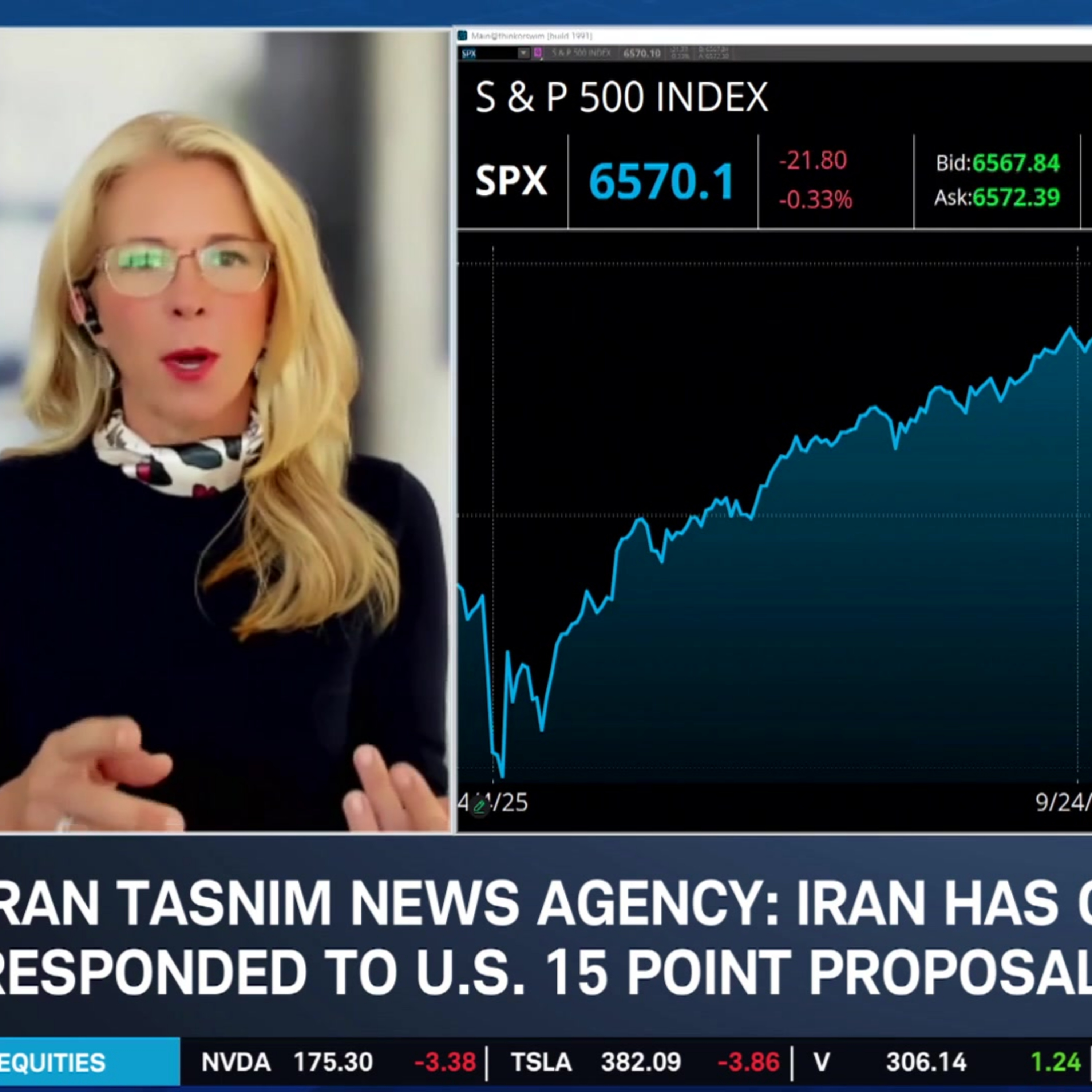
Liz Ann Sonders: Base Case is ‘Rolling Recessions’ Through Market Segments
About this episode
Liz Ann Sonders emphasizes that a lot of money in markets is short-term positioning, causing volatility and potentially leading to sentiment misreadings. She thinks there is complacency in markets underneath the turmoil. She explains what would happen in markets if the Iran conflict ends quickly, with energy taking multiple years to rebuild and fertilizer also seeing an impact. Her base case is “rolling recessions” through different market segments.
======== Schwab Network ========
Empowering every investor and trader, every market day.
Options involve risks and are not suitable for all investors. Before trading, read the Options Disclosure Document. http://bit.ly/2v9tH6D
Subscribe to the Market Minute newsletter - https://schwabnetwork.com/subscribe
Download the iOS app - https://apps.apple.com/us/app/schwab-network/id1460719185
Download the Amazon Fire Tv App - https://www.amazon.com/TD-Ameritrade-Network/dp/B07KRD76C7
Watch on Sling - https://watch.sling.com/1/asset/191928615bd8d47686f94682aefaa007/watch
Watch on Vizio - https://www.vizio.com/en/watchfreeplus-explore
Watch on DistroTV - https://www.distro.tv/live/schwab-network/
Follow us on X – https://twitter.com/schwabnetwork
Follow us on Facebook – https://www.facebook.com/schwabnetwork
Follow us on LinkedIn - https://www.linkedin.com/company/schwab-network/
About Schwab Network - https://schwabnetwork.com/about
Get every episode summarized
Each time Schwab Network publishes, we email you a written briefing from the transcript — the topics, who appeared, and any specific claims, with the ad reads skipped.
Email me new episodesFree for 3 shows. No card needed.
Hosts & guests
Transcript ready
67 searchable segments. Every word is indexed and playable.
Full transcript
Schwab Network — Liz Ann Sonders: Base Case is ‘Rolling Recessions’ Through Market Segments. Machine-transcribed; use the interactive transcript above to jump the player to any line.
Oh and welcome back to Morning Trade Live. It's time now for the big picture so let's welcome in Lizanne's orders chief investment strategist Schwab Center for the Natural Research. A very good morning to you Lizanne. So my previous guest Philip Deel called this market whistling through the graveyard which I really liked. Obviously we've got talk of talks for a ceasefire with no confirmation. We do have the energy risk premium being priced in here and some of the data starting to flash stagflation rewarding signals. How would you characterize the markets this week? So I think one of the the facets of market action over the past month that maybe gets under reported is is just how short-term oriented a lot of the money is. It is kind of swirling around in the market and leading to a lot of these rapid fire rotations and even when you get some sort of actual narrative shift or headline changes we make assumptions that what's embedded in market action is okay the market is now viewing and a de-escalation
happening in the near term and not a long drawn out military conflict and I'm not sure that's the calculus at play. There's so much more short-term money gambling oriented money in the market both on the part of retail traders but also you know CTAs and systematic hedge funds long short hedge funds and I do think that there is some complacency here when you when you broaden out the lens to the impacts of this lasts for a significantly long period of time. And you feel like some of that short-term gambling is playing out in areas like the semi-v software spread I mean it just like looks as if it's a ping-pong match going between those two sectors in softwares and hardware. So then Lizanne if this conflict is wrapped up soon do we then go back to the pre-war playbook or has something fundamentally changed in this market? To me something has fundamentally changed and it's similar to what fundamentally changed during the worst part of the pandemic when there was
this global realization of the necessity of more diversified supply chains and that's clearly what we're experiencing now given that the straight-of-promise as a choke point has no other options. That of course is led to a huge build-up of storage and then production shutdowns not to mention what has happened from a military standpoint and taking out in the case of cutter you know big chunk of that LNG capabilities and and you know they've already come out and said that's a three to five-year rebuild process. You think about the constraints on getting fertilizer through that cannot be turned back on very quickly that feeds into crop output and food prices. So I do think that this is for slightly different reasons especially given what's happened with Ukraine going after a straight that Russian oil comes through we're sort of exacerbating the problem now and that has been a little bit kind of second-page news. So I do think we're rethinking
especially the supply chain piece of this again circumstance is different than the pandemic but it does have bring with some similarities. So then what is the concern? What is the knock-on effect of that sort of long-lasting impact then? I mean you know is it recession because you know I've been asking various guests what their checks are telling them. My previous guest said 50-50 you're starting to see you know 20-30% chance from you know some of the more sort of high-profile Wall Street analysts here. I'm just wondering you know what you're modeling as far as sort of the long-term effect in this market then. So I'm not sure you can think about a an across the economy recession as having very elevated odds right now. That said we haven't had a full economy recession really since the global financial crisis. Yes we had the COVID related recession which is incredibly short-lived. What we've had though throughout the course of the early part of the
pandemic through to the present time are these rolling recessions. You get these sectoral recessions where different pockets of the economy for different reasons come under constraint. We saw in broad manufacturing only recently seemed to be pulling ourselves out of recession conditions in manufacturing. You had the offsetting strength on the services side of the economy. So my base case at this point is that we will continue to have these rolling recessions somewhat obviously as we look at the current backdrop sustainable increase in oil prices or sustainably high oil prices could feed into sectoral recessions in some of those consumer oriented areas or companies that have energy costs as a big part of their input. So I think that's the way to think about recessions is the possibility that they continue in this rolling way. There are opportunities within the market given what you're saying here. You have said that the Fed is in a pickle. So let's talk about some of the headlines we got this morning. Jobs to 10K good news whoo can perhaps pre-decide relief on
that front but then Lizanne you get the OECD expecting inflation of 4.2% versus 2.6%. How much of a pickle is the Fed in? Oh I very much so right now. Now I think it is somewhat premature to assume that the market is right in pricing in a rate height. That is not our base case at this point. The Fed of course is still data dependent. We get new data points every day but they are at the mercy of operating with a dual mandate. Most global central banks only have a single mandate which is inflation and that's why you're seeing this upward pressure now and assumptions about needs for tire monetary policy because the Fed has that second mandate of the labor market to the extent we see continued weakness in the labor market. I think that reinforces worst case scenario that the Fed just stays on hold. I don't think it would be their inclination even with energy field inflation in an environment where we see significant weakness in the labor
market to consider hiking rates. That said if we are able to see a maintenance of this incredibly resilient labor market claims being a leading indicator proxy for that then I think you do need to start to consider maybe that the Fed has to think about tightening policy. It's a tricky balancing at Lizanne. Thank you so much for joining us today really really insightful. I really appreciate your analysis. Lizanne Saunders at Chief Investment Strategist Schwab Center for Financial Research.
More episodes
More from Schwab Network

Stock Market Today: ORCL & ADBE Earnings, AEO Plunges Near 52-Week Low
Schwab Network

Thursday's Final Takeaways: Crude Taps $103 & PPI Hotter than Expected
Schwab Network

Balancing High-Conviction AI With High-Dividend Diversification
Schwab Network

EARNINGS PANEL: ORCL, ADBE
Schwab Network