About this episode
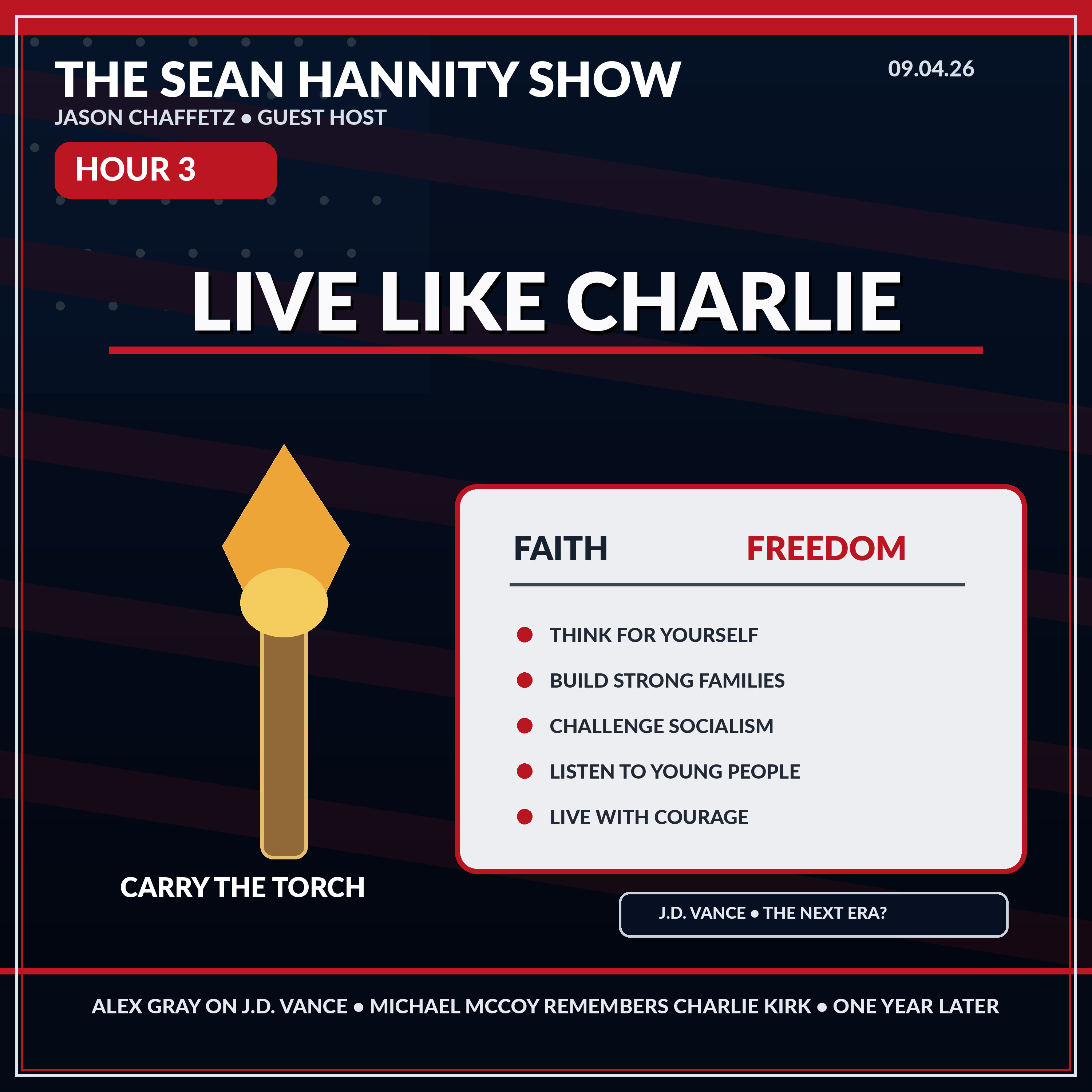
As the one-year anniversary of Charlie Kirk’s assassination approaches, Jason Chaffetz reflects on his friend’s influence on young conservatives, faith, family, and the fight against socialism. Former National Security Council official Alex Gray joins Jason to discuss why J.D. Vance represents a lasting challenge to the pre-Trump Republican establishment and how the party’s foreign-policy direction could change for a generation. Then Charlie’s former chief of staff, Michael McCoy, shares personal stories about Kirk’s commitment to young people and explains why carrying forward his mission may be the most meaningful way to honor his legacy. :::
See omnystudio.com/listener for privacy information.
Get every episode summarized
Each time The Sean Hannity Show publishes, we email you a written briefing from the transcript — the topics, who appeared, and any specific claims, with the ad reads skipped.
Email me new episodesFree for 3 shows. No card needed.
Hosts & guests

Transcript ready
382 searchable segments. Every word is indexed and playable.
Full transcript
The Sean Hannity Show — Live Like Charlie. Machine-transcribed; use the interactive transcript above to jump the player to any line.
This is an I Heart Podcast. Guaranteed Human. I'm watching AOC. She said I was only kidding about the things I used to say. But they'll go back to those things. We must pass my trans bill of rights. If Democrats were able to take back the gavel and the house would you support impeaching Donald Trump? On day one, Peter, I am so thankful that young activists have really drawn the link between climate change and white supremacy capitalism.
Hannities on on. And so is the countdown. Team minus 60 days. Until election day. Get where you coming to your city. You're gonna play our guitar and say you will come to Seoul. Son Hannity. And the new Sean Hannity show. More behind the scenes information on breaking news. And more bold inspired solutions for America. Hey, this is Jason J. Fitz. A Philan in for Sean. We got this final hour of the Sean Hannity show. Truly appreciate Sean, allowing me to fill in for him in honor and to privilege a lot of people want to do it. Not many people get to. So I'm very grateful for that. We're coming up on a Liberty weekend, right? It's gonna official end of summer. We got kids going back to school. Colleges kicking off. Football's in the air. That's one of my ex. I love football.
Football's changing. You know, we gotta be careful with the game. The way college. I love college football. But man, it's turned into. It's turned into pro football. So that's a whole subject into itself. But it's also this week is also a little bit of tough. It's a little bit of toughness. Because we're coming up the way the calendar falls out September 10th is the one year anniversary of the assassination of Charlie Kirk. I was there. I saw it. I felt it. I heard it. I lived it. And Charlie didn't. And that's a really tough time. Later in this hour, we're gonna talk to Michael McCoy. He was the chief of staff to Charlie Kirk and turning point USA. We're gonna talk about that. It's kind of a hard subject. But you know, as Americans, we don't turn away from hard things. We understand that hard things make us stronger, better.
And when we say we never forget, I mean that. Like we really shouldn't ever forget. And of course, we have the anniversary of 9-11. Hard to believe it's been 25 years. Something like 100 more than 100 million people in America. Either too young to remember or were not even born when 9-11 happened. But I'm old enough to remember exactly when it happened where I was. And the devastation and that terrorist attack was. So we're gonna talk a little bit about that. Which is also a good segue to our next guest. Because Alex Gray is the former national security. He worked with the former national security adviser, Robert O'Brien. Remember Robert O'Brien is a really good friend of mine. He was the national security adviser to President Trump in his first administration. Alex was like his chief of staff. So he's highly involved in the national security council. The whole security apparatus understands it.
And I want to talk to him a little bit about where we are in this world in this country. So let's welcome in Alex Gray. Hey Jason, thanks for having me. Hey, thank you. I had the pleasure of seeing you in person earlier this week. And I thought, oh, Alex would be great to talk about this. Because you know, I'm gonna be careful with this one. But there's a opinion piece that came out in the Wall Street Journal. Really took on JD Vance, the vice president, was very aggressive. But then I saw you posted on X and tweeted out about your take on JD Vance. And talk to me a little bit about that perspective, what happened. And then we'll talk about national security in general in a moment. Yeah, thanks Jason. Look, I think that the vice president is causing a lot of antibodies in the world. What I would still say is the Republican establishment.
And I say that because you and I supported the president early on. And a lot of people in Washington and the Republican establishment, particularly the foreign policy, national security world that I work in. They didn't support the president. And when the president won, they thought that they would wait them out. And Donald Trump would be in a variation and he'd go away. And they could go back to help things work. And that didn't happen. And then when 2020 happened, Joe Biden came in, they thought that it was finally over. And they'd go back to business as usual. And Donald Trump came back and it just keeps going on. And the foreign policy establishment is looking at JD Vance. And they're now looking at a 20 year period potentially for the things that traditional, pre-Trump Republicans don't like, trade, immigration. Non-interventionist foreign policy. Things that JD Vance and Donald Trump stand for. If JD wins in 2028, those things are going to become the Republican party.
And they are scared. They are terrified of it. And I think that's why Jason, you're seeing the vitriol that's being directed at the vice president by the people who don't want to go, but they want to go back to the pre-2016 GOP. You know, it's interesting. I have a discussion very similar to way you articulate it. You said it very well, better than I do. But one of the things that we talk about is, you know, pretty much every president, including Democrats, said, oh, let's move our US embassy to Jerusalem. And everybody kind of gave it lip service. But then Donald Trump actually did it. It's like, it's so shocking to people. It wasn't, it was difficult to do, but for Donald Trump, it wasn't difficult to do. He campaigned on it. He said he was going to do it. Then he did it. And it's been good for the United States. It's been good for the world. But it was so different than these other establishment Republicans who campaigned on it. But then when it came time to actually do it, wouldn't actually do it.
You're 100% right. And I would say the Iran nuclear deal that he tore up, the Obama, GCPOA. I think a lot of Republicans ran against it. I'm not sure how many would actually have had the guts to tear it up the way Donald Trump did. I think that goes for immigration. Republicans talked about being tough on immigration. Yes, actually have done the things Donald Trump did. No, I think it goes for things, you know, even a little more technical. Like the INF Treaty that limited the range of ballistic missiles. And, you know, if you really believe we should have a missile defense, we don't need an INF Treaty. And Donald Trump gripped it up. You know, Venezuela, Nicholas Maduro, actually being willing to go in and take action, actually willing to go in and to capitate the supreme leader of Iran. I mean, all of these things that traditional Republicans said they would do, Donald Trump actually did. And I think the problem is, JD Vance is in the same mold and that scares people. It does scare people. I mean, we've talked tough on Cuba, for instance.
And it does seem like, and it may happen, you know, once Iran is settled down a little bit more or maybe after the midterms, but that Donald Trump with two more, basically two and a half more years under his belt, certainly with Marco Rubio, is the Secretary of State that something is really going to change in Cuba. But again, Republicans talked tough about it, but never did anything about it. Exactly. Look, and I think, you know, when you look at, you know, the old line promises made promises kept, I remember in the first Trump term, he abandoned the people whiteboard of all the President's campaign promises, and they would check them off, and kept them even more so in this term. And this has been an administration where, you know, I think too many Republican presidents have treated kind of traditional grassroots Republicans as obstacles to be gotten around, and people you have to placate during election years, but it's not actually about answering the things they want done.
This administration has been so different, and I think that's why, you know, the establishment is looking at this Jason, and they're saying, wow, we may finally be out of luck. Like, the Republican Party may actually become a grassroots party in 2028 if someone like JD Vance gets elected. Well, and that's why I'm just calling it the way I see it, the Wall Street Journal opinion piece was just really taking a stab at JD Vance. But I think it'll be interesting to see how it plays itself out. And the other thing that's really interesting to me, we're talking to Alex Gray, the thing that's really, really interesting to me is John Federman. The Senator Federman has been like the voice of reason on the Democratic side of the aisle, but he seems to be at the lone wolf over there who will actually call balls and strikes because the Democratic Party of old who would actually join with Republicans on a lot of things, they are so far into crazy town.
It's hard to imagine. Yeah, I mean, it is nuts. And I mean, we're talking about, you know, the Democratic Socialist of America, whose leader went on one of the Sunday shows and said that their platform includes getting rid of the border and getting rid of the United States Senate. I mean, this is what we're dealing with. And John Federman, who I think is probably a pretty traditional left of center Democrat by 1990 standards, is doing the thing that most Democrats did just 20 years ago, which is support the state of Israel's right to exist and defend itself. On controversial position before a couple of years ago. And he is on the hit list of the DSA and the Democratic Party activists. They want to take him out of office. They want to ruin his political career for taking him. Yeah, I think you and I would say for a Democrat of just 10 years ago, pretty mainstream positions. Yeah, there was, you know, I started in Congress starting in 2008 and was there until 2017.
And there was a time when, yeah, it was Republicans, Democrats with like one or two outliers. And they all supported what we were trying to do in peace and safety and security. But it's just the idea of supporting local police forces and the, you know, the standing for the flag. And then now it's just, I went to one of the state of the union addresses by President Trump. Even when you leave Congress, you still have floor privileges. So I went and did that. It's unbelievable. The president would like recognize just an ordinary human who had done extraordinary things and was heroic. Democrats couldn't even stand up. I mean, they just sat on their hands. They just couldn't do it because of this whole Trump terrainage syndrome. It's so real. It's palpable. But it doesn't seem to go away. And I worry that, you know, if the House and the Senate flip hands, that, you know, is that we play in the little promo and the lead up to the, to the show.
Democrats just want to impeach again. That's the only answer they have. They don't have policy. Yeah, they don't have policy. They have an extreme agenda. I mean, a truly extreme agenda. And I mean, I, I was encouraged people to look not just at what candidates day, but look at what the Democratic Socialist of America, who, who now have so much power and control over the Democratic Party itself, what the DSA platform is. It's creating something like 20 justices of the Supreme Court. It's making, it's abolishing the Senate. It's adding three or four additional states. It's getting rid of the border. I mean, these are just truly insane positions, almost cartoonish positions, but they're real. And so I think people need to understand this is what we're dealing with. Not just what Democratic candidates say when they're trying to win your vote, but what's actually the intellectual foundation behind so much of the crazy socialism that's being espoused.
Well, I hope everybody gets a chance to follow Alex Gray on X. It's at Alex Gray for OK. He's from Oklahoma. So that's what the OK is about. Alex Gray for OK. I hope you have a chance to look at that. It makes a lot of sense. Great deal of experience for young in his career there with Robert O'Brien really did make a deal. And really did make a difference and served the president, the president Trump quite well and still very friendly with the administration. So Alex Gray, thank you so much for joining us today on the Sean Hannity show. Thanks for having me, Jason. All right, Alex Gray, thank you. Stay with us. We're going to be right back. Are you ready to get out of the media spin room while you come to the right place? This is the Sean Hannity show.
Well, like I said, this is we go through Liberty and then we have sort of a tough month. We have right out of the shoots. It gives a little somber before it gets a lot better with the RNC midterm convention. But as I said, coming up on September 10th, that's the anniversary of the assassination of Charlie Kirk. And then September 11th, the 25th anniversary of the 9-11. That's kind of tough. Now, coming up after the break at the bottom of the hour, we have Michael McCoy. He was the chief of staff to Charlie Kirk, turning point USA. We're going to get him to talk a little bit about Charlie and turning point and in the year that it's been since then. It really is, it's going to be a difficult thing.
It is for me personally. You may not have known Charlie. You may not have heard of Charlie. You may not have followed Charlie. But I got to tell you, he was one of the great voices of the conservative movement. He could articulate things. And I loved the way he started and did things and would challenge people to come. You got a problem. Let's talk about it. And his message was a really strong one. So we're going to talk about that at the bottom of the hour because he got a lot of people with a lot of hate out there. Now, Judge Tony Graf has made a ruling that there is enough probable cause to bring Tyler Robinson to trial or the murder. From my perspective, and again, I'm bragging again, but I'm not an attorney. This is taking so long to go through this process. For somebody who was arrested fairly shortly after the assassination. But this process is going to go on and on and on.
Unfortunately, you want justice. You got to make sure that you do do do diligence that people have the opportunity to go seek things out and to provide a proper and thorough. That's what we do in the United States of America, which is different than the rest of the world. But the judges ruled that there will be a trial for the murder of Charlie Kirk. And finally, you get through that hurdle. Then you got to go through discovery and all the other things. And so that will continue on. But that's that's coming up. So boom, you know, enjoy the holiday. Enjoy the three days. Enjoy football as it gets back into the air, which is like one of my favorite things. Before we know it, the leaves will be changing. And in some point, somehow, some way we will have the trial of Tyler Robinson, who's accused in this murder. But stay with us because Michael McCoy. You really want to hear from him and listen to him because I think he's got some important to say from a very unique perspective.
That not many other people have. So stay with us. We're going to be your right back. The radio show, the mainstream media loves to hate. This is the Sean Hannity show. Hey, this is Jason J. Fitz fillin' in for Sean. And I know Charlie Kirk was a good friend of Sean's. He was a friend of mine and good friend.
Somebody I admired, somebody that I tried to emulate. Somebody who was one of the best voices in the conservative movement. He just believed things and said things in such a great way. And could answer any question coming his way and would challenge people. Hey, you got it. Rather than fighting and turning to violence, ask me anything. And his life and legacy and his message was a powerful one. And yet he was assassinated in that anniversary of September 10th is upon us. It's next week. Now, the judge in this case, as I was saying before the break, it's been going on a long time. But Judge Tony Graf has made a ruling that essentially allows the death penalty, which they have in Utah, to be on the table and that there is enough probable cause to bring Tyler Robinson to travel.
Let's listen to it in his own words. Let's go to cut number one. The state's evidence of identity is substantial, combining forensic DNA matching with statements attributed to defendant and minig responsibility for the shooting. First, the DNA profiles obtained from the Mauser 30-Oz6 Calibre Bolt Action Rifle, the suspected murder weapon, provide forensic evidence connecting defendants to the firearm. Defendants DNA was identified as a major contributor on multiple key components of the firearm, including the stock, grips, buttplate, the trigger and trigger guard. This physical evidence is cooperated by the toolmark analysis, which matches the engraving cutter recovered from defendant's residence to the cartridge causing casing and live ammunition found within the Mauser rifle. Furthermore, the FBI DNA analysis places defendant's DNA on a screwdriver recovered at the crime scene with a likelihood ratio exceeding 30-Quintrillion.
Second, the surveillance tracking evidence provides additional cooperation. Agent Holes Review of this campus surveillance footage tracked a suspect matching defendant's physical attributes, clothing, shoes and distinct gate from the parking structure to the rooftop on the low-cibility associated with the shooting. And then fleeing the scene immediately following the shooting, this physical tracking is reinforced by Ms. Noble's Ring Doorbell Camera Footage, which captured defendant's vehicle identified by its unique wheels and custom styling, parking near the location shortly after midnight on September 11, 2025. Viewed in the light most favorable to the prosecution, this evidence is sufficient at this stage to support a reasonable belief that defendant is the individual who shot and killed Charlie Kirk. Accordingly, the state has demonstrated probable cause as to the identity and homicide elements of count one.
So that's Judge Tony Graf making his ruling which paves the way for this trial to finally get going and it's going to be a difficult time obviously for the Kirk family, but also for our next guest, Michael McCoy, Chief of Staff to Charlie Kirk and an important player there at Turning Point USA. Michael, thank you so much for joining us on the Shawnee Anady Show. Well, thank you, Jason, for having me and if I remember correctly, you were there that day. Yeah, I was. Like so many, so many people. And so, you know, it's been a really, really tough year. And in the midst of all of this kind of watching the trial play out and watching, you know, those of us who've been so close to Charlie and been a part of this. And so, you know, I think that there's, there's justice, but I feel like there's two forms of justice, right? You, you want to let the prosecutors do their job and the court and ultimately the jury.
But the second form of justice is, you know, for us that knew Charlie, that were friends with him, that were so close with him to carry on, you know, his legacy to make sure that the day that he was assassinated was not the end of his mission, but a beginning of even greater commitment to it. You know, the greatest form of remembering him is honoring him and his, and in this work and honoring his legacy. And he spent his entire life building, turning point, USA and sacrificing himself for young people. He did everything for young people and he ultimately died doing exactly what he loved. You know, he was on college campuses and he was fighting so hard and this has been a really tough year. And it wasn't just us who lost, you know, just a newer close friend to Charlie. It wasn't just us who lost him. It was everybody who knew him, who followed him and young people. And there's a tremendous void that was left behind. And as we approach this one year anniversary, asking ourselves, you know, how can we make sure that we honor Charlie?
How can we, a good stewards of this legacy that he's left behind? Now, well said, you know, it's interesting, right? Because he was never an elected politics. But he challenged people to learn how to think, you know, and young people go to college. And college is not for everybody. That was part of Charlie's message. You really got to start thinking, what do you believe in and why do you believe in? He also, I thought, did a masterful job of saying, I don't know where you are in your religious journey, but it's okay to talk about religion. It's okay to wear it on your shirt sleeve. And he did, and he paved the way on that religious side as well. But when he talked about the evil of socialism and communism, and you know, he had those white shirts that said freedom across. Not only was it wasn't just some bumper sticker, it was like the way he believed you should live your life. You know, and he would advocate things like strengthen families and getting married early and having more kids than you can afford.
And doing things that drove the left absolutely nuts. Michael, tell me, how did you first get involved with Charlie and Turning Point? And maybe share some of that kind of personal one-on-one story because you, you went, you know, all in with Charlie Kirk and Turning Point. Yeah, you know, I met Charlie when I was 18 years old. I was driving him to the airport and his girlfriend Erica. And when we, you know, the entire car ride, he was just grilling his questions about philosophy and American history and asking me what the answers were and when I didn't have them, you know, that's myself, you know, this guy probably thinks, you know, I'm not very smart. This is my hero, and I probably just let him down. And you know, once we got to the airport, he goes, you know, I don't think you should go to college. And in my head, you know, subconsciously, I'm thinking he doesn't want me to go to college because he probably thinks I'm an idiot for not answering all these questions that he just... But he goes, no, I don't want you to go to college. I want you to come work for me instead. I want you to come work at Turning Point.
And, you know, I ended up accepting that offer and it was the greatest offer I ever accepted. But, you know, as I reflected on that, you know, why would Charlie want to offer me a job? I mean, 18-year-old with zero life experience. And obviously not that smart because I haven't any of his questions. And I ponder that and I sat on it. And the answer lies in what he did. You know, he went on college campuses consistently and authentically because he loved young people. He saw something in young people that we didn't even see in ourselves. You know, he saw something in me that I didn't even see in myself. And he wanted to call us to something greater. He wanted to challenge us, push us harder. You know, Charlie didn't just show up on college campuses to pander to young people. You know, he certainly wasn't the first to show up on college campus. But, he was the one that showed up and told young people not what they wanted to hear, but what they ought to hear. You know, get married young, have more children than you can afford. And you said this earlier, Charlie wasn't an elected official. He wasn't a politician.
But, somehow, he was one of the most powerful people in the private sector to influence the government. You know, I would have this, I had the privilege of having kind of a front row seat to watching Charlie at these debates on college campuses and that church is. One of the times that I remember is, you know, he had this question from a student asking him about single family housing and if they would ever be able to afford homes and be able to afford getting married. And it wasn't, but two days later, we're at the White House and I witnessed Charlie at the White House regurgitate those exact same talking points to the president and his staff. You know, we really ought to figure out how to make sure young people can afford homes and have a future in this country and have an America that we were able to enjoy, not a different version of it. And in a way, Charlie was like an unpaid, powerful, lobbyist for young people because he loved young people. He cared about young people. He went to college campuses. He used to say, I'm here to do three things. Teach, learn, and listen. And if I'm not doing all three, I'm not doing a good job. You know, half the time he was talking to young people, his microphone was down on the table. He was listening to them.
And that was something he loved young people. He wanted to listen to what they had to say. And he wanted to offer a solution. And, you know, parents heard about Charlie Kirk from their kids. You know, their kids were the ones that would say, hey, there's this guy in social media. You got to hear about this. That's amazing. And we ought to make sure that we continue looking out for young people and care for them the way that Charlie did. There's a tremendous accountability on everybody's shoulders to do that and to honor him, especially as we approach this one year in a grocery. Well, our daughter who was a student that had gone to Utah Valley University, you know, I've been in politics. I've been in Congress. You know, you meet and see and interact with a lot of people. And she got to introduce and go to the White House and do all kinds of fun stuff. But there are only two people that she really wanted to spend time with and talk to. One was President Trump. And the second one was Charlie Kirk. And that's why four of our family members were there that day because Charlie was going to be on campus. And she witnessed it too. And it was, you know, it's just absolutely horrific.
The one other thing I've mentioned before and I won't wax on about this. But later that night, I got a call from President Trump. And I remember talking, speaking with the President about Charlie and how much Charlie meant to him personally. And that the President said, I don't know if I would be the President of the United States without Charlie Kirk. Because he did have so much of an impact. And for a person his age and not being an elected official, not a trust fund, baby, not anything else. And he actually made the argument and it was resonating. And I think that's what scared the left. I think that's what propelled so many people to try to take him on. And we don't know. But maybe that's ultimately what cost him his life. But he was making the case. I told my wife and others, I really thought that Charlie at some point in our lifetime was going to be the President of the United States. And his life was cut far too short. Final thoughts, Michael, as we kind of wrap up this segment. And sorry, you have to go through the hardness and the difficulties with the Charlie Kirk with his greater family and the turning the people at turning point.
Thank you. You know, my final thoughts and you said it had such a young age who's able to accomplish so much. Charlie remembered that young people are able to accomplish so much. You know, there's a tendency sometimes to write off young people to think that not capable. But as you look in our rich founding and the history of our country, we're a country that was for the most part founded by young people. And the average age of a continental army soldier was like in 19 to 20 year old. Thomas Jefferson was 33 when he wrote the Declaration of Independence. He was two years older than Charlie Kirk. James Monroe was 18 when he left college to go fight for independence. Alexander Hamilton was, I think, 19 when he became right hand to Washington. And so young people have a rich history in this country. And they're capable, more capable than they think to fight for independence, to fight for truth, to stand up when they don't think that they have the strength to do so.
So you too, if you're listening to this as a young person, you too can become someone like Charlie Kirk. You can become somebody like our founding fathers. You know, the youngest sign of the Declaration of Independence was only 26 years old. That you can be one of those people. You can be a young person in the powerful room and you can enact a lot of change. And so live like Charlie Kirk. You like Charlie Kirk. Yeah, it's a great message. Michael McCoy. Thank you so much for joining us on the Sean Hannity show. And it's going to be a tough day on the 10th, but let's all remember, never forget, but also live the messages you so articulately said, let's, you know, live that throughout the year, not just on the on September 10th. Thanks so much for joining us and stay with us. We're going to be right back. The Sean Hannity show powered by American capitalism and never government subsidized.
Sean Hannity is on right now. Hey, this is Jason J. Fitz. I want to thank Sean Hannity and his team for allowing me to fill in for him on an average as I said before, not many people get to do it. A lot of people want to, but not many people get to. So I appreciate the confidence and hear me out. Now, the United States, we got problems. We got challenges. There's frustrations. There's a lot of bad things happen, but you know, it's still the greatest country on the face of the planet. Somehow, some way we figured this out. And it's the people of our country that make us so good, so strong, so vibrant in everything we do. And to the blows in the United States military, those the first responders here at home, thank you, thank you, thank you for all you do and how you do it. There's a lot of people away.
And they're serving overseas and they're at a military base or on a ship or something. And you know what God bless you. We're thinking of you. We love you. We need you. It is imperative to what you do and how you do it. And just know that the love of the American people, the support, even though you may hear some bunch of garbage online, it's still the greatest country. I'm Jason J. Fitz. You can find me at Jason in the house on all my social media and my podcast. Just type in Jason in the house. Thanks for having me on.
More episodes
More from The Sean Hannity Show

The Vote That Exposed the Socialist Shift
The Sean Hannity Show

No Verdict, No Closure
The Sean Hannity Show

SOUNDBYTES 19 - ANNE HATHAWAY, ILLEGAL IMMIGRATION, VICTIM CULTURE
The Sean Hannity Show

The Culture Fight Starts on Campus
The Sean Hannity Show