About this episode
Stop_forcing_work_on_one_percent_battery
Interactive timestamps
Jump to segmentGet every episode summarized
Each time ÆON imminent 🧬 🌀 publishes, we email you a written briefing from the transcript — the topics, who appeared, and any specific claims, with the ad reads skipped.
Email me new episodesFree for 3 shows. No card needed.
Hosts & guests

Transcript ready
409 searchable segments. Every word is indexed and playable.
Full transcript
ÆON imminent 🧬 🌀 — Lion don’t work. Machine-transcribed; use the interactive transcript above to jump the player to any line.
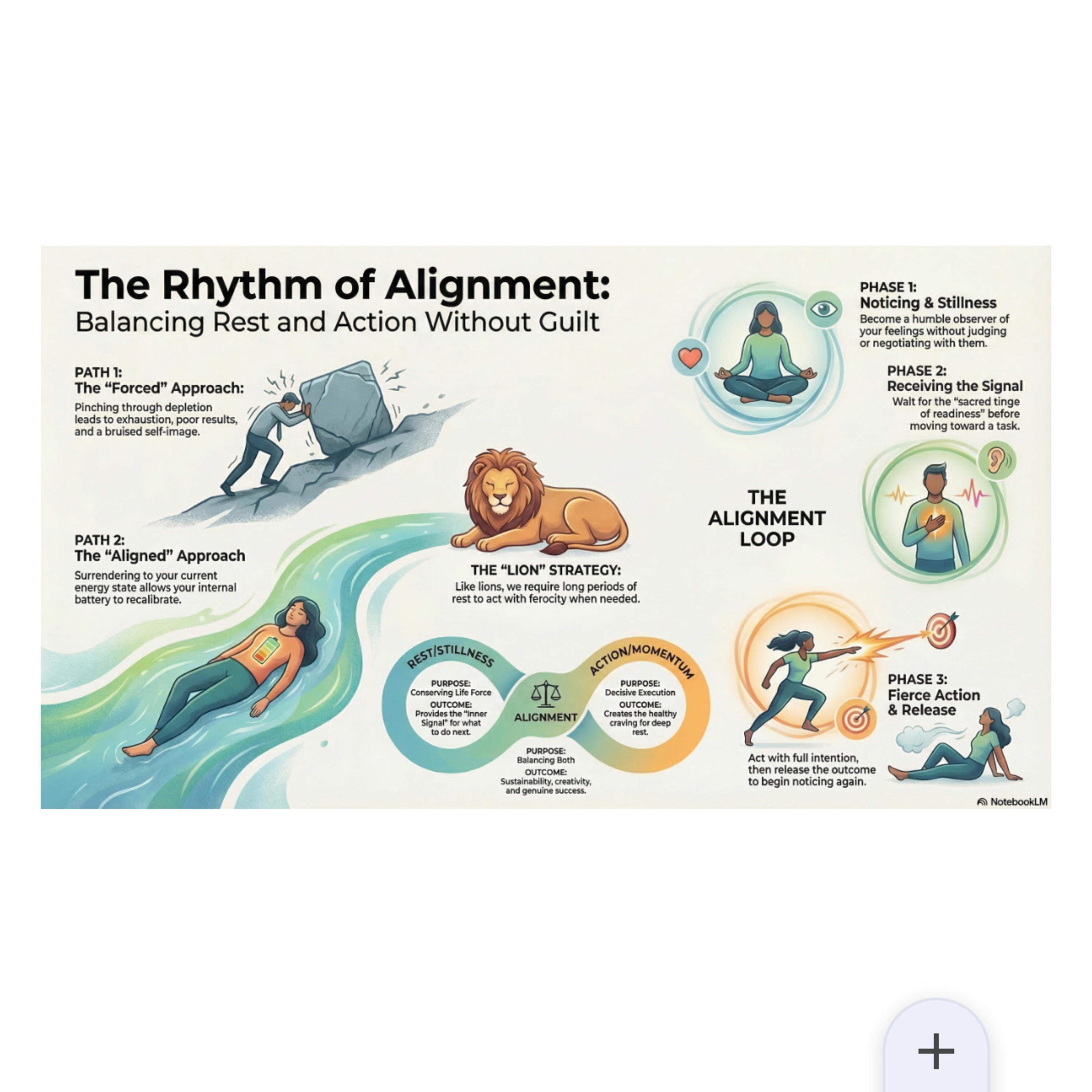
0:00So imagine your smartphone is sitting at like exactly 1% battery. Oh, the danger zone, right. The little red icon is flashing the screen is automatically dimming to save power. And it's just absolutely begging for a charger. Yeah, it's barely hanging on exactly. But instead of plugging it in, you decide right then and there to open up, I don't know, a massive editing app and try to render it to our 4K video. I mean, the device would immediately freeze. The processor would just max out entirely. Yeah, the phone would overheat and the whole system would just crash to a black screen, right? Right, because we would never expect a machine to perform its most demanding like processor heavy tasks when it's utterly depleted. We completely understand the basic mechanics of a battery. We do. But when we look at our own lives, you know, our own cognitive energy levels, the minute we feel emotionally or physically drained, what do we do? We try to render the 4K video. We force it. We sit at the desk, stare at the screen and basically demand peak performance from a system that is operating on 1%.
1:01We really do treat our own biology with significantly less grace than we treat our electronics. And honestly, that paradox is the entire foundation for our deep dive today. It's so true. Yeah. So today we are looking at this deeply reflective essay by a writer named Isabel. It's titled, how to embrace the seasons of your life without guilt. Such a great title. Right. And we're also going to look at some really sharp commentary from a couple of pre-readers, Josiah Verne's and David Glass. Awesome. So the goal here at the mission is to really figure out how you navigate those inevitable periods of burnout, low energy and, you know, emotional dysregulation, but without that crushing, suffocating weight of productivity, gold. And to do that, I feel like we have to look at a concept that will probably make anyone listening right now who considers themselves like a high performer, feel a little twitchy. Oh, absolutely. Because the core thesis here is that action and rest are equals. Like they're not a hierarchy where action is the CEO and rest is the lazy
2:01intern you hide in the base. Yeah, they are complete equals. Right. And it poses this crazy question, what if the absolute best way to get more done to be your most creative and effective self is to actually surrender to doing absolutely nothing? I know it sounds so counterintuitive, especially in our culture, right? We basically treat exhaustion as a status symbol. We really do. But Isabelle points out this fundamental truth about human dysregulation. Yeah. Like when life throws complicated, painful things at us, grief or stress, or just unexpected crises, our nervous systems become dysregulated. And there's a biological reality to that, right? Exactly. The physiological reality is that your brain is suddenly diverting massive amounts of energy just to process that emotional load. Wow. So your capacity for deep work or creativity is basically functionally gone. Right. And at that exact moment when you're standing at that crossroads, you essentially have two choices. She calls them path one and path two. Okay. Let's unpack this because path one is definitely the high way most of us are
3:03permanently stuck in traffic on it. Oh, 100%. It is the path of just forcing yourself to push through. Like you sit down, you grit your teeth and you try to do everything you thought you needed to do completely ignoring how depleted you actually are. And people choose path one because, well, it feels safe. Yeah, it feels like you're doing something. Right. If you keep your hands on the steering wheel, even if the engine is literally on fire, you can at least tell yourself you're driving. Right. Right because society has just completely conditioned us to believe that motion equals progress. But what's fascinating here is that the mechanics of path one actually guarantee failure, don't they? They really do. What's fascinating here is that when you force cognitive work through a dysregulated nervous system, the work just happens so much slower like waiting through mud, exactly. And the quality degrades significantly. You end up draining whatever microscopic reserves of energy you had left. And you push yourself from mild depletion straight into clinical burnout.
4:03Plus there's the psychological damage of that. Like you spend three hours staring at a blinking cursor, typing a sentence, deleting it and eventually just like crying in the bathroom. We've all been there. But instead of saying, Hey, my battery is at 1%. You walk away with a bruise self image. You start calling yourself lazy or uninspired or incompetent when the biological reality is that you are just entirely empty, right? Which brings us to the alternative path to yes. Path to is a very specific sequence. It goes like this stillness, then rest, then pause, then you receive the inner signal of what to do. And only then do you act. Okay. I have to play Dill's advocate here for a second. Go for it. Because for someone listening right now, who is, I don't know, prepping for a massive Q3 review or staring down a strict deadline that pays their mortgage, path to sounds honestly terrifying. Oh, I'm sure it does. Like just letting it be and waiting for some mystical inner signal. That feels like jumping out of an airplane without a parachute and just
5:05hoping you suddenly learn how to fly on the way down. Yeah. But that panic is really just the illusion of control talking. The illusion of control. Right. The fear is that if you stop forcing it, everything falls apart. But let's look at the actual output of path one when you are up against those high stakes deadlines. You think you're protecting your job by forcing the work, but you were usually turning in subpar deliverables that took twice as long to produce anyway. Oh, yeah. That's true because life isn't meant to be 100% force. Stillness isn't a luxury and it's not a delay tactic. It is a mandatory biological prerequisite, prerequisite. Wow, if you are constantly drowning in the noise of doing, you cannot hear the signal of what actually needs to be done. You lose your strategic edge completely. You're basically just spinning your wheels in the mud and calling it a road trip. That is such a vivid way to put it. So forcing it doesn't work. We have to look at how nature solves this problem of high stakes performance, right? Exactly. Because nature does not feel guilty about taking a nap.
6:06And this source material actually moves away from these abstract concepts and gives us some really vivid biological frameworks starting with the lion. Right. The lion is bill uses this phrase act like a king. And if you think about lions, the literal apex predators of the jungle, they lay around sleep or casually peruse their environment for up to 20 hours a day. 20 hours of absolute inactivity. And it isn't because they're lazy. Right? No, we're out of it all. They are conserving their metabolic energy for decisive, fiercely explosive bursts of action. Because a lion hunting is a high stakes life or death endeavor. Exactly. If a lion forced itself into constant moderate exertion all day long, like just pacing around, worrying about the gazelle doing jungle busy work, it would be way too physically drained to act with the necessary ferocity when the gazelle actually appears, which is such a crazy dual truth of biology. If you think about it, you need deep rest to take action with your full energy. And you need to act with full energy to actually crave deep rest.
7:06It's a perfect loop. I hear that, but, you know, a lion doesn't have an inbox. It fills up with 500 emails while it sleeps for 20 hours, fair point, fair point. And this is actually where a reader named Josiah Verres brings in a fantastic counterargument in the comments of the essay. Oh, yeah. I love Josiah's take on this. Yeah. He points out that the lion metaphor doesn't really resonate with him because humans are not ambush predators. Evolutionarily, we are endurance predators, like we would track prey for days. Right. So Josiah argues we are much more akin to bears, like we spend weeks or months expending massive amounts of sustained energy. And then we enter a long drawn out season of fattening up, hibernating, and basically just enjoying the fruits of our labor. I think the bear analogy really highlights that different metabolisms of work exist for different people. Yeah, total. But whether you operate on a daily cycle like the lion or a seasonal cycle like the bear, the core principle is absolutely identical. Peak performance requires peak recovery.
8:09Here's where it gets really interesting, though. Let's bring this into the 21st century with our smartphone by our analogy from earlier. OK, let's do it. Because modern work culture expects us to be plugged in, holding a steady charge at 100% all day every day, or at the very least operating at this constant low level hum of anxiety driven productivity. Yes, like eight hours of moderate stress at a desk followed by checking slack messages in bed, which is so unhealthy. Right, but nature, whether we're talking about the lion or the bear operates by fully, completely draining the battery to zero and then leaving it on the charger for a long, uninterrupted stretch until it is fully recharged. If we connect this to the bigger picture, neither the lion nor the bear operates on a middle ground of chronic low grade stress, right? They don't do middle ground. They require dramatic shifts between peak exertion and total unapologetic recovery. Unapologetic is definitely the operative word there because the modern knowledge worker rarely experiences true peak exertion or true recovery.
9:13We just live in a perpetual state of drained battery anxiety. And that perpetual drain leads to like the immediate fear most people have when they hear this advice. Oh, I know exactly what you're going to say. Right. The listeners internal monologue is probably screaming right now. If I actually let myself rest, if I give in to this exhaustion, I will literally never get up again. I will fuse with my sofa exactly. I will eat potato chips until the end of time and become a permanent couch potato. The couch potato paradox is a bell addresses this head on in the essay. When people finally stop and tune into their bodies, the loudest message they often hear is lay on the couch, eat junk food and binge reality TV for three days. And the immediate assumption is that their inner voice is inherently lazy and needs to be suppressed. Right. But Isabel argues from a strictly physiological standpoint that these seemingly unhealthy urges are actually a reflection of severe burnout. Is an emergency break exactly that because you haven't granted your body
10:16conscious deliberate permission to rest. The nervous system just takes over. Wow. It resorts to aggressive self numbing behaviors just to shut the executive function of the brain down. So it forces the shutdown. Yeah, passive numbing like mindlessly scrolling or binge watching essentially anesthetizes the prefrontal cortex. The body is stealing rest because you refuse to give it freely. So what does this mean for like my classic Netflix and chips weekend? If I'm doing that, am I failing at resting? No, no, the goal isn't to moralize or shame the Netflix binge. The goal is to recognize the mechanism behind it. Okay. It is an emergency response to depletion, but it isn't true recovery. The essay introduces this concept of aligned rest, aligned rest. I like that because when you numb out on the couch, you were pausing the drain on your battery, but you aren't actually plugging the phone in. Aligned rest actively recharges the system. And Isabel gives some really beautiful examples of what aligned rest looks
11:16like once you get past that initial, you know, emergency break phase. She does. Things like reading by candlelight, crafting, cooking a really complex meal, or I think her personal favorite was logging off completely to bake a strawberry pie from scratch. Oh, yes, like whipping the cream by hand, taking pictures of it in the sunlight. Notice what all those activities have in common, though. What's that? They are active tactile and require presence, but they are entirely low stakes. Ah, low stakes. Right. They engage the parasympathetic nervous system, baking a pie gives your brain a tangible sensory task with a clear reward, which actively repairs cognitive burnout rather than just temporarily masking it. That makes so much sense. And reader David Glass actually chimes in on this exact point. He notes that the more you feed genuine aligned rest, the more it pulls you toward things that make you giddy. Giddy is such a great word for it. It really is because it implies a return of joy and energy. But conversely, the less you feed genuine rest, the more you get pulled into
12:18those self numbing emergency break behaviors, you're reminds me of like building a workout habit. At first, putting on your running shoes sounds awful, and your body actively resisted. Oh, the worst, right. But eventually the physical system adapts and actually craze the movement. We had to deliberately train our nervous systems to crave aligned rest instead of just defaulting to anesthesia because rest in action are just two sides of the same coin of existing. Neither has more moral weight than the other. That's a great way to look at it. You wouldn't attach moral superiority to inhaling over exhaling. Oh, of course not. They both have to happen for the organism to survive. Okay. So we understand the mechanics now. We need to balance the force of path one with the flow of path two. We need to find our inner lion or bear and we need to shift from numbing out to aligned rest. Yes. But there's this massive psychological hurdle we still have to clear. And that is the feeling of permanence. Oh, this is so important. Like when you are deeply burned out or your emotions are completely
13:18dysregulated, why does the brain convince you that it is going to last forever? It is a fascinating trick of human psychology. Honestly, it's heavily tied to state dependent memory, state dependent memory. Yeah. When your nervous system is in a state of low energy or depression, it actively struggles to vividly recall what high energy or joy actually feels like to illustrate this. Isabel shares this perfect anecdote about being a lifelong east coast weller of the winter story exactly every single winter when the temperature drops and the trees are bare, she becomes entirely convinced it will be winter forever. Like it's never going to end. Her brain just accepts the cold as a permanent, inescapable reality. Even though she was lived through dozens of winters and knows logically that spring exists, right. And then inevitably that first sunny above zero spring day hits and her serotonin systems just completely reboot like clockwork. She is shocked by the warmth every single year, but you know, nature is unpredictable.
14:20She tells another story of how right after one of those beautiful spring-like melting days, a thick, fluffy snow storm arrived basically overnight. And the weather is the ultimate framework for our internal emotional seasons. Absolutely. When an emotional snow storm hits, like when we feel that sudden wave of grief or exhaustion or just a total lack of inspiration, our default path, one behavior is to essentially put on a t-shirt, run outside into the blizzard and pretend it's summer. We try to force exertion. We try to render the 4k video in the snow. And the application of this metaphor is just profound. Instead of running into the blizzard in a t-shirt, we should, as Isabel puts it, cozy up by the embers of our psyche and tend to ourselves. I love that phrasing cozy up by the embers. It's beautiful and it is crucial to understand who she is giving this advice to. Right, because she's a coach. Yes. Isabel works one-on-one with highly driven individuals, investors, executives, top-tier artists, so not slackers.
15:21Not at all. These are not people with endless leisure time. These are key performers operating in extremely high stakes environments. And she emphasizes that even they, especially they need to internalize this impermanence to truly maintain their edge. So think about the last time you, listening right now, felt totally stock on a project or overwhelmed by life. Didn't it feel like you would never have a good idea again? It always feels that way. Didn't it feel absolutely permanent? It's just so deeply human how quickly we forget that our inner seasons change. We spend more cognitive energy fighting the weather, stressing about the fact that it's snowing than we do just sitting by the fire waiting for it to melt. This raises an important question, though, about how much entirely unnecessary suffering we cause ourselves by trying to convince our minds. It is sunny when it is emotionally snowing. So much unnecessary suffering. The essay offers a specific, continuous loop of awareness to combat this amnesia. What's the loop? It's noticing, allowing, embracing, feeling, doing, releasing, and noticing again.
16:27That's a lot of steps. It is, but it's really an active practice of non-judgment. If you just allow the low energy state to exist without attacking your own character for not having the hunger to execute every single day, the emotional winter passes. It always melts. It always melts. I feel like that is the core takeaway to carry with you because embracing the seasons of your life without that suffocating guilt means stopping the constant grinding force of path one. It means looking at your own biology and recognizing whether you need the lion's quick daily recovery or the bear's long seasonal hibernation. Right. And it means upgrading your rest from just numbing your brain with a screen to finding tactile aligned rest that engages your parasympathetic nervous system and actually makes you giddy. Yes, find what makes you giddy and above all, it means recognizing the trick your brain plays on you and remembering that emotional winters are never permanent. It really is a fundamental shift from fighting your own biological hardware to finally cooperating with it. Yeah.
17:27But you know, there's one final provocative thought I want to leave on the table today, something that builds on this entire discussion of nature and seasons. Oh, okay. Let's hear it. So we have spent this entire deep dive talking about nature, right? Lions, bears, whether patterns, physiological responses, right? But look at the modern environments we have engineered for ourselves. Oh, wow. Okay. We work in climate controlled offices that are locked at exactly 72 degrees 12 months a year. We stare at artificial blue light emitting screens that mimic high noon, even at midnight. We have 24 seven digital connectivity, meaning the hunt for the proverbial gazelle never actually ends never. We have systematically erased physical seasons and natural biological cues from our daily environments. So we've basically completely sanitized our surroundings of any signal that it's time to stop precisely. So the thought to mull over is this, have we accidentally engineered an environment that constantly forces us into path one?
18:28Oh, my gosh, because we have stripped away the feeding daylight, the dropping temperatures, and all of nature's environmental cues to rest. Are we now unfairly punishing ourselves with guilt for not knowing how to hibernate as wild? We are expecting our biology to act like a machine precisely because we live inside machines that honestly reframes the entire concept of guilt for me, doesn't it? Because if it never gets dark and it never gets cold, how is the nervous system supposed to know it is actually safe to power down? We are literally fighting our own architecture. Well, thank you for joining us on this deep dive. Hopefully you walk away from this feeling a little more seen and significantly less guilty about your own biological needs. Absolutely. Maybe today's the day you log off, go bake that pie from scratch, and give yourself absolute permission to experience whatever season you are currently in. Enjoy the pie. Because trying to force high level output when your internal battery is depleted isn't a badge of honor. It's just a really great way to crash the system. So plug in, find your aligned rest, let the snow melt, and we will catch
19:28you on the next one.
More episodes


