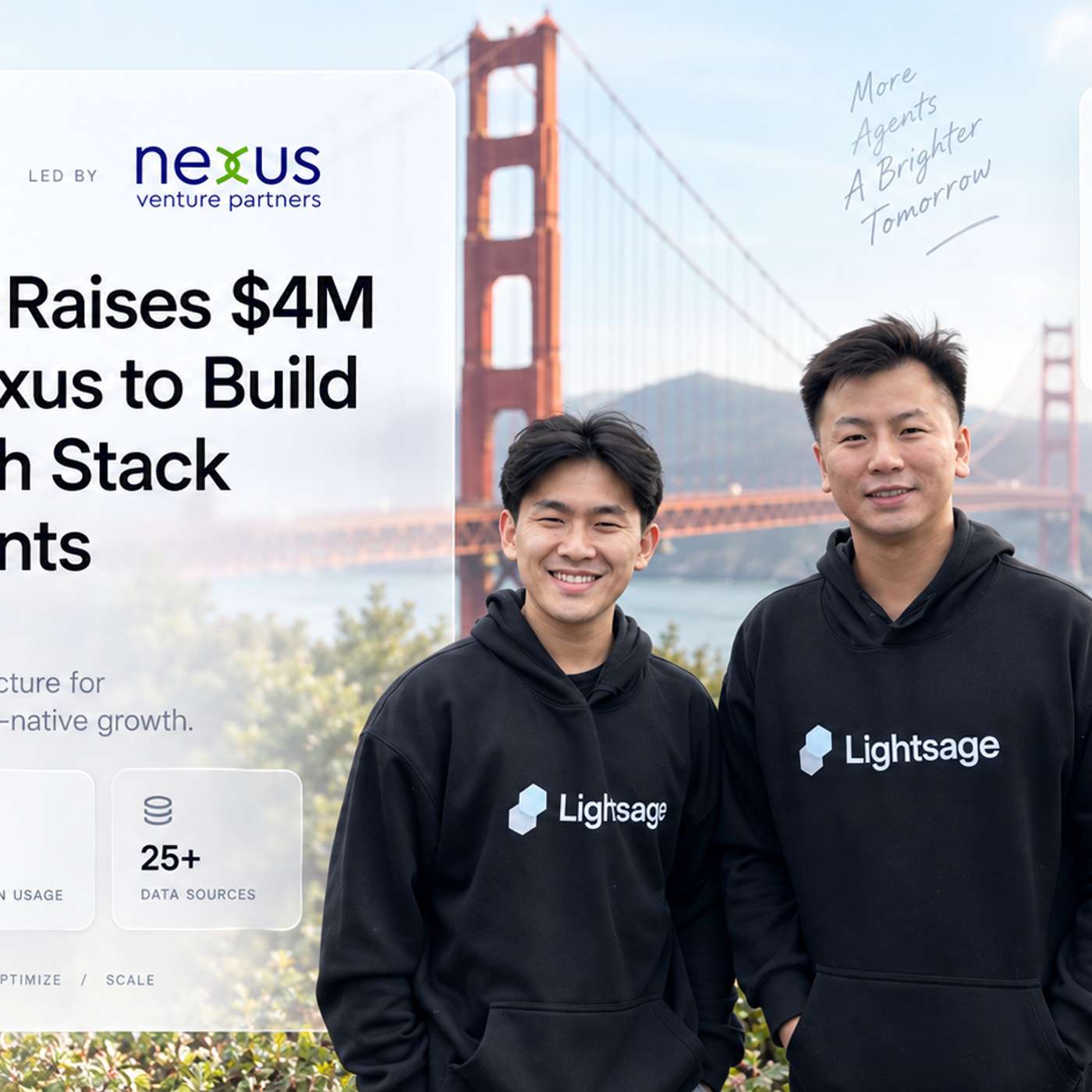
Lightsage Raises $4M Led by Nexus to Build the Growth Stack for AI Agents
About this episode
This story was originally published on HackerNoon at: https://hackernoon.com/lightsage-raises-$4m-led-by-nexus-to-build-the-growth-stack-for-ai-agents.
Lightsage has raised a $4 million seed round led by Nexus Venture Partners, with operator angels from Salesforce, Postman, Apollo, DocuSign, GitLab, Resend.
Check more stories related to undefined at: https://hackernoon.com/c/undefined.
You can also check exclusive content about #lightsage, #ai-and-ml, #startup-funding, #good-company, #technology, #ai, #aritificial-intelligence, #yoga, and more.
This story was written by: @ishanpandey. Learn more about this writer by checking @ishanpandey's about page,
and for more stories, please visit hackernoon.com.
Lightsage has raised a $4 million seed round led by Nexus Venture Partners, with operator angels from Salesforce, Postman, Apollo, DocuSign, GitLab, Resend, Firecrawl, Daytona and Tinyfish, to build what it calls Agent-Led Growth. The company simulates how coding agents such as Claude Code, Codex and Cursor discover and integrate software, isolates why they fail and reports on real agent traffic to a product's docs and APIs. Bots passed humans as the majority of web requests in June 2026, coding agents already generate several billion dollars in annualized revenue and every major forecaster puts agent-driven commerce in the hundreds of billions by 2030. Lightsage is building the analytics and optimization layer for that buyer, starting with developer tools, where customers including Firecrawl, Reducto, Daytona, Rime and Tinyfish are already on the platform.
Get every episode summarized
Each time The Good Tech Companies publishes, we email you a written briefing from the transcript — the topics, who appeared, and any specific claims, with the ad reads skipped.
Email me new episodesFree for 3 shows. No card needed.
Hosts & guests
Transcript ready
191 searchable segments. Every word is indexed and playable.
Full transcript
The Good Tech Companies — Lightsage Raises $4M Led by Nexus to Build the Growth Stack for AI Agents. Machine-transcribed; use the interactive transcript above to jump the player to any line.
This audio is presented by Hacker Noon, where anyone can learn anything about any technology. LightSage raises $4 million led by Nexus to build the growth stack for AI agents. By Ashahn Pondy, in June 2026 Cloudflare reported that machines had overtaken people as the source of most requests to web pages, 57. 5% against 42.5, across over its chief executive, had not expected until late 2027. In the same quarter cursor, a coding agent that did not exist four years ago passed $2 billion in annualized revenue, while Cloud Code reached $2.5 billion nine months after launch, put the two facts side-by-side and a new kind of software customer comes into focus. One that reads documentation at machine speed, chooses a library without opening a vendor's home page, installs an SDK, authenticates and calls an API before a human has looked up from the terminal. Every dollar of marketing technology ever built was designed to convert someone else.
LightSage has raised $4 million in seed funding led by Nexus Venture Partners to build the growth stack for that customer. The round includes operators from across the developer and AI ecosystem, among them former Salesforce CTO Stephen Tam, Postman CEO Abana of Astana, Apollo CEO Matt Curl, DocuSign President and GM of Growth Robert Chatwani, former GitLab head of Growth Helacoo, Resend CEO Zeno Rocha, FireCrawl CoFounder Eric Charla, Daytona CEO Ivan Burazan, Tiny Fish's Chief Operating Officer and Adam Frankel. The capital funds what the company calls agent led growth. A discipline it argues will do for AI agents what product led growth did for self-serve human buyers. A customer that never visits the homepage, the measurable change is in who is knocking. CloudFlair Radar put automated traffic at a majority of HTML requests for the first time in June, with AI crawlers accounting for 20. 3% of verified bot traffic and AI search bots
of further 6. 5%, which means roughly one in every seven requests to a web page now originates from an AI system of some kind. Human securities 2026 benchmark measured agentic traffic growing 7,851 percent year on year, about eight times faster than human activity, with open AI's GPT bot alone up 305 percent in a year. For a software vendor the decomposition matters less than the intent behind each request. A crawler that reads a docs page to train a model is a cost. An agent that reads the same page because a developer asked it to add authentication tone application as a prospective customer in the middle of an evaluation, one that will either complete the integration and generate usage or abandon it and choose a competitor, all without leaving a trace in a sign-up funnel. The traffic has crossed the line. The instrumentation to tell those two visitors apart, let alone to understand why the second one succeeded or failed, has not existed until now. The buyer already spends billions. Coding agents are the first
population of AI customers whose behavior is large enough to measure and whose spending is large enough to matter. Cursor went from $100 million to $2 billion in annualized revenue in roughly 13 months, with enterprise accounts now about 60 percent of that revenue. Claude Cod crossed $500 million within four months of general availability, $1 billion within $6 and $2. $5 billion within nine, open AI's codex, bundled into Chad GPT rather than sold on its own, reported more than a million active developers in a month and a 20-fold increase in usage between August 2025 and February 2026. Each of those agents makes procurement decisions on behalf of its user dozens of times a day. When a developer asks for web scraping, a sandbox, a transactional email provider or a document parser, the agent selects one, reads its documentation, chooses an SDK, handles credentials and runs the integration. A vendor that appears in the agent's first choice and integrates cleanly acquires a customer with no marketing spend at all.
A vendor whose docs confuse the agent, whose authentication flow trips it or whose MCP server is incompatible loses the sale at a step no analytics tool records. The commercial states of agent behavior are therefore already measured in billions of dollars of downstream software revenue, which is why LightSid shows developer tools as ITS first market rather than as its eventual one. From product-led growth to agent-led growth, the founding argument, from CEO John Liang Lee and CTO Sean Ur, is that the internet is moving from an era in which AI tells people which software to use tune in which AI uses the software itself. That shift changes what growth means. Software companies spent two decades learning how to convert humans, first through sales-led motions and then through product-led ones in which the product itself was the funnel. Agents create a third buyer with a different journey entirely. They may never search, never click an advertisement, never sign up through a form and never sit through a demo, yet they still have to understand the documentation, choose the right SDK, authenticate and reach a working outcome before any revenue exists.
Lee's position is that visibility still matters but is no longer the test. Fettest is whether an agent can get from discovering a product to a successful result. The company's view is that every software business will eventually have to optimize for that journey in the way it currently optimizes for a human one. That reframing is what separates agent led growth from the generative engine optimization products that preceded it, which measure whether an AI system mentions a brand and stop there. LightSage begins where those products end, at the point where the agent tries to use what it found. How the platform works, LightSage gives a company a way to see its product through an agent's eyes. The platform runs large-scale simulations across answer engines and coding agents, measuring where the product appears against competitors and then following what happens next. Agents are given real tasks that require them to navigate documentation, choose tooling and successfully use APIs, SDKs, command line interfaces, MCP servers and agent skills. That is the same sequence ad-evelopers agent runs when it integrates a product in production.
When the agent fails, the platform isolates why. The breakmites it in discoverability, in confusing documentation, in authentication, in a specific API endpoint. In an SDK implementation or in an incompatible MCP server, a team can fix the issue, rear-run the workflow and measure whether agent success improves, which turns agent optimization into the same fix and measure loop that growth teams already run for humans. A second layer reports on real agent traffic rather than simulated runs. When agents visit a company's website or documentation, what they interact with and whether those journeys turn into product usage. The longer term goal is to close the loop entirely by feeding those findings back into development and deployment workflows so that products improve for agents continuously rather than in audits. The platform currently supports Cloud Code, Codex, Curcer, GitHubCopilot, OpenCode and a growing set of other coding agents, which matters because agents DO not behave alike. Different agents approach the same product in
different ways. Those patterns shift as models and interfaces change. A workflow that succeeds in one agent can fail in another, so a single agent test tells a vendor very little about its actual conversion rate across the population that is choosing its product. Where LightSidge sits in the AI visibility market? The market one layer up has already been priced. Profound, which monitors how brands appear inside AI assistance, raised a $96 million series C at a $1 billion valuation in February, bringing its total to $155 million and making it the first unicorn in generative engine optimization. Berlin's PKI reached $10 million in annual recurring revenue 16 months after launch and is reported to be raising at a $200 million valuation. Dedicated IVE visibility platforms raised more than $300 million between mid 2025 and spring 2026, with traction counting more than 60 active competitors in the category. Those companies measure mentions, when a person asks an assistant for a commendation, does the brand appear in the answer? LightSidge starts once to
platter, when an agent has been handed a task rather than a question and has to install, authenticate and run the product it picked. Nobody else has raised institutional money for that step. The two problems also sell to different people. A visibility score can be moved with content, so the buyer sits in marketing. Agent experience, the company's term for how easily an agent can understand, use and pay for a product, moves only when documentation, SDKs, authentication and integration surfaces change, so the buyer is just as often an engineering leader. LightSidge's argument is that agent experience will matter to growth in the way developer experience came to matter for winning human developers. The $300 million already committed to the visibility layer suggests investors have accepted the first half of that argument and are now looking fourth second. Early traction, the company is starting with developer software because agent behavior their ISEsie to observe. Customers including FireCrawl, Reducto, Daytona, Rhyme and Tiny Fish use LightSidge to understand
why agents choose certain products, where integrations break and how key workflows perform after a product or documentation change. Two of those customers, FireCrawl and Daytona, also appear in the Angel Syndicate through their founders. Customers who write checks and toe-avenders seed round usually do so because they tried to solve the problem by hand first. A typical engagement begins with a coding agent repeatedly recommending a competitor. LightSidge reproduces the same task across products and across agents to isolate the cause, which may be visibility, documentation or the product experience itself. It then measures whether a change to any of those moves the outcome. The output is an engineering ticket with a measurable result rather than a content brief. The investor thesis, Nexus is an early stage firm with $3.2 billion undermanagement whose portfolio includes Postman, Apollo, IO, FireCrawl, Gumloop, Fingerprint, Tensorwave, Minio, Zepto and Delhivery. So the lead investor already backs three of the companies whose founders or executives
joined this round as angels. Partner Abishek Sharma frames the opportunity historically. The internet brought the economy online by letting humans discover, choose and transact through digital channels. That shift created an enormous marketing technology industry devoted town-standing and optimizing the human journey. AI is now transferring that agency from humans to agents that discover, evaluate and act on a customer behalf. Nexus's view is that LightSidge is building the intelligence infrastructure for that era, helping companies optimize for agent conversion rather than only for awareness. The analogy carries a large number. Roughly $200 billion a year is spent on marketing software across more than 14,000 tools. All of it built to measure and convert people within a broader Mardeke economy that precedents research sizes at $669 billion in 2026 growing at 19% a year. The equivalent stack for agents, from attribution to evaluation to optimization, is close to empty. Capital is already moving toward it. Venture funding into
AI-native marketing technology reached $2.22 billion in 2025, nearly three times the 2024 figure, with a further $902 million recorded in the first eight months of 2026. The market the round is written against. Developer tools are the beachhead, not the destination. LightSidge's stated ambition is to become the infrastructure companies used to understand, improve and win the agent channel as agents begin acting directly across B2B software, infrastructure and payments. The forecasts for that channel are large on every definition anyone has published. Bane expects agents to initiate, influence or complete $300 billion to $500 billion of USC commerce by 2030, between 15 and 25% of the total. Morgan Stanley puts autonomously executed purchases at $190 billion to $385 billion. McKinsey and ICSC see $900 billion to $1 trillion in US retail revenue orchestrated by agents, within a $3 trillion to $5 trillion
global opportunity. Gartner projects $15 trillion of B2B spending flowing through agent exchanges by 2028. Said Gartner's B2B figure aside and the spread between the smallest and largest consumer forecasts is still a factor of 35. It is entirely a matter of where each firm draws the boundary of the word agentic rather than any disagreement about direction. Narrow the question to US consumer e-commerce and the major houses converge on agents handling 10 to 25% of online sales within four years. Every one of those transactions begins with an agent evaluating a product and then either using it or giving up. LightSidge instruments that event, if the forecasts are even directionally right, the company is building the measurement layer for a channel that will be worth more than the entire martyck industry that measures humans today. What the round has to prove? Three things will decide whether this seed round compounds. Each has a design decision already sitting against it. The first is whether agent behavior IS stable enough to optimize for. Different agents integrate differently and their patterns move
with every model release, which could make optimization a moving target. LightSidge's answer is to treat that instability as the product rather than as an obstacle by running the same task across Claude code, codex, cursor, copilot and open code simultaneously and reporting the spread, so that a vendor sees its conversion rate across the population instead of a single point that goes stale. The second is attribution. Human acquisition can be traced through searches, clicks and signups. While agents may discover, evaluate and use a product without following any of those paths, which makes their traffic and revenue hard to credit and therefore hard to budget for. LightSidge is building the analytic slayer that ties agent visits to product usage. The company's plan to deepen attribution specifically is the most important line in its use of funds, because the moment a growth leader can show agent sourced revenue on a board slide-ist moment agent led growth gets a budget line of its own. The third is expansion beyond developer tools. Coding agents are the EASI ESTP opulation to observe because their procurement behavior is visible
in Auderminal, whereas the far larger populations of agents acting across B2B software and payments will be harder to simulate. The mitigating factor is that developer tools are precisely where the integration surfaces that matter for agents, from SDKs to MCP servers to CLIS, are already standardized, so the evaluation harness lightSidge builds for that market is the one the next markets will need. The company is hiring across technical and commercial roles to build it at lightSidge. CUM, careers, what to watch, the straightforward read on this round is that lightSidge has identified the one place in the growth stack where the customer has changed but the tooling has not. It has arrived early enough to define the category rather than compete inside it. Machines already make most of the requests to the web. Coding agents already booked billions of dollars in annualized revenue. The visibility layer above this problem has already produced a unicorn. What did not exist was a platform that treats an agent as a buyer with a journey, watches the journey end to end and tells a company where it broke.
Three signals will show whether it lands. None of them is an announcement. The first is a published attribution figure from a customer. A specific share of new usage or revenue traced to agent sourced integrations, because that single number would turn agent-led growth from a thesis into a line item. The second is first customer outside developer tools. Most likely in payments or B2-bin for structure, since that is the test of whether the evaluation harness generalizes. The third is whether the agent platforms themselves begin to treat agent experience as a ranking input, because the moment a coding agent prefers products it can integrate cleanly as the moment every software company needs Tucknow its own score. Underneath the mechanics sits a plain proposition about where software value is moving. For 30 years the winning company was the one that best understood the person on the other side of the screen. An entire industry grew up to measure that person's attention, intent and conversion. Agents do not have attention to capture. They have tasks to complete. They will choose whichever product lets them complete the task.
If that is right, then the companies to twin the next decade of software distribution will be the ones whose products are reassiast for a machine to use. The discipline that measures that ease is the one light-sage has just raised money to build. Don't forget to like and share the story. Vested interest disclosure. Hacker Noon has reviewed the report for quality, but the claims here in belong to the author. Hashtagdyor. Thank you for listening to this Hacker Noon story, read by artificial intelligence. Visit Hacker Noon.com to read, write, learn and publish.
More episodes
More from The Good Tech Companies

Protection Funds, Insurance and FDIC/SIPC: What Actually Covers What
The Good Tech Companies

Credible Captain Launches Independent Consumer Review Platform Focused on Transp...
The Good Tech Companies

4 Ways to Win a Hackathon (None of Them Is Writing Code)
The Good Tech Companies

Tokenized Stocks vs Real Stocks vs Stock Futures: Wall Street Without Walls and...
The Good Tech Companies