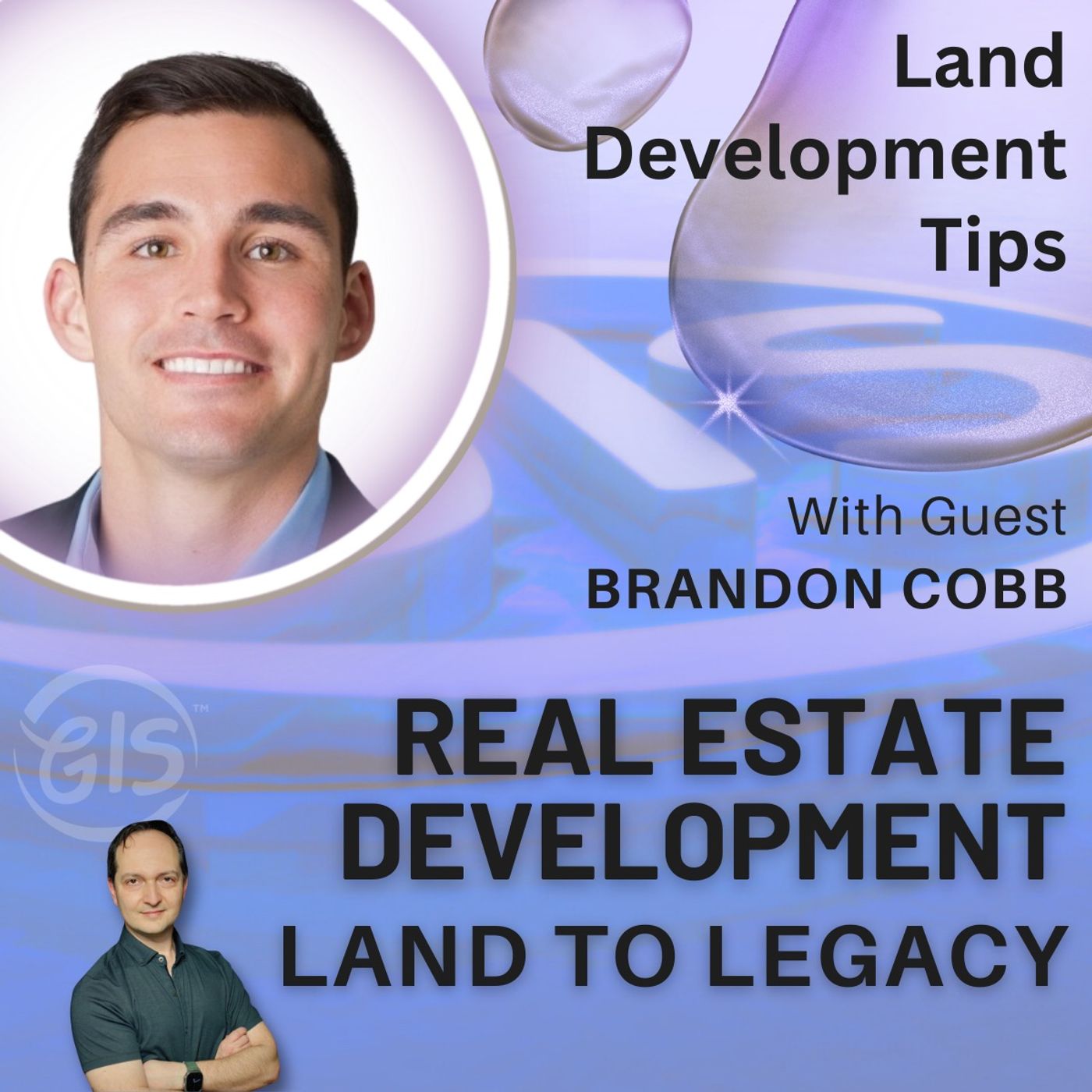
About this episode
A failed motivational blog, a risky early move with retirement money, and a career setback all became part of the path that led Brandon Cobb into one of real estate’s most overlooked value-creation plays: land entitlement. In this conversation with Eugene Gershman, Brandon breaks down how raw land can be taken from a simple parcel to a 50-, 100-, or 200-home community, why builders often prefer buying finished lots instead of taking on development risk themselves, and what landowners should understand before selling too early and leaving serious money on the table.
Guest Bio
Brandon Cobb is a real estate entrepreneur focused on land development, paper development, affordable housing, and selling individual lots to builders. Eugene introduces him as someone who has completed more than 180 transactions. In the episode, Brandon shares how he moved from a successful career in medical device sales into entrepreneurship, then into flipping houses, building homes, and eventually developing land after national homebuilders began approaching him to buy projects he was working on.
Episode Highlights and Chapters
01:29 Eugene sets up the conversation around how value is actually created in land development, with a focus on paper development, affordable housing, and the real leverage behind entitlement work.
02:50 Brandon shares how losing his medical device sales job became the turning point that pushed him toward entrepreneurship and real estate.
05:44 After getting inspired by a Shark Tank pitch, Brandon experiments with several failed business ideas before discovering real estate, flipping his first house, and learning through costly mistakes.
21:33 Brandon explains the layered value creation in land deals, from entitlement to infrastructure to vertical construction, and why multiple exit strategies make the model so attractive.
24:16 The conversation turns to why national builders often prefer entitled or finished lots over raw land, especially when speed, timing, and return on capital matter more than taking development risk themselves.
26:31 Brandon breaks down what builders typically want in a project, why around 50 lots can be a meaningful threshold in his market, and how smaller communities can still work when they fit a builder’s pipeline.
28:25 One of Brandon’s biggest lessons for landowners is to understand what their land could be worth after entitlement, instead of selling as-is and potentially leaving major upside behind.
29:42 Eugene adds the owner’s perspective, explaining the tradeoff between certainty and upside, since developers often take on the work and risk but also delay the seller’s payoff until approvals are complete.
32:08 Brandon shares the two main ways people can work with him: education and coaching for people who want to learn land development, and passive investment opportunities for those who want exposure to the strategy without operating deals themselves.
Contact Information
Brandon Cobb
https://learnlanddevelopment.com
Investment opportunities:
https://hbgcapital.net/waitlist
Interested in being a guest on our podcast? Contact us at:
https://giscompanies.co/podcast/
Download the Feasibility Study Checklist to assess your project’s potential
https://giscompanies.co/development/feasibility-study/
Hosted by Simplecast, an AdsWizz company. See pcm.adswizz.com for information about our collection and use of personal data for advertising.
Interactive timestamps
Jump to segmentGet every episode summarized
Each time Real Estate Development: Land to Legacy publishes, we email you a written briefing from the transcript — the topics, who appeared, and any specific claims, with the ad reads skipped.
Email me new episodesFree for 3 shows. No card needed.
Hosts & guests
Transcript ready
585 searchable segments. Every word is indexed and playable.
Full transcript
Real Estate Development: Land to Legacy — Land Development Tips. Machine-transcribed; use the interactive transcript above to jump the player to any line.
0:00And I had my whole identity wrapped up in this career until one sunny Friday afternoon, my boss says, Hey, you know, come on over to Starbucks. I need to talk to you and I'm having a really great day. I'm like, okay, we made like $30,000 from that transaction, which if you're listening to this, don't do what I did. Do not sell your retirement accounts. You can actually use those to invest in real estate. That was stupid, but I paid the penalties, everything. And then one day the light bulb moment went off and we had a property that we could buy that was fire damaged and we could buy it for less than what the home was worth. And by this point, we had done some full gut renovations and we're kind of comfortable doing some bigger projects. Though, oh my gosh, why are we flipping houses? We need to be building houses phase one is land entitlement. That's just taking a piece of raw land and getting approved for the community. And you can sell it at that point. We do those deals, no construction whatsoever, just sell it. So for this, we've got the land entitlement. When you take it from farm to 50, 100, 200 home community,
1:00it's worth a lot more money. So we force appreciate it that way. When you develop it and put the roads, you tell us the infrastructure. You don't want to leave money on the table and you know what? What you might find is that you don't want to do any of this. And you like the idea of somebody else doing it. All right, and we are back with real estate development land to legacy. And today we're talking about something most individual landowners don't fully understand. And that is how value is actually created in land development. And so my guest, Brandon Cobb, has completed over 180 transactions now. And he focuses specifically on land development on paper development and then building affordable housing and selling individual lots to builders.
2:04So it's a little bit different angle from what I've done before. We typically go for multi-family town homes. I hear about paper development, but I don't really fully know that business. So Brandon's going to share with us his experience. And then we're going to talk about getting fired, right? Stacking up failures. I've failed a bunch of times, you know, paying what we call the dumbtacks, how he discovered the land niche and windtilement might be the real lever in development. Anyway, Brandon, welcome. Thanks. It's great to be here, Eugene. So tell me, you got fired and then you discovered real estate. How did that whole thing happen? Yeah, you know, it's been a while. I guess we're going on what like it's been over 10 years. So I don't have this story of this dream of wanting to do land one day. And if you told me, you know, 10 years ago, we were inventing these new housing neighborhood that I'd look that you like you had 10 heads.
3:08Because I was actually very happy. I don't have some story where I worked in corporate career for decades and got fed up and had some dream. No, I was actually living my dream, which was to do medical device cells. Like I loved what I did being in the OR every single day, rubbing shoulders with orthopedic surgeons, training hospital staff on my product. And you know, of course, the coolest part was wearing scrubs every single day. You know, like, I don't know why. I thought that was really cool. But I really enjoyed selling a product that I believed that made a difference in the patient's life. So to me, I kind of had it all. Had a boss who was like a father figure to me. He was the guy that gave me my shot breaking the industry. Took me years to break in, by the way. And so, you know, I really valued what I did. And I had my whole identity wrapped up in this career until one sunny Friday afternoon. My boss says, hey, you know, come on over to Starbucks. I need to talk to you and I'm having a really great day. And I'm like, okay. And before I can tell him how much money I'd made him that day. And I'm excited I was, he fires me.
4:09And just like that, my career as a medical device cells rep was over. And if anybody's ever lost a career like that, where like your whole identity is wrapped up in it, you're not just losing a career or a job. It's a sense of identity. And I'm like, oh, my gosh. Like, am I cut out for this? Am I not? What did I do wrong? And that's like the only thing I could think of that day is what did I do wrong? What did I do wrong? Like, what did I do wrong? Because I loved what I did. But, you know, the lesson that I learned was that nobody was going to look out for my financial hoping but me. So you can be as low as you want to these companies. Put it in the blood, sweat, and tears. Even work the decades, climb the ladder, but you're one restructuring your, you know, one economic event away from, you know, losing your job. So it's if it happens, not a win. And so I'm very thankful for that. I learned a lot. And that's kind of how I started my entrepreneur journey. You know, from then, that sort of flipping houses. Then I started building houses. And then we always started graduating up and started to do these neighborhoods after we got a knock on the door
5:10from these large national homebuilders that saw some of the land that we were developing. And we're like, hey, like, we want to buy it from you. And they were offering us crazy prices. So we're like, yeah, you can have it. Interesting, interesting. So we jumped fast forward in a little bit. But so tell me, how did you end up in real estate? And what made you think that real estate is going to be it? I mean, it's a complete polar opposite to working the corporate job, but knowing the formula, you know, somebody advising you, guiding you, telling you what to do to the just going out on your own. When I got let go, I got my inspiration from Shark Tank. I was watching a Shark Tank episode and this guy got to deal with the sharks wearing or his business was sending potatoes with a face and a message on them. That was it. It was the most ridiculous thing ever. And I'm like, if these guys can make money doing that, surely I can figure this out. So I started a course on how to break into medical devices. Because I thought, you know, there's a lot of guys that reach out to me.
6:10They asked me how I do this. Maybe there's a market there. That failed. I was all about motivation. I was like, dude, I'm going to start my own online motivational blog. So I did that. You just tumble, rumble, all that stuff. It failed. And I said, you know what? I really like the whole Tony Robbins thing. Maybe I, you know what? I want to be a life coach. So I started doing that. And Eugene, you're not going to believe this, but not many people want to take life advice from a 27 year old. So that failed. And then I discovered this vehicle called real estate. As you know, kind of the rest of this history. You know, the first house I found, I sold all my retirement accounts, bought it cash, partner, ended up flipping it. We made like $30,000 from that transaction. Which if you're listening to this, don't do what I did. Do not sell your retirement accounts. You can actually use those to invest in real estate. That was stupid. But I paid the penalties, everything. But it's worth it because it helped me start and launch my business. And I made about $30,000 from that transaction. And we literally, if you've seen the movie Batman,
7:12where the Joker slides down the big polymoney, turns around lights it on fire with gasoline in front of the mob, that's what we were doing with the marketing dollars. Right? And that just kind of kept the turns. So we kept getting more and more deals from doing that. And you know, fast forward and the rest is kind of history. We started flipping houses. And then one day, the light bulb moment went off and we had a property that we could buy that was fire damaged. And we could buy it for less than what the home was worth. And by this point, we had done some full gut renovations and we're kind of comfortable doing some bigger projects. We're like, okay, well, can't be much more than getting it down to the studs, like what we've done before. So we reframed the second floor that was all crispy. Basically built the new home. The foundation was still good. And we ended up making about three times the amount of money on that new build as we did a home around the corner that was, you know, like a full gut rehab. And we're like, and we did it in less time. So that was the, oh my gosh. Why are we flipping houses?
8:12We need to be building houses. So we grew and scale that company. And that's where HPG Capital was born. We needed to go and pull all of our own money out of the business, you know, to be able to run operations and not have it locked up in all these properties. So we started raising capital from investors, really started building homes, started scaling that. And we said, you know, sure would be easy if we could build multiple homes on the same piece of land. Because we were going after your infill spec, you know, one Z2Z little lots kind of here and there. We wanted to build a runway for years. And so that's exactly what we did. And eventually we started going after these parcels where we're putting the roads, utilities, the infrastructure and everything in. And we just started getting bought out by these big national home builders. We like working with them because unlike a lot of buyers, they don't have a plan B, C or D. Like plan A is to buy land and build homes. If that doesn't work out, plan B is to buy land and build homes. And if that doesn't work, then you have plan C, which is to buy land and build homes.
9:13So like they're Wall Street, right? They're publicly charted companies. And they have to make the stock price go up. And the only way to do that is to buy more land and build more houses. So we, you know, that's who we work with now. But, you know, everything we do in land development, it doesn't matter what real estate niche it is, to get a development approved, whether it's single-family, multi-family storage, industrial, whatever it is, you have to go through the same process with the city. Awesome, awesome. So one thing that I started asking all of my guests is to share one piece of advice that developers or landowners interested in development could take away from this episode. So I'm going to ask this question of you, but hold on with your advice. We're going to come back to it. We now approached sort of the substance of our conversation is about land development. So I do want you to share that advice. I'm sure you have a lot, but try to think of the most important key thing
10:16that people need to have. The reason I started doing this show is after having worked with so many owners I realized that there are two sort of main camps. Some people think that real estate development is extremely complicated and it's like they would rather figure out how to launch a spaceship but they would not touch real estate development. And then other people think that it's super simple, you hire an architect, you hire a contractor, and you get a dump. As long as you have the money, you can get a dump. And what I wanted to do is I wanted to kind of bridge the gap between the two to show them that it's a little bit more complicated than just hiring two consultants. And no, it's not as difficult as launching a spaceship. In fact, my go-to phrase used to be still is sometimes it's not rocket science. We can figure it out whenever we touch something new. And you sort of stumbled on that thing.
11:17But tell me, going from flipping to building homes to then just prepping the land, what changed in your mindset? You know, that's a great question. To be able to go from flipping houses to building houses, there was a little bit of a jump but it wasn't a very far jump because over time we started with some basic flips and then started getting into more and more deeper and deeper rehab. So we got comfortable with the construction, right? And for us to flip and go to building, it really was, well, we just really need to do the foundations and framing. I mean, we've done everything else. So it wasn't that big of a leap, right? I needed to have that mental confidence to be able to do a certain amount of the construction before taking that big leap. And it was the same thing when we went from building lots of homes separately individually in these neighborhoods where we just would tear one down and build on a vacant lot, something like that. To, hey, we're going to take a raw piece of land and put everything in it.
12:19We had done some projects, you know, that like an eight build where, you know, we had to put like, you know, utilities and everything in the ground, like we learned kind of on a smaller level, like what we needed to do. And that really helped, right? So it was similar. We'd gotten used to some of the construction, some of the ground construction before getting into it. Now, the real key here was getting into land development. You've got to have the right partners in place. So there's a team that you have to build that doesn't work for you, by the way. And you're going to lean on them. One big one is your civil engineer. That civil engineer is going to be the one that's designing how deep the sewer goes, how, what's the slope of the road? You know, where's the stormwater going to run around? And so I don't need to understand all that stuff. I just need to find the right civil engineer who understands and is familiar with that area and then use them to design it. And then I just need the right contractors in place to be able to go
13:21and manage that project to be able to execute what the civil engineer says. So that's, that's pretty much it. I just needed to find the right people. It was a big mindset shift. If I need to know everything myself to, I just need to find the right people in order to do this. I'd say those were the pretty big shifts that enabled us to get into each of those separate businesses. Interesting. Yeah. In my world of multi-family development, we, the driving consultant is typically the architect. They're usually the ones that deal with the city or municipality and kind of coordinate all of the consultants. And subdivisions, it's your civil engineer who is typically driving the bus. Where do you think, what's the difference in risk between developing full structures, whether it's single family or multi-family versus developing a land?
14:25Are risks different? Are they similar? Can you compare contrast to? Yeah. So what you're asking is when you're developing land, just the land, what that was risk for versus building the actual homes. Yeah. So, yeah, quite a bit. So let's go into the houses. So we were building quite a bit of homes in 2022, 2023 and rates went up. And these were all spec houses. So at the time, it made sense for you to build something and not have it pre-sold. Because by the time it was built, it was worth more money, right? That's, it was crazy, crazy years back then when it's crazy. It's crazy for me to think like back when, because it really wasn't that long ago, but it was a completely different market, right? So when you're building a house that's not pre-sold, you have time risk, you have market risk. Well, what happened to us was probably one of the, probably several of the worst possible things, like we got hit with a trifecta. We got hit with interest rates. That was a black swan event, right? Those doubled. All your construction loans are adjustable rate mortgage. You cannot get a fixed rate construction loan.
15:26So all of our rates doubled. And then the houses sat on the market for a year. We were expecting, you know, 60 days max, like homes were selling in like 10, 15 days back then, but you know, we had underwritten 60 days. So we got hit with that. So our holding cost actually quadrupled. Twice the monthly payment, twice the length of time. So that took a hit. And then you had the market risk, right? Of, or I guess you could call the speculation risk. And so, you know, prices actually came down. Now, at the time, we had some severe supply chain restraints. And so one of the big issues that we just could not underwrite, we didn't expect products we needed to build the homes to be unavailable. I mean, we got so desperate for some of the products to finish these houses. We were shipping them in from overseas, like literally from Turkey and China. Because you know, if you can't get a water meter box, well, good luck getting a certificate of occupancy for your resident to move into. You know, cities not going to sign off on it.
16:27So some of those risks just kind of summed up when you're building homes is you've got the construction risks. So can you actually execute on the project? Do you have a good GC in place or are you good at building homes? The time risk, what's the market going to do? What's the risk of your competition? You know, absorption rates and things like that. You got to make sure that the product is going to be very well received. So there's a lot of moving pieces there with new construction. Not as many pieces when it comes to land. And there's two phases when it comes to land. I call there's three phases in the development process. Phase one is land entitlement. That's just taking a piece of raw land and getting approved for the community. And you can sell it at that point. We do those deals. No construction whatsoever, just sell it. Phase two is development. This is where you're developing and selling lots to a builder. You're creating a neighborhood with no homes. So you're putting in the roads, the sewer and the water, the stuff like that. And then phase three is obviously new construction.
17:29And so when we were doing our land deals, we structure the land entitlement a little bit differently. So during our due diligence period with the land entitlements, we have our buyer lined up already. So it's pre-sold before we get out of our due diligence period. There's less moving pieces, meaning my costs are going to be maybe a traffic study. There's a few feasibility studies we need to do to make sure it's okay and not toxic piece of land or the soils aren't good, stuff like that. And then the civil drawings. So my line item, I might have God knows how many line items on my budget for a new build. I only have a couple when it comes to doing land entitlement. And most of it's the civil engineering. So that risk of, am I going to go over budget? What's the cost of this project? Is a lot less. And if you do the risks right, if you mitigate those right, then you can reduce a lot of the risk with entitlement. So for example, if I'm getting a geotech report, the soils are good.
18:29Okay, I can build on it, right? You don't want to have to build on like a beach with sand, right? You know, it's just going to wash away. So you want to make sure what you're building on is good. Second, endangered species report, you want to make sure there's no bald equals nests. You're going to come to a felony about cutting the trees down, something like that. Third, environmental report, you want to make sure that there's no Godzilla's growing on the land because there's some toxic, you know, nuclear side or something crazy like that. So you know, you get those done. So there's the risks of, can you actually get the land approved next? Like so as the land safe, that's risk number one, where number two is, can you get it approved by the city? We don't buy anything until we have those approvals. So we put the land under contract with an option from the seller to buy it contingent on getting the outcome we want. And so we kind of remove that risk right there. And then risk number three is your buyer risk. So we get a in buyer lined up during our due diligence period. That tells us to move forward. And if they were to back out last minute, we make sure that the deposit that they put down
19:31covers the money that we have spent on the project. And so if some reason they back out last minute and like we just can't close and the sellers like, you know, I'm taking your money. Thanks. Okay, at least we're covered then on that point. So that's some of the risks when it comes to doing the land entitlement portion. With the land development, similar to land entitlement, it's kind of halfway between new construction and that. You don't have near as many line items as you're managing with a new construction project. But you are still doing construction. And so I don't care how good you are. You're always going to have surprises on a land development project. So you know, put eight, eight percent, 10 percent into your budget account for that contingency. So you've got the budget risks there. And then you've also got the same kind of risk. You're buyer walking on the deal. So you want to make sure you've got a significant deposit from them. We typically want to see 10 to 20 percent of the purchase price of the property. And this is why we like working with national home builders because they've got the money.
20:34They're putting down the, you know, seven figure multi-seven figure deposits that we need to feel very comfortable with the project. So those are some of the risks that are involved in each of them and kind of how we mitigate those. Interesting. Yeah, that's a very detailed explanation. So a lot of times owners come to me with a large acreage and they have been approached by other developers to buy it from them. But they're telling me, look, is it worth it for me to go through the same process that you just described. Get the engineering done and sell them as, you know, design permanent lots, maybe before doing the construction. What's your advice? What type of a return could somebody get on just going through the entitlements? Yeah, I mean, it's enormous. The amount of equity that is created.
21:35One of the reasons I like this particular business is we have multiple ways to force appreciate the property and the event that we need that, right? That's a very important piece on any kind of real estate risk mitigation is, do you have multiple exit strategies? So for this, we've got the land entitlement. When you take it from farm to 50, 100, 200 home community, it's worth a lot more money. So we force appreciate it that way. When you develop it and put the roads, you tell us the infrastructure, you're adding another layer of equity on top that you're creating. And of course, when you build the homes, that's when you create the most equity right there on the back end. So we have multiple tools in our tool, but in the event that like one thing doesn't work out for some reason, we can kind of do the next thing. So we've got multiple exit strategies that are lined up. So you can make an enormous amount of money. I mean, we don't do any land entitlement deals unless we're making seven figures on it. Like I only need to do a few deals a year on the land entitlement stuff. I don't have to do 40, 50, 60 land flips or anything like that. And those are the kind of deals that we want to work on. You know, it takes a little bit
22:39longer to do them. But in my opinion, it's not the hustle and bustle and every day of trying to just do transaction. Oh, yes, I say it is definitely worth it. One of the things that I would tell them, and it's very simple to do this is you just get a concept plan done. Take that concept plan to the city. Concept plan is just a product, right? Meet with the planning director. If you're in a suburb, if you're in a metropolis, there's probably a council person assigned to your district going meet with them and just pitch them the idea and kind of get their input on what they would like to see on your land, right? They'll kind of tell you what they would approve or not approve. Pull up a chair and say, Hey, what are some things the developers have done to create win-wins for you? Right? What's the council approving? Like you'll find out that maybe they don't want townhouse, so don't bring them townhouse. Maybe they want a certain type of product, you know, listen to what the city wants and be on their team. If you bring them something and work with them rather than trying to shove something down their throat, they'll work with you. If the city likes it,
23:42we then bring it to our buyers list. So we work with a lot of national homebuilders. The developer, in this case, might shop it to somebody and say, Hey, what would you be wanting to pay for this if I were to get it fully entitled? Obviously get multiple offers on it, right? Don't just go with the first one that comes across your desk. And if you like the difference between, you know, what you've got in it and what they're offering you, boom, do the deal. That's one of the reasons that we're able to profit on it and pay landowners more than what their land is worth is because we do that forced depreciation strategy with the land town. Interesting. So why do national builders buy already entitled lots versus buying raw land those same farmlands and doing it themselves? That's a great question. So what was happening in 2022 when things were really booming and grooming was there was not enough developers out there to give the builders the finished lots that they wanted. So they had to go and create their own pipeline. Builders actually don't want to do
24:42the development. They are Wall Street. Okay, they're owned by Wall Street. Wall Street wants to get their money in and out as fast as possible, which means if I could just build a home really quickly and then sell it, I just want them, they want to get a 20 to 25% IRR on their money and get it in and out as fast as possible. When you develop, you introduce the weather risk and that distorts the time of the project. And when you distort the time, you distort the IRR, right? You know, if I make $100 in a year or if I make $10 on $100 in a year, well, that's a 10, you know, 10% IR. If I make $10 on my $100 in six months and I do that twice, well, that's a 20% IRR annualized, right? So the time is very important. What happened was since then, they, you know, because they got stuck with some projects that didn't really pencil because, you know, rates came down, they've been paying premium for lots. Now, like they don't want to do the development. They
25:42really want to buy lots. So if you are in a position to deliver lots to the builders, they are willing to pay a premium for them because they don't want to do that development piece. So they will do the development if they have to, which a lot of times is, it's just there's no market to feed the machine, right? With the number of homes that they're doing, they don't have enough developers out there doing that. But they would prefer to just buy finished, ready to build lots if they can. So if they're out to the builders, there were enough developers out there, they would not develop anything. They would just buy the lots. Interesting. Is there like a formula that most of those guys like like the minimum number of lots, the minimum acreage, or the maximum lot size, or is it different in every situation? Yeah, typically 50 is what we see in our market. They got to justify putting a team there. So 50 is kind of what we see now. If they already have a project going in a certain area where they scoop up a 30, yeah, I'm sure they would because
26:43they've already got a team there and it's going. For them to go and set up in like a whole another market, it might need to be like 150, 200 home, you know, community. So it just depends, they would prefer to be there for several years. That's their preference. They want to have a runway for several years. But what it does is it opens up this ability for people like us to go after these 50, 100 home communities in our market because they're not going after those. They're going after the two, three, four, five hundred home communities that they can do. And so if I bring them something and say, if I get this approved, will you buy it? They're like, heck, yeah, well, they'll buy 80, 50, 80, 100 home community. But the sales reps typically aren't going after those types of deals. And that's what I also love about it is the sales reps are on your team. They work with you because it's not their money. They just want the commission. And so they're going to give you a real good deal. They're going to open up everything and they like you're on a team with them to get the company's money. Right, right. Yeah, that makes sense. That makes sense.
27:48Do they typically work with brokers like real estate brokers or do you just develop relationship with these national builders directly? I mean, I have a list of all the national builders directly. I can pick up my phone. I can call any of them. I have the sales reps number. I've got the VPs of land. We've developed those relationships. I'm not going to pay somebody 3% for something I can just pick up the phone and do. Yep, yep, makes sense. All right, cool, cool. Well, so in the beginning, ITs that you're going to share with some of the most important thing owners who are contemplating development should know what would be that lesson that you would like to share. Yeah, so knowing the value of your land, right? And whether or not you wanted this, we've actually got a free course. If you want to go grab it, it kind of shows you how to value your land and how much it might be worth. You can go grab it, learn land development.com, right? Because I mean, that is free. Just click the land development 101 button and you can grab it and it'll go into showing you how a developer thinks and values land. But if you own the land,
28:51and I were to give somebody the number one piece of knowledge, it's actually go through the process of understanding what the land could be worth if you go through the process, right? You don't want to leave money on the table. And you know what? What you might find is that you don't want to do any of this. And you like the idea of somebody else doing it. And if that's the case, you know, you can, you can sell it to them. But you'll probably make more money rather than selling it as it is. Most developers are not going to pay you a premium for it because they're taking on the risk of the city potentially not approving it. So if you can hang in there with the developer under contract and let them get it done for you, pay for all the civil drawings, pay for the approvals and get it to the finish line, you can make a lot more money on it. Interesting. So that's also brings up a point that I mentioned to my owners a lot is that keep in mind when you're selling
29:51to developers in most cases, you don't get paid right away. In a lot of these cases, you're going to have to be willing to wait until they go through the entitlements until they are able to actually closing your transaction. And so the question we ask is, you know, it's a risk and reward. Yes, you could spend a little bit of your own money or, you know, in some cases a lot of your own money to go through the development and then it might take longer. You might not get approved. You might not be able to sell it for as much as you thought you would sell it. So it is safer to sign a contract with a developer who is going to do all the work and obviously then make the profit. So you've got a guaranteed exit. But down the road, if you had to liquidate today, the price is likely going to be even less. And if you were to do it on your own, then obviously there's risk involved. So it's always that risk reward that we try to educate and explain that it's very
30:53important to keep in mind. And, you know, if you were willing to take a risk, you have to be comfortable with that risk. Yeah, that's right. I would totally hire somebody like you to do this if I didn't have the knowledge to do it. And I know there was like a, you know, multi-seven figure payday on the end of it. If I could get my land approved again, right? It just makes sense to pay somebody to do it. And there's people out there that like you that have that knowledge on how to take things through and force multiply the value of the property and they're worth their weight and go, we work with some of those people and deals that we don't do locally. Like we need to have people in other markets that understand this process and how to do it. And we pay them, you know, take it through having that local relationship and how to navigate all that is extremely valuable. You'll find there's people in the area that used to work for the city that have kind of flip flop sides. And they'll, because they know everybody and they know the process, they'll kind of like work with you to help you, you know, kind of push your deals through. So yeah, those people are worth their weight and goal. Absolutely. Absolutely. Brandon, this was super useful. Tell me a
31:58little bit more about this mastermind program that you have and let the listeners know how to find and how to get in touch with you. Yeah. So there's two people that we serve. The first are people that want to learn how to do this. So if you're like a builder and you're on the skeleton of my homes, you're building or maybe you're a land flipper and you want to do some larger land deals. That's kind of what we see as like a who's really a good fit for this program or people that just want to do development. You can go to learn landdevelopment.com. There's a free course. You can go grab it. I've got interviews with civil engineers, private equity companies that want to fund your deals like all this kind of stuff. It's all on there. Go grab it. There's a video on there as well. If you want to learn more about the coaching community, if you just like the idea of somebody and holding you through your your first deal and raising the capital for it, all that fun stuff then the community might be a good fit for you. The other person we serve are investors that they don't want to do any of this. They don't want to learn any of it. They just want to give their money to somebody to do it for them and get passive income from it. So if you
33:00like the idea of diversifying your alternative investments in real estate with this land strategy, if you like that, even investing in stuff that's pre-sold to the AAA rated national builders, you can go to hbgcapital.net forward slash wait list and you can watch a video on our strategy and book a call with us. Again, it's pronounced hbg like Harry Bob Gary capital dot net and I joke the dot com was stolen. So you can go there, book a call. And if you want to grab our free ebook that we have 100 questions business owners asked before investing, you can go to hbgcapital.net. Awesome. Thank you very much Brandon. It's been a pleasure. Thanks for your valuable advice. And I'd love to talk to you again. Hey, thanks. I appreciate you having me on.
More episodes
More from Real Estate Development: Land to Legacy

Protect What You Build
Real Estate Development: Land to Legacy

Building Wealth at Your Pace
Real Estate Development: Land to Legacy

Land Use Traps
Real Estate Development: Land to Legacy

One Deal Changes Everything
Real Estate Development: Land to Legacy