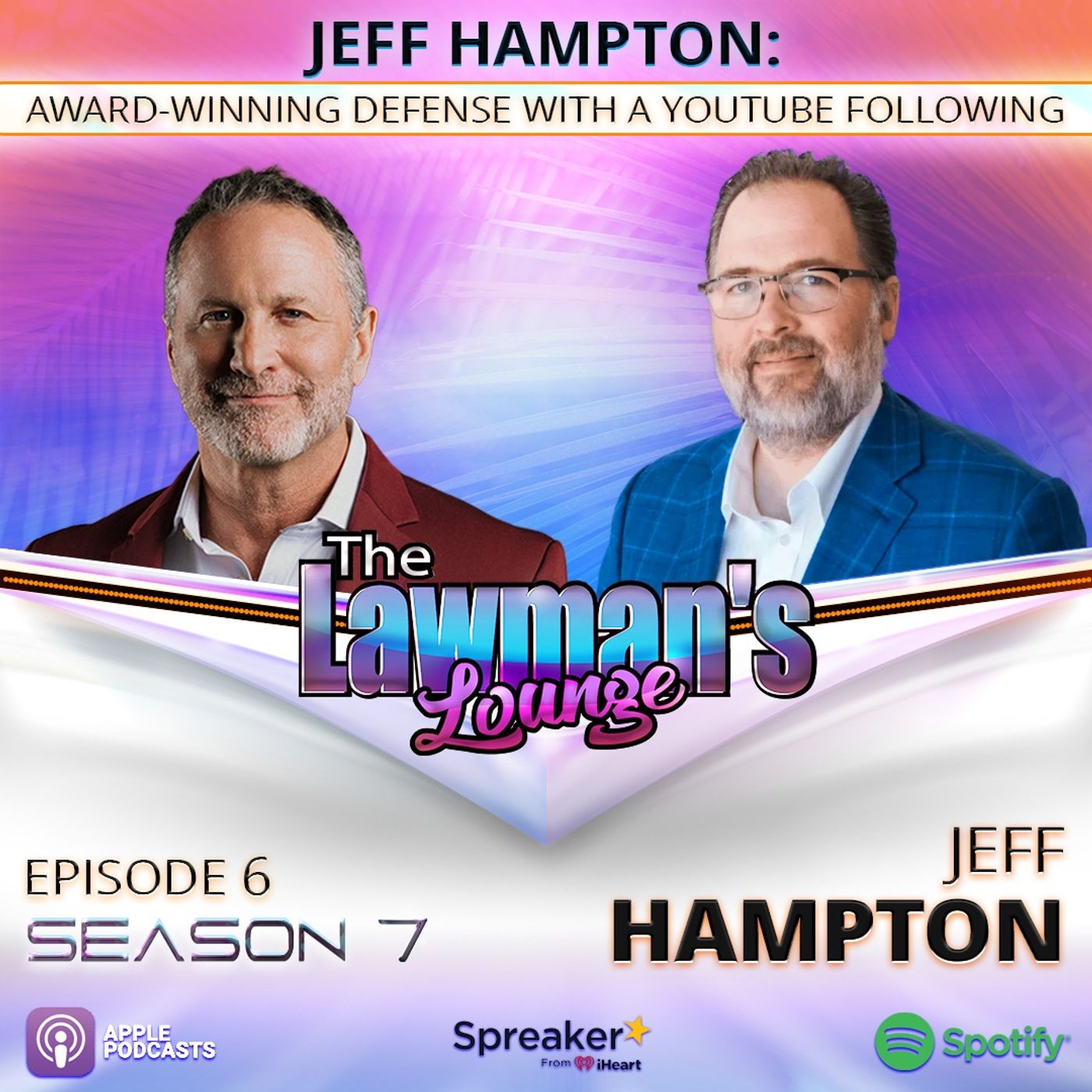
Jeff Hampton: Award-Winning Defense with a YouTube Following
About this episode
Jeff shares the strategies behind his massive YouTube following, the mindset shift attorneys need to succeed on camera, and the simple content habits that turn viewers into loyal fans.
From boosting visibility to building trust before a client ever walks in the door, this conversation pulls back the curtain on how lawyers can use YouTube to transform their practice.
🎧Check it out wherever you listen to podcasts
Become a supporter of this podcast: https://www.spreaker.com/podcast/the-lawman-s-lounge--4267400/support.
Get every episode summarized
Each time The Lawman's Lounge publishes, we email you a written briefing from the transcript — the topics, who appeared, and any specific claims, with the ad reads skipped.
Email me new episodesFree for 3 shows. No card needed.
Hosts & guests
Transcript ready
953 searchable segments. Every word is indexed and playable.
Full transcript
The Lawman's Lounge — Jeff Hampton: Award-Winning Defense with a YouTube Following. Machine-transcribed; use the interactive transcript above to jump the player to any line.
You are listening to the Lawman's Lounge, a podcast dedicated to help you take back and show of your life and your business. Here's your host Bill, the Lawman Eumanski. Hey, it's Bill Eumanski, the Lawman, and welcome to the Lawman's Lounge, everybody. Today we have a really, really cool guest. I met him at a Max lower conference a while back, but none of them beforehand, a guy who runs two separate law practices, but also decided to get into YouTube coaching, and what's interesting about that YouTube also execution and performance as well, where he'll either teach you what you need to know about YouTube, or he'll have a team doing it for you. What I love about this guy though, is YouTube, everyone might be thinking, well, we're going
to talk about YouTube again, isn't YouTube not marketable? I can't ever get my YouTube to move. I don't know if YouTube really works, it just helps with branding, not client acquisition. I hear a lot of that, and I hear people that give up on YouTube, and he's going to be here to dispel that, additionally, I'm part of a couple of unofficial masterminds where we have seen how people that have thrived on YouTube, not just my next guest, have actually gotten cases and are getting more cases now, so in fact, because there's so few people I think that do it well in the legal space, and that's probably a fact, and I don't know why those same people are all over TikTok and Instagram, but they don't spend the time and attention on YouTube that it deserves. Maybe our next guest, Jeff Hampton, we'll talk about that. Welcome to the show, Jeff. Thanks, Bill. Excited to be here, man. Yeah, so tell us a little bit about who you are and what you do and how you got into
YouTube. So I'm going to, yeah, so I'm going to turn, like you mentioned, a second ago, I own a criminal defense practice in the North Texas area where we're growing and we've got a good size group of attorneys there, but really that's where it started. I started back in 2020 with the small team that we had at the time and during the pandemic is when I really jumped into YouTube. Over time, what took place is that I also started a secondary business that I have called STR Law Guys, which is basically an asset protection law firm for Airbnb owners, because I own a portfolio of short-term rentals as an investment for passive income on that end. And so that kind of led into that naturally on the asset protection side with my partner, Stephen Tobin in that business. And then how I ended up getting into the consulting side was not something I decided I was going to start. I actually had a gentleman who reached out to me that's, I think, a part of one of the groups you're talking about that actually offered to pay me if I would show him some
of these things and that's when it kind of was like, wait a minute, I'm not sure that's what I do. I'm actually just kind of doing this for my law firm and then I enjoy teaching, I enjoy sharing information with folks and being able to do that. That kind of started YouTube Rainmakers and since then obviously that's taken off. So YouTube has leveraged, I've been able to leverage YouTube now to the point where 65 to 70% of our calls, they'll mention a YouTube video for the criminal offense firm. And so it's been transformative for my business as an organic anchor for leads. Yeah, let's talk about your law firm quick. Like what's the size of both of your law firms? Yeah, just a little bit about that. Yeah, so the criminal firm, we've got 10 lawyers, we've got a staff of another 15 or so that we've got in addition to that staff members and we cover all the main primary north Texas areas. We've grown. We have a Dallas location, multiple locations in the Terran County Fort Worth area.
And so we're mid seven figures range in terms of what we bring in and revenue. And then STR law guys, which is a nationwide asset protection firm, hasn't been around as long, but we're still, we're in the seven figure range on that end and it's a smaller crew, but we've got three lawyers. We've got 10 staff members and that continues to grow. That's awesome. And now you've got this YouTube business has been going on. Tell us a little bit about the business itself. Yeah, because I know how it started, but tell us about where you're at with it now. So we've grown. We're still trying to keep it pretty much somewhat boutique. I have my hand in every client situation that we have. You know, we're not even at a full 30 client set yet of attorneys that we work with. But I do a lot of consulting. There's really three levels that we offer to clients. The first one is the done for you where we just do the same thing I do for my stuff. Same team, same thumbnail people, all that that work on my clients for all my channels. That's the done for you side.
And then we've got consulting. I work with some bigger like really bigger law firms that also have in house teams, right? And they're frustrated because their in house teams don't really know some of the same strategies because we don't know what we don't know. So I help teach them how to fish. I basically help them come in and improve what their processes are on a one to one consulting. And then I do have a course for like the newer attorneys. You know, some I think about the, you know, the kids coming out of law school and they're starting their own practice and they're trying to figure out how YouTube integrates into their marketing part plan on that sort of stuff. So that's an option for those as well. So let's talk about YouTube in general. And you know, again, you know, I had started the intro off about how YouTube, you know, basically it's not as sexy as TikTok or Instagram, Facebook, meda ads, although that's been around as long as seems. But tell us a little bit about why that, that, that may not be true.
So I'm going to tell you, and this is the part I always give is a big disclaimer to people. There may be other ways to do things. I can tell you what I know worked for me. Okay. So I don't want to pretend like I know everything about all these things, but I can tell you what I have learned. I've had videos that get five, seven, eight million views on shorts and even go semi-viral on TikTok. The problem is short-form content in my experience, particularly depending like if you're a PI lawyer or a big criminal offense case, people are less likely to hire you from a 60-second clip. It, I don't, it builds no trust. It might grab my attention. So it creates awareness and a visibility. It make me, may introduce me to you as a brand, but there's no reason I should work with you on, on a short-form clip. Long-form content to me is there's two, two parts to that. When you do this on YouTube, why do people invest in SEO? Why do people still spend their time trying to have their website rank? Because when people are doing searches, it's high commercial intent.
If someone is searching for an aggravated assault lawyer, they're not searching to be entertained. They're searching because they need help. And of course, YouTube is the second largest search engine in the world and I have videos that you can, when you start ranking them for search, they become evergreen. When they're ranking, you're at the top of those high-intent searches. People are clicking and, you know, there's two big aspects to this. Do you want to create content for vanity sake so that it looks like you're getting a bunch of views and you feel good about yourself or do you want to create content that's ever green where people, when they search for them, they want to actually call in and work with you, right? And so I, and one of the things I can do and I don't want to get ahead of myself so you can cut me off, but there's two big parts to this. It's not just what you do on YouTube. When you create good long-form content on YouTube, it's where can I leverage this long-form content on my other marketing where I see an increase in conversions for all my other stuff? And I think this is where most people fail. I hear a lot of people in the lawyer marketing space saying things like, let me get you more leads.
Let me get you more leads. I'll drive more traffic. But there's only two ways to make more money. One is you either have to get a lot more traffic at your current conversion rate or you can improve your conversion, right? You can make more money off the traffic you're already getting, right? And for what I see the easiest lever to pull here is improving your CRO, your conversion rate optimization on the front end, you're going to make money faster than trying to dump loads of more money into ads trying to increase that traffic on the, on the, on the front end. Right. And actually, when you do it faster, you can then also spend additional stuff over your margins. Yes. Back into advertising as opposed to taking the bigger risk. So it kind of one feeds the other, I think, too, as well. So tell us a little bit about the, and I had seen your presentation and, you know, we don't have the time to go through all of it, but it was pretty phenomenal. Give us the highlights of the dos and don'ts of an appropriate YouTube strategy, because
it's, you know, and a lot of it's easier to see digitally, I mean, to see actually visuals of. I know, for example, you have over a half million subscribers and I think you millions of views a month. So, you know, just tell us a little bit about the dos and don'ts. You know, you have in fact given good advice to us, because our YouTube channel, we haven't really worked much on it. We put videos up and you're the one that said, you know, your thumbnails, you got to fix those. And, you know, we haven't started fixing them yet, because we've been so busy, but I can tell you like it was good advice for sure and something that I took into account. So tell us a little bit about, you know, the dos and don'ts of having, you know, a successful YouTube channel that actually converts for you. Yeah. So I think the first part is to be very specific about why you're creating the channel. And if you're going to create the channel, I think sometimes what people will do is they'll
say, I'm creating the channel to create, to get leads and to monetize and actually make more money for my firm. And then when they launch a search based video approach, because I'm going to break down the strategy on this, when they launch a search based video and they don't go viral or get the views they wanted in the first week, then they're just like, ah, this is waste of time. This is going to work. And they measure it by the immediate views that they get. And so I tell people right out of the gate, this is a just like SEO, and I don't think it has to take as long with SEO, like, you know, I've got some immigration attorney that we a thousand extra channel in 30 to 45 days. So there's examples where you can blow up very quickly, but the long game is if you have no channel, no channel, and you're going to start putting out content, the dues, let's talk about the dues. The dues number one is start first with good practice area search based content. And if you do this, you're setting a foundation for videos that are going to start ranking for search in your geographical area in your state for practice area content.
And when you start doing this, this is laying a foundation that is just going to keep building for you. And it compounds over time as you add more and more of those content. The big don't is what I see people trying to do is they'll chase views, thinking that's the metric for the thing that they are successful. So I'll see, you know, a guy I saw that was, he was, he's a PI lawyer, but he started doing, you know, videos about the best pick chicken Parmesan in places he visits, right? And here's what the big don't is on that. I said, listen, do you think the people who care about your chicken Parmesan post are the same people who care about your car accident post? They do not. Right. They're different people. So what happens is, and then people don't understand the YouTube algorithm, YouTube only cares about two things, predicting what you want to watch and keeping you on the platform. So when those are the two things it cares about, and you create different type of content, just take chasing views, you're actually going to attract people that when you launch your core content that leads people to hire you, it's going to hit back metrics, and you're
not going to get the result that you want. So you've got to be very clear, your intent for why you're creating this and lean into that strategy and not immediately deviate trying to chase views in your first couple of months. That's a, that's a big do. Back to your other point, which is about thumbnails, thumbnails and titles. Most attorneys create a template thumbnail. So because I get it, like we put afterthought to the thumbnail, because I've got a record. What am I going to talk about? I got to get the editing done, and then we go, okay, it's ready to launch. Okay, hey, hey, hey, who came up with the thumbnail on this thing? Slap it up there. What did we say? We were going to do on the title. Okay, that sounds good. Launch. And then we sit there and we're like, God, it was a 1% click-through rate. What happened? Why did this not work? You have to start with all the great people. I learned this stuff from derrily use Patti Galloway, big name people out there that do this on, on both entertainment channels, but also in big mainstream channels like, you know, many more subscribers than I have. And you start with the packaging in mind.
Because if no one's going to have a new reason to click, no one will ever see your great content. Right? And the thing I try to encourage lawyers to do is to understand, it doesn't always, it can be your face. But you've got, it doesn't have to always be your face. Because that thumbnail needs to put the viewer in the action. That's the pain point. I like to create conflict in the thumbnail. And then I like to provide a empowerment in the title, meaning if I see the issue that I know my client has or that the content is speaking of, and then I provide empowerment for how to address it in the title, it gives people a reason, a photo, a fear based in issue to click. And you'll see increased conversion rates on those sort of things when it comes to a click-through. And so I tell people, don't just do it the way you see other people do it, because that's what they've done. If you do that, you're mirroring, and you're basically copying failure, because a lot of attorneys are using nothing against the suit. I mean, I'm sitting around a sport coat, but it doesn't have to be like you're walking
into the courtroom, and all dark thumbnails with, you know, a paragraph all over the thumbnail, that looks boring. Because that's a big deal. What about it? What about a shortness view, like with some gray hair? No, you can pull that off. You can pull that off. Just curious. Maybe I just need to. Maybe I just need to try it, but the suit doesn't work for me, so I'm going shirtless next time, 60 years old and proud. My thumbnail will be lost at it's 60, five ways to build fake abs, using AI, and I think that would be a great thumbnail. That's good. I'm going to hire you to produce that whole line. It might be clickbait, but it would get clicks. But anyway, that's, yeah, good point, you know, like, I think thumbnails are, so, you know, it's interesting is chat and claw. I think some of the other AI products now have thumbnail makers. Have you experienced with any of that? You and your team? Yes, yes. So here, and here's what I warn people about.
They're great tools, and they're going to keep getting better. The problem is AI right now is really good at taking direction and making modifications to something that already exists. It's not very good at coming up with something whole cloth. And so when you try to direct it and say, hey, look, here's this video. It's about this thing. Please come up with a thumbnail with this, this, and this. It'll end up bringing you something that looks very AI-ish, right? And so when you look, you can see channels that are doing that. There's a lot of faceless channels on YouTube that are doing that, and there may get a one hit wonder every once in a while that'll go off, but for the most part, the viewer can tell that, and it doesn't really bring people into something that looks authentic yet. Now, that may change. It's going to continue to get better, but right now, it's only as good as you're able to prompt it. Right. Yeah. So the agentic part of AI, as it relates to creatives, is still in that stage with as far as creating thumbnails, where it's not, you know, it's too reliant upon the prompt at
this point. Yeah. Interesting. Tell us a little bit about more about the, the, the do's and don'ts, because there's, I know there's more of them. Yeah. Yeah. Yeah. The tagging, a bunch of the other stuff, the, the foundational aspects you got to have. So I'll walk you through some other ones that most people don't think about when they create. And I did this a little bit as part of the presentation at Maxlcon, but one of the things many people don't think about is how they start and end their videos. And you got to really give a, a person a good reason to watch, because we've talked about titles and thumbnails, and you got to make sure the title and the thumbnail compliment each other and earns the click. But then the first words that come out of your mouth is going to determine whether someone is going to continue to invest in watching you, or they're off. Because I've seen videos get a 20% click through rate, and they start off like this. And then the average view duration, which is the link someone watches is low and short. And the video goes like this, yeah. It just dies. And the reason why is because YouTube's going, whoa, whoa, no one's watching this.
So one of the best things you can do, and I give people that there's three steps to a good beginning of your video. And those three steps as, as, as a do is number one, please don't do big, long graphic intros to your YouTube videos. Don't do a welcome to the Hampton law firm. And I'm Jeff Hampton. Don't do any of that. Instead, what you do is you jump right into a curiosity inducing statement. You've got to be the first work sentence out of your mouth has got to hook these people. And it's got to be specific to know your audience. Because the number one thing most people say is, Jeff, how do you hack the algorithm? How do you get people to, no, no, there's no hacks. It's knowing your audience. If you understand who your audience is, and a guy's getting better at doing this, helping you with defining your audience. But if you understand who your audience is, then you can make a statement in the first sentence that will stop people, they'll go, what? Then that's not enough. Once you stop them, sentence number two needs to be, you've got to set the stakes. Meaning what? Not that just that you're curious, it's got to be personalized to you. So this is important, but check this out.
If you don't do this, this is what it'll cost you. Then the third part to this is letting people know what you're going to give them in the video. I'm going to give, I'm making a promise to you, and I'm going to give you a pay off to that promise. When you do that, that sets it up and then don't me end or jump into your content, okay? And then I'm going to tell you, there's a great creator. She's only like 19 or 20 years old, her name's Jenny Hoyos. She's an amazing creator and the big thing that she did, millions and billions of views. She's like, when you start thinking about something, you can be personal, but when you script stuff, don't say anything more than needs to be said, but say what needs to be said. If that makes sense, say what needs to be said, but not any more than what needs to be said. If you start repeating yourself too much, I hear people do these things where they'll say something, they'll go, okay, let's give a summary of what we just covered. No, that's a retention killer. Don't do that. You've already showed them. You've already told them something, they don't need another summary, they'll get bored. So I watched my videos before I ever put them out and I'll read my scripts and I'll say, is there any section in here where I'm like, if I start to feel bored or I have
other people that'll read it and it starts to feel bored, I'm cutting it. We're getting rid of that. Let's practice one together. I'll do the beginning part. You do the content. You ready? Okay. All right. I've been listening to you very, very carefully. It's three step process and then basically give the content, don't repeat yourself. I look might be, how do you feel to buy a test when you're drunk? Okay. If you fail those feel to buy a test, you're going to jail. I got three steps on how you can perform field sobriety tests when you're intoxicated. Your turn. Okay. So here's how I would change it. The first thing I would change, just to critique what you just said, I wouldn't even, I like to frame it from there's a chance you're not even intoxicated but you're being forced to do field sobriety tests because number one, it's broader because people have to understand
there's chat times you might have just had one drink at a bar. So let's do you had one drink and you were honest and you told an officer you had something to drink and the officer, you've just been pulled over. You see the red and blue lights behind you. The cop walks up to your window and says, I think I smell alcohol. I need you to step out of the car. Now that's a hook because what does it do? First of all, it puts the viewer into the situation. I can use B roll that paints a picture of someone being pulled over and a cop walking up and leaning in and talking to them. And then the second thing we say, we basically lean into that and say, what you say next or what you do next could determine whether you maintain your freedom, your finances in your future. In this, I'm Jeff Hampton, the people's lawyer. In this video, I'm breaking down the top three steps you need to know to stop tricks from, cops from tricking you during field sobriety tests, right? Now, what happens is I did I need to go right into step number one or trick number one. Number one. And then I tell them what it is and I then, I basically give them a summary, a title for it, but then I reverse engineer it back to understanding how to empower themselves
to avoid that. Okay? And then literally it's okay to start with videos that are three or four minutes long to you practice this. And then what you end up finding is what I do now, if you go watch my content, I'm adding case law. I'll site statute. You say, well, why does that happen? Why does it matter? Because Google brain pulls your transcripts and can tell the quality of your content and keywords that I integrate into my, my scripts, that helps them rank, right? And so it also increases my authority. If I'm in your quote in case law and I'm giving examples of things, I'll have people call into my office and be like, I don't care who I'm working with here. I want the same firm that Mr. Hampton's doing this talking with. And so that's an example of how you could modify that hook. Yeah, that's good. I just wanted to do it so we can give an example for those of people listening and seeing the video because we'll see the master in action. And so that is a great and that's great critique and that's exactly the right kind of hook that you get people to start listening and watching and following.
So let's talk about, you know, there are people out there who have tried YouTube, they've got a channel. I'll give you an example ourselves. We've had a channel for years, we sometimes we have some great views, sometimes we don't. How do you rescue a channel or refresh a channel or should you start over again? Yeah, so these are great questions. So the first thing I like to do when someone comes to me and I've had attorneys that have come to me with, you know, 10,000 subscribers and they've got, they used to have some traction. And then what they ended up doing is their channel ended up kind of just just going down, down, down, down, they're trying to figure out what the issue is. There the first thing I want to do is do I do a 10 point channel on it. I want to do a full 10 point channel on this client and I want to look at it and say, okay, first of all, where did this start to turn in a negative direction? What was the kind of content that was being posted? Was there something changing here? And when I find a lot of time where we get desperate, if we're not, if we're only chasing
views, and that's our only metric, if we're not getting the views we used to get, we start to get desperate about feeling like we've got to do something else to get more views. And sometimes when we try to do something desperate and do something different, but it doesn't line up with our audience avatar, then we do that segmenting that I talked about before, right? Where you segment out of your audience and that's where channels go to die. That's a graveyard. And sometimes I try not to get people to start new channels. I would love to salvage an existing channel. The only time I see that is being the case is if someone were to come to me and say, Jeff, look, I've been doing P.I. content now for six years and I think I'm going to transition into, you know, workers comp, just workers comp, not P.I. Or I'm going to go from criminal to P.I. I get that a lot. I'm doing criminal and I want to go into P.I. Well, here's the problem. The same people want to watch your criminal stuff or not going to want to watch your P.I. That's where you would start two channels and I did that on my asset protection. That's why I started two different channels is to do it that way. So there's really a couple of reasons why a channel doesn't do well.
If you're doing YouTube right now and you feel like it's not going well, the first place to look is your packaging. And I would want to do a hyper analysis of, okay, why isn't this working? What is your average click-through rate on your videos now? And some of you will go, well, the best I can do, it's not possible to do more than three or four percent. I get videos with 22 percent click-through rate. So it is possible to do that. You just have to figure out the combination and I'm going to give you some insight on this. That might not make sense with unless you're kind of see a visual. But don't ever put together a thumbnail on its own and a title on its own and slapped it together. What you want to do is come up with three to five thumbnail ideas, okay? Then list them down. Come up with three to five title ideas and I wish people would understand this. Look at the thumbnail first. Pick your top one. The one that you really think is the highest conviction. Look at that thumbnail and compare it to each one of those titles. If you do that, you're going to feel the trigger of where the title completes the thumbnail. It does that. If you don't do that and you just take one and one, it doesn't equal to one plus one that's
not equal to it equals zero. Instead would you have to do multiple things to choose from. And you know, I think I showed this before, there are now AB testing features on YouTube. There are ways that you can actually go in and AB test titles and thumbnails. So that's the number one reason I see people fail or is they're packaging. And then the second reason I see people don't do this very well is they're creating videos that are like a minute and 10 seconds or a minute and 20 seconds and they're posting them as long-form videos, okay? That's a short, anything three minutes or less, and actually I think YouTube's extending it out to four. Anything less than that is now it's going to be considered a short in the eyes of YouTube. Okay. So if you post short form content as a long form video, you're in the wrong, you're in the wrong atmosphere here on YouTube to get the results you're wanting to get. So I think that yeah, that's great. I love the matching of the thumbnail and the title, titling together. So I was kind of how I frame when I give speeches, I try to match the bulk of the speech,
the principle, the speech. And then I put titles next to it going back to the bulk of the speech and picking one out. And I just did that one because it gets the emotional hook together, which if you do it separate, you sometimes forget what that packaging look like versus the title. So what I mean by that, it's different with the speech, but it's the content of the speech. What are your three points you're trying to make, and then you see the list of the titles next to it versus trying to create that separately in your head, remembering what the speech is, you may miss a way of creating that emotional gap together to close that gap. So that makes sense is a lot of things now with pushing with SEO into AI and people doing searches on channels and looking at the best lawyers, they talk about Reddit and they talk about Yelp coming back into play. I haven't seen much strangely enough, although that doesn't mean it doesn't exist, Google
still owns YouTube, right? Yes. And so I wonder if Google's AI component looks at YouTube for authority. And I'm wondering, have you explored any of that, and what are your thoughts on that? Yeah. Yeah. So first of all, that's absolutely the case. In fact, both ChatGPT has mentioned, both ChatGPT as well as Google in terms of Gemini, whenever you do a search right now, you'll have the AI search has taken up. It's coming more and more of a zero click environment, right? Where there's more and more like 55% of searches are now zero click. And a lot of those that are coming in, Neil Patel did a big study on this, where one of the things that he showed was that on Google searches now, YouTube has said, and they're continuing to pick videos, YouTube videos, because they're the number one media platform in the world now. They're pulling YouTube videos as part of contextual results for any AI.
And ChatGPT pulls from it too, Reddit, not as much as it used to be. That continues to go down less, because it's like any good SEO. SEO starts to realize, like if you're doing garbage posts on Reddit trying to game the system, like some people have tried to do, they pull less and less from that, but YouTube content that is done well and also ranks for search, try doing searches on your phone. What ranks on Google searches on your phone sometimes, long-tailed YouTube searches, you're going to find shorts and long-form videos that pull up on your phone all the time. And that's because Google owns YouTube and YouTube content they know people watch more of, right? You're going to actually spend time in a video more than you will want to read someone's website. Right. So that's what, that's why I always tell people here, I mean, of course, I love YouTube and I see what it's doing for me, but I see YouTube as being one of those areas. I talk to PI lawyers. I'm like, why would you spend all this money investing in short little ads on TV, paying astronomical legacy pricing for a media platform that's dying? Why would you spend all that money when you can go into the biggest media platform with
more control and create organic content and ad-based content on YouTube and reach way, way more people? Because you can tie in your YouTube content into performance backs and everything else that goes on with Google. And so you have access to all the same great keywords and everything there. And sometimes there's a little bit of a variance between what Google search keywords are and YouTube search keywords, but you can integrate those in together. And that's where I see, here's the thing, man, it's, you know, I'm not making this up on my and I'm pulling this from other entrepreneurs. Go look at guys like Alex Hermozzi and people that are crushing it. They have an enormous YouTube presence and that's their content engine, right? That's where they pull from. And he had like $180 million a week in launch this last year. Yeah, amazing. Yeah. And, but here's what he did. Here's what's key. Most people, another big mistake, I'm going to jump into this room for a second, attorneys want to create commercials on YouTube. No, don't do that. No one wants to watch a commercial on YouTube, right? So what it's, what Alex Hermozzi says is he gives, gives, gives, gives, gives so that
when he finally asks, he gets a huge haul. So when you give away so many of the great secrets and information that we know as attorneys, when you do ask, then it turns around and you're getting a huge benefit or a huge ROI. Right. So let's talk about how some lawyers spend money branding YouTube. There's a lawyer up north, there's a lot of DOI work and I asked him if he spends any YouTube advertising, he's like, no, I spent all the money on branding. Meaning he's not doing, not shooting advertisement videos, but using the medium, you understand what I'm saying? He just, he does, he spends a tremendous amount with just branding. And he, he sometimes will tell you it's like, it feels like the attribution, it's hard to attribute solely to the YouTube videos, but that is traffic to everything picks up. Almost like a billboard versus lawyers that are doing a lot of advertising.
I don't mean creating a commercial, I mean, they're using, you know, YouTube and spending money on advertising. What's your philosophy on branding, advertising? That's separate aside from lawyers thinking they can create commercial videos, which you're right. No one wants to watch. Yeah. So look, I'm not against the advertising on YouTube. The problem I have is how people do it. And so that my issue is I would never run, I would never run content through an ad. I had not tested organically. Like it, let me just say this, if I'm going to run an ad and I'm going to basically supercharge it with a bunch of money, it'll reach and your click-through rates may be garbage. You may not be able to, I don't know, I mean, it's given a bunch of views or I, this is creating this way. Well, but is it, is it doing what it's supposed to be doing? So what I love to do is whether it's through a short form approach because most of the ads a lot of people are doing both on Meta as well because I've been doing this testing and with Meta is you can create shorts on other platforms. If they start to perform in an outlier way, like in a higher than average way for your
channel on that platform, that's the kind of stuff you put ad money behind. Because why would I want to put ad money behind something that didn't work organically? But if it did work organically, it's the best test at all, right? Right. Like organic is the best laboratory for you to launch content from. And then when it works, you know you can put ad spin behind it. Plus, especially Meta's better than this, that even Google and YouTube, Meta's going to give you a lot of the data that comes from that that you could turn around and most attorneys aren't retargeting like they should. If you then take that and retarget and those look-alike audiences, those sort of things will turn around and that's when you really see a lift. But I believe I like to start with organic first. If I start with organic first and I'm seeing and I can test that, it's not costing anything, I'm not wasting big-eyed budgets. And then it works. Then I put money behind it and boy, well you see results. So let's talk about production and AI avatars and people that aren't comfortable on video. There are people that you could practice with them all day long and they just don't
have the ability to come off on screen. So I've had clients like that who complain and you try to do some coaching with them, but not everyone can have a personality on screen. So how do you handle that? What would you suggest about AI avatars? I mean, at this point, it doesn't seem like we've build up too much authenticity at this point, but they're getting better and better. And along with that, even if someone is good but doesn't want to spend the hours and how many hours it would take, it's got to be drastically different for different people. But I'm sure you have a range in mind of what it takes to, you know, if you want, for example, you're a family lawyer or a PI lawyer or a criminal lawyer in your market, you know, how many hours a month do you have to create content or what are you advising when you're coaching or when you're doing it, you know, you're doing it all.
You still need the content from the lawyers. So how many hours are you expecting them to produce content for you? That's ideal. Yeah. So let's start with the avatars, the AI avatar stuff. I'll jump into kind of time commitments and what people should commit into. First of all, on the audience are the AI avatars that look, they work on meta. Like you can create organic content. You see all that stuff out there with like, you know, Mr. Rogers and Tupac and all these fake stuff that's put out there together by AI. That works on meta. They don't care. You can do somewhat on TikTok too. You're not going to run into any shadow bands or problems like that. YouTube is different. So when you upload a video, one of the things it says in the detail section of your video is it makes you push yes or no, is any of this altered content. Now I'm a part of the YouTube partner program. And as part of that, I get a direct access to representatives in YouTube through Google. And I asked them directly, if they do this, let's say we go and, you know, let's say
you want to create the hey, Jan or whatever. You want to come in there and create one of these AI avatars and we post that. How does that work? If I mark no or if I just don't mark it at all, they said, if you don't mark it, all right, I can tell you're using AI and you just won't get me, you won't get any content, you won't get any views. It's not going to work. You'll be basically shadow band on the video. So we can tell what it is. If you mark yes, it has to say altered content. It'll say altered content on the video for the viewer. And to me, that doesn't build trust for a law firm, right? Like if I'm doing that, if I'm going to hire you and it's not you, we're right now people I think still want that authenticity, if they're going to hire someone when you're talking about your freedom, your future, your finance, all those sort of things, I think that matters. So here's one way around that. Okay. Now, if you've got good editing, one of the things that I've done with people who are not really great in front of the camera is even someone that's not great in front of a camera, I usually can coach them to let's do something facing the actual camera and we're going to get you, we're going to get you to get your hook out.
We're going to get this hook out and we're going to get your call to action out. And then occasionally pan in for the next point of the video, like point 1.2.3. The rest of it we can do with their voice on B roll type content, illustrating the examples of what's going on, but it occasionally needs to pan back to the expert. They're still giving away their good stuff, but 90% of the video is never this front facing face. All it is, and then there are ways you can use things like 11 labs and different things like that where you're able to take good audio content and their YouTube's not monitoring that the same way they are, the stuff you see. And so there that can work, so there's ways you can get around that, but I try to coach up all my clients on how to do better. And quite frankly, this is all an investment, like it's all about people believing in you. People follow people, and they need to see a face of who this expert is to put trust in it. Yeah, I find that media coaching, when you do interviews on TV, it's an investment,
you know, how to sit in your chair, how to face forward. Same thing as far as how you communicate on YouTube, just different approaches. So like, let's talk about the time commitment, because part of that is not only the production, but can be in a scenario where you're actually having to coach the people up, because you don't want them shooting video that's going to waste your time, even with B-roll and using all the other little tricks that you mentioned, you still got to get the person to at least deliver the lines, or deliver the hook, or deliver the catch, and deliver the information and build up credibility, the B-roll, and all that other stuff's not going to do on it. Tell us about the typical time commitments when you're doing it for the law firm involved. And is there a team involved with that? I mean, let's talk a little bit about that. Yeah, so from our perspective at YouTube Rainmakers, one of the things we'll do is we offer two types of scripts. Number one, sometimes people get overwhelmed with this, where they're like, some people
want word for word scripts, and I provide them training on how to use it with a teleprompter. So it doesn't look like you're just going, you know, just looking like they're terrible on the teleprompter. Others feel more empowered and get more energy when they only have to go off of the word for word hook, which is not long, and the call to action, then we just give them the outline of everything in the middle, and I want to be real clear about this bill. It's not even about someone's speaking ability. They don't have to be charismatic. They don't have to be amazing, but they've got to be authentic, right? If someone is even just kind of a little crass and maybe not even very, maybe doesn't meet the definition of what you would expect, that person will stand out at a New York lawyer who was just like, hey, hey, and the whole thing is like, whoa, that's really aggressive. But people loved him, right? That's kind of stuff was who he was, and he stood out from the crowd of a boring suit who's just talking about the same way monotone the whole time. So one of the things I try to do is have people lean into that. And so a lot of our clients will use the script approach so that they stay on point.
It takes them about an hour and 15 to an hour and 30 minutes a month to do a month's worth of content. Now what is a month's worth of content? Here's your starting point. This is where I think you should start. If you don't know, if you feel like overwhelmed doing anything else, you can do one long form video per week. Just one. If you're going to start with one, you want to launch that at or near the same time every week. Or cadence of regular release. Another reason why a lot of channels don't do well is people will launch a video than they'll wait three months. Then they'll launch another video. Then they'll launch a video the next month and then wait four months. You will never be able to present or get good consistent results if you do that. You've got to be on a regular cadence. And then instead of being overwhelmed with a bunch of short form clips that you just don't know if you can handle, you can take the best performing parts of that long form video, which you can go in and look at the retention curve on YouTube. And you can take those and cut those up into short form clips and then repurpose them on all the other platforms. That's the starting point.
That's just like if you can start there, you'll start building a brand and you'll be everywhere because these algorithms are smart. They see my YouTube video and I log into meta. I'm going to be showing your content there and those my IP address and those what I'm looking for. It's going to create more of an everywhere optimization. And that to me is the starting point. And if you work with us, you're not working any more than an hour and a half where most attorneys get overwhelmed. And by the way, this is the opportunity bill. You said almost no one's doing this is they look at it like I would know how to get a thumbnail. I don't know how to script this thing. And then even where do I find an editor? And then even when they put it together, they go, God, I don't like how I look on that thing. I'm not launching it. Right. Right. And so go look at my early content. I think I showed this one on my presentation. Go look at my first videos. They were horrible. But what I had to do was push launch. I had to start putting out content and you're going to get better. You know, I'm a lot better on video now. I wasn't when I started. That wasn't great. You know, I'm laughing because I remember seeing your video.
But you know, and you touched upon something that is common among all people that are successful versus people that overthink things and can't seem to get out of the box. And I think we talked about this privately once where that was a difference between you and I a long time ago was, you know, you got to push launch. You just got to, you got to do it. And you got to keep practicing. You certainly can't, you know, redundancy and doing the same crappy material over and over again is not growing. But you needed to do it because it could be just one thing that a coach helps you with or a stranger helps you with or a YouTube video helps you with or chat tells you. And the next time you shoot in that video and it's 40% better. That is 50% better and 80% better and 90% better and 100% better, 200% better and all of a sudden you're a pro at it. So that's really, really important. It's like you just got to get out there and do it. So you know, our time is almost coming to an end.
But I, and we've been on for, I think about 30, 40 minutes so far and you just have so much information about YouTube and about how to produce. I think one of my questions to you is, you know, now that you've developed momentum for your criminal firm, have you seen your newer videos over the last year or two perform at a higher click through rate and a higher view rate proportionately to the older videos? And what I guess what I mean by that is not number of views or percentage of click through rate until it's tested because you can't test a five year video versus a three week video. But you have metrics where you're able to say, hey, here's a video that I shot and consistently we're shooting videos that are coming out of the box a little bit quicker because we got the recipe down. We understand what the algorithm needs and we're able to use it.
Yes. And this is where, this is where I'm integrating now, I'm building out a lot of AI systems for this too because here's where, here's the great thing that I want to measure. I get super detailed and granular about these things. When I launch a video, I want to know click through rates at the one hour, four hour, eight, twelve, twenty four, basically seven or three day, seven day and 30 day marks. And what happens is if I do that across and I'll break them down based upon if it's a gun-based video in police, if it's a tech based privacy video in police, I break it down into what I call my content silos and I want to measure what are my average click through rate, my average view duration, the percentage of the video viewed, these, this data will then allow me to have a dashboard that as I launch a video, I see what those averages are and as I hit those metrics one hour, I'm seeing am I within the average below or above the average because I need to know that if I'm going to pivot, if I'm going to make these changes. And this is where I see AI making a big transformative difference as it's able to keep
up with these type of metrics and less manual. But yes, has that gone up? Of course, it has one of the areas that I, you know, as you gain more subscribers and you gain more regular returning viewers, you're going to get a push on views. So I'm not always just looking at the views initially. That's the thing that you can get obsessed with is on the views. Sure, right. I'm looking at those metrics because in the first hour or two, you're going to have a higher click through rate with people who already love you, right? As soon as your got video comes out, it could be a stinker video. They're still going to click on it because they're returning viewers and they just love your brand, right? Right. I'm looking to see over this period of time how that's resonating with the new viewers and those sort of things and I'm at 555,000 subscribers. I'm just now starting to use more of my face on my thumbnails. Interesting. Yeah. Well, I mean, I could probably tell you why, but I'm just talking with you. Well, now that people, yeah, great point. I'm not taking my shirt off, Bill. That's for you. Okay. But I'm just teasing. I'm not. But I got, I got a very good question for you because, you know, when we're dealing
with solos and they're the brand, that's one thing. Well, let's talk about content. Let's have a real discussion about content like I'll use my firm as an example. I've got a lot of young people that are doing content. I've got a lawyer in here who blows up on TikTok, you know, and it's like share the wealth. But what, you know, so for example, if I was going to work with you and I wanted to shoot some videos, I could probably do four times the amount of work because I have 12 lawyers and I've got five here that love doing content. And, you know, it's under Yomansky, but basically there's five separate lawyers and they can come in. They shoot social content all day long and they like doing it. Is there a negative to that because there's a part of me that's like, and it was not about like, you're the brand, so you're worried about not getting the business. But if it's not a generic firm like Justice League Association or not that's generic, but like a box or a franchise name, you know, is there a risk if, because to me, like
it's great to show diversity of a black female on a Latin male on a white guy on a white woman on, you know, just different videos that, you know, to cross spectrum what the United States actually looks like. And have more than just the white guy on, you know, I'm a conservative guy, but like race matters, diversity is something that you do see and, you know, people are not colorblind. I mean, they see color. So if I'm talking about a DUI, but then Coanasia, my firm talks about DUI, that's a black female talking about it. And there may be people that will relate to her because she's female or black or because she's more attractive versus someone else in my firm doing it who is a guy and whatever. So, you know, the idea is putting out different faces, I know you could AB test and everything, but is that a strategy that would work or do you feel like it's still better to have
a predominantly the same person do that? And I don't know if you have examples of clients that have done it both ways or a client that has done it with success, putting different people from his law firm, promoting them within as well. Yeah, great question. So probably the best case study of this is, and the hardest one to pull off would be somebody like legal eagle. So everybody knows who legal eagle is, but he's not like whatever, 3.7 million subscribers or whatever big, but for the longest, he did all of his own videos. Now, and I actually talked to him about this, Devon Stone, when I saw him at an event back in December, a year and a half ago, but one of the things he was doing was trying to make sure and transition from him having to do all the videos to having someone else kind of come in and work with him on that. And I believe you're going to do this. It was important for him to do a transfer of authority. So everybody knew his face, but what he started to do is he would then do a video and then
bring on the other person on that video, introduce people to it, maybe have heard of a video once every month, and introducing people to that person, but him still being the primary. And then you have a transition phase. Now, this isn't as big of a deal for a smaller channel, right? Because honestly, most people don't come to the channel because they want to know about me or anything. They just want to know about the content. So as long as it's branded, along as it's all part of the brand, you could even do it. And here's one thing most people aren't doing is do your own mid-roll ad. Like you can sometimes do a mid-roll or end ad, mid-roll ad where you talk about the service you can offer. That could be your face in the middle of that video. And then it transmits transitions over to one of your attorneys. So they understand still who you are, right? And I've done some mid-roll ads for my own stuff where then that transitions over to, okay, wow, yeah, that's still, it's still bill. We know who this is. That's the brand. That's the name of the firm. But that diversity is not a bad thing. And it's better to do that at an earlier stage in the channel than the transition later.
Because he found that there was a big drop off for him. There were views being watched by her. They weren't getting the same views. That wasn't the same traction. Now slowly but surely because he's continued to transfer that authority, that started to come back up. But I don't believe that's a problem. I think you just have to be very deliberate about doing in it and not just leaving people on a cliff. Right. There's got to be, right, I think there's got to be a transfer authority, but also it is also an opportunity in a way if you're not getting authority in the first place. So I'm not getting that many views. I get it. That's a thing. So tell, let's talk about how people can get in touch with you, how they can find you. Certainly we'll have you email us, make sure we get that stuff in the content. We'll post this on LinkedIn. We started doing more on LinkedIn. We usually house our stuff on Apple podcasts, mainly Spotify. For strangely enough, we put on YouTube, but we don't invest in YouTube.
So on that aspect for the podcast, but we put on Instagram. So we'll put your content in there and I've talked to other guests who sometimes we'll get a client coming in because like YouTube, your podcast contents evergreen and the more you're doing it, we've been doing it six years. Your list grows and people still follow and then new followers come. So tell us how many people can get in contact with you. Yeah. First of all, you can just look up. My name is Jeff Hampton on LinkedIn. You can email me personally if you ever have a question about content and just understanding Jeff at youtubebraemakers.com. And then of course, youtubebraemakers.com is my primary website. So happy to answer any questions. And Jeff, I just enjoyed having you on. We're going to wrap up and I really appreciate you coming on. We're going to end right now and I definitely thank you for coming on, dude. Thank you so much. Appreciate you. No problem, Bill. Listen, if you ever need anything on that end and I know you've got your criminal guys,
there's a couple of those that are working with me or one or two of them that's done to some consulting. So if there's ever anything I can do to provide value to the rest of y'all's group, let me know, man. I'm available. Well, thanks for listening. The Lawman wants to hear from you. So if you have any questions, give them a shout out. Follow them on Instagram at Bill's Lawman. You can also visit the website at www.thelawman.net and on youtube at Bill, the Lawman, Eumanski. And there'll be a place there where you can ask questions. And if you have any questions about your business or anything, just hit them up and we'll try to get an answer to you. We try to bring the best advice that we possibly can. And if you thought it was good, talk to your friends and we'll see you next week.
More episodes
More from The Lawman's Lounge

Reinventing the Lawyer: Ryan McKeen's Bold New Path
The Lawman's Lounge

Orlando Pirates: Building a New Football Era
The Lawman's Lounge

Texas Legal Champion: Fighting for Families Impacted by Tragedy
The Lawman's Lounge
SEO Mastermind: Leading The Evolution of Digital Growth
The Lawman's Lounge