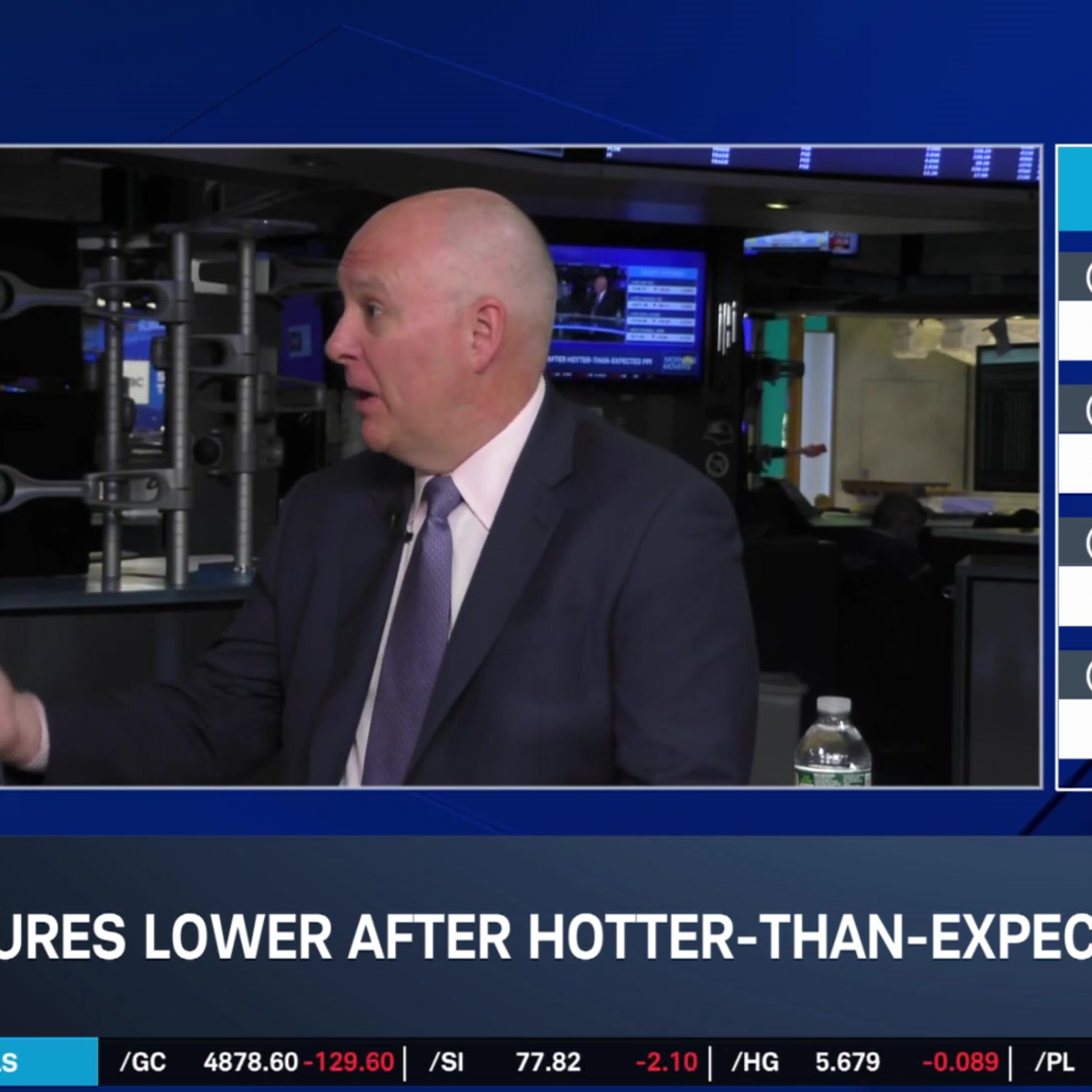
Janasiewicz: Look Beyond Mag 7 as Crude Oil Volatility Continues
About this episode
Hotter-than-expected PPI and crude oil volatility remain key focuses for Jack Janasiewicz ahead of Wednesday's trading session. He talks about investment strategies to keep in mind with inflation concerns heating up once again. Turning to stocks, Jack says now is the time to turn away from the Mag 7 and look into the broader market.
======== Schwab Network ========
Empowering every investor and trader, every market day.
Subscribe to the Market Minute newsletter - https://schwabnetwork.com/subscribe
Download the iOS app - https://apps.apple.com/us/app/schwab-network/id1460719185
Download the Amazon Fire Tv App - https://www.amazon.com/TD-Ameritrade-Network/dp/B07KRD76C7
Watch on Sling - https://watch.sling.com/1/asset/191928615bd8d47686f94682aefaa007/watch
Watch on Vizio - https://www.vizio.com/en/watchfreeplus-explore
Watch on DistroTV - https://www.distro.tv/live/schwab-network/
Follow us on X – / schwabnetwork
Follow us on Facebook – / schwabnetwork
Follow us on LinkedIn - / schwab-network
About Schwab Network - https://schwabnetwork.com/about
Get every episode summarized
Each time Schwab Network publishes, we email you a written briefing from the transcript — the topics, who appeared, and any specific claims, with the ad reads skipped.
Email me new episodesFree for 3 shows. No card needed.
Transcript ready
144 searchable segments. Every word is indexed and playable.
Full transcript
Schwab Network — Janasiewicz: Look Beyond Mag 7 as Crude Oil Volatility Continues. Machine-transcribed; use the interactive transcript above to jump the player to any line.
You want to welcome in our next guest, Jack, Genesee, with lead portfolio strategist at the Texas Investment Managers, joining us here at the big board. Jack is good to see you in person. Let's talk about oil prices and where things sit now. We're taking a little bit of a step back today, but they are elevated, relatively speaking, compared to where we were before the war with Iran. We're sitting around $96 a bear on West Texas Intermediate. Talk me through what you're paying attention to here. I'm curious to know your thoughts on it. The market may be underestimating where oil prices sit right now, if equity markets may be at the same time. We're focusing on a couple things. One is just looking at the actual futures curve, right? It's in backwardation, and we're just watching the evolution of that curve going forward because what we have been starting to see is those moderate-dated contracts are starting to drift higher, and the shorter contracts are starting to flatten out. That's telling us the market is starting to reprise, maybe a higher for longer scenario there, which obviously would not be good for the market. The other one is really looking
at the inflation curve, and what are we seeing with inflation expectations? The one-year inflation expectations has been drifting higher, but the one-year, one-year forward inflation expectations has been pretty stable. We're not at least seeing the concern filter through to the inflation expectations backdrop, and if we do start to see that, then I start to get a little more worried that maybe the equity markets need to reprise themselves. Let me ask you, that speaking of inflation, we just got a new PPI print come in that came in hotter than expected of, seven tenths of a percent. That falls in increase that we saw in January and December. So there's this upward trend here. Court still hotter than expected that up, five, a half of a percent. That's a tenth straight monthly increase for a core PPI. I know it's not the feds preferred gauge, but it gives you a direction or an indication of the direction of travel of inflation. Are you worried at all about? Yeah, I mean, again, higher for longer here with oil, then it's certainly going to see through to the broader economy. So it's something to keep paying attention to. And I think the bigger issue that we sort of are concerned about is we're coming in from,
I think, a weaker standpoint with regard to the consumer. In the past, we've had a little bit of a spike in energy prices. The consumers in a much better spot, we're seeing a softer labor market. You're starting to see wages continue to sort of go lower, spending sort of starting to pull back a bit. Now you start throwing on a potential consumption tax related to higher energy prices. It's going to be tough for them to absorb. And I think that's the bigger concern here is that it ultimately feeds through to the consumer. And consumers maybe not as quite as strong as it had been in the past to absorb this sort of price increase. Are you worried about growth projections are starting to come down from different economists that I've talked to. And some are even starting to, you know, kind of increase the odds. Not by much, but for recession risk, right? Seeing like 20 to 30% odds is what I'm seeing now. But in general, what is that signal that you're watching? Yeah, and I think it makes sense to sort of start to creep up your odds for the potential for a recession and just translating that into potential portfolio ideas. You know, I think maybe that puts a little bit of a headwind into the cyclical trade,
at least in the near term, or until we get greater clarity on this going forward. So we've been slowly rotating out of the cyclical trade, which has done very well of late and it's sort of going back to the growth backdrop because again, if you start downgrading growth, what does the market bid up? The market bids up scarcity. Well, if growth is slowing growth technically becomes scarce, wouldn't be surprised if we start to see the growth complex coming back into leadership and more specifically tech coming back into leadership. So maybe a place to hang out from a more defensive bias while still staying invested. Tech will place to hang out from a defensive bias. It sounds a little interesting. We've actually been swapping into equally weighted tech, so trying to dilute down a little bit more of the concerns with the AI Cat X plays. But again, the rest of the tech space is still in pretty good shape, right? The hyperscalers are still going to be spending money. They've told us that, so that's going to be benefiting someone else's earnings, the broader tech space. You know, tech still, I think, has a serious multiple re-radings since the start of the year, so much cheaper valuations. And you're looking at still above S&P average earnings per share growth, fat margins, you know, still pretty good balance sheets.
So again, back to those defensive quality characteristics, the broader tech space, I think, still holds that. So I want to dive a little deeper into that in regard to the Mag 7. Where does that sit from your perspective? Because like, you know, for instance, I think about NVIDIA, and that's like, it's like an A student, but it's just stuck in this range. It's being treated like a, I don't know, a C student now. And I think this is part of why we're sort of thinking about maybe looking more at the broader market and broader tech spaces and really looking at the equally-weighted backdrop to sort of dilute that down. But again, I think the concerns are just going to continue to loom over the Mag 7 because of those concerns with regard to CapEx spend with AI and that sort of thing. And as a result, you know, that might be sort of creating a headwind to them in terms of seeing significant upside. So there's still great companies, no doubt about it. I think the concerns are just still going to linger, and that might be holding investors back from really pushing them back up again. And as a result, we think the broader space is where you want to be playing in. I want to get a quick thought from you on the Fed later today. Obviously, they're set to make an announcement of the consensus views.
We won't get a change in direction. Basically, they'll be on pause again. Right. Do you think the Fed is stuck between a rock and a hard place? They're certainly in an uninvailable position, right? Because I think the risk in here going forward is that you're potentially going to see higher inflation, especially at the core level. And at the same time, you're going to start to see probably that unemployment rate drifting higher. So the balance of risks that we sort of always refer to in the SEP afterwards, you probably can see both of those starting to tick back higher. So then it becomes what's the Fed's response function? And if you sort of think about it as the consumer starts to slow because they're spending more money on energy prices, that probably just leads to demand destruction, which ultimately caps the inflation backdrop. So it sort of does its own work for it. But if the Fed starts to hike in here, it probably puts downward pressure or accelerates maybe that growth backdrop that is probably already going to be slowing and exacerbates that issue. So maybe the best way to operate this for the Fed in here is simply, let's just sit on our hands and let the market do its thing,
and we'll be doubted dependent and see how this plays out. But I think the risk here is a policy mistake, the Fed starts to hike, and maybe that exacerbates the downside risks here. And I want to go to another area of opportunity where you see, obviously, as a longstanding PM, people want to know, where do we go? You prefer AM over international development. Tell me a little bit more about that. Because I do feel like when you think, yes, there's been out performance so far this year. Can we expect that to continue, especially because the war has repercussions, no matter where you are globally? Yeah, and I think of this through the lens of terms of trade. And so if we think about emerging markets, and when we talk about emerging markets, we're really specifically targeting Latin America in this case, in really China, Latin America because net exporters of energy, so there'll be a beneficiary of higher energy prices, longer term. China, which I think is a little bit insulated in here, because they've done a pretty good job of building up reserves. On top of them, still being able to have access to Iranian oil and Russian oil. So that's our preferred area within the EM space, again, through the terms of trade lens. And then again, if you think about Europe,
Europe is going to be a net importer of this, so it's going to be a headwind for them going forward. All this, again, presumes that we have energy prices that settle into a higher range than what we typically bet. All right, Jack will leave our conversation there for now. Thank you. Excellent. Thank you. Appreciate it. That's Jack Janice with some lead at portfolios, strategists at Nittixas Investment Manager.
More episodes
More from Schwab Network

Stock Market Today: ORCL & ADBE Earnings, AEO Plunges Near 52-Week Low
Schwab Network

Thursday's Final Takeaways: Crude Taps $103 & PPI Hotter than Expected
Schwab Network

Balancing High-Conviction AI With High-Dividend Diversification
Schwab Network

EARNINGS PANEL: ORCL, ADBE
Schwab Network