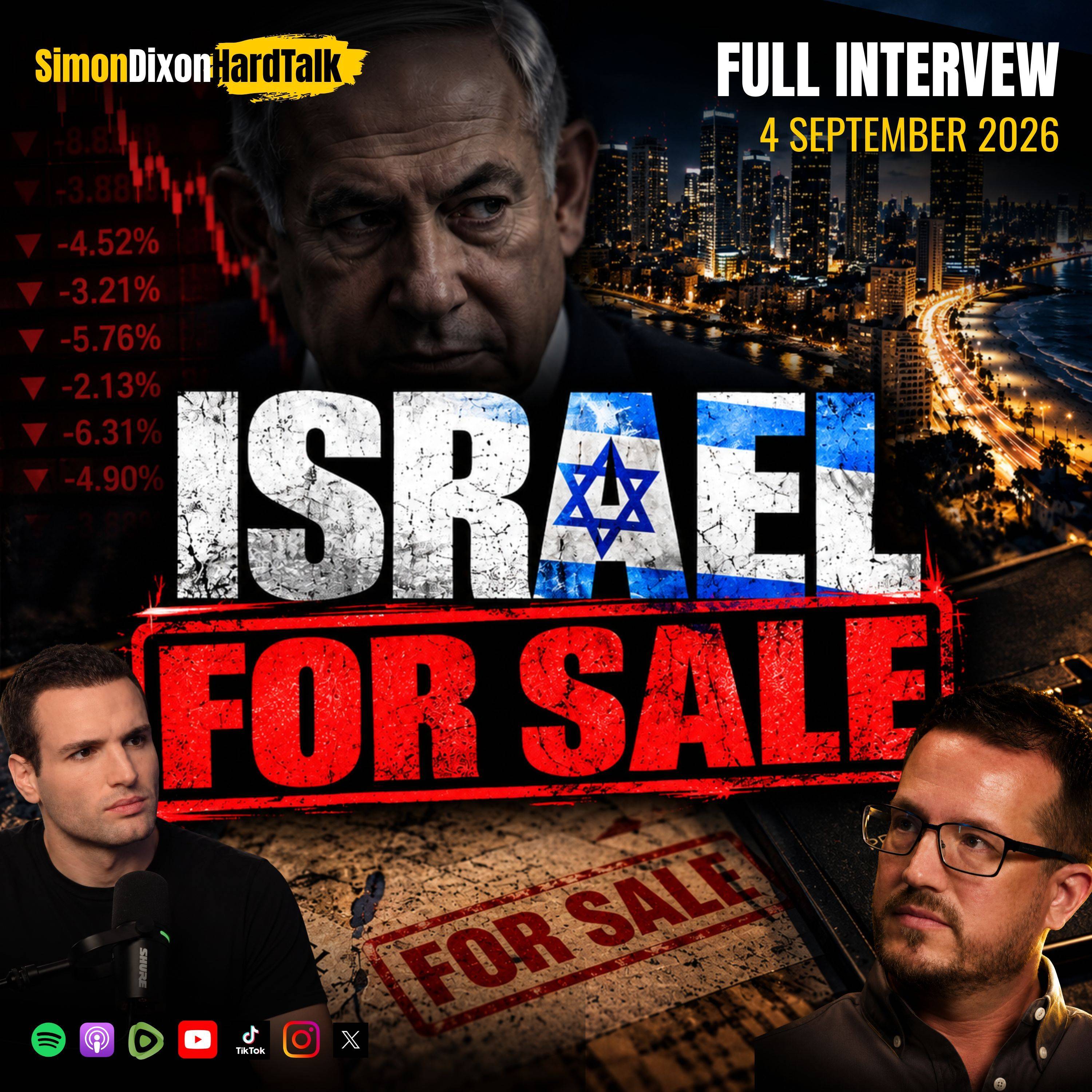
Israel Is Being Privatized — And Netanyahu Is Being Left Behind | Simon Dixon x Wally Rashid
About this episode
A pre-recorded interview I did with Wally Rashid on his channel, recorded on 3 September 2026.
In this interview, we dive deep into the geo-financial reality of the Middle East, focusing on a major theme: the privatization of Israel. Israel’s economy is decoupling from its stock market, which remains at all-time highs due to military, tech, and banking stocks.
However, the state is being laden with corporate debt, and state defense companies are preparing for public listings (IPOs) to sell off state assets. In my view, Netanyahu is acting as a puppet to power, serving the interests of major military contractors, global financial investors, and technology companies. At the highest levels of capital, ideology does not drive decision-making—rational self-interest and capital preservation do.
As the Military-Industrial Complex (MIC) begins to retreat from the Middle East to find other war zones, Israel is being transitioned from being funded by the Pentagon to being funded by private corporate debt. If power no longer needs Israel as a destabilizing node, the financial markets will force a regime change.
I encourage you to watch both parts of today's broadcast to see how these two pieces fit together.
0:00 Intro
5:40 How long will the collapse of the U.S. Empire take?
8:48 Israel vs. the Financial Industrial Complex in the Iran war
17:12 Will Iran be able to maintain a long-term toll on the Strait of Hormuz
19:26 What is the point of the latest Iran war escalations?
22:10 How long will the Iran war continue for?
25:45 What role does the Turkey, Saudi Arabia, Pakistan defense Mecca agreement play?
30:16 How the Israel/Palestine conflict will be solved via pressure from global financial markets
34:14 When will Israel be controlled by global financial markets?
37:49 How will settler violence will be contained by global financial markets
41:22 How will the Military Industrial Complex shift focus to the United States and Europe?
44:54 How the Military Industrial Complex is implementing the AI Surveillance State in the West
46:20 How the Military Industrial Complex will destabilize the West
49:48 How can young adults financially prepare for a multi-polar world?
53:18 What role will gold play in the future as the dollar declines?
57:38 How betting markets like Polymarkets and Kalshi represent a sign of a declining empire
1:02:28 How declining empires push degeneracy on their poorest citizens
1:05:18 Why it’s important young adults take control of Artificial Intelligence (AI)
1:07:55 Why everyone needs to have their own decentralized AI model
1:11:24 What open source AI model does Simon run?
Get every episode summarized
Each time Simon Dixon Hard Talk publishes, we email you a written briefing from the transcript — the topics, who appeared, and any specific claims, with the ad reads skipped.
Email me new episodesFree for 3 shows. No card needed.
Hosts & guests
Transcript ready
555 searchable segments. Every word is indexed and playable.
Full transcript
Simon Dixon Hard Talk — Israel Is Being Privatized — And Netanyahu Is Being Left Behind | Simon Dixon x Wally Rashid. Machine-transcribed; use the interactive transcript above to jump the player to any line.
Everybody asked me what's going to happen to Israel. I think it's being privatized. I think it's being acquired and I think it's a distressed asset. And I think Net in Yohu is facilitating that, not for Israel, but for real power. And so does Israel rule the world? Or is Israel part of a greater power structure? I was invited onto a podcast by Wally Rashid to answer that question. Let's play it now. I'm here today with Simon Dixon. He's an investor and geofinantial analyst. We're going to be discussing the Iran War and the Middle East in general. So Simon, thank you so much for joining today. Yeah, thank you for having me. First time on the channel. So I'm really excited about it. Likewise, well, I want to start off with the Iran War. You know, where are we, where are we at right now? And where are things headed? Because we keep hearing on the news, new updates that there's a ceasefire that there isn't recent escalations started up again.
So what are your views on the Iran War? Where we're currently at and where we're headed? Yeah, I take a slightly different take on it. So a little bit of background. I tend not to see this as a war between nations. I tend to see this as a war between different power dynamics. And by that, what I mean is that when I think of Iran, I think of a couple of factions. And I know it's a bit of a wet and nice phrase, but I for want of a better word. You know, there is the Iranian government and then there is the IRGC. And just like within every country, there are different power structures and power dynamics. And so I believe that the IRGC is the military on of Iran. And if the Iranian government represents the China aligned more pragmatic ones that have been negotiating with America throughout this whole process. And so you get a little bit of good cop ad cop in that dynamic.
Then when I look at US and Israel, I see Israel is what I call a node of the military industrial complex. So I don't see a sovereign country. I see a country that represents war and military profits. And netting your who is bought a pawn in that power structure. Then when I think of the US, I think the US of as a node in what I call the financial industrial complex, which is Trump is hugely alone. The line rather with global financial powers. And so his job is to kind of ask it strip America and end the world reserve currency. So when I look at this war right now, I don't really analyze in terms of the same thing. Now, I do believe that today we are witnessing the change of an empire. So in terms of generally big, big, big geopolitical macro picture.
We are witnessing the end of the US dominated dollar hedgehog, hegemony. And we are transitioning toward a multi polarity based upon many different regional players and different power structures. So in making that change, there are very many things that need to be sorted. One is energy flows. The other is access to strategic choke points like the straighter for news and other ports. The other is heavy price things, petro dollar global reserve currency clearing and payments currencies. And to me, when I see this war, I see a realignment of the world with a bunch of countries that have the depositoring for power. But generally, we're in what I call bounded escalation. What that means is that there is a major stress in the US market, the bond market, and also inflation and price of oil.
There is an economic pressure on Iran that is relieved through China. And China is partnered with both Iran and many of the other Gulf countries in order to try and get a steady flow of energy. Put all those power dynamics. And if you're analyzing US versus US and Israel versus Iran, then I can see how this would be very confusing. If you switch the power dynamics to what I believe the main powers are, everything that's happening right now is pretty logical. It's a military negotiation. Because at the end of this, we're going to have one of the biggest changes that we will ever witness in our lifetime in terms of where the power dynamics land at the end of this. So if you look at the MOU, you have a 300 billion dollar investment, which is on or off, now it's off. Whoever makes that investment sets the order, you have a total charge being charged on the straight up on this.
You have a relief of sanctions that releases significantly more oil on the market, which will be priced over in the Iran or it will be priced in the local Iranian currency or it will be priced in dollars. And you've got sanction relief that will release a bunch of money. And whatever the end result of that is that impacts will the Gulf countries China and Iran itself. So we are in, I believe, a bounded escalation where we're not going to enter into World War III. So IOGC power dynamics are going to remain. But we are transitioning to a world where China is more important and America is more regional, rather than the key defining player in the Middle East is how I see it. How, how, what is the timeline for that? You know, I, I think a lot of people also notice that the United States Empire is, is weakening.
But when you say that we're going to see the United States return to a regional power, what is the timeline for that? And then what is the timeline for, you know, the loss of the United States dollar as the global reserve currency? Yes, so there's a couple of things that the first thing is, if you look at the British Empire to the American Empire, that was a 10 20 year transition. I believe that you could look at COVID as a defining moment. Then you could look at Trump tariffs. And you could look at the closure of the straight before me. So the British Empire, you know, it's, it's moment was the Sui's canal when it can no longer defend, you know, after World War II, after the, the new monetary order was set up a bread woods. So that's around 44. Then in 54, 10 years later, you have the Sui's canal moment. And then 10 years after that, you just had a slow environment where the stock market in Britain was doing incredibly well.
The bond market was dumping more and more debt on the British people and the growth of the economy was decoupled from the markets. And then that just carries on and it's like a slow depression, a slow transfer. We're witnessing a similar thing in America right now. Now, when in terms of world reserve currency, there is you, you know, world reserve currency means that it comes with a massive obligation, which is you have to export dollar debt globally. At the moment, we're witnessing the foreign central banks and foreign countries are less willing to purchase loans to the US government, either bond, bond market. And so therefore, the US is trying to find ways of dumping the debt on the American people, rolling it up into pensions, increasing the treasury budget, and probably eventually the federal reserve will have to purchase that debt as well. So this is not a fast thing. This is not a big move. You know, it takes like, it's normally a managed transition and you leverage America and the American military to gain access to as many assets.
You know, that's kind of like explains the Venezuela operation explains your crane operation and also the Iran operation as well. So it's not a sudden crash. It's a slow asset stripping where all value leaves the economy and shifts over to the markets. And that's exactly what we saw from the British to American transition. This one's a bit more complicated because with with the Dutch to the British to the British to the American, there was a very clear handover in this one. There's no clear handover because this multi polarity. And there's a non aligned rising force in China. So this one's a bit more messy. But the, you know, I expect this to continue into another decade ahead in terms of really realizing what's actually happened to. Yeah. So I with Israel, I take this Iran war as, you know, definitely pushed by Netanyahu for Israel's interests in the region. They've been wanting Iran, Iran's government to collapse for a very long time. They started off with funding and arming the protesters and that didn't work.
And, you know, so now we're here. Do you take do you not view that as the main driver then or can you explain where you see that narrative fitting into your view of the situation. Yeah, I think people go through so I see it slightly differently. That is true if you stop at that there. But most people have come to the realization that there are lobby powers in America that are more powerful than voters. And I think many mainstream Americans are starting to understand the power of the Israeli lobby and a pack, you know, since October the 7th has been a bit of, you know, many people would have been aware of that. But others, this become mainstream narrative now. What people never ask is what about the Israeli lobby on Israel. And so Israel is not a sovereign country like America's not sovereign country. America is mainly owned by financial military and technical companies. And those lobby powers, whether it be for, you know, they dictate, you know, they write policy through NGOs and various other things.
And they pay for politicians now Israel in the APAC lobby is a lobby that's aligned with military. And so there's been a very there's always been an American empire big money laundering operation where America prints the money dumps the devil and the American people. The launders are through to Israel and then Israel spends it back on military companies, which props up the market. And so war becomes a stimulus for economic growth. And so Israel's role in this power structure has always been to serve military companies. This why right now in Israel, the economy is decoupling from the stock market. So the stock market in Israel is at all time highs, which is mainly military companies, technical companies and some banks. And so when you laden the company, the country are with debt. So it's debt is increasing is debt to GDP. It's privatizing more and more of its military stocks. And so we got two of the big Israeli defense companies go in public and selling some of the state assets off.
We just had to do all time with Greece where Greece is getting 25% of the military production of their agreement with Israel done in Greece. So that's taking away much of the that would normally have been done in Israel. So what I see is Israel and Netanyahu is a puppet to power just like America and Trump is a puppet to power just like Kierstommer in UK is a puppet to power. And so Israel is more aligned with military wartime profiteering. And and when you say netanyahu wants this, there is a dynamic that Israel's role is changing in this new this new power dynamic as it were. And Israel's new role is what you know, think people the political system in Israel is kind of fighting for. And netanyahu was a very useful nodes to companies like hot lockied more in general dynamic B a systems, Albert systems.
And right now I believe that there is a change in Israel's role. And netanyahu is just a puppet a puppet as big as Trump is. And so what what I encourage people to look at is ask the same question. People seem to be able to understand the Israeli lobby in America. But what about the lobby power within Israel and who does the Israeli government answer to. So these global financial investors, because I like your worldview. And I guess where I always what I always question is don't they. I mean, a lot of these investors they themselves are ideological Zionist. Is there no. Does that does ideology not, you know, not play a role in it? Or do you think it's very rational in the in the way that these financial investors consider consider these sort of actions. Yeah, ideology in my understanding of the world and I used to work in investment banking. So I kind of understood some of the dynamics in, you know, I've seen pitch decks where you have to pitch that to come out of a war.
And so peace needs to be 100 times more profitable. And so war is a mechanism for acquiring resources building back, getting new contracts acquiring resources, vandalizing a country, you know, regime changing leadership. And just really subordinating a country to private corporate power. And on the, I lost my trailer thought was the question again remind me very briefly. Yeah, I mean, I just question I like your narrative. I always think, okay, where do are some of these global financial investors so Zionist that they'd rather put Zionism above financial markets and advances really interest that the expense of the global financial markets. Yeah, so ideology drives human behavior, but capital doesn't care about ideology unless it's a weapon. So if you want to recruit an army in Israel, then you radicalize Jews into normal to live anywhere else, but Israel.
You weaponize and use anti-Semitism to recruit and you radicalize evangelical Christians in America to justify war. You radicalize Muslims and create covert groups like ISIS and Al Qaeda. And you use ideology to recruit an army like the idea. And then that's very useful for military power because you can create divide and conquer narratives. Now the most useful politicians are ones where there's a lot of ideology behind the narrative, but then they work for lobby. And so Israel is a radicalized population in general. And I think of like the idea for like a group like ISIS and Al Qaeda, they've been radicalized, but at the higher levels of leadership, they serve a very rational agenda at the very top in capital. They don't care about ideology. It's not Zionism is not something they look to preserve. Politicians may be Zionists, but politicians are just puppets to real power.
So at the higher levels, Zionism is just a useful ideology for recruiting an army of radicalized Jews. And then using that in order to put them to war with Muslims and then create divide and conquer operations and get evangelical Christians in order to push out that narrative. And now those people may believe in it, but the higher level of power, I don't think ideology drives it. It's pure country ration or self-interest. And it depends if the country is subordinate to corporate power. And in corporate power, they couldn't give two shifts about Zionism. When Zionism is profitable, they'll use it. When Zionism is known on the profitable, they'll dump it. And right now, the reason that I think you're getting a bit of a shift is because the whole narrative around Israel and Zionism, it was a very, you know, it was obviously since October the 7th.
It's had a faction of power that had been allowing the alternative narrative to get up. At the same time, there are people that are holding onto that own narrative, you know, the old narrative of you must protect Israel. It's a God gave us the land and the evangelical Christians and neocons supported. But to me, that's just for public consumption. That's just for media. And real power is just ruthless money and power. With the straight of hormones, maybe about a month ago, like major shipping companies came out and said that it is, they will not tolerate a tolls through the straight of hormones. And they were basically stating that it seems like to the United States to take some sort of action to stop that. And this is the day after look like, well, the international community will financial markets tolerate the idea of Iran continuously holding the straight.
So I don't think Iran will, my prediction in my opinion would be that I don't think I think Iran will charge a toll. I would be done in conjunction with the mine and the mine is out of a GCC. And GCC is normalized between Iran's by a China and China has their own interests and private financial power, the fig will all be jockeying for what their toll booth looks like. Whatever happens in Australia for mues will happen or will set a chain of events over the next decade that removes the post world war two Bretton Woods order where one vital part of it, not just the petro dollar and other parts of the dollar system. And it was the free passage and protected by the American Navy. That is what is being completely disrupted within the Middle East. And so I'm very interested in the nuance and the detail of how that fears charged.
I believe it will be charged. I believe there will be reconstruction 300 billion dollar agreement. I believe there will be sanction relief. I believe there will be. You know, Iran continuing its membership of the OPEC. And all of these things they completely change like the Middle East how it's historically worked. So I don't think it will be Iran on its own. I think it will be Iran with a mine and a mine will be some kind of covert deal. The service, the interests of China, the financial industrial complex and the golf countries as well. That's the process. I think we're going through. Is the United States right now re you know these escalations restarted is this all part of seeing how they can get there. You know how they can get the best bargain out of these negotiations and is that really kind of what we're seeing right now they're all just fighting for their best interest. Get the best out of they can out of this negotiated settlement then.
Yeah, so in my opinion again, America's not sovereign country. So Trump doesn't work for American interest. Trump works for global finance and transnational capital. And so he's getting the best deal he can get for big oil companies, big finance houses. And if you analyze it from this perspective, what everything Trump's doing is quite rational. If you analyze it from the perspective of he's serving the American people and the empire, then nothing's rational will be completely and every headline will send you on a on a crazy loop. Net in your who is most likely going to be regime changed and there's going to be a new leadership within Israel bar in the timing. So you've got the elections and the political process that's starting in October in order to get political votes in Israel, you have to be a radical Zionist. And you have to be doing the things and the posturing the net in your who's doing you also need to continue the land grab to get more leverage.
And you need to continue the Trump meeting with Iran. And so all of those things is things that net in your who will be using in order to get more leverage. Trump is if you look at it, they go back to the table and then you know via Pakistan and Qatar. And then they get a new bound of escalation. And with each round of escalation, you tend to see more hard line of members of the IORGC that are no longer with us. And then it goes back to Emma you back to the table. And then that keeps happening until I believe a deal will eventually be done. And again, the reason that Trump seems so irrational is because I don't think Trump knows what comes next. He's been told what comes next and that's not coming from Israel. That's coming from you know financial powers. And Israel is also posturing because there's a there's a real big change happening. So I do genuinely believe that if you think of more of like a battle between the military and net in the are who the financial and Trump.
With a narrative on top of it to make it look like Israel's in charge and they're calling all the shots. That that's kind of how I see it. And this is something the timeline could be this negotiated settlement, you know, sometimes during Trump's term, likely not after he leaves office trying to have it done before. I mean, you know, there's a lot of hypotheticals but. Yeah, I've got I've got the timing wrong. I thought it would have been done by now in my previous predictions. I thought this would be more like the 12 day war where it was quite theatrical. I was wrong in terms of timing and and the speed of which they're actually getting stuff done. But to me, when we saw the Mecca agreement between Turkey, Saudi and Pakistan. I think there's very strategic things that are happening in in in in an order. You know, we're seeing the you know, the Hamas stand down and the deal there, but with continue escalation from Israel committing more crimes against humanity in garden.
We see more land grabs in West Bank, but I think that's all posturing for land because it's going to be negotiated back in the next order. We're seeing Saudi and the Houthis and Yemen acting more like political instruments rather than alignment with Iran. I think I think Yemen's going into its own negotiation with the Houthis and the Houthis will be integrated into a political process and a military process. I think we've already we will see the similar things within Lebanon. And we've and to me, Iran in this deal or the pragmatic elements of Iran. A no longer funding resistance, but there needs to be a transition to integration between country, state, politics. These are very complex things. This has been like a you know, a century of, um,
Sais Pico, Middle Eastern colonialism and all stuff, where effectively when I saw that Mecca agreement, you've got the military might of an A. Remember in the Middle East were Turkey that has a huge manufacturing base and during production with the financial might of Saudi Arabia with the seasons military of Pakistan and nuclear power. Now they've signed their NATO agreement. There's been rumors that Syria will probably sign on Bangladesh will also sign on. And eventually I believe Iran via these China normalization deals will be. And so right now what is Iran doing? It's taking the US out of the region. We're led to believe the Middle Eastern Gulf countries don't want that. I believe the Gulf countries do want that. And there's somewhat of a theatrical element to this. Because effectively US has been expelled from the region.
And now you get new defense contracts, new security agreements, new, you know, even UAE looking like UAE left OPEC. That props up the petro gover. So when you have leaving, you know, leaving from OPEC in these different things. To me, this is all signaling strategic sequencing into a new world order, where the Middle East will no longer be dominated by America and China will be the most important strategic partner in the region. Who would the Mecca agreement? I think the way I've viewed it is it actually I kind of I liked hearing that I felt like it would bring. And the ability actually and it was a way to reel in Israeli aggression because immediately after Israel say that they're strengthening ties with India, the UAE Somali land. And they seem to kind of signal this thing called their hexagon against Sunni aggression.
Where do you see the Mecca agreement if you could elaborate a little bit more on how does the financial the global financial market view that and what's what's its role there. I think it's the biggest change that we'll witness in our lifetime and I expected to grow from here. I think it will hold it slightly different to a NATO agreement. It's not where NATO was built out of aggression towards the Soviet Union. Whereas this Mecca is genuine defense. Now people will say people are trying to spin it in terms of into unification against Iran or as a unification against Israel, pick your geopolitics is neither. This is genuinely in my perception. The unification they called it Mecca because that's a unified terms across she or Sunni non sectarianism. And so I expect Syria to be joining I expect other countries to be joining over time and I think eventually Iran.
I think it is the foundation of a post non US world order where Middle East becomes more like West Asia. So I think it's the most significant thing we've ever seen. It doesn't work in the same way. It is about building their own military manufacturing. If Egypt joins which is Turkey invited Egypt and the historical tensions between Saudi Arabia, Turkey, Egypt. The fact that we're now getting these new agreements and Turkey invited Egypt, then you got Africa, Pakistan, Asia and Middle East. This is the empire's worst nightmare. This is why co-valpations were waged across the British and American empire to prevent such an allegiance and alignment. And so what do we need in order to get to that stage? Well, Iran needs to get rid of the US bases. The militias need to be integrated into regional state power and a new agreements that say a country can call upon the others.
If they want to bring someone into any type of and our forces a new integration between Iran, the Gulf countries. And as much as I love Israel to get justice for everything they've done, I just have to be pragmatic here. I think they need to be they will be reforms and forced into you know, a new. Because here's the thing that the negotiation I believe is with global financial power. Global financial power is no longer profiting from the forever war in the Middle East. This is the last part before they return home, you know, before they escalate in Europe, before they escalate domestic terrorism in US. This is America being contracted into a regional power and a military will then only be able to rate war in the Western hemisphere after this. So this is a radically radically changing time. And if you look at all the contracts with Locking Martin general dynamic, Ray, they're budgets are moving towards artificial intelligence cyber security significant budgets in terms of escalation in Europe.
But more regional stability negotiations within the Middle East. And so these are all the final posturing between different powers that are trying to get as much power in this new order. And I believe we enter into an era over the next five years of regional stability that we've never seen before. Oh, and I feel like there is evidence to back up your claims Saudi Arabia starting to really do investments with Syria in a way that I personally like it stabilizes Syria. I think there was a large optic fiber contract that they made. I can see that but Israel is a destabilizing force. So you mentioned a negotiated settlement. You can't have a stable Middle East with Israel Palestine conflict. So how are the financial markets. Viewing Israel now it seems like Israel since it's a destabilizing force. How does that? How does that negotiated settlement play in? How would the world, how would the financial markets pressure for that?
Can you explain a little bit more with that so the Israel power Sun conflict playing into that story? Yeah, so let's look at a couple of players. So you've got, for example, many people see the president of Syria based upon his ex ISIS position. And because ISIS has historically been weaponized by Mossad, Western intelligence and CIA and MI6, they see him as an Israeli puppet. In reality, he was, you know, when Saudi power was aligned with Western military power in the oil petro dollar environment, you had, you know, these, this, you know, this kind of radicalism. And he pretends that this was about religion when really was about destabilizing countries. But people like. And then when they're in the president of Syria, their shapeshifters, if you ask them to be a militant, they'll be a militant. If you ask them to be a president, they'll be a president.
But they were, he was primarily a product of Turkey and the Gulf countries and Saudi. So he represents their interests. Israel is posturing for additional land grab. And Israel has been privatized right now. So it's been loading up with corporate debt. Many of his state assets are being put on the public markets, which means ownership changes. UAE is purchasing many of those assets, which changes the dynamics in terms of financial transactions. India is also purchasing some of it and they talked about other deals. Netanyahu is preserving his personal interest right now. But eventually he'll be changed with the political environment that's happening in October. I believe the sequence of events that needs to happen is there needs to be some kind of agreement from IRGC into the new regional order. Which will be represented by some kind of MOU or something, which I think will eventually get to.
Once that happens, then I think you'll get regime change into the political process in Israel. And then it will be a more gold friendly that will lead to a Palestinian state, normalize fire, wrong China type of Israel, which I know people find very hard to imagine. Based upon what we've seen. But I don't think Israel is going to be backed by the US military in the future. Which means that Israel's world changes. It's being funded by a debt rather than pentagon budget. That changes everything. And so if power no longer needs Israel as a destabilizing node. Then they'll regime change Israel and change Israel. It's as simple as that. Will there be a fight? Will there be a battle? Absolutely. But if you believe Israel is a sovereign state that's ultimately in charge, then you can't imagine how that happens. If you believe that it's actually subject to military companies negotiating with banks and financial companies that want regional stability and sovereign wealth funds.
Then Israel will be put in place when the time is right. But right now is posturing and improving the negotiation position of the financial industrial complex. You're saying Israel is being privatized and it's selling off its assets in comparison to other countries. How would you say that this is very like Israel has really sold off itself to where now these financial markets have a lot more. Pressure on Israel to the point where it can actually make these fundamental changes or is it still in the process of it? Like where does it fall like from Venezuela type privatization where it's basically a puppet to where it is now. How money where would you put Israel on that? So I think you can look more so there's a couple of state defense IPOs coming up later this year in November and December, which is our bait system. Some of the key assets of Israel they're going public once they go public it means goal funds can buy them.
And when goal funds in the Abraham courts can buy them then that buys you more influence over military. And as I said when you look at the devil of the detail of every deal like the Greece deal people will have all that evidence Greece and Israel. Israel controls Greece. If you look at that they gave up about 25% of the purchase of intellect of the production of intellectual property into golf into Greece as well. By bit is a bit of a slow process but I believe netting your who is privatizing Israel trying to be useful to power get as much leverage. And that's a very shifting role this has been a long time in the making. But yeah it's becoming less and less sovereign if you look at many of the deals that are happening state power is being replaced by private power and it's being loaded up by debt rather than funded by Pentagon.
I know we have a narrative around like Israel being burned to the US Army to me that's more of a reflection of reality. The Israel has always been a mechanism for laundering and having plausible deniability for the deep stays crimes against humanity. And so you know when when you get Israel to do it you get the whole story that American complaint and say hey this is an us we would never do a genocide. You know that's those Israelis and I don't want to diminish because the radicalization and crimes against humanity the Israel commits a forced. And if I put my humanitarian hat on I'm with you you know in my humanitarian hat. I'm you know very much on the side of Palestine but in my power dynamics hat in my analytical hat. Israel is not in charge.
Israel is just a puppet of US military contractors and technology companies. So when Palantir which is floated on the US stock market needs to test genocide as a service uses row and Palestine. When you need to test occupation as a service uses row in the West Bank when you need to test drone integration use your cream. When you put all the value flows back up to the the most liquid capital markets in the world which is the United States. And so if you have a question for Israel and you know what I mean is some of your remains in the Israeli stock exchange as well. When there is the sort of negotiated settlement you're saying that the where the pressure is going to come on Israel's because the golf States a lot of these other major power major financial markets are going to have so much sake they were going to be able to pressure Israel into a settlement. So if you have a question for Israel and you know what I mean is that the financial markets are going to be so strong that those things will figure themselves out because any sort of negotiated settlement right now with what's happening on the ground it look like it could lead to something like that.
So you've got the right and the military action of their superior military industrial complex Israel is kind of a lot of what Iran has done has taken out all the much of the technical industrial complex notes in the region. So many of what allowed it to have the I and home and various different technology that infrastructure is dead. It's gone. There's probably not being rebuilt. So right now the current justification for Israel relies upon the what I call the resistance economy. If Iran is entering into a deal. And then the purpose of Israel to the military is no longer there. So then Israel needs to find a new form. And if America is not destabilized the region because financial powers are investing via Syria and all these different deals. The Océan across Iraq and Syria. Well, bang deals are being done visa integration into payment systems.
And then it has a network of central bank digital currencies which clears our sides with many of this this China integrated infrastructure. Means that Israel will have no choice now many people over the next five years. Israel is rat you know the radicals ionists they'll just leave an all of them have less their population has been declining. They've gone to Cyprus they gone to Thailand. And they kind of left with just the severe radicals but in the end all land, conquested through Israeli terrorism, which is stay sponsored terrorism. That will eventually be part of a negotiated settlement I believe. And then eventually we'll get back to the deal that Hamas agreed to, which is kind of the stalemate at the moment they're saying we won't have that our weapons until Israel is retreated. And we've got an Arab army defending. And then Israel saying well we're not going to retrieve so there is a sticking point.
But nothing stops his train in my perspective. This will be eventually there will be a Palestine Palestine will become more significant. I don't think it will be free. I think it will be funded by the same type of infrastructure of the three hundred billion dollar investment that Iran will receive, which will be most likely golf China integrated. And some compensation to the financial industrial complex for allowing the military to leave and end up forever war. Nothing stops our train from all the financial flows that I'm seeing. But you have to have some patience because this isn't fast. This is big power dynamics changing. Yeah. I think I rationally I see a lot of that happening. You mentioned terrorism and the West as the financial industrial complex really starts to take foothold in the Middle East and the military industrial complex retreats a bit more. You say to it will start to really prioritize the West and domestic terrorism and fueling conflict in Europe.
Can you elaborate a little bit more when you say fueling conflict in Europe? Do you mean continued Russia Ukraine aggression and when you say domestic terrorism in the United States? What's that look like? You elaborate on that. Yeah. So when you look at the balance sheets of military companies, they're revenue never goes down. It just goes to a new location. So if you ever want the military to settle a war zone, then needs to be a new one for it to go to. And if the American military is becoming more of a regional power, it will be looking at where it can exert its influence. So you've got central South America. You've got Europe. And you've got domestic. And so what you've seen is companies like Corsica, CEO group, geo group. They built a whole infrastructure around. You've got the highest level of incarceration in America in the world, like four million people in prison or something like that. They build a whole privatized prison sector.
Palantir has been utilizing via immigration policy and testing a lot of what has been testing around the world. For its police and surveillance state. The clarity act and genius act and the Department of government efficiency built a lot of data. And now you've got programmable stable coins and central, you know, central bank digital currencies programmable financial instruments. You've got social credit scores being built using X and algorithms. And so what you can see is that America is preparing for a police and surveillance state. So they're not being done by the private sector in America, but it's being done at the state level across Europe. So, you know, the governments across Europe have a specialized. They're getting ready for European central bank digital currencies. There's probably another trillion dollars of profit to be made from the Russia, Ukraine war. And so I'd expect probably another couple of years of that.
And further narratives and you're seeing Trump, he's basically been pushing NATO to increase their budgets. And you're starting to see a lot of the wealth inequality and deterioration across Europe. This is essentially the military, the covert regime changes, civil unrest, color revolutions, all the tactics that they used in the Middle East and Asia. They've been used at home. And so you're seeing a lot more tensions, a lot more algorithms being used to radicalize people, a lot more people arguing left and right labor conservative, Trump anti-Trump Muslims, Jews, Christians, like every type of way of radicalizing people through algorithm. I think they're getting ready to manufacture some civil unrest so that they can usher in this police and surveillance state based upon social credits, artificial intelligence. And the destabilization of Europe so that the financial industrial complex can vassalize those governments further.
And then we're seeing that from central and South America as well. So it won't necessarily look like bombs then, but more so, more type of like flock cameras, more surveillance, less like as what we're seeing this military industrial complex. I mean, obviously they're continuing weapons developments, but the shifts from that in the west to more against surveillance, that sort of thing. Yeah, what I call the technical industrial complex. So the military and technology are kind of being integrated as more and more of military budgets go to cybersecurity. Right now it's palantir that's running this war in Iran and it's palantir that's doing the occupation and it's palantir that's killing children in Gaza. It's palantir that just targeted that wedding in Iran. It's palantir that killed the children in that school. So these are, this is a brochure for US technology companies and Israeli defense companies that be imprivedized and being sold across what they tend to do.
What America and Europe has always done is you manufacture violence and civil unrest and you come with the solution. And so the more you can manufacture civil unrest, the more you can come with a police and surveillance state as a subscription model for governments to make up for lost profits from the forever war in the Middle East. Yeah, that means that sounds scary in the west like being a westerner. It's not a nice idea. It doesn't seem like that will bring stability. It feels like you're saying more stability in the Middle East and more destabilization in the west. That's my prediction. Yeah, and you can kind of see that with capital flows. And what you're seeing across the west is that the stock markets decoupling from the economy record levels of debt. And those debts as more or more of those countries are being burdened with debt. That's propinion the stock markets and we're getting you can see it reflected in bond yields at the moment like the cost to lend to the US government is blowing out.
And with every with every crisis, you get more concentration of wealth up. So in the west, we've got K shaped economies where effectively, if you only assets, you're getting richer. If you were in the debt, you're getting poorer. And that's getting its side into his extremes in both America, Europe, particularly UK. And then what you tend to see is that you get a relocation of wealth. If you look at if you're a following exchange traded funds. There's more concentration like the top seven magnificent seven tech companies in the S&P. They're like 30% of the entire index now. And as you add an anthropic and as you add open AI and now you've had space sets, that would go to 40% and beyond. So you're getting tech dominance across the markets. The rich again and richer, the poor again, poorer the stock market is 92% owned by the top 10% of institutions and wealthy.
And the same is happening across Europe, UK, and you'll see in the weaponization of immigration policy in order to manufacture such tensions. And so I expect I expect that to continue, you know, we're entering into this ultra has and has nots. And so if you live in the West and you own assets, then you're beating inflation and you're kicking ass. If you don't, if you're on the wrong side of the debt cycle, then your your life's getting worse and worse and you're not being inflation. And you're having to, if you have assets, you're having to sell down more and more of your assets to meet your expenses. And so eventually that that type of tension is end of vampire type of tension. And you can see that that's why we're seeing just, you know, mass deployment of this control grid and this technology ready for such such an environment.
So yes, that's what I see from the West sadly. It's not quite sadly because that needs to happen in order for the rest of the world to be able to rebuild. And capital doesn't move if you look at the ETFs about 50% of the ETFs is now in emerging market. That was about 30% like a couple of decades back. So more and more of these flows are going into emerging markets. So the thick is is hedging for multi polarity and extracting as much as they can using the capital markets and just loading up how whatever amount of debt they can on the on the governments. So with the knowledge that you have, let's say if you're between the age of 20 and 35, you have, you know, I feel like the average person between that age might even have $20,000 in debt. They might be making like an extra $1,000 of spare money a month they can spend.
What would you tell somebody like that like your average young adult that might just have 500 to $1,000 a month. And they do what they can realistically to prepare for that where what would you tell them to do if they had just an extra $5 to $1,000 could they do anything with that that would make them a little bit better off in that world that you picture. Yeah, look, there's no there's no other way of saying this other than the people that win in this market spend less than they earn and invest the difference in assets. There's no other way of saying it. So if you're deep in debt, you have a tough decision to make your decision is you can keep paying your debt. And go further and further into whole. Or you can figure out a way of spending less than you earn and investing the difference in assets. However you get that as long as you do that every month, I think you'll be okay. And once you're on that trajectory, you're beating inflation.
Now, obviously the question comes out what assets, even if it's just the S&P 500, even if it's some Bitcoin, some gold, some commodity index, some emerging market, you pick your thing. I'm going to tell you what it is, but you have to own more assets to outperform inflation every month. Now what they want you to believe is there's no future. They want you short term gambling. They want you investing in crypto scams. They want you gambling gambling's massive on the rise right now. And so it's the long term plan that makes you win this the asset owner wins. And so your job today, this month is to figure out how to spend less than you earn, invest the difference in assets and own more assets every month. And then get better at investing as you progress. There's only going to be two types of people, those are don't assets and those are on a universal basic income.
Because eventually, you know, this AI trade is going to lead to more, I believe, unemployment. More and more unemployment. And so you need to hustle right now. You need to increase your income. You need to reduce your expenses. And every month you need to own more assets. Do that. Bed, get better at it. You'll be fine. Don't do that. You're likely to be one of those people that is helicopter money, a stablecoin, programmable money integrated into your social credit score and Palantir. So that a drone can tell you when you're allowed to spend and what not to spend over the next 20 years. And you just have no choice. Even if it means you move country in order to get your cost down, I can't make these financial decisions for you. But again, long term plan, own more assets, spend less than you earn, invest the difference to science what you're going to do with your debt, tackle it this month and carry on every month.
Otherwise, you're not going to be okay. Where does gold fit in not just for as asset to own, but also, you know, we're seeing gold rise as the dollar weekends. Can you explain a little bit more about where you see gold fitting into the slager? Do you expect it to continue to rise because of the weakening dollars of global reserve currency then. We see a lot of people, especially I feel like in that alternative media space, really starting to glorify gold in a way that I don't feel like I've seen before. What are your thoughts on that? Yes, so the real currency pair to understand the devaleration trade and the weakening of the dollar is US dollar to gold. It's the only it's the most important thing. The things you need to look at is US dollar to gold on a long term horizon. My personal belief is that if the price goes down, then you get to buy more gold that month. If the price goes up, then your wealth is going up and you're beating inflation in this trade.
You got to have a long term horizon, not short term speculation. I think the gold trade continues to strengthen relative to the dollar. I think currencies that are connected to key metallics and energy resources, they're strengthening relative to the dollar and currencies that don't have key metallic resources, refinement capabilities or commodities and resources. They're weakening relative to the dollar and then obviously the golf countries, they're they're picked to the dollar as well. So as the dollar weakens, they have to sell off their treasuries in order to destabilize or they have to get an FX swap line or they have to sell down their gold. Eventually they won't sell down gold. So there will at some stage, I believe, be a deep hegging there in line with the order. And so central banks all around the world are requiring gold. So right now, a dollar still kicks ass as a payment settlement rails in terms of its payment.
Still the best currency in the world as a saving vehicle, awful currency, but still better than many others, depending on the parameters I said. Price in gold, I see only get weaker and weaker and weaker and that is the only one that matters. And so what the key things I expect you to look out for, look out for gold as a currency pair against the dollar, strengthen the gold dollar weakening long term, forget the month to month. The yields on the government debt are hitting a major major problem level right now there above there about four and three quarters for the 10 year, that says mortgages that means everyone's mortgage will get more expensive if they need to refinance. The 30 year debt is above five and a quarter or around five and a quarter right now. That is a blowout phase for the US government. They have to get that down. The only way to get that down is to manufacture a crisis and do QE. So the Fed will have to start buying those bonds to get those those yields out.
I believe continual strength within the stock market, the valuations are insane. There's a very hard trade to time. But all value is going into stocks and real estate in this market in this fiscal dominance. And those are the bonds are getting wrecked in the gold trade. So the gold trade is that while many of the financial industrial complex are still using US government debt as collateral and they're willing to do that, four and central banks are not. And so you've seen the gold as a reserve asset has overtaken the market capitalization of US treasuries. So for and you're seeing that in Japan right now, as is these rates go up, that breaks a lot of things. The petro dollars breaking the euro dollar market breaking the Japan carry trades is breaking. These are the constructs of what what brought up the petro dollar and the order. And so many are fleeing into gold right now. And I think over a long term horizon gold will protect you from that trade.
You mentioned gambling and recently, especially I feel like call sheet poly markets, those are bettering markets. The rise in which the speed in which they're growing to me is it's it's shocking. And I also feel like I feel like it has this weird connection. I view it no differently than I view porn or drugs. It feels like it's being sold unregulated. And I feel like it's it's not something that's that you can strategically, you know, map out. It is gambling in a way. When you stated gambling is that where you're referring to these betting markets as well. Can you explain a little bit more about their rise or where how you view their rise in this sort of narrative and lens. Yeah, the rise of 24 seven gambling markets, you know, via the crypto. What you saw is you have Bitcoin and then you had the crypto market and crypto was Silicon Valley, SyOps that are building programmable tokens money, pump and dump scams, stable coin, central bank digital currencies gambling markets, prediction markets.
And so there's kind of Bitcoin, which is on the, you know, the the debatement trade it's on money is not in by anybody. Then you have crypto. And one of the big use case that are coming from that is stable coin, which is a mechanism of creating a programmable dollar back by debt. tokenize everything. This is the world economics forum, you know, black rock, you will owe nothing and be happy. We'll custody the asset you get a token. The prediction markets is the number one user case has come out of the crypto besides stable coins. And that is using blockchain assets in order to predict markets. And it's very concerning, as you said, it's it's kind of addictive like end of empires, like kind of our republic, you get record levels of degeneracy. You're seeing the rise of only fans where women looking at, you know, neo prostitution in order to supplement their income.
Men and boys are looking at gambling and crypto trading and trying to get a 1000 extra turn. And many of these markets, the real money can manipulate the gambling those those markets, because when you got real capital, you can put it behind these bets and it becomes a self fulfilling prophecy. And then the retail gambler, you know, it's it's kind of like the house never loses, right. It's the same with these things. If you got real capital, you can manipulate the markets and then currently being investigated for it. Yeah, one of the growth of this crypto gambling and gambling sites is a concerning trend. And I think it's a real reflection of the youth trying to make fast money, you know, and then being manipulated by real power that's able to push and control those markets. It's a very concerning thing is it's you know, everything's about driving you to not believing there's a future having a shorter shorter term in positive behavior.
And that makes you easier to control, you know, when you're mentally weak, when you're unhealthy, when you're addicted, whether it be pornography and you're not having children, whether it be, you know, gambling as a financial vehicle, whether it be even only fans and prostitution. These are very degenerate types of behaviors that is designed to get you more weaker and weaker and weaker and more subordinate, you know, and to the system and this police and surveillance state. So yeah, you have to counter these trends and you have to be aware of them. You have to understand what the algorithms are trying to do to you right now. They're trying to turn you into the most radicalized version of whatever your ideology is. And that is a weapon that is being used. So at the same time, you need to recognize what what the opportunity is here, you know, A.I. is changing everything. It is a control grid, but at the same time is making people productive, where they can create things that they can have before.
So there's a ganging yang for everything here. There's a good and evil in everything. And you need lots of mental strength to recognize that to see through the siops, see through the manipulation. Make sure that you're not falling for the behavior that they're trying to drive you in. And then utilizing this technology for what it is today, spend less than your own investor difference, accumulate assets and build a future. And this is what we need. Yeah, you mentioned the rise into generosity. And I agree and it's not in I'm not even saying it in a moral way from a religious perspective or anything. I'm very, you know, culturally and very to the left, but it's this. Imposement of things that make you feel good in the moment, but long term, they don't make you feel good. Like the predictive markets, it's very short term, you know, gratification, only fans. But yeah, it is being imposed. I'm not blaming the younger generation. I feel like it's something that's being pushed on them that it hasn't been pushed to the same degree on older generations.
And then you're seeing a bit of a divide and conquer in weaponization of that as well between the youth and the boomers, right. So the boomers have their real estate, got their stocks. There is going to be a big wealth transfer from the boomers that in that age, where they're retiring. There is a pension crisis. Then, you know, the youth are going to inherit those assets. These demographic changes, we're touching upon a lot of change here right now. And that was, you know, those that were having children after World War II. And there is definitely a tension that you're seeing between the youth that is still saying, I'll never own my house. If I'm to give some advice to you, you need to understand there is a new game. The house is AI. The opportunity today is for you to support those mean this transition to AI because nothing stops his train. Like this, this AI and robotics economy.
There are a lot of people that need to adjust to it. If you're young, dive into that, figure out how to help people transition to that world. It's one of the biggest changes we've ever seen. There's no fighting it. There's no stopping it. Unless you can go out and go off bridge very few people can do that. You need to earn, you know, increase your your your purchasing power. Avoid these degenerate activities that drives you into short term thinking. And recognize that this is the new house. Understand that assets and your savings are very different to what the boomers live from. And eventually if you get the asset accumulation phase right, you'll be able to buy your house outright into the future in 10, 20 years or something like that. But don't start with the house because you're just that economy is dead. You're not going to you're not going to increase your wages to be able to buy a house. You can end up a debt slave on the wrong side of the trade.
So just recognize the world is changing lean into what's happening. Protect yourself and just really guard your mind in terms of everything your screen wants you to do is probably the opposite of what you should be doing. You mentioned young people leaning into AI because that's where the new houses. What's that look like? Do you mean just you know, invest like purchasing stocks of AI companies is that's what I inferred from that are you and are you referring to something different. What's that look like in real? There's two parts of it on the investment sides, you know, own part of the assets on the actual practicality side become better at AI within your niche within your passion than anyone else. The whole world, the boomers are going to have to need people like you to adjust to this what technology was that they don't understand you were born with a phone in your face. There's both a weapon that has been weaponized against you and it is also an opportunity.
So you to rise AI that it's never been cheaper to build stuff, produce stuff. There is information and resources that are available to you that was never possible. At the same time, you know, you're building a police and surveillance day with it. Why not build alternative decentralized we all need to host our own AI in our own environment, you know, open source AI can be downloaded onto your own environment everyone needs to do that we need a digital resistance against the centralizing AI right now. This is the opportunity for the youth I look to the youth and I say that's your ground, you know, you were born with a phone in your face. The boomers that's not their world they're going to be relying on you to figure that stuff out. And so use it as a mechanism for increasing your income accessing the right level of information and just turning it into an opportunity. But also recognizing the decentralizing and centralizing forces that's the youth's opportunity.
Then yes, you need to also own some of the AI infrastructure, whether it be stocks and also exit the system. So, God, we talked about that as a mechanism, pick points, another one, self custody, Bitcoin, you know, that is a way of controlling your own keys boy, boy, cutting the system, storing your own wealth. You know, the youth of the ones that are going to be able to harness these tools. So that's your opportunity. And later if you get that right, you'll buy a house outright, whereas the boomers were able to live off their house and their stocks get a better job and their wages would increase at a fast or their assets would increase at a faster rate. That's not the world we live in anymore. I'm glad you actually mentioned local AI. Because I actually, I was going through a moment where I was actually wanting to just purchase my own computer and my own hard drives actually have it at my house and run a local bot within it simply because I, as you know, somebody with a, you have a larger public platform.
There's concern about your data and everything else. And I think everybody should be concerned whether you have a platform or not. Is that something you already do you actually have your own system where you're actually running a local, a local model. Yes, and everybody needs to do it. There's advantages and disadvantages. So, you know, when, when you use somebody centralizing, Claude and the IP and AI, you get access to the internet and real time. The model is a slightly better. But the open source environments running on your own computer. You know, these are really good for building a business on top of your own AI with your own keys. These are the, I want people to get excited about these opportunities, sovereign opportunities. You know, this is the technology that the youth need to build. And so there's there's pros and cons to all of it. But this is, you know, if we are moving to a world of an AI control grid run by robotics, which I believe we are over the decade ahead. And it's happening rapidly.
Then we've got peak centralizing forces central banks, central AI companies, mill, McFick and Tick centralizing. How do you combat centralization where you do it through decentralization? So if billions of people are running their own AI's on their own environment, storing their own keys, storing their own identity using decentralized social platforms. This is what the youth should be. This is the future that the youth need to build. And the boomer's don't know how to do that. That's that's where I'm saying you need to lean into the trends. And we win through a digital resistance. You know, decentralization is the antithesis to centralization. You know, we did it in Bitcoin with money. We allow people to own their own money, spend their own money and have a fixed supply like gold. Now we need to do the same with social data, AI and, you know, I still rely upon YouTube, but I've built my own centralized decentralized cloud servers and my own websites.
These are the things and the opportunity to learn these skills just by utilizing AI. Like, is the opportunity? So you need to, I want everybody to be leaning into that. And so that they get excited about that because one thing I've noticed, I don't know if you see the thing, if you use your phone right now, the world looks really bad. But if you go out in the garden and touch cross, the world's not as bad as it looks. Now, I don't want you to be ignorant about the crimes against humanity that are happening, the Palestinian cause, the Israeli and the stuff like that. You can't be, you can't bury your head in the sand. You've got to get that balance right as well. But you do need to, you know, you do need to have, you need to be building your future. You need to understand that the, that this sovereign side is the antithesis to this centralization. And that's your opportunity. Figure out this stuff, help others figure it out.
And I'm sure you'll be rewarded financially and you can spend less and you earn an investment difference in decentralized technology. What open source model do you run? I've been using some of the Chinese stuff, experimenting with the Chinese stuff. It's not as good. But it's catching up rapidly. And then the problem is as it doesn't access the internet in real time. So you can use it to run your own models and, you know, in run your own environments. But, you know, I would encourage everyone to go into their AI and ask, what are the options for decentralized AI, you know, what sovereign, how do I say that way? I mean, systems at the moment and go down that rabbit hole. I don't want to advise you on any particular one because it could be a CCP something up or something like that. But I want you to go on your own journey of discovery. Simon, thank you so much for chatting with me. This was really, I found it really interesting. It was very informative.
I hope this alternative perspective, I know some of the things like when you say these things, pretty much I probably said something that everyone will hate. You know, pick your hate. But I'm just trying to navigate the world as I see it. And I hope there's something useful in this. And, you know, yeah, we've got a lot of work to do. And they want you to think that is hopeless and useless. It's not hopeless. It's not useless. There are big forces. And we all need to be as strong as we can to get through this massive, massive change, where we're all going through major, major change. And we need a strong version of you and everybody to get us through this. Working people find you online. So I go live on YouTube and follow the money every week. Simon Dixon 21. I back it all up on Simon Dixon.com in a more decentralized environment. And I'm regularly on X at Simon Dixon, Twitter. I'll take it in the description. Simon, thanks so much for joining today.
Thank you for having me.
More episodes
More from Simon Dixon Hard Talk

India, China & Iran Just Sent a Major Signal — BRICS Is Next | Simon Dixon Hard...
Simon Dixon Hard Talk

You Think You’re Watching a War. You’re Watching a New World Being Built | Simon...
Simon Dixon Hard Talk

Bond Yields Blow Out — Bitcoin & Gold Break Higher | Simon Dixon Hard Talk LIVE...
Simon Dixon Hard Talk

The Bond Market Is Screaming — America Is Sacrificing the Reserve Currency | Sim...
Simon Dixon Hard Talk