Is Berkshire Hathaway (BRK/B) Culture Breaking Under Greg Abel?
About this episode
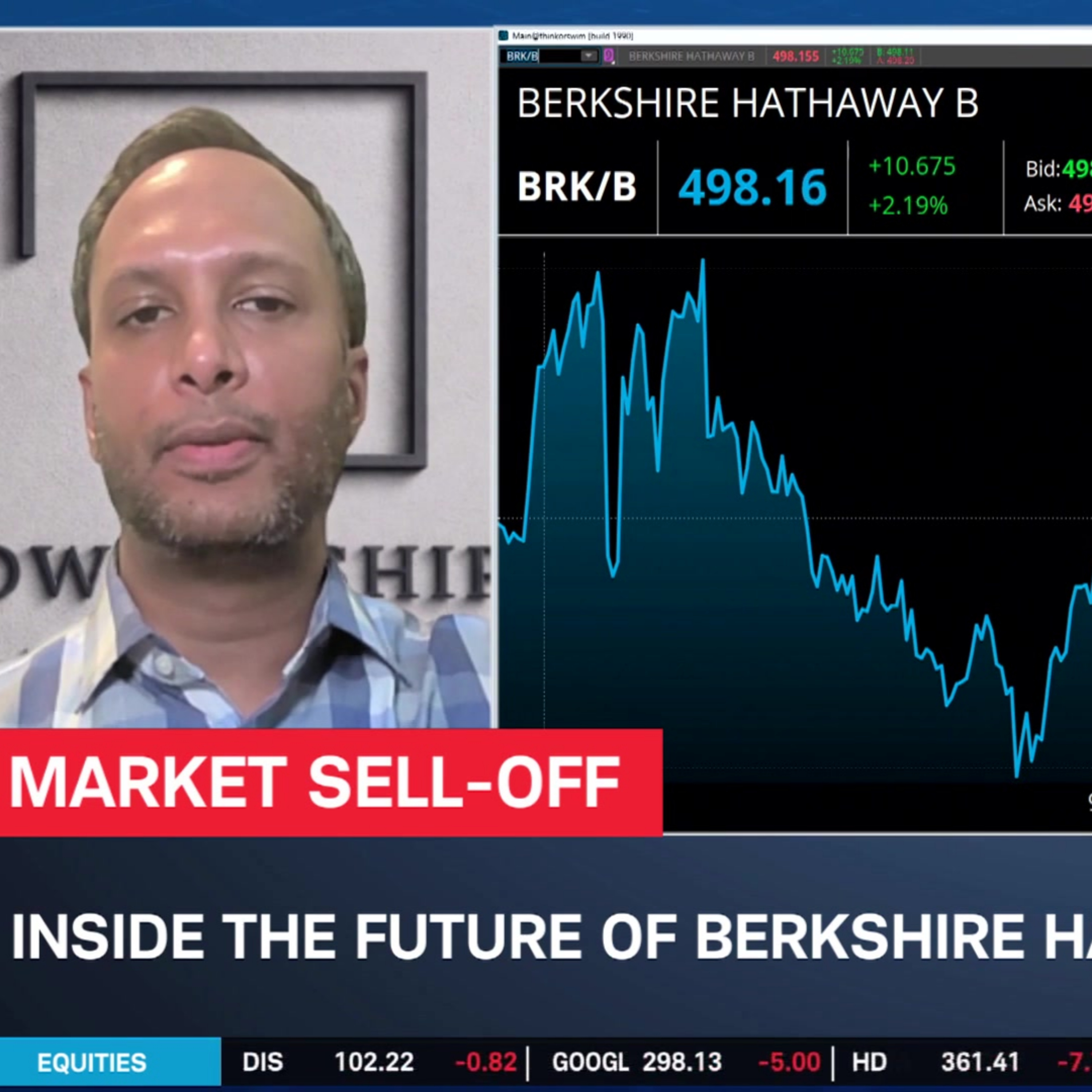
Haren Bhakta walks through the shareholder letter Berkshire Hathaway (BRK/B) released with its earnings, and how the tone has changed with Greg Abel assuming the CEO-ship. Haren thinks Berkshire could look to improving the businesses they own, which Warren Buffett largely stayed away from, rather than focusing only on capital allocation. He notes that Abel specifically called out a subsidiary in the letter, signaling a possible culture break. Haren also thinks the board of directors may take more control and less companies will be interested in being acquired by Berkshire.
======== Schwab Network ========
Empowering every investor and trader, every market day.
Options involve risks and are not suitable for all investors. Before trading, read the Options Disclosure Document. http://bit.ly/2v9tH6D
Subscribe to the Market Minute newsletter - https://schwabnetwork.com/subscribe
Download the iOS app - https://apps.apple.com/us/app/schwab-network/id1460719185
Download the Amazon Fire Tv App - https://www.amazon.com/TD-Ameritrade-Network/dp/B07KRD76C7
Watch on Sling - https://watch.sling.com/1/asset/191928615bd8d47686f94682aefaa007/watch
Watch on Vizio - https://www.vizio.com/en/watchfreeplus-explore
Watch on DistroTV - https://www.distro.tv/live/schwab-network/
Follow us on X – https://twitter.com/schwabnetwork
Follow us on Facebook – https://www.facebook.com/schwabnetwork
Follow us on LinkedIn - https://www.linkedin.com/company/schwab-network/
About Schwab Network - https://schwabnetwork.com/about
Get every episode summarized
Each time Schwab Network publishes, we email you a written briefing from the transcript — the topics, who appeared, and any specific claims, with the ad reads skipped.
Email me new episodesFree for 3 shows. No card needed.
Transcript ready
102 searchable segments. Every word is indexed and playable.
Full transcript
Schwab Network — Is Berkshire Hathaway (BRK/B) Culture Breaking Under Greg Abel?. Machine-transcribed; use the interactive transcript above to jump the player to any line.
So joining us now is Haran Bhakta, founder and CEO of Inside Ownership Index. And so, Haran, thanks so much for joining us today. I really, I read the entirety of your take on some of these shifts we're seeing and from a language standpoint, from Greg Abel's first shareholder letter. And so, walk us through some of the key differences and also key similarities that you did notice from this letter. Yeah, well, first, Jay, thanks for having me on. I thought the key difference in what was a tone of a letter where for one, he calls out a subsidiary, a BNSF railway, talking about being disappointed if they don't hit certain operational metrics in the future. And Buffett has never criticized a subsidiary or managers. He's never called that a subsidiary like that in the way Greg Abel did. And so, I see a big shift from capital allocation to now operational excellence. Okay, so do you see this being like a one-off moment?
Or do you see this really as a more transparent, frankly, leadership style that could be taking away? Yeah, no, it's completely transparent. I mean, I'm pretty sure he got a lot of advice on this letter. And the tonal letter was clear that he's going to focus on improving the economics of the subsidiaries they already have. And not really going to be focused on future capital allocation, which Buffett really was the expert on, was making future investments, and not really improving operations of companies that he purchased. But to give a quick example, someone, I think back in the early 2000s, someone asked him, you own all of Nebraska Furniture Mart, and you own 20% of American Express. Why doesn't the furniture store accept American Express?
And his answer was quick. It was that we don't tell our managers what to do. I wouldn't imagine a subsidiary now under Greg Able, not accepting American Express. Okay, and so as far as some of the, for Berkshire for a long time, it's been defined by extreme decentralization in a trust in its managers. And so I am curious where you see the line between preserving autonomy, as well as now introducing accountability, without, of course, breaking the culture that's been established for the last 60-plus years. Yeah, I mean, that culture is breaking, in my opinion. Future CEOs were acquired, and they chose Berkshire, and they sold for a lesser price than what they would have gotten from private equity. But they chose Berkshire because they knew that they were not going to be told what to do and how to run the company, or as Buffett says, how to hold the bat. You find a bat or batting 400 in the baseball game,
you know, Buffett doesn't tell him how to hold the bat. But now we see Greg Able, you know, essentially telling them how to hold that bat. Okay, and so Buffett did famously, again, view benchmarking against peers as more of, less, really less important, frankly, than some of the long-term value creation. And so you've mentioned, of course, the difference received between Able and Buffett already. But how does right now some of these comparisons maybe perhaps lead to the way that Berkshire, as a whole, is measuring its success going forward? Well, Berkshire, a quick example is how the directors of Berkshire all get paid around, you know, less than $5,000, or on average $5,000 annually to be a director. So those are true owners on the board carrying about capital allocation. They're not there to just reaffirm what the CEO wants to do. Now, I'll make a bet that within 10 years that eventually those directors will be, you know,
paid just as other directors or other corporations getting $200,000 to $300,000 a year. You know, where those directors are there to really, you know, approve an acquisition or something like that. While Greg Able doesn't have that flexibility to go and make an acquisition as Buffett did. Buffett had a clean, like, the directors didn't even ask any questions. If Buffett wanted to make an acquisition, they just gave a check mark. But that's not going to be the case for Greg Able. So, you know, it's going to be really hard to really, I guess, in the near term, you have Buffett in the office. It's going to be a little bit hard to know what Greg Able is capable of until Warren Buffett has actually gone. Yeah, like, I do understand what you're saying. Where there's going to be much more of a proven timeline before we see, like, just like the, you know, a blinding faith in this new leader because frankly, I'm sure that he has been, I mean, for years we've been talking about the succession.
This is not anything new or any surprise to Able. But it's different now that, of course, he is truly the CEO. And so, as we do look ahead to this now post-Buffett era, do you see this being a net positive? Or maybe, I mean, this is, I guess, the million-dollar question because it's very difficult to gauge, like, how a new CEO can really shape a company. But do you see just based on, again, some preliminary commentary from that initial shareholder letter from Able? Do you see this being a positive or perhaps more of some, more of a neutrality, at least for the coming months? Well, Buffett being in the office five days a week, I mean, that was really comforting to me knowing that, okay, well, but, you know, Berkshire still essentially found her lead. So, you know, Warren Buffett still in the office five days a week, you know, fielding phone calls from potential acquisitions. But my fear is that once he's gone, you know, those future acquisitions, those future, you know, great acquisitions that they've made in the past, those phone calls aren't going to come in.
So, most of those acquisitions came from inbound phone calls, not Buffett going out there, like, looking at deal flow. So, you know, going forward, those phone calls are not going to come into Greg Able. So, that's what has me afraid as a future shareholder in Berkshire is that evolving cultural difference as well. So, just, you know, between capital allocation and culture, it's going to be a seismic shift once Buffett's gone. Yeah, and unfortunately, it's not the greatest time to feel this shift because the market's already feeling a bit of a shift overall. And so, we'll have to obviously watch Berkshire as it's, I mean, it's typically a great gauge over, I mean, really interesting trends shaping the overall economy. But I do agree that we're going to see, I think, a bit of a period of transition, which is already at Frickland or way. But so, I appreciate your time and all of that breakdown run, Bhakta, founder and CEO of the Inside Ownership Index. Thank you.
More episodes
More from Schwab Network

Stock Market Today: ORCL & ADBE Earnings, AEO Plunges Near 52-Week Low
Schwab Network

Thursday's Final Takeaways: Crude Taps $103 & PPI Hotter than Expected
Schwab Network

Balancing High-Conviction AI With High-Dividend Diversification
Schwab Network

EARNINGS PANEL: ORCL, ADBE
Schwab Network