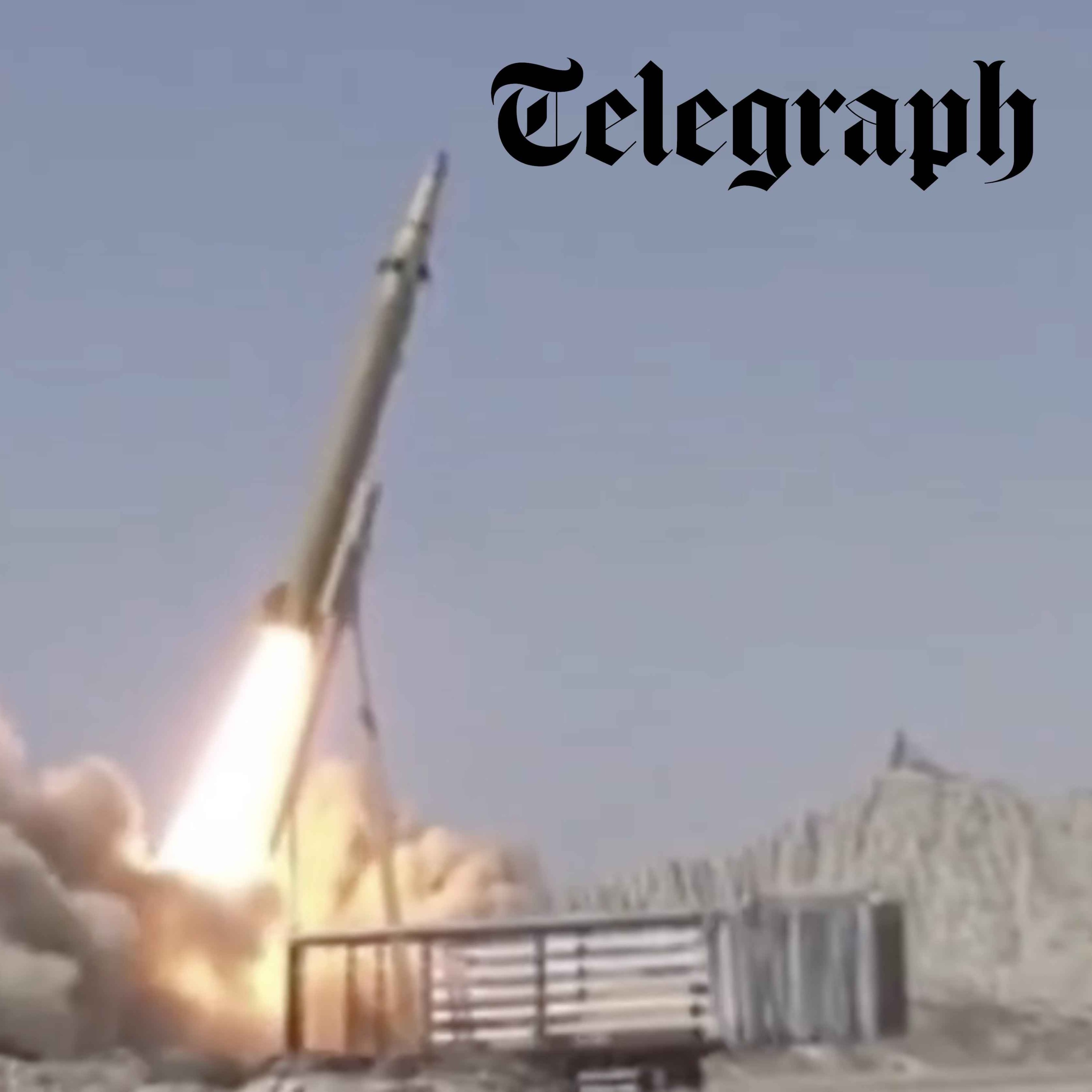
Iran captures US submarine drone & how Russia supercharges Iran’s weapons
About this episode
Iran claims to capture an advanced US Navy submarine drone in the Strait of Hormuz. How significant is it?
On today’s episode of Iran: the Latest, Roland Oliphant talks to Nikolay Kozhanov, former attaché at the Russian embassy in Tehran and now at the Gulf Studies Center of Qatar University, about the escalating US-Iran missile attacks and how Moscow is helping Tehran. He explains that Iran will get as much as possible out of whatever equipment they capture to get around US sanctions.
From advanced missile technology to specialised hardware for electronic jamming, Nikolay also explains how Vladimir Putin is fuelling the war to help drain the US military and distract from Ukraine.
Plus, the US has destroyed five Iranian oil tankers near Kharg Island after the IRGC fired ballistic missiles at a Navy warship twice this week. Is this Iran’s new military doctrine in full swing?
Highlights
- US blitzes Iranian oil tankers off Kharg Island
- How Russia supercharges Iran’s weapons
CONTRIBUTORS:
Roland Oliphant, co-host and chief foreign affairs analyst @RolandOliphant
Nikolay Kozhanov, Gulf Studies Center of Qatar University @KozhanovNikolay
WATCH US ON YOUTUBE: https://www.youtube.com/playlist?list=PLJnf_DDTfIVAif-vifC6F2aoPB8GIw6dk
CONTENT REFERENCED:
Iran fires new electro-optical missiles
https://www.telegraph.co.uk/us/news/2026/09/09/us-forces-destroy-five-iranian-oil-carriers/
UK gas prices hit four-year high as US-Iran conflict escalates
https://www.telegraph.co.uk/business/2026/09/09/uk-gas-prices-hit-four-year-high-as-oil-tops-100/
Winner Best News and Analysis Podcast - Publisher Podcast Awards 2026
Nominated Podcast of the Year - Society of Editors News Podcasts Awards 2026
Nominated Best News, Politics and Current Affairs - British Podcast Awards 2026
The Telegraph, Winner Podcast Publisher of the Year 2026 - Publisher Podcast Awards 2026
Audio Producer: Peter Shevlin
Video Producer: Max Bower
Researcher and Social Producer: Lucy Hadlow
Studio Operator: Andy Watson
Executive Producer: Venetia Rainey
► Sign up to our most popular newsletter, From the Editor. Look forward to receiving free-thinking comment and the day's biggest stories, every morning. telegraph.co.uk/fromtheeditor
► EMAIL US: Contact the team on [email protected]
► GET THE LATEST HEADLINES: Find all our latest Iran coverage here: https://www.telegraph.co.uk/iran-war/
Hosted on Acast. See acast.com/privacy for more information.
Get every episode summarized
Each time Battle Lines publishes, we email you a written briefing from the transcript — the topics, who appeared, and any specific claims, with the ad reads skipped.
Email me new episodesFree for 3 shows. No card needed.
Hosts & guests
Transcript ready
310 searchable segments. Every word is indexed and playable.
Full transcript
Battle Lines — Iran captures US submarine drone & how Russia supercharges Iran’s weapons. Machine-transcribed; use the interactive transcript above to jump the player to any line.
The Telegraph I'm Roland Olufins and this is Iran the latest Wednesday, the 9th of September, 2026. On today's episode, the United States and Iran trade their largest missile strikes in their current round of TIP-at-at-escalation, hitting targets in both Jordan and the Gulf. Meanwhile, the Iranians say that they have captured a US submarine drone and oil finally surges past $100 a barrel as the markets allow themselves to panic just a bit about the consequences of the ongoing fighting. For a short time ago, the United States military began major combat operations in Iran. Iran's Supreme Leader Ayatollah Ali Hamani was killed in the attacks.
For the first time ever, the US Navy used a surface sea drone in combat to strike Iranian targets. The third time was completely killed against anyone really think that someone can tell President Trump what to do? But first, we can't ignore it. There's been an extraordinary couple of days of diplomacy between Israel and the United Kingdom yesterday. Ed Miller, the Foreign Secretary, said that Britain would impose import bans on goods from illegal Israeli settlements in the West Bank. The West Bank and the move that he said was meant to protect or restore the two-state solution. The Israeli response came late last night and it was absolutely furious. Not only did they ban several British MPs from entering Israel, but they said they would shut down the British consulate in Jerusalem, an extraordinary step-step that has only been taken in this century against Britain by Iran and Russia.
It is by any measure something of a diplomatic crisis. And interestingly, the United States, a close ally of both Israel and Britain, seems unsure what to say about it. Here's Marco Rubio, the Secretary of State. Well, they alerted us to it. We don't have any announcements. Obviously, there's a decision that they make. And the President has expressed this in the past. We don't want to see anything destabilizing going on right now on the West Bank or so much going on in the region. We think it has implications as well on our ability to make progress with regards to Gaza and the 20-point plan and the border piece that we're very committed to. Obviously, we're not going to do what the UK did. We saw their announcement today, but I don't have any comment on it right now. The President has said that the British will suffer because of that with the U.S. that he's against it. Well, I would say that the President has not commented on this, as I said, neither have I at this point. We were made aware that they were going to make this decision. We heard their argument as to why. But look, we share the goal of stability. We don't want to see some uptick and violence or an uptick and conflict or tensions in the West Bank at a very tenuous time in the region.
There's always tenuous times. But beyond that, as at this moment, we don't have any further comment on the UK decision that I think was announced just a few hours ago. So, what does all this mean? Does Britain respond to the Israeli response? And what does the American apparent confusion say about all this? David Blair, the telegraphs chief foreign affairs commentator, has been thinking about this. Here are its thoughts. Israel has landed Ed Miliband with a wrenching dilemma. Ever since General Al-Mbi captured Jerusalem more than a hundred years ago, Brissen has had an official presence in the Holy City, but not for much longer, because Israel has ordered the closure of the British consulate in Jerusalem in response to Miliband imposing sanctions on settlements in the occupied West Bank. So here's Miliband's conundrum. He could hit back and expel Israeli diplomats from London, but only if he's willing to risk these rallies clearing out the British Embassy in Tel Aviv, or he could do nothing.
And let Israel get away with shutting down an entire British diplomatic mission. Only two other countries have done that in the 21st century. Russia, which closed the British consulate in St. Petersburg in 2018, and Iran, where regime mob stormed and looted Britain's embassy in Tehran in 2011. So Miliband has to decide what happens next. For now, at least, he doesn't have to worry about condemnation from the American administration in Washington. Marco Rubio, the US Secretary of State, declined to comment on the British sanctions on Israeli settlements, perhaps, because America shares some of Britain's frustrations with Benjamin Netanyahu's government. But now Miliband must choose whether he's willing to risk making Israel pay a further price. David Blair, there with his thoughts on the latest from the Anglo-Israeli diplomatic pantomime, we'll be bringing you all the rest on that story as it develops as I'm sure it will over the coming days.
But now to our main guest, Nikolai Kuzhanov, is an associate research professor at the Gulf Studies Center at the University of Qatar. He's an expert on Russian foreign policy in the Middle East, Iran's economy, and he was also interestingly once a Russian diplomat posted to its embassy in Tehran. That gives him a unique perspective on the internal dynamics of that relationship, just how close is the Russian Iranian alliance, and what is the overlap between Russia's war in Ukraine and Iran's war in the Gulf? Before that, we started off by talking about the latest strikes overnight. So Tuesday night, five Iranian oil tankers were struck by US Senkhaun, they said in retaliation for an attempted ballistic missile strike by the IRGC on a US Navy warship. Then Iran carried out a ballistic missile attack on a US base in Jordan, the Aayazrak Air Base, according to the IRGC, and they also said they struck some tankers in the Gulf.
And it's going to run through what happens. I'm going to start with the Americans, say, Senkhaun said in a statement on September the 8th, that's yesterday. After the IRGC targeted US Navy warships with missiles twice over the past two days, it destroyed an IRGC, five IRGC, it says IRGC crude oil tankers, they call the CavS, the Charminar, the Horizon, the Riesco, and the Gulf of Omar, and also one called the MTDERIA near Kharg Island. Marco Rubio characterized this revenge or deterrence for what they said was unsuccessful. American strike on US Navy ships, he said Iran continues to try to hit US naval ships every time they do that, they're going to lose tankers. The Iranians then said they retaliated. The IRGC saying they launched a devastating missile attack on US forces at the Aayazrak base in Jordan. Jordan says it intercepted 18 of 20 ballistic missiles fired. The US official says that Iran strikes on Jordan were ineffective and all American troops are accounted for, although the Iranians claim to have caused damage.
And we have all kinds of interesting kind of video footage of interceptors going up over Jordan, unconfirmed reports on myself, clustering munitions being used. The IRGC said today on Wednesday that it attacked ten ships, including two US vessels and eight oil tankers attempting to cross what they called a prohibited non-save area of the state of hall mousse. So it seems to me that that's just the latest kind of kinetic action of the past 24 hours. It's been remarked and was remarked on the podcast yesterday, which my colleague and he was hosting. It seems to show that Iran is escalating its response to America's escalation in a sense. Is that how you see it? Well, there are several dimensions of all this situation, I will say. On one hand, definitely we see a certain escalation. The both sides, they are rising. They are trying to raise the stakes in this game because the attempt to reach out kind of an negotiation solution for now.
Let's say in definitely in the stalemate more or each other's sides declared that stalemates for to a certain extent fees their interest, which I will say is to a certain extent as stretching the truth because the instability around the Gulf, it's negative effects both sides. The United States in terms of the inability of the US administration to show that they managed to achieve a certain victory over Iran. And for the Iranians in terms of the economic situation, so the main goal, the main priority to lift sanctions pressure hasn't been yet achieved. But on the other hand, I will say the escalation is just the part of the same old game that we have been watching since, I would say, April, when was size the use of carrots and sticks, changing the periods of negotiations with the periods of certain control, the escalation, I would say. So I don't expect a situation going beyond what we've already seen.
What would you mean beyond what we've already seen? There's a limit, you mean, to the amount of escalation. Where is that limit then? Well, no one wants to return back to the situation of March 2026. So I will say they don't want to go into what we can really call a war. So right now it's the princess in the Gulf, the gist of the Kantist, they are calling it tensions, the latter, which is quite interesting. And the war, the same time they're also trying to see to point that there is a reason for instability around these tensions. I guess the main threshold here is not to return to the massive exchange of the US strikes by both sides. The tensions still to rebuild their economic infrastructure that suffered quite a lot. And I guess the United States clearly understand that their capacities are insufficient or withstand against the full-fledged attack by the Iranians,
especially given the fact that we see, I don't know, the real capacities. So to wage this war, quite a lot of speculations about the fact that actually Iran has not demonstrated all capacities it has to retaliate to the United States attacks or to a stage its own attacks. Well, we had Mohsen Rizai not on this podcast, although that would be a very fascinating interview if we could get him on. But he was saying yesterday, and finish was talking about it, that we've got this new missile which can now hit American ships and we've got a new missile doctrine, which means we're going to, we're not going to retaliate, we're going to take preemptive action. You seem to be saying that despite that kind of rhetoric, there's still a clear cap on how far they're willing to go. You're sitting in Qatar right now. The tensions in the Gulf, the latest from the UK Maritime Trade Organization, it's going to monitor things.
They've got a report this morning, I'm just going to read it out. We've received a report from a third party of an incident 24 nautical miles northwest of Port Rashid in the UAE. The Master of Attankers reported citing a vessel listing while at anchor, possibly indicating water ingress following an attack from an unknown projectile. Vehicles are advised to transit with caution and report any suspicious activity while authorities are investigating and so on. Both sides are now saying they're hitting tankers. How's that going down in what's the mood where you are? Well, no one of course is hippy boat was happening around. The fact that the Gulf countries, they fell the prey of the conflict. It wasn't, and it was and it is the conflict they didn't want to start and they didn't want to pay for it. But they're paying quite a big price. Of course, the volume of these payments is different. On one hand, we have Oman and the UAE who managed to circumvent the state of hormones. Their incomes in a certain extent, they were higher than before, March of February, March 2026.
So they indeed like enjoying a certain increase in the incomes because of the rise in the oil prices. But at the same time, such countries like Kuwait, Qatar, Bahrain and even Saudi Arabia, the experience of substantial losses and substantial restraints in terms of their financial stability. So the reserves are so far enough to keep on moving, keep on the social life moving as if it's a regular, usual case. But the conflict is going, of course, the bigger are the concerns about how long will it take to return to normal life, once the agreement is achieved. On the bright side, however, what I can hear here in Doha, there are certain expectations that on one hand, there will be an agreement with the Iranians. On the other hand, the Gulf is currently discussing options to circumvent the state of hormones and to join efforts, something which is really unheard of,
to minimize the impact of this war on the economists and their life. The oil prices actually, I think, is gone above $100 for the first time in quite a while. So we've been noting for the past, I know the past few weeks, really, we've been kind of saying, oh, look at that oil price, it's hovering around 85, 90, it's higher than it was, but it's definitely not a crisis price. But suddenly now it is up this morning on the back of all these tensions. How significant is that, do you think? It was definitely a sign that neither Iran nor the United States, one other thing that's just one side is controlling the state of hormones. So for the Iranians, it was a way to show that the kind of success in convoying the oil from the Gulf, declared by Trump, is a kind of, well, a success, but success, which is not durable and which is not sustainable. So they reminded that they are still in control
on, they still have an ability to create certain troubles. However, I also would like to emphasize that the straits of hormones, it has now been completely closed. So if we have a look at the passage of tankers, of course, in the abnormal conditions, we could still see that a certain portion of oil is coming out. So the main problem is usually experienced by the allergic supporters, so the first and foremost by Qatar. But as for Saudi Arabia, as for the UE, of course, they are using the circumvention routes. But for instance, the Emirates, according to what we read in the press and the media, they are quite effective in using the American convoys, the transportation with the switched trackers, while the Gulf and they are quite effective in terms of the ship-to-ship transfer that allowed them to maintain at least something around 1 million barrels of the bus through the strait of hormones.
It does demonstrate that the Iranian plan, which is to throttle the strait and then hold hostage, is not quite working. The Americans have somehow managed to loosen that grip in a way, which is an interesting development. I wanted to come on to weaponry, while I really got in contact you in the first place. This story last week about Russian weapons and Iran and a relationship there. But before we get there, because it's slightly related to it, speaking about technology in the Gulf, Iranian forces said yesterday they'd captured a US Navy C drone. And the IRGC Navy has now published a video of it this morning. They say it is an Anduril dive LD drone. It certainly looks like one, if you compare it to what's on the Anduril website. The US military is acknowledged the incident, but down-plowed saying it was defective that it lacked secret technology. The drone malfunctioned more than a day earlier while surveying regional waters and sportive ongoing operations. That's Navy Captain Tim Hawkins, a spokesman for Senkhan, speaking of Washington Post.
He said it's an older model. It used commercially available technology and had no exquisite defense technology for anyone to exploit. The dive LD, I'm just getting into this because I find it fascinating. The dive LD, you can look it up on the Anduril website. It's 5.8 meters long, 1.4 meters wide. It's an autonomous undersea vehicle can operate continuously at sea by itself for up to 10 days to a depth of 6,000 meters, which is pretty impressive. I think it's pretty impressive. And they say it can be used for intelligence preparation of the operational environment, or Ipoi, intelligence surveillance and reconnaissance, ISR, mine warfare, MW, or precision placement, which is delivering a weapon payload or force to a specific location. It's also advertised for commercial uses, environmental monitoring, undersea pipeline, surveys, or those kinds of things, or other maritime companies might use. I'm wondering how significant you think that is given the technological aspect of this war and the technological arms race that underpins all of it.
Big things they have small beginnings, right? I trust that the Iranian drone program with the capturing of certain sometimes quite old drones used by the US Army in the region, plus of course the help of the Russians, that is harder to deny here. Any technology of that kind that ends up in the Iranian hands, be it an outdated, old, available in the market, it's definitely a way to strengthen their own capacities because we should not forget about the sanctions existing around Iran, that are limiting access even to all of these countries, even to the not that much new technologies. In this case, it's also telling us about the growing capacities of the Iranians to capture these drones. I mean, yes, there are news about that there were malfunctioning, that were preceding the capturing of it, but who knows how and by whom they were caused. Of course, we're also a mask-keeping mind that the current war has absolutely changed its logic.
So the main emphasis on the use of drones of any kind is quite important these days. Soon we will see at least good copies of this drone in the hands of the Iranians. It might require them months, it might require them years, but in the end, I'm afraid it might be quite a long-lasting repercussions. We're going to take a short break now. When we come back, Nikolai explains the fraught historic relationship, which makes it difficult for Iranians and Russians to trust one another. Welcome back, you're listening to Iran the latest with me, Roland Nolofanant, and you're today by Nikolai Kuzharnov, the research associate professor at the Gulf Studies Center of Qatar University. The reason I got in touch with you about a week ago was that Vladimir Putin and Master of Pizestia, the Iranian President, had met at the SCO Summit in Bishkek in Kyrgyzstan.
It was, I think, their first face-to-face meeting since the Israeli-American Iranian war began in February. Vladimir Putin said all the kind of boilerplate supportive things about Iran that you would expect. And then he also said, we're providing you with all the goods you need. What goods might that be and then write on you? The Financial Times published this piece the next day giving an example, which was apparently Russian help in developing a ramjet-powered hypersonic or supersonic cruise missile. Something that they themselves don't have, technology that Russians do have. I was wondering if you could help us, our listeners, really get into the meat of this relationship because we hear a lot about Iran and Russia being allies about Iran, has since she had drones to Russia and Ukraine, Russia providing some support to Iran. Maybe start, is there a way that you can kind of summarize the nature of the Iranian-Russian relationship? Just how close are the ties between Tehran and Moscow at the current time?
That's a good question, because we'll hear a lot from the Russian or Iranian side, calling this an alliance. A lot of analysts in Europe in the States, they start on repeating this word or they are saying that now we have the confirmation that it's a real alliance. In reality, these relations, they are based on pragmatic interaction that allows them to be durable enough to stand against the external pressure. And at the same time, it provides a lot of freedom within this bilateral track for both sides to choose what they exactly want to get from these relations. The best example here is the recent agreement on strategic cooperation that was signed between Russia and Iran last year. It definitely builds up a kind of a 20-year-long road-märfer cooperation. More with institutionalizes these relations, but at the same time, when it comes to the military cooperation, it emphasizes an important, but at the same time, it's also emphasized that the countries are not necessarily forming a military alliance.
So it doesn't mean that each of them will be immediately fighting for the other. But at the same time, they are agreeing to help each other against what they call an aggression over the third side. So which is quite interesting. So we are not dealing with the same type of agreement that is between, for instance, Russia and North Korea, where it's really like close to the military alliance and now are in the classical understanding. We have North Koreans of St. Trips to fight. Exactly. But here is the reflection of the traditional complexity of these Russian-Rinian ties, where both countries, they have a certain background, historical background, which doesn't allow them to trust each other, each of the two. It has its own goals and priorities, and sometimes it's like we're getting close together. It's not always in the mutual interests, but at the same time, due to the external factors, due to the developments of the last 30 years,
they ended up being in the same antivacant trench, where they have to help each other. And this help also has its own specifics. So we don't see Russia directly fueling Iran with the weapons. At the same time, it helps exactly in those areas that helps to strengthen Iran's capacities to fight. Where is this story about developing this new cruise missile coming to that? We have quite a lot of stories in the past when the Russians were promising supply of new fighter jets to Iran. It took laws, if I don't mistaken, a decade before Russian promises to supply S-300s, ended up in the proper agreements that was fulfilled by Russia. But at the same time, Moscow was actively supporting Iran with the access to the technologies needed to develop their own capacities on the one hand. And on the other hand, it was also providing assistance in those areas where Iran initially elect its knowledge, its own experience, such as, for instance, the radio warfare.
You mean electronic warfare? In Russian language, it's radio for radio-electric warfare. Oh, well, yes. Okay. We were talking about jamming and things like that. Yes. We were talking about jamming and the history of Russian Iranian corporations in the drone construction. It hasn't started in 2022 when Russia got the Shaheids. It started roughly about 2009, 2012, if I'm not mistaken. When Moscow, according, by the way, to the official statements by the Russian media, they supplied Iran with a certain equipment that allowed the Iranians later on to catch and down quite a number of American drones. They were operating, it worked from Afghanistan, right, Iraq, or Afghanistan. There were some navy drones also catched in the Gulf area. Afghanistan was one of the biggest cases when they managed indeed to get, if I'm not mistaken, these striking drones or the new model.
So later on these technologies, they allowed the Iranians to build up their own versions of drones that later on ended up being in Russia. This exactly reflects the nature of this interaction because Moscow cannot afford itself to be fully aligned or to be fully associated as a supporter of Iran. Why not? From an outsider's perspective, you might say, they obviously share a common enemy in the United States. They're basically aligned over Ukraine. Iran is supplying Shaheids. So what's the basis of this reluctance to kind of, well, be fully aligned? Why not? There are several factors, but just too, the most important from my point of view. First of all, it's not only about the United States. It's also about the other countries or the Gulf. Russia and Russia and the economy right now is heavily dependent on effective cooperation with the GCC states. Russia doesn't want them to see Moscow through its cooperation with Iran as an Iranian ally or as a force that might change the balance of power in the Gulf.
Why for Moscow, it's better to provide Iran with certain technologies with certain data, maybe with some equipment which is not considered as empowering Iran against the direct neighbors like the GCC states. This is interesting, Nikolay. Finish your point. So that's why even in these conflicts, Russian statements, they were quite controversial and activities. On one hand, they indeed beat the GCC back to the resolution against Iran and the UN Council. But at the same time, the bilateral meetings, different levels Russia was trying to send the message to the Gulf as a look. We are not as a full-fledged ally of Iran, we're also unhappy about the instability which is happening in the Gulf. So what leaps out at me is that the conventional kind of explanation, I suppose before 2022 at least, throughout kind of the previous 20 years of Vladimir Putin kind of reign administration, whatever you want to call it, it was about balancing this relationship with Israel.
And the hence, the S300 thing about, okay, we'll supply Iran with S300s, the Israelis can plane so we don't and so on. But what you're saying is that today actually places like UAE, Qatar, Dubai, Saudi are actually much more important to Russia. Because why? Because of economic access to the outside world, under sanctions. It's the economic access to the outer world. It is the way to circumvent sanctions. So Fujera became one of the hubs for the re-expert of the Russian oil to, even to Europe, not to say to the African countries to India. It is a safe haven for those Russian tycoons and business who would like to live through the war outside of Russia, but without moving to the West. It is also the source of the investment in the Russian economy, which might be not a lot of the big numbers, but they do matter in the absence of any other sources to fund the Russian economic development.
It is also the way to get out of the international isolation, not to say that there are personal relations of the, at the level of the regional elites inside Russia, like for instance, Chechen leadership and the UA leadership. In the end, within the last 20 years, more than 20 years of Putin's rule, we see a pro-Arab lobby emerging in Russia represented by quite influential people in and around Putin's inner circle. All of this is strengthened in Russian interest, and all of this creates heavy bonds between Russia and the GCC states, but the trick is that Iran is also important in its own way, and the two GCC and Iran, they are not mutually replaceable. That is why Russia has to balance between them, and hence to demonstrate that these connections with Iran is not a food-of-fledged alliance, though honestly, Russia was not that successful in that.
Quite a lot of people here in the Gulf are actually accusing Russia of being too close to Iran. I see, so they are not convincing them. There has been talk about Russia finding alternative ways to strike back at the West. There has been all this talk about escalated hybrid warfare and sabotage warfare in Europe, and I believe Vladimir Putin himself saying things like, well, if you are going to help Ukraine strike our supply lines, we will find ways of, we will supply arms to your enemies. One of those was speculation that Russia would help supply, perhaps missiles to the Houthis in Yemen, perhaps provide assistance to the Iranians as a way of hitting back at the West. How far do you think that's going to happen? So that was the second factor which is determining, actually, the Russians will have these special relations with Iran that are neither the full-fledged alliance, nor the parallel courses, but a kind of a transactional interaction.
For Russia, it's quite important that America is getting sucked into the conflict, because lots of Russian behavior in the international arena, of course, now is determined by the situation in Ukraine. And one of the strategic thinking by the Russian leadership here is related to the idea that more United States are involved in the situation in the Middle East, the less they are thinking about Ukraine. The less attention is given to Ukraine, the less weapons going there. So that's why Moscow, from my point of view, is interested in keeping this conflict simmering. It doesn't want Iran, of course, to be completely defeated, and that's why it's supporting its weather weapons, but also it doesn't want to be seen as an ally. That's why it supplies weapons and technologies in a certain limited way, but to make sure that this confrontation keeps on simmering, keeps on burning.
And from my point of view, there is a clear parallel between the dynamics of the Russian-American relations, and Russia is used of Iran and the Middle East as such as a way of the asymmetric warfare. In the last year of Biden's presidency, we saw that Moscow was actively exploiting the Middle East to harm the US interests in asymmetric response, which was feeding into the Russian military doctrine. Now these assistance to Iran, I would say, is far way measured, and intensification is usually happening when Russia is getting dissatisfied with the way how the US administration is approaching to the Ukrainian conflict. I see. Okay. So for Russia, or bottom line, Russia sees this conflict as benefiting its position in Ukraine, and therefore, it good that America is being drawn into it.
Absolutely. So Nikolay, I'm wondering if you think that has any bearing on this, the Iranians unveiling this new missile, they call it the Cass and Bessier, they say it's a solid field rocket, they've tested it against American ships, this is a new capability. I mean, how much involvement do you think the Russians had in that? Do you think that's the kind of thing the Russians may have been helping the Iranians develop? Here we enter definitely a certain area of assumptions and suggestions and speculations, but I would say that's exactly what Moscow could do. Both in terms of the building up the Iranian capacities to keep on fighting, and also as a way to strengthen its cooperation with Tehran without creating immediate negative effect on the size of the Gulf monorca. And also as a way of certain gratitude to those Iranians for the previous assistance. For the Shahed's? Well, you mean? Shahed's. And not only again, we are forgetting that Russia, on the failure of the Russian Blitzkrieg in Ukraine, was a total shock for Moscow, and Moscow turned to be completely unprepared for the continuation of its aggression in Ukraine.
And in that time, in the first months of this conflict, it was actively collecting military equipment, just the conventional weapons from all over the world where it could get it. And there are some evidences, for instance, that the Iranians were supplying even the military helmets and bulletproof wests to the Russian army for a while. Oh, good lord. So help well beyond the justice she heads that we know about. Absolutely. Well, again, I'm not disclosing any secrets here. No, no, I know. I think generally the discussion is always out of the Iranian-Sensha heads. But that's the main problem with these relations, that we're usually... Our attention is usually drawn through and away towards big things, like as for hundreds. So, hoi-soop, sohoi fighter jets. But in the reality, the backbone of this reaction is a day-to-day cooperation in the training, in the technological development, in exchange of data, in exchange of experience of how to build a military production in the 90s, the Russians were helping Iranians to build up its military industrial complex.
In 2022, the Iranians were helping Russia to deploy the Shahes production in Alaboga, near to Kazan. And this is much more important than these big things. So, these small developments that are happening on the ground and they are indeed creating quite a strong confusion between the two countries. This is fascinating. And I think this really helps us understand the dynamic between Tehran and Moscow in this war. So, thank you very much for that. I want to finish, maybe, by talking about the... I think you said earlier that in the conversation, there were kind of cultural reasons where they can't trust each other. And I'm quite interested in that. You were... You did work at the Russian Embassy in Tehran at one point. I think many, many years ago, as you say, in ancient history. But what are these cultural reasons that stop Russians and the Iranians trusting one another? And I kept on traveling to Iran after I also left the embassy and left the Ministry. So, I know this country a little bit from inside, even beyond those four years that I spent in Tehran.
And for me, it was always fascinating. If it was fascinating that in Iranian mind, there was always a mixture of what it used to as Russia. So, on the one hand, they have a natural affinity to the Russian literature, to the Russian philosophy. You can find almost all classical Russian literature books being translated in Persian. Easily, both in the street and to Tehran University, which is famous for its bookshops. But at the same time, the political experience is creating a substantial mistrust, because Russia, in the 18th century, it waged at least two words with Iran. In the 19th century, in the 20th century, tried to occupy and to cut certain territories from Iran at least twice.
And of course, the famous events of the Iranian revolution of the early 20th century, they couldn't be studied without the study of the Russian involvement. Then Moscow basically used brutal force to suppress the national movement in Iran. All of this left a deep impred on the Iranian historical memory, which is quite fascinating. You can just take a cab in Tehran, and if a driver learns that you're Russian, you'll immediately hear the whole history of the Russian historical crimes. Not to say that, for instance, my favorite example is the memory, which is embedded in the historical memory, which is embedded in the language itself. So, for instance, when an Iranian needs to say that the deal was unfair, or the agreement was extremely unfair, they are saying, I would talk much I, which refers to the talk much I, peace agreement of 1828 between the Russian Empire and the Kajar,
Kajar Persia, that allowed basically the Russians to completely reap of the Iran on money. And it took a couple of decades for the Iranian economy to recover after this agreement. So, when you have such background, of course, you must be prepared that from time to time, people will be recalling that you're not the country that must be trusted. That was Nikolai Kajanov, research associate professor at the Gulf Studies Center of Qatar University, and former Russian diplomat, he made clear that that was a very, very long time ago. That's all for today's episode. We will be back tomorrow following all these rapidly developing stories I have to say. Until then, that was Iran, the latest. Goodbye. Iran the latest is an original podcast from the telegraph created by David Niles and hosted by me, Roland Olephant and Vanisha Rainey.
If you appreciated this podcast, please consider following around the latest than your preferred podcast app. And if you have a moment, leave a review as it helps others find the show. For more from our foreign correspondents on the ground, sign up to our new daily newsletter, Cables via our website, or listen to our sister podcast, Ukraine, the latest. We are still on the same email address, battlelines, telegraph.co.uk, or you can contact us on X, you can find our handles in the show notes. The producers Peter Shevelyn, the executive producers of Vanisha Rainey and Louisa Werbs.
More episodes
More from Battle Lines

US fears Iran war could drag into 2029. Trump insists it’s ‘worth it’
Battle Lines

US Gen Ben Hodges: Trump’s Houthi Red Sea crisis, Pentagon chaos and 9/11’s lega...
Battle Lines

Iran’s Houthis seize key Red Sea port as $100 oil threatens global economy
Battle Lines

Iran uses new missile to target US warships as UK sanctions Israel settlements
Battle Lines