About this episode
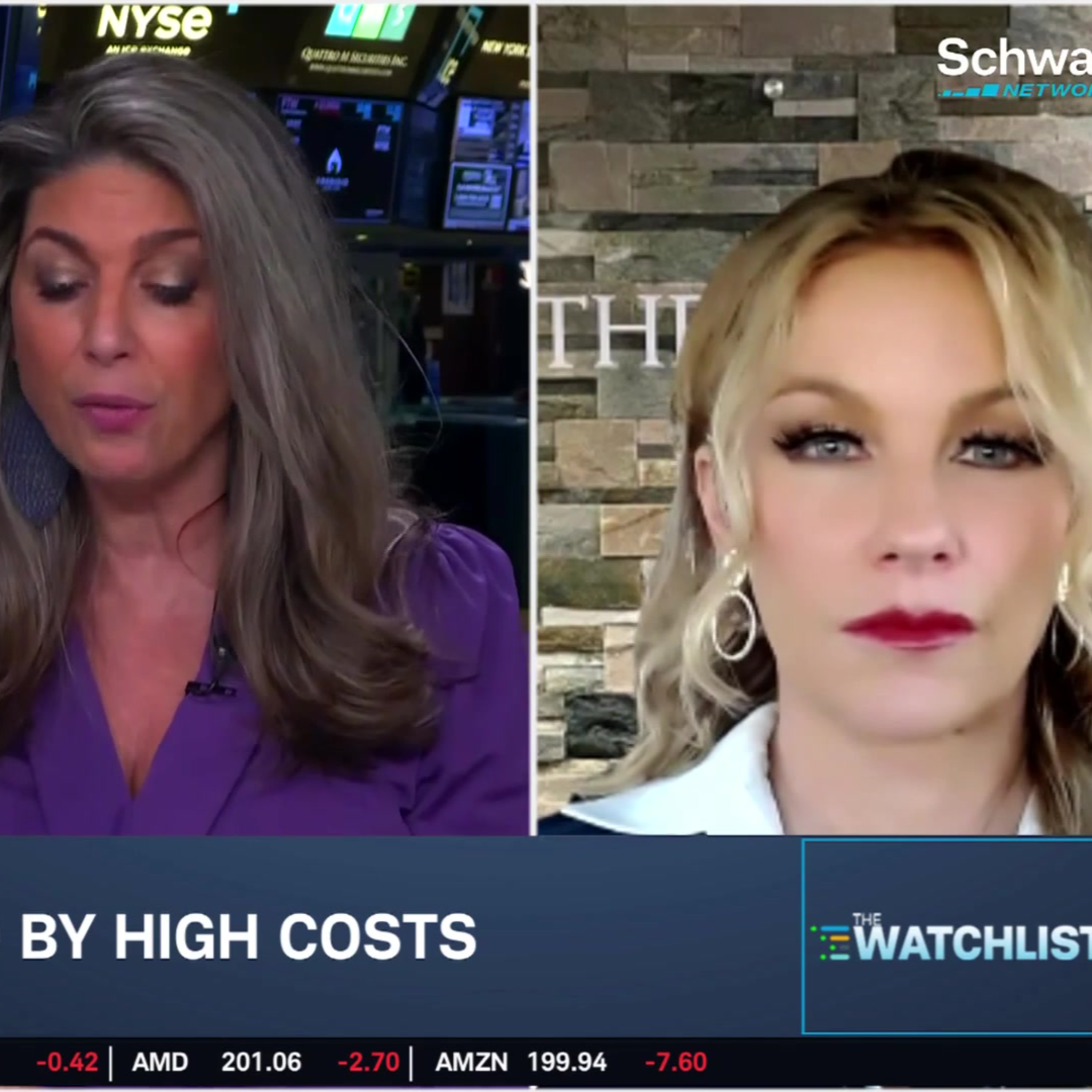
Brian Jacobsen and Rebecca Walser cover upcoming economic data and the latest on the partial government shutdown. Rebecca looks at further-dated oil contracts showing lower prices and says the administration has made it seem to consumers like the Iran conflict will be short. Brian is “nervous” as the VIX climbs to 30 and talks about how investors can take “bigger bites of the apple.” Rebecca advises investors not to panic, but says people may be reassessing their risk tolerance.
======== Schwab Network ========
Empowering every investor and trader, every market day.
Subscribe to the Market Minute newsletter - https://schwabnetwork.com/subscribe
Download the iOS app - https://apps.apple.com/us/app/schwab-network/id1460719185
Download the Amazon Fire Tv App - https://www.amazon.com/TD-Ameritrade-Network/dp/B07KRD76C7
Watch on Sling - https://watch.sling.com/1/asset/191928615bd8d47686f94682aefaa007/watch
Watch on Vizio - https://www.vizio.com/en/watchfreeplus-explore
Watch on DistroTV - https://www.distro.tv/live/schwab-network/
Follow us on X – / schwabnetwork
Follow us on Facebook – / schwabnetwork
Follow us on LinkedIn - / schwab-network
About Schwab Network - https://schwabnetwork.com/about
Get every episode summarized
Each time Schwab Network publishes, we email you a written briefing from the transcript — the topics, who appeared, and any specific claims, with the ad reads skipped.
Email me new episodesFree for 3 shows. No card needed.
Transcript ready
109 searchable segments. Every word is indexed and playable.
Full transcript
Schwab Network — Investor Psychology During the Iran Conflict. Machine-transcribed; use the interactive transcript above to jump the player to any line.
Our panel is ready to talk about inflation, labor, this economy, Brian Jacobson, chief economic strategist at Annex wealth management, and also Rebecca Walser, president of Walser wealth management. At the same time, I'm seeing some headlines that U.S. House Speaker Johnson is calling the Senate DHS bill, I guess they're looking at it as a joke didn't pass, and I don't know, there's a lot of back and forth on this, but I think the main point is that he said he spoke to the president a few moments ago, the president understands the path that the House Republicans are pursuing, saying now the House will vote on temporary DHS funding as soon as possible. So we'll wait to see any headlines on that, of course the president also had plans to sign an executive order on refunding the TSA, so we'll wait and give you any headlines there, but it does say here that he spoke to the president a few moments ago. Rebecca Walser, how are you feeling about this market and what it means for some of the prints that we're about to see, whether it's inflation or GDP or jobs?
Yeah, Nicole, I think we have something that's in common, so when we saw the consumer sentiment, Michigan survey obviously going down our worst read since December 2025, but what's really interesting, we saw both middle income and upper income really participating in the downward sentiment, unlike this K economy where the lower income has felt this hard go of it for a while, but now with stocks, households that actually have stocks are actually the ones that came the most downwards, obviously, and that's because we've obviously had this route, and now inflation expectations are higher. But the interesting thing about this consumer sentiment that we just got released this morning in Nicole is that the expectations are higher for 3.8% inflation for the year, but long term, they still go back down to 3.2%. So even like the oil contracts that are in December, the futures contracts that show will be back down somewhere in the high 70s, low 80s, possibly, as of yesterday, anyways,
that same sentiment looks to be hitting the American consumer. So far, this administration has done a pretty good job of making this Iran conflict war seem like it will be short term. All right. Brian, how are you feeling about the market, the growth outlook here? We have a lot still going. This war is not ending anytime soon. In fact, it's on pause until the April 6th date, but anything you happen between now and then and afterwards. That's right. And that's where I think Yogi Barra, right, famously said, it ain't over until it's over, and I think that's really the approach you have to take to this. We don't know when it's going to end, but in terms of the market action, when, you know, the VIX broke above 21, that's where I got a little bit nervous, because oftentimes what happens is you don't get that blow off top until you get really well above 30. Right now, we are at about 30, 31. If we get to 32, 36, that's kind of the range in which it's like, okay, now maybe you can start taking bigger bites at the Apple in terms of allocating towards positions when you
start looking through the chaos as opposed to the driving through it, right? And I think that's really what the investors are trying to wrestle with right now, because the shorter lived this conflict is the less the economic damage. We do know that it does affect headline inflation, OECD, the organization for economic cooperation development. They said that for this year, they're expecting that inflation is going to be like 4.2%. Most of that, though, is because of food and energy prices. The core is unlikely to be affected. In fact, I'm more concerned about the growth effects of high oil prices than I am about the inflationary effects. The inflationary effects tend to reverse rather quickly once there is some sort of resolution, which I expect that we will see one before the end of April. But of course, I could be wrong. That's more up to President Trump than it is to me. But it's more, what are those longer lasting growth effects? Because consumers now, they have to reallocate their budgets. They have to dip into the savings that they would put into their accounts, or they have
to increase their credit card debt, reallocate away from discretionary spending. So the longer this lasts, the worse the growth effect than the inflation effect. All right. So you did say here in your notes that now for investors and policymakers, patients, diversification, risk awareness seem to be some of the best bets at this moment. Rebecca Walser, are there do's and don'ts for investors today? Yeah. I mean, I would say to his point as well, behavioral finance don'ts, like don't panic, don't panic sell, you know, take a breath, take a pause, patients is a very key concept. That's not to say that perhaps a lot of people think, Nicole, that they have high risk tolerance when everything is going to the green and upside up into the right. Everyone's got super bullish sentiment and very high risk tolerance. Once these things start to us, you know, go down and their confidence gets shaken. Maybe their risk tolerance isn't as high as they thought and they might need to reassess their risk allocations to something that's a little less, you know, risky.
That's a little bit difficult in a market where precious metals, which would be a normal safe haven are going down as well because of liquidity concerns, raising capital, taking profits, any time you have an energy related economic event, it does become more difficult for the average Joe because they don't understand how long this is going to last and all the sectors that it's going to influence. Obviously, it's not just gas at the pump, it's your airline prices, it's all transportation costs, it's shipping, it's everything, your deliveries to Amazon could get more expensive. So I would just say behavioral finance 101, take a deep breath, assess your risk, but then make sure you stay in the game at least somewhat or otherwise you'll miss the upside and you'll get out when it's, you know, the wrong time. We were talking about earlier today when we were saying how in the Gulf War, afterwards Gulf War 1 and 2, one of our guests was noting from the beginning of the word, and afterwards we were up 30%, but you had to sort of play it out throughout the war. Do you have an ETF or specific play Brian that works, whether it's bonds or certain ETF
or sector that you do like that you could recommend? Yeah, so I can talk about what we've done here on our investment committee, which is in terms of we have liked energy and free cash flow generating stocks up until this point. Now that energy prices, the oil price is up to 99, maybe it's at that point where President Trump is going to take notice and say he has to do something, say something in order to maybe get that price a little bit lower, maybe this is kind of that line in the sand. And if that's the case, what we've done is actually tried to lighten up on our energy overweight, move it more back towards neutral or slight underweight, and then favor banks. So you know, there are a number of ETFs that are out there. We do really like some of those areas in which the financial sector, some of the deregulation that's taking place also likely when we get through this, which we will is that we're going to see that pick up and merger and acquisition activity, plus a lot of the banks, they actually thrive on some of the volatility from their trading desks. So it would not be too surprising if we see actually financials do well coming out of
this. And maybe we're getting closer to the end than we are towards the middle or even, definitely the beginning. All right. Well, thank you both very much.
More episodes
More from Schwab Network

Stock Market Today: ORCL & ADBE Earnings, AEO Plunges Near 52-Week Low
Schwab Network

Thursday's Final Takeaways: Crude Taps $103 & PPI Hotter than Expected
Schwab Network

Balancing High-Conviction AI With High-Dividend Diversification
Schwab Network

EARNINGS PANEL: ORCL, ADBE
Schwab Network