
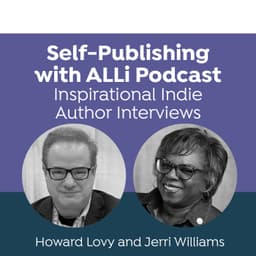
Inspirational Indie Author Interview #204: Jerri Williams — How a Retired FBI Agent Created a Thriving Indie Publishing Platform
About this episode
My guest this episode is Jerri Williams, a retired FBI agent who spent twenty-six years investigating major financial crimes before building a second career as an author and podcaster. Since 2016, she has produced a long-running FBI true crime podcast, written widely about FBI myths and misconceptions, and built a strong independent publishing platform.
Find more author advice, tips, and tools at our Self-publishing Author Advice Center, with a huge archive of 2,000+ blog posts, and a handy search box to find key info on the topic you need.
We invite you to join our organization and become a self-publishing ally.
About the Host
Howard Lovy is an author, developmental editor, and writing coach with a long career in journalism and publishing. He works with writers at many stages of their careers, with a focus on helping them develop their ideas and strengthen their work while preserving their unique voices. He lives in Northern Michigan.
About the Guest
Retired FBI agent Jerri Williams spent twenty-six years as a special agent specializing in economic fraud and corruption investigations. She is now on a mission to show the public who the FBI is and what the FBI does. The FBI Agents Association recognized her as its Distinguished Service Honoree for sharing FBI stories. Through her police procedural novels, her nonfiction book, her blog, and her decade-old true crime podcast, "FBI Case File Review," she debunks misconceptions about the FBI found in books, TV, and movies. She has also worked as a consultant for major TV studios, assisting producers and showrunners in developing realistic FBI characters and storylines.
Get every episode summarized
Each time Self-Publishing with ALLi publishes, we email you a written briefing from the transcript — the topics, who appeared, and any specific claims, with the ad reads skipped.
Email me new episodesFree for 3 shows. No card needed.
Hosts & guests

Transcript ready
229 searchable segments. Every word is indexed and playable.
Full transcript
Self-Publishing with ALLi — Inspirational Indie Author Interview #204: Jerri Williams — How a Retired FBI Agent Created a Thriving Indie Publishing Platform. Machine-transcribed; use the interactive transcript above to jump the player to any line.
Indie Author Lab from the Alliance of Independent Authors is a brand new, in-person event for Indie Authors during London Book Fair Week. Taking place in London on March 11, 2026, it's a full day of mentoring, workshops, and community connection. Created for Indie Authors by Indie Authors. Learn more and secure your tickets at self-publishingadvice.org. Slash Indie Author Lab. I'm Howard Lovey of the Alliance of Independent Authors and Book Editor at HowardLovey.com, and you're listening to Inspirational Indie Authors. Every episode, I interview an ally member to find out what inspires them and how they are an inspiration to other authors. My guest this episode is Jerry Williams, a retired FBI agent who spent 26 years investigating major financial crimes before building a second career as an author and podcasting. Since 2016, she has written widely about FBI myths and misconceptions and built a
strong independent publishing platform. All that Jerry Williams tell her story. Hi Howard, it's great to be here. This is Jerry Williams, retired FBI agent, author, and podcaster. I've been writing book smells since 2016. My first book was published, and I would call myself an accidental Indie author. All right, well, we'll go into that, and a good thing you're retired, so I don't have the right to remain silent, and I'm saying we'll not be used against me. I should be asking you because you're the one recording this, so I'll try to make sure that I only say things that I want everyone to everyone to hear. Well, you've said you've always been a storyteller, so first tell me where did you grow up and was reading and writing? Will he's a part of your early life? Absolutely, I am an
Air Force. So my father was in the Air Force the entire time I was growing up, we never lived anywhere for more than three years. So we were always, always moving, and even during those three years that we might have been in England or Germany, we probably moved during that time period too. So I was always having to make new friends and sisters, but I was always coming into a new environment, and sometimes when it took a while to get settled in, books were my friends, my whole family read books, and we were the type of people that would go visit someone, and then look around to see if they had a magazine or a newspaper or a paperback nearby. So we were very used to picking up a book and reading it whenever we had any leisure time. So what eventually led you to law enforcement? What did you study in college? I studied psychology, and after I graduated from college, the first full-time job,
permanent job I had, was what we called an aftercare counselor, but it's really like a juvenile probation officer, but I got the kids that went away to the reform schools and placement centers and group homes. The kids that had gotten into trouble and were adjudicated and sent away for a while. And so it was called an aftercare counselor, where I really got to use my psychology degree in the different treatments that we did with the kids and their parents as they were returning back to the community. So it was psychology that first was your first connection with law enforcement? Yeah, I was always fascinated about what made people take. So definitely, I never looked directly at a law enforcement position. Again, I was thinking psychologists, psychiatrists, something like that. As a matter of fact, in college, I took all of the prerequisite courses like organic chemistry and physics and things like that to go to medical
school, but never, never got that far. But my roommate in college was a police officer. When she graduated, she became a Baltimore city police officer. So when the FBI was looking to recruit more women and minorities, it wasn't something that I rejected. You know, I looked at it and I thought, well, let me see what this is about. And I bet the psychology degree didn't hurt either, you know, human motivations are very much a part of law enforcement. And then also later for your writing career too. Absolutely. Both of those have been a great resource for me as I began my writing career. So I've written four books. I've written two crime novels, paid a play and greedy givers. I've also written together with my son a puzzle book, an FBI puzzle book, but my bestseller, are what people know the most about as an author is my book called FBI mis and misconceptions,
a manual for armchair detectives, where I help people understand the cliches and misconceptions about the FBI and books TV and movie. So I speak to a lot of writers groups. I was just speaking to the mystery writers of America's New York chapter last week about, you know, how to write authentic FBI characters. So you're you're you're rushing on ahead. We're still we're still in your backstory right now. So we'll get to your books a little later, but that no, that's fine. Tell me how you spent most of your career in the FBI. I worked economic crime, financial crimes like Ponzi schemes and advanced face schemes, telemarketing frauds and and embezzlement things like that. I always found it fascinating what people had to say to themselves to make it okay to steal somebody else's money. Was that was there a particular case or a moment
in your FBI career that made you realize I need to someday tell these stories? Well, I think I always knew that I wanted to write a book. I knew that before even showing the FBI because again, I'm a reader and you know, when you really love books, there's always in the back of your mind the thought I could do this too. And so I know I always wanted to write a book and so definitely looking around and hearing the stories, the true stories of the FBI. You know, I knew that I had a huge resource for potential plots and characters. Yeah, yeah. Now toward the other of your career, you became a spokesperson for the Philadelphia Division. How did working with the media changed the way you thought about public storytelling? Well, you know, that was a strategic move on my part because I was at the end of my career. I had
been starting to to write a book. My first book took me eight years to write before it was published. You know, I'm sure you've heard that story before. And so I was, yeah, so only a year. And so I knew that that position, I was doing it part-time anyway, anyway, as a collateral duty, backing up the person that was the main spokesperson. So when she retired and I was offered the full-time position, no longer doing investigations, just helping shape the perception of the FBI and the Philadelphia Division, I said yes, because I knew that would put me in next to a position with other people, writers, reporters, producers that were, you know, interested in FBI stories. And so I worked that job for my last four and a half to five years of my career. So that's what I did just as I retired from the FBI.
And it definitely was helpful because my very first editor was a managing editor at the Philadelphia Inquirer. She was the one who taught me how to write. So you knew that you were going to ease into a quiet life after retirement. You had planned this, you're writing life way in advance. Yeah, that was definitely something that I started before I retired and a goal that I've had, you know, all of my career. Now what came for us to just start writing or to just start the podcast or both of the same time? I finished the book and I at the time was pursuing traditional publishing. So I had a literary agent who told me I was with Curtis Brown, who told me that I needed to start working on a platform. You know, as we were submitting the book to different publishers that I should start building my platform. And at the time in
20, this was around 2014 and 2015, you know, a lot of people were blogging, but I decided I was going to do a podcast. I was listening to podcasts, most of them concerning writing and writing and books. And so I thought I would do a podcast, but it made more sense for me to do a podcast about the FBI. Yeah, well, that was my depression of you. You kind of predicted the true crime podcast. Yeah, they were there were some I think I think maybe serial started in 2014. So I started my podcast in January of 2016, but I really didn't know much about the true crime industry. I accidentally put my podcast in the category of literary arts because I thought of my podcast again, as a way of helping other writers, other authors learn how to write authentic
FBI plots and and characters because I had read a lot of books that feature the FBI and there were a lot of things that, you know, that were wrong, you know, that well, you know, I'm old enough to remember the old FBI show from the from the early 70s and then the late 60s. And then of course, you know, there's the X files. So that's as far as I go in terms of knowing about the FBI. But so what frustrates you the most about how the FBI is portrayed in popular culture? Well, many of the books about the FBI that feature an FBI character are serial crime books, you know, books about FBI profilers and they have the FBI profiler, you know, going down a dark alley yard to a damp basement, actually actively searching for the serial killer. And we all know that FBI profilers are like consultants. They're not the investigator. They work with local
enforcement and state investigators and FBI agents out in the field to help them find ways to solve their what appears to be unsolvable case. And so they're really not out there doing the things that most books and TV shows and movies, you know, show an FBI profiler doing. So, you know, that can be, that can be a little frustrating, but I understand now as an author that you can't have an FBI profiler sitting in an office, you know, flipping through a file. That just is not a story. And so I definitely understand. And, you know, I'm not bad at people now. You know, if they want to write a book and show their FBI profiler, you know, out in the street, you know, what guns are blazing and car chases and all of that, I understand that as an author, the most important thing is your story. So if you have to
make a creative compromise to get that story right to create your tension, your drama, you know, your complexes and, you know, all the things that you need to make a good story, I understand, but I do warn people that if you go too far or if you have it totally wrong, that's going to take your reader out of the story. And that's one thing you definitely don't want to do. Yeah, yeah. So you're okay with creative license instead of having a profiler sit behind a desk advising their out in the field, which doesn't necessarily happen, but it makes for better drama. Yeah, I understand it now. A serial killer books are totally, they're a genre on their own. And so it was created probably by, you know, silence of the lamps and other great books like that. And now it's what people expect. And I don't think you can really do
a good crime novel with the old way. I think they did an excellent job in the TV show Mine Hunter, where they had them more at an academic level, but still were able to find ways to create that drama and that tension, but showing them in their real position, what they really did. So my second one, and I, you know, I struggle between, is this the first or the second one, but it would be that the FBI doesn't play well for play well with others. I mean, you've seen that thankfully, Shay, where the FBI comes in and just takes over, you know, they're in charge, you know, and just tramples on everyone. And that just doesn't happen that way. And matter of fact, and there are many books that talk about, you know, the FBI coming in and taking over a local murder investigation. And that will really just throw me out of the story. Maybe you want to pick up the book and throw it across the room, because in most situations, the FBI
does not have a jurisdiction in a local murder. Now, you may see the FBI working with a local police department, but that's when they're invited in. And I know everybody knows about the Nancy got three case that's going on. The FBI was invited into that. It was not necessarily something that would come under the FBI's jurisdiction, normally, but they were invited to assist. And so just familiar, that's a famous news anchor's mother who went missing Nancy got three. Yes, yes, I know that ally is a very international organization. So thank you for letting people know I made that assumption. But there are certain jurisdictions that the FBI is allowed to investigate. And then some that, you know, just are not under what we do. And so
that's a bit of a drama, I guess, you know, from what I've seen on TV and in books, the the rivalry between the FBI and the local police. But you're saying that that just doesn't happen that way. It does not happen that way, not at all. But again, I understand why people do it, because you want to create that tension and drama. But there may be other ways that you can do it, you know, maybe show this particular agent or this particular detective that are working together. They just don't like each other. But again, to set it up where the FBI is coming in and trampling, you know, over the local police department is is not accurate. And and somewhat harmful to law enforcement, because let's just say you aren't a small police department and you've never had any interaction with the FBI. So, you know, when the FBI shows up offering help, they're suspicious in their
rejecting it because they read too many books and watch too many TV shows and movies where the FBI wants to take over. And so, you know, it's it's not like it's harmless when misconceptions and cliches are written over and over again. So, I like to say to people, when you're doing a research, don't necessarily rely on another TV show or movie that you've been watching to get your information about the FBI or law enforcement in general, you know, reach out. Yeah, reach out and see if you can actually speak to somebody, you know, in the law enforcement industry to answer your questions or, you know, read some of the great books that are out there, not just mine, but others that help answer your questions about what an agent or a police officer or detective or state trooper or whoever would do in that situation. You've been a strong advocate for Hindi publishing,
but you also, well, first of all, you're kind of the poster person for the for indie publishing because you have your own platform, you're on print, ebook, audio, podcasts, you have your own platform, like you were advised earlier in your career. Are you still open to traditional publishing or are you in the all the way? I am still open. I actually have an agent now that I met. I was not actively looking to write any more books and go traditional, but I met an agent who really liked my platform, enjoyed my indie published books and offered me representation. And so I'm pursuing that right now, but I am definitely an advocate for indie publishing. I had mentioned that I was an accidental ending. And that was because, you know, I did have an agent with pursuing traditional publishing back in 2015 by 2016, agent had not been able to sell the book.
And I did not want to put that book that I had been working on for eight years. And then continue to work on with the agent. I had a very hands on literary agent. I wasn't going to put that in the drawer. They offered Curtis Brown at the time was doing this white glove Amazon thing where they offered to, quote, unquote, publish the book for me. And so my book was published with the Curtis Brown logo on the spine. And after that was done, that's when I learned about indie publishing. And that I could have just done that myself and not had to pay the 15% in an agent thing. And I actually had already started writing the second book was a duology. I was going to be a trilogy that I made it into a duology. And I was had started writing the second book. And I realized, well, no traditional publisher is going to want the second book. And a book that had already been published, you know, independently. And so I got that book
back from Curtis Brown. It wasn't like I had sold them my rights or anything that had just had put it up for me. So I got it back and did it myself and published the second book. And I enjoyed that so much that when I decided to write the nonfiction book, I did that myself. And that's done really well. So yeah, I'm definitely an advocate for indie publishing. And I think that what I would suggest to people is to look at all the pathways and figure out which one works best for you. If you have a platform, such as I've been doing the podcast for 10 years now, I have lots of thousands of listeners. My website's pretty robust. You know, I also do a blog about the FBI and books TV and movies. And so I'm in a position that to do marketing, you know, my everything that I do is content marketing that leads back to my books. And so they still sell
today. Yeah, that was going to be my next question. You know, as you know, traditional publishers, don't ask what they can do for you, but what you can do for them. What is your existing platform? Do you need to, does the marketing kind of handle itself because you have such a long established platform? Absolutely. I have never, and I'm not against paid marketing, but I have never done any ads or promotions for my books because the, you know, the content marketing that the blog posed and the podcast episodes I do, you know, I always put a little, you know, plug in for, you know, the work that I've done. And, and so that works for me. What kind of audience do you attract to do? I have, you know, former, former law enforcement people reading your stuff, true crime fanatics? I actually have three types of
audience. I have the traditional true crime people that just want to hear about, you know, true crime cases. I have my second largest group, I believe, are law enforcement people, you know, who retired agents and police officers. As a matter of fact, I don't know if you were going to mention this, but, you know, I took my own horn. I was given a G-Men Honors Award by the current FBI agent association for telling FBI stories. And so I have a lot of people who are interested in joining the FBI that also listen. But the third group are authors and producers and script writers and, you know, people that aren't writing stories about the FBI. And, you know, that's the other, the third group of listeners that listen to the podcast and all those people.
At some point or another, whether it's just out of loyalty and support, it will go out and pick up my books. So it's, it's a great, it's a great relationship between, yeah, myself and my listeners and my readers. That's wonderful. It sounds like a great combination. Well, looking back on 10 years as an author and, and podcaster, what have you learned about sustaining a creative career after retirement from your first profession? You have to put yourself out there. I think there are some wonderful, wonderful books that people are not going to have an opportunity to read because they don't know that those books are there. And I think that that is one of the things that whenever I'm talking to somebody about indie publishing, the first thing is great. You know, I'm so, I'm so glad that you have this book that you want to publish. And the second question is, how are you going to find readers? What are you going to do
to make sure your book gets out there and gets to the hands of people who would love exactly what you read? And I think that sometimes as authors and writers, especially who want to go indie, they forget about that second part. That second part is, is as important as the first part, if you want to be successful and have people who know who you are and who want to pick up every copy of a book that you publish. Well, sounds like you found that perfect formula. And, and did you found success? Well, Jerry, thank you so much for appearing on the show. I appreciate you setting the setting the record straight on on what the FBI does and does not do. And thank you for having me. I've been a member of Ally for many, many years now and it is wonderful to be able to be on your show that I've listened to so many times before.
Great. Thank you, Jerry. Bye. Bye. You've been listening to inspirational indie authors. I'm Howard Lovey, content and communications manager at the Alliance of Independent Authors and book editor at HowardLovey.com. If you are a member of Ally and would like to be considered from the show, please write to me at Howard at allianceindependentauthors.org and tell me what inspires you and how you could inspire other authors. As always, find more author advice, tips and tools at our self-publishingadvice center, self-publishingadvice.org. And if you haven't already, we invite you to join our organization and become a self-publishing Ally. You can do that at allianceindependentauthors.org.
More episodes
More from Self-Publishing with ALLi

Inspirational Indie Author Interview #205: Jackie Watson. North East England Aut...
Self-Publishing with ALLi

News: Paris Book Festival Drops Amazon Sponsorship; Audible Launches Lower-Cost...
Self-Publishing with ALLi
Visually Crafting Your Story: Using Plottr to Plan, Structure, and Finish Your B...
Self-Publishing with ALLi

Building Bookstore Relationships Through Goodwill: Member Q&A with Michael La Ro...
Self-Publishing with ALLi