About this episode
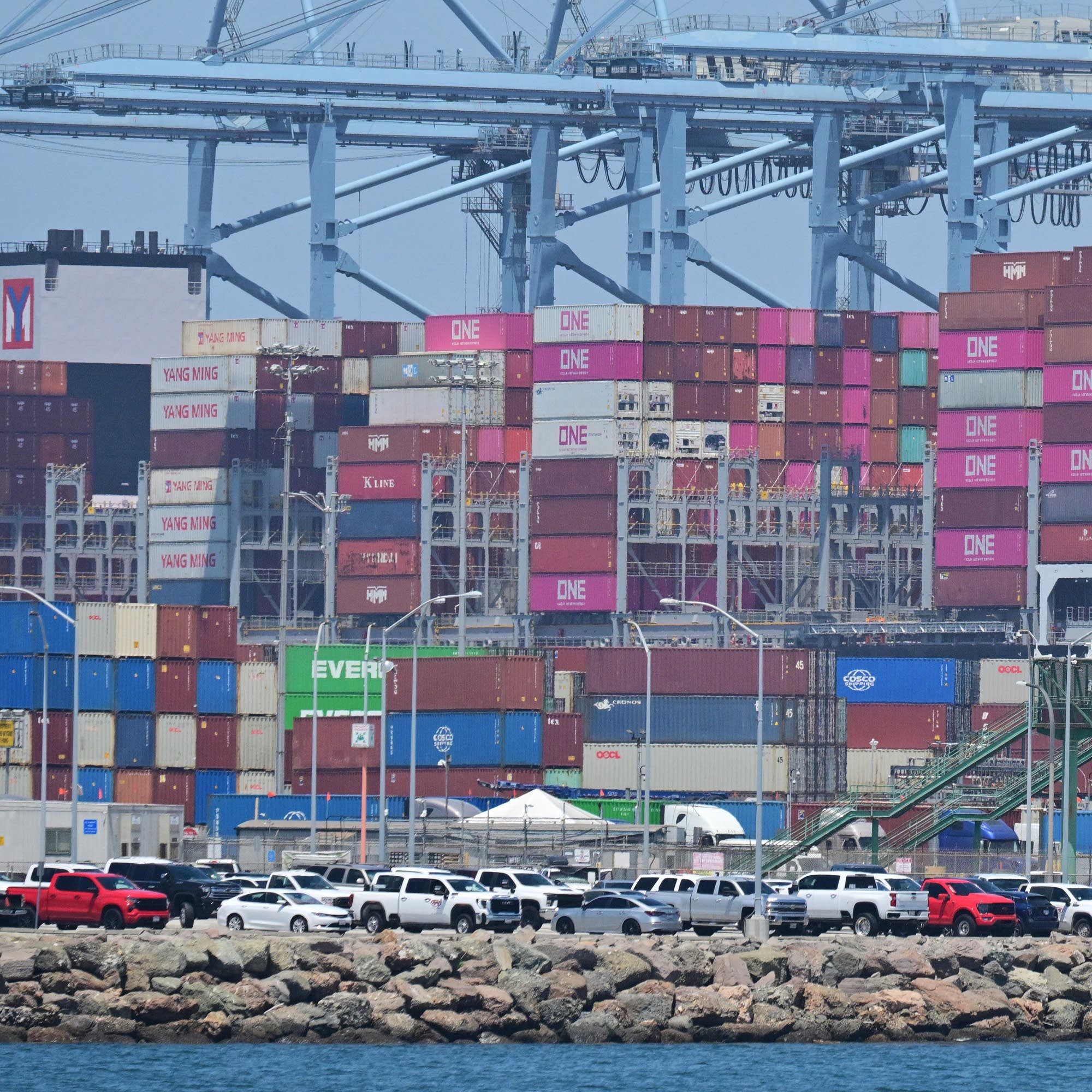
August marked the third-highest level of container imports to the U.S. on record. Sure, it’s usually a busy month for holiday shopping inventory, but there’s also that pesky looming inflation and ongoing tariff uncertainty. In this episode, why U.S. retailers are stocking way up. Plus: The stock market braces for a likely Fed rate hike, wildlife highway crossings save money and lives, and Carter’s undergoes a rebrand aimed at a new generation of parents.
Every story has an economic angle. Want some in your inbox? Subscribe to our daily or weekly newsletter.
Marketplace is more than a radio show. Check out our original reporting and financial literacy content at marketplace.org — and consider making an investment in our future.
Read the stories in today’s episode:
- If the Fed hikes rates, here's how the stock market might respond
- For those without a degree, the job market looks pretty good
- Imports boomed this summer in anticipation of higher costs
- Wildlife use bridges and tunnels too, but it’s spendy
- Carter's big rebrand amid challenging children's clothing market
- The complicated history of New York's iconic Charging Bull statue
Get every episode summarized
Each time Marketplace publishes, we email you a written briefing from the transcript — the topics, who appeared, and any specific claims, with the ad reads skipped.
Email me new episodesFree for 3 shows. No card needed.
Hosts & guests

Transcript ready
231 searchable segments. Every word is indexed and playable.
Full transcript
Marketplace — Imports are way, way up. Machine-transcribed; use the interactive transcript above to jump the player to any line.
Running a business is hard enough, so why make it harder with a dozen different apps that don't talk to each other? Introducing ODO. The only business software you'll ever need. It's an all-to-one, fully integrated platform that makes your work easier. From CRM, accounting, inventory, e-commerce, and more. And the best part, ODO replaces multiple expensive platforms for a fraction of the cost. This is why over thousands of businesses have made the switch. So why not you? Try ODO for free at odu.com. That's odu.com. This message comes from Capital One Commercial Bank. Your business requires commercial banking solutions that prioritize your long-term success. With Capital One, get a full suite of financial products and services tailored to meet your needs today and goals for tomorrow. Learn more at capital.1 slash commercial. Member FDIC. On the program today, we'll talk about the markets, stock, and labor both.
A corporate rebrand and the Wall Street Bowl. From American public media. This is Marketplace. In Los Angeles, I'm Kyle Rizdall. It is Tuesday, today, the 15th day of September. Good as it always is. To have you along, everybody. You know, one of the realities of the Kevin Warshled Federal Reserve is that we kind of don't really know what the central bank is going to do when it wraps up its two-day meeting tomorrow. Lack of forward guidance at all. But just because we don't know, doesn't mean Wall Street doesn't have an expectation, a 90 plus percent expectation that Warsh et al will raise their benchmark interest rate by a quarter of a percentage point. So money will get more expensive. That, of course, will trickle out through the economy. And in that way that capitalism works is going to make its way back to Wall Street.
Marketplace's Mitchell Harman gets his going. So what could happen the day after or even the afternoon after the Fed hikes its benchmark interest rate? We probably shouldn't expect a large and immediate impact of a rate hike on stocks since it's already priced in. Bill Mers at US Bank Asset Management says capital markets have been anticipating higher rates for a while. And once the Fed starts, it's not usually one and done. There's a limit to what a single rate hike can do. Markets are already pricing in three to four rate hikes by next summer. It's an open question how much rate hikes might drag on business investment and consumer spending, which are key drivers of corporate profits and stock prices. But up till now, they've held up strongly. S&P 500 earnings, they're expected to grow about 31 percent this year and about 14 percent next year. Yon Grown, chief economist at Societage in Iraq, has an altogether less saying wine view of what's coming. I mean, it's definitely not pricing to stocks. So we'll see what's going to happen tomorrow.
Grown says with a new Fed share who hasn't established his credibility yet and shuns forward guidance about interest rates. The market is just not really believing the Fed that really has the willingness to go all the way. He thinks investors will eventually get the message with stock prices taking a hit later this year when he predicts inflation will still be high inducing the Fed to hike rates again. Equity analyst Jeffrey Roach at LPL Financial has looked at the last 30 years of Fed rate hiking. What he's found mirrors something a former Fed chair once said about taking away the punch bowl. The punch in the bowl is low interest rates, the lubricating beverage that brings investors to the stock buying party. When rates go up, you get the punch bowl taken away, you complain for a little bit. Then after a while you just move on. Historically, stocks tend to fall for a few months, but 12 months after that they're back in the black as companies and consumers adjust to higher rates. I'm Mitchell Hartman for Marketplace. Well, speaking of which Wall Street today stocks down bonds up yields that is oil up as well, details numbers when we get there.
Most of the time when we talk about the American labor force, we talk about it in the aggregate, the overall unemployment rate, the total number of new jobs created. You get it, right? The US workforce though is not a monolith, 170 ish million people in different categories and different places with vastly different occupations. And it turns out that half of that labor force right now, the half or so without college degrees, is having a very different year than the other half. Dad Levin on wrote about it the other day, he's the chief economist at the Burning Glass Institute. Welcome to the program. Thanks for having me. You have written and we have all heard and we've reported on this program that it's it's been a tough year for recent college graduates. Tell me though about this other half of which you write. Yeah, the other half which is mostly people without a bachelor degree are actually having a pretty good year.
Their unemployment rate is unusually low compared to their history. So that's that's a very good development for them. It is indeed. Why is it happening? I think there are several reasons. One is that over time, fewer and fewer people at that age group do not have a bachelor degree. Yet the number of jobs that meets that education group is continuing to grow. So we have kind of a shortage in blue color and manual services workers. There is also the fact that so far AI is much less impactful for jobs that don't require a bachelor degree than for more professional and management related job. And finally, the change in the immigration policy is, you know, remove the lot of undocumented immigrants and they mostly compete with the people who do not have a bachelor degree.
So now it's easier for the remaining population to find a job. Right. For those at the at the lower end of the employment spectrum, they are getting more jobs. There are more jobs for them to have. What's the pay in those jobs or wages doing them any good? Yeah. In recent years, their wages have been growing faster than for a worker, a young workers with a bachelor degree. So the kind of the bachelor degree premium in terms of wages is shrinking. Let's look at real wages here for a second now, adjusting for inflation. Is that still true that the bottom end is doing all right? Yeah. You know, during especially the period of the strong labor shortage that we had in 2021-22, then the increasing pay for manual services and blue color jobs was much, much higher than for college grads.
Just to be clear here, it's not like it's bad out there for recent college graduates, right? I mean, they're still getting jobs at some decent rate. Yeah, the large majority of them are finding jobs. But compared to history and given that we are now in an actually pretty strong economy and profitability of companies is very high. So given all that, you'd expect their unemployment to be lower than it is now. Right. Just imagine what will happen if the macro conditions change and we start seeing layoffs and companies worried about profitability. I think that will get the world quickly. All right. So rolling in altogether for me macroeconomic conditions, things like interest rates and unemployment rate and the overall labor market. Does this trend for the folks on the lower end of that spectrum? Does the trend hold, do you think? I think for the near future, yes. But one thing that I think is under discussed is that while now the AI is mostly impacting office related jobs, I think the day when it will also impact manual types of jobs is not that far and getting closer rapidly.
So I think I wouldn't let the current condition change people's decision of whether to go to college because I think in 10, 20 years we will see even more automation of labor, manual labor jobs than for professional jobs. Yeah. God, let me know. Chief economist at the Burning Glass Institute. God, thanks very much for your time. I appreciate it. Thank you. Enjoy it. Hey, you know what we haven't talked about in a while? I mean, a lot of things, I guess, but I'm thinking specifically here about supply chains. And we haven't talked about them mostly because they're working pretty well. Business is booming at US ports because we've been importing a whole lot of stuff. The portal Long Beach here in Southern California just logged its busiest August ever and its fifth busiest month ever. The portal Los Angeles right next door. It's one big complex just had its biggest summer on record.
And the nation as a whole has marked its third highest month for container imports. That's mostly commercial stuff like the stuff you buy from Amazon. All those records, by the way, despite trade wars and actual wars and inflation marketplace is killing wells explains what's going on there. There are two big reasons why imports are especially high this year. Lisa L. Ram who teaches supply chain management at Miami University in Ohio says for one thing, the economy is still pretty strong. I wouldn't anticipate the consumers would still be buying things like they have been, but apparently they are. And for another, the economy is really uncertain partly because the war in the mid east keeps dragging on and dragging oil prices up. So importers, they want to lock in to the rates now for anything that they think they might be needing in the future. Importers are uncertain partly because of ever changing tariffs. The uncertainty caused companies to start hedging to start inventory front loading.
Joseph Sarkis teaches supply chain management at Worcester Polytechnic Institute. He says the tariffs are not doing what the Trump administration wants them to do. These tariffs are not stopping organizations companies from purchasing from international sourcing. And those importers don't really have any alternatives. Rob Hanfield who teaches supply chain management at North Carolina State University says building domestic capacity could take a decade transitioning to a domestic manufacturing base isn't easy because we just don't have that capacity. In part, it's been a good summer for imports because that time of year is usually good for them August is traditionally a big month for imports. Because that's right when companies are setting up their inventories for holiday shopping. I'm Kayleigh Wells for Marketplace.
Every year on the highways and byways of this country millions of cars and trucks run into wildlife. That's problem. Yes, obviously for the animals. Also though for human safety and economic well-being. Those collisions cost drivers and their insurers billions of dollars a year in repairs. The thing is there are actually ways to keep drivers safe and wildlife off roads. But a federal program that helps provide safe passage for deer and bears and elk and all the other critters out there runs out of money this year. Marketplace of Kentland tan takes us to western Wyoming. U.S. Highway 191 connects the town of Pineville, Wyoming to Jackson Hole, Yellowstone, Grand Teton National Park, tourists, daily commuters and livestock trucks drive it. And there used to be this one dangerous stretch. It was an absolute gauntlet and it was terrifying to drive, especially after dark. I'm standing on a hill above that stretch with Jill Randall. She's with Wyoming game and fish.
You know, half a dozen pronghorn get hit by a semi or something like that and it would just be a blood bath right down the highway. You see the road slices through a sagebrush ecosystem that's hundreds of miles long and is home to 40,000 pronghorn, which some people just call analog. They travel through the area Randall and I are standing to get to their summer and winter ranges. Pronghorn have been using this area to cross for over 7,000 years. So even with a highway and traffic, they still tried to dart across. But that blood bath gauntlet stopped about 12 years ago when a wildlife crossing was built. So this is kind of a bridge that goes over the highway. Randall walks with me over the grassy path lined with tall dirt berms. It's 150 feet wide. Wow, so when you're really out here is wide. Yeah, it feels a lot more connected to kind of the range land.
You don't feel like you're standing on top of the highway right here. It's one of two crossings in the area. Tall fencing lines the highway to funnel pronghorn to the bridges and it was almost immediately effective. For pronghorn, we've had about 100% reduction in mortality. Other animals use this grassy freeway like Mule Deer and Sage Grouse. They don't have to pay at all the people do. The project cost 11 million dollars. Kind of a bargain says Randall. The cost of doing nothing was going to exceed the cost of constructing the project in less than 15 years. Pew research estimates about 200 people die each year from wildlife collisions. Thousands more are injured. And car repairs cost drivers at least 8 billion dollars a year. I've had a deer before. It's absolutely terrifying. Rebecca Baslow King is with the Center for Large Landscape Conservation and she was driving at night in Montana.
I mean, we just absolutely smashed a deer in the front of the car. Unfortunately, we were okay. But the car wasn't. It all likely could have been avoided if there was a wildlife crossing structure. They prevent collisions. They support public safety. They save money. Congress set aside $350 million five years ago. Dozens of projects got money like a panther and alligator crossing in Florida. In Nevada, 61 underpasses for the Mojave Desert Tortoise. The demand when those grants have opened has been like five to one in terms of available funding. But the money is drying up. There's so much work to do. It is it is overwhelming. Marcel Hauser is with the Western Transportation Institute. He says some communities have gotten creative. Increasing county taxes. And in Montana, 20 bucks from each wildlife license plate goes toward crossings. But when you're looking at a $10 million plus project, Hauser says you're going to need federal help.
Mostly because our roads are similarly funded. So the problems are associated with having roads and traffic. It's an infrastructure problem. And there is another five years of funding earmarked in a bill that's sitting in Congress. I'm Caitlin Tann for Marketplace. The state of America is the most important source of funding to the world. The state of America is the most important source of funding to the world. The state of America is the most important source of funding to the world. Coming up, that would mean the city would have something worth $10 million on public land. I mean, okay, first though, let's do the numbers. Downdustrels down 328 today, that's 0.610th is the percent equivalent 52,093.
The NASDAQ down 204 points, about 810th percent, 25,981. The S&P 500 slid 34 points, 410th percent, ended things at 75,85. There's another number for you. 70% 70, that's how much the national average for a gallon of diesel fuel is increased from one year ago. So says AAA, currently at a record high of $6.26 per price of global oil. Benchmark Brent Crew rose 2.8% on the day, $108.00, Barrow West Texas, and immediate. Hello, Creshing Oklahoma, up nearly 4.5% $105.00 per single barrel of that. Kelly was talking about record cargo, trapping US ports, shipping and logistics company Mattson picked up 810th percent star bulk carriers. That in 1 and 210th percent, bonds down, yield on the 10-year tee note up to 5%. Actually, the close was 4.9999. You're listening to Marketplace. Running a business is hard enough, so why make it harder with a dozen different apps that don't talk to each other?
Introducing Odo, the only business software you'll ever need. It's an all-to-one fully integrated platform that makes your work easier, from CRM, accounting, inventory, e-commerce, and more. And the best part, Odo replaces multiple expensive platforms for a fraction of the cost. This is why over thousands of businesses have made the switch. So why not you? Try Odo for free at odu.com. That's odo.com. The Marketplace podcast is supported by the University of Illinois Geese College of Business. Earn a world-class MBA degree completely online at your own pace. Through their online MBA program, you'll learn from amazing faculty and network with classmates on a global scale without having to put your career on hold. Take your career to the next level by applying what you learn in real time. Start at online MBA dot Illinois dot edu. That's online MBA dot Illinois dot edu. Support comes from wise, the smart way to manage the currencies you need around the globe.
Fed up with losing out to hidden fees when you send money abroad with your everyday bank, choose the smart way. Wise, you can count on the exchange rate you'd usually find on Google. No unwelcome surprises. Plus, ditch that, where's my money feeling? Both transfers arrive in under 20 seconds. Join millions, saving billions on hidden fees. Be smart, get wise, download the Wise app today. Tease and seize, apply. This message comes from Capital One Commercial Bank. Your business requires commercial banking solutions that prioritize your long-term success. With Capital One, get a full suite of financial products and services tailored to meet your needs today and goals for tomorrow. Learn more at capital dot one slash commercial member FDIC. This is Marketplace. I'm Kai Rizdal. All right, here's a question. What do you do if you're a 161 year old kids clothing company and you're trying to keep up in a retail economy that is changing almost every time you turn around?
Your rebrand is what you do. Carters, perhaps better known to parents as purveyors of Oshkoshbagosh and Skiphop is out with a new logo and a new marketing campaign. As it tries to catch the attention of a new generation of parents who shop differently than their parents did in a slice of this economy that is dealing as many others are with changing demographics and sharper competition. Marketplace is Stephanie Hughes reports. Carters is the largest baby clothing company in the country. It has a bunch of known brands. So why the refresh the old logo was frankly pretty basic. Tom Nickuch is an equity research with Needham and company the old logo was block letters spelling out carters. The new ones in cursive has a little star where the apostrophe used to be. Nickuch says it's more whimsical kind of reflecting that you know children are you know the shining stars in our lives. That fits with the new marketing campaign called watch them glow. Nickuch says the idea is to catch the attention of the modern parent which there aren't as many of these days.
Because there's one big issue facing the children's clothing industry. There are fewer children essentially since the great financial crisis. The number of births in the US has declined almost every year. More than 700,000 fewer kids were born last year than in 2007. And there's increased competition to sell tiny pants for those existing kids with digitally native brands popping up. And only so much parents are willing to pay. Neil Saunders is managing director with global data. There's a lot of price sensitivity. Parents don't always look for the absolute cheapest thing because they are focused on quality as well. But they are laser focused on value. One of those value shoppers is Jessica Pokerl. She has a 10 year old son and a nine month old daughter. She looks for deals more now than when her first child was born. I'm more likely to buy things used. And then I want to resell it. Let's say she has something nice name brand resellable that she gets a spain on. I am working in the laundry room to get that out.
She's part of the resell market for kids clothing which has expanded. That's yet another challenge for companies selling those tiny new pants. I'm Stephanie Hughes from Marketplace. All right. Let's take a little bit of a turn here. Shall we from kids clothes to the heart of American capitalism or more accurately to an icon thereof in New York City down in Lower Manhattan. There's a statue that has come to symbolize Wall Street that is visited by hundreds of thousands if not millions actually of tourists every single year. The charging bull sits just north of bowling green. Ben Fractinburg wrote about the history of it for the city reporter. My name is Ben Fractinburg and I'm the visuals editor at the city reporter local news site in New York.
As a photographer, you know, I'm always keeping my eye open for interesting stories, especially in the summer. And I happen to be walking by the bull the colleague of mine. I noticed a long line of people a tourist lining up behind the bull to take photos with its rear end. And they were waiting upwards of like 45 minutes. And I thought, well, this could be, you know, a funny sort of fun social media story to do in the summer. And then as I started reporting the plot thickened so to speak. This Italian artist named Arturo D'Amodica decided to make this giant seven ton golden statue of a bull that looks like it's about to charge at you. Really to honor the vitality of the American people and the way that American people have, you know, rebounded from difficult times. You know, other stock market crashes, but including the one in 1987. And just before Christmas of 1989, he placed it in front of the stock exchange as a piece of guerrilla art.
And the leaders of the stock exchange at that time, you know, were not too happy about it and paid to have it placed in storage in Queens. This gentleman Arthur Piccolo who works in Lormenhat and read the story in the New York Post about it was inspired to get in touch with the artist. You know, this is the late 80s. So the only way to track down this artist was to look through the phone book and convinced Arturo that it would be a good idea to have it moved to bowling green. So the artist paid to have it taken out of storage and placed in bowling green and it's been there ever since. No, we don't know who owns the bull. You know, I spent nearly a month trying to figure it out calling everybody I could trying to get in touch with everybody I could connected with Arturo who sadly passed away, got in touch with lawyers that were involved with his estate. You know, he didn't have a will so couldn't find it that way. You know, the city doesn't own it. It's sort of amazing to me that nobody in city government would know.
You know, it was reported that Arturo had put it up for sale in the mid 2000s and he was asking $5 million then. Let's say it's that was the value and it's at least doubled in value in 20 years. That would mean the city would have something worth $10 million on public land and not know who's liable for it. I've definitely gone down the rabbit hole with this not to mix metaphors and I've become a little bit obsessed with it. You know, I want to my I'm still trying to figure it out. I've been making international phone calls to the gallery that purport it to represent him when Arturo the artist passed away and you know, just trying to get people on the phone. Well, the sort of funny interesting thing about it too is that it's one of the most famous symbols of capitalism. At least in New York City, I'd say behind the stock exchange, it's the most famous symbol of a free market system. So the fact that nobody knows who actually owns it, I think there is definitely a bit of a poetic irony there.
Yeah, a little bit of irony. Ben Frackenberg of the city reporter in New York City. This final note on the way out today, there was new data from the Census Bureau this morning on household finances. Media and household income hit $87,000 last year, $87,460 to be precise. The fly in the ointment, if you will, is that that 2025 data is before President Trump's war with Iran. Also women who worked full time year round last year, earned about $0.84 for every dollar that men worked. That is up, although obviously not enough, from 81 cents a year earlier. Jordan Manjus and Neil Maharas, Janet Wynn, Olga Oxman and Virginia K Smith are the digital team. I'm Kai Rizdal Wewils, see you tomorrow, everybody.
This is APM. I'm Lee Hawkins, host of Must Be the Money, a podcast for Marketplace. Each week I speak with inspiring entrepreneurs and business leaders about their lived experiences, and they share tangible insights to help guide your path to success. Here from icons like Angelica Nwandu, Van Lathan, Angela Yee, Matt Barnes, and more about how to seize opportunity, manage money and meet challenges with resilience. Listen to Must Be the Money, wherever you get your podcasts.
More episodes
More from Marketplace

Caught in the Canada trade war crossfire
Marketplace

Home improvement stores feel the pinch
Marketplace

Bond traders take a turn in the spotlight
Marketplace

A cast of hawkish central bankers
Marketplace