About this episode
Get every episode summarized
Each time Radio Islam publishes, we email you a written briefing from the transcript — the topics, who appeared, and any specific claims, with the ad reads skipped.
Email me new episodesFree for 3 shows. No card needed.
Hosts & guests
Transcript ready
321 searchable segments. Every word is indexed and playable.
Full transcript
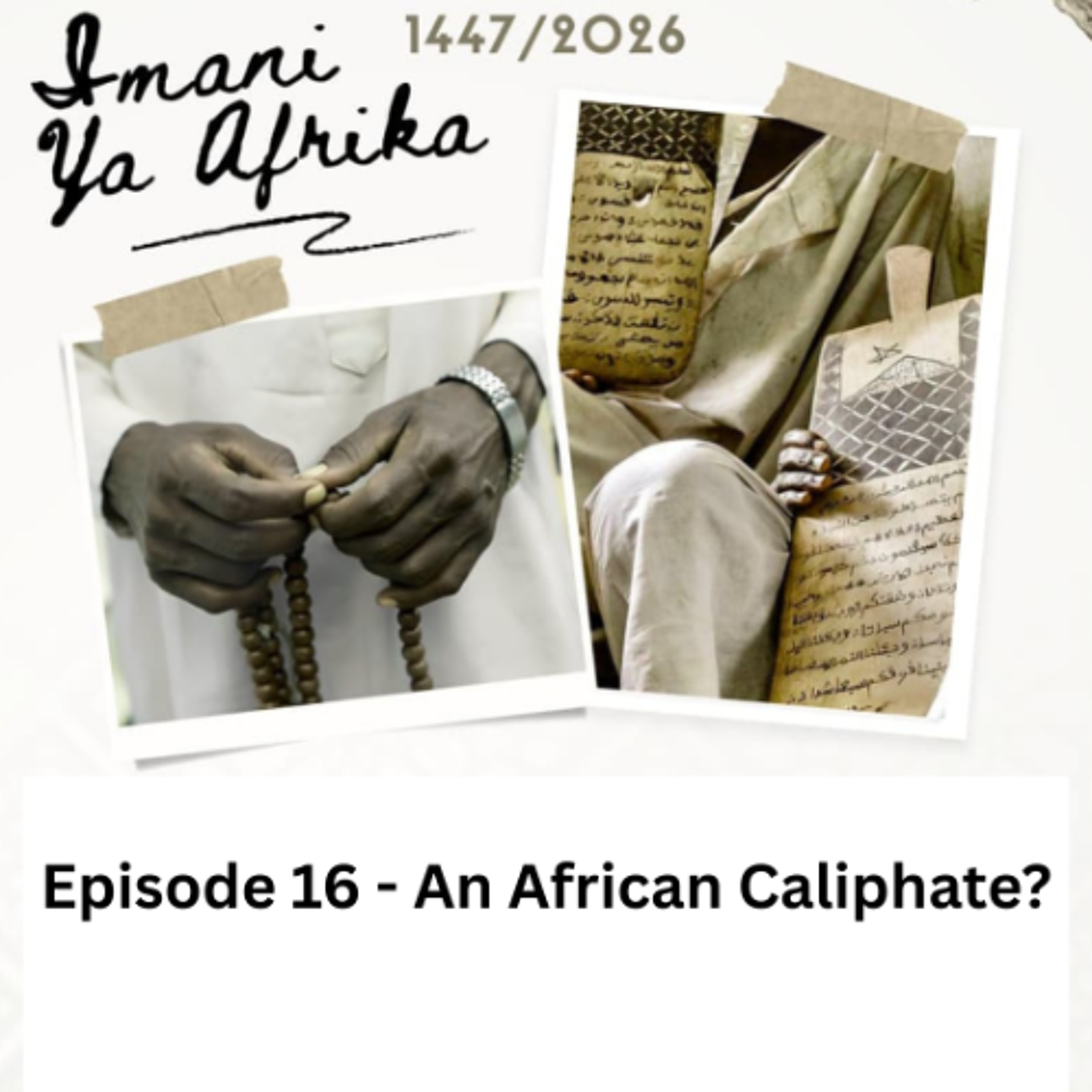
Radio Islam — Imani ya Afrika - Episode 16 - An African Caliphate. Machine-transcribed; use the interactive transcript above to jump the player to any line.
When you think Muslim-hero, what comes to your mind? Do you think Salah-e-Din, Mehmet Fateh, or how about the Mamluksultan Saif-e-Din-Klotus? All of them military leaders, all of them wielded unimaginable strength, but what if I told you that there existed another Muslim-hero whose story was so miraculous that it seems like something out of a novel? Chances are, you probably never heard of him. From humble beginnings as a student of knowledge to the rise of being the founder of a new movement that would transform and revive Islam right here, in the belly of Africa. Pre-colonial Islamic history in West Africa is characterized not only by glowing dynasties and rich educational endeavors. It is also marked by powerful revival's movements that sought to reform religious life and establish governance based on Islamic principles. In the 11th and 12th centuries, powerful reformist movements arose in North Africa
that would profoundly shape the Islamic history of both the Maghrib and West Africa. The Morabitun dynasty emerged in the 11th century under the guidance of the Skala Abdullah-e-Venyaa Sin. Although rooted amongst the Sanharja Berber tribes of the Western Sahara and North Africa, the movement quickly diffused southwards into regions corresponding to present-day Mauritania and Senegal while also expanding northward into Morocco. From these desert foundations, the Morabitun built a formidable political and religious movement that strengthened Islamic practice and trenched Malikifik across Western Islamic lands and forged trans-Saharan links between North and West Africa. Their power proved decisive beyond what is considered Africa as well. When Muslim rule in Al-Andalus came under severe pressure from the Christian kingdoms Morabitun armies crossed into Spain and played a pivotal role in reviving and stabilizing Muslim political authority there. In the 12th century, they were eventually replaced by another reformist movement
in Muahidun, founded by Ibn Tumat, which went on to dominate much of North Africa and Al-Andalus. Sin had become weak, one old man had figured he went for Hajj. He spoke to Al-Alamah, please come help me bring alive deen in my people. See, you went to North Africa and he spoke to the Al-Alamah there and they sent a man by the name of Abdullah bin Yasin. So he came into these areas and worked on the Sanhaja-Lamhtuna communities. And they lived in the desert so they used to wear their Imamah and they used to cover their faces to protect them from the heat of the sun and the desert sand. Mulahtamiin, they were known as. And when this alim used to teach them, many people didn't like it. This community were upset with Abdullah bin Yasin because he came from another area. And he carried on with his Dawat. But then they tried to kill him. They tried to burn his house while he was inside. He got out of the house and he ran and he chased him. He ran into the desert. And in the desert he ran and ran until he fell.
And he fell in such a dying he cried to Allah. He says, oh my Allah, what do I do? By this time this is about 450 hijri now. He made years of effort. Oh my Allah, what do I do? If I go back home, dead deen is strong. Who's going to guide these people? And with determination he returned. He stood at the entrance of town and he said to them, that I know you all don't want me, but I want you. Who of you will join me and he made the skill? If you don't want me, I'll stay in the desert. I'll sleep in a tent. But I'll teach those who want. And the man who invited him, Sheikh Yahya joined him, Al-Lamduni. And few others, five of them. And he started teaching them. And look how Allah makes it with the effort. Five becomes ten. Ten becomes twenty. Twenty becomes hundred. Hundred. Thousand. Thousands. They took over an area called Murraakish. That was an area infested with highway robbery and hijacking. But through Dawah, through Iman, through Aamal, it became an area of deen and Iman and salamati.
Murraakish actually translated means, Mur Sariyan, when you pass your travel quickly, it's a warning. You're going to be hijacked. But look how deen changes it. Two weeks ago, I was called to a distant part of Western Africa. To a place called Sokoto in Nigeria, which is the mouth of the Sahara Desert. And it flying over the desert and coming down into this historic town, I was surprised to see that the people were living in a type of Islamic bubble. They were living in an Islamic world. 99% of the women wearing hijab.
90% of the men actually were wearing Islamic clothes. When the time comes for prayer, if they couldn't make it in the masjid, they pray in the streets. They pray in the front of their business. When Timbuktu was at its peak in the 15th and 16th centuries, a number of its scholars came to live and work in Hausa Land. Hausa Land refers to the historical region of West Africa, inhabited by the Hausa people, covering parts of present-day Nigeria and Niger. Before the colonial period, it consisted of a network of independent city-states, such as Kano, Katzina and Zaria. Isoufi Sheikh Muhammad Ibn Abdul-Kareem Al-Maghili visited Kano about the stand. Al-Haj Ahmed bin Omar Aqeed settled in Kano, where he taught Islam, and Muhammad Ibn Ahmed became a magistrate in Katzina. After the initial entry of Islam into this region, in the later centuries,
a number of scholars led jihad movements in this area, aimed at correcting religious practice and challenging existing political orders. The most notable example emerged in present-day Nigeria, where the scholar, with Maidan Danfodio, led a reform movement that resulted in the establishment of the so-called Sokato Khilafa. Those and similar movements reflect the dynamism and vibrancy of Islam in West Africa, and often overlooking dimension of Islamic history. While discussions of revivalist movements and caliphates tend to focus on regions beyond Africa, West African Muslim societies, likewise, produced powerful reform movements that sought to renew religious commitment, reshape political authority, and align social life more closely with Islamic teachings. Of Maidan Fodio was born in the Hausa city-state of Gobiir, in the year 1754. He belonged to the Torodbe, a clan of scholars and teachers who came to exercise powerful influence
as royal advisers and administrators. He also became a disciple of the Qadiriyah Tariqah. The Shahu was born into a highly-cultured family and was fed religious Islamic knowledge until he couldn't fit it within his mental capacity. His father was Muhammad Ibn Saleh, known generally as Fodio, all the Lunar. And his mother was Hawa, bin Muhammad Ibn Atman. His first teachers were his parents, as he learned the Qur'an under his father's hand, and most of his education was from his family and close relatives. Afterwards, he studied Hadith in which he received qualifications in the six most canonical books of Hadith, including Al-Mawatta by Imam Malik. He then mastered Arabic, grammar, morphology, and rhetoric. Plus, getting qualification in Tefsir of the Qur'an and became a jurist in the Maliki method. In his studies, Shia Khufman learned the basics of reading, writing, and deen through his boyhood while learning the Qur'an from his father. He would also study with the acclaimed regional scholar, Jibril bin Omar, with whom he would influence his further
for social, economic, and spiritual reform in West Africa. Part of the process of Tejdid involves a Mujedded taking a group of people and sculpting their character to that of the prophetic moral. These people then go out to call for the revival of Islam. They are the shapers and shakers who shoulder the responsibility of running the new social aura when it is established. As a Mujedded created people who are reflections of his own image who in turn create others in the same fashion and so on. He couldn't rely on the scholars that had rooted themselves in the corrupt infertile land. Instead, he created his own community of scholars and teachers. These students of his formed the inner core of a movement and spearheaded the prosecution of the true Jihad and carried it to its successful end. Shia Khufman began preaching and teaching religion and its role in society. Growing influence around his place of birth attracted the eyes of the Hausa rulers who vehemently opposed the preaching of the deen in the region. The ruling authorities became increasingly religiously
suppressive and despotic with their authority to the point where the core principles of Islam were not able to be practised. The social system was immoral and women were oppressed as Shia Khuf said they were neglected like animals. Mixing was very open and rampant. Chaining and fraud was rife as certain Sharia laws concerning property were key to the Hausa ruling class. Muslim scholars were silent in the face of such tyranny and injustice. Some even supported it and others objected to it. Although he is renowned as a fervent revival of Islamic rulership in the region, his original intent wasn't to acquire political authority or leadership. He was focused on social reform. He addressed the social ills, not looking at political things. What are the social problems? What are the family problems? What are the problems with the youth? He fought and struggled for women education. That women have to be educated in Islam. He struggled and he corrected the innovations
that had come into their religious practice. And he showed them separate your culture from your religion. His reform message brought him into tension with the political authorities, including the ruler of Kabir, who he addressed, calling for justice and adherence to Islamic law. Perhaps in an effort to buy the loyalty of the Shia Khuf, the king offered wealth in arms like gold. Of man stood up before the king and said he and his community are in no need of his wealth. Instead, he requested a couple of things. And the Shia told him, I have five demands. Number one, allow me to call to Islam freely within these lands. Number two, anybody who accepts Islam should not be forced to go back. Number three, treat every man with a turban and every woman with a hijab with respect.
Number four, free all political prisoners. This is an Islamic scholar. But he said free all political prisoners. And five, that you should lift the taxes. Lift the unjust taxes off the masses of the people. So he was seeking economic reform. And this is important that our Islam is connected with our economic life. Sometimes we separate our Islam and we say, no, that's religious. But now I'm doing my business. That's religious. No, I'm running a state. No, it's all together under the laws of Allah, so part of it all. When a ruler by the name of Yunfa became the Sarki of Kabir in 1802, he initially showed respect for the Shia Khuf. Soon, he, however, also realized the perceived danger that Shia Khuf man and his followers posed to his rule and began to threaten them. In 1803, Yunfa summoned Shia Khuf man down for you to his court
where he attempted to have him killed. He was determined to break the Shia Khspawa. Yunfa had invited Shia Khuf man to his palace and so to end his greatest threat. Upon entering the palace with his brother Abdullahi, the Sultan fired his gun at the Shia Khuf in an attempt to kill him. By some miracle, the gun misfired and almost burnt Yunfa in the process. Athman Danferio had survived the attempt. Yunfa made his enmity clear to Athman. The Shia Khuf bravely informed Yunfa that he does not fee him, nor anyone except Allah. Danferio walked away unharmed and didn't mention this to a single soul. There are many milestones of Shia Khuf man Danferio's life. In his subsequent struggles and leadership, that bear resemblance to the noble Sira of Rasulullah Salallahu Alaihi Wasallam. Hidra was now on the table and according to the Shia Khuf, obligatory if the Jamaha was to survive its spiritual journey. Now, I don't know about you, but this is starting to sound like something similar to the Prophet's story.
In 1804, the Shia Khuf and his followers left Degal and made Hidra to goodle. The scale of people fleeing alarmed the rulers of Goba. So much so that efforts were made to stop the mass movements by intimidation, plunder and slaughter. This was followed by persecution of Muslims, killings and confiscation of property. This, as you would expect, was suffocating the Muslims and left them with no choice, but to take up arms and defend themselves. The only option left on the table was Jihad. So the flag of Islam was hoisted for the first time in that region. They pointed his brother in esteemed scholar Abdullahi as its commander. The Jamaha wasn't as organized and well-equipped as the Goba forces, as they were made up of people who were poor and driven away from their homes and properties. But they all had one thing in common. That is, their beliefs and being inspired by their love for Allah and his religion.
The two armies met at Gurdam on a lake known as Teppkin Kwato, in 1804. By some miracle, the Muslims emerged victorious. Abdullahi said this victory was their battle of battle. This greatly boosted the morale of the Muslim forces and enhanced the prestige of the Shahu and increased his influence. But this was, in no way, a complete victory with a bow on top. Several years of hardship laid ahead and owe how hard they were. They were surrounded by enemies, persistent hunger and starvation, as well as raging war remained an obstacle in the face of their survival. So if the battle of Teppkin Kwato was their battle, then the battle of Tuan Tuwa was their battle of Ahud. Abdullahi was injured and nursing a wound from battle, and Muhammad Billah Osman Sun was sick. Billah advised that the Jamaha not go out and meet the enemy. Instead, they should stay close to the camp and remain defensive.
The advice was rejected and the two armies met. The result was a crushing defeat to the Muslim. The Jamaha unleashed a feast counter attack on the enemy which retreated to Guwandu. This retreat was decisive in the turning point in the struggle, since Muslims never suffered defeat again at the hands of Hossar rulers. After several expeditions were undertaken, leaders from different parts of the region pledge allegiance to the Shahru and recognize him as a new Khalifa in Sakoto. By 1808, he and his followers conquered Gobiur, Kano and other Hossar city-states. He retired from battle in 1811 and returned to teaching and writing. But his armies continued their conquests until 1815. By that time, Shahrtan Fodjos' religious empire included most of what is now Nigeria and northern Cameroon as well as parts of Niger. For the first time in history, all of the Hossar city-states were now under one ruler. Shahrtan Fodjos established a new capital at Sakoto and soon his state was called the Sakoto Khilaf.
The establishment of the Khilafa meant that a new role emerged for the Shahru and his companions. Along with calling people to Islam, they now had to administer the state according to the Shahri'a stipulated in the Quran and the Sunnah. The Shahru was meticulous in stipulating principles and writing guidelines for which rulers and followers are to abide by if the Khilafa wished to grow morally, socially, economically and etc. He touched on everything from prioritizing justice in society and politics, employing righteous and courageous scholars as advisers to rulers, utilization of state resources and being conscientious of the hereafter. The so-called Khilafa established by Shahrhothman at Sakoto was called the Sakoto Khilafa and was based on the Abbasid model. The Khalifa assisted by a council of ministers, provincial administration was in the hands of governors who were appointed and could be deposed by the Sultan. At its height, the Caliphate included 15 major Emirates extending over 180,000 square miles and had 10 million inhabitants.
Beyond his jihad and rulership, the Sakoto movement also led to a poetic and literary explosion in the Hausa city-states. The surviving Arabic writings of the Sakoto Khilafa far outnumbered the whole literary production of the central and western Sudan from the year 1000 CE when Islam first appeared in West Africa up till 1802. Arabic was now widely used for diplomacy and correspondence throughout the region. Shahrhothman divided the responsibilities for the Khilafa between his two wazirs. Abdullah, who ran the western parts of the Khilafa and Muhammad Bello, who administered the eastern parts. The Shahrhuh remained Emir al-Mutminin, though he did not take the wreck part in the administration. He devoted most of his time to teaching and writing, counseling and guiding the Ummah. By the year 1812, the Shahrhuh had fully given up his responsibilities to the two wazirs. In 1815, he moved to Sakoto and in 1817, he died at the age of 63.
But in the last phase, he decided to leave the political path. And he said, I've done my job and the Shahrhuh spent the rest of his life teaching. That's when he went to the higher levels of spirituality, with specialized students. So it doesn't get out of control. People are going out of Islam outside of Islam with their spirituality. That's when he did in the last phase of his life. And he died in 1817 at 63 years old. So much even died at 63 years old. An illustrious shoot of the Dunfordio family is the Shahrh's daughter, Nana Asmao, trained by her father and extended family in the Islamic sciences. She went on to write over 60 poems and treatises spanning four languages. She expanded the Tataru system for female Islamic education. And in doing so, she expanded a network of Islamically grounded women who continue to serve West African Muslim communities until today.
Nana also played an advisory role to the Sakoto Khilafah. Her sister, Mariam, was also a capable scholar. Although the political Khilafah was later dismantled under colonial rule, the Sakoto Sultanate still exists today as an important religious institution in northern Nigeria, reflecting the enduring legacy of Shahrhuh Mandan Faudio's reform movement. Shahrhuh's Mandan Faudio was what I found to be that type of a scholar that a lot blessed might give a balanced approach and it is rare that you find somebody who has qualities like him.
More episodes
More from Radio Islam

How Children Shift The Dynamics of Marriage: Guest Fatima Talia
Radio Islam

The Big Picture with AB Dawjee – Sat,05.09.2026
Radio Islam

Your Sunday Reset (06.09.26)
Radio Islam

A Chef's Journey of Passion & Purpose: Chef Sameera Ismail
Radio Islam