About this episode
Get every episode summarized
Each time Radio Islam publishes, we email you a written briefing from the transcript — the topics, who appeared, and any specific claims, with the ad reads skipped.
Email me new episodesFree for 3 shows. No card needed.
Hosts & guests
Transcript ready
179 searchable segments. Every word is indexed and playable.
Full transcript
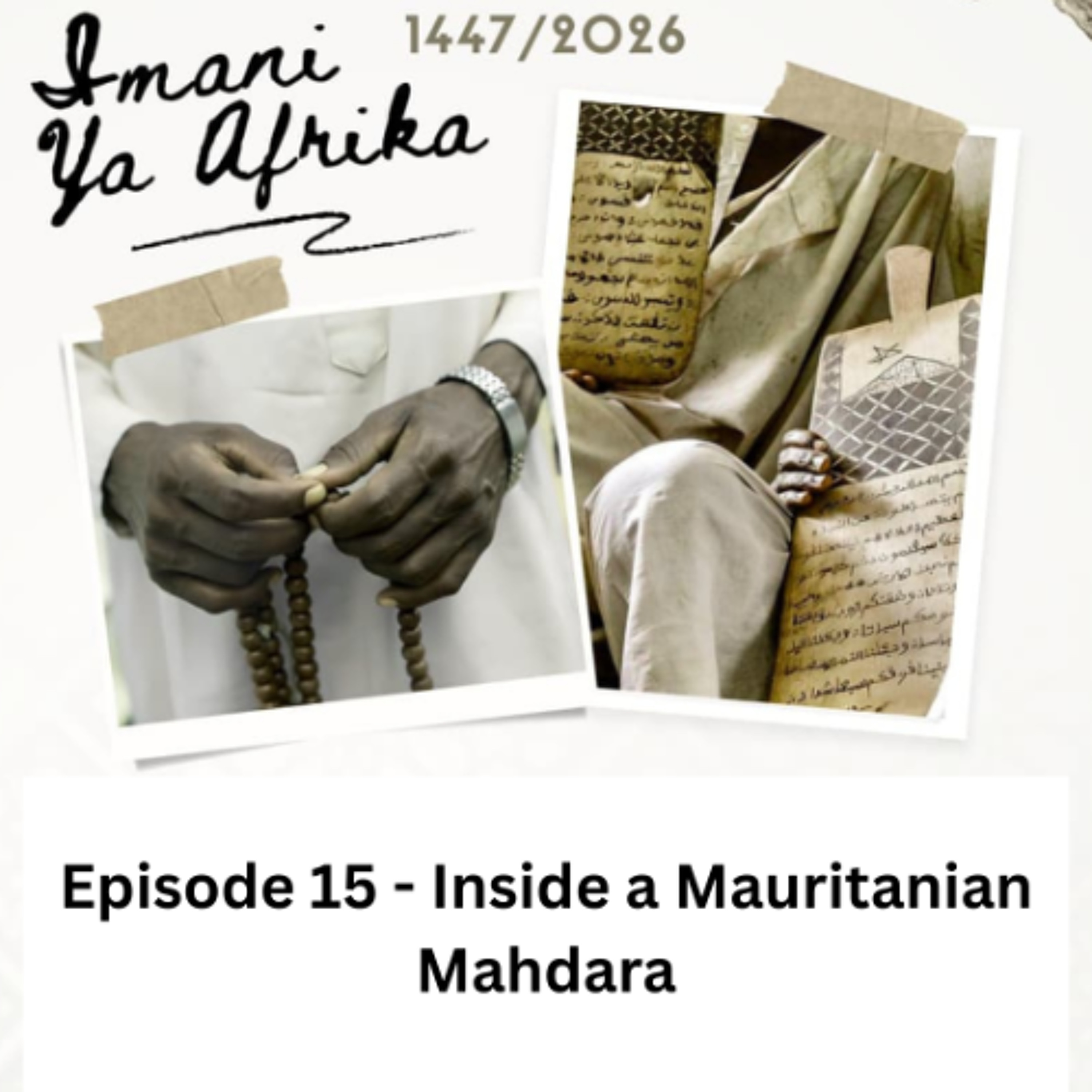
Radio Islam — Imani ya Afrika - Episode 15 - Inside a Mauritanian Mahdara. Machine-transcribed; use the interactive transcript above to jump the player to any line.
حمد اللي من أرسلها خير الرسولي لخير أمات بخير الملال وأفضل الصلاة والسلام على الوباب صفوة الأنامي وأله أفنان دوحات الشرف وصحبه والتابعين عم السلام the ol west african city of t��buks to is famous as a great center of who still learning from islam school to stage it is renowned for its many many schools and its archives of rare arabic manuscripts yet t tobouks to is not unique it was one among many scholarly centers to exist in pre-colonial west african في الوقت بيون تنبق two أسماني أماركاني أجوز that the intellectual history of Muslim West Africa was far richer, broader and more connected to the wider Muslim world than commonly assumed
West African Muslim scholars were deeply integrated into global Islamic intellectual networks they travelled widely for knowledge to places such as Cairo, Fais and the Hajjaz while scholars from North Africa and the Middle East also taught in the region as a result West African scholars actively contributed to feel such as Fick, Quranic studies, Akheda, Grammar and literature producing a substantial written tradition more than just oral teachings the Arabic language played a transformative role in West African history some Islamized people in the Sahara gradually let go of their linguistic cultural and ethnic identities to claim exclusive Arab identities others have retained the African languages but have used Arabic script to transcribe them to compose scholarly treatises to chronical history and to write poetry this book highlights another category of sources writing in Arabic languages or in African languages written in the Arabic script
the history of Arabic writing in Africa spans a period of 800 years and West African Muslim scholars side in their work scholars from a variety of region and I think this is evidence that they have long been integrated into a global network of intellectual exchange reflecting on how Islamic scholars have blended with local cultures across West Africa one needs to consider Ajami which is the practice of writing non-Arabic languages using the Arabic script there is virtually no region that has historically been under Islamic influence that has not adopted the Arabic alphabet for transcribing non-Arabic languages there is a tested usage of the Arabic script in 80 languages in all parts of Africa from the North, West, East, Central and even Southern Africa in excellent manuscripts in African languages as diverse as Walloth, Hausa, Fulani, Mondays, Songai and particularly Swahili
Ajami was not used only as a medium of correspondence but also as a medium of learning in which treatises and poems were written some hallmarks of Islamic education in classical Africa are a strong teacher student relationship based on the Ijaza system little in the way of formalities such as central administration, graduation exams or degrees and a strong focus on memorization and terpia a teacher taught the Quran or rules of grammar, fit and other subjects but he did way more than that he was the Morabit amongst Arabic speakers of Southern Sahara the Malam amongst the Hausa, the Serno amongst the Polar speakers, the Serine amongst the Walloth and the Mori amongst the Mandin he played a central role in most life cycle events whether it is birth, death, illness, employment, harvest, travel or elections the teacher intervened before and after to pray that his following or disciples might succeed
survive and be safe from reversal of fortunes the objective of this education was not for information but transformation a sentiment in the Walloth language of West Africa describes a product of this education system as a walking Quran meaning that the individual was transformed through education to become a virtuous Muslim someone who throughout his life follows the teaching of the Quran and refrains from its prohibitions vestiges of Africa's Islamic learning legacy can be seen in the distinct calligraphic scripts developed by the Muslims of Beladis Sudan and the means of collating manuscripts manuscripts were made of loose pieces of paper typically conserved in a goat's skin wallet wrapped around the text block travel also played a key role in diffusing knowledge and books to the region often pilgrims and route to or coming from the Hajj stopped in major cities to study and trade and brought back books to Beladis Sudan
African Muslim scholars produced works in all genres from Tafsir and Quranic sciences to Hadith, Syirah and Madh, Fikh, Akhidah, Tassawwuf and the Arabic language and Rakhia sciences numerically the most works are in the genre of Fikh historically, Andalusia and large parts of North Africa and West Africa have been governed by Maliki jurisprudence since the rise of the Morabitoon movement and as such Maliki works feature prominently in learning and teaching in this region in terms of Tassawwuf the two dominant Sufi orders of sub-Saharan Africa are the Qadiria and the Tijania young 15-year-old boy a militant boy just walks past he has memorized over six volumes of classical poetry which is over two thousand lines of poetry
the greatest medieval cities of Islamic learning Ashinkreet and Walata both situated in present day Mauritania Mauritania remains remarkable even today for preserving an authentic culture of learning where traditional desert Mahalder still nurtures students in Quran, Fikh and Arabic much as they have for centuries many people when they heard Mauritania they just said this is the tenth desert very simple life how can these people have this very sharp memory in Quran in old poetry
with this very simple life so in short the answer is in two points the first one is in the strategy of Hefuth the second is in which is the real secret is the lifestyle when I say lifestyle I mean the environment there is make you close to Allah if you look at Tehzir this particular Mahindara has been running continuously for the last 200 years they currently have about 300 students it's a very very basic village an asiotact is just upgraded last year what is very first electricity line so alhamdulillah they are still very traditional at night you'd walk in the dark as this electricity in just a few places people going from the home to the masjid students and people in general are really simple whether it's their food whether it's a place of sleep it is basic beyond comprehension
for especially for us spoiled South African actually the one house in the valley which was the most sophisticated was actually built by a South African family that had stayed there for a few years it was the most advanced house as it was the only one in the entire village was a toilet inside the house it is a saying that culture eats the strategy for breakfast I think that's the secret of Mauritanian culture that culture give you that environment the strategy you may fail but with that environment you know there's something that when you achieve anything in that environment you'll always humble yourself because you see someone else who go further at the heart of Mauritanians enduring legacy of Islamic scholarship lies the traditional Mahdara system so the actual name Mahdara means a place of gathering and it's actually a special name which was adopted and not the word madrasa or kutaf which is similar to magda was not used
but it's something unique to indicate its distinctiveness because its structure its mode of operation is all very different to a normal madrasa the students living in rural desert areas come from all over and gather around a shaykh for the lessons and therefore a Mahdara a place of gathering the very first one was initiated in the early 11th century by the al-Murabid al-Murabid scholar Abdullah Bin Yasin and the objective at the time was to bring religious teaching to the Sanhaja burbas who are residing in that area a Mahdara is basically completely centered around a round-known shaykh whether he's living in the highest of mountains like Shaykh Murabid al-Haj or along the sea shores the capital of Lakhshod so wherever he is that is where the students will come the actual Mahdara moves with the shaykh if the shaykh is a nomad chabla that changes his location according to the seasons as the nomads would do in summer and winter
they have different locations then the entire Mahdara we can't ignore everything with the students the animals the tents everything all will move with the shaykh and therefore they have been turned nomads schools there is one particular Mahdara which was called al-Kahla and that continued for 400 consecutive years and turned to as closed by the French colonialists in 1947 the entire system is characterized by deep spirituality at what effect me a lot when I see that old man 77 years old my teacher he stands for tiyamud layl all the night just like a pila all the night that leave remarkable effect in my life subhanallah so he's not teach Islamic studies or Quran he embodied this Islamic Quran do you know that all these villages teaching Quran all the village wake up two hours before phasier the whole finish women men children everyone the students will
run to the mosque you will enter the mosque two hours before phasier and it's full you will enter the masjid two hours before phasier and masjid it's full full of student of knowledge i think that's the secret of this environment hallmarks of the Mahdara tradition in Mauritania include highly erudite teaches rigorous memorization the careful oral transmission of texts and the use of wooden lobes on which students write and revise their lessons all cases will teach without any remuneration it is done see sabid illa and he's done to spread the knowledge of being which he has been in doubt with regard to the student teacher relationship if it's a large Mahdara then there wouldn't be too much of interaction individual interaction between the stars and the students if it's a much smaller one then if the student is absent the sheikh will inquire about him
visit him if he is sick and they would have a much closer relationship this will you they teach for as long as they love so some sheikh taught for 70 years others taught for 60 years others for 40 years and they basically as soon as they appointed as a sheikh they were continue teaching for the rest of their life in mahdara doesn't follow the teaching methodology of a modern university law of a traditional daru alun and we are accustomed to having and we start sit and explain a lesson sit and explain a lesson and we will be learning from Kitab's listening and understanding in Mauritania it's really very different many many times especially in the past there were no Kitabs or no books were involved to explain that Islam was taught in the very early stages of Islam by Rasulullah salam al-Baira sahaba to others orderly without the medium of books people's memories were strong because they worked for it and didn't rely on books so the the system in Mauritania
today the Ralamah they are tired as far as possible to emulate this if there are 200 students the sheikh who are from memory teach up to thirsty different Kitab at different places in the different books getting virtually in the digital attention to the students in the desert you must understand that life takes time there's no rush there's no meetings things happen when they happen and so it is with studying and with lessons it will carry on for years at whatever pace is deemed necessary and the result is that after the same period of time that a student at a modern institute at university for example would have studied but he might have studied many more books for example but he might remember much later the students at the Mahbara would have studied a three amount of of Kitabs but would remember it and recite it that is as if he is reading and looking into the book where when a person are asking to recite certain couplets there are no exams so the focus on books is on it is completely on the Kitabs and not just what to study for the exam
we don't allow children to read from the most half directly no the children should memorize Qur'an from the lower from that wooden tablet our father said that that wooden tablet will make Qur'an stick in your memory so every wooden tablet has two sides front and back and you write in that front for example three portions of Qur'an maybe half page half page half page and every single day you'll come to the teacher and recite to him and then you start memorizing by a lot of repetition repetition is a very famous in Mauritania that they said at least during the day you have to repeat that half page two hundred times they said repetition is not for tomorrow repetition is for ten years ahead that's what we call in Mauritania hisbulloha hisbulloh means you are now in the first hezab you know Qur'an divided to sixty hezab
hezab is the half of juzer okay you are now in the first juzer for example okay while you are still in this hezab you have to repeat the whole hezab every single day day and night one time in the morning one time in the evening till you finish all these this hezab okay and then in the weekend we have another also portion of revision do you know that in Mauritania and went it to desert the people revise ten juzer every single day Qur'an is every three days because there's no destruction there's no internet there's no phones there's no TikTok no Instagram the first thing I noticed in desert that 24 hours there is not 24 hours it's 48 hours maybe 72 hours it's it's something subhanallah shocked me time so you can do whatever you want
when the time comes to the to wash your lower that wooden tablets when the front side is full now you have to wash with water because you write something else what is the teacher remind you don't wash this till you it's in your heart in the day of juzer it will be in your heart so while you are washing remember if you don't take care of Qur'an wash that from your heart even in the modern age the system continues to endure standing as a shining model of dedicated scholarship and a powerful reminder of focused learning in a world increasingly overwhelmed by destruction so what I like in this desert that clicklem is very clear you know many miniseek of knowledge nowadays shall I start with this book with that book no the clicklem
is ready for you since you born you finish Qur'an you restart with arabic straightaway and every single subject have three levels you'll start this poem in the in the beginner in the intermediate in advance everything is clear the maqda ras today have alhamdulillah retained most of the traditional ways with very few changes they are a number of small maqda ras small madrasas in this very vast country still teaching in the traditional manner some are just a few students around in shaykh while there are others that are more established one of the biggest destruction in western culture is multitasking you want to do everything in one time you want to resist in this course and that course and you do have and you wash your instagram scroll and your tiktok and this all in one time that's impossible the desert teach me focus on one task till you complete it then move to the next task
More episodes


