About this episode
Get every episode summarized
Each time Dr. Eric Berg DC publishes, we email you a written briefing from the transcript — the topics, who appeared, and any specific claims, with the ad reads skipped.
Email me new episodesFree for 3 shows. No card needed.
Hosts & guests
Transcript ready
85 searchable segments. Every word is indexed and playable.
Full transcript
Dr. Eric Berg DC — How to Fix Sleep Apnea without CPAP (3 Exercises). Machine-transcribed; use the interactive transcript above to jump the player to any line.
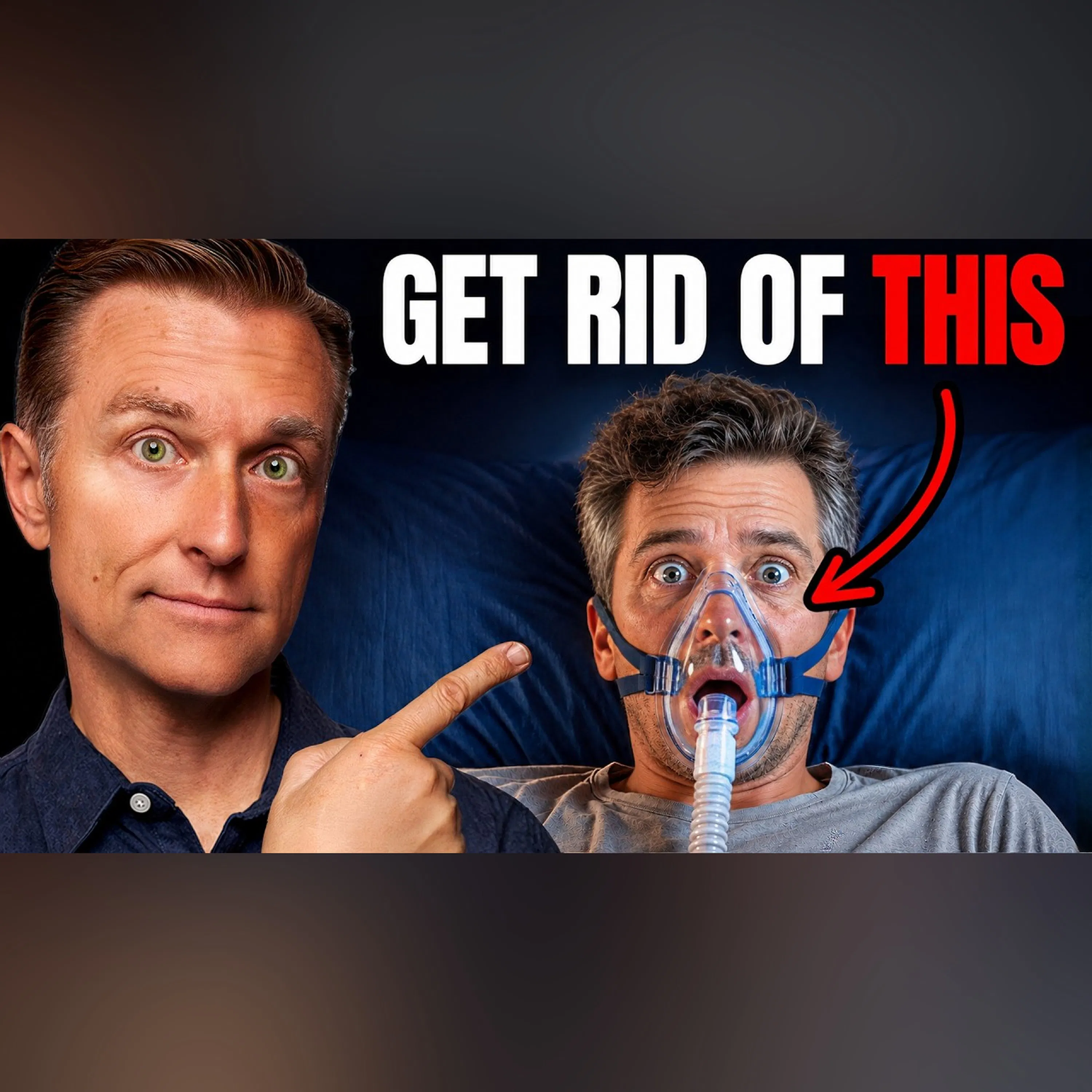
Let's talk about how to fix sleep apnea without CPAP, three exercises that actually work. Over a billion people have sleep apnea and many of them don't know what I'm about to show you, simple exercises to fix sleep apnea. After this video, I want you to walk into your bathroom where you have your mirror and say, ah, and look back into your throat to see how much space you actually have. With sleep apnea, the airway is narrow and the muscles in the back of the throat are a little too relaxed and they can collapse at night and cut off your oxygen. And there's definitely a connection with a good night rest and having enough oxygen. And if you don't have enough, that's going to keep you up. And of course, a lot of people with sleep apnea are on the CPAP machine blowing air into their mouth, trying to overcompensate with this obstruction in the back of the throat. Another common thing that we're taught is that you need to lose weight to get rid of sleep apnea. Apparently, that only actually helps in about a third of the
cases. There's a lot of people that are thin and they have sleep apnea. Your airway in this tube in your throat is made from about 20 different muscles. If those muscles lose tone, they become and they actually increase in volume and they can obstruct the airway. Especially if you're sleeping on your back where you have gravity pulling the back of the tongue into the airway. So today, I'm going to show you three very simple exercises to strengthen those muscles. So you will no longer have this obstruction in the back of your throat when you sleep. These exercises will also help you stop snoring if that's also a problem. And you really only need to do these exercises once a day for seven minutes. Before we do these exercises, I want you to check something right now. We want to check where your tongue is inside your mouth. If it's resting on the floor of your mouth, that could be part of the problem, especially if you are a mouth breather. And in this video,
I'm not going to get into the various theories of why the tongue muscles and the related muscles lose their tone. It could be because we're consuming a lot of soft food. It could be because we eat meat that doesn't have collagen anymore. And it's just very, very tender. So we can just speculate. But in the meantime, let's actually get you to breathe through the night. I am also going to highly recommend that you start training yourself to breathe through your nose, especially at night. There's even mouth tape that you can get to kind of get in the habit of doing that. Now, when you start breathing through the nose, this creates a back pressure that actually helps reduce sleep apnea. And I know with a lot of people, when they breathe through the nose, there's more of a restriction. And they might feel that they're not getting enough oxygen, but that's actually not true. That restriction helps balance out oxygen and CO2, increasing the absorption of CO2. If you even just think about a panic attack, usually the person is hyperventilating. They actually
have too much oxygen without enough CO2. So what do we do for a panic attack? We breathe in a paper bag, increasing CO2, which then allows us to get more oxygen. So nose breathing, despite the feeling that you're not getting enough air, actually will help you get more oxygen in the lungs. So let's dive right in. Exercise number one is called tongue root press. So what you're going to do is you're going to place the tip of your tongue behind the top of your front teeth. From there, you're going to flatten the rest of your tongue up against the roof of your mouth, creating a suction cup. Pressing hard from the tip all the way back to the base of the tongue in the back part. So you're going to hold this pressure for just five seconds. Then you're going to relax for two seconds and you're going to repeat this 15 times. When you drive the base of your tongue upward,
place your thumb underneath your chin. You're going to feel some soft tissue going upwards. That's the main muscle that's being activated. And doing this exercise over time is going to start to increase the opening in the back part of the throat. Out of these three, this is going to be the most important exercise to do because when you're sleeping and the back of the tongue is not toned, it'll choke the back of the throat and cause you to wake up. And people will sleep apnea. They're waking up many, many times through the night. Exercise number two, the palate lift. Imagine the very beginning moment of a very giant yawn that upward suction in the back part of your throat. I think the best way to do this is to look into a mirror with your mouth open. Why did enough to see that thing in the back of the throat called the uvula? And without any noise or sound, you're going to actively lift that soft roof of the back part of your mouth upward and downward.
Exactly as if you were trying to kind of stifle a yawn or prepare to sing a high note. You want to hold that lift at the top for about three seconds. Okay? Then let it down and you're going to beat that 20 times. And when you look at the mirror, you're going to actively see that uvula retract upward and downward. The whole back upper part of your throat is going to open up. And this specific exercise is the one that actually really helps snoring, especially when you hear your spouse snoring with that deep vibration. That's the top part of the palate vibrating. So a lot of people ask me, what supplements do I recommend? Now, of course, I'm not biased of my own high quality supplement line. But if you go to Amazon and type Dr. Berg supplements, you'll find more information. Number three, okay? This is called the cheek suction and hold exercise. So think about this exercise as having a fish face for about five seconds or you're about to play the trumpet for about five seconds. You're going to inhale slowly through your nose while you suck your cheeks inward tightly
between your teeth. And you're going to do this for about five seconds. And then after five seconds, you're going to immediately blow air into the cheeks, puffing them out as far as they will go while you keep your lips sealed tightly. And then do this repetitively for five cycles, okay? That's simple. I also highly recommend you start training yourself to breathe through your nose. So the combination of these three simple exercises with this is going to be huge. There's a couple things I want to mention. You want to do this for a couple of months, okay? At least two months because it's not going to happen overnight, even though you're probably going to see results within the first week. What's interesting about alcohol, there's a lot of people who drink wine before bed. The alcohol in wine and other alcoholic beverages actually affects the nerve that goes to these muscles. Remember, you have like 20 muscles in the back of your throat. So people that drink alcohol tend to snore more. People that drink alcohol tend to have more problems with sleep
apnea. So there's another interesting piece of this puzzle related to vitamin D. A high percentage of people with sleep apnea have not enough vitamin D. So I'd highly recommend that you increase that because there's many different mechanisms involved with having sufficient vitamin D and allowing the muscles to work better, having less inflammation. And so either get more sun when you're outside or at least take between 6,000 to 10,000 I use the vitamin D3. And when you take this, also make sure it's paired with vitamin K2 and magnesium. I have a free download that I want to give to you. This free download is my daily routine in the checklist. This is the routine that I use every day to feel like I'm 18 years old, even now I'm 60 years old, and I want to give it to you for free. And so there's a little link down below. Click it and definitely download that. And because so many people have a habit of drinking alcohol before bed, guess what? I created a video on this topic to help you transition off alcohol. And for that information, you should watch this video right here.
Check it out. Yeah, this one right there. Click it.
More episodes
More from Dr. Eric Berg DC

The #1 Best Protocol to Reverse Gout (and Prevent It)
Dr. Eric Berg DC

Take ONE Teaspoon of This Spice to Resolve Your Diabetes
Dr. Eric Berg DC

The Top Foods That Have Been Blocking Your Nutrient Absorption (Vitamins & Miner...
Dr. Eric Berg DC

DON'T CONSUME THESE IF YOU'RE OVER 50!!!
Dr. Eric Berg DC