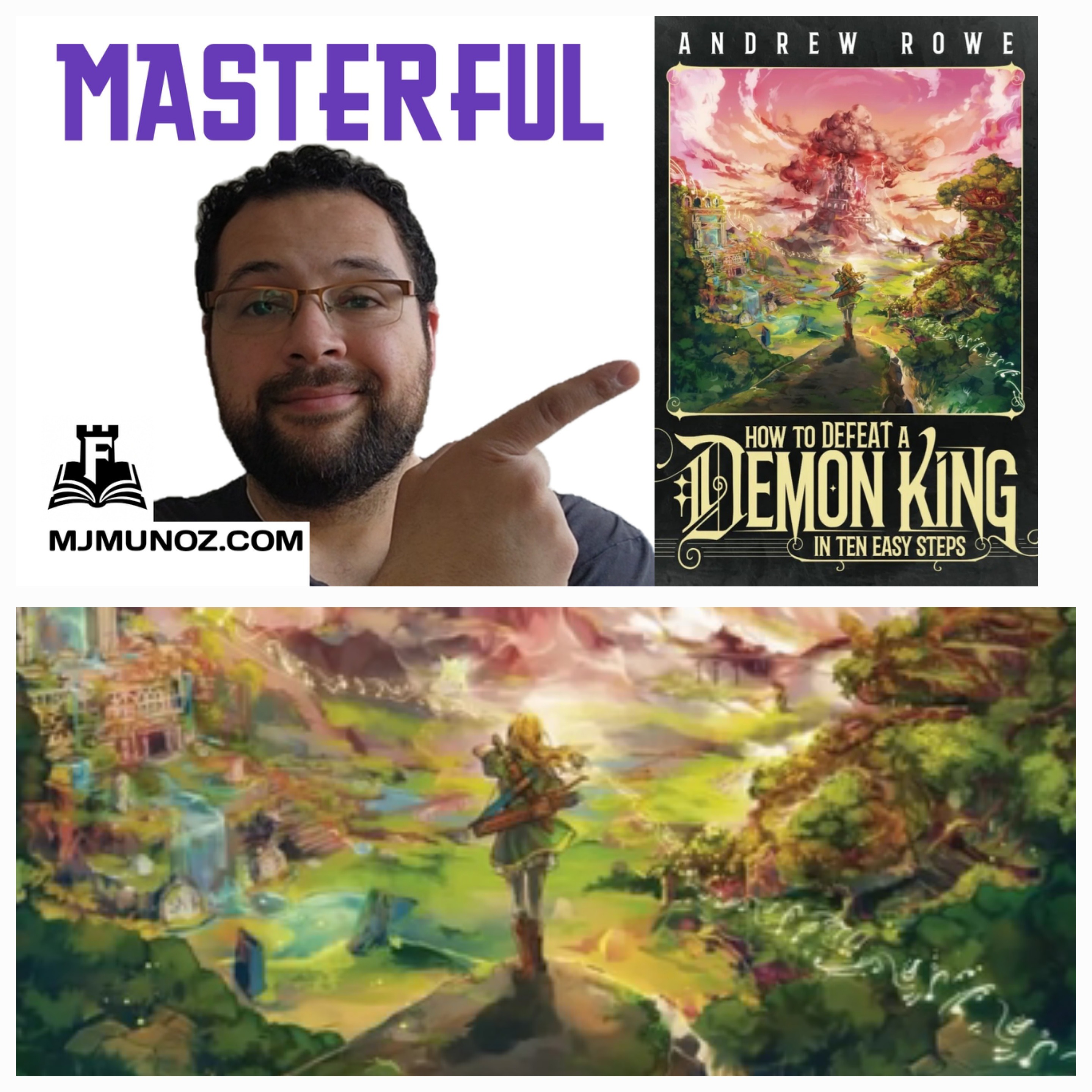
About this episode
I usually dislike first person narration in fantasy books. But Andrew Rowe’s How to Defeat a Demon King in Ten Easy Steps completely won me over.
In this Fortress Fiction book chat, I talk about why this Zelda-style fantasy parody works so well, and what it taught me about two different styles of first person storytelling.
It turns out not all first person narration is the same. Some books use a confessional style that focuses heavily on internal thoughts and emotions. Others feel more like someone telling you the story of an adventure.
Andrew Rowe’s book uses that second approach, and it makes all the difference.
I also talk about:
• why Yui Shaw is such a compelling narrator
• how the book cleverly plays with classic Zelda-style adventure logic
• a great example of suspense created through first person narration
• why the final battle still feels exciting even though we know the narrator survives
If you enjoy fantasy parody, game-inspired worlds, or clever adventure stories, this one is definitely worth checking out.
Book:
How to Defeat a Demon King in Ten Easy Steps by Andrew Rowe
Question for you:
Do you like first person fantasy novels, or do you usually avoid them? And what are some first person books that actually work?
BONUS LoZ ALTTP - https://mjmunoz.com/2021/01/25/the-legend-of-zelda-comic-showcases-shotaro-ishinomoris-mastery-celebrateishinomori-2021-stc-56/
Get every episode summarized
Each time Fortress Fiction publishes, we email you a written briefing from the transcript — the topics, who appeared, and any specific claims, with the ad reads skipped.
Email me new episodesFree for 3 shows. No card needed.
Hosts & guests
Transcript ready
147 searchable segments. Every word is indexed and playable.
Full transcript
Fortress Fiction — How to Defeat a Demon King in Ten Easy Steps Book Chat. Machine-transcribed; use the interactive transcript above to jump the player to any line.
I usually hate first-person writing, but Andrew Rose, how to defeat a demon king, and ten easy steps is one of my favorite books, and it's written entirely in first-person. How does that happen? Anyway, figuring out why that works actually helped me understand something about first-person narration that I hadn't realized before. So for a little bit more context, I recently read another fantasy book in first-person. I had a decent premise, but the narration dragged it down for me big time, and I thought, yeah, this is why I don't like first-person, it's awful. It has this kind of first-person writing that I usually bounce off of, and as I thought about it more and more, it made sense to me why. I previously had the firm stance that I prefer third-person, it's superior, you need third-person limited, or I didn't know. Do we need third-person omniscient? I don't really know, but it's not really something I'm interested in listening to, but listening to this Andrew O'Book, this Demon King book, made me rethink my stance on first-person
because it's a great first-person book, and what I discovered is, it turns out that not all first-person narration works the same way. While preparing this review, I realized that there seem to be two broad styles of first-person storytelling. One is what I would call confessional first-person, the other is adventure narration, for lack of a better term. The confession style tries to put you inside the character's head constantly, there's lots of internal thoughts and feelings, not just emotions, but physical sensations as well, which is weird. It has this very present moment perspective, and this is what kind of, or not kind of, this is the kind that usually repels me, and I just, I don't get the appeal of it. It's not for me. Adventure, ish narration on the other hand, is someone recounting events of an adventure. It feels like a storyteller describing what happened, they just happened to be part
of the story, and it's closer to someone telling you a story at a tavern or a ran-of-fire or on a trip or whatever, and that style of storytelling is something I'm neutral to, and I even enjoy it, and actually I love the bomb books, the Wizard of Oz books, in the first few books you meet characters, and when you meet them, and they join the party, essentially, they will go into a story and tell, they will tell a little bit about themselves, and I don't remember if it's I was doing this, and then this happened, I kind of think it is, so the book switches from third person to first person as one of the characters, the Tin Man, for example, is telling you about what happened to him, and then it switches back to third person, and that's the kind of context in which it makes sense even in the third person's book, for there to be first person, first factor, that's a little bit of a tangent, sorry. This book, how to defeat a Tin King in ten easy steps, feels less like you're trapped inside the character's head, and more like she, Yui Sha, is telling you the story of an
adventure, which is great, it's a great contrast, so it's like I said, it's like she's at a tavern telling you the story, honestly, the way it ends, there's almost like an epilogue where this story could be her telling you, hey, I've been inventing, you know, this is all the stuff that happened to me a while ago, and it's been a while since then, and I'm ready to go on next leg of my journey, and I just felt like getting all off my chest and having a drink with somebody before I went on, and took on this new challenge, which is interesting, and it's funny because it kind of one could say it removes the tension because if you're in the moment, if the first person, if the person's telling you the story, you know they survived, unless there's a twist and they're dead and they're ghost, telling you to do another ghost or something like that, which should kind of be funny. And I would say that's true with both types of first person, both the confessional and this adventure style, first person, you know the person survived, so you would think that removes the tension, however, that's not always true because like most things, it's
all about the execution of the storytelling, so, um, another little tangent, the confessional stuff, I feel is very much like the book I read was for girls, little girls, basically, that seems to be who it was marketed for, maybe, but I think there's this concept that women are more interested in emotions and women are more interested in people and men are more interested in objects, women relate to people directly through people, through having relationship with them, through talking with them, through talking about their feelings and things that happened, whereas men do things together and that's how men bond and that's how men, um, kind of process emotions and interact with the world, it's, well, you know, there's this issue going on, what is this thing, you know, what are the things? I need to understand what's going on with this thing and this thing and this thing that are all some of the, that are all the, that are all parts of this larger thing that's going on so I can understand it so I can interact with it and that's how I'm going to
deal with it, versus women might want to know, well, what's happening to the people who are, uh, you know, affected by this thing? Yeah, this thing happened, what about the people? Um, and I feel like this confessional writing style kind of leans into that, it's written, at least this other book was written by a woman, two girls and it's all about the internal feeling all about this personal stuff and there's even like little personal politics type stuff going on, um, but this story has, is written by a man, has a female protagonist and she's telling you the adventure that she went on, the things that she, the places she went, the people she was with, the things that they encountered in the items they got and things like that because it's kind of a Zelda parody, send up type of deal, um, and how she thinks about them a little bit and how she feared out clever ways to work around the limitations that she has as her, as a person, not being a hero, not being the hero class, it's kind of like a game lit type of thing. It's not full of RPG, I'd say game lit because it, just because that's why I'm saying, um, but, uh, it's interesting because it deals with events and things more than it does with people.
There are emotional moments, there are touching moments, um, but that's not the focus, it's not focusing on the emotions and on the people, isn't how you get to those things, you know the characters, you travel with them and then things happen and you react emotionally to them, which makes sense. That's the kind of storytelling I prefer. So anyway, uh, getting back to it to be more specific, um, you know, like I said, it focuses on events and emotions, there's strategy, there's clever plans going on, there's adventure pacing, it just keeps moving, there's not a lot of sitting and dwelling with things. There's some reflection times, but it's just, let's keep moving to the next thing. Uh, there's this great thing that happens, maybe three quarters into the book, UE goes into this, it's like where the master sword is, she goes into where the master sword is, she can't pull out the master sword because it's locked in this thing only, the hero can get it out, she can't, she's not a hero and she doesn't tell her party members what she's doing or her one party member at the time and she also doesn't tell the audience what she's doing
and she basically says, you'll find out later what happened. And that's it. It creates a suspense. Uh, it's a clever use of the first person limitation that she's choosing to withhold information from us and we know that and she knows that we know that. And then it turns into this cool surprise at the end, which is really neat. Um, again, despite the fact that she's telling the story and we know she survives, um, there's this great final fight that's really intense, even though we know she survives. And, uh, the narration is still exciting, even though it's first person. So she's saying, I did this. I did that. You know, the demon Lord did this, whatever. Um, but it works. It didn't feel claustrophobic at all. It felt and it didn't feel like we weren't in the scene. Like we, I don't know. I don't know if there was a media see there because I hear first person who's good for a media see, but I don't really buy it. I don't really see it. Uh, it doesn't really make sense to me. It seems like it's good for like wasting time. Um, sorry. Sorry. Sorry to me. I mean, um, and I think the parody tone works with the narration, well, um, there's this Zelda style structure. And if you ever played a Zelda game or two, you understand you go to this temple, you collect these things, you go through
these challenges, whatever. And she kind of like gets to examine those things like, well, you know, why are these enemies leaving this room? Why would the silver goddesses put this stuff here? Um, why wouldn't the demon Lord just do this? And, uh, it's interesting because it's like, huh, well, why, why do the games work like this? It takes the conceits of the games and it says like, if this were real, why wouldn't somebody just work around it? And then it says, well, somebody can work around it. And that person is that somebody is Uesha, and she's going to do it. She's going to kick button. It's going to be really cool. And you're going to enjoy watching her figure out ways to work around the system that has been set up, which is pretty cool. And, uh, she also gets, you know, like I said, to poke fun at things. And it's really enjoyable. So at several points, I actually forgot that the story was in first percent at all because it was just that good. And I was that drawn into what was going on. So this book, this book actually changed my perspective a little. I do not hate first person narration. I strongly dislike a particular style of it, which I've spent some time
describing to you. Again, there's the confessional style of storytelling. Or there's the confessional style of first person versus the storytelling style of first person book story, whatever. And this book showed the difference to me. And it's just it's clear to me that one is superior to the other. That's a matter of my preference. I'm curious what you think. Do you like first person books? Do you avoid them like I usually do? What are some great first person novels that you would recommend? Because if there's more good stuff like this, that would be great. And you wrote as much of other books. I checked one of them out. It's a series of six and they're first persons. I was like, I don't know how I'm going to do this, but I might, I might, if somebody strongly recommends it, I'll check out them out and it can be good. Again, if you know first person fantasy or adventure story that really works, I'd love to hear it about it. Let me give you some historical examples. Jules Burns, Journey to the Son of the Earth is first person, or on, trying to think. The Alan Corner main books are first person. And
they're telling of these adventures that happen to these people and they're classics. They're probably classics because they're good. It's been a long time since I read Journey to the Son of the Earth. I read it when I was in high school. It's been a couple decades. And I haven't read it since then, but anyway, that's just two examples of stuff recently. I tried an Alan Corner main book. I never finished it, but it was interesting to me that it was in first person. I just got distracted and wanted to read other things. So anyway, again, please give me an answer. If you tell me your thoughts about first person books, whether you love them, hate them and ones that you recommend. And also, I would be remiss if I did not tell you to check the pen comment to find more of my reviews or my book chats where I'm talking about books in kind of a loose manner, not going super deep into them, but giving you a broad assessment of them, a broad idea of what they're about and encouraging you to check them out. You can find probably some bonus content too. If you check the pen comment, there might just be something interesting for you to find over there. Anyway, till next time, folks, this is MJ with Portrosfiction, signing out.
More episodes
More from Fortress Fiction

The Book of Three Chapter 11: Taran Grows Up
Fortress Fiction
The Book of Three Chapter 10 On Lore and Lineage
Fortress Fiction

Is The Nixie's Song Off Key? - Beyond The Spiderwick Chronicles Book 1 |FF 18
Fortress Fiction

Kid-Lit Audit: 30+ Middle Grade Books Reviewed: What I Loved, Loathed, and Would...
Fortress Fiction