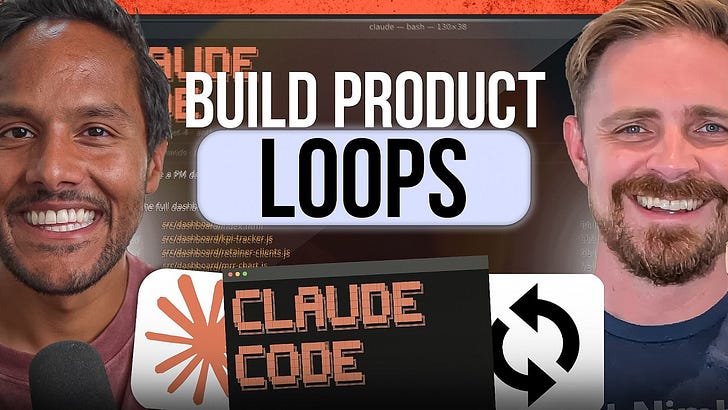
How to Build Effective Product Loops in Claude Code, with Chief AI and Product Officer at JobNimbus, Tyler Folkman
About this episode
Today’s episode
Most PMs have automated something with AI by now. A PRD review. A weekly status update. The problem is that every session starts from scratch.
Loops are what fix that. A skill that runs the same way forever is just a skill. A skill that takes the log of what happened and rewrites itself is a loop. Everyone keeps saying loops are the new prompts. Almost nobody shows you how to build one.
Tyler Folkman is Chief AI Officer and Head of Product at JobNimbus. In this episode he builds a loop live on screen. He runs a preflight check on his own podcast recording, spins up three prototype variants while answering questions, writes a decision skill from scratch, and closes the loop on camera.
He also covers the loops every PM should be running, the hooks that stop Claude from doing real damage, and the point where vibe PMing breaks.
Brought to you by
Customer.io - Send smarter messages using your product data
Ariso - Ship AI agents and features faster with fewer regressions
Viktor - AI employee connected to 3k+ tools with every action approved by your team
Bolt - Build a complete design system from your code
Product Faculty - Get $150 off their #1 AI PM Certification with code AAKASH150
10 Key takeaways
1. A skill becomes a loop when you feed the learning back. A static skill sits there and stays the same forever. The loop closes when you hand the AI the log of the whole session and ask what to improve. Skip that step and you are just running a skill.2. The gate is the most important part of the loop. Fetch inputs, do work, pass a gate, write the artifact. The gate is where you validate the work was correct, and making it deterministic matters more than anything else in the chain.
3. Agents make decisions, prompts wait for you. The difference is not the model. An agent gets a task plus a way to verify itself and executes as far as it can alone. Prompting keeps you in the loop, which caps how far you can scale yourself.
4. Write the first version of a skill by hand. Human authored skills tend to beat AI authored ones because you know more about what you actually want. Once you are on the AI loop it moves fast enough that injecting your own thinking gets hard, like promising you will still pedal on an ebike.
5. In product, the gate is a customer, and that breaks the loop. Code loops run fast because the gate is a test. You cannot lock customers in a room and iterate on them. The workaround is mining the research calls and transcripts you already have to build a cheap first filter.
6. Prototypes are free now, so generate variants instead of one answer. The internal standard is at least three variants per idea. One minimal, one full featured, one creative. Then narrow a hundred ideas down to five before anyone talks to a real customer.
7. Synthetic customers filter, real customers decide. Customer research transcripts loaded into a warehouse let AI inspect a prototype as your customer. It is not a high bar, but it catches low hanging failures fast, which is the whole point of a gate.
8. Write docs for AI, keep human docs to three pages. Part of onboarding is not written for people to read. It is context so the AI can answer questions. Anything a human is expected to read should be one to three pages, visual, and cut down by hand.
9. Hooks add determinism that a prompt cannot. Telling Claude never to delete everything or never to share credentials only works if it reads that instruction today. A hook fires on the bash command itself. Session close hooks can also force the improvement step you would otherwise forget.
10. Ship AI output you have not thought about and it costs you. Passing unreviewed AI work up the chain just moves the effort to someone busier than you. Answering a question in a meeting with what Claude said is the failure mode. Use AI to push your thinking, not to replace the part where you do it.
Related Content
If you don't know where to start on Claude loops, I got you covered with my ultimate guide on Loops for PMs. And then you can follow it up with The Complete PM Guide to /goal in Claude Code. Tyler mentioned the evolving role of PMs and how it is shifting into a Product Builder role, so you can read all about it in my How to Become a Builder PM deep dive.
If you want to advertise, please email productgrowthppp[at]gmail[dot]com.
P.S. Please subscribe on YouTube and follow on Apple and Spotify. It helps!
This is a public episode. If you'd like to discuss this with other subscribers or get access to bonus episodes, visit www.news.aakashg.com/subscribe
Get every episode summarized
Each time The Growth Podcast publishes, we email you a written briefing from the transcript — the topics, who appeared, and any specific claims, with the ad reads skipped.
Email me new episodesFree for 3 shows. No card needed.
Hosts & guests

No transcript yet
This episode has not been transcribed. Request it and it moves to the front of the queue.
More episodes
More from The Growth Podcast
How to build a Company Operating System with Hermes and OpenClaw
The Growth Podcast
How Srini Raghavan helped $3.4B SaaS Giant Freshworks Embrace the AI PDLC
The Growth Podcast

3x CPO Oji Udezue on the Essential Claude Skills for PMs
The Growth Podcast

How to Build Frontier-Lab Quality Evals with Daniel McKinnon, ex-PM at Meta, Goo...
The Growth Podcast