About this episode
This story was originally published on HackerNoon at: https://hackernoon.com/how-to-build-an-ai-medical-scribe-with-assemblyai.
Building a medical scribe requires more than transcription accuracy. It's about creating a system that fits into clinical workflows while respecting privacy.
Check more stories related to machine-learning at: https://hackernoon.com/c/machine-learning.
You can also check exclusive content about #ai, #medical-ai, #voice-assistant, #assemblyai, #deployable-healthcare-solution, #python, #ai-medical-scribe, #good-company, and more.
This story was written by: @assemblyai. Learn more about this writer by checking @assemblyai's about page,
and for more stories, please visit hackernoon.com.
Building a medical scribe requires more than transcription accuracy. It's about creating a system that fits into clinical workflows while respecting patient privacy.
Get every episode summarized
Each time The Good Tech Companies publishes, we email you a written briefing from the transcript — the topics, who appeared, and any specific claims, with the ad reads skipped.
Email me new episodesFree for 3 shows. No card needed.
Hosts & guests
Transcript ready
80 searchable segments. Every word is indexed and playable.
Full transcript
The Good Tech Companies — How to Build an AI Medical Scribe With AssemblyAI. Machine-transcribed; use the interactive transcript above to jump the player to any line.
This audio is presented by Hacker Nune, where anyone can learn anything about any technology. How to build an AI medical scribe with Assembly AI by Assembly AI. AI medical scribes are transforming healthcare documentation, but building one that works in clinical settings requires more than basic transcription. You need accurate medical terminology capture, reliable speaker identification, and privacy safeguards that protect patient data. This tutorial walks you through building a functional AI medical scribe in Python. You'll start with basic transcription and progressively add speaker identification, PE reduction, soap node generation, and automatic data deletion. By the end, you'll have a working prototype that handles real world clinical scenarios. What makes a production ready medical scribe? Before diving into code, understand what separates a proof of concept from a deployable healthcare solution. Essential features checklist feature why it matters implementation complexity, high accuracy on medical terms misheard drug names or dosages create clinical risks medium.
Requires domain specific model speaker identification distinguishes doctor from patient for proper documentation low, handled by speech recognition API API reduction removes names, dates, and identifiers to protect privacy medium. Needs careful configuration soap node generation converts conversations into structured clinical documentation medium requires LLM integration automatic data deletion ensures patient data doesn't persist on third party servers low straight forward API calls step one. Basic transcription setup. Start with a simple transcription request. This establishes the foundation before layering on medical specific features. Step two adding speaker identification medical documentation requires knowing who said what was it the doctor prescribing medication or the patient requesting it speaker diurization automatically separates different speakers in the conversation assembly eyes speaker diurization identifies when different people are speaking and labels them as speaker a speaker b and so on.
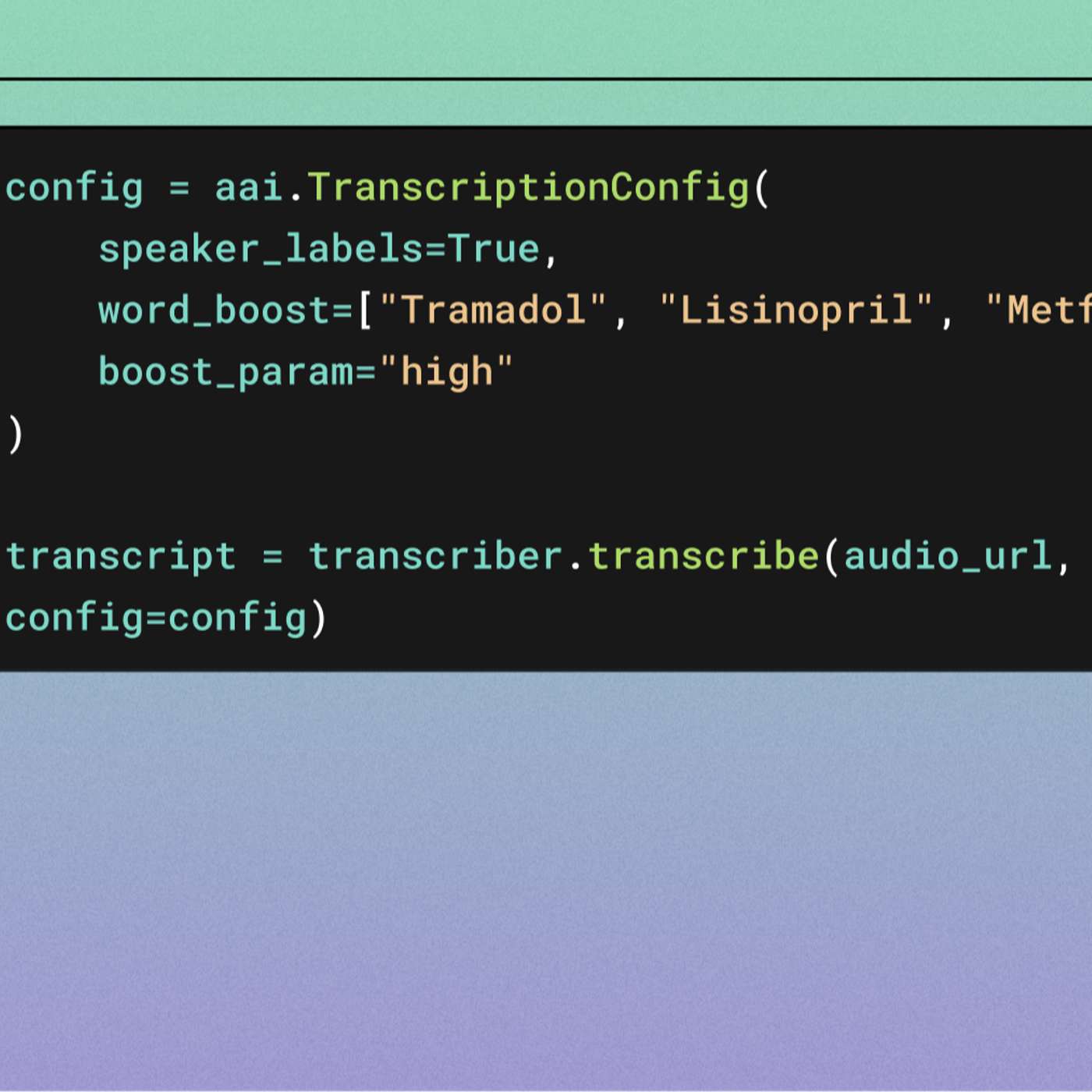
To separate speakers further we can use assembly eyes separate speaker identification featured to match specific names to speakers. Here we'll map these speaker labels to roll doctor and patient. The speaker diurization works best when each speaker talks for at least 30 seconds uninterrupted though the model handles real world conversations with cross talk and short phrases. Step three improving medical terminology accuracy with word boost and protecting patient privacy with p reduction. A common problem doctors prescribe tramadol but transcription shows tramadol in lower case. Small formatting issues like this matter in medical records where precision is critical. Assembly eyes word boost feature lets you bias the model towards specific terms and their proper formatting. You provide a list of medical terms drug names or procedures and the model medical conversations also contain protected health information, phi, patient names, birth dates, social security numbers, addresses. If this data appears in your transcripts and you store them
on third party servers you're potentially violating privacy regulations. Assembly eyes p reduction automatically identifies and removes personally identifiable information from transcripts. You can configure what gets redacted and how. Step four generating soap notes with LLM gateway. Raw transcripts are useful but doctors need structured documentation. Soap notes, subjective, objective, assessment, plan are the clinical standard for organizing patient encounters. This is where large language models come in. Assembly eyes LLM gateway provides a unified interface to various LLMs. Call it with your existing assembly AIAPIKE. The LLM processes the conversation and outputs structured clinical notes. The doctor gets documentation ready for the EHR without manual transcription. Step five automatic data deletion. The most reliable way to protect patient data is to ensure it doesn't persist on third party infrastructure. After retrieving your transcript and generating soap notes, delete the transcript
from assembly eyes servers. Data retention for LLM gateway when using LLM gateway with an executed business associate agreement, BAA, and anthropic or Google inference models, assembly AI provides zero data retention for inputs and outputs. The LLM gateway processes requests your transcript text and the generated soap notes are not stored beyond the immediate API call. Only minimal metadata is retained for logging and billing purposes. Time to live FOR transcript TS for additional protection of transcript data. Assembly AI offers time to live, TTL settings. As of November 26, 2024, customers with assigned business associate agreement, BAA automatically have a three-day TTL applied to all transcripts. This TTL is subject to change, transcripts automatically delete after this period, even if you forget to send a delete request manually. Putting it all together, here's the complete implementation with all features enabled. Why this approach works for medical AI?
Building a medical scribe requires more than transcription accuracy. It's about creating a system that fits into clinical workflows while respecting patient privacy. This implementation handles the real-world challenges, medical terminology accuracy through word boost. Clear speaker attribution with speaker diarization, privacy protection via PE reduction and automatic deletion, structured output through LLM generated soap notes, data minimization by removing all traces from third-party servers. The result. A functional prototype you can test with clinical audio. From here, add features like real-time transcription for live consultations, integration with EHR systems, or custom soap note templates for different specialties. This implementation addresses the core challenges of medical AI, terminology accuracy through word boost, clear speaker attribution with diarization, privacy protection via PE reduction and automatic deletion, and structured output through LLM generated soap notes.
The combination creates a foundation for clinical grade medical scribes that respect patient privacy while delivering documentation that fits into real healthcare workflows. From here, add real-time transcription, EHR integration, or specialty specific templates. Next steps, want to build on this foundation? Check out these resources, assemblyize speech to text documentation, PE reduction policies and configuration, LLM gateway for medical use cases. If you're building a healthcare AI product and need help with compliance, accuracy benchmarks, or production deployment, the assembly AI team has experience with medical AI companies and can help navigate technical and regulatory challenges. Thank you for listening to this Hackernoun story, read by artificial intelligence. Visit Hackernoun.com to read, write, learn, and publish.
More episodes
More from The Good Tech Companies

Protection Funds, Insurance and FDIC/SIPC: What Actually Covers What
The Good Tech Companies

Credible Captain Launches Independent Consumer Review Platform Focused on Transp...
The Good Tech Companies

4 Ways to Win a Hackathon (None of Them Is Writing Code)
The Good Tech Companies

Tokenized Stocks vs Real Stocks vs Stock Futures: Wall Street Without Walls and...
The Good Tech Companies