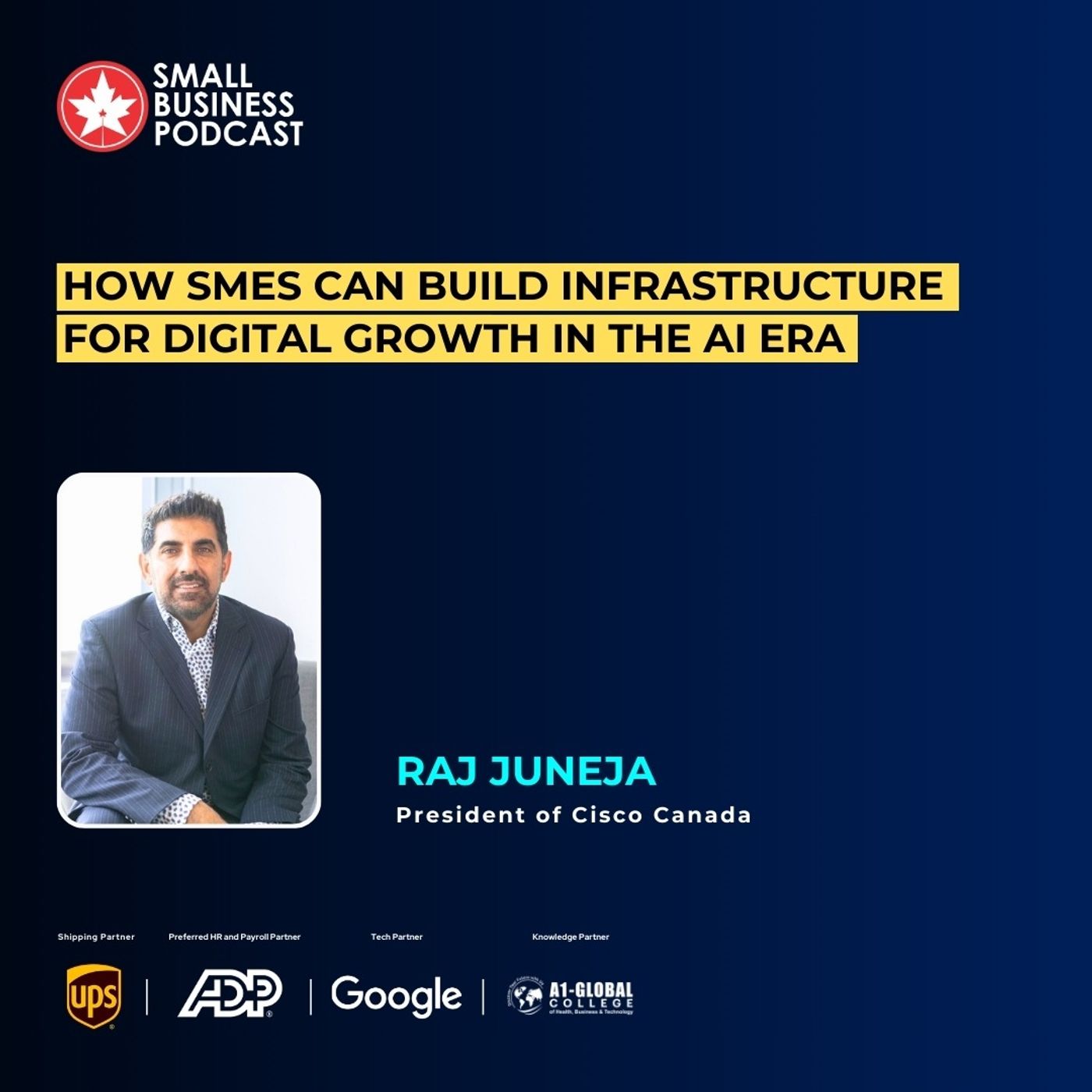
How SMEs Can Build Infrastructure for Digital Growth in the AI Era
About this episode
Welcome to the CanadianSME Small Business Podcast, hosted by Maheen Bari. As AI shifts from experimentation to execution, many Canadian businesses are discovering that their underlying networks, security, and infrastructure are not built for what is coming next.
In this episode, Raj Juneja, President of Cisco Canada, shares why infrastructure debt is the hidden risk behind AI adoption, how leaders can close the talent and technology gap, and what it truly takes to build secure, scalable, AI-ready foundations for 2026 and beyond.
Key Highlights
- Infrastructure Debt Risks: Why outdated networks and weak security can derail AI adoption.
- Closing the Talent Gap: How organizations keep pace when AI outmoves internal expertise.
- AI-Ready Foundations: Practical steps to build secure and scalable networks.
- Strategic Investment Priorities: How leaders align tech spending with real business outcomes.
- Avoiding AI Pitfalls: The most common implementation mistakes SMEs must sidestep.
Special Thanks to Our Partners:
- UPS: https://solutions.ups.com/ca-beunstoppable.html?WT.mc_id=BUSMEWA
- Google: https://www.google.ca/
- A1 Global College: https://a1globalcollege.ca/
- ADP Canada: https://www.adp.ca/en.aspx
For more expert insights, visit www.canadiansme.ca and subscribe to the CanadianSME Small Business Magazine. Stay innovative, stay informed, and thrive in the digital age!
Disclaimer: The information shared in this podcast is for general informational purposes only and should not be considered as direct financial or business advice. Always consult with a qualified professional for advice specific to your situation.
Get every episode summarized
Each time CanadianSME Small Business Podcast publishes, we email you a written briefing from the transcript — the topics, who appeared, and any specific claims, with the ad reads skipped.
Email me new episodesFree for 3 shows. No card needed.
Hosts & guests
Transcript ready
229 searchable segments. Every word is indexed and playable.
Full transcript
CanadianSME Small Business Podcast — How SMEs Can Build Infrastructure for Digital Growth in the AI Era. Machine-transcribed; use the interactive transcript above to jump the player to any line.
Welcome to the Canadian SME Small Business Podcast, a podcast for Canadian Small Businesses. We interview Canadian experts and entrepreneurs to provide expert insight into marketing, innovation, business leadership, technology, and trends that impact small businesses. Whether you're just getting started or already established, UPS is here to help you make the most of your time. Their services, tools, expertise, and team of UPS Small Business Ambassadors can help businesses with all sizes, simplify processes, improve customer experience, and guide you on the path to growth. My name's Elaine Tank-Komo, founder of Easy Dazies, the official schedule for kids, and I want to invite you to visit UPS.com to learn more and save up to 52% or more on shipping. This is a paid advertisement. Hi everyone, this is Mahin and welcome to the Canadian SME Small Business Podcast. Now as AI transitions from a boardroom trend to an
operational necessity, many, many Canadian businesses, they're realizing that their digital foundation might not be ready for the load. And to compete in 2026, we have to look past the apps and focus on the infrastructure that really powers them. Joining us to discuss this topic is Raj, Jen and other president of Cisco Canada. And with the early 30 years in the technology sector, including leadership roles at Splong, Salesforce, and CA Technologies, Raj is a veteran strategist dedicated to helping Canadian organizations accelerate their digital journey. So without our further ado, let's welcome Raj and dive in. Raj, you're very pleased to have you on the show today. Welcome to the podcast. How are you? Thanks Mahin, so glad to be here. I'm doing great, looking forward to this discussion. Very pleased to have you with us. Raj, let's open a discussion about understanding the hidden trap of infrastructure debt. Raj, many SMEs, they're rushing to adopt AI, but you've warned about something called AI infrastructure debt.
Tell us what risks do SMEs face in their network and security? I'm not ready for new technologies. Yeah. So infrastructure debt, so this is interesting. And you talk about two things, networking and security. And when you think about those two, I'd liken those two as layers of IT architecture to like the foundation of a home. So if you rush to build a house without making sure that your foundation is solid, you're effectively setting yourself up for structural failure sooner than later. And the same is true for technology. If your network and security posture aren't ready, what you're going to see is that if you layer on technology on top of a poor foundation, especially if you think about what's happening right now with AI, while you're doing is you're introducing risk. The interesting part is that right now in the mark as a whole, there's a lot of formal around AI adoption. And boards are asking, what's our AI
strategy? And a lot of organizations are feeling pressured to just check boxes off to say, hey, like, let's do this quickly. And but the real questions that they're not asking themselves, and they should be is our infrastructure ready to support this? And going back to that analogy of the house, your foundation can't handle the load. You're going to add more weight, and effectively increase the risk to that foundation. So if we break that down, let's look at both of those pieces, those fundamental pieces on the security side, threats are evolving rapidly and becoming way more sophisticated. Without modern security, the controls that you have in place and adopting new technology, you're basically adding to your attack surface. A successful ransomware attack can be devastating, and specifically for an SME, it's not just operationally, but financially and reputationally. Research has shown that 80%
of small to medium businesses that face a ransomware attack, blow out of business. Like, how much higher can the stakes get? Like in that case, going back to the analogy of the house, isn't the house just come crashing down? And then we need to take a look at the network and AI enabled applications. Whether they're for customer service, marketing, automation, virtual assistance, emerging agentic workflows, all of those are bandwidth intensive and latency sensitive. So if the underlying network is outdated or constrained, the performance suffers. And that leads to a core user experience, customer dissatisfaction, and ultimately revenue impact, because, you know, customers are faced with a poor experience there. So it starts off as a crack in the foundation, and then what lines of happening is eventually the same outcome, the house comes crashing down. So effectively, that foundational crack, whether it be security vulnerability or a network
strain, you're creating that instability and you can't afford to take shortcuts at that layer effectively. So that really puts things into perspective erosion. You're right. There's no, there's so much excitement around AI and digital transformation, but if the underlying network and security infrastructure isn't strong can quietly become the biggest risk in the room. And this is such a strong point here as well, that readiness has to come before acceleration. Now Raj, let's build on that and talk about another major challenge, which is the gap between how quickly technology is advancing and whether organizations actually have the talent and skills to manage it effectively. Please shut the light on how can businesses keep up when AI moves fast through that internal expertise? Yeah, this is one of the most common concerns that we hear, and the first step is just being realistic about where most organizations actually stand.
So Cisco conducts an AI readiness index. And our AI readiness index shows that only about 8% of Canadian organizations actually consider themselves fully prepared for AI. So if you feel behind as an organization, you're not actually you're you're actually in the majority right now. So the key to the key to this is taking a pragmatic approach. AI readiness is the start with the technology. It starts with having a clearer understanding. So that's it's basically clarity. Like what outcomes are you trying to achieve? What use cases are you trying to align with your business priorities? And do you have those capabilities? Whether they're internal or external to effectively execute on those priorities? So from there, then it becomes a talent and enablement conversation, adopting AI's and just about tools. It's about learning new ways of working. And so to build that AI fluency, it's similar to working out. It requires consistency,
deliberate practice and a willingness to go through what I always say when I take a break from working out and start again, the first two weeks, which are the most painful. And it's that level of uncomfortability. Not everyone adopts at the same pace. So organizations need to assess their current skills and then create a structured development plan. The good news is that they don't have to do this like rapidly and overnight. The most successful companies, if you look at practices and that they've adopted over the course of years, you think of like ITIL, there's the most successful companies have built a roadmap and one that balances competitiveness with sustainability. You don't try to boil the ocean. You start where AI can create impact and you expand from there. For SMEs in particular, it's important to understand that you don't need to hire a full-time AI specialist to begin realizing that value. The goal isn't to reinvent your
business, it's to enhance it. So that might mean targeted upscaling, leveraging programs like that companies like Cisco has to offer with our networking academy, partnering strategically, or identifying that people within your organization that are digitally savvy. And those are champions that are existing in the organization that are early adopters and they will absolutely help accelerate things. And here's the interesting part. You can actually use AI itself to help you identify skills gaps, use cases, and design your roadmap. So that's the beauty of the time that we're living in. The technology that feels like it's moving so fast can actually help you move faster. And if you approach it with that lens specifically. That really captures the tension that leaders are feeling right now, Rajan. AI is moving at a pace that can make even strong teams feel behind.
And that challenge isn't just adopting new tools. It's really making sure that people or your people can understand, manage, and use them responsibly. Rajan, with that in mind, let's talk about the practical side, like how can SMEs build scalable AI-ready networks? We are really getting buried in technical complexity or overspending in the process. And I'd like to know what steps help the secure scalable AI-ready network despite talent shortages? Yeah, I mean, this goes back to the foundation that we talked about earlier, that the house. If you're unsure whether your network is ready or you don't have deep expertise in house, the most important thing to know is that you don't have to solve this one alone. For many SMEs, partnering with organizations, I can say that's the smartest thing that they can do is they already do this. In fact, industry data shown that 40% of SMEs, their budgets go to manage network services. And so they're already familiar with service providers
and technology providers that give them access to enterprise level expertise without having to hire a full internal team. And so that gives them the ability to stay focused on running their business and still modernizing their infrastructure. From a practical standpoint, building an AI-ready network starts with modernization. If you're running outdated Wi-Fi, aging switches, infrastructure that's past its lifecycle, that's going to limit performance and resilience. And so today's applications, especially like AI enabled in cloud-delivered ones, like I said earlier, they're so bad with intensive. They're always on and latency-sensitive. So the network has to be built for that reality. And on the security side, fundamentals matter more than ever. So you think about things that we've been talking about forever. Multi-factor authentication, strong identity management, proper access controls,
network visibility. These aren't flashy solutions that are earth shattering. We've been doing them forever. But they help to dramatically reduce risk. A common misconception that a lot of people have or organizations have is that moving to the cloud automatically means that you're fully secure. How providers secure their platforms. But organizations are still responsible for how the users access and use those systems. So that's why security becomes so critical. And I'll address something directly. Secure a scalable infrastructure isn't just for large enterprises. Solutions today, they're designed to scale across organizations of all sizes. SMEs can absolutely deploy enterprise-grade networking and security in a way that's financially and operationally realistic. We look at the Canadian market. 98% of it falls under that category of a small to medium business. We have, we service the majority of that market.
Cisco is in the majority of those customer bases. So having that preconceived notion that Cisco, as an example, is an organization that only is expensive and only working with the top tiers is absolutely that. It's a misconception. Ultimately, the goal is about resilience. And because for an SME, we already discussed it. You can't have a major outage or a ransom where it's incident, it's disruptive. And in fact, it can actually take down their business. So investing in a secure, scalable foundation isn't about over-engineering. It's about protecting your ability to draw. That's a practical way to look at it, Rajan. You're right, when scalability and security are built in from the start, businesses, they, they avoid that constant patchwork fixes later. And it truly means that being intentional early on makes all the difference. So thank you for emphasizing on that. From there, let's talk about the bigger picture. Raj, how should leaders prioritize tech investments for
real business value? Yeah, this is probably one of the toughest questions that leaders are wrestling with right now. Everybody, including us, we are constantly trying to demonstrate value to our customers and quantifying that value so that they understand it. And honestly, there isn't a clear formula for that just yet, especially with AI. We had a recent AI summit and Jensen Wong and Chuck Robbins talked exactly about this. The big takeaway is that we're still early. The ROI math isn't standardized. So if there's no universal formula, what do you do? I think it starts with discipline. Like don't rush to invest in tech, especially the AI, just because there's pressure to do something we talked about formal earlier. Start with a business outcome. What are you trying to move? Is it revenue? Is it speed to market? Is it the cost structure customer experience? If you can't tie it to one of those, it's probably a science project. And then for SMEs in particular,
this gets exceptionally real. Many of those leaders are wearing multiple hats, operations, finance, customer service. And AI can be incredibly powerful, but not as some grand transformation, but by automating, repetitive, admin-heavy work so that the leaders can focus on growth, which is why they they're able to wear all those hats. But what we're essentially seeing across Canada is that smaller SMEs usually start simple. They use AI that's already embedded in tools, marketing platforms, customer service systems, virtual assistance. And they're not building custom models. And as they grow into that 200 to 100 employee range, they start to expand into customer experience and service optimization. From a prioritization standpoint, I'd suggest three steps. First, look at quick wins. Like where can you drive measurable efficiency or
productivity gains in months, not in years? Secondly, make sure that the foundation is there. Network, the capacity that's that's required, security, data readiness. If your infrastructure can support the tools, you're just introducing more risk. And then last but not least, be pragmatic about the economics. Budgets are tight. There's no question. Most organizations are leaning on hyperscalers right now because it's the fastest way to access AI capabilities without massive of front investment. That buys you some time to give you the opportunity to learn before you decide what you want to build internally. So if I had to summarize it, prioritize business outcomes first, infrastructure second, and experimentation third, not the other way around. That is exactly where we that that tells us that this is where leadership really shows up.
And it's easy to chase trends, but prioritizing technology based on measurable business values, what actually moves in you. And this was such a great question and he responded. It's so well, Raj. And to close this all out, let's talk about execution and understanding why is implementation off in the biggest risks and how does long-term thinking really help businesses avoid expensive mistakes. Raj, what common AI implementation mistakes should SMEs avoid? Keep coming back to this, but the biggest mistake that I'm seeing is that it's followed. Like it's companies just feeling pressure to show that they're doing AI. So they move fast and without being without being clear around the problem that they're solving. And that usually leads to scattered pilots and very little impact. For SMEs specifically, I'd probably highlight a number of pitfalls. The first one is they typically will skip the foundation. We talked about
that earlier, how you can't compromise there. Your network isn't ready. Your data is an organized, your security posture is weak. AI is just going to amplify and expose those gaps. It's like putting like a turbo engine into a car with bad brakes. That's the way I would liken it. Treating AI as a science project or a tech project, that's another pitfall. This is a change management exercise. I'd liken it to when people were adopting ITAL practices. It affects workflows, roles, culture. If you don't bring people along, adoption is going to stall. And worse, you're just going to slow down other priorities. The other pitfall I'd see is choosing tools before defining outcomes. I've talked about that before. You start with a business objective. Are you trying to reduce admin work, improve customer service, increase response times, revenue per second,
revenue per customer? All those outcomes should dictate the tool, not the other way around. I think trying to build everything themselves. SMEs don't need to become AI labs. The most successful ones that we're seeing are simply using AI that's already embedded in platforms that they trust. Marketing, automation, CRM, collaboration tools, that's faster, low risk, and far more cost effective. And finally, it's underestimating security. As you adopt AI tools and more AI enabled tools, you're expanding your attack surface and multi-factor authentication, proper access controls, strong identity management. Those aren't optional. For SMEs, a ransomware event as we talked about is absolutely catastrophic. So if I had to summarize, I'd say move with urgency,
but don't be reckless, be strategic, secure, and outcome-driven. And if you focus there, I think you'll avoid many of the pitfalls that we're seeing. That's incredibly valuable insight, Rajan. A lot of SMEs, they rush into AI without a clear plan or realistic expectations or being proper alignment across teams and hearing all these great insights and common mistakes upfront. It helps leaders avoid costly detours. And I hope our listeners learn from these and understand that this is often the fastest way to really build digital transformation that delivers real results and actually lasts. As you wrap up, if there's one final key piece of advice for SMEs leaders, they're shaping their 2026 digital strategy, what would it be? How my advice actually comes from what I talked about earlier was the AI summit that we just had last week. From industry leaders like Chuck Robbins and Jensen Wong from ongoing conversations
that we're having with customers across Canada, take action, get started now. Waiting for perfect conditions or complete clarity is no longer a viable strategy. AI is here and it's evolving rapidly and it's already reshaping the competitive landscape. However, and this is important, you don't need to tackle everything at once and you certainly don't need to do it alone. You begin with an honest assessment of where you stand today. Take a clear look at your organization. Do you have the foundational infrastructure, the network capacity, the security posture to support new technologies? Do you have the right capabilities and skill set, and should you be investing in trainings or programs or partnering with managed services providers? Next, identify one or two specific areas where AI could deliver meaningful impact. Perhaps it's automating an administrative function so leadership can focus on the strategic priorities of
the organization. Perhaps it's enhancing customer service capabilities. Maybe it's strengthening security, broad detection. Start there, achieve some tangible wins, learn from the experience and then build on that foundation. Keep respected too. Only 8% of Canadian organizations as they said consider themselves fully prepared for AI. They're not behind. Just because they haven't solved everything yet, the momentum matters. Start moving deliberately and remember that the substantial resources that are out there that they can leverage to support them. Technology partners like Cisco, which I should note serves companies across the full-size spectrum from 10-person startups to major enterprises, managed services providers, training platforms like Cisco's Networking Academy. These resources are available to help navigate this transformation. The organizations that are
going to thrive in 20-26 and beyond will necessarily be the ones with the largest budgets or the most extensive technical teams. They'll be the organizations willing to start, willing to learn and willing to adapt. So my advice is pretty straightforward. Take that first step. The journey to AI readiness doesn't begin with having figured everything out. It begins with asking the right questions and then taking purposeful action. That is such a key takeaway for any reader that is looking to future-proof their business. Thank you so much, Raj, for joining us and for sharing such great expertise in your vision. Thank you. Nice to meet you. I really appreciate it. And listen, I was Raj, teenager, the president of Cisco Canada. A powerful look at why the right infrastructure is the true backbone of the AI era. Thank you for tuning into the podcast. Please be sure to subscribe for more expert insights and visit Canadian SME.C for resources. A special shout-out before we leave to our partners, UPS, Evangel Global College, Google and EDP for their ongoing commitment
to empowering small businesses across Canada. Please keep moving forward and we'll see you the next one.
More episodes
More from CanadianSME Small Business Podcast

The Health-Tech Giant: How VitalHub Built a $100M Global Software Empire
CanadianSME Small Business Podcast

How I Scaled 22 Stores in Canada’s Most Regulated Industry
CanadianSME Small Business Podcast

How Calgary Became One of North America’s Fastest Growing Innovation Economies
CanadianSME Small Business Podcast

The $100M Talent Secret: Why Wellness Beats Salary
CanadianSME Small Business Podcast