About this episode
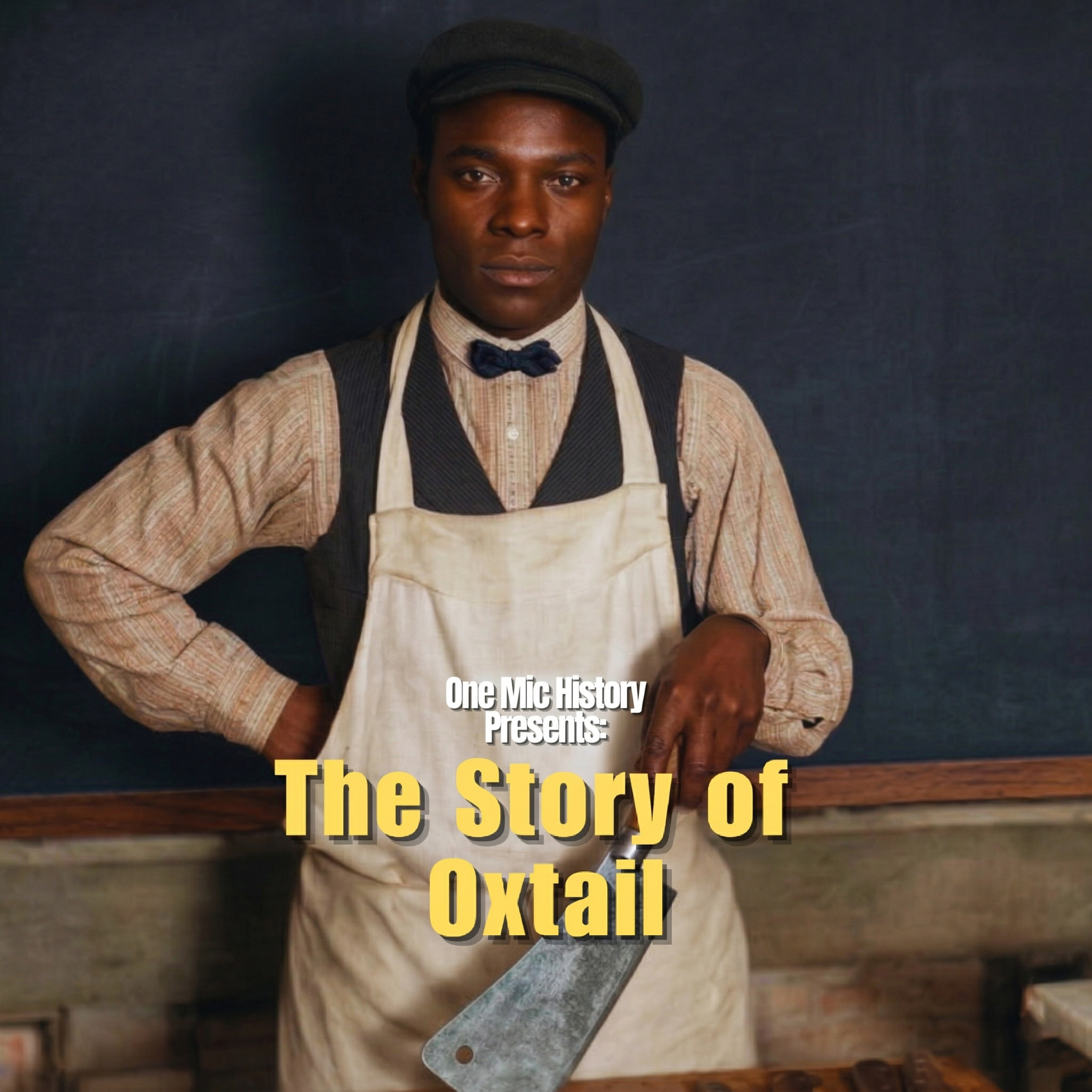
You walk into a restaurant today and see a plate of oxtails for $35 or $40. A century ago, that exact same cut of meat was considered garbage. The white folks tossed it to the side, assuming the tough, bony tail was completely worthless.They were wrong.This is the history of how Black cooks across the diaspora, from the American South to Jamaica took the scraps nobody wanted and built an undeniable delicacy.
Get every episode summarized
Each time One Mic Black History publishes, we email you a written briefing from the transcript — the topics, who appeared, and any specific claims, with the ad reads skipped.
Email me new episodesFree for 3 shows. No card needed.
Hosts & guests


Transcript ready
177 searchable segments. Every word is indexed and playable.
Full transcript
One Mic Black History — How Black Cooks Humiliated Enslavers With Oxtail. Machine-transcribed; use the interactive transcript above to jump the player to any line.
If you walk into a restaurant today, you open the menu and you see a plate of oxtail. It's going to run you 35-40 dollars. Usually, when you pay for a cut or beef like that, you're expecting a premium cut, a ribeye, a filet. But this is literally just a cow's tail. A century ago, it was considered garbage. The white establishment would not touch it. So how did this pile of trash become a 40-dollar luxury item? Well, today, this isn't a story about a family recipe. It's a story about how black cooks, engineer, and economic flip, how they sold these systems on trash right back to a world for a billion dollar profit. So join us today while we discuss why black folks love oxtails. And if you enjoy stories like this, you can find more stories like this at onemycatchtreet.com. Please like and subscribe. But without further ado, let's get started. To understand oxtails, you have to understand the disrespect.
If you go back to 1800s, the plantation economy was running at full speed. In the American South, it was cotton. In Jamaica, it was the brutal product of sugar. Wind cows or steers were slaughtered. The colonial establishment took the high cuts, the hams, the roads, the steaks, the premium ribs. They took the meat that was easy to cook and easy to chew. It was left over, wasn't even considered food by white folks terms. It was biological waste, it was the intestines. It was the feet, the ears, the tail. It was the meat that was specifically designed to make you feel like you were at the bottom of the economic ladder. The system tossed the weighty scraps into a pile and gave them to enslaved black folks from Mississippi to Kingston. Now this is the exact moment where most places would talk about the struggle. The textbooks let's give you a white watch story that tells you how sad and hungry all of us were. They want you to view enslaved cooks like they were helpless victims, tossing whatever
random garbage they could find into a pot to make a desperate watery soup. But black cooks didn't have time for pity. They were too busy engineering a masterpiece. They looked at that pile of discarded bones and oxtails and they saw what white plantation owners couldn't see. When the white owners looked at oxtails, all they saw was tough, bony, unchewable pieces of garbage. But when black cooked looked at it, they saw collagen, they saw marrow, they saw the building box of concentrated flavor. They realized that the system's arrogance was actually a massive vulnerability. The system thought that it was hoarding all the good meat, but they were completely unaware they were throwing away the most flavorful parts of the animal. See, black cooks understood something that many people at the time didn't. That most cooks were lazy and impatient. A steak was easy. You throw a ribeye on a hot fire for five minutes on each side and it's done.
Anyone can do that. It requires zero culinary intelligence, but oxtail requires time and strategy. Think about the anatomy of an oxtail. The cow spends its entire life using its tail to swat flies. It's a constantly moving appendage. That means that the muscle fibers in the oxtail are thick like steel cables. It's the heavily exercised muscle packed tight with thick, connective tissue, cartilage and massive bones. If you try to cook an oxtail like a steak and just store it on a grill, it will literally break your teeth. It's like chewing a leather boot. So black cooks across a diaspora hack the system by turning the calf iron pot into a chemistry lab. They didn't just cook the meat. They broke it down on a sailor level using two parallel methods. In the American South, they utilized the ancestral knowledge of Western Africa, one pot cooking. They seared the meat and submerged it in seasoned liquid and let the low and slow method
melt the connected tissue into velvet gelatin creating a rich, thick gravy. For down at your maker, these cooks took it a step further. They looked at the sugar that they were harvesting and weaponized. They took cane sugar, burned it down to the bottom in heavy Dutch pot until it was smoking and caramelized. Using this legendary browning technique, they tossed in the oxtails and locked in that deep, dark, mahogany crust and that flavor profile that is impossible to replicate with just salt and pepper. Then they used island's arsenal, scotch-bonded peppers for that aggressive heat, all spice, fresh thyme and scallions. They let it simmer for hours until the thick cartilage melted away. Then they stretched the meat by adding butter beans to soak up the liquid that was left behind. This wasn't just survival, it was two parallel scientific methods for processing oxtail.
They engineered scraps into a masterpiece. They created a closed loop, flavor profile or nothing, was wasted. Yet if this technique just stayed on plantations, it would have been a footnote. But black folks were about to move. When a massive patient came, the great migration kicked off some years later. Millions of black Americans headed north and west to cities like Chicago and Detroit and Harlem and Oakland. And at the same time, the Caribbean's were boarding ships to London and Toronto, Miami, Brooklyn. They packed their suitcases and brought along their culinary blueprints. By the mid-20th century, oxtail moved world-door roads into the concrete urban centers of the world. The Caribbean opened restaurants, boarding houses and alley cook shops that fed the massive black working-class population coming off 12-hour ships. To make a profit, these business women needed a cheap protein and oxtails, they were
dirt cheap. Why? Because white packing plant executives in Chicago and British butchers in London still thought the oxtail was trash. Black entrepreneurs bought the tales for pennies. They cooked them using methods that had been perfected by their ancestors and they sold them by the thousands. This wasn't just a dinner service, it was an economic engine. Black families bought homes, funded churches, sent their kids to college, off the profits from this trash meat. Black cooks were beating white butchers by exploiting their own ignorance. Now you know, the establishment was never a gond to allow us to keep this secret for forever. Fast forward to the late 20th century, early 21st century, and the food network error kicks in. High-end white chefs start looking for an authentic poor people ingredients to put on their menu. They realized that they had been ignorant of goldmine.
White chefs and corporate restaurants suddenly discovered oxtails. They realized that the meat that we've been eating for a century was perfect for the high-end stews and Italian raguas. They slapped it on menus and called it nose-to-tail dining, acting like they'd invented a concept of not wasting the animal. This was the jujurefication of poor people food. Once the establishment wanted it, the global demand skyrocketed. But there's a bit of a mathematical problem with oxtail. A 1200 pound steer only has one tail. The tail only yields about a pound and a half of viable usable meat. When black and brown people wanted it, the supply was fine. When the entire world wanted it, it was a rare commodity. The price of oxtails went from 99 cents a pound in the 90s to $5, then 8, then 10, then 14 pounds at the grocery store. The system couldn't beat the recipe so they priced us out of our own invention.
In the end, we thought that black history is about us constantly begging. We told our ancestors spent all of their time asking the system for a seat at their table. But oxtail, it flips that narrative. We didn't ask for a piece of their pie. We took the garbage that they were thrown away and turned it into an undeniable legacy and made it so good that the system literally had to buy it back from us. The true power in all of this is not begging for a seat at their table. It is engineering your own developing your own recipes and your own table. Plantation owners thought they were humiliating us by giving us their scraps. They didn't realize they were handing us a key to a big $1 empire that spanned from Atlanta to Kingston from London to Brooklyn. So next time you see a plate of $40 oxtails, you don't see an expensive meal, you see the
economic flip that was developed by black folks. The system can never defeat you if you know how to extract value from the places that they are always to arrogant to look. Thank you. This will be one of my black history. I'm your host country boy. And this is the story of why black folks love oxtails. Yeah man, it's nice. It's nice to get back and do food again. I kind of missed it. This is a lot of fun. I have been trying to do more where we push outside the boundaries of American black folks. I was reading Malcolm X. You can check out my live about it. And he talked about how black Americans like to think of themselves inside of vacuum and that the whole world is dealing with similar struggle, same struggle and that you're not in a bubble. And we all dealt with the same things. You did look outside of that. Why are you begging for civil rights from the State Department?
Why are you not asking or looking for funding from African nations from black nations, which is extremely true. Anyway, in my estimation, that means that I need to start looking more towards diaspora. So yeah, this is me trying to bridge outside of that a little bit. Anyway, I hope you enjoyed it. I would like to meet all my day ones. I love all of you guys. All my financial contributors, you guys are amazing. You allow me to keep this thing moving, to keep this thing going. Please subscribe to my sub-stack. I am putting out articles every single week and doing notes most days. Right now we're doing women's history month, while I'm doing black women every single day. So join me on sub-stack. Join me here. Please subscribe. I love you all. Thank you for your support. Peace.
More episodes
More from One Mic Black History

How the Black Family Reunion Beat Sundown Towns
One Mic Black History

The Cost of Being the Token Black Friend
One Mic Black History

How Black Women Smuggled Fufu into the South
One Mic Black History

How Harlem Musicians Outsmarted Segregated Clubs
One Mic Black History