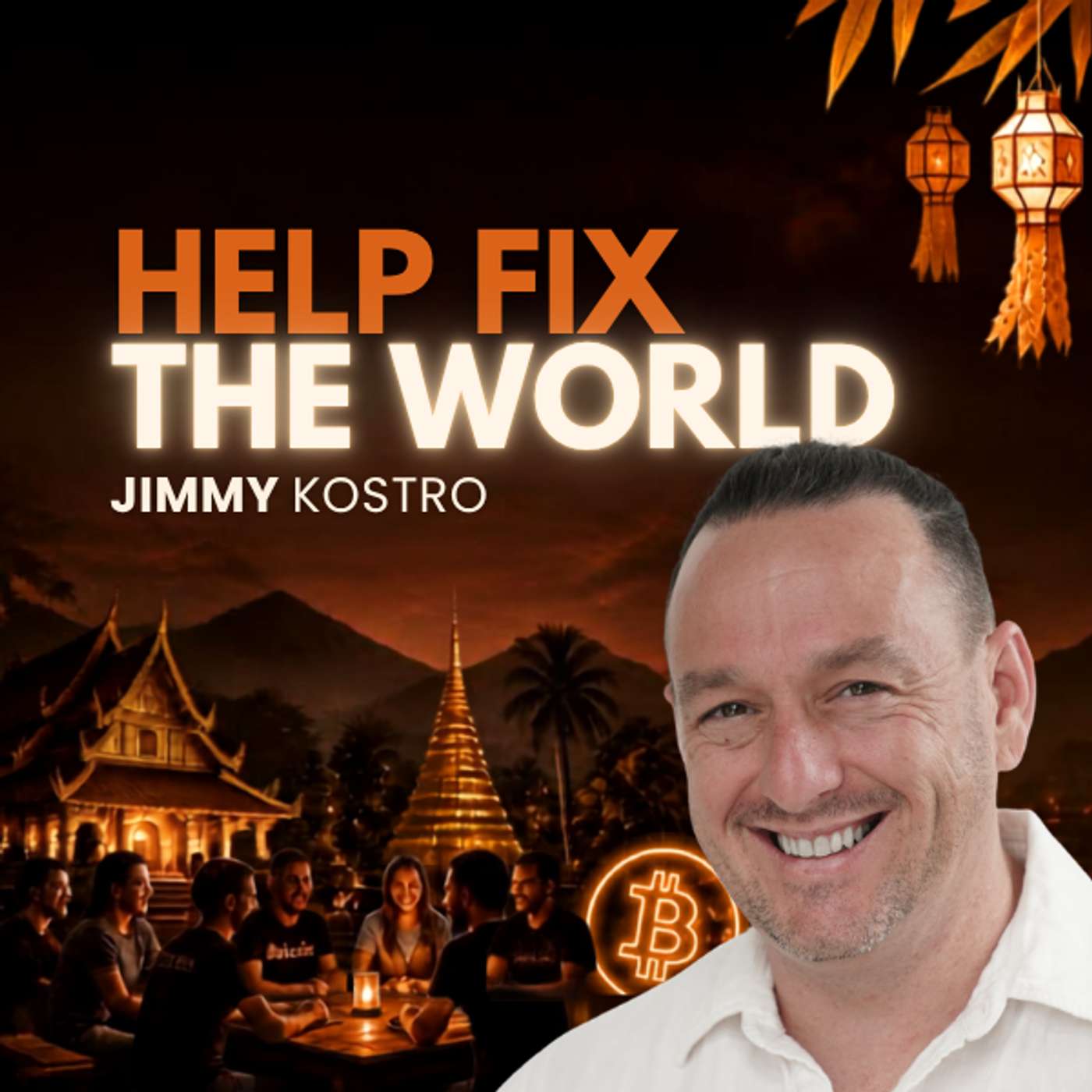
About this episode
What does it look like when Bitcoin stops being a price chart and becomes a physical community, a school, and a lifeline for people living under surveillance and near a conflict zone?
Jimmy Kostro, founder of the Bitcoin Learning Center in Chiang Mai, shares how he built Asia's largest physical Bitcoin hub almost by accident. What began as a charity putting teachers in children's homes turned into off-grid solar mining, a four-storey education centre, and a Thai-language media operation reaching tens of millions. Jimmy explains why real Bitcoin adoption is built on local leadership, trust, and giving without asking for anything back.
This conversation explores how a physical hub changes lives in ways an app never could, why you cannot manufacture legitimacy as an outsider, and what Bitcoin freedom means for people who keep two phones just to stay safe.
🎙️ EPISODE SUMMARY
Jimmy and Anja discuss building Bitcoin community, financial education, and freedom in Southeast Asia.
The conversation moves from Jimmy's unlikely path into Bitcoin outreach, through the off-grid solar accident that led to mining and a viral moment of global donations, to how an abandoned building became a four-storey hub with 500 members and seven full-time staff. Jimmy explains how the team won over local government and universities with a Bitcoin half marathon, how a single camera grew into a media arm with tens of millions of views in Thai, and why leading with generosity rather than transactions is what made the community take root.
The episode also examines the real costs and funding behind a non-profit hub, why the model cannot be exported without local leadership, and Jimmy's work telling the stories of Burmese communities living under surveillance across the Myanmar border.
🔑 KEY TAKEAWAYS
Asia's largest physical Bitcoin hub grew from charity work, not a business plan
An off-grid solar system led to mining and a viral wave of global donations
A physical space teaches saving and financial literacy in ways an app cannot
A Bitcoin half marathon opened doors to local government and universities
Consistent media turned one camera into tens of millions of views in Thai
Leading with generosity, never a transaction, is what built lasting trust
Real adoption needs local leadership that outsiders cannot manufacture
Bitcoin freedom is a lifeline for people who keep two phones to stay safe
⏱️ CHAPTERS
00:00 Intro: Two Phones to Survive
00:52 Who Is Jimmy Kostro
01:14 From English Teachers to a Hill Tribe
03:17 The Solar Accident That Started Mining
05:30 The Viral Moment That Built a Community
09:17 Bitcoin Adoption and Thai Culture
14:03 The World's First Bitcoin Half Marathon
16:45 Building a Bitcoin Media Empire in Thailand
24:30 Why Real Adoption Means Giving, Not Selling
27:45 The Real Cost of Running a Bitcoin Hub
31:45 Why Bitcoin Communities Need Local Leaders
40:23 Safety, Freedom, and Life Near the Myanmar Border
47:51 One Myanmar and Life Under Surveillance
🔗 FEATURED LINKS
Jimmy Kostro on X: https://x.com/JimmyKostro
Bitcoin Chiang Mai: https://bitcoinchiangmai.org
🔗 AFFILIATE LINKS
Buy Bitcoin in Australia With a $10 Sign Up Bonus
HARDBLOCK: https://hardblock.com.au/join/honestmoney
Learn to Acquire, Secure, and Manage Your Bitcoin
MINERACKS: https://www.mineracks.com/honestmoney
Shop Signing Devices, Bitaxes, Nodes, Apparel, and More
SHOP BITCOIN AUSTRALIA: https://shopbitcoin.com.au
Collaborative Security, Inheritance Planning, and Retirement Strategies
THE BITCOIN ADVISER: https://thebitcoinadviser.com/honest-money
Reached Terminal Bitcoin? Borrow Against Your Bitcoin Without Selling
LOAN MY COINS: https://www.loanmycoins.com/honest-money
📌 ABOUT THE HONEST MONEY SHOW
The Honest Money Show explores the forces shaping our financial world, from monetary systems and personal finance to Bitcoin. Through in depth conversations with builders, thinkers, and educators, the show challenges mainstream narratives and provides practical insights into financial sovereignty.
🔗 CONNECT WITH US
Subscribe for weekly deep dives into Bitcoin and money literacy.
Follow us on Instagram, X, TikTok, and LinkedIn at HonestMoneyShow.
⚠️ DISCLAIMER
This podcast is for general information and educational purposes only and is not financial, legal, or tax advice. The views expressed by the host and guest are their own and do not represent any organisation or regulatory body. Financial markets are volatile and speculative. You should seek independent professional advice before making any financial decisions. By listening, you accept that all actions taken are your own responsibility, and neither the host, guest, nor the podcast accept liability for any loss or damage.
#Bitcoin #BitcoinMining #ChiangMai #Thailand #BitcoinAdoption #JimmyKostro #FinancialFreedom #Myanmar #SelfCustody #BitcoinAustralia #FinancialSovereignty #HonestMoneyShow
Get every episode summarized
Each time The Honest Money Show publishes, we email you a written briefing from the transcript — the topics, who appeared, and any specific claims, with the ad reads skipped.
Email me new episodesFree for 3 shows. No card needed.
Hosts & guests
Transcript ready
1,033 searchable segments. Every word is indexed and playable.
Full transcript
The Honest Money Show — How Bitcoin Became a Lifeline on the Myanmar Border. Machine-transcribed; use the interactive transcript above to jump the player to any line.
Everyone I know has two digital, two Apple IDs. Like one holds their real life. And the other is the account they show, the police are the soldiers when they search their phone. You need local leadership and local management to run a physical Bitcoin community. We can't manufacture trust or legitimacy as an outsider. The more people we can help, the more people can learn about basic savings. The sooner we can fix the world. Welcome to Honest Money. I'm your host Anya and today's episode is brought to you by Hideplock. Joining me today is Jimmy Costo. Jimmy has founded Asia's largest Bitcoin physical hub in Chiang Mai. And we're here to talk about that today.
Welcome to the show Jimmy. Welcome. Thank you very much for having me. I would love to learn more about how this all came about. Yeah, so we started, it was wild. We started by nothing Bitcoin first. That was a big part of this is never leading with Bitcoin. So as Bitcoiners, we were helping disadvantaged communities around the region. We started by putting English teachers in orphanages or they're called children's homes here. And we had about four teachers distributed and they were part time helping these children. We then began working with border communities closer to Myanmar because in Northern Thailand, we're only a few hundred kilometers from the border. We went up there and what was really fascinating was we found this hill tribe of a hundred children and they're like, these well behaved,
like well mannered kids in the middle of the mountain, like five hours from the major city on top of the mountain in the middle of the jungle. And we're like, okay, this is like, we got to help these people here. So we ended up helping build bathrooms, dormitories, providing scholarships, giving our time, giving our energy and effort and funding to build things like a hundred person kitchen that the children no longer had to be cooking in the dirt like outside. It's not very sanitary. It's not that clean and the weather gets pretty rough. So they're eating outside and cooking outside. So we're able to do all these things. It's kind of like how it all started. And then we recognized like the children were kind of small a little unusually small. And it was kind of obvious when you think about it, you're like, okay, well, they don't have
the nutrition that we have access to. So we're like, okay, man, how can we help them store vegetables and protein all the way up here? So okay, why don't we help instead of building bathrooms and dormitories and things, why don't we help build an off-grid, 10 kilowatt solar system on top of this building where they were? And now the idea is we can have a freezer which we brought up there eventually and they could freeze the proteins and vegetables and fruits. So this is like brilliant. So instead of having to go up there all the time, you could every two weeks or so, they would have this freezer. So we did this and they worked out wonderful, but then something unexpected happened. We learned that they weren't using like half of the energy it was generating. So as a big corner, I think you could see where this is a linear, it's a linear thing here, right? I know.
So we obviously come back down, we tell our friends about it and this is how much extra energy. So a piccolo bob space, our friends down in Bangkok said, hey, here's some extra miners. Next time you go up there, go with a couple guys and connect it. Okay, to pull this in like, put it all together, the, these were before the last having, the miners were, the S9 miners kind of got one over there. So it wasn't going to generate much money at all. Like it was like at the time, I think it was 40,000 sats per month or something or maybe five or $10 per month. If it runs full time, it rains up there, there's children, it's dirty, like if it ran full time, right? We got, when we put a message on it, the time it was Twitter turning into X, we had mentioned that we had just connected and took a photo and videos,
we connected the sale drive on top of the mountain, five hours away in the middle of the jungle to the Bitcoin network. Well, we got more donations to the address of the miner in one day than the miners would make in a full year if they were operational. So that's how that started a big wave into like, oh wow, there's some Bitcoiners in the North and that's kind of how it kicked off. Love that and like has it attracted other Bitcoiners to travel there? Like I assume people just naturally hear about it and then want to visit. So this happened exactly, exactly. So we had a lot of questions like that after that was heard. So we ended up getting like scrappy mics like that. Like we just got mics to answer because we were answering from traditional like the wire and like it is needed to answer more questions and make it a little more professional.
At the time, there's like a hub in Bangkok called Bob Space and there's like a meetup in the North but it's like kind of a little crypto Bitcoin. It's not Bitcoin focused. There wasn't a Bitcoin focused place up here. We're on the border of Myanmar. We're also close to Lau and China. So like those places can't, they're not allowed to come together like this. So we recognize there's a need for it. But like to answer your question about did people come? People came in droves. Like they wanted to see what's going on who we were and why we're doing this. So and then like as you do this consistently, more people would come and like that Joe Nakamoto comes and then he does a video about it and then it starts to have this compounding effect, you know? So yeah, we have a ton of people come. But like at the time we had this old abandoned building
that we're in right now. And her father, my co-founder, her father had this old abandoned building. Trees were growing in here. Stealings were small. So we've gutted the whole thing and we weren't even sure what the future was going to be. We're like, okay, we should just like do our non-profit foundation work on the first floor. As Bitcoiners and then we're like, wait a minute. This is kind of slow. The English teacher thing like English, like we focus on basic savings, basic finance, financial literacy, we're on the border. Let's start doing workshops, education of Bitcoin. And so the second floor and third floor we're gonna be like maybe a school, maybe a accommodation, but as people started coming, we're like, we need more space. So then the second floor became another huge event space. And then the third floor, I was like, maybe we'll have like a penthouse off like a cool condo master bedroom.
Nope. We ran out of space on the second floor. And now our events were a hundred people big. So we needed the third floor for the space. And then the city wouldn't let us grow anymore. So we had to have this like fourth floor studio but it's like not allowed. The city limits don't allow you to go higher. So we have four floors. And now we have seven people that work here full time. We have an international manager, Neo over there. Eve downstairs, she's our domestic national manager, fire co-founder, CEO and director. We have an intern here today, hang, he's on his end of his internship. We have two media, our media team upstairs, a third person and we have, it's coming next week. And we have an events coordinator named Kate. So we do a ton from just that. And now that has evolved into more things too. We can talk. Yeah, I love that.
But tell me about your meetup. So I want to know how the local adoption is happening there. Like what did the local think of Bitcoin? Yeah, so in the north, they were always just watching stuff online because there was no physical gathering for the locals. And there's kind of this cultural thing called Grang Gai where they don't like to interrupt. They don't want to be rude. They want to be soft and kind. So there was no real place. So just kind of like unwinding a little bit. Chiang Mai is like a big expat mecca. Sort of like a Bali, something like that. And so you have like your international side and you have your Thai side. And it doesn't, there's not a whole lot of international that speak Thai and not a whole lot of local that speak international. So you have to have a little bit separate. So for the local side, they would have their very structured.
They like lessons, they like to sit down and have it organized. International like to like kind of have more of a hang out social thing. So we had to mix and match this. When we would have our events, we would have like Burmese on Thursday, International Friday and then Thai Saturday. Because if you have 100, 150 and the building only fits 100, you have to separate them. Which kind of works out because if you don't speak fluent in one language, you don't feel super comfortable mixing. So that's been that experience. We have regularly about three to five people visit here every day. It's crazy. Like that's a lot like to handle. That's actually Nio's job. Half of his job is to just take the incoming and you never know who's gonna come through the door. And yesterday he was help, it's walk-ins.
It's like super crazy. So like he'll, he helps somebody put help them get too too Bitcoin off of an exchange, older gentlemen, on, you know, to use treasure as a hardware device. Totally crazy. But yeah, so like our meetups will be like, I don't know, maybe monthly for the Thai local, but we do like larger things like like meetups are like kind of okay, but we'll have seminars with the university or the government and major events so we can make the most use of our time. You know, like a meetup it might be like once a month, but like what are you doing every day? Quick one for the Aussies listening. Hardblock is offering a $10 sign up discount right now. And if you're with another exchange, ask yourself this, are they Australia's longest running Bitcoin only exchange? Because if not, maybe it's time to switch.
Head to hardblock.com.au forward slash join, forward slash honest money, and start stacking stats today. You know, like so every day we're working on Bitcoin education, working around events. I know that we do tons of media, which is, which we should get into. Yeah, so what it looks like on the meetup side, it's like it's not like a meetup, like you just go to once on a Thursday, it's like, hey, you want to come learn, you come here, or if your community wants to put together an emergency, multi-sig, hardware, workshop in August, then here it is. And then really you can only reach 50 people that way anyway. So that's when that's when you start just recording the stuff and then it reaches, we're reaching millions of people this way in tie. So it's like an evolution. Yeah, no, that's really inspiring. I think having a physical hub is so important. And yeah, we tried to set one up.
Well, we did actually set one up in Sydney. And unfortunately there was a freak flood that happened due to a plumbing accident. And now it's just going through the insurance claims and all of that. So we don't know what the future of that will be. But I'm really like, I was surprised to hear that the local government is involved in universities as well. So like I mean, you guys seem a lot further down that advocacy and adoption path than Australia is by comparison. Because over here it's crickets. Yeah. Well, it started a couple of years ago when we ran out of people to educate. We thought, like, how can we attract more people and create awareness and exposure to Bitcoin? So we said, why don't we put on a marathon? How do we do that? So we got in touch with the local race organizers and said, hey, we want to put on the world's first Bitcoin half marathon.
Well, because it's 3,000 people and there's road closures and permits and all sorts of stuff, the city has to approve. So they're like, so they call us in and they're like, OK, so what is Bitcoin? Pull the chair. And you asked. So, but what was very cool about when we had this initial introduction, a couple of things, we had Orange Pilled a doctor a couple of years before that. So to put in perspective for your audience, we've been doing this here for three years. But like, as it was built four years ago, we were still Bitcoiners talking about Bitcoin every day and it announced that. So we Orange Pilled a doctor in a Bitcoin. He became the local deputy mayor at the time that we were putting on the world's first Bitcoin half marathon. So he he was already aware of all this because in Southeast Asia, Bitcoin and scam are very close together like whoa.
So and his superior was also was also familiar with Bitcoin. These are like two very serendipitous great things that helped us get in with the local government. They then open the door to say, I think it's good for your team to teach our staff the basics. So they could answer questions to their spears and have a better understanding of what this Bitcoin thing is. So we started classes with them. They opened the door to like any department that was available that we just got an open canvas. So we started calling them like Bitcoin safety classes, like kind of terms that maybe would be easier for them to embrace. Same thing with university. We would we would synthesize it to like basic savings, financial inclusion, modern finance, economic empowerment,
just really simple things. So this was easier for for them to relate and them to share with their colleagues and their superiors to get any sort of approvals that you know that might otherwise be more difficult to get. Yeah. Yeah. And tell me about the media. What kind of media are you guys doing? This is certainly crazy. So. So when we started having these time meetups and these big quarterly events, we'd have these quarterly bit devs, which we have a hundred people here. And you know, there's a hundred Bitcoiners. They come. It's crazy. One time about 17 months ago, 18 months ago, the Thai Bitcoins were together and they saw we had like a mic like this and then like, you know, a tripod over there and like a basic camera and some like basic pieces. And they said, Hey, one of the guys said, I have like a part time
podcast that I like. He does on Spotify. It's not like a video. It's like audio. So he was familiar with it. And he's like, wait a minute. Why don't we put together a podcast and my co founder would be the host. So they did. And we went like we said, OK, let's do this because it makes perfect sense to help reach more people. Over a period of the first year. So this is like totally crazy. By starting the podcast, then in Thai, there wasn't many of them. So there wasn't there was only like one in Bangkok. There was nothing really in the north. So the Thai people, this is like products market fit. They're very curious about the topic. And we didn't just do one media like every time there was a big corner that was coming to town in Thai, they would just have like a weekly
podcast. So figure 52 guests. But then they wanted to do more. They wanted to do weekly Bitcoin news. For me, I was like, the news really like guys are pretty busy. But the news became a staple. And it's everyone's a and it's still going even last night. And then they do bit devs and then they do BLC library, which is book reviews, right? And then we have bit health, which is we have another another doctor, not the not the government mayor, a different doctor, a doctor led physician led bit health, the intersection of Bitcoin and help. So this place has became a by another byproduct, just like the, just like giving and helping disadvantaged communities as a humanitarian thing turned that into this big signal. The same thing happened with having a physical hub brought people together,
say, listen, more people that can't come here, whether it's geographically challenging, it's far, it's expensive, we have to let people know about this information because you guys have such wonderful guests come through. So they start recording and now we have like five or six media verticals. Right now we're doing one called our local region, CNX builders. We have Queen B, which is a female, female builders, entrepreneurs, initiative going on right now. And now we have five studios. So I almost want to take you around. This is one of them. I'm going to be visiting. I'm telling you that right now probably by the end of the year, like I really want to visit. Come, come, come, come. We have five places for you to come in like obviously our neighbors except Bitcoin, which is super cool like because like can't escape this thing. So we have, we have five studios and a health company said, listen,
I've seen your media. Now, here are these numbers. These numbers are crazy. In just one year, our YouTube grew to 10,000 subscribers in a language only spoken by less than 1% of the population. There's 20% of the world speaks English. We just hit, we're just hit a million views this month, which, and we've only been going for a little over a year for the YouTube. In Thailand, the Thai people really embrace Facebook, like the Filipinos and the Thai are the power users of Facebook. If you think about it from a country lens. So like if you're if your local business is not on Facebook, you don't exist. It's crazy. And I know Bitcoiners are like, oh, like telegrams, signal, everything over there. But, Noster, but what happened is we've been to platform three times because of the word Bitcoin in the name.
So on the third time, we didn't give up. We called it BLC for Bitcoin Learning Center. BLC Chiang Mai, I think it is. And we have just hit 10 million views in 15 months, like 15 months, two days ago, on our Bitcoin content. 10 million, this is crazy. In parallel, a year ago, we started another brand called Run for Freedom, because we had the marathon, which we're doing again in November. And we have an ultra marathon next month in September, called the BTC 100 or BTC 50. So all of this is bringing awareness exposure to Bitcoin in like many ways. The Run for Freedom brand just surpassed 9 million views. And our TikTok has 6 million views. So if you put all these things together, we have 27 million views in tie on basic Bitcoin stuff.
Not in, of course, there's BitDevs and there's mathematicians and experts and all of that. But together, if you look at it holistically, our physical hub, the media has became a byproduct of that now to take it one step. Further, Anja, outsiders have now asked us, can you do the media for us? Can you be our media department? We're like, I guess, sure. So when it's opened up an opportunity for us to, and so we just started, I think we're on our fourth week with one, our first customer in doing their media. So they'll come once a week, the record for an hour, our media team will create like this 15 minute trailer, break it into like seven or eight clips per week. And then that's like, over each every week.
So we have them go through like, click up and slack and it's kind of cool. So the media, so having clients, paying clients has become a byproduct of just consistent media being done here over time. I love it. I find these stories so inspiring and I can't wait to share this, this some episode with everyone in Australia, like some pretty much friends with everyone from the major city, like all the organizers. And yeah, like we all really care about adoption and everyone's doing their own little thing, whether it's, they're really passionate about going around in orange-pilling merchants or someone runs a book club or someone runs bit, there's, you know, like it's just, it's really inspiring. And what stage did you feel that things really started to kind of take off? As soon as we started having people come to us, the number one question that everyone would ask,
like maybe not like hardcore beer quenners, but like they're trying to figure out what do you get out of this? Why do you do it? That was the number one question, because they couldn't figure it out. They're like, well, what are you selling? Like, you know, what is the, what are you selling? Catch. What is it? And they can't wrap their head around it. And it's kind of cool and I get it. I understand. So the time when I realized what was really transpiring was, we always led with helping and giving, just help and give as much as possible and remove any transactional relationship. So like, even though all of the exchanges work with us and they give us the referral link, it's like a policy here. Don't give anyone like, don't do that. Like, you don't want to take, okay, it's so hard to build a community. Every person matters so much that you can't treat anyone just like ordinary.
You have to really, really cultivate that relationship. And as soon as you try to do some transaction, we even removed, there's a fee in the Bitcoin ATM downstairs. There's like an API into the exchange and there's like a lightning wallet fee between the guy that hosts our lightning wallet because for legal purposes, we just want to insulate ourselves. We pay that like 10 cent thing because we don't want at any capacity, anybody to think that there's a transactional. We want it to be just you're here to learn and be part of a community. And the community doesn't just mean like education. It means like hospitality. Need a way to sign, verify and secure your Bitcoin? Australia's one-stop shop for Bitcoin has you covered. From signing devices, nodes and backup solutions to bid access, daco and a car. Visit shopbittcoin.com.au
You want people to stay? Like I've never been here when this building closes after an event because when you get a bunch of people together and you help get food and maybe some beers or whatever, they just, we just tell them make sure to turn off the air condition and close the door. So like when I realized early on that there was, this was catching on because our approach to it was just help people, just help people and be kind and be generous and be thoughtful. And then people want to play with you. So that's when I realized, okay, that's kind of our identity. Let's go and do that as long as possible, as far as possible without having to take on any sort of like outside money. Now to answer like, how do you fund it? That's another crazy question that a lot of people ask. So a couple of things.
Well, one, we couldn't do this without Bitcoin. Not that we were necessarily selling our Bitcoin to do this over the years. It's just that Bitcoin has freed our minds to know our future is safe in five and 10 years as long as we keep our Bitcoin safe. So we don't have like that suffocating anxiety to have to like take, take, take and store, store, store and invest, invest, invest and figure out the whole, we just, we don't have that to step worry because we believe so much in what you do and what everyone's doing here. We just, that's our world. So we couldn't do it without Bitcoin. But in Thailand, versus Australia and Sydney, these are massive different costs. So I also have a business in America that was luckily able to help over the, especially the early years, not so much now, to help fund it. And then if you look at like a salary comparison,
a high quality worker above the average standard costs in Thailand and Chiang Mai, if you pay like a thousand dollars, you're getting a high quality, English speaking, honors graduate, university level, you know, a thousand dollars a month. So this would be, and if you maybe Sydney might be four thousand or more. So if you have six or seven people, then it's 70 thousand, you could do that for like, under a hundred thousand dollars and really move the needle. Now that's just salary, that's just like employment costs are programs and running the building and everything else is a little bit more than double that. So if it may be if it's two hundred thousand dollars or more depending on the year and the market conditions, then that will be what it costs to run the place too. So we funded through our business operations and now our BLC media, our arm is gonna help fund it.
And then when we built this last year, HRF was in the region. They were in Bali and like around and they had heard because we support Burmese community and we have win, Coco Un from HRF, come and present here ever since the last three years. He was talking about us and then Bob Space, they're also a grantee of HRF and he's like has like an office here and this is like a second home in the North. And we call this Bob Corner because he's so many miners over there. I'm gonna show you, I don't know if we're allowed to in the podcast, but we're just gonna show you. So there's like a... All right. Fire. And you could actually see a little more of the office from this view here. But yeah, so... Cool, orange flour, Bitcoin sign. There's Neo. There's hang over there.
There's some work. So yeah, so he'd encouraged them to like come check us out. Well, we didn't know they were bringing Jeff Booth, Miles from Block, Obey from Fettie, Leopoldo Lopez, Favent Aswella, Gladstein. I mean like what? This is crazy. And then I'm sure you could understand the rest because when if those people come through and then they're telling their stories on what Bitcoin did and then that snowball's into even more people coming. So... So have you heard of other people learning about the model that you're running there and going and doing setting up something similar in their country? Has that happened? Yeah, so we know what everyone's doing because everybody comes here and tells us. So like they'll go travel Asia and they'll go to every spot they can because they're Bitcoiners and they wanna go around.
And they'll tell us their experience everywhere. And we are in very good relationships with all of the physical communities worldwide. Bitcoin Beach, Alice in El Salvador, Lugano, Plan B Network, or Perfufuork Building. I mean, the guys in India, Pichala, obviously in Bali. I mean, yeah, everybody, we know everywhere. We know everything. We know the cool, and they come so regularly, we get to find out how everything's going because people just tell us like, oh, they thought it would be like that, like this. I will say we kind of set a pretty high bar here. So I kind of like, it's better to come here last. But yeah, there's quite a few things with that. Like, okay, you can't do this in another nation if you're not from that nation. So like, let me unpack that.
You need local leadership and local management to run a physical Bitcoin community. Now, I'm not, I'm American living in Thailand. If me and you and, I don't know, I saw a British Hadoi on your podcast. I was watching it a little bit, another day. If us three came together and we had a million dollars, we couldn't just do this in Thailand or, or Cambodia or anywhere. You need, you need, because there's so much career risk with someone who interact, the international person cannot establish enough credibility without putting a person at risk. And there's local language, local permits, building, property, cultural nuance. We can't manufacture trust or legitimacy as an outsider. It is already hard to build a business
and then do a Bitcoin business and then it be a nonprofit. Like, it's all just very, very, very difficult. So you definitely need, like, that's why, when I heard of our friend Sean building the one in Malaysia in Kuala Lumpur, I was talking to win from Ansharef, because I knew he was gonna go talk to him to say, make sure, like, number one priority here is like, he knows that we gotta get a Malaysian dude or girl, a person as your manager, because life is already hard enough and you're gonna come up against, Emil, immense challenges. So, so this is something a takeaway of like, if you're gonna do this, you gotta, you have to like, you have to have no overhead. I mean, none, like, you can't be renting a place. You can't, you have to like, really go into it sharp. You have to know that you're never gonna, if the leader, like, the one that's gonna drive it,
like, just accept that you're not gonna make money. Like, like, because if you get an opportunity to make money, you wanna give that to your editor. You wanna give that to someone that could take this content and make it cool. You wanna be able to do that so you could impact and reach more people. So, there's like, all of learning lessons doing this from my experience. And yeah, so we need try to advise everybody and anyone that asks us open playbook, we're happy to help everybody because the more people we could help, the more people could learn about basic savings, the sooner we could help fix the world. I love it and I love the running idea. I think that's such a clever way to get attention, you know, in just, we have an event, so I live in Byron for context and we have this annual event that I don't participate in, but it's fun nonetheless. It gets a lot of attention. It's just people writing bicycles through town,
make it and it's on every year. And the locals come out and just watch these people and it's like a thing. And so imagine, you know, if there was a group of Bitcoiners, running in orange, running Bitcoin, like that would just be such a cool way to get attention without, you know, forcing it down on anyone's neck. It's just like, oh, okay, I wonder what this group is about. You know, that sea of orange of 3,000 people running through, like the aerial photos of that are incredible. And you get to capture such great media from that. And then if you do it right, which is not my strong suit, but events, you can, these events cost like minimum $100,000 US to do. But you know, you can get a title sponsor and gold and silver. And if that's your thing, this is a really good opportunity for a hub to earn enough money to be sustainable. That was another reason we went into it.
Unfortunately, we learn like we're not that, that's not our like DNA. So that was an expensive learning lesson. And we have one major one we're working with Binance, which is cool. We worked with Tether last year, which was cool. And then Tether was gonna work with us again on this one, but they decided very last minute, like two last minute, they weren't going to. So now, you know, it's cool because you can work with hospitals and car dealerships, like it doesn't have to be finance. You kind of just don't want finance. And you want like Bitcoin is the focus, creating awareness exposure, like the question, what is Bitcoin? And then you have all of your community. So we have 500 members. So you can't have a meetup on Thursday. You have to like have this organized catered planned events, almost tickets. That's why we were going to sat, land this a lot. Also we work with everybody.
So like there's about 250 international and 250 tie. And then, you know, so if we have a big, our quarterly meetups will be international. And then we'll just do tie every day. So like when we have our next, this is so cool. You should come here in November, if you can. Okay, I'm writing these down. November 22nd. Okay, right. Because next month might be too close, and I think I'm seeing you next week, and then we capture in Korea and Hong Kong, right? I'm looking forward to that so much. Sweet. So because we have a big event in September, but that's too close. In November, we're doing the half marathon again. When we have an event like this, there's so many Bitcoiners that come to our event that are building only fits 120 people that we rent the local movie theater
just to fit all of the big coiners that are coming to the event. So then we put on like Bitcoin as hope, and we'll do these 10 or 12 minute TED talks of, you know, we're doing Bitcoin as freedom coming up September 25th. And then November 20th, 22 is the race. What day is the actual Friday 21st? So I think like the 21st is the actual day that we would have the movie theater. And then if you're in town, we'd have you like, we'd ask you if you'd be interested in doing, you know, 10 minutes on, hey, what's your experience from the Honest Money Show and tell people about that. And so it's really fun. We record it and it's like you could have popcorn and watch your friends talk about Bitcoin. Yeah, man, it's super cool what we do here. Not your case, not your coins. If you're holding Bitcoin, your self-custody setup needs to be done right.
Mind racks deliver paranoia grade security so that you can sleep at night knowing that your money is protected. Take control and secure your money the honest way. Head to mind racks.com forward slash honest money. Every week it's really is. Look, I find Thai people really, really beautiful and I have some Thai friends and they just really are special. And I'm curious to know, what is there anything about Bitcoin that appeals to them and I guess their culture and way of living that maybe doesn't so much to Westerners? Yeah, you know, there's two, there's a few sides to this. So gold is a big thing in Southeast Asia. Like so they understand that property very well. So understanding digital gold is not as far as a leap for many people. That's one thing. And then unfortunately, like the lottery is a big thing
in the Thai places too. See, and people start learning about that and gambling is big like here and in Vietnam. It's fucking huge. So, you know, I think a lot of people have experienced this with their family, whether that's gambling or gold or the lottery. So, and, you know, I think, yes, that has its negative effects, but I also think that people actually question what it is that they're doing. And it's very common to buy gold and store gold. So, yeah, and like when you say the Thai people are so kind, like listen, this is the best place in the world to live. So when I started, I left America in 2017, after getting involved in Bitcoin, I'm like, okay, if I could have this very talented, woman that runs my operations, which she's been running for like 13 years now out of South Florida, I could leave. So why am I gonna stay in America
when I could go travel? So I checked out 40 countries and I'm like, okay, cool, cool, cool. And when I got to here, for me as a bit, coiner, like the safety is like number one. Like I just feel totally safe. Like if I go to the restaurant in the cafe, if I take the motorbike downstairs, we have a company, little scooter. I don't take the key out of it. Like if I go to the restroom, I don't like put my phone or my, in my pocket, pocket book or my, close my laptop. Like I just leave it there because why would my brain even think? You know, when I travel now, I have to like unwind my brain a little bit. Like wait, be a little more thoughtful here because you're not in Thailand. It's crazy. It's just so, so the people are so kind. They're thoughtful, they're considerate. The food is remarkable. If you can make a Western living and live here,
that's a superpower. If you, you know, so you have the weather, which is, you know, it's a little rainy season, but the quality of life, if you can figure out that geoarbitrage or earn in the West, earn Western income, live in the East, be safe. You could help a tremendous amount of people. Like we're reaching millions of people and this is early days for us, you know? Like it's just so crazy. So, yeah, the type people understand Bitcoin a little bit better. I mean, there's only 70 million. We've reached 25 million views. I know there's multiple people per view. Our other friends, there's five other major Bitcoin communities. We're helping each other. What we do is when we have like go to university or like something, we'll reach out to the, based on the topic, the strongest Bitcoiners that are tied in their region and say, we'll fly you up because it only costs 30 or 40 US dollars
to fly up in, inside the country. We'll take you to the university. So we'll cover your airfare. We'll cover like your hotel for the night. So maybe it's like a hundred bucks. That is the best use of our Bitcoin. You get the strongest brightest, most intelligent people in front of academia, in front of local government and let them do their thing. Like what? This is what you're supposed to do. So we bring these camps together. And now all of the regions like, you know, in Lao, Cambodia, Malaysia, Indonesia, Vietnam, they all come here because we do that because we have the bandwidth and the heart and the desire to go far and wide with doubling down on our skills that we are serendipately learning what they are. Like these mics and these media people are all byproducts of building a physical place for people to come and then tell us who we are.
Yeah, one of the most, I guess, inspiring parts of being a Bitcoiner is watching someone go from a non-Bitcoiner to becoming a Bitcoiner and then just wanting to dedicate their life to it. And then they go away and build things and educate others. Like do you have many of those stories in Thailand? You know, there's no breakthrough moment. It's just a combination of consistent applied effort. Hundreds and thousands of consistent dependable. So when you have like a community meetup, if there's a leak in the building, like you gotta let everybody know, like we're gonna move across the street for this one. To see someone switch on is very rare. You know, very rare. Plus I'm always in translation. So I don't speak fluent Thai, but I understand, but like so if 95% of what we do is in Thai, it's hard for me to see someone capture it.
And now, okay, if we reaching 12 million people, I don't like to let it include TikTok, because it's like the way that they mention the views is like just like scrolling or something. So if we have 100 people come here a month, that's 1200 people a year. But if you go 10,000 times that, that's 12 million. That's the what we reach with our media. So I don't, we don't see the aha moments. In fact, what we do are total soul purpose here, other than to be kind and help more people than we did yesterday is just to be a touch point in someone's journey. Jamie, yeah. So what does the future of like what, where do you see it going five years, 10 years from now? That's such a cool question. Well, I want that building. There's a little like there. What are you? I feel like I'm working across the street. I am. It's a haze.
We'll see, like we will like to expand our event space. We have so many talented people come here that I want to help them find work. I want to be able to like be a bridge and help create like a be a global talent partner for Bitcoin companies, any companies, because such bright intelligent people come here. And man, what an impact that could be if we could help people, especially the Burmese. We started a project called One Myanmar, where we tell the stories of their life and what they're going through. And if you watch my presentation in Hong Kong, which is pretty intense, you know, how they have to have that. She was here a few weeks ago, and she looked at me and she said, everyone I know has two digital, two Apple IDs. Like one holds their real life.
And the other is the account they show the police or the soldiers when they search their phone. So like, man, to think about like what I could be doing in five years or 10 years, I got to help these people because I have the energy still. I have the desire. I just want to keep learning how to help more people. And this is all because Bitcoin's giving me the freedom to be able to think like that and not be selfish about myself and my future. So yeah, I think like the community will be more in control. You know, I'll be able to step back a little bit more. Our teams are growing. They're developing personally and professionally where they can manage the business. They do, we go away for months at a time. I go to speak at Prague, in America and all over and sometimes we go away for a while. We're down to New Zealand last year, which is really cool. I know you're in Australia, but.
Yeah, so I think like it would be cool to see this continue. You know, help more people find jobs, help, help Burmese people learn more about this, get information into Burma, work with bigger organizations, create a sustainable model that we could hand to every other country and say, you're a Bitcoin community. This is how we do it. You should try it too. Yeah, and then I think our story is like, we didn't know what was next. You know, we were helping people. We were giving our time. And we're building bathrooms and I'm looking at like this crazy things like water wells and Wi-Fi and kitchens and like. And then the mining came and then the information and the influence came and then the media came and now this. So, you know, we're going to continue to like be open-minded. You know, I didn't think that the book review was a good idea.
This gets 55,000 views on a book review. I'm wrong. You shouldn't have to be open to letting the community discover what the community wants. And I think that's always going to be an evolving thing. Yeah. What would you say was the most surprising thing? Like, you know, if you could go back, is there one moment in your journey that you thought was like not at all what you'd expect? Yeah, all of this. I mean, everything. All of this. Like I wouldn't have been able to think this way. I mean, like I just, um, everyone gets along really well. Everyone is very. I didn't expect. I, okay. Let's grow in America. I haven't spoken to the people that work in my company in six years. I don't know what their voice sounds like. I created an environment so it's all done over Slack and digital. I always believed that if something was important enough, we can't really decide it right now. We had to like digest it.
We're going to digest it. Someone needs to write it down. And since we don't have like a scribe running around with us all day long, you have to like put it somewhere that you could review it and read it because that makes sense. So 13 years ago, um, or whenever Slack came out, maybe like 12 years ago, we started using Slack to communicate every single thing. Okay. Now fast forward to three or four years ago. I had to go from living like totally digitally where there's, there should never be a reason to talk to anybody. It's like, I can't review it to the exact 180 opposite degrees to a physical community where I'm with the physical team every day, working like that. You know, um, I was surprised, um, how different that was for me for per, to do like to be a leader that way and show up that way.
You know, um, that was a big shocking thing that was for, for, for me that I didn't expect. But a lot of it's, like I said, a lot of it's a, um, and serendipity. Um, I'm, I'm just so grateful to be healthy and, and have the ability to do this and, and meet people like yourself and, and contribute to the global Bitcoin community. I love that. Um, well, I'll drop all your notes, um, like all the, everything I need to in the show notes. Um, so people can know where to find you, but do you have anything like any final words you want to share with my audience? Come, come see, come see, come see if all of this is checks out. And, and then, and then when you leave, let people know what you thought and, uh, let us know how we could improve. Um, we're always looking to improve and, and we're here to help. We help thousands and thousands of people physically and, and millions of people digitally. And, and if there's anything that we could do to help your audience, we're here to help. Thank you so much, Jimmy. Thank you. Still here.
You're one of the good ones. We'll be back next week with a brand new episode. If you enjoy how we cut through the noise, consider supporting us directly by the lightning QR code. Got a question or a thought to share? Comment a wide open. We'd love to hear from you. For bonus content and updates, follow us on socials at Honest Money Show. Until next week, take care of yourself and your money and stay decentralized.
More episodes
More from The Honest Money Show

Why Bitcoin Might Be the Best Thing for the Planet
The Honest Money Show

The Big Print: How the Federal Reserve's Money Printing Will Affect You
The Honest Money Show

Bitcoin: A New Monetary System, Not Just a Digital Coin
The Honest Money Show

Don't Let Your Bitcoin Be Stolen: Expert Advice on Security, Self-Custody, and M...
The Honest Money Show