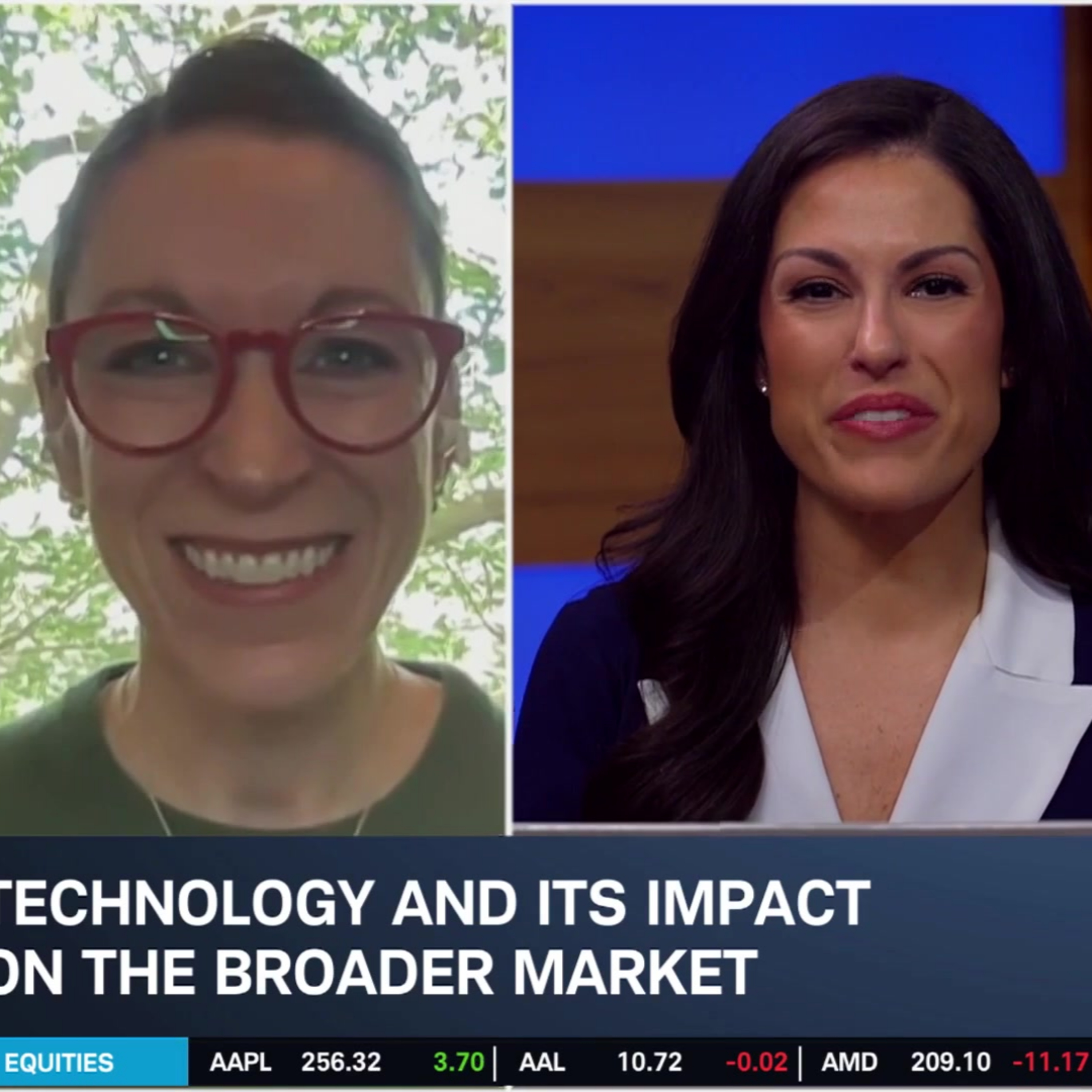
Healthcare, GOOGL & PLTR Establish AI Software Strength in Tech Slowdown
About this episode
The AI theme is "on hold" due to the current geopolitical environment, says Talley Leger, but he believes an eventual rebound will lead to AI's next wave of innovation. He also likes the rotation from hardware to software amid the SaaS-acre that cut down software stock prices. Meghan Joyce says there's plenty of use cases developing in the AI software space, from healthcare to Palantir (PLTR) and Alphabet (GOOGL).
======== Schwab Network ========
Empowering every investor and trader, every market day.
Options involve risks and are not suitable for all investors. Before trading, read the Options Disclosure Document. http://bit.ly/2v9tH6D
Subscribe to the Market Minute newsletter - https://schwabnetwork.com/subscribe
Download the iOS app - https://apps.apple.com/us/app/schwab-network/id1460719185
Download the Amazon Fire Tv App - https://www.amazon.com/TD-Ameritrade-Network/dp/B07KRD76C7
Watch on Sling - https://watch.sling.com/1/asset/191928615bd8d47686f94682aefaa007/watch
Watch on Vizio - https://www.vizio.com/en/watchfreeplus-explore
Watch on DistroTV - https://www.distro.tv/live/schwab-network/
Follow us on X – https://twitter.com/schwabnetwork
Follow us on Facebook – https://www.facebook.com/schwabnetwork
Follow us on LinkedIn - https://www.linkedin.com/company/schwab-network/
About Schwab Network - https://schwabnetwork.com/about
Get every episode summarized
Each time Schwab Network publishes, we email you a written briefing from the transcript — the topics, who appeared, and any specific claims, with the ad reads skipped.
Email me new episodesFree for 3 shows. No card needed.
Hosts & guests
Transcript ready
73 searchable segments. Every word is indexed and playable.
Full transcript
Schwab Network — Healthcare, GOOGL & PLTR Establish AI Software Strength in Tech Slowdown. Machine-transcribed; use the interactive transcript above to jump the player to any line.
Welcome back to Trading 360. I'm Marley Caden. It's time now for our 360 round for that. Let's bring in our panel to take a closer look at AI and how it's shaping the markets right now. Joining us, Megan Joyce, the co-founder and CEO at Duckbill and Tally Lige, the chief market strategist at the Wealth Consulting Group. Tally, let's start with you. You know, as we look at AI, it's obviously been the dominant theme in this market. From your viewpoint, where are we right now? Are we early innings in a multi-year cycle? Are we starting to run ahead a bit of reality right now? I'm getting comments from from both sides as I as I do these interviews. So I'd love to know where you think we stand. So I think right now the theme is probably on hold on a tactical basis, but I think that it still has legs longer term. This is an environment we expected and called for just thinking about the broader tech sector for now, where the rest of the market is catching up to technology, but the space still has an important
role to play in terms of efficiency, productivity, and margins. And that really is, I think, the tailwind that is driving this rotational catch-up phase for the rest of the market. And Megan, as we take a closer look at the rotation, I see from your notes, you're specifically watching AI in spaces like healthcare, finance, logistics. Where are you seeing the fastest real world adoption and revenue impact today? The AI application layer has really struggled to keep up with the infrastructure layer in terms of generating shareholder returns from even real world impact. But the companies that I'm most excited about are furthest ahead in two things. One is leveraging existing distribution channels and data sets where they already have an advantage and are applying AI to make headwinds. And then the other is where companies are using boots on the ground to bring this to bear really quickly. So in the healthcare space, there's immense
opportunity for areas like drug discovery and diagnostics, a company that I'm involved with garden health, is leveraging AI with immense data sets to save lives through better diagnostics. Processing data sets that were previously unprocessable or would have taken years to do now in lightning speed to figure out how to save more lives faster with the data that they're already sitting on. So, Talie, Megan just mentioned some application processes there and software being a part of that play. What's your thought on that? Are you moving into software? Are you staying with semis? We've had this sass pock lips or sass occur, whatever you want to call it. Where's the next leg of gains coming from an AI? Marley, great questions. So in February, I penned a note talking about a rotation from peak love and semiconductor names as a group to peak hate in the software names as a group. And it was really
just a risk management move for us on the semiconductor side of the trade. I mean, look, those names went up over 100% since the April lows. So as responsible stewards of capital, we wanted to protect those gains for our clients. And since then, semiconductors have been as a group underwater. And meanwhile, not much except perhaps energy and software names have been doing anything amidst this war torn tape. So it's nice to see that rotation into, and I would offer IGV as an ETF example that has been quietly carving out to a bottom here. And we obviously focus a lot on the IGV and the software performance here. But Megan, you specifically called out Palantir in the notes that you sent over. So while we're talking stuff where I want to stay with them, you call it AI that actually works. What gives Palantir
a real world edge versus the competitors when it's arguably still in an experimental phase? Yeah. So people are really skeptical about what AI can do, especially knowing that it still does hallucinate. It needs to be worked into workflows. And what Palantir has done has spearheaded this idea of forward deployed engineers to get people and enterprises on board with their models before they even start paying a dime. And a lot of other companies have looked to Palantir's successors actually starting to replicate this in their own approach. Open AI, for example, just took on a same approach, modeled on the Palantir model. But Palantir is furthest ahead. They have boots on the ground, both on the sales and tech side of things where they can actually run boot camps and get people building on their platforms. And that gives them an incredible hook into these enterprises and ways that are really durable. And Tally, let's pivot to Mag 7 names here, because obviously they always come up when we get mega cap AI conversations. In that group,
who do you like for AI opportunity? So within there is one and it's a software name. It's Microsoft, which we own and like in our quantitative stock selection model. And I guess from a technical perspective, I'll just start there. The trend is generally your friend since 2020. It has been acting week year to date, but we think the valuations are attractive. And there's strong free cash flow and margins. And I would agree with your other guests on Palantir, not a Mag 7 name, but we also own that name and our Quantstock selection model. Very interesting amidst this Iran conflict. Yeah, and Microsoft in a significant downturn right now, they're about 32 percent off of their October highs. But Megan, as you look at the big at the Mag 7 names and some of these big tech names, is there anybody that you favor in the group? You know, don't sleep on alphabet.
They were counted out when chat GPT launched years ago and everyone thought that they were slow to the punch, but alphabet has been the sleeping giant who is starting to wake up and find its footing in this space. And what's even more meaningful to me is that they have already presents in the lives of millions and millions of people around the world every day. How many of us use the Google search engine as an automatic search engine reprogrammed onto our smartphones? How many of us use Gmail and Google Calendar and G Suite? Those tools will provide a distribution channel for them to ship these AI products really seamlessly such that consumers don't even realize they're starting to use these AI products when they are. And I think that's a real advantage. You're starting to see Google eat into open AI's market share as they've awoken to the power that they have and they're pre-existing data and distribution. You bring up a great point there. I have every one of those tabs open right now on my computer. I want to thank you both for being with us to take a deep dive into AI and where we might find some opportunities. They're Megan Joyce, co-founder and CEO at Duckbill and
Callie LeJay, the chief market strategist at the wealth consulting group.
More episodes
More from Schwab Network

Stock Market Today: ORCL & ADBE Earnings, AEO Plunges Near 52-Week Low
Schwab Network

Thursday's Final Takeaways: Crude Taps $103 & PPI Hotter than Expected
Schwab Network

Balancing High-Conviction AI With High-Dividend Diversification
Schwab Network

EARNINGS PANEL: ORCL, ADBE
Schwab Network