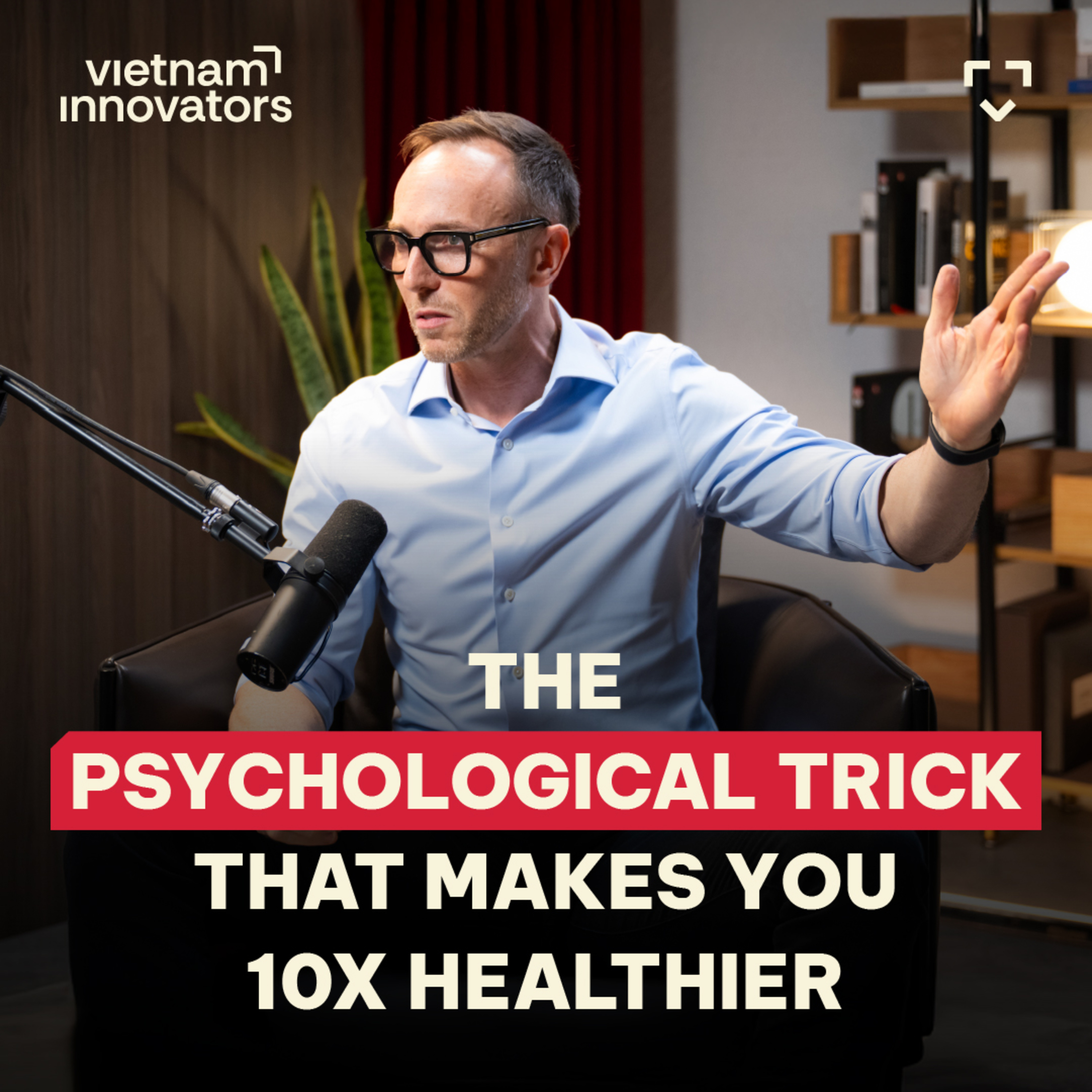
Health Tech Founder: Why I Refuse To Charge My Users A Single Cent For Better Healthcare? | EP 380
About this episode
The rapid growth of the healthtech industry and AI in digital health is reshaping how people access and manage healthcare worldwide. Instead of relying solely on hospital visits, many technology-driven solutions now allow users to track health metrics, manage chronic diseases, and build healthier habits directly through mobile applications.
Amid this wave of innovation, technology entrepreneurs are increasingly combining artificial intelligence, health data, and mobile platforms to create more personalized and preventive healthcare solutions. One of the notable figures pursuing this vision is Ofir Ejnes, CEO and Co-founder of Elfie, a digital health platform that is expanding across multiple Asian markets, including Vietnam.
—
Listen to this episode on Youtube
And explore many amazing articles about the pioneers at: https://vietcetera.com/vn/bo-suu-tap/vietnam-innovator
Feel free to leave any questions or invitations for business cooperation at [email protected]
Get every episode summarized
Each time Vietnam Innovators publishes, we email you a written briefing from the transcript — the topics, who appeared, and any specific claims, with the ad reads skipped.
Email me new episodesFree for 3 shows. No card needed.
Hosts & guests
Transcript ready
854 searchable segments. Every word is indexed and playable.
Full transcript
Vietnam Innovators — Health Tech Founder: Why I Refuse To Charge My Users A Single Cent For Better Healthcare? | EP 380. Machine-transcribed; use the interactive transcript above to jump the player to any line.
Do you know what's the number one cause of death in the world? Number one. I don't know. Do you realize that you and I are sitting here? We have no clue what's very likely to kill us. Humans are humans. When something scares us, our natural reaction is just to ignore it. We only really start thinking about our health when we have to go to the hospital. If you bought a car, you would not cross your mind not to go to the garage a few times and then. You'll only go to the doctor if you feel bad. Prevention versus treatment. The most important thing that you can actually do for your health is to self-monitor regularly. If you don't, there is no prevention. The most important thing that you can actually do for your health is to self-monitor regularly. We did not gain if I helped. We gamified self-monitoring. We put it in a way that allowed us to give it for free. We don't believe in monetizing the user. You tell me how much I can charge a Vietnamese to remind them that you sick every month. Good morning, Vietnam. Welcome to another episode of the Vietnam Innovators podcast.
Thank you for tuning in every single week, supporting the pod. Without you, this would not be possible. We're now on episode 380-something. It depends when this episode is rolling out. And it's with one of my dear friends, Ophier Ejeanus. He's the founder and CEO of Elfee. Elfee is a health care company. But I'll let him talk a little bit more about that in a little bit, health tech correction. Ophier has done a lot of amazing things for Vietnam in Vietnam before that. He was also a founder of Pyramid Consulting Pico, which some of you in the tech sector may be familiar with. Ophier, welcome to the podcast. Thank you, sir. It's been here. Yeah, it's been a few years in the making. Yeah. Now you're doing Elfee. Yeah. So maybe a quick transition over to that. Give me your quick elevator pitch about what is Elfee exactly, and then we'll get into it. What is Elfee?
Well, I guess, simply said, Elfee is the world's first free, gamified, medically published health super app. Exit in my previous company, I did what a lot of guys do. I went to do a full checkup, right? Wanted to know how hard I can party, right? And the results came back. I was diagnosed with a couple of conditions, right? Which, I mean, I wasn't shocked. I was running in the family, but I'm knowing nonetheless. Very selfishly, I downloaded all the apps I was supposed to use, mostly American, because the disease management was invented in the US. I won't drop the names, but all the famous names. And, you know, because I liked the thing that I'm Elfee, of course, I had the sleep app, and I had the nutrition app, and I had a meditation app, and I had a sports app. I was running 13 apps in parallel. And I said, OK, that's not great, right? This is just awful. I mean, the experience by itself already was awful.
And at a very basic level, today, health is ridiculously fragmented, right? I was, my data was distributed between 14 apps. You don't need to have a PhD in data to understand that that's need a good for your data, need a good for your retention. Some data is in some clinics. Some data is over that, you know, that blood test, like everything was completely dispersed. And so we said, OK, at a basic level, what people would want is to have everything in the same spot. The analogy that I like to make is a little bit Spotify. If you remember Spotify, you know, they went to the labels, and they said, you know, it would be great is to have all the music in the same spot. That would be good, right? And except that we understood that in our story, the music labels were actually big pharma. Why big pharma? Because no pharma in the world has every condition under the sun. They have a random distribution of conditions and therapies that the research team was able to discover over the last, you know, decades. So if you want to create the supersets,
you would have to convince many of them to pour all their therapeutic errors inside the same application, right? And of course, you need to add to that all the wellness stuff. Because the paradox is that even people that have quite serious conditions, they're more likely to use their sleep app, their nutrition app, their step app, then the things that they actually should be using. So we put, we really had this vision of putting everything together. We've put it out there. Luckily, some very large pharma has chose to trust us. We put it in a way that was allowed us to give it for free to the world, which we thought was fundamental. Because one of the really core philosophies that we have is that we don't believe in monetizing the user, which is a big departure from the way. You know a lot of people look at this market.
And so we really wanted to create a health ecosystem. And so essentially, do CSR scale? It's a pharma sponsoring this, right? So we can give it to the world. And then on top of that, we've built a premium version, if you will, for insurance companies that they offer the next level of care. But again, we don't take money from the user. It's financed by the insurance company, right? So there we connect to their telemedicine, or you know, to their doctors and network, whatever benefits that they get. And today, long story short, with all of that, we started practically five years ago. We've crossed 1.4 million users. We're adding 30,000 people per week. We'll be in about almost 20 plus countries within the next month. Amazing. So actually, you pay users in a way, or reward users for kind of like getting their health improved.
That's important. You might fall double-click on that for a second. Yeah, please. Because, you know, there's this thing about, it's called, you know, serious gamification, right? There's kind of like, often an epidemic relapse, when you say, oh, you gave me a fight health. You know what I mean? Yes, yes. That's not OK, right? It's a serious topic. You shouldn't do that. And I think it's really important to stress something out. We did not gain if I help. We gain a fight self-monitoring. And that's a quite structural difference. Because you see, what we've discovered inside LV is that the most important thing that you can actually do for your health, right? It's not just having a perfect gym plan or a perfect diet plan. The most important thing that you can actually do for your health is to self-monitor regularly. I mean, another word for that in the farm industry is like prevention versus treatment, right? Because like, as people that have health issues,
I mean, I'm sure you've had some of the past, I've had some of the past. We only really start thinking about our health when we have to go to the hospital or we have to go to the clinic. That you see, that's exactly what you said. That's the entirety of the issue. It's like, it wouldn't cross your mind, right? If you bought a car. Yeah. I don't know how many you have now, but if you bought one of your cars, for sure. And then, you know, like, you would not cross your mind, not to go to the garage a few times and then, right? It doesn't cross your mind. However, exactly what you said, you'll only go to the doctor if you feel bad. And this is the biggest issue because it doesn't matter if you're perfectly healthy. It doesn't matter if you have a condition, you need to self-monitor regularly. If you don't, there is no prevention. Well, let's talk about that for a little bit. I guess, from all the, you know, pharma companies, customers you've worked with from the people that use your app every day, do you feel like that culture of actually caring for your own health on a daily basis?
Does it exist today? Has it changed all in the five years that you've been building this business? And removing Elfie out of the whole equation, I think, just as society in general, as, you know, presumably, they're becoming more health conscious. Things like, you know, what do you call, like, beyond meat? I think it was an example of that, although I don't think they've done so well in the past couple of years. Alcohol, you know, youth drinking trends have essentially collapsed in some markets. Give me your high-level thoughts on that. Do people actually care about that? Sure. So, I guess my read on this is this. Is that, look, we're, I'm very fortunate, we're very fortunate, you know, you can get the whoop and the aura and the what-mots and do go to all the fancy longevity clinics and do all that good stuff. That's what you call the very happy few. That's a 1% to 1% even though that gets a lot of attention, you know what I mean? And we see that there's tremendous traction in that upper echelon.
For the majority of humanity, the situation is still quite dramatic to be fair. I'm just gonna share with you some numbers because I think, you know, the thing that got me started with this and I think that it was, that was funny. You know, I like to, I used to like to believe that I was somewhat educated, that I knew stuff. I had no idea, like if I see right now, like maybe you know because you probably researched this, but do you know what's the number one cause of death in the world? Number one, and I mean, not even close to second. Yeah. Way ahead, what would you say? I don't know. And you can get everything, right? War against what? It's probably not even health-related, right? It's probably like accidents, like car accidents or something? Hypertension. Hypertension, okay. Hypertension. Do you realize that you and I are sitting here? We have no clue what's very likely to kill us. Yeah, yeah. Topic that, you know, you would imagine we would care a little bit. So now that we're talking about hypertension, though,
what is the cause of hypertension? There's a lot of causes, it's genetic mostly, but of course part is lifestyle, but half is genetic, it's half-half. But let me give you some numbers cause this is what it's insane. Today, over 100% of death that occur every year, plus minus 70% is correlated chronic condition. Which means that's likely what's gonna kill you, okay? So the awareness issue is not insignificant. So going back to our previous point, creating the motivation for people to actually self-monitor, to actually look at their data, to go get checked regularly is key because as you know, as everything in health, it's about how early do you catch it? What's this essentially, what health is? So, and it's not that it will never happen to you. It's just a matter of when. So it means that the big piece of advice I can give you is just to check yourself regularly, right? That makes sense. Now, let's think to the second number. Once awareness is there, right? This is according to the WHO. 60 to 80% of people in the world are aware
are not treating their conditions correctly. And you know what? And that was a big part of, you know, of starting out face that it's not because, you know, they're responsible or that, you know, they don't care, it's just that humans are humans. When something scares us, when something bothers us, our natural reaction is just to ignore it. That's what we do, right? So I think that that was really like the switch for me, you know, to understand that you aren't designing, you know, for clinical logic. You're designing for psychology and behavior. If that makes sense. Psychology behavior, I like that note because in today's age, at least everyone's so digital, everyone's got a mobile phone in their pocket. Some people are mobile only, in fact, they don't even have computers. So that whole lifestyle and attention has now gone on the screen. And so when it comes to health, like overall
in a person's 16 hour waking day, how much of that is actually spent on health? You know, exercises, I think becoming more popular, but it's also increasingly low people's sedentary lifestyles. So you got to capture them where their attention is. Hence, I guess what you're doing at healthy, right? I mean, yeah, for sure. I don't have any other health app, actually. Other than what Apple just threw on my phone. So I guess there's a couple of points in what you're saying. I think the first thing that I do want to call out is that this is probably the most exciting, you know, more than technology's history, right? Obviously, what everything that's happening with AI, it's not not exactly a big surprise, but I do want to bring him back to health. Look, I don't know if you had that experience, but that's has been mine. You know, I don't know how many times you were in a doctor's office and they were going to papers and saying words that you could barely spell and then telling, and you go, my GG2256 is not great, huh?
Okay, you got it, yeah, totally. And that goes on, you know, for 20 minutes and you walk out with a couple of boxes and you're like, let's see, right, till next time. Yep. And that guy, typically, you see him how often you see your doctor per year, if things are well, almost none. Sorry. So this chain, this is a complete paradigm shift because for the first time, and this is what, this is our mission at Alfie, right? Because you can put all your data inside the same space, which is exactly on your phone, which you hold in your hand. You have, and we provide and say the Alfie, like a 24-7 AI companion that can help you make sense of what it means. This is a revolution because this is essentially the handholding and the support and the understanding that you need it between those doctor visits. Because the poor doctor is, you know, they're overwhelmed and you'll speak to any doctor like their life is not easy. So the only solution here is user empowerment.
And that is the conduit to that, right? This constant little support that you get. And the key thing to your point is that you have to make it rewarding. You have to. Because what this has done to your points is that this is the entertainment economy, right? This is what you're now doing right now. Yeah. Everything has to be entertaining, right? So that's why gamification is so fundamental to what we do. You could have all the knowledge in the world, but I need to find a way to make you want to ask for it. Yeah. That makes sense. Let's take a little step back first. I think, you know, a lot of folks heard, you know, what is Elfie exactly? What is it doing, the mission, the vision? That's awesome. We have one job at Elfie, which is to motivate you to self-monitor. Now in order to do that, when introducing to the market and you notion, you're very familiar with a diet plan,
you're very familiar with a gym plan. We're introducing the notion of a self-monitoring plan. Now what does that mean? That means that when you download Elfie, the app is going to ask you, okay, how? What do you want to monitor? Right? And this is where the holistic bar comes in, right? Everything should be in the same spot. And everybody's different. You're going to go, I want to monitor my hydration. I want to monitor my sleep. I want to monitor my workouts. Whatever. Click, click, click. Great? Then the app is going to ask you, okay, how have you been diagnosed with anything that you know? You can say, no, I'm perfectly healthy, or you could go, no, actually, you know what? I've got cholesterol. I've got heart failure. I've got diabetes type 2. Whatever that is. Click, click, click. And then what the app does is that it creates a personalized self-monitoring plan just for you so that you know exactly what's the frequency and what to do how often. And that's the key of everything. Because what we found in our research
is that if your self-monitoring regimen is random, then it just dies. Right? So this structure kind of like keeps you on track, does some extent, to track the important things in your life. And progressively the plan will change over time based on the data that you enter. Okay? And so, and the second thing that we've done is that we've gamified that self-monitoring. Right? So essentially, like I said before, we didn't gamify health, we gamified self-monitoring, and I'll give you an example. So I obviously, I take a lot of supplements, you know, in some drugs. So when I tell the app, okay, today, I took my supplements and my drug. Let's say I get a thousand coins, right? Can you guess how many I give you if I said I took none? Oof. I mean, even more? I don't know. No, less. Nothing. Interesting answer. Okay. The same. The same.
Okay. Oh, because you're still reporting at the end of the day. Okay. Because what I want to drill in your head is that you'll be rewarded just for tracking your data. Got it. I don't care if it goes to the left, it goes to the right. I just want you to see it. Right? And that's fundamental. And so every time people enter the data that they chose to track, they get coins, right? And then we follow some quite advanced gamification frameworks. And then you can basically reinforce that behavior of self-monitoring by saying, okay, now, you know what? You can spend your coins. You can spend your coins on charity donations. You can spend your coins on challenges. You can spend your coins on straight redeems, vouchers, discounts, rewards, lotteries, like whatever gets you going. Because everybody's different, right? Everybody's going to have a different relationship with what makes you motivated and excited. And so we've built an ecosystem where there's something for everyone, right? So that you can actually find your motivation, right? That's right for you. And I think another important aspect, like I said before,
there are two actually, is that it's the family support aspect of it. Because actually, you know, as I said, it's 50% genetic. So it's very likely that you have somebody around you or unfortunately might end up having provide support for your kids. You can actually co-track people, you know, in your family that what would you provide care for, you know, inside the application. And then we wrap all of that in AI, within an AI companion, where you can ask any question at any time, they'll tell you exactly what you need to know. And so if you put all of that together, and I'm not sure, like I said before, Elfie is the first free, gamified, medically published health super app. Everything that you need at the same spot with the support that you need and the motivation that you need. I want to talk about how you approached the expansive Elfie as well. I found that particularly an interesting approach when you first told me a few years ago.
So not working with the companies or getting more users or something like that, but also like even the market approach. So if you had almost the first, that makes sense. You live here, team is here. You went to Brazil, you went to Egypt, and you're now in 20 different countries. Could you explain to me the reasons for going to those countries and not like the US, or maybe you are in the US now, but why didn't you go to the US first? Why didn't you go to your home country or Europe or these other developed markets instead? Walk me through the need, but also the market need to have Elfie in those kind of countries. Sure. So I guess, look, I guess it goes back to, you know, the way I look at the markets, right? So my belief is, just let's start from that, is that, like I said before, for this to work, it has to be free, right? So that means that at some point, you have to find a way to get this financed, right?
So it means that you have to ask the question, what value do you bring to the legacy players, right? And today, the legacy players, you know, the farmer companies, the insurance companies, and the governments, they're not aligned, right? In terms of interest, because the farmer is trying to sell treatments, right? The insurance is trying to reduce health claims, the government's one's population health, and nobody's really taking care of behavioral change. There's nobody to champion it, right, in the ecosystem. So you have to create a common denominator where you bring value, right, to those stakeholders, and to have the ability to be distributed at scale, and actually have impact, right? So we start with farmer, right? So, you know, the thing with farmer is that, you have to be interesting for them, right? You have to be large-scale, right?
It's very hard to imagine a world where you entertain one app or a disease per country. You see what I'm saying? Like, you have to think big from the get-go. And I think that developing countries kind of like give us the opportunity to test artises and to demonstrate that it works, and then grow in confidence, you know, with the farmer, demonstrating to them something that was, I profoundly believe it, but it was not obvious to people, because you know, the thing when you start, you know, this is a thing you hear a lot in digital, is that they'll tell you, oh, no, no, no. The Cambodian is completely different than the Mexican, that's completely different from the Egyptian, that's completely different from the guy in Iceland. Then you look at them and you go, yeah, but I'm pretty sure Facebook looks exactly the same in all those countries, and I'm pretty sure that Uber and Airbnb, et cetera, they all look exactly the same. So there was this belief, right, at the end of the day, there was an opportunity to create a single global platform that could impact people
positively across market at scale, right? So, farm off course tested us in markets were progressively important for them, right? So that was the first distribution channel. And now that we were able with farm on it to actually put out there some pretty significant medical publications, that demonstrate that we actually make people healthier, which is the most exciting part, obviously, of what we do. That allows to engage the conversation with the insurance companies who now want to offer this solution to their entries, to reduce their claims. And this is how eventually you escalate the government, we have a couple of government conversations going on, should be announced soon, where they say free platform, where you can see in real time where people are doing what's going on. So it was really about aligning interest in a way that allowed you to distribute the solution at scale, because if not back to what I said before, you stack in this 1% logic.
I mean, you've seen especially in Vietnam, Vietnam actually is a perfect test case for this. You tell me how much I can charge in Vietnamese to remind them that you stick every month. Yeah, oh, zero. Zero, exactly. The right answer is zero, right? So that's it. Once that is said, you understand what you actually need to do if you want to go out there. That makes sense. Okay, yeah. I mean, I was running through my head. I mean, this sounds like a great case study in like stakeholder management. You have three very large kind of stakeholders on the health side of things, and they all have their own interests, you know, bureaucracy. But hopefully, you know, they all have their own KPIs too, right? Yeah. And how do you find that alignment? I think that's a masterclass right there. Yeah, yeah. Well done. And so many different countries nonetheless. I mean, like a Brazil is no, no, no similar to like a Vietnam, for instance. So the whole AI thing, I'm sure Alfie itself uses it on the back end
to power the app and all that. Do you mentioned AI content created by AI? Yeah. Yeah. It doesn't directly have to do with Alfie specifically and we'll go back to it. But since AI everyone's talking about and your tech entrepreneur yourself, do you believe, especially in the health sector, that, or what is your belief, given that you're in the health sector, how AI can really influence the future of health? I know, very broad answer, a question. But what are pharma executives thinking right now? What are... Yeah. I think, like I said before, I think reduction at a point a little bit is that I think that AI is going to be your health companion 24-7 when you can only see your doctor two or three times a year. Yeah. It's going to be... Look, it's the... You know, one of the things so recently, we released inside Alfie, we released lab results. I'm sure there's a company in the US, you know, that's very popular right now, you know, that sells for $99 or whatever
a bunch of blood tests and... huge success. We wanted to give that for free, right? So we reverse engineered the thing, we put it out there, because... Actually, we realized that the main behavior of people around the world is, you know, you'll go to a blood test here, then you upload it in Chad GPT or General Nile, what does it mean? What's wrong? What should I do, right? And so we wanted to simplify that. Yeah. Because that's what... That's the opportunity. The opportunity is support. The opportunity is understanding and the opportunity is, again, just constant availability. That's... I mean, that's a big thing. People think about their health that way at times. Sometimes in the middle of the room. No, they only think that that's the point. Yeah, for sure. At first, you don't know when. Yeah. First, you don't know when. And objectively, if you don't create... And that's my whole point, right? If you don't create an externality, if you don't need the experience enjoyable, you won't do it. That's everything about what we do.
You know, the thing is that, people when they hear the word, are rewarding. Rewarding. Rewarding. Now, what this actually means is that you created a neural pathway that whatever it is that you're currently doing feels good to you to a point that you're okay repeating it. That's it. That's the engine, right? That's what you need to put together for you to actually do something over and over again. Because, unfortunately, people don't change because something is important. They change because something is enjoyable and they're okay right to repeat it. Okay. So, if you're... I want to... The next couple of questions are more about you as a leader as an entrepreneur. I want people to get to know you better. The same way that I know you as well. Not just about the industry. What's one failure or a mistake that you made as an entrepreneur
that really still hangs on you today that when you reflect you're like, hey, I could have done that a lot better and I'm going to take that forward with me at L.F.E. I think without an inch of a doubt the biggest takeaway that I have is that the greatest and the worst decision you'll ever make is the people you work with. And I think that, you know, Thanksgiving, that says about the age... Greatness happens in the agency of others, right? The single most important decision you make is, again, is the people around you. And I think that when I started L.F.E. that was my second, right, company. I think that what I feel today, you know, the proud and the respect, you know, that I have, you know, for the people that I'm privileged to work with,
that means everything to me. That's amazing. No, well done. I think going back, you started your business 1999. So 27 almost years of building companies, building teams, working in teams. At times you probably felt you were working alone because you're not with the right people at the time. And sometimes it's, you know, it's not even about the person themselves. It's just the dynamic as well. And the situation that you're in and it requires so much adaptation. But how do you set those blocks of foundation at the very beginning? You know, hopefully you've been able to set that for yourself at L.F.E. and I, you know, I think the results thus far, at least, have definitely spoken for themselves. Yeah, and Logan, just a double click on that. I think that the one thing, of course, that happens over time, is that you know yourself really, really well. And you know what you're really good at. And you know what you probably shouldn't be doing. And I think that if you can assemble a team around you that's really great at the stuff that you suck at, that's it. Yeah, right. It's as basic as that.
So it sounds very easy to just say that though, but in practicality, is it not easy but have you been able to find those people that can do what you perhaps are not that good at? Yeah, I mean, look, honestly, my co-founder, I mean, he's the most complementary relationship I've ever had in my life. You know, like, he is amazing. Aside from your fiancee. Yeah. Of course. Thank you. I apologize. No, for sure. But I mean, professionally look, I really think that, again, it's like over time, you kind of understand what is that one question you really should be asking during that interview, right? It sounds the same thing. You know what's that key thing that you're looking for? And then there's just a value system, right? You want to be, of course, there's skills, but there's values. And I think that, and to be fair, I had the privilege, which I'm also about to build a friendship before we built a business. So it felt very natural. And you know, and again, I don't take it for granted.
I agree with you. It's not easy, because like most entrepreneurs, you started a company with who was there at the time. You know what I mean? And then decades later, you know, things just evolved. You became someone different. They became someone different, right? And the probability that you evolved in complete parallel path is not super likely, right? So I think, again, the key takeaways is, again, just understand who you are, understand who the people in front of you are. And, you know, just make the tough call. No, very good. Tough call, but easier later, perhaps. Yes. One last question for you over here. And thank you so much for sharing that really heartwarming response. I appreciate it. I think our audience would too, especially the entrepreneurs listening today. So I always ask this to all my podcast guests. We have you on the show here today to share about your own entrepreneurial story, what you've learned building Alfie, why it's needed, all that good stuff.
What's something that you want to learn more about? So that we can invite the next guest and answer some of your questions. So it could be about any industry. You don't have to name a name, but maybe you do. That's keeping you up at night and you want an answer that, yeah, I can't give you. And as you're thinking, I just want to let the audience know, if you feel like you know somebody or a company or anyone that can help Ophere answer his question, please let us know in the comments below. I'm sure Ophere would love to hear from you. You know, I think that obviously I'm very passionate about, you know, tackling this global health issue. So for me, like, I'd love to hear from people, you know, from the WHO, I'd love to hear, you know, from the World Economic Forum. I'd love to hear from those guys, you know, how do they get involved more
and actually, you know, spreading the impact? Because I think that there's a new opportunity right now that technology is creating. You know, and I think that like I said before, success is going to come from creating the one thing that's lacking, which is a digital standard for health. I'd love to know, you know, if you can get to those people, you know, how they see this. Well, maybe we can start with the WHO's representative and Vietnam. Absolutely. Absolutely. We're here. Absolutely. I think we have that content actually, so maybe we'll reach out. But I think really good point, Ophere, you know, from the private sector, from the national government sector, there's a huge interest, of course. But who are those like overarching organizations, who have a lot of resources, a lot of play and say in the whole system, how can they somehow contribute more or not in just in terms of actual implementation, but perhaps even a knowledge sharing, stakeholder management, whatever. Impact, yeah. Just, yeah. It's really an impact. Yeah, yeah, exactly. Very good.
Okay, well, if you feel like you know, Ophere, source one of those guests for us, you know, let us know and we'd love to hear from you. Ophere Eginus, the founder, CEO of Elfie. Ophere, it's been a pleasure. You know, this is a few years in the making. We finally have you in the studio and I'm sure we'll catch it more offline another time. But that's a block for Elfie and, you know, keep it going. Thank you so much. This is really great. Thank you for having me. Thank you so much. See you guys next time. Bye-bye.
More episodes
More from Vietnam Innovators

Can Immigration Save Japan? | Kenji Govaers & Michael Kokalari | EP 405
Vietnam Innovators

Emergency Podcast: When Will Vietnam's Stock Market Go Up? | Michael Kokalari -...
Vietnam Innovators

What Will Closer US-Vietnam Ties Mean For The World? | Michael Kokalari & Dan Ma...
Vietnam Innovators

Has Your Company Been An Awesome Culture Yet? | Stephen Turban | EP 402
Vietnam Innovators