Heading Outdoors for Labor Day Weekend? Here's Some Wildfire Safety Tips
About this episode
Get every episode summarized
Each time KQED's The California Report publishes, we email you a written briefing from the transcript — the topics, who appeared, and any specific claims, with the ad reads skipped.
Email me new episodesFree for 3 shows. No card needed.
Hosts & guests
Transcript ready
148 searchable segments. Every word is indexed and playable.
Full transcript
KQED's The California Report — Heading Outdoors for Labor Day Weekend? Here's Some Wildfire Safety Tips. Machine-transcribed; use the interactive transcript above to jump the player to any line.
From KQED. On the California Report Magazine, we bring you stories about Californians helping out their neighbors, like a little store in Oakland where shoppers can walk out with one item for free. I mean, opening up a shop and giving away stuff for free, my first customer thought I was insane. Still here, so it seems to be working. I'm Sasha Koka. You can hear more Community Connections stories on the California Report Magazine podcast. Good morning. This is the California Report. I'm Adibolanyo since San Francisco. Two wildfires are raging in Big Sur. The timber fire to the north started in the first week of August. And several weeks later, the Plaskit Fire broke out to its south. Together, they've burned through more than 55,000 acres, with containment at 19% for the Plaskit Fire and 23% for the timber fire. The progress made on the timber fire has prompted the reopening of portions of Big Sur
along Highway 1 in northern Monoray County. Earlier this week, Katie Brown spoke with folks keeping the now open strip of the Big Sur Valley alive. This famous stretch of coast attracts millions of visitors each year, but it's been mostly closed to the public and thousands of firefighters from almost every state are pitching in. Andrew Madson is a public affairs officer with the US Forest Service. He says most of the rigs are from California. There's all kinds of LA County people here, seeing them from San Diego to Larry. Just outside Fifre State Park, firefighters are fueling up trucks and hooking their hoses up to hydrants, sucking in thousands of gallons of water. Ready? Yeah, send it. Madson says the terrain is dry and extremely steep. The topography. I mean, it looks like an EKG readout. It's impossible to safely put firefighters in to go direct. And so firefighters are relying on aircrafts to drop water and people in those remote areas
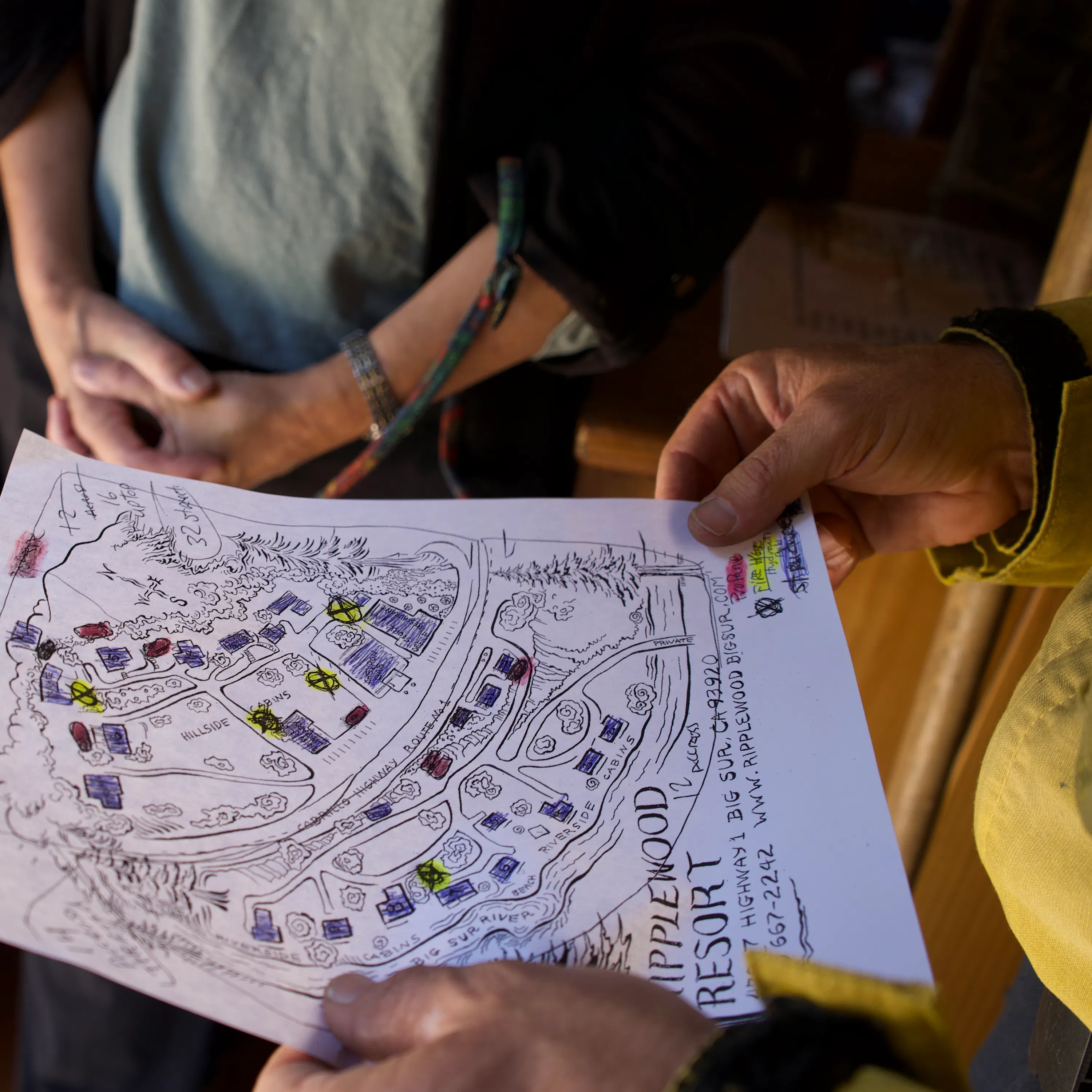
and drones to identify the hotspots. But Madson says the big help would be... If we can get some rain on this thing, that's typically what puts out Big Sur fires in the backcountry. Rusty Sexton is a battalion chief from San Diego and relies on maps to strategize the best way to fight the blaze. The map grows with the fire. And Big Sur residents who've lived through wildfires have been sharing their own maps to point out wells and streams. They've been through it, they've seen it, and so they've got more on the ground information. Carol Shadwell is one of the folks Sexton is talking about. She owns Ripplewood Resort on Highway 1 in the heart of Big Sur. She's talking to a firefighter and looking at a hand-drawn map her sister created. Have your nice water tank and hydrants? The only found one. Ripplewood Resort was in an evacuation zone, but she never left. It's my home. Firefighters were relying on the resort's general store for basics. I couldn't imagine having to say, oh no, oh no, you can't come in here. No, I can't tell you what you need or want.
This is the fourth fire Shadwell has lived through. During the evacuation, she extended story hours to accommodate firefighters and once the wildfire is fully extinguished. She says, oh I'm going on vacation. If firefighters say that'll only happen once it rains. That was Katie Brown of KSU News reporting from Big Sur. Labor Day weekend is here, and as you've heard, we're still in the middle of fire season without much rain and sight. We know many of you will likely be heading outdoors to enjoy California's wilderness, so KQED Outdoors reporter Sarah Wright is joining us today to walk us through some ways to stay safe. Hey Sarah. Hello. So what should campers know before they head out if they're worried about a fire in your buy or scared that one might start while they're out? Yeah, so I think the first thing to do is to just check in with where you're going. So let's say you're going to a state park or a national park. You can check the website. They'll have fire information posted, usually social media as well. And if you're really worried about it, you can call up the ranger station and local
rangers will usually have all of the information about any fires that are burning nearby. And then also like any evacuation information you may need to know, like one thing I like to do is take note of paved roads nearby or escape routes nearby. So I think if you're extra worried, those are great precautions. If you want to be, you know, double, double secure, I would check air quality. If that's something that tends to bother you, bring in a mask just in case and you can even bring like a go bag or an emergency beacon. If you're really worried that you're going to have to leave quickly. Okay, let's say I didn't have time to do any of that and I'm out on the campground and it's just too late. I didn't know until I got there. What do I do in that case? This has actually happened to be twice. So I'm an expert in this situation. One was in Big Sur. I was driving on to my campsite and I literally saw a fire on a mountain while I was driving down there.
So I turned around. I got the heck out of there. I think that's like my number one piece of advice is just go, don't hesitate. The second time I rolled up to a campsite, it was beautiful, everything was great. And then a couple hours later, the ash started falling from the sky. And once again, I just left. It's not worth it to be out there in danger. Just go. You may have to leave your stuff. So like be okay with that. Don't pack up your tent. It's not worth it. And find that road that you took note of. There's probably going to be emergency vehicles going up and down it. So if you happen to be stranded without a car or you need help, a paved road is a great place to be to get that help. And then if you do have cell service, maybe you're the first to spot the fire. Like you can be the first in that call. Say it in 911. So what else should campers know during fire season? Well, I think that here in California, we have a lot of messaging about how dangerous wildfires are. That includes you as a camper. A lot of people love having a campfire camp, totally understandable.
But there are many parks and zones of the California mountains where that is not a good idea and even banned for most of the summer. So pay lots of attention to what the local fire regulations are. And if you're out there and even if it's not banned, but it's a really windy day, you know, just don't start that fire. Don't use your stove. You can bring food that doesn't require being cooked while you're out there. And if you do make a campfire in a legal, safe way, make sure you put it out before you go to bed or before you leave your campsite. What that means, and I say this literally, it should be cool to the touch. So you should be able to put your hand into the fire pit safely. And so that's going to take a little time. But that's really the attention that we need to pay here in California because fires can escape so, so quickly. Sarah, thank you so much for those useful tips. No problem. Thank you. That was KQED Outdoors Reporter Sarah Wright.
And that is the California Report for Friday, September 4th, where production of KQED News. Our engineers, our Danny Bringer, Brendan Willard and Christopher Beale. Our producers are Billy Cruz and Christopher Alam. Our senior editors are Angela Carral and Aaron Boldessari. Our managing editor is Ted Goldberg and our editor in chief is Ethan Tovan Lindsay. I'm Marie Boilanios. Thank you for listening and have a great day. Support for the California Report comes from Monterey Bay Aquarium, inspiring conservation of the ocean through amazing live exhibits and global action. More info at Monterey Bay Aquarium.org slash connects. James Irvine Foundation, committed to a California where all low income workers have the power to advance economically. Learn more at Irvine.org and Eric and Wendy Schmidt whose philanthropy works to create a healthy, resilient, secure world for all on the web at the Schmidt.org.
More episodes
More from KQED's The California Report

Sonoma County Agency Agrees to Reel in Drone Program After Privacy Violations
KQED's The California Report

Immigration Related Threats by Employers Spiking in California, Worker Advocates...
KQED's The California Report

Native Americans in Central California Ring in Powwow Season
KQED's The California Report

Formerly Incarcerated Advocate on Why Sexual Violence Persists in Men's State P...
KQED's The California Report