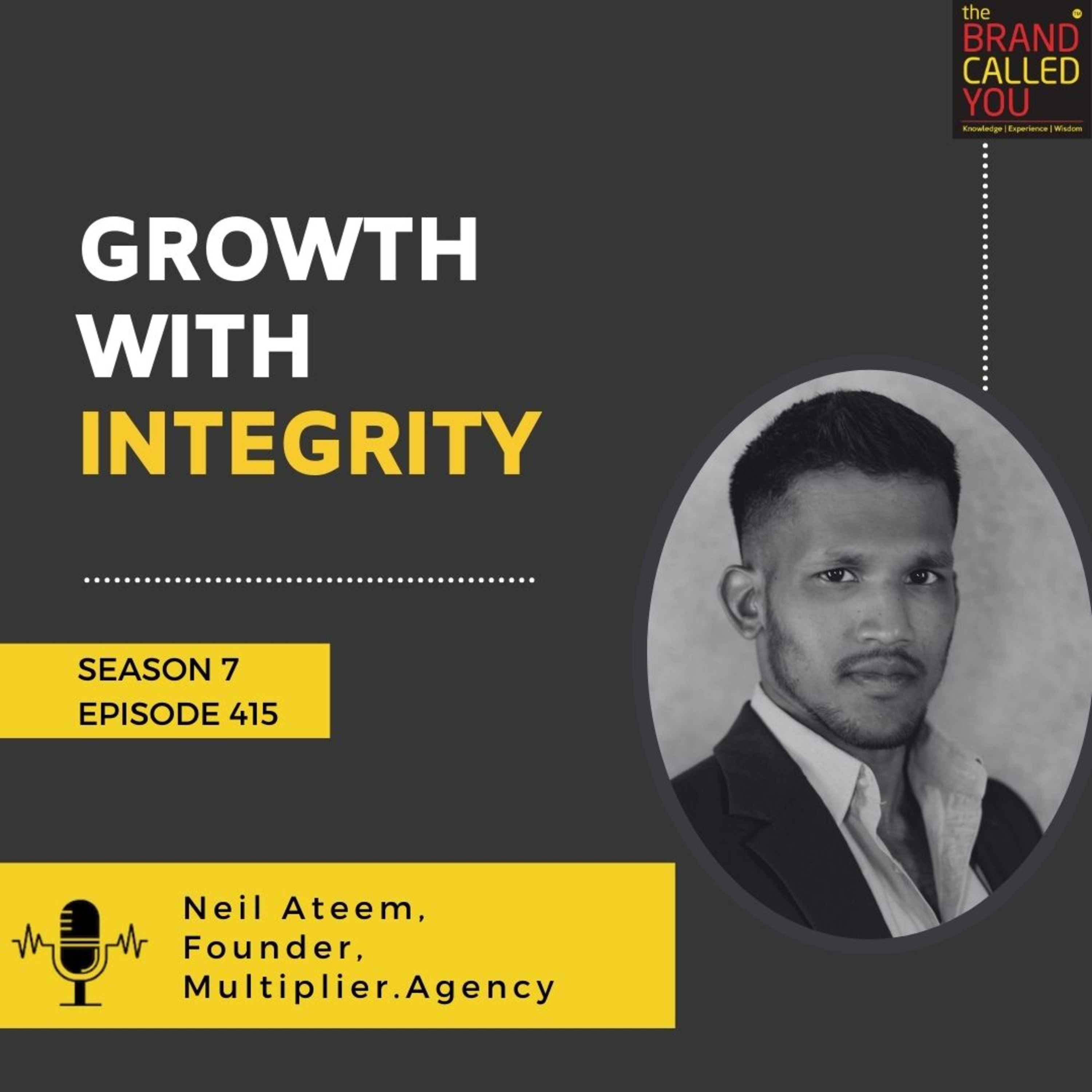
Growth With Integrity | Neil Ateem, Founder, Multiplier.Agency
About this episode
In this episode of The Brand Called You, Neil, Founder of Multiplier.Agency, shares how mission-driven companies can achieve sustainable, predictable growth without compromising authenticity. Drawing from his background in tech, wellness, and systems thinking, Neil breaks down value-first marketing, ethical scaling, subscription economics, and the mindset shifts founders must make to grow responsibly in volatile markets.
00:38- About Neil Ateem
Neil is the founder of Multiplier.Agency.
Get every episode summarized
Each time The Brand Called You publishes, we email you a written briefing from the transcript — the topics, who appeared, and any specific claims, with the ad reads skipped.
Email me new episodesFree for 3 shows. No card needed.
Hosts & guests
Transcript ready
253 searchable segments. Every word is indexed and playable.
Full transcript
The Brand Called You — Growth With Integrity | Neil Ateem, Founder, Multiplier.Agency. Machine-transcribed; use the interactive transcript above to jump the player to any line.
Welcome to another episode of the Brand Called You, a what-cast and podcast show that brings you leadership lessons, knowledge, experience, and wisdom from thousands of successful individuals from around the world. I'm your host Ashutosh Gargant, and today I'm delighted to welcome a very senior and respected leader from the world of branding and marketing from Trinidad and Tobago, but talking to us from Bali, Indonesia, Mr. Neel Athim. Neel, welcome to the show. Thank you Ashutosh, thank you for having me and happy to be here. Thank you. Neel is the founder of Multiplier Agency. So Neel, my first question, what personal experience is most shaped your decision to build a multiplier as a mission-driven growth agencies rather than a conventional marketing firm? So the thing about Multiplier is an extension of my passion, right?
I've been in the wellness, personal growth space for a long time, and it's always been with mission-driven companies. So I think it's directly aligned with what I'm passionate about, what I like doing. So it's not a grind for me, you know, working with clients, different companies because it's fully aligned with who I am and what I actually do every day in the end. So it feels more like play than work for me most of the time. So directly out of that experience, I decided to go this route because I saw the need as well, aligning my expertise with the need in the niche, you know, in wellness in mission-driven companies because a lot of them struggle being mission-driven companies to do marketing right, to not come off as CLZ or exploitive, you know, because marketing can have that connotation as well, right? So it's aligning that authenticity and doing it in a right way to bring about impact and not just revenue and just focusing on making more money, but also, you know, impacting
people's lives. So yeah, that directly aligns. Absolutely. And how did your background in tech and systems thinking influence the way you approach marketing strategy today? So yeah, my background is in computer science, that's actually what I studied and I made the transition. So the thing about marketing, when you get to a mass scale, it's a lot of numbers, it's a lot of data, it's a lot of picking up trends and seeing things that other people would most likely miss, right? So on a large enough scale, you need to be able to be analytical at the same time as a marketer, you need to be creative. So I think that skill set really helps me to merge the two because I am a creative, but I have that logical background. So I know how to merge it really well, you know, you can be the jack of trades or, you know, master of one. So I prefer to go to the jack of all trades route, because in today's world, in the marketplace, there's a lot of specialists that go really deep into one thing, but you don't see a lot
of people who are quite a few things and combine that, you know, and I think, yeah, I learn to leverage that skill really well said. You speak about value first strategy. What does this actually look like in execution and not theory and give me an example if you can. Sure. Okay. So let's say, I do a lot of digital products, online courses, et cetera. So let's say you have an entrepreneur and organization who wants to do an educational product, product in a specific niche and they want to acquire customers. Now you can go the route of, yeah, saying, hey, I have this and trying to sell it. Or you can start giving value as in educating them, giving them something that they can actually use, you know, like so you can do webinars, even on your ads. If you're running ads, let's say you have an email list, you're sending out emails and you're actually providing value, you're giving them stuff they can take practically to solve
their problems, make their life easier. It doesn't need to be everything that you have package and ready to sell, but some of it, you know. So that way now, you actually build the trust and they actually say, ah, this guy knows what he's talking about, oh, girl, and I'm getting value from them now. It's that reciprocity, right? In G.L. I'm going to talk about this in his book. So it's essentially, that is essentially a value first marketing there. So you always want to give, give, give, and then the ask would be seamless after that, right? Then coming, coming out and just saying, hey, give me money and, and, you know, he has the product. Hmm. Amazing. How do you distinguish between growth so that is impressive on dashboards versus growth that is genuinely healthy? Hmm. That's a good one. So every company wants to grow, right? No. It's case by case. You can have an entrepreneur who is bootstrapped, no funding and wants to grow really quickly. Or you can have something that is, let's say, VC backed or they have funding and they
have the pressure on them to scale. Now, the thing about growing is that it can be linear, right? Which is, you know, the regular trajectory, right? Any company can do, let's say, 10%, etc. Or you can have hockey stick growth. Now, anything beyond linear, I would always be cautious because if you're following a trend, something specific is working, it may not last forever. And at the same time, while acquisition may be high, you need to think about retention, customer life and value and the brand, the reputation. So if you're doing something, let's say that's out of line with your business and your brand to acquire a customer, you need to think about the long-term implications of that. So while growth may be amazing to be on that hockey stick trajectory, you still want to manage it and actually look at the risk because if you have a business that you want to have for a really long time, which most people do, you need to protect the brand at the same time. So if you do shady stuff to get aggressive and acquire a customer and grow really fast,
that might come back to bite you, you know, after some time. Very interesting. Why do so many growth campaigns generate short-term revenue, but damage long-term brand equity? Well, that kind of touches on the point I just mentioned, right? So if you're going really aggressive now and probably doing shady stuff, like let's say, for example, you know, there's really gray hat or black hat practices in marketing that people may use, like things like buying an email list and then blasting that email list. If you do stuff like that, it may work now. You may get some customers, but then you might get flagged, you know, from the platforms, from people themselves saying, like, hey, how did you even get my email address? Why are you sending me? Why are you scamming me? You know, like things like that. And then once a snowball effect takes place, where they start going online on forums and say things like Reddit and saying, this is a scam company, like it's really hard to recover
from things like these. Yeah, things like this, you need to look out for, right? And of course, that's why I work with mission driven companies because the probability of them doing these types of strategies is really, really low. And Neil, what in your view was some of the common mistakes companies make when launching subscription models? So, okay, there's something very distinct about subscriptions, right? So, okay, just to give a little more context to the audience, so you have transactional revenue, which is you pay a certain amount of money, you get a specific product, and then that's it, goodbye, right? You may come back to buy another product, maybe, but the beauty of subscription, it's ongoing, right? The customer life and value is longer. You may be monthly, annually, whatever. Now, the mistake that is usually made with subscription is not understanding the point of subscription to the consumer, because to you, yes, it is to make more money and get
reoccurring payment coming in, but to the customer, it means constant value being delivered. So, think about everyday product. You may have YouTube premium, you may have Spotify, Apple Music, whatever it may be, or chat GPT, or, you know, any of these, right? You're paying for it because it's utility and you get value out of it constantly. So, within your product, within your subscription, whether it's a service, product, coaching, online education, whatever it may be, you need to think about the constant value. And pay that with, yes, you may be delivering value, but you don't want to deliver too much, that would overwhelm them and cause them to actually cancel or churn at the same time. So, it's finding that delicate balance. No. Having scaled subscriptions from 0 to 8 figures, what is the single hardest phase most founders underestimate? I would say it's the product testing phase because, okay, some of the biggest breakthroughs that I
had came from one year of testing or more. So, you have to be, you know, thick skinned in order to be testing a lot, putting budgets out there and continuously refining and testing because you can't say, okay, I tried one, two, three and then say, okay, this isn't working. But if you can make it to the 10th iteration or 20th iteration and keep going until you figure it out, something will actually come through, right? So, this is what I've seen from many companies. It's like the ones who are willing to just keep testing, keep testing until they find a willing formula because it won't just be off the bat. You think you have the perfect product, often then, yeah, it doesn't always work like that. And what would you say at what point does adding complexity to a subscription actually slow down growth? Well, that touch is on a point you just mentioned earlier, which is overwhelmed, right?
So, complexity can tie directly to overwhelmed, which is giving too much, you know, just having too much there. A person think about this. If you have a subscription product that they're using every day, whatever it may be, you're competing with everything else, right? Which is their sweep, their family life, their job, you know, their career, their hobbies, passions, whatever it may be. And then they have to go use your product or service subscription, right? So, you don't want to overwhelm. You want to make it as easy and seamless as possible while still delivering value. So, yeah, it's that delicate balance there. Amazing. Why do so many product launches fail despite good products and strong audiences? That's an interesting question. If you have a good product and a strong audience, the likelihood of failure is really low. So,
good product meets right audience. I don't see how it can fail unless if pricing is not right. So, there can be failure for the organization themselves, right? So, maybe it's underpriced. And, you know, you're not getting the values work out of that product being delivered. Or it may be a single product and there's no upsell, no crosssell, like no backhand offer to it. So, maybe you have some really good value going out and it's, let's say, low ticket. And then you have the right audience, but you have nothing else to sell them. So, your customer life then value may be really low. And then that's it there. So, that can be a point of failure as well. Really interesting question. Yeah. Thank you. And how do you design campaigns that feel ethical and aligned while still being commercially aggressive? Yeah. So, it needs to be aligned in terms of what the business actually stands for, promotion stuff, right? But aggressive is a strong term.
You don't need to be aggressive if you go with reciprocity or value-first marketing as we mentioned earlier. So, that is the key element in there. If you're giving, giving, giving, you know, you're making someone else's life better, right? And saying, hey, buy this. You say, hey, did you know that if you have this, you can do this? Or get this product now, 50% off. You know, like, okay, why? Why should I get this product? So, you first need to describe their problem. Give them something that they can apply and use. And then, hey, if there's 50% off, great. Because I'm already sold. I understand that you know my problem. And I see you have the solution for it. So, it's always that value-first approach trying to educate the audience as well rather than just saying, buy this. What does predictably growth really mean in volatile markets like wellness, education, and digital products? So, this ties directly to subscriptions, right? Subscriptions. Absolutely. The base of predictability. Because if you're dependent on transactional
revenue, it's always going to be, oh, I need another customer. I need another customer, rather than like, okay, I have 1000 people on subscription, bringing in 49 bucks a month per person. And I have a generate of, let's say, 500%. So, I know 5% of people are going to leave. I have x amount coming in. That is predictable, rather than, okay, I need to spend 10,000 dollars to acquire 50 customers. And it may fluctuate one month and may only get 10. So, this is where subscriptions come in. And this actually changes the valuation of a company as well. That's one of the main reasons why companies try to go this subscription route as well. The next question is, what role does narrative play in converting at scale, especially in high ticket or transformational offers? So, one of the methods used in product launches is the PLF
matter by Jeff Walker, right? And any season in product launches will know about this. And the narrative or the storyboard that you use is usually the thing that you warm up the audience with. You know, you can do it over a seven day, a 10 day period. If you're an email list, it's ongoing. So, it's building, it's more about building relationship, rather than talking at someone. It's having a conversation with them almost, right? And obviously, it's not possible to have that conversation as you pick up a phone and call. But true email, it's like involving them when they write back. Ask them to respond. What other questions they may have. So, then they feel seeing, they feel heard, and you're actually addressing what they're interested in and building that relationship over time. So, an email list is a good example of this. You know, you can, and a good analogy is thinking about an email list as someone you're quoting or dating, you know? You don't want to keep them waiting and message them once in a while. You want to keep the messaging daily. You want to check up on them. How are you doing? Give them value, you know?
So, that's a good way to build a narrative out and align these principles to an email. And in your experience, where do founders unintentionally become the bottleneck to their own growth? Oh, that's a good one because I've been there and done it myself. Become the bottleneck when you try to do everything yourself. And you want perfection, but the thing is, it may not be what you would deliver, but you have to learn to let go and outsource and train the team, make them competent, implement processes, and they will get better. They will become so good at that thing if they specialize, right? And you, as I mentioned, being the generalist trying to do everything, which is not always the best case. Yes, in the initial phases of business is great, but as you start expanding, you realize, like, you only have, you know, X amount of time and energy in the day. So, learning to outsource and distribute. What metrics do you personally trust the most when evaluating whether a business is
ready to scale further? Yeah, just two. So, I look at CAC or customer acquisition cost, and then LTV or CLTV customer access and value. So, how much does this business pay to acquire a customer? Look at that. And then how much does a customer bring in throughout the lifetime of of the relationship with the business and the customer? If you can look at those two metrics, there's a million metrics, obviously, right? You can look at CPM if you're running ads, your open range on emails, like your cost per lead, you know, all of these things, but your acquisition costs. How much it takes? How much you need to invest to get a customer and how much is customer would spend throughout their lifetime with you? Like, if you can look at those, you will be able to evaluate any business. That'll also give you the gross revenue per customer, isn't it? Correct. Exactly. Okay. I've time for two more questions for you, Neil. What difficult
decisions separate founders who plateau from those who break through to the next level? Difficult decisions. I mean, as a founder, as an entrepreneur, you would know that building a business is not the easiest thing. So, I guess plateau can come if you're good with where you're at right now. If you have a lifestyle business, if you want to grow, if you want to scale then, on that instance, you don't want to try to do too much in terms of, let's say, lifestyle in terms of external things. Yeah, it may be a hindrance. So, it's knowing how much you want to push it, right? As an entrepreneur, it's like, you can hit that plateau and be happy as a lifetime style business or push more, say no to other things and then, you know, take it to the next level. So, it's always a challenge there, right? Interesting. And my last question for you,
what emerging trends in digital marketing are overhyped and which ones are quietly transformative? Right. So, the ones that are, I wouldn't say it's overhyped, but it's definitely picking up, is content creation using AI. And this causes a level of distrust amongst audiences. This is an upcoming trend because companies are just churning out content out there for the sake of creating content. And it's a lot of AI generated stuff. Now, AI is amazing. Don't get me wrong, but it can have these implications where there's no human-to-human connection. And then, it's a bit so less at the same time and anyone can generate it. So, whether it's a billion dollar company or someone sitting in a basement, you know, just putting out content for content sake. So, this is a double-edged sword, as they say. And on that note, Neil, I just want to say thank you so much for talking to me about your own journey. I thought we got to cover some very interesting ground on digital marketing, on subscriptions, and some of your thoughts on how to manage the
challenges. Most founders, most entrepreneurs face when it comes to digital marketing. Thank you for speaking to me and good luck to you. Thank you. Thank you for listening to the brand called you, videocast and podcast. A platform that brings you knowledge, experience and wisdom of hundreds of successful individuals from around the world. Do visit our website www.tbcy.in to watch and listen to the stories of many more individuals. You can also follow us on YouTube, Facebook, Instagram and Twitter. Just search for the brand called you.
More episodes
More from The Brand Called You

Who Leads When AI Thinks? | Adrian Wolfberg, Author & CEO, Organizational Insigh...
The Brand Called You

Love Your Profit: Kirsten Graham, CEO of Six Figure Business Coaching, on Financ...
The Brand Called You

Leading with Purpose: Soyini Coke, Principal at Annona Enterprises & Host of Cap...
The Brand Called You

Unlocking Human Potential: Sam Kukathas, Founder of Soul Purpose Leaders, on Tra...
The Brand Called You