Get every episode summarized
Each time Dentistry Made Simple publishes, we email you a written briefing from the transcript — the topics, who appeared, and any specific claims, with the ad reads skipped.
Email me new episodesFree for 3 shows. No card needed.
About this episode
“You may not know this, but I have Exema. But why let Exema take over when you can talk to your doctor about Epglyce?”From the transcript
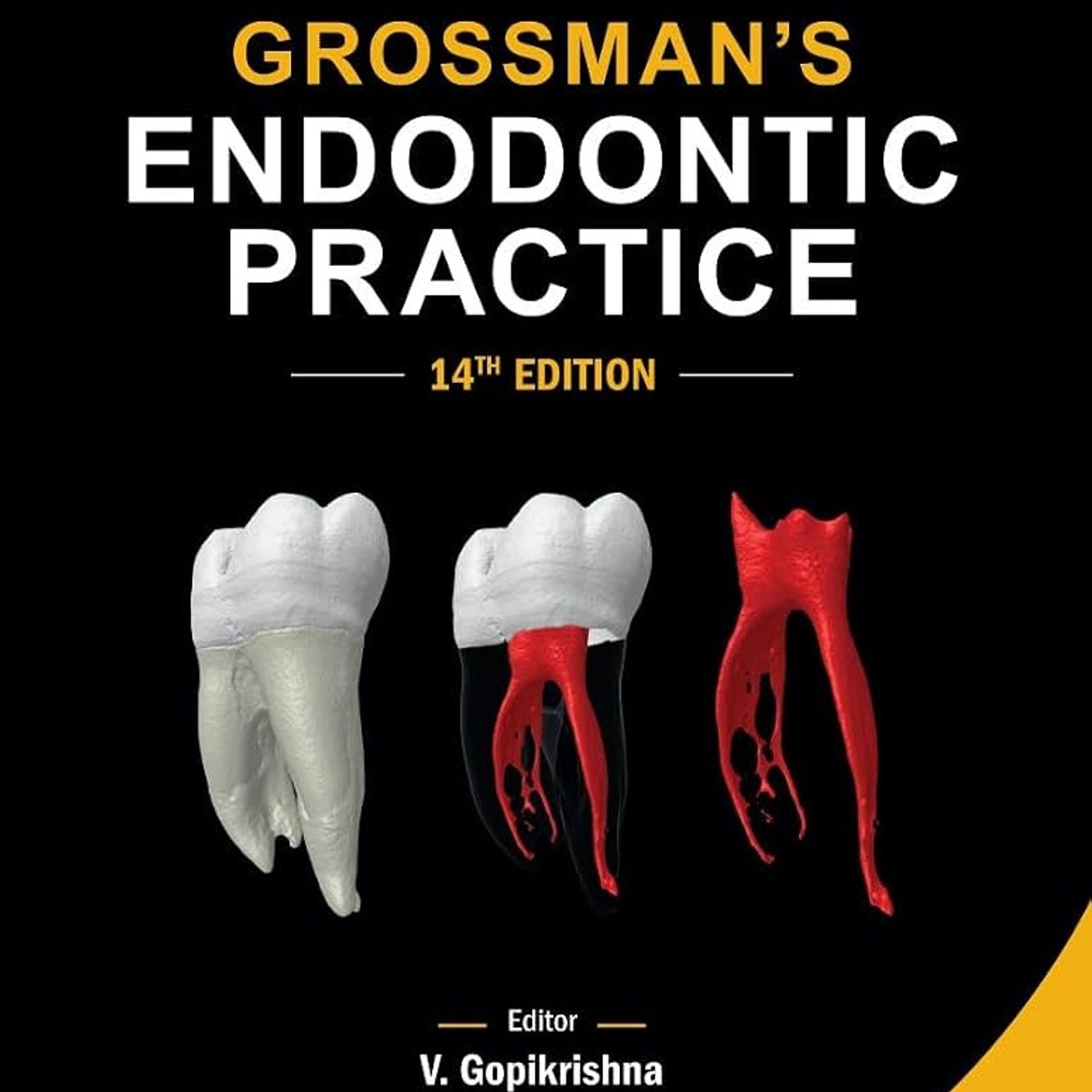
Get the Book now from Amazon:
https://www.amazon.com/dp/B08PP9HXDM?lv=shuf&channelId=500&plpRedirect=mhFallback&linkCode=ll2&tag=cvthunderx-20&linkId=41d7e14b41b7579829adfd8f79a1c1b3&language=en_US&gaOptInStatus=true&ref_=as_li_ss_tl
You can listen and download our episodes for free on more than 10 different platforms:
https://linktr.ee/dentistry_made_simple
Produced by:
https://www.podcaistudio.com/
Get every episode summarized
Each time Dentistry Made Simple publishes, we email you a written briefing from the transcript — the topics, who appeared, and any specific claims, with the ad reads skipped.
Email me new episodesFree for 3 shows. No card needed.
Hosts & guests
Transcript ready
316 searchable segments. Every word is indexed and playable.
Full transcript
Dentistry Made Simple — Grossman’s Endodontic Practice. Machine-transcribed; use the interactive transcript above to jump the player to any line.
Hey, it's Kelly Rowland. You may not know this, but I have Exema. So I get how it can steal your time. But why let Exema take over when you can talk to your doctor about Epglyce? Epglyce, lubricism ab LBKZ, a 250-mg per 2-mg leador injection, is a prescription medicine used to treat adults and children 12 years of age and older, who weigh at least 88 pounds or 40 kilograms with moderate to severe Exema. Also called a topic dermatitis that is not well controlled with prescription therapies used on the skin, or topicals, or who cannot use topical therapies. Epglyce can be used with or without topical corticosteroids. Don't use if you are allergic to Epglyce. Allergic reactions can occur that can be severe. Eye problems can occur. Tell your doctor if you have newer, worsening eye problems, you should not receive a live vaccine when treated with Epglyce. Before starting Epglyce, tell your doctor if you have a parasitic infection. Paid partnership with Lili Respect your time. Ask your doctor about Epglyce and visit Epglyce.com or call 1-800-LiliRx or 1-800-545-5979. Well, this is the home of champions. So why not talk about the champions at
Galpin Ford celebrating 80 years this year. That's right, family owned and operated since 1946. They are the number one Ford dealer in California and the number one volume Ford dealer in the world of all time. They have one of the largest inventories. 3000 vehicles for you to browse at galpinford.com. Find your vehicle there, set up your finance or lease terms, and they will drive it right to you. Plus, they're the number one Ford credit dealer in the world. And Mike Schwarz, the general manager wants you to ask for him by name because he's a champion. It's galpinford.com. Ask for Mike Schwarz. We're listening to champions. Let's talk about a champion. Galpin, Mazda, one of the largest inventories of Mazda's anywhere on Earth and they are ready for immediate delivery after you simply log on to galpinmasda.com. You know the general manager because I know the general manager. So ask for Dan Sturkel. Get that 10 year, 100,000 mile limited powertrain warranty. I almost every pre-owned and every new Mazda they have in stock. And again, you can shop and buy from home. Find your vehicle at galpinmasda.com. Set up your finance or lease terms and they'll drive it right to you. Again, it's Dan Sturkel at galpinmasda.com. Right now, you might actually have
a tooth in your mouth that is just completely dead inside. Yeah, totally necrotic. Right, like the internal tissue could have basically turned into solid debris and you wouldn't feel think. But then you know, the second a clinician tries to fix a different tooth. One that's causing you absolute agony standard anesthesia might just completely fail. It's wild, but that is the paradox of this specific field of medicine. You're dealing with this incredibly complex hidden biological environment, you know, and the clinical symptoms, they rarely actually match the microscopic reality. Which is exactly why we're jumping straight into the deep end today. So whether you're a dedicated dental student, maybe a young professional grinding away in your first clinic, we're just a lifelong learner who's fascinated by human biology. We are unpacking the definitive benchmark in the field. Grossman's endodontic practice, the 14th edition. Exactly. And our mission for this deep dive is to really understand this microscopic war between the bacteria that are trying to destroy a tooth and the highly engineered techniques we use to save it. And to really appreciate how precise this
field has become, you kind of have to look at the legacy of Dr. Lewis's encouragement. Right, the visionary himself. Yeah, the father of modern endodontics, because back in 1939 in Philadelphia, he founded the first root canal study club. And you have to remember, during that time, the prevailing medical belief was the focal infection theory. Right, which was the idea that a localized infection, like a bad tooth, was the direct root cause of systemic diseases all over the body. Like, arthritis, heart disease, you name it. Exactly. And because of that theory, the standard of care was incredibly aggressive. I mean, dentists were simply extracting teeth left and right just to prevent systemic illness. Wow, just pulling everything. Yeah. So Grossman and his study club, they really had to objectively prove that root canal therapy could predictably and safely eliminate the infection, you know, saving the natural tooth without jeopardizing the patient's overall health. He effectively defended the entire biological foundation of modern endodontics. Well, let's actually start right there with that biological foundation, because when most people
picture a tooth, I think they just picture the hard outer shell, right? The enamel indent in and then the soft squishy nerve inside the pulp. Right. The classic diagram. Yeah. But treating them as separate things clinically, that seems to be a huge trap. Oh, it is a massive oversight. Biologically, you have to view them as a single integrated unit, the pulp dent in complex. The pulp dent in complex. Yeah. They share developmental history. And they are in constant microscopic communication. The dent in is full of thousands of tiny fluid filled tubes that lead directly to the pulp. So it's porous. Exactly. So when bacteria breach the enamel, the pulp feels it immediately. And when that pulp ultimately loses the battle against those bacteria, we get pathology. One of the end stage results mentioned in the book is pulp necrosis specifically, coagulation necrosis. Yes. What is actually happening to the cells when a tooth dies that way? Like physically. Well, the pulp is really unique because it's soft tissue trapped inside a rigid,
unyielding box of dentin. Right. It can't expand. Exactly. When it gets inflamed, it swells, but it has literally nowhere to go. So this internal pressure builds up and actually cuts off its own blood supply right at the tip of the root. Oh, wow. It basically suffocates itself. Essentially. Yeah. In coagulation necrosis, the blood supply stops, the cells die, and the proteins denature. So the normally soluble sort of jelly-like pulp tissue essentially precipitates into a solid, rubbery mass. Wait, if the nerve is totally dead like, it's turned into solid debris. How does a patient show up in the clinic with a 10 out of 10 tooth egg? Because the pain isn't coming from inside the tooth anymore. It's not. No, it's coming from the tissues surrounding the root tip. That's where all the bacteria and the toxins are spilling out. But this highlights a notoriously difficult clinical trap. There is a really poor correlation between what the patient feels and the actual histopathology of the pulp. So diagnosing pulp disease is almost like, I don't know, like
being a mechanic trying to diagnose a broken transmission solely by listening to a rattle on the highway. That is a great way to put it. You can't just rely on the patient saying it hurts because the internal reality, whether that nerve is inflamed, partially dead, or completely necrotic, might be entirely different than what the pain suggests. Right, and you cannot just open the tooth to take a look without committing to the entire procedure. You have to rely on a very strict diagnostic workflow to piece the puzzle together from the outside. Right, and the book breaks that down into history, clinical exam, tests, imaging, diagnosis, and consent. Exactly. It involves a detailed medical history, visual and tactile inspections, palpating the gums, checking if the tooth is mobile. Let's actually look a bit closer at the bite test. Because the clinical data suggests you have to be incredibly specific with the patient here. You don't just ask if it hurts when they chew. No, you need to know if it hurts when they bite down or when they let go. Right, the timing. The timing points to completely different structural problems. So if a patient feels pain on
biting, that typically indicates symptomatic apical period on Titus. Meaning the inflammation is at the root tip. Right. The tissue at the very tip of the root, the apical form is inflamed. So pushing the tooth down into its socket aggravates that tissue. Makes sense. But pain on release, when they open their jaw, that is the classic indicator of a crack tooth. Pain on release. So it's kind of like stepping on a loose floorboard over a puddle. Oh, exactly. Like stepping down creates a gap and the water rushes in. But taking your weight off makes the board snap back, squirting the water upward with a sudden burst of pressure. That is exactly what happens microscopically. Just like that water shooting up the fluid in those microscopic dentinal tubules we talked about, it shifts violently when the crack snaps shut and that fire is off the nerve endings. And you isolate this in the clinic using a specific tool, right? Yeah, an instrument called a tooth sleuth. You have the patient bite down on specific individual cusps to find the exact fracture line. And then there's vitality testing too. Right. Thermal tests with cold or heat and the electric pulp tests, the
epi, just to see if the nerve fibers can still actually conduct an electrical signal. Okay, so before we move on to the treatment side, we have to recognize that the tooth doesn't just exist in a vacuum. It's anchored by the periodontal ligament. Right. The gum is in the bone. The endopereo inner relationship is critical. Popul diseases and periodontal diseases can directly infect each other through these tiny lateral canals in the side of the root. So they bleed into each other's territory. Literally, when a massive infection causes irreversible damage to both the attachment apparatus, the gums and the internal pulp tissue, treating just the root canal or just the gums will fail, you have to perform combined treatments. Okay, so let's say we've run our tests. We know the nerve is dying or it's already dead, but committing to a root canal might actually be the completely wrong medical decision. Why is that? It comes down to case selection. The American Association of Endodontists, the AIE, provides a very specific endodontic case difficulty assessment
form. It forces the clinician to objectively evaluate the risks before picking up a drill. Like what kind of risks? Well, does the patient have a limited mouth opening? Are the canals severely calcified and blocked? Are the roots curved like a fish hook? But let's say a prostate dentist sends a patient over and says, look, I really need this specific root save so I can anchor a massive permanent bridge to it. Like the tooth is strategically vital to the whole dental plan. Modern guidelines are very hard line on this. Under no circumstances should endodontic treatment be dictated only by the strategic need for the tooth? Really, even if it messes up the bridge plan. Absolutely. If the tooth is periodically doomed or if there just isn't enough healthy tooth structure left above the gum line to actually restore it afterward, doing a root canal is just bad medicine. Patient health and long-term restorability have to dictate the treatment plan. Okay, while we're on the topic of case selection, what about orthodontics? Like if a tooth has no vital nerve inside it, can you still put braces on it and move it through the bone? Yes, the evidence
is definitive on this. A pulpeless endodontically treated tooth responds to orthodontic movement exactly the same as a vital tooth. Oh, wow. I wouldn't have guessed that. Yeah, because tooth movement relies entirely on the living cells in the periodontal ligament and the surrounding jaw bone, it doesn't rely on the internal pulp. Okay, let's pivot to the acute scenarios because this is where things get intense. A patient is in your chair. They are in absolute agony and you give them an inferior alveolar nerve block. Their lip is completely numb. Their tongue is numb. Right, the classic signs of anesthesia. But the second the drill touches the tooth, they literally jump out of the chair. If the nerve block successfully numb the jaw and the lip, the tooth has to be numb too, right? I mean, it's all the same nerve pathway. You would think so, but the hot tooth completely rewrites the rules. A hot tooth. Yeah, this usually happens in mandibular first molars, the lower back teeth. You have to remember that nerves fire based on electrical charges. The inflammatory mediators
that are spilling out of a severely inflamed pulp actually alter the resting electrical potential of those local nerve fibers. Oh, so the basically lower the threshold for the alarm to go off? Yes, exactly. They make the fibers hyper reactive to the point where standard local anesthetics simply cannot block the signal. The gate stays open. So what do you do? Just power through. No, no, you can't do that. You often have to resort to supplemental injections. You deliver the anesthetic directly into the ligament space around the tooth or sometimes even straight into the surrounding bone just to force those specific hyper reactive fibers to quiet down. Man, that sounds incredibly difficult to manage. And what happens when a procedure seems to go perfectly, but then the patient calls you the next day with their face severely swollen. Ah, that is a flare up. Flareps. What causes those? There are a few predisposing factors. Having severe pain before the procedure even started as a big one over instrumentation is another meaning you accidentally push your
files past the end of the route into the bone. Ouch. Yeah, or extruding chemical ear against out of the tooth into the surrounding tissues. How is a clinician supposed to manage a swollen face and that kind of pressure after the fact? You have to establish drainage. Usually there's a build-up of purulent exidae, which is a mixture of dead white blood cells, tissue debris, and bacteria. It creates immense hydrostatic pressure at the root tip. So you have to release the pressure valve? Exactly. Sometimes establishing drainage means going back into the canal with a very fine file, like a number eight or 10k file, and going just one millimeter beyond the apex to physically puncture the tissue and allow that purulent exidae to drain back up through the tooth. Wow, straight through the tooth. Yeah, and then you pair that with non-steroidal anti-inflammatory drugs, NSAIs, and long-acting anesthesia. You might also reduce the bite slightly so they aren't hitting it when they close. Well, this is the home of champions. So I want to talk about the champions at Galpin Ford, celebrating 80 years this year. That's right, family owned and operated since 1946. They are the
number one Ford dealer in California and the number one volume Ford dealer in the world of all time. They have one of the largest inventories. 3000 vehicles for you to browse at galpinford.com. Find your vehicle there, set up your finance or lease terms, and they will drive it right to you plus the number one Ford credit dealer in the world. And Mike Schwartz, the general manager wants you to ask for him by name because he's a champion. It's galpinford.com. Ask for Mike Schwartz. McDonald's is putting value back on the menu. Whether you're craving a Big Mac, McNuggets or sausage egg and cheese, McGrittle's, make it a meal and save. Your favorite is now your wallet's favorite too. Extra value meals are back. Get a big something extra with a Big Mac or 10-piece McNuggets, fries and a medium Coke all for just $9. Limited time only, promotion pricing may be lower than meal pricing. Toyota's easy choice sales event is on. Whether you're looking for the performance
of a Camry, the versatility of Arat 4, the efficiency of a Corolla or all electric driving in the BZ. There's a Toyota that's just right for you. And with great deals across the lineup, now's the time to find yours. But hurry, these deals won't last long. Toyota's easy choice sales event end soon. We make it easy. Toyota, let's go places. Let's look at another acute emergency scenario. Trauma. Let's say a young kid takes a baseball to the mouth and a front tooth is heavily damaged. With trauma, the protocol hinges entirely on whether the route has finished growing. Okay. In young patients with open apuses where the route tip is still like a wide funnel rather than a closed point route canal treatment should be avoided if it all possible. Wait, really? Even if the pulp is severely inflamed from the impact? Yes. Unless there is absolute undeniable evidence of necrosis, you hold off. You want to allow for pulp re-bascularization. So the body can heal itself.
Right. The goal is to keep the tissue alive so the route can finish forming its walls. Now, if the tooth is completely knocked out of the mouth and a vulsion and you have to replant it back into the socket, the clinical consensus recommends using calcium hydroxide as an intra-canal medicament for up to one month. How does packing calcium hydroxide into a traumatized tooth actually help it survive? Well, calcium hydroxide is highly alkaline right. It is a very high pH. When you place it inside the canal, it creates an environment that actively neutralizes bacterial endotoxins and dissolves leftover necrotic tissue. Okay. But more importantly, that high pH chemically stimulates the surrounding tissues to begin forming a hard calcific barrier at the route tip. It stabilizes the environment to prevent the body's immune system from panicking, attacking, and resorbing its own route. That is fascinating. We are really dealing with an incredibly hostile biological war zone here. The bacteria are trying to destroy the tooth and the clinician is trying to clean out this microscopic, dark, curved space. Which is why the dental operating microscope,
the DOM has become such an integral standard in modern practice. You just cannot treat what you cannot see. But we aren't just talking about a strong magnifying glass here. No, not at all. The true advantage of the DOM is coaxial illumination. Coaxial illumination. Right. The light source is perfectly parallel to your line of sight. It beams light straight down into the canal, which completely eliminates any shadows. Ah, because normally the drill or your hand would block the light. Exactly. That combination of intense magnification and shadowless lighting is absolutely required to prevent eye-atrogenic procedural errors. Eye-atrogenic meaning an injury caused by the medical treatment itself. Correct. Without a microscope, a clinician who is navigating a curved route blindly might accidentally gouge a hole straight through the side of the root wall and that completely compromises the tooth. Let's actually talk about the instruments used to navigate those spaces. Because the engineering evolution in the book is staggering. It really is. Historically, dentists relied on barbed approaches. These were literally soft iron wires with angled cuts on the surface
to create barbs. They were designed to just snag the entire pulp tissue and rip it out in one piece. Sounds aggressive. Very. Then the field moved to stainless steel files like K-type files and reemers and rotary instruments like gate-sclid and drills. I actually find the design of gate-sclid is really fascinating. There are these long burrs used to open the top portion of the canal, but they've built in failure mechanism, don't they? They do. They are engineered to break at the neck right up near the hand piece if the cutting tip binds in the dentin. Which seems counterintuitive, like you want your tools to not break. Well, think about the alternative. Rather than snapping off deep inside the root canal where it would be nearly impossible to retrieve, it breaks safely at the top so you can just pull the shaft out with tweezers. That's brilliant. It is. But the real game-tanger for shaping the main canals was the shift from stainless steel to nickel titanium or needy. Why is stainless steel being phased out for larger canal sizes? Because of its physical
stiffness. Root canals are rarely perfectly straight. You know, they curve. If you take a stiff stainless steel file once you get past size 20 and push it into a curved canal, the metal wants to remain straight. Right. So it will forcefully carve its own path into the outer wall of the curve, causing canal deviations or ledging. Niddy on the other hand is super elastic. It bends and follows the natural anatomy of the canal without exerting heavy lateral pressure on the walls. And the metallurgy behind Niddy has advanced to a point where the files almost seem to defy physics. Oh, absolutely. The clinical data points to M-wire technology and controlled memory wires. To understand how they work, you have to look at the crystalline structure of the metal itself. At room temperature, these alloys can exist in a martensite phase. Which basically means the atoms are arranged in a relaxed, pliable grid, kind of like an accordion. Exactly. You can literally bend the file and it stays bent. It has zero memory. This allows you to slide it effortlessly into a severely curved canal. But when the metal is subjected to body temperature or the friction
of cutting inside the tooth, it changes shapes. The crystalline structure snaps into an austenite phase, which is a rigid, highly structured grid. They manufacture actually heat treat these files so that their transition temperatures are perfectly calibrated, typically finishing around 55 degrees Celsius. It gives the clinician unparalleled flexibility and fatigue resistance during the procedure. So once a clinician has used these memory wires to shape the canal and they pull up those clean white, detonal shavings, they know the canal is sterile and the bacteria are gone, right? That is actually one of the oldest, most persistent myths in the field and modern science completely debunks it. Wait, really? Yes. The color of the detonal shavings is absolutely not an indicator of a clean canal or the absence of bacteria. You cannot visually verify sterilization based on dent and dust. What if the files aren't sterilizing the tooth? How do you actually clean it? Chemistry. Chemistry. Yeah, the mechanical shaping just creates a continuous type-oring funnel. The chemical arrogance, primarily sodium hypochlorite, do the actual
disinfecting. Sodium hypochlorite actively dissolves organic tissue and destroys bacterial biofilms. And delivering that chemical safely requires its own specialized technique, according to the textbook. It does. The protocol dictates using very fine 27 and 30 gauge needles, but crucially, they must be side-vented. Side-vented, meaning the liquid comes out the sides, not the tip. Right. The liquid sprays out laterally against the canal walls rather than shooting straight down and you insert them precisely one to three millimeter short of the working length. If you shoot sodium hypochlorite straight out the tip and push it past the root into the jawbone, it causes severe agonizing tissue necrosis. Yikes. Okay, so you've safely flushed out the bacteria and shaped the canal. But now you've just created a massive empty void inside the bone. If you leave it like that, it's just a bacterial playground. How do you seal off a microscopic curve space? We call this obturation. And this actually ties back to our traumatized teeth with
open apuses. If you have a wide open root tip, you can't just pack standard filling material down there. There's no stop. It will just push straight into the bone. Right. So for these, we perform a single visit a pexification. You use a biocompatible material like MTA mineral trioxide aggregate to create a three to four millimeter artificial plug at the very bottom. It essentially pours a biosuramic concrete floor at the bottom of the root so you can fill against it. Yes, exactly. Now for standard fully developed groups, we have a few techniques. Warm vertical compaction is currently the most popular globally among specialists. It requires a thermoplastic unit to heat the gutta perchia, which is a natural rubber material. So it flows three dimensionally into all the microscopic side tunnels. So it melts into all the little crevices. Right. You also have cold lateral condensation, which is older but still widely used. And single cone techniques utilizing newer biosuramic sealers that chemically bond to the dentin. But the root canal is really only half the battle. A perfect three dimensional seal inside
the root will fail if the restoration on top of the tooth leaks. Oh, the coronal seal is paramount. The guidelines lay out strict material rules for building the core of the tooth back up. Dual cure resin based composite is the ideal gold standard. A malgum use is diminishing rapidly due to environmental concerns regarding mercury disposal. Right. And glass ionomers, they should never be used as a core buildup material for endodontically treated teeth. They simply do not have the mechanical strength to withstand chewing forces over time. Okay, what about placing a metal or fiber glass post down into the root canal? It used to be standard practice to stick a post into an anterior tooth, like a front tooth to strengthen it after a root canal. That is a major paradigm shift in modern dentistry. Anterior teeth receive predominantly sheer forces like side to side tearing forces when you bite into food. Clinical studies clearly show that placing a post does not strengthen an intact endodontically treated anterior tooth. Wait, so drilling a hole to put a post in actually
does more harm than good. Exactly. Removing healthy dentin just to fit a post weakens the structural integrity of the root and it significantly increases the risk of a vertical root fracture. You only use a post if the tooth is so badly broken down that you absolutely need it just to hold your composite filling material in place. Wow. So what happens when despite the perfect core buildup, the side-vended irrigation and the operating microscope, the treatment still fails because, biological systems are unpredictable. Failures happen. Common pauses include misdynatomy, like a hidden fourth canal and a molar that wasn't disinfected, or a poor coronal seal that let bacteria slowly leak back in over the years. Sometimes extra-addicular cysts form outside the root in the bone, which root can outfiles literally cannot reach. So if a tooth is failing, the first step is usually non-surgical treatment. Right. You go back in from the top, remove the old material, and try to disinfect again. But if that fails, then you move to endodontic microsurgery. You
approach the infections surgically through the gums and this relies entirely on what we call the microsurgical triad. What makes up the triad? Magnification, illumination, and specialized instruments. You use the DOM to clearly see the tip of the root surgically. You illuminate it coaxially. And instead of using a standard bulky drill, you use highly specialized ultrasonic tip. Ultrasonic? Yeah. These vibrate at incredibly high frequencies, allowing you to gently clean the infected canal from the bottom up, precisely along its long axis without shattering the root. Then you fill that tiny root end preparation with MTA to seal the exit permanently. Man, we have covered a massive amount of ground today, from the biological reality of coagulation to creases, to the precise fluid dynamics of a cracked tooth, into the crystallography of memory wires all the way to the microsurgical triad. It really proves that modern endodontics is a highly technical war against microscopic bacteria. It really is. It requires an intense understanding of biology, chemistry, and physics, but it is an incredibly rewarding field when
you understand the why behind every instrument and technique. Well, as promised to the clinical learners listening, we have a quick review exercise to test your diagnostic instincts. All right, here is your rapid fire scenario. You have a patient with a mandibular first molar, they complain of sharp pain, but they specifically mention that it hurts when they release their bite, not when they bite down. What is your primary structural suspicion based on this exact symptom? I'll give you a second to think about the loose floorboard analogy. If you said a cracked tooth, you have been paying attention, and you would confirm that diagnosis clinically by isolating the cuss with a bite stick, right? I spot on the tooth sluth. Now, I want to leave you with a final thought to mull over as you head back to the clinic or your studies. We've seen how technology has moved the field from hand-cranked iron broaches to temperature-controlled memory wires and from working blindly to operating under microscopes. Yeah, huge leaps. But as regenerative endodontics continues to rapidly evolve, we have to ask ourselves, are we approaching an era where sealing a tooth
with artificial rubber and biosuramic concrete will be entirely replaced? Replace to what? Well, will the future standard of care be engineering stem cells to regrow the patient's own vital pulp tissue from scratch inside an empty root? Oh wow. Yeah. Keep an eye on the literature because the biological future of this specialty is being rewritten right now. A living, breathing root can now. We will see where the science takes us. Until then, keep those microscopes close. We'll catch you on the next deep dive. Toyota's easy choice sales event is on. Whether you're looking for the performance of a camera, the versatility of Arab 4, the efficiency of a Corolla or all electric driving in the BZ, there's a Toyota that's just right for you. And with great deals across the lineup, now's the time to find yours. But hurry, these deals won't last long. Toyota's easy choice sales event end soon. We make it easy. Toyota, let's go places.
Only at McDonald's. McDonald's is putting value back on the menu. Whether you're craving a big mac, McNuggets or sausage egg and cheese McGrittle's, make it a meal and save. Your favorite is now your wallet's favorite too. Extra value meals are back. Get a big something extra. With a big mac or 10 piece McNuggets, fries and a medium coke all for just $9. Limited time only, promotion pricing may be lower than meal pricing.
More episodes
More from Dentistry Made Simple

Little and Falace's Dental Management of the Medically Compromised Patient
Dentistry Made Simple

Malocclusion: Causes, Complications and Treatment (Dentistry and Oral Sciences)
Dentistry Made Simple

Local Anesthesia and Extractions for Dental Students: Simple Notes and Guideline...
Dentistry Made Simple

Lasers in Oral and Maxillofacial Surgery
Dentistry Made Simple