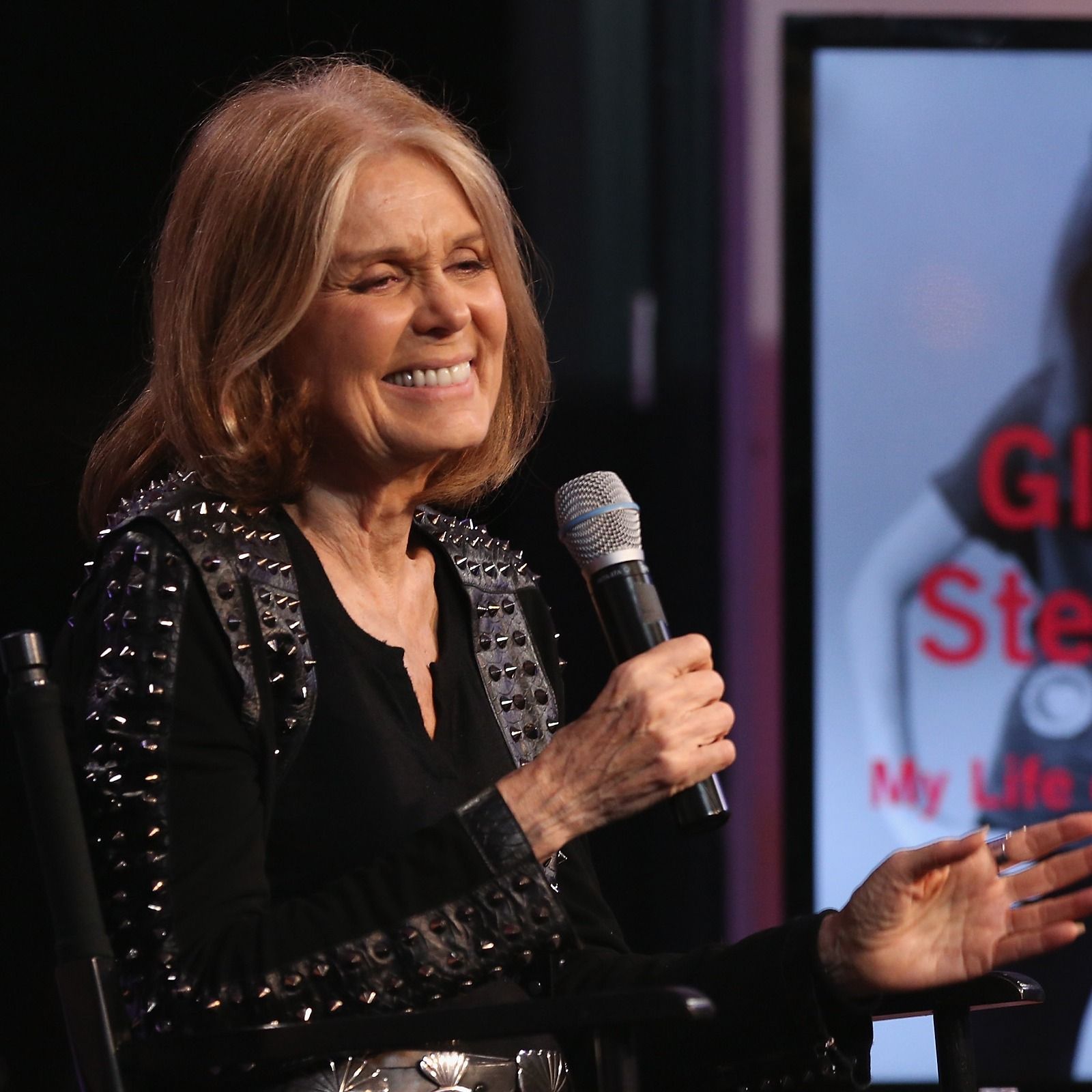
Gloria Steinem in Conversation with David Remnick, from 2015
About this episode
Gloria Steinem, who died on September 2nd, at the age of ninety-two, was one of the most influential figures of our time in politics and feminism. Her work shaped the ideas of generations of Americans. Steinem was one of David Remnick’s very first guests after The New Yorker Radio Hour launched, in 2015; her autobiography, “My Life on the Road,” had just come out.
Further reading and viewing:
- “A Feminist Fractal in ‘The Glorias,’ ” by Anthony Lane from 2020
- “Road Warrior,” by Jane Kramer from 2015
- “Glora Steinem Doesn’t Drive,” a short film by The New Yorker from 2015
- “Feminism 101,” by Rebecca Mead from 2013
- “Cover Woman,” by Hendrik Hertzberg from 1974
- “Liberation,” by Anthony Hiss, Jane Boutwell, and Hendrik Hertzberg from 1970
New episodes of The New Yorker Radio Hour drop every Tuesday and Friday. Join host David Remnick as he discusses the latest in politics, news, and current events in conversation with political leaders, newsmakers, innovators, New Yorker staff writers, authors, actors, and musicians.
Hosted by Simplecast, an AdsWizz company. See pcm.adswizz.com for information about our collection and use of personal data for advertising.
Get every episode summarized
Each time The New Yorker Radio Hour publishes, we email you a written briefing from the transcript — the topics, who appeared, and any specific claims, with the ad reads skipped.
Email me new episodesFree for 3 shows. No card needed.
Hosts & guests

Transcript ready
236 searchable segments. Every word is indexed and playable.
Full transcript
The New Yorker Radio Hour — Gloria Steinem in Conversation with David Remnick, from 2015. Machine-transcribed; use the interactive transcript above to jump the player to any line.
Gloria Steinem, who just died sadly, was without a doubt one of the most influential figures in politics and feminism. She helped to shape the ideas of generations of Americans. Gloria Steinem was one of my very first guests after we launched this program in 2015, and her autobiography, My Life on the Road, had just come out. Your book is called My Life on the Road. It wasn't called that in the beginning. You had a different title, and it was called Because Everyone Matters, and your editors said, or you said, maybe we should think better of this why. Well, actually, you know, I'm really good at giving other people titles. I'm so good at it. It's what I love it. And I love it. But I'm not so good at doing my own titles. So, isn't it true that Ms. Magazine at one point before it became Ms. was called Bitch? It was called Something Else. It was an idea. It was called Sisters, and then people thought it was a religious magazine.
It was called Bimbo. It was called all kinds of things. And it was called Ms. even though at the time we didn't know that this was a term from centuries ago in England that was just a abbreviation of mistress, which like master doesn't betray Marital status. We didn't invent it. We just found it. But why did you not decide to call this because everyone matters? I mean, we had lots of titles, no mad, you know, but then no mad sounded random, even though no mad's themselves are not random. But did it conflict with black lives? Yeah, no. My favorite title was America Dash, as if everyone matters. A little irony here. We need a little irony as if everyone matters. And I was still campaigning for that. But when black lives matter came along as a hashtag and has become so deeply important, I didn't want it to take away from that or seem to be derived from that. Actually, my book was another book, a different book, which was published in India last year,
is called As If Women Matter. So you can see I was fond of this concept. We get right off to the races with this book, with its dedication. That often, that usually doesn't happen. And the dedication is to Dr. John Sharp. And I'd love for you to tell us who he was in your life and why you dedicate the book to him. I was living in London on my way to India. I had just graduated from college. I was on my way to India. I was working as a waitress in an espresso bar. I was pretty sure that I was pregnant and I was doing all the things you're not supposed to do, like go horseback riding and throw yourself downstairs and other superstitions. And then I met an American playwright who made me understand that it was somewhat possible in England because if you got two physician signatures that said your life was at risk essentially, that it could be performed legally in London.
So I picked a name out of the phone book, literally, a nearby name. And he was a wonderful, gentle old man in a bed sitting room. And he said, as I say in the dedication, that he would take the big risk of being the first person to sign for this abortion if I promised him two things. First I wouldn't tell anyone his name. And second I would do what I wanted to do with my life. Now, I've always remembered that and I've always honored the name part. But I know since he was a very old man at the time, and this was a half century ago. And given the changes in the world, I think now he would want to be known as someone who knew the laws were wrong and unjust. Are you surprised that at this date, so many years after a rovy way that we're still arguing about this in our Senate campaigns, congressional campaigns, and most of all in
the presidential campaign, as if almost as if Roe had not happened, we're not arguing about loving, about interracial relationships and marriages. We're arguing about this. Why is that? Well, it took me a while to figure it out too, because they don't tell us this in school. You know, the economic courses ought all to start with reproduction, not just production, because it's actually more basic, but they don't. So what we don't learn is that reproduction is kind of the whole ballgame, and who controls it is the most fundamental question. We're in the middle of a presidential race, and Hillary Clinton, who I know you supported for a long time, had a confrontation with a discussion with members of Black Lives Matter. And you want to run a tape of that and then we'll discuss it. You were saying that what the Black Lives Matter movement needs to do to change white hearts is- No, I don't believe you change hearts. I believe you've changed laws, you've changed allocation of resources, you've changed
the way systems operate. You're not going to change every heart. You're not. But at the end of the day, we can do a whole lot to change some hearts and change some systems and create more opportunities for people who deserve to have them, to live up to their own God-given potential, to live safely without fear of violence in their own communities, to have a decent school, to have a decent house, to have a decent future. So we can do it one of many ways. You know, you can keep the movement going, which you have started, and through it you may actually change some hearts. But if that's all that happens, we'll be back here in ten years having the same conversation. Now that conversation has led to a lot more conversations, whether it's online or in kitchen tables. And I wonder what you thought of it. Well, I understand where that's coming from. You know, there was a great South American novelist, one of the great novelists who said
the people could withstand floods and pestilence and killings, but when the laws were unjust, they went crazy. So there is a kind of betrayal trauma, you know, you might say, that comes from the law, but she's underselling culture. A culture is really just deep politics. Do we have a democracy in our house? Do we see violence at home? If so, as children, that's going to make it seem normal and inevitable until somebody in a social justice movement raises the possibility, you know, that it's not inevitable. So the law tends to change last and often needs to be subverted by culture. Is it just a question of different roles? I mean, in the mid-60s, you had a movement pushing on race. Lyndon Johnson essentially said to the movement, if I'm going to have a voting rights act, you have to make me. And Selma came about.
And Selma... That's what Rosa felt, too. And Rosa felt, as Obama is always fond of quoting. So is it a question of differing roles? Or do you think that Hillary Clinton is a little bit deaf to this new movement or new stream of the movement? You know, I don't know. She has more black support than any other candidate, more than Bernie Sanders, more than any other candidate. But I don't think it's really... You know, you can't understand what it's like to be black in America, unless you're black in America. You can't understand what it's like to be a female human being, unless you're a female human being in some ways. But we can strive to empathize with each other first, empathy is first, and then listening. I think there's a very simple activist rule, which is if you are in a situation in which you have more power, then you have to be careful to listen as much as you talk. And if you are in a situation in which you have traditionally or that moment have less
power, you have to talk as much as you listen, which is sometimes just as hard. This goes to your metaphor that you talk about in the book of the turtle. I wonder if you could tell us that. Ah, yes. Well, that's happened to me. It just shows you that some things happen to you and you don't understand them for decades. I was in college taking the least scientific science course I could possibly find. And it was geology. So they didn't have physics for poets, were you? No. And we were on a field trip in the Connecticut River Valley, looking at meander curves of old age rivers, I believe. And I, of course, was paying no attention because I had discovered up a path and on the muddy embankment of an asphalt road, a turtle, a huge, I'm a really pretty big turtle, who was embedded in the mud on the side of the road and I was sure was going to crawl up on the road and be crushed.
So I picked up this turtle with some difficulty and lugged, I mean, it was snapped, it was very pissed, walked all the way down the road and just slipped it into the water of the river. And my geology professor came up behind me and he said, you know, that turtle has probably spent weeks crawling up that road to lay its eggs in the mud on the side of the road and you have just put it back. All right, I felt terrible, but it was too late. However, it took me decades to understand that was a political lesson. Always listen to the turtle. That is the person who is experiencing something probably knows more about it than the experts. Gloria, we're sitting here at a time when the evident hostility toward Hillary Clinton for various reasons and for various directions is quite clear. You've been watching her for a long time. What's the reason for it? Well, to address some of the deep reasons for hostility to women and leadership roles,
women of every race, Hillary and everybody else. I think in a deep sense, we won't escape this until men are raising children as much as women are and women are as active in the world outside the home as men are because right now we associate, most of us women to have been raised by women as infants and little children. We associate female authority with emotionality and nurturance and home. We don't see it as a comfortable kind of leadership in the outside world, a rational leadership where we've mostly seen men. So I don't think this is going to go away easily. It's going to take quite a long time. So it's not peculiar to Hillary Clinton? No, it's not. Or more Americanness. No, it's not. No, I mean, part of the reason that we have female leaders earlier in other countries is because they have stronger family systems, you know, in India, say, with the Nehru family.
So the family mitigates the disaster of being a female, so to speak. I'm happy to say I think we're more democratic than that. We don't quite view families in the same way. So when we finally get an elected woman, I think she's much more likely to really represent the majority of the country. Seven years ago, you wrote an op-ed piece for The New York Times. And it was the moment of an intense rivalry between Obama and Hillary in the primaries. And I wonder what lesson you derive from it because it caused a real storm. It was a highly supportive of Hillary, but it had things to say about, well, it was comparative about black suffering and feminism and the history of women. And you kind of stepped into it in a way. And I don't, maybe you could describe that. And what lesson? Because you were usually so adept at these situations, whether it's bringing others onto
the stage or using your own influence to be inclusive, that this was a moment where there was a first time I remember seeing, wow, glorious times in a situation. And it's inevitable that anybody that's, as you say, media worker might have that happen. How do you look back on that? Never let your text be edited on the telephone, even if it's The New York Times. Your advice to the young journalists out there? It was a very bifurcated experience because I got all these phone calls from people who knew me, telling me how wonderful the column was and how it had changed the results of the primary New Hampshire and how much it, because I had posited the idea that, you know, what if Obama were a woman. And I had made clear in the text of the column that I supported them both, you know, that I would, I wanted sequentially, one should be president and then the other that, that race and sex were intertwined, that you couldn't uproot one without uprooting the other.
But what really happened was that the one sentence that was from the kitchen to the White House, that that sentence, which could be construed as making a value judgment, was used as the poll quote. And once the poll quote got on the web, then there was. Well, hell broke. Yeah. If people read the whole column, or if they knew me, you know, it was extremely painful. It was very painful. How so, how did you experience that? Well, you know, to be misunderstood makes you feel crazy. You know, I mean, it was, it was thinking I had said something that I spent my lifetime not saying. But it was in the end, it was a great experience. Because my friends rallied round, you know, in a, in a wonderful way. And also because at the end of it, I suddenly remembered something that the great Florence Kennedy said, which is that the purpose of kicking ass is not that you get your ass kicked at the right time for the right reason, but that it keeps your ass sensitive.
So I thought, good, I, you know, this is, this is, this is a good result. The late Gloria Steinem, a conversation from 2015. Thanks for joining us. This is the New Yorker radio hour. See you next time. If you ever had the urge to sneak behind the cordoned-off areas of a museum or roam the halls after closing time, the Smithsonian's flagship podcast Side Door will sneak you behind the scenes of the world's largest museum and research complex. Some learn about the ghosts that supposedly walk the museum halls after dark. How a train robbery gave rise to criminal forensics. Why leeches are actually the coolest thing ever and how to get away with murder in the
Arctic. Maybe. You'll discover stories of history, science, art and culture you won't find in a display case. You can listen to Side Door wherever you get your podcasts or find us online at s i dot e du slash side door.
More episodes
More from The New Yorker Radio Hour

Edwidge Danticat on Haitian Americans in a Time of Peril
The New Yorker Radio Hour

Sarah Longwell, a Former Republican, on “How to Eat an Elephant”
The New Yorker Radio Hour

Ian Frazier and Samy Burch on “Coyote vs. Acme”
The New Yorker Radio Hour

Kai Bird on Roy Cohn, a Founding Father of Donald Trump’s America
The New Yorker Radio Hour