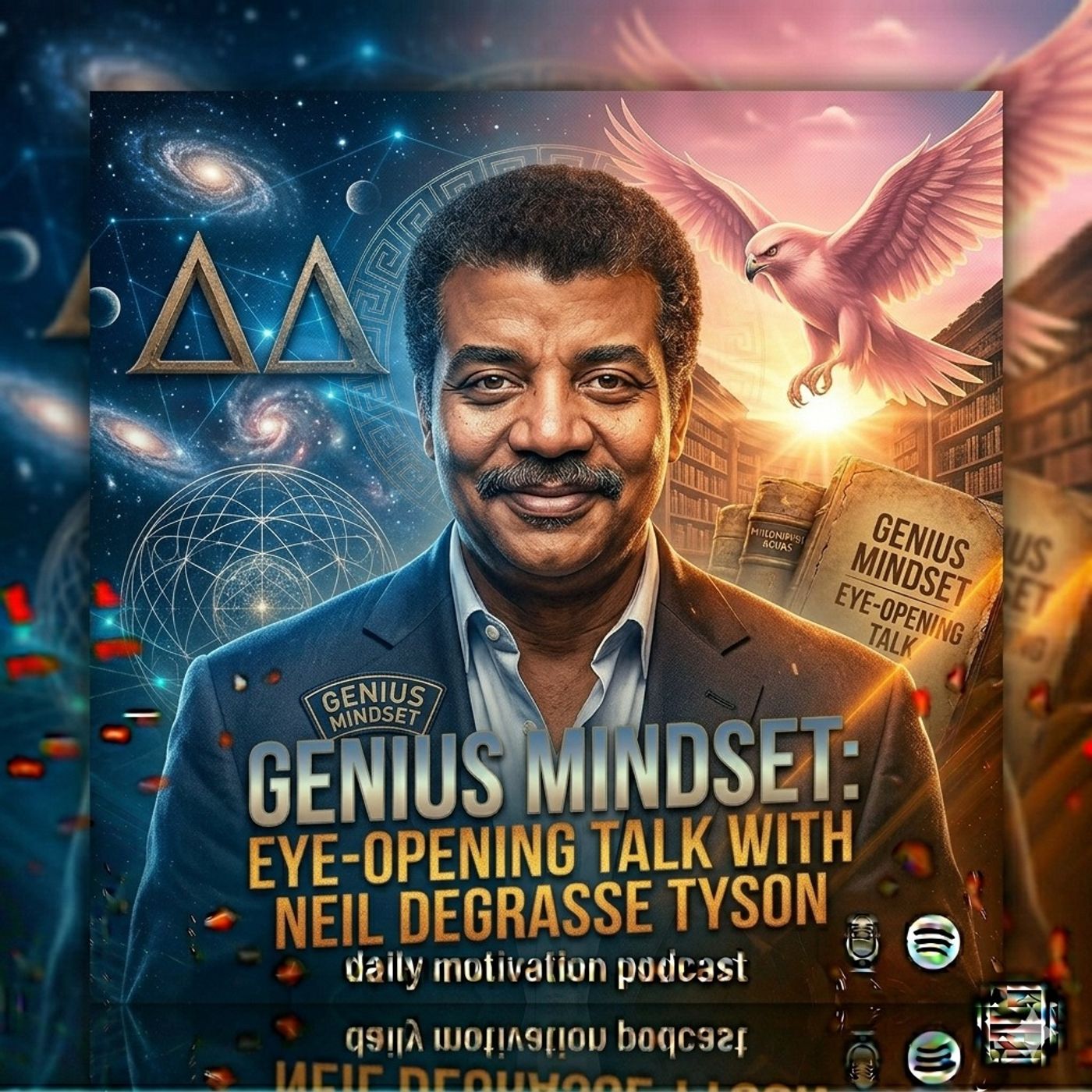
Genius Mindset: Eye-Opening Talk with Neil deGrasse Tyson
About this episode
Best Self-improvement Motivation
Genius Mindset: Eye-Opening Talk with Neil deGrasse Tyson
Discover the mindset of a genius with insights from Neil deGrasse Tyson. Boost curiosity, critical thinking, and unlock your true potential.
We Need Your Love & Support ❤️
Get 3 Audiobooks Free - 👍
👉 How to Boost Your Productivity (audiobooks)
Listen To The Ultimate Life-Changing, Self-Improvement & Self-Development Motivational Audiobooks For Free:
The Subtle Art of Not Giving a F*ck👈
Think Like a Monk by Jay Shetty👈
You Are a Badass by Jen Sincero👈
All The Light We Cannot See by Anthony Doerr👈
How to Win Friends and Influence People by Dale Carnegie👈
Attention Span: Finding Focus for a Fulfilling Life by Gloria Mark👈
A Promised Land by Barack Obama👈
#Motivational_Speech
#motivation #inspirational_quotes #motivationalspeech
👉Best Audiobooks for You - 👍
Hosted by Simplecast, an AdsWizz company. See pcm.adswizz.com for information about our collection and use of personal data for advertising.
Get every episode summarized
Each time Motivational Speeches publishes, we email you a written briefing from the transcript — the topics, who appeared, and any specific claims, with the ad reads skipped.
Email me new episodesFree for 3 shows. No card needed.
Hosts & guests
Transcript ready
148 searchable segments. Every word is indexed and playable.
Full transcript
Motivational Speeches — Genius Mindset: Eye-Opening Talk with Neil deGrasse Tyson. Machine-transcribed; use the interactive transcript above to jump the player to any line.
On my tombstone, I want the epitaph be ashamed to die until you have scored some victory for humanity. And a victory for humanity is not a victory for yourself, it's not statues, it's not your name, it's just humanity's better off. Any of us, I think, should want the world to be a little better off for you having lived in it. That doesn't mean people praising you, not even about that, but what do you have to give with no expectation of return? No one ever told me that I had to search for meaning in life. Many people look for meaning in life, as though it's going to be under a rock or behind a tree. And I'm thinking to myself, you have more power than that. You have the power to create meaning in your life, rather than passively look for it.
So, for me, I create the meaning. And meaning to me is, do I know more about the world today than I did yesterday? That enhances meaning for me. By whatever powers I have available to me, have I lessened the suffering of others? Or the carlier to that would be, have I enhanced the life of others? And I don't mean have I devoted the whole day to doing that, then I would be ignoring myself. But if there's some small gesture that I can do that can completely add value to someone's life, I'm going to do it. Because the leveraging of 10 minutes of my life into the happiness or enlightenment or the reduced suffering of someone else, I'd be irresponsible if I did not. What I do for the public is prime, almost 80 plus percent of it is driven by duty. Not by ambition.
What gives you the sense of duty? Because I can do something. And if I can do it better than others, and it's for a greater good in society, I would be irresponsible if I did not. What was it about your dad that impacted you so much that you still carry today? For me, at least, was what level of wisdom did he glean in his life and then successfully communicate to me either by example or by just explicit statement? For example, in high school, he was in gym class and they were lining up and they were about to enter the next athletic unit and it was track and field. And the gym instructor pointed to my father online and said, Cyril Tyson, everyone look at him, he does not have the body type that would excel in track. They used him as an example and he says, what?
No one is going to tell me what I can't do in my life. And he used that as the reason to start running and he started track in that moment. He decided that one of his next tasks in life would be to take up running and excel at it. Within a few years of that, he became world class. At one time, had the fifth fastest time in the world. In the middle distance, they don't run this anymore, 600 yard run. In 1948, the Olympics was not yet ready to come back to us because we're still reeling, reiling from the Second World War. Instead, it was still in Olympics, it was called the GI Olympics and it was held in Hitler's stadium. So he competed in Hitler's stadium in the late 1940s and just one of the great memories of his life. But what I'm saying all of that is they were competing against the New York Athletic Club.
The New York Athletic Club at the time accepted only white Protestant. So there's another club called the Pioneer Club, which took everybody who was not accepted to the New York Athletic Club, which was basically Blacks and Jews. It was really what that came down to. And his best friend, Johnny Johnson, was coming around the back stretch, might have been the quarter mile, coming on the final straightaway and a runner from the New York Athletic Club is a few paces behind him. And Johnny Johnson overhears that runner's coach say, catch that! And he overheard this. So what did he say to himself? He said, this is when he ain't gonna catch that! That extended his his his lead to the finish line and he tells the story not with any bitter tone. He said he never had that kind of tone when he shared those stories
with us. It was, here's an occasion to parlay what today might be called a microaggression into a reason to excel even more than you had expected of your own abilities and talents. And so I have taken that lesson with me. What's the impact you want to have on the world? My impact would be people learn from me in a way that they are empowered by what I taught them. So that when they think of what they learned from me, they no longer think of me. They think of their own base of understanding of how this world works. And so that I become irrelevant. Because if people say this is true because Tyson said so, then I failed. That's not how you teach someone. That's teaching them by authority. I want to teach you how to think about the world and then you say, I have a new way to understand the world and you run off! Don't even look back! Because a new level of hunger has descended upon
you and methods and tools to feed that hunger are now accessible to you. So my impact would be that others are impacted and they don't even remember that I had something to do with it. I met Carl Sagan when I was 17. I was applying to colleges. He was at Cornell. I had been accepted at Cornell but didn't know what college I wanted to go to. And the admissions office saw that I wasn't totally in the moment there. Therefore, I didn't know this. They had forwarded my application to him. For his reaction, I was already deep in the universe since I was nine. And he sent me a letter. He doesn't know me from Adam. I'm a 17-year-old kid from the Bronx. He's a professor of astronomy at Cornell University. And I get this letter and I open it and says, I understand you like the same stuff I like. Do you want to come visit the campus to help you decide if you want to go to Cornell? It was like, whoa, he hadn't done Cosmos yet. That's how old I am. But he was already famous. So I took him up on it.
I took a bus up to Ithaca, New York. He met me outside his building on a Saturday. Vited me up to his office, saw the labs. I'm there in front of me. He did something really cool. He reached back. Didn't even look. Grabbed a book off the shelf. It was one of his books. I thought that was the baddest. That was a bad-ass thing. Don't even have to look. That's one of my books. Yep. Okay, here. And he signed it to me. Nealtime's a future astronomer signed. Carl. Later in the day, I'm ready to go back to New York. It begins to snow as it does often in December. And if I got any says, here's my home number. If the bus can't get through from snow, spend the night with my family. And go back tomorrow. I'm thinking, who am I? Why? Why? I'm nobody. But I was somebody to him. And I said to myself, if I am ever as remotely famous as he is, I will treat students the way he has treated me. If Einstein were here and we're talking with Einstein,
we can talk for hours and hours and hours. You know what question will never come out of our mouths? What college did you go through? I want to go to that same college. I bet most of your people have sat in this chair. It's not about what college they went to. It's about their own initiative, their own drive, their own ambitions, their own curiosity. That is not taught in school. Sadly, school, they view you as this empty vessel that they pour information in and you test it over here, you get a high grade, you're praised. Is that who become the shakers and movers of the world? I don't think so. School should as a minimum preserve that curiosity for you. Yeah, if you lost some of it because it's not going to be in all of us, put it back in so that when you graduate school, you can give literal meaning to the word commencement. Commencement means beginning. It doesn't mean ending. And so you leave school and you say to yourself,
I now know how to learn. I now have a curiosity of all things I have yet to be exposed to. And I will now become a lifelong learner. Without that, you become ossified in whatever was the body of knowledge that existed the day you graduated. And you will lead a life always looking back at that time without continuing to grow who and what you can become in life. I think we should all get as high grades as you can. But if you don't get the highest grades possible, no one should be standing in judgment of that. If you have some other ambitions that have pathways that don't get encoded in the GPA that other people are referencing. When you approach a topic that you don't know well, how what is your actual process to learn? Great question. I read things that take me to places where other people think, if I'm an educator, I want to know that because when you're speaking to
me and I have some understanding of you, I can navigate your receptors for learning. I don't have to have you come to where I am. That's not right. I'm the educator, not you. You're the curious person. So I'm going to meet you on your territory. How do I create meaning in my life as I go forward? My first question of me wasn't, where do I find meaning? It was how do I create meaning? And that started early, early teens. Did you help your kids with this? Is that something that you found a way to sort of educate on or pass down so that they would be asking a similar question instead of doing this sort of wander search thing? Yeah, I have an orthodox approach to what we did with our kids. We discuss this, my wife and I, and I wanted to make sure that however they were raised, that they retained the curiosity of childhood into adulthood. Okay, let's say there's a little toddler walking here. Okay, crawling on the ground, it comes up and they start grabbing this. What's it for?
I think, no, don't touch that. Okay, this was an experiment waiting to happen that you just squashed. This is a cup. It has water in it. Okay, this is breakable. The kid doesn't know that. They want to experiment. So they'll grab it, they'll fall, it'll break, water will spill all over. That was an experiment you just prevented. They are experimenting with their environment. Everything is new to them. I saw a woman walking with her kid. The kid has galoshes on and a grain coat on and they're coming down the walkway and this is big juicy muddy puddle right there. And I said, please let the kid jump in the puddle. You know the kid wants to jump in the puddle. The kid is like three or four. You know the kid and what does the what does the mother do? You pose the kid around to prevent that from happening. That's an experiment in cratering. That's what had craters happen that way. You splash the water, there's mud, it's fun. You get to see the cause and effect of a force downward force operating on a fluid.
Gone. That was a bit of curiosity in that moment that was extinguished. So with our kids, curiosity provided it does not kill them. If it meant we had extra work in front of us, I would do that extra work. And I have pretty high confidence that they'll retain that curiosity through the turbulent middle school years into high school and what is an adult scientist, but a kid who's never lost the curiosity.
More episodes
More from Motivational Speeches

The Mindset Shift That Will Help You Close More Deals | Dan Lok
Motivational Speeches

The Value of Time: How to Charge What You’re Worth | Dan Lok
Motivational Speeches

The Time I Went on the U-I Talk Show | Dan Lok
Motivational Speeches

The Three Most Powerful Words You Can Use When Selling
Motivational Speeches