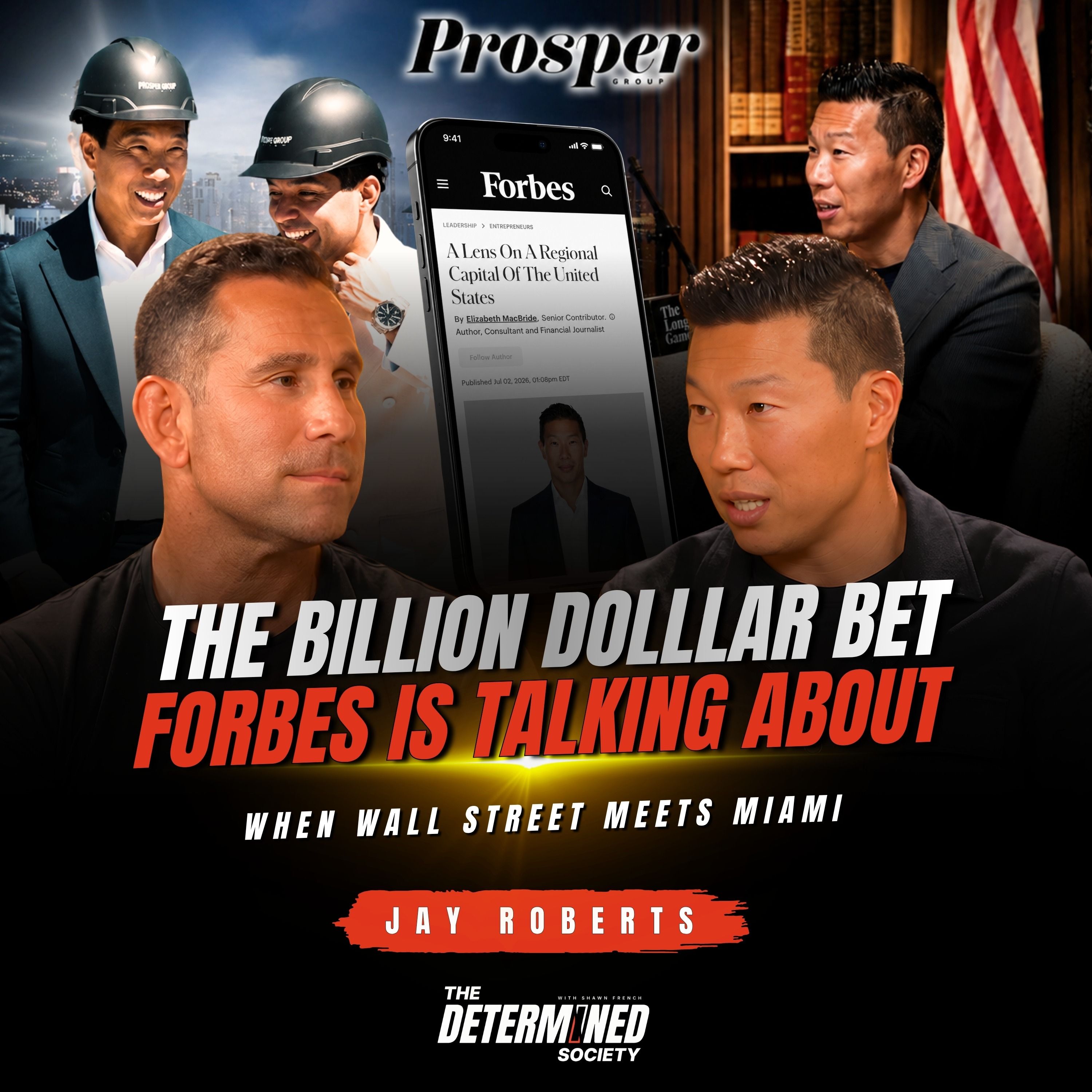
From Wall Street to Breaking Norms | Adversity & Rebuilding
About this episode
In the new episode of The Determined Society, Shawn French sits down with Jay Roberts for a powerful conversation on adoption, ambition, Wall Street, failure, rebuilding, real estate, health, family, and what it really means to play the long game.
The episode dives into different chapters of Jay’s life, including:
• Being adopted from Korea and raised in America
• Growing up with a single mother and no safety net
• Turning insecurity into drive
• Losing family during the financial crisis
• Why success is built through process, not shortcuts
• The power of writing goals down
• Building a vision for your life, family, and business
• Wall Street, investment banking, and extreme work ethic
• Public failure and starting over in Miami
• Real estate, big deals, and thinking bigger
• Health, longevity, and quality of life
• Family, presence, freedom, and what really matters
This conversation goes beyond money and business. It is about process, resilience, ownership, health, family, and building a life that is not just successful on paper, but meaningful in real life.
Connect with Shawn
https://link.me/shawnmf32
Subscribe to our newsletter for all updates and heavy doses of DETERMINATION: https://thedeterminedsociety.com
Subscribe on Apple/Spotify:
Apple- https://podcasts.apple.com/us/podcast/determined-society-with-shawn-french-adversity-mindset/id1555922064
Spotify- https://open.spotify.com/show/5kS9tkLGQLcVyRgB3mDznw?si=184c18d1b9d44f53
Connect with Jay Roberts
Instagram: https://www.instagram.com/jayroberts/
LinkedIn: https://www.linkedin.com/in/jayroberts
Website: https://www.jayroberts.com/
The Determined Society is hosted by Shawn French — a show for people who refuse to quit. Every episode goes beyond the highlight reel to explore the real stories behind resilience, reinvention, and the relentless pursuit of a life built on your own terms.
Subscribe on YouTube, Spotify, Apple Podcasts, and all others.. If this episode moved you, share it with someone who needs to hear it — and leave a review. It helps more than you know.
Hosted by Simplecast, an AdsWizz company. See pcm.adswizz.com for information about our collection and use of personal data for advertising.
Get every episode summarized
Each time The Determined Society with Shawn French publishes, we email you a written briefing from the transcript — the topics, who appeared, and any specific claims, with the ad reads skipped.
Email me new episodesFree for 3 shows. No card needed.
Hosts & guests
Transcript ready
1,392 searchable segments. Every word is indexed and playable.
Full transcript
The Determined Society with Shawn French — From Wall Street to Breaking Norms | Adversity & Rebuilding. Machine-transcribed; use the interactive transcript above to jump the player to any line.
And if you want to be in the top point, 0.01%, you have to enter an arena with 10,000 other people in a fight to the death and come out victorious. That is what you're competing with. And it can only be done if you have true passion and purpose behind what you're doing. You have to be willing to outwork every single person because what we have nowadays is a lot of people see things on social media platforms. You see this meteoric, quick rise and they feel like, okay, I can get this done in 90 days, bullshit. My parents just passed away. I had a choice, two different paths to go down, to kind of be sorry for myself or put my head down and grind it out. But there are individuals that have to hop and look off the train. You have to keep going through it all. It gets better, but it may not feel like it in the moment. But if you keep going, the clouds do dissipate.
You see the sun shine. And in today's society, in the determined society, if you wanna be ultra successful, you have to be super determined. J. Roberts, welcome to the determined society. Thank you. Yeah, Sean, great to be here. Do you miss three months old South Korea, given to an orphanage after all these years, what do you actually know about where you came from? So I've been back to Korea once. I was raised by an American family grew up in Southern California, and I was born in the United States. I was born in South Korea, in the United States, and I was born in the United States. Southern California. And I consider myself very blessed. So, as you mentioned, could have been a statistic. Really here pursuing the American dream. And that's one of the beautiful things about this country, is that you can come here with nothing. I was raised by a single mom, secretary, two sisters, and my uncle, really.
And you can put your mind, you can be determined, you can have a vision for your life, and you can work very hard and accomplish. And really the sky is the limit here in the United States. So, what I remember from Korea is nothing. I've been back one time. I don't speak Korean. My last name is Roberts. And so I really identify more with the American culture. Absolutely, man. If you could sit down with your biological mother, what would be one thing you would want her to know? You know, people have asked me similar questions my whole life. Growing up in schools, it's different being adopted. Your parents are American. I'm Korean, I look Asian. I got asked many times, do you want to meet your real parents? Many, many, many times. People don't ask me that anymore. But I always say, these are my real parents. So I personally have no longing or no questions
of my biological parents. There's been many people who've been adopted, who go searching and looking, maybe they have questions about why they were adopted and why they were given up or why they were in an orphanage or their family. Personally, I have zero questions. I don't, I personally don't think about it. I'm very, again, very grateful for my family that did adopt me, for giving me the opportunity for the confidence, for the love and support, to pursue my dreams and really build something from scratch and from the ground up. It's amazing because three months old, you don't know anything, right? You don't have any neurological programming. You don't know what it's like. So when you're growing up in California, I can appreciate, this is my family. This is it right here. How much of the drive and determination you have did you learn from them? The drive and determination, Sean, I think is, is it was a few different factors.
I had a very positive front group that was very competitive. We played sports, we played basketball, we played baseball together, we played soccer, football. So we had this competitive, healthy competitive drive amongst each other. And then I was also sort of the kid on the outside looking in because my friends parents, they all lived in these, or my friends, they lived in these big houses, they had two parents, their dads and moms were successful. And we weren't, I grew up in a townhouse. Again, my mom was a secretary, she made $30,000 a year. So there's almost like an insecurity that you develop and a drive of like, I don't want to feel like that. I need to work, if I want to be like that, like my friends or their parents growing up, have a house on the beach or whatever in the city, you had to work very, very, very hard. So that built in me this drive, this determination to really be obsessed with my goals and working
and my vision and ultimately building a company. You brought up something very important there and I think people overlook and really demonize. The word insecurity. I think if it's harnessed and used correctly, it could be one of the biggest driving forces and positive things in your life. When you were growing up and all your friends were in these bigger houses and you come from the townhouse, single mom, $30,000 a year, did any part of that play in your mind at the time? Yeah, absolutely. So there was always like, somewhat of like an embarrassment because we didn't come from better means. And I think as a kid, you don't really know. You just, you're around your friends and, but it built this, this inner determination, this inner drive with no safety net that if I want to get out and I want to be better, I have to work my ass off.
And then my parents actually passed away. My mom and my uncle, my senior year of college. So this was in 2007, 2008 happens the world's banking system or the US banking system implodes with the great financial crisis. My parents just passed away. I had a choice really two different paths to go down to kind of be sorry for myself. My parents just passed away. It's a great financial crisis. Or put my head down and grind it out. And if, for those of you listening, if you don't have a safety net, you didn't start on third base. You really have to stay focused. And my sense of urgency of getting things done and not having a safety net, you know, I think has helped propel me to, you know, to where we're at today. I can relate to that because when I left corporate America I started to start the show, right, in 2024. It's not when I started the show. The show was about three years old or close to it.
And then I left. And I realized very quickly, I'm like, oh shit. I've had three kids and a wife. Wow. I don't have anywhere to go other than up. So I had to be very determined and process oriented in order to build this thing to where it is now, right? And I think that's a special gift. And I'm glad you addressed the audience on that because what we have nowadays is a lot of people see things on social media platforms and they see this meteoric, quick rise and they feel like, okay, I can get this done in 90 days, bullshit. Yeah. You can't get it done in 90 days. Nothing worth anything is going to happen in that quick period of time, not even the body you want. Right. It's a quick fix. It's a band-aid and the pendulum is going to swing hard the back way. So would you call yourself a very process oriented and strategic individual? Super process driven. Every day, I, you know, every night, I have a to-do list and I write out my to-do list for the next day
and I've been doing this for 20 years. So, you know, since college, since I graduated college, it's my wife knows like, you know, Jay has to make his list before we go to bed. You know, before I, you know, go upstairs and, you know, and we hang out and spend time together. So you have to know where you're going. It's really important to write things down and check them off the list. Success is many small things done over and over and over as you know, Sean. Come on. And you've been determined, especially, you know, on your podcast, you've interviewed hundreds of people, hundreds of successful people, people who've, you know, been, been to the bottom and risen back up to the top. So process oriented, organized and something else that I do that I think is very powerful and I don't know if enough people do this is, I have a written vision for my life. Business, for my business, for my family.
Really, these are goals for the next 10 years in the next decade and there, it's a digital vision board that I read in the morning. It has pictures, it has, you know, this written out. And so I'm imprinting this on my subconscious and my conscious every single day. It's really like programming my own mind. Sure. If you've read the book, The Power of the Subconscious Mine, I'm like the secret, thinking grow rich, the power, the laws of success in 16 lessons. So process is important, having goals is important, visualizing is important, having affirmation, surrounding yourself with really positive people. I remember the time I was sitting there watching TV and my son is standing right behind me looking over me and laughing hysterically and I'm thinking, what are you laughing at son? He goes, dad, you're balding, you have this massive ball spot on the top of your head. Immediately I was mortified. I might take a picture of this thing
and he did and come to find out. He wasn't just joking with me. He wasn't just playing around or whatever kids do. He was telling me the truth. So immediately I took action and got a hold of lock lab and I'm gonna tell you what, I've been using this product for four months and my hair is growing back, it is fuller and I need haircuts more frequently. So being on camera and taking constant pictures all the time for the Determine Society podcast, I have to not be bald. I mean, it's just one of those things. I'm not ready for that yet. Lock lab has given me the opportunity to regrow my hair so it's fuller and I could not be more happy with the results so far and I know they're just gonna get better. I just take one pill a day so it's super simple to fit into any routine. Lock lab was formulated by past president, the American Board of Hair Restoration Surgery and one of the American Hair Loss Associations 2026 best surgeons in the world
to give men the most hair back medically possible. You can get Lock lab 100% online and delivered direct to your door. Simply click through the questionnaire and once approved, you'll receive your treatment in days. If you've been thinking about doing something about your hair loss, now's the time. Go to locklab.co and take the first step with a free consultation. Okay, now you're speaking my language here. Because I feel all the things that you're talking about, we're talking about the secret to think and grow rich, vision-born manifestation. That's only half the equation and I want the audience to really dial in on this, for those that are watching or listening because a lot of people watch the secret and read the secret and then they think like all you gotta do is blink and then that red Ferrari's gonna show up in the driveway. It's not freaking accurate. You know, there's a process involved in it. There's strategy involved in it. And the one thing that I think is so important to point out
and I'm sure you can speak to the audience about this is not just having the process and doing it. It's expectation. The expectation destroys people because they think that, okay, my expectation is, if I do this, I get that. They turn it into a quid pro quo instead of turning it into a standard and understanding that that journey and everything that you do at night to ride down your to-do list and you check it off the next day, that's the win. The results and the runs on the scoreboard come after a long period of time of doing that over and over again. And I think that has lost in translation a lot. It's absolutely right. So, you know, I have a podcast called The Longing and I thought long and hard about the name. Should be about real estate, should be about deals, deal making and similar to your show, Sean, the determined society, the long game. People who reach the pinnacle of success,
they're very determined. It's a journey and it's a long road. You know, you know, there's no shortcuts. There's ups, there's downs, there's problems, there's headaches on a daily basis. You don't just write it down and in 60, 90 days, like you said, a red Ferrari shows up. You program yourself and you build these habits that you have to implement and execute and compound over and over and over. And the universe and the world is, is I like to think, you know, perfectly, it's gonna give you what you put into it. And we always say, you know, if it was easy, everyone would do it. So it tests you. It tests you in every level that you go up. The tests, there's more tests. And there's more challenges.
The problems get bigger. You just have to learn how to solve them. And hopefully you have more support around you at the time when the problems get so big that you can, here you go, you handle this part, I'll handle this part. But I just think that it's critical to understand that doing these things daily, no matter what it is, I don't care if you're working on your body and we'll get to that, right? The whole longevity game. But when you're working an IPO, right? Or, you know, massive public offerings, you know, selling skyscrapers on the water, building your body to a certain point, building a family, you have to do things without expectation of something in return for a very long time. And when you can do that, things get a little lighter. You know, you're not always waiting for that, well, where's my reward? You know, where's my piece of chocolate? Let's speak, right? I just think that's something that, there's not enough people talking about it.
They want to make it look like it's so easy. You're right. And, you know, other people say this, but it's really falling in love with the process. We have to, you have to fall in love with the process. Because once you get the reward, you get the reward. And so yesterday we closed on a real estate acquisition, one acre, waterfront site in Brickle. Nice. To build a 60-story tower. And there's been so much work that has gone into this deal and this transactions, there's been ups and downs and headaches. You know, and it's done and I was talking with my wife last night and reflecting, you know, and it was really complicated transaction. And at the end, it took, you know, a few weeks longer because it was so complicated. And I'm appreciative of how complicated it was because now the next deal that you do or that I do,
it's gonna be easier. It's, you know what to look for. So, you know, when you have challenges, you have problems. It's really a privilege. You know, when you're pursuing really big goals and you're pursuing any goals in your life, whether it's fitness, like you said, family, you know, a marriage, your kids raising your kids, having a business, starting a podcast, it shouldn't be easy because nothing that is easy is valuable. Everyone is doing things. If everyone can do it, it's not valuable. Yep. Yep. You say, love falling in love with the process. It's an overuse term. And I don't think enough people explain it, man. You know, when you hit a goal, right? Have you ever hit a goal and be like, ugh, the next day, you're happy that day. The next day you wake up and you're like, what now? Like you feel that crash, that adrenaline, that you get kind of in a lull and a down mood. It's because you weren't appreciating what the real win was.
What the real prize was. It's everything that it took to close that one acre on the water and brickle. It's everything that it took to build your business. It's everything that it took to build the shows. And I can remember looking back when we hit a million in a year for the first time. Yeah. And it was in a November. And I was so happy and I just thought, oh my God, this is just, from here on, this is gonna be amazing. We'll go up the next morning depressed because I realized there was nothing else I was chasing at that time because I hadn't planned. I wasn't thinking ahead of like, okay, but what after the a million, now everything I do, even if it's painful, I absorb it because when I do hit something, now I can actually appreciate it. Yeah. Yeah. The pain is instructive. The pain is instructive because it gives you feedback. It tells you that you're doing something wrong and you need to adjust, you need to course correct. And it helps you, so we wanna avoid pain. But the pain is oftentimes the ways
you have to address the problems head on. We have to do that. All of us avoid pain, avoid running on the treadmill, lifting weights and whatnot. But yeah, achieving things is great. You also see so many successful people, actors, celebrities, and they say money is not the answer. They have wealth and fame and they're not happy or they're addicted to drugs. So you look at that and as intelligent people and your audience is their smart, you could say money is not the answer. Of course, we're all pursuing things in business and it has a financial or monetary benefit. But really it's what I've learned and what I've learned and what I value in my life are the simple things. Having a nice meal with my wife and my son, my son hugging me, is an amazing feeling. We love animals, we love nature.
So what social media and society is trying to put onto us, it really expensive watches, cars, people don't really care. That only impresses yourself for like a week. Yeah, for a week. But are you a good person? Do you like yourself? Do you have a good relationship with your significant other? That's really what's important. And we haven't talked about this, we're gonna talk about this, but health. And there is a big focus on health today because you could be, look at Elon Musk, wealthiest person, he has terrible health. This guy is out of shape. He wakes up every day just like we wake up. And when you're in shape and you're healthy, you feel good about yourself. Sure, right? You could have everything, it can be taken away from you like that. Steve Jobs, look at the founder of OnlyFans. He had the highest revenue per employee more than Nvidia. He died at 41.
Yeah, he didn't have his health. So health is really important. It truly is, man. Everything we're talking about is just about being a well-rounded individual. And we talk about simple things and we're talking about money, right? Because we all want money. We need money to survive. It's currency, we buy things with it, right? We need it and it's expensive to live here. But when I look at what I want to accomplish in this world and in this business, and I'm interested on your take on this too, I want a lot of it so I can spend more time with my three kids and my wife and so I can pick up at any time if I'm not recording. But like, all right, let's go away for a week. That's what I want it for. I don't want things, yeah, I want nice things. Like I want to get the house that we're gonna be in forever so I can go out in the backyard and just chill. You know, when I'm not doing what I do, what does your take on all that? I love the game. I love the game.
I love the process of business. I love the competition. I love the challenges and the strategy. I like to think big. I like to think big. So that's something that I learn. Whether it's the secret, think and grow rich is really having big goals. Isn't that exciting? I like figuring things out and solving big problems. And with that, we're doing big deals. So we have nearly three billion in a development pipeline now and we're doing these larger transactions. It's just more exciting. In terms of financially, you don't really need so much money. There's enough, like you said, if you're your dream house, you spend time with your family. What people really want is they want flexibility. They want freedom to be able to do what they want to do. If they work for someone else, they don't want to have to enter to someone. If you're a business owner, you want to have that safety,
that security and that freedom. So I think that's what most people really want. And that's kind of what I was explaining, right? It's the freedom. It's the flexibility. That's the American dream to me, right? There's other things that you need to do in order to achieve that. Because if you're chained behind a desk or chained to a boss at corporate America, and I lived in corporate America for a long time, and I owe everything to what I learned in corporate America. I learned process there. And I took the processes that I did in human resource and HR and payroll and did it in medical. And then I do it here. It all translates. But the one thing that always made me felt suffocated was when someone's like, where are you at? What are you doing? I didn't feel free. I didn't feel like I had a flexible life. And to me, that is something that I won't stop until I have complete autonomy with. Yeah. They say entrepreneurs will work 16 hours a day so they don't have to work 18 hours a day for themselves
so they don't have to work 8 hours for someone. 1000%. And I know you can relate to this, right? So when you're building your own thing, you stay up late and you're dialed in and you're prepping for a show or getting ready for a deal. And it doesn't feel like work. It feels like you said, the game, the problem solving. And if you can look at it like that, I think a lot of people watching and listening right now would have a different perspective of what they're going through right now. Right, taking ownership of your life, taking ownership of your decisions. Some people want that, but they don't ultimately want the buck to stop with them. And in finding something that you're passionate about, there's a lot of things too, especially with AI. AI has completely changed the world so fast every day. The systems have changed. But yeah, working for myself, building Prosper Group
is something that I do seven days a week. We're launching a car wash platform now. And two Sundays ago, I woke up at 2.45 AM on a Sunday. I worked for two hours. I hit the road from 4.45. I drove for 11 hours around the state of Florida looking at car wash sites back in by 3.45 to see my wife and have dinner. And it was amazing because it's something that I'm passionate about. But that's the kind of obsession that really people need to have today. And for those listening, the houses that the people want to live in, the cars that you want to drive, you want to jet are these things. There's so few people that have them. You have to be willing to outwork every single person. Hormosi said this. And he said to think about it, put it in perspective.
If you want to be in the top 1%, you have to enter a race with 100 other people and win. And be number one. Exactly. If you want to be in the top 0.1%, you have to enter a game, a competition with 1,000 other people and win and be number one. And if you want to be in the top 0.01%, you have to enter an arena with 10,000 other people in a fight to the death and come out victorious. Number one, OK, that is what you're competing with. And it can only be done if you have true passion and purpose behind what you're doing. Because if it's just about $1, it won't work. The favorite thing, my favorite thing that you said about that morning, that Sunday morning, waking up at 2.45, working for two hours, driving around Florida, looking for car washlights. Wasn't that? That's cool. That's your mission. That's your business. But to be home by 3.45 to have dinner with your wife and your son,
that is what a man, that's what a father and a husband does. And I love that. Because you could easily say, I'm exhausted. I'm just going to get a hotel. I'm going to get some dinner and I'm going to go to sleep. But then you miss that time. I think that's commendable. I really do. I see value in that. I remember the time I was sitting there watching TV. And my son is standing right behind me, looking over me and laughing hysterically. And I'm thinking, what are you laughing at, son? He goes, Dad, you're balding. You have this massive bald spot on the top of your head. Immediately, I was mortified. I'm like, take a picture of this thing. And he did and come to find out. He wasn't just joking with me. He wasn't just playing around or whatever kids do. He was telling me the truth. So immediately I took action and got a hold of Lock Lab. And I'm going to tell you what, I've been using this product for four months. And my hair is growing back. It is fuller. And I need haircuts more frequently.
So being on camera and taking constant pictures all the time for the Determined Society podcast, I have to not be bald. I mean, it's just one of those things. I'm not ready for that yet. Lock Lab has given me the opportunity to regrow my hair. So it's fuller. And I could not be more happy with the results so far. And I know they're just going to get better. I just take one pill a day. So it's super simple to fit into any routine. Lock Lab was formulated by past president, the American Board of Hair Restoration Surgery, and one of the American Hair Loss Associations, 2026, best surgeons in the world, to give men the most hair back medically possible. You can get Lock Lab 100% online and delivered direct to your door. Simply click through the questionnaire. And once approved, you'll receive your treatment in days. If you've been thinking about doing something about your hair loss, now's the time. Go to locklab.co and take the first step
with a free consultation. Yeah, absolutely. Brooke, Roman, my wife and my son, amazing. And Sean, something that I think when you reach a certain place in your career or life, I'm most happy and fulfilled when they're happy. I don't need much. My laptop, work, my phone, it can make some calls, text, the internet. But to see my wife and my son happy and fulfilled and be able to have so much joy, that's my purpose. And that's what I'm working for. We took the kids to Atlantis and we were gone for six nights. And we had a blast. My favorite part was seeing my daughter overcome a fear and go down the leap of faith slide. It was my son being so excited because he's brave. And I wish this was going faster.
And then to see my youngest getting comfortable in a pool. Those were moments right there that I absolutely love. Of course there was moments where I didn't love. I didn't love the meltdowns by 7 p.m. when we were trying to go to dinner. That was not fun. But also the absence of that also pains me. When I'm over here, I'm standing. I got more shows. Is I miss those moments. And I think that if we can all point to the things that matter to us the most, it's going to help us become more efficient and successful than the things that we're building. Right. I'm guilty of this of being on my device, being on my phone, being on my laptop, both, being on my iPad, being on the phone on a call. But being present with your family and with your loved ones is so important. So that's something that I need to work on, for sure. Brooke tells me this. Oh, Jacqueline tells me too. I mean, I hear it. And I just think that from their perspective,
that they have it right. And I will also say, I think that we'll never know what goes on in a woman's mind and the stresses that they deal with and the fears that they have. Conversely, as a father, there's a lot of things that go on in our minds that they don't know. Am I doing enough? Am I providing enough? Do my children feel safer around me? Am I a good dad? Am I setting a good example? There is a lot of heaviness that I feel that men go through that causes us to pick up that device and see what more we can do so we can feel like we are doing everything we can for our loved ones. Sean, that's a great point. It's our obligation to provide for our family. At least that's what I believe in. That's in our household, the male and female roles. So I gladly take the stress and the pressure and the responsibility to provide for my family and make sure that they're comfortable.
Brooke, and she understands and she respects that. And she acknowledges it. She tells me thank you for all that you do for us. And I understand that if I'm up late working, before I go to bed, she understands. So it's great to have a partner like that. And I'm sure you do too. Oh, absolutely, man. I love it. There's black out times that my kids will come and say, OK, give me your devices. And we started this from when school is in session, from like four to 730 or 8, I don't even know where my phone is. My daughter's put it in a box somewhere. And that's cool because I can have that time with them. And I think what children really crave is like you said, the presence. It's not about the amount of time that you're spending. It's about how present are you when you are spending time with them? Are you just sitting there watching the clock tick waiting for your next opportunity to pick up the phone? Those are hard moments, man. Those are really, really difficult. Yeah. Let's back up a little bit.
Because we always talking about how driven and how you love the game, you walk into Wall Street. And you are working with the largest public offerings, the markets ever seen. You're moving $8 billion. What does that look like on a day-to-day basis? It's a grind. Yeah, it's a grind. So investment banking is corporate America. And working in New York City is the training ground. I think it's one of the best training grounds. And finance, Wall Street, New York, investment banking, hedge funds, private equity, everyone's really competitive. You're working long hours. I've said it before, but on average. So our deal team at Bank of America in the real estate gaming and lodging group was led by a person there, managing director, who's still there, Jeff Horowitz. He's the chairman of the group. We were on the 25th floor at Bryan Park, one Bryan Park.
But our average day, Sean, was 9 AM till 3 AM. Wait, repeat that for the audience. Our average day, this was nearly every single day for a year, 9 AM till 3 AM. So it was very intense. If you left in our group, if you were leaving at 3 AM, half the group would still be there. And they would say, it must be nice to work a half day. It must be nice to work a half day. So when that's sort of the average, we were working Saturdays. You're coming in maybe at lunchtime on Sunday. But if you have a book, you have to do. You have a client. We're working late. Definitely seeing the sun come up. You build this work ethic, and you see the speed and the focus and at an institutional level, and the quality of the work product that you have to make,
was really great training. So I certainly wasn't the smartest in my group. There were people who were better bankers than myself who were there for many other years. I had the good fortune of working on certain deals. MGM Growth Properties IPO. One of my first client was Digital Realty Trust. Data Center, REIT, Data Centers are huge now. Andy Power was our managing director when I was an intern. And then he went on to Digital Realty to become the CFO, and now he's the CEO running a multi-billion dollar company. So that experience in New York on Wall Street is invaluable. And I bring that with me to what I do now. So you see the speed. And really what I think also helps is that most people have never worked till 3am. Like my, I've never worked till 3am. Right, no. Right, no. So like my analyst, he stays late now.
He works maybe on average at 8 o'clock, but I'm like, if you even worked one night till 3am, no, never. So it's looking. It's also that whole time you're not always working. There's times that there's some downtime. But when you have that as your baseline, OK? Now long hours, they don't face you. No. They don't face you. You're not like, oh, it's 8 o'clock, 7 o'clock. That's lunchtime in banking. And so you have this other perspective on what it's like to really grind. I mean, that's a grind. What in those, how long were you working from 9am to 3am? For a year. For a year. In that year, what did you notice about your mental health and even your physical health? Physical health went, yeah, definitely went down by the end. During this time, I did run a marathon.
I ran the New York City Marathon in November 2025. That was the beginning at the end. Yeah. You're tired. You're eating back then. We had something called seamless. So you get free meals. You get free dinners when you work at the bank. So definitely not the best health. Definitely not sleeping well. I was younger. I was in my late 20s. So you can manage it. Now I need 8 hours of sleep. Yeah. Do you get a full 8 hours? I do. I do. Yeah. I go to bed early. Okay. I go to bed early. Okay. Yeah. The reason I asked that question, because you're in great shape, you're working on your body and all that kind of stuff, I would imagine even running the New York City Marathon. How do you have time to train for that? You have to make time for it. You have to make time for it. So I don't work out as much as I used to. I used to go to the gym every day like it was brushing my teeth. So that's something that I started when I was young, playing sports in high school.
And I kind of weirdly had a, had, had, from a very young age, had a desire to live a really long time. You know, even before it was like trending, trendy, trendy too. So you know, I've taken care of my body. I started taking NAD eight or 10 years ago and I've been taking that, you know, for, you know, daily, you know, and so I did my biological age, Brian Johnson, who, you know, who's spending all this, you know, money, $2 million a year on health. He has this, this speed of aging test. So, you know, I did it when I was almost 40 and it said my biological age was, was 24. It's wild. So that was like a year and a half ago. So yeah, you know, I, I, with, with the advancements in AI right now and you're in great shape, you look young. I don't know how old you are. I'm almost 48. Okay. Yeah. You look, you look like you're in your 30s. Like, keep him around. Yeah.
You look, you look like you're in it. And I'm not just saying that, but you do, you do look great. The goal now is to stay alive. Mm-hmm. Is to stay alive because with AI, Google solving disease, solving, you know, you're getting anti-aging. Really it's, it's, it's an equation and I think they're going to crack it. So, you know, staying alive now, staying in the best health that you can. It's really important. We're seeing a, a move towards health and wellness, less drinking, less smoking and really focused on taking care of our bodies. It's interesting you brought up Brian Johnson because when I was getting ready for our conversation, I'm like, I read that. I'm like, hmm, you know, and I've interviewed Brian Johnson before. He's a great guy. He's a very nice man. You know, all these years putting all this work into everything he had, I mean, his house is a laboratory. And now I think he's dealing with some health issues that, you know, some autoimmune stuff. But at what point does it backfire?
I think it's starting to backfire for him. I just read him, say on X the other day that he's reduced his, by not going in the sun, he's reduced his skin age by nine years. Okay. I grew up in Southern California. You look like you enjoy the beach. I just got back from vacation. Yeah, you know, so I like being tan. You know, there's vitamin D. It's healthy. And he said, I miss the sun. Fuck man. It's like, and I was looking at him. He's like, he's pale. You know, his skin looks young. Yeah. But if you don't get like the sun, you don't feel the rays like beaming into your, into your, you know, into your energy and your cells like, and you don't get to go on a vacation. Yeah. And like you're not putting on crazy sunscreen. Like there's still a quality of life and enjoy life. Like what is so, you know, it takes people who are, you know, perceived as a little crazy
to move the needle. And I think he's doing that. Sure. You know, but maybe he finds that he's going too far. Yeah, I just, I always like, I look at him and like, dang, like how much was too much, right? Because now you're dealing with this and it's at what point is that actually living now? Yeah. Because a lot of people would say like, well, just enjoy your life. You know, have the cake. And I agree with that. I'm going to eat some cake and then out again. And if you put Oreos in my house, it's game fucking on. Yeah. I had to keep them out of there. But, but like, you know, to be that locked in for so long consistently and not doing anything, not even like catching a ray of sun, bro. Like, I just see that as potentially problematic and it could backfire. And now we're kind of seeing it, not judging him because I love that guy. He's a good dude, but it's sad to see, you know, it's sad to see people talking about it and kind of chuckling at it because I don't think it's funny. No. All he was trying to do was do something for himself so he can be around for his son, you know, and then also show other people that you can be healthy.
You don't have to do it at the extreme that I'm doing it, but you can dive into longevity. And I think all of us right now are doing that to some degree. Like, I stopped drinking. It's not because I'm against it or I had a problem, but I just don't like it anymore. Yeah. So I'll touch it. Yeah. I just don't care. You know, and I think people are becoming so much more aware of the big C word now, cancer and just everything that, and we have children, you feel this responsibility and this anxiety of just, I got to be there for them. You know, I've got to figure this thing out. And I think that's healthy. But do you live a little bit or do you, are you so locked in that you feel like there's nothing else? I have a, we love to travel. So you know, when we, we do get a chance, we, you know, we like to explore new places. Last year for her birthday, I took her to Paris.
So her birthday's coming up in a couple of weeks and we're going to Tursten Cacos with her family, my family. We've been together for three years going on three years now. But we talk at night and we're like, how thankful are we have, you know, like we've lived a great life. That's awesome. You know, we talk, we've been to Costa Rica. We've been to Belgium. We went to London. We went to France. So, you know, many places together, Mexico, you know, all these places that we want to take our sun. So we do like to travel to answer your question. I'm plugging. But you know, right now it's, it's, it's grinding, but it's, it's a love. And it's a passion. Well, it seems like you have perspective too. Yeah. Well, you're very locked in on your, on your health, but then you're also very keyed in on what's going to fulfill you and your wife and your son. Right. What's the, what's your favorite trip that you guys have been on? I remember the time I was sitting there watching TV and my son is standing right behind
me looking over me and laughing hysterically. And I'm thinking, what are you laughing at, son? He goes, Dad, you're balding. You have this massive bald spot on the top of your head. Immediately I was mortified. I might take a picture of this thing and he did and come to find out. He wasn't just joking with me. He wasn't just playing around or whatever kids do. He was telling me the truth. So immediately I took action and got a hold of lock lab. And I'm going to tell you what, I've been using this product for four months and my hair is growing back. It is fuller. And I need haircuts more frequently. So being on camera and taking constant pictures all the time for the Determined Society podcast, I have to not be bald. I mean, it's just one of those things. I'm not ready for that yet. Lock lab has given me the opportunity to regrow my hair so it's fuller and I could not be more happy with the results so far. And I know they're just going to get better. I just take one pill a day so it's super simple to fit into any routine.
Lock lab was formulated by past president, the American Board of Hair Restoration Surgery and one of the American Hair Loss Associations 2026 best surgeons in the world to give men the most hair back medically possible. You can get lock lab 100% online and delivered direct to your door. Simply click through the questionnaire and once approved, you'll receive your treatment in days. If you've been thinking about doing something about your hair loss, now's the time. Go to lock lab dot co and take the first step with a free consultation. Oh, good question. We just talked about this. Hers is when we went to St. Bart's. We went to St. Bart's when we first met my favorite trip. We went to Jacksonville, Wyoming recently. Costa Rica was cool. Costa Rica, we do, oh, this is my favorite trip.
I was blanking. Just this past March, we went to Peru. Oh, really? So we went to Montepicchew and we stayed at this amazing hotel and resort called the Belmond Rio Segrado. It's up in the mountains of Cusco and there's a river, the sacred river running through it, wide open, green grass, trees, and they have alpacas on the property. That's cool. And Sean, they set it up. It felt like there was almost no one there. We felt like we were the only ones there. They bring alpacas. We're having lunch on the river and the alpacas are there with fluffy or picking them up. They're eating grass. That was really special. That was one of my favorite trips. Was your son there? He was not. He was not. It's so crazy to me because we took the family to my wife's home country last summer. We went to Quito Ecuador.
That was my favorite vacation because I got to see where my wife grew up. I got to see her childhood home. I got to see how she lived. I got to meet her family. My kids got to see a different culture. They went to a third-year-old country. I just think there's so much you can teach a child and even learn about yourself going to different countries and traveling and just being well traveled. Yeah. Absolutely. So our son, Roman, he's 18 months, we took him to New York. Maybe he was six months. We banned him from traveling after that for like six months. He lost his traveling privileges. No, poor guy. God bless his heart. He was screaming and crying for 45 minutes straight and people around us were like, oh my god, these terrible parents. But we're taking him to Turks and Quico. So we're really excited. You're giving him his passport back. You get to fly in his nose. He doesn't have to know fly zone anymore.
That's right. That's good, man. Well, you know, young kids, I remember my oldest. Anytime we would spend the night somewhere else, he wouldn't sleep. And he would just cry. And he was like, dude, this is brutal. So I can feel that, man. But it'll get better. Yeah. It has. Yeah. So back to the health thing. What does your actual regimen look like that has kept you so biologically long? I think it's a few things. And nothing that's like earth shattering, movement. I've been going to the gym and lifting weights since I was in middle school. My uncle, so I grew up in Orange County. We were just talking about this. There was a gym behind my house called the Ross More Athletic Club. And my uncle would get me an annual gym membership for my birthday. So he got me into fitness. That was one of the youngest guys to work out of the gym. My mom knew that I loved it so much.
She would ground me from going to the gym. Oh, damn. If I got in trouble. Plank sports, lifting weights. So that's going to the gym. Not everyone has enjoyed their whole lives. And there's more people getting into it now. So I started that early. Now getting enough sleep is super, super important to me. And being able to recover, taking supplements is I think good. I think it's helping. The test show that fasting has helped. I'm just staying active. And I think one of the most important things to stay healthy. And we kind of talked about this as being, is to keep a positive mind. Is to keep a positive mind. So my wife jokes with me like, she wants me to have gray hair. And I'm like, listen, this is not happening. She's like, you've tricked your body into thinking that it's young.
Part of my affirmation is that I'm an amazing health. I'm young. I'm vibrant. I'm full of energy. And I don't know if that actually has an effect, but I think having a positive mind, like I rarely get sick, I think that helps. Drinking a lot of water, our body is made up of nearly 80% water. Just being generally positive, that might sound like cookie. I think to anybody that hasn't really taken a hard dive face first into personal development may think that sounds a little cookie. I think it makes perfect sense. Because the more you tell yourself something, this is who I am. This is what I do. I'm healthy. I'm young. I'm vibrant. Your actions start to back it up. And that's where people get completely confused. Because people will think that, well, just because you say you're affirmations, and I'm going to tell you something
that's very unpopular in my household. And I've caught a lot of heat from this, for this, for my wife. She'll teach my daughters and my son and our son, affirmations. And she goes, do the affirmations with them on the way to school? I'm like, no. What do you mean they're great? I go affirmations are hot air if you don't have any work behind it to back it up. You know, and so I think I got a young age, yes, teaching them that stuff is great. Absolutely. But when people meet someone like you or me or hear us even talking about that, if it's clipped or whatever, that's not real. It is real. You just have to now create the actions that back it up that turn you into that person to have that lasting effect on what you're talking about. That's right. It's a big difference. Yeah, absolutely. A big difference. You have to put in the work. There's no avoiding work. The work is the way.
The pain, the problems, the challenge is the way. There's no avoiding it. It'd be nice if you could, but what'd it be worth anything, right? I mean, because I can think of many moments where it's just been painful in this process here with the show. Okay. I could just skip this freaking part, man. But then when I'm not allowed to skip that part and I work through it, I can look back maybe three to six months later and be like, oh, that's why. Because now I'm dealing with this. And now this is easy because I dealt with that. That's right. And it's a gift. Yeah. Yeah, it truly is. Absolutely. You know, what is your thought on failure? I think everybody fails at, you know, all the time. So what are you failing at or what do you think you're not getting the results that you want? I think you only have these, you know, quote unquote, failures is if you don't get back up.
So, you know, from the most successful people, everyone comes up short sometime. Everyone has losses. No one is winning 100% of the time. It's just not happening. So, you know, Sean, we talked about, you know, we talked about this is short, just, you know, when you don't get the result, that means you didn't do the right thing. You weren't ready. You know, you have to learn. You had to do a different move. You had to work a different way. You had to approach it and maybe you didn't put in the work. Maybe you didn't stay out long enough. And you know, you said something earlier in the show of, you know, people want the success and, you know, the secret like I want this and is that most people, you know, and, you know, I've done this. I did this especially when I was younger is we put too short of a timeline on things like I need to do this. I need to, you know, make this amount of money in two years.
If I don't like by the time I'm, you know, whatever, if you're younger, you know, 34, whatever, or I need to lose, you know, 15 pounds in two weeks, you know, you didn't gain 15 pounds in two weeks. There it is. That part. Yeah. Doesn't matter what it is. You're in a bad financial situation, bad career, bad relationship, bad body, bad attitude. That shit didn't happen overnight. No. Why do you think people expect it to dissipate overnight? They don't want to go through the work. That's the end of the day. People don't want to do the work because it is boring. It is mundane. We have shiny object syndrome. So, you know, we want it to happen right away. We see everyone else on social media that's doing this and doing that and going here and going there and, you know, perfect lives and blah, blah, blah, blah, right?
So people switch all the time. If it's not happening fast enough, they have two, we all have, you know, really small attention spans. And our expectations are that it's going to happen too fast. Like when I hit 40, I started thinking in decades. So I have goals. You know, my affirmation is over the next decade. And then you have to break that down. And then, you know, decades are years, years are months, months are weeks, weeks are days, days are hours, hours are minutes, minutes are seconds. Okay. And then what are you doing each second, each minute, okay? And this is why I have a to do list. So, you know, we got to get a lot of things done in these minutes, in these hours, in these days, and they turn into weeks and months and ultimately into a decade. And you mentioned Alex Hormuzzi earlier and he talks about thinking terms of decades. Yeah. Because if you think in anything less, you're going to be very disappointed at your outcome.
Yeah. And when I heard that, I don't know, I heard that if like I think maybe three, four years ago, I'm like, I should probably adopt that. Yeah. And I'm really really really adopt that. Because for me, when we're talking about our personal growth and things like that, see, I have this theory that, you know, people stop doing the work, not because they don't want to do the work. It's because they're afraid of who they see themselves as in that process and they run from it because they don't want to dive into the painful portion of it. And they're not willing to spend the decade becoming the best version of themselves. And that's what this show is about. Yeah. It's becoming the ultimate version of yourself. Yeah. And the period in the story and it takes a lot of getting kicked in the teeth, it's going to hurt a lot. And I think that's also, like I said, at many times in this and it's a gift. Yeah. You have to embrace it. And Sean, you, most people, okay, so to reach your highest self, this is my philosophy
and my theories, you have to have incredible courage to shed the life, the identity of who you are now, who your friends are, where you're at in life and where you want to be. Because your friends don't want you to be so much above them. So they will try to keep you, you know, where they're at. So you have to eliminate a lot of these things in distractions and influences in your life if you want to go to the next level. So they say, you know, expertise in becoming great is really built in solitude because you have to go on a personal journey that only you can go on. And you have to change your own self identity to reach the highest heights that you want to reach. I love that so much because, you know, the version of yourself that has everything and
doing everything that you want is not the same person that's sitting in that chair right now. It's not the same person sitting in this chair. So we have to grow into that person and sometimes not everybody, but there are individuals that have to hop the fuck off the train. Yeah. Yeah. And when that happens, because it's happened to me a lot over the last year, Jay, it's been a painful year. It's like, damn, like, go on and go on and go on. But then I realize like, wait a second, I may feel like I'm losing a lot of things right now. But God's preparing me for what He has next for me. So let's just focus on that and in solitude. That, I want you to explain that to the audience because I understand what you mean. And I don't think you mean being alone all the time, but you have to spend moments, sometimes hours with yourself to reconcile everything going on. Yeah. To pursue big goals, whether it's in sports, it's probably one of the easiest examples
to look at. Yeah. You know, like Kobe Bryant, he was just obsessed. You look at Tiger Woods, Tom Brady, Michael Phelps. Michael Phelps talks about working out 365 days a year on Christmas. He's in the pool swimming. So those are extreme examples, right? But also with extreme results. Look at him, right? And so in solitude is that most people are average, right? That's the definition of being average. So if you're going to be around most people, you're going to likely be average. You're going to have average thoughts, you know, average habits. And if you want to advance, you need to be around people with better habits and, you know, better influences. And the higher you go up that, you know, sort of the pyramid or the ladder, so to speak, you know, there's fewer and fewer people that are on that journey.
Yeah. And that will appreciate, you know, what you're doing. And, you know, and you have to go on that journey yourself, right? And to get these results, most people aren't on that journey. So they can't identify with the worker or, you know, with the habits that you're doing. They think it's crazy or they might call you obsessed. So, you know, you have to say no to most things and you really have to cut out a lot of things from your life. What are some of the things that you say no to now that the old J wouldn't have? I've been saying no for a long time. I've been saying no, you know, for a long time. What I would say now is that when you have really high quality, high trust relationships, okay? I'm focused on those and growing and building those relationships, the 80-20 rule, okay, you get 80% of your results from 20% of the work that you're doing, okay?
So the other 80%, you know, you're not getting the results. So what I'm doing today is I'm focused on that 20%. And how can I leverage and maximize time with those people and those relationships, you know, so that we can all grow together, become better, you know, go up together, win together. So it's, I'm really focused and investing in super high quality, high trust people and high integrity. I think that's beautiful because where I'm at as well as I only want to pour into the relationships that I know are going to ride with me. Even if it's for a season, right, you know you're aligned with the type of person they are and the goals that they have. True, you may split down the road, maybe you get too busy, they get too busy and just nothing bad happened. But the quality of the people that you're around and actually are listening to mean everything. I will not take advice from anybody that has not done or seen what I'm doing done.
Yeah, that's right. No shot. Yeah. And I used to, hey, what do you think about this? I don't know, man, I don't think you should do it, you know, I mean, you know, you, it sounds risky. Sounds risky, man. Yeah. Really, like how are you going to build this show? You're never going to make any money. Yeah. And I said, what did you say? Yeah. Repeat that, please. Yeah. You're not going to ever make any money. Okay. Yeah. So now I know. Yeah. Now I know you're trying to keep me somewhere. Yeah. And I think that if we can identify in the audience that can identify those types of relationships quickly and easily and early on and move away from them and find people that push them. And when I say this, this is kind of what people don't like. They don't like when those people push them to a point to uncomfortability. I want someone making me feel this big because then I know they got my best interests in mind. I want someone to tell me, hey, you're not good at this, but you're great at this. Let's focus on this over here that you're great at.
And let's build this thing over time. But I want people pushing me. I want those quality relationships. Yeah. And each transparency, you need feedback. You need constructive criticism. You need to know what you need to improve. Absolutely. To get better. You can't have people around you that are just saying yes and not telling you your fault to your blind spot. Absolutely. Dude, what an amazing journey you've had from coming from Seoul, South Korea to LA to NYU, to Wall Street to hear in Miami and Brickle and building skyscrapers on the water man. And after everything you've been through in your life and everything you've seen, the failures that you've personally had and the failures that people around you have had, what does the word determination truly mean to you? Keep going. Keep going. No matter the circumstance, no matter the problems, the challenges, the hurdles, the obstacles, the pain, the heartache, the headaches, keep going. You have to keep going through it all.
It gets better. It may not feel like it in the moment, but if you keep going, the clouds do dissipate. You see the sunshine in today's society and the determined society. If you want to be ultra successful, you have to be super determined. You have to be focused. You have to be laser-dened. You have to be willing to put in the work that certainly other people, thousands and millions of other people aren't going to put in. Love it, man. It's a cancer. That's it. Staying determined and doing the work and you when you don't want to hurts like hell, but so what? Yep. It's worth it. So does the other side. That's right. So thank you so much, man. Awesome having you on. Great conversation. And I know it's going to help a lot of people. Sean O. Thanks for having me. Absolutely. And for you guys listening, thank you so much. If you want to have updates on the determined society and amazing guests like Jay Roberts and everybody else we have on, head to www.thedeterminedsociety.com and sign up for all updates.
And until next time, guys, keep working and stay determined.
More episodes
More from The Determined Society with Shawn French

WWE Loss Into Reinvention | Daria Berenato on Breaking Norms & Overcoming Advers...
The Determined Society with Shawn French

Ulysses Diaz: Breaking Norms From Prison to Knockout Power | Adversity & Discipl...
The Determined Society with Shawn French

Grief Into Purpose | Susan Malzoni on Determination Adversity and Meaning
The Determined Society with Shawn French

Addiction to Empire | How Determination & Discipline Rewired Eric Spofford's Lif...
The Determined Society with Shawn French