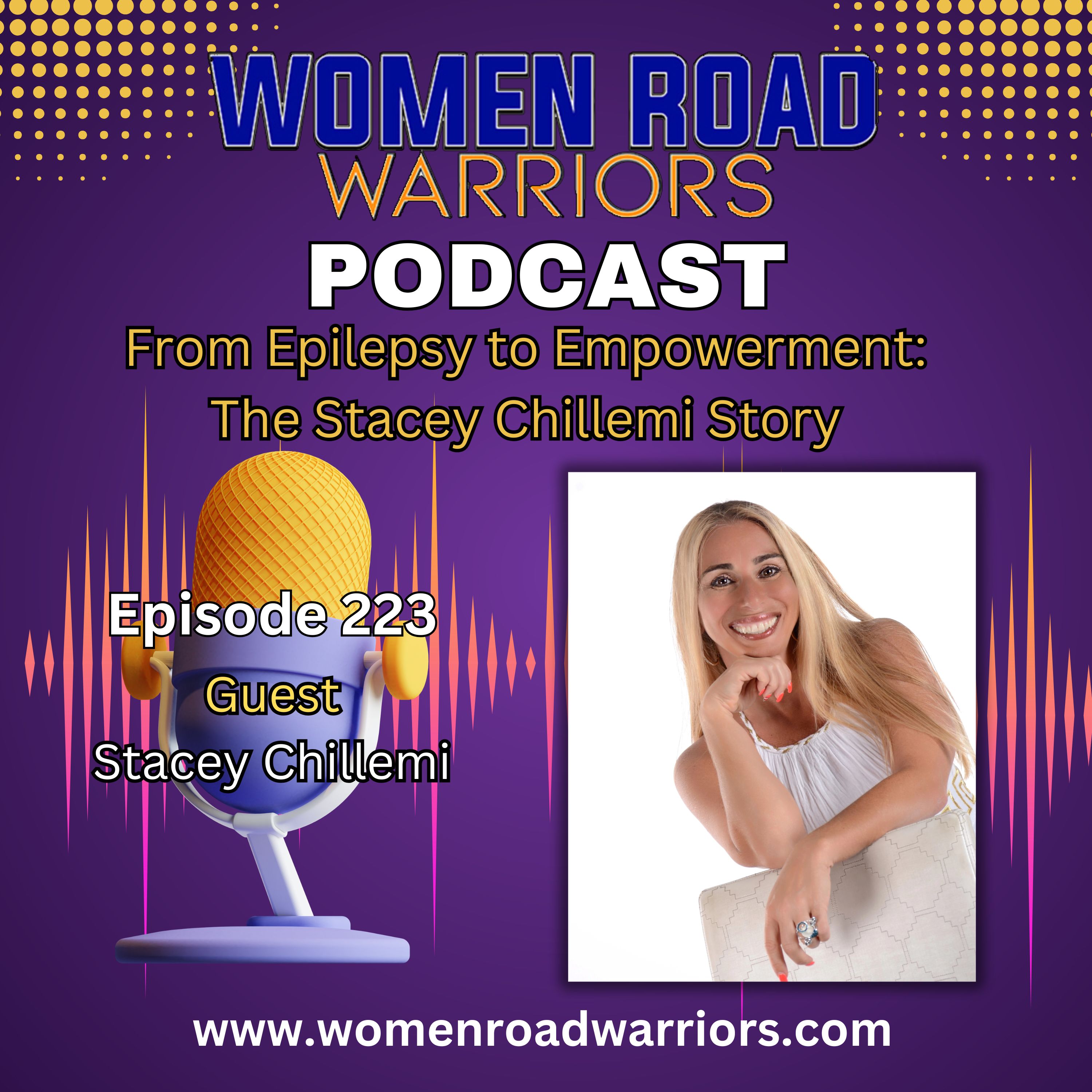
From Epilepsy to Empowerment: The Stacey Chillemi Story
About this episode
Resilience, mindset, overcoming adversity, and personal growth take center stage in this powerful conversation with bestselling author and keynote speaker Stacey Chillemi.
What if your greatest challenge could become your greatest purpose?
On this inspiring episode of Women Road Warriors, Shelley Johnson and Kathy Tuccaro welcome Stacey Chillemi—20-time bestselling author, keynote speaker, and mindset coach whose work has empowered millions around the world.
Stacey’s journey began with a life-altering diagnosis. After developing epilepsy following childhood encephalitis, she faced obstacles that could have defined her limitations. Instead, she transformed adversity into advocacy—ultimately speaking before Congresson behalf of people with epilepsy, which helped pass the Americans with Disabilities Act. She then became a global voice for resilience by helping others unlock healing, confidence, and leadership.
Today, Stacey reaches millions through her books, coaching programs, and the fast-growing Advisor Series for Mindset & Self-Improvement podcast and YouTube channel. Her message has been featured across major media, including NBC Dateline, News 4, The Morning Show, The Dr. Oz Show, Psychology Today, Business Insider, and collaborations with leaders like Arianna Huffington.
In this powerful conversation, Stacey shares how anyone can shift their mindset, rise above challenges, reduce stress, and step into their true potential.
If you’ve ever faced adversity, questioned your path, or needed a reminder of your inner strength, this episode will leave you inspired and empowered.
Listen now to discover:
• How to transform adversity into purpose
• Mindset shifts that unlock resilience and leadership
• Practical ways to reduce stress and reclaim your power
• Why your story—no matter how difficult—can become your greatest strength
🎧 Listen now and discover how to turn life’s challenges into unstoppable momentum.
https://staceychillemi.com/about/
https://podcasts.apple.com/us/podcast/the-advisor-with-stacey-chillemi/id1671441889
https://womenroadwarriors.com/
@wisdom4u
@Podcast Support Network
@theadvisor_sc
@The_Advisor_SC
@theherbalguide
#Resilience
#mindset
#Epilepsy
#AmericansWithDisabilitiesAct
#ADA
#OvercomingAdversity
#PersonalGrowth
#TheAdvisorWithStaceyChillemi
#StaceyChillemi
#WomenRoadWarriors
#ShelleyJohnson
#KathyTuccaro
Get every episode summarized
Each time Women Road Warriors publishes, we email you a written briefing from the transcript — the topics, who appeared, and any specific claims, with the ad reads skipped.
Email me new episodesFree for 3 shows. No card needed.
Hosts & guests
Transcript ready
700 searchable segments. Every word is indexed and playable.
Full transcript
Women Road Warriors — From Epilepsy to Empowerment: The Stacey Chillemi Story. Machine-transcribed; use the interactive transcript above to jump the player to any line.
This is Women Road Warriors with Shelley Johnson and Cassie DeCaro from the corporate office to the cab of a truck. They're here to inspire and empower women in all professions. So gear down, sit back and enjoy! Welcome! We're an award-winning show dedicated to empowering women in every profession. We're inspiring stories and expert insights. No topics off limits on our show. We power women on the road to success, with expert and celebrity interviews and information you need. I'm Shelley and I'm Cassie. We have someone with us today who's turned adversity into advocacy, illness into empowerment and pain into purpose. From facing the challenges of epilepsy after Encephalitis as a child to speaking before Congress, she's dedicated her life to helping others unlock healing, mindset and leadership.
Stacey Chilemi is a 20-time best-selling author, keynote speaker and high-impact coach, whose work has reached millions of people worldwide, including more than 8 million views on YouTube. She's been unstoppable with a career that took her to NBC on date line, News 4 and the Morning Show. You've also seen her five times on the Dr. A's show, featured in Psychology Today and Business Insider, and collaborating with leaders like Ariana Huffington. She leads the advisor series for Mindset and Self-Impowerment, a fast-growing podcast and YouTube channel that teaches men and women how to rise above challenges, reduce stress and discover their true potential. But Stacey's story isn't about fame, it's about resilience. We're honored to have Stacey on the show with us to share her powerful insight. Welcome, Stacey. Thank you so much for being with us. Oh, thank you so much, it's the honor to be on your show, I appreciate the invitation.
Thank you. You're quite the powerhouse, holy smokes. Oh, yeah. This is so exciting. I mean, you really are amazing, Stacey. Your story is incredible, and your resilience is a testament to the true human spirit of vanquishing what gets in our way. You experienced your first seizure at just five years old when you were diagnosed with encephalitis, and later epilepsy shaped much of your early life. Would you mind sharing your story with us? Sure, I'd be honored to do that. So at the age of five, my mother heard a gargling sound in my bedroom. She went in to check on me, and she saw me in a grandma seizure and I was turning blue. My parents had rushed me to the hospital, and they found that I had encephalitis and had traveled to my brain. I was induced into a coma, and they said that probably if she comes out of the coma, she would probably be paraplegic or she'll have severe brain damage. My father, who was religious from Greece, he came from a small island, one church, one
doctor, one everything, and they was a statue in Greece right by the church, and it was known to have tear drops come down its eyes. He told me that he was praying by my bedside, and he was envisioning the statue, and he looked up after he prayed, he said, and a tear drop rolled from my eye, and I woke up. The first thing I asked for was McDonald's French fries, and I actually wasn't paraplegic. I didn't have severe brain damage, but I did have epilepsy. Till this day, they don't know exactly where the epilepsy is in my brain, but it's probably throughout my brain, they said the encephalitis probably traveled throughout my brain and caused different scar tissue, which they can't find. But anyway, to get back to the story, after that, I struggled that life was like a roller coaster ride. I went through school and then college.
During college, it was on my bucket list to get a degree and to do all these great things that girls think about as 19 and 20-year-olds. When I was in college from the stress in the late night study, and I had non-stop seizures, and I didn't even know if I was going to finish college. I went to the library, and in the library, there was maybe three or four books on epilepsy. They were written by doctors and medical terminology, and if you weren't a doctor, you basically didn't understand what they were talking about, which really frustrated me at the time. I wrote to the epilepsy foundation in Washington, DC, and I said, please publish my article. I asked people to share their stories with me, and I asked them, how do you cope with epilepsy? To my surprise, I got three to four hundred letters from all over the United States and Canada. People shared their stories. They shared how they deal with epilepsy, and it was very inspirational. For the first time in my life, I realized that I wasn't alone. I took a lot of their information, and what I did was that I created my own regiment.
I got through college, and I started working in New York. I was working on NBC. I was working on all the different TV shows, and I was living the lime life of a girl in her 20s. Then one day, I was walking, and I was in one of the corporate offices, and I felt to the ground, and I had a seizure, and one of the executives saw me, and he stepped over me. I was conscious, but I couldn't move at the time, and no one was there. They just stepped over me, and he left, and very goodness, wow. And so I was released from my position because of my epilepsy, and I remember just walking out of there, and I just kept saying to myself, I don't know where I'm headed, but I'm going to be a success. And I kept that mantra in my brain from the rest of the entire of my life. And so after that, I started my own writing business, and I met a lot of people. A lot of very successful people, like the owner of Grammarly, and lots of others who would
just start out and creating their softwares, and I was doing a lot of the writing research for a lot of these people. And then one day I met an herbalist, and he would need a lot of writing and research done on natural living. So I started to do all the natural holistic research, and I said, wow, a lot of these things could apply to my own life. And I started applying different techniques, like detox, and using certain arrows and supplements, and changing my life and the way I thought, the way I slept, and incorporating yoga, did meditation, did all these things. And my seizures went from 12, 9, 8, 7, 6 to the point where they became controlled. And then later on, the epilepsy foundation got wind of what happened, and they sent me to Washington. And I spoke in front of Congress, and we got the Disabilities Act approved, and I just kept going. I started to really get into the realm of natural healing, and how far, you know, I realized
love, if it helped me, it could probably help anybody with any condition. And so then I really focused on dedicated my life to help others, and trying to figure out ways to show others that we could rise above the chaos, we can overcome our obstacles in life, we can overcome these things, and we can reach our full potential in life, that we shouldn't have to let anything in life stop us from what we want to be, or who we want to be. And we all have entitlement, we all have beauty within, we all have strength, and we all have the ability to become anything we want in life. And we shouldn't let others tell us we can't, and we shouldn't have, you know, things in our life that pull us back, you know, there was many times I felt to the ground, I felt like every time I moved two steps forward, I got knocked back three, but it didn't stop me. I just got back up, and I kept fighting until I reached the, you know, the point in life where I could look in the mirror, and I was happy with the person I saw. Oh, bravo. You have the drive of so many people, and what a wonderful message that you have.
And I love the fact that you are instrumental in the American Disabilities Act. When you spoke in front of Congress, what about job discrimination against people with epilepsy? It's something that was an eye-opener that they needed to know about. I mean, I find it shocking that an executive just walked over you when you were in need. I mean, that. And then you were dismissed. That makes no sense at all. And you have made so many changes as an advocate for people. And then, of course, what you're doing with herbs and everything, I mean, this is really helpful for anyone. I would think with any kind of physical condition or disability and for their health, too. I think what really, really inspired me was when I was trying to find my purpose in life. I had taken my experience and I took all those letters. I took the most inspirational letters and I put that together and I wrote about my regimen about how I overcame epilepsy and I put it into a book and I called it epilepsy.
You're not alone. And that book, one day I got an email and I opened the email up and I said, I just want to say thank you. I found your book and Barnes and Nobles and I just want to let you know I was on the Burgess suicide and you saved my life. Thank you. And it was then that was really that that was the eye opener. That was when I really realized how powerful the words of wisdom can be and how we can change me, you, Kathy, how we could all change people's lives by the words we say, by the words we put on paper, how we can make such a difference in this world. Everybody, everybody on this planet can make a difference. We have to just stop and think about what we're saying and to who we're saying it to. And we can help so many people, every single one on this planet, we all could, we could all be a benefit to each other. If we just use the right words at the right times, at the right point, point of our lives. Wouldn't it be nice if everyone did that? Can you imagine what the world would be like?
Stay tuned for more of Women Road Warriors coming up. Dean Michael, the tax doctor here, I have one question for you. Do you want to stop worrying about the IRS? If the answer is yes, then look no further. I've been around for years. I've helped countless people across the country and my success rate speaks for itself. So now you know where to find good, honest help with your tax problems. What are you waiting for? If you owe more than $10,000 the IRS or haven't filed in years, call me now at 888-557-4020 or go to mytaxelpmd.com for a free consultation and get your life back. Industry movement trucking moves America forward is telling the story of the industry. Our safety champions, the women of trucking, independent contractors, the next generation of truckers, and more. Help us promote the best of our industry, share your story and what you love about trucking, share images of a moment you're proud of, and join us on social media. Learn more at truckingmuseamerica.com.
Welcome back to Women Road Warriors with Shelley Johnson, that Cathy Tacaro. If you're enjoying this informative episode of Women Road Warriors, I wanted to mention Cathy and I explore all kinds of topics that will power you on the road to success. We feature a lot of expert interviews, plus we feature celebrities and women who've been trailblazers. Please check out our podcast at womenroadwarriors.com and click on our episodes page. We're also available wherever you listen to podcasts on all the major podcast channels like Spotify, Apple, YouTube, Amazon Music, Audible, you name it. Check us out and bookmark our podcast. Also don't forget to follow us on social media. We're on Twitter, Facebook, Instagram, Pinterest, LinkedIn, YouTube, and other sites. And tell others about us. We want to help as many women as possible. We're continuing our conversation with the incredible Stacy Chilemi. Before the break, we were talking about Stacy's remarkable journey.
How a diagnosis of Encephalitis as a child led to epilepsy and her first seizure at just five years of age. What's so powerful about Stacy's story is that she didn't allow those early challenges to define her limits. Instead, she transformed them into a life of service and leadership. Today, she's a 20-time best-selling author, keynote speaker, and a high-impact coach, reaching millions around the world and generating more than 8 million views on YouTube. You've likely seen her on Dateline NBC, News 4, The Morning Show, and even five times on the Dr. Oz Show, and her works been featured in Psychology Today and Business Insider. She also leads the advisor series for mindset and self-improvement, helping people rise above challenges and discover their true potential. She's helped so many people who've lived with epilepsy. And she was instrumental in getting the American Disabilities Act passed. Stacy, in our last segment, you said something so profound. After realizing how one of your books had made such a difference to a reader and it saved
that person's life, you said, we could all be of such benefit to each other if we just use the right words at the right times. Kathy, you said you had a thought on that. In reference to that, I got a phone call yesterday or day before from a lady that used to be here at work, our personal trainer, and that's all she's ever done was fitness and she's 50, and she says, Kathy, I don't want to do this anymore and I want to be just like you. I don't know if you know this, but I operate the world's largest mining equipment in the world. And so the truck I drive is bigger than a house. It's tires of 14 feet tall. It's crazy what I do. Anyway, so this woman, she, she was our personal trainer a couple years ago and then the Ky Bosch program, so I kind of was helping her get, take steps into how she could become a whole truck operator. And she gave me a call yesterday or a couple days and said, Kathy, I just need to tell
you, I'm crying right now because I got, I just got a job offer. I'm now officially a haul truck operator and it's just, it's all thanks to you and she says, I'm 52 and I didn't think I could do it. And you have no idea how much you inspire me and, you know, all your hard work and she's crying on the phone and she said, if I could just hug you, I would. It's funny because she called me and when she called me, I was just sitting here probably due to night shift feeling miserable and thinking, you know, and I'm just not doing enough out there. Like, I'm not inspiring anybody. What am I doing? And then she calls and I'm like, oh, thank you, universe. That's pretty awesome. That is awesome. With everything we do, we don't realize that the power that we truly do have, you know, it's a ripple effect. It's almost an invisible thing that we do not see. And like Stacey, what I do, what I've done to keep me focused, I've received letters from people all over the world at gifts and pictures and they draw art and they do this.
And I made a wall of love because on my whole entire office is letters, people write on napkins, the, you know, I'll screenshot something what they say on, on, on, on Facebook or Instagram and all printed. And they'll draw me stuff. And so I have this huge, huge wall because on the days that I'm struggling, that I'm thinking, okay, I'm, I'm just not, you know, and I look at this and I look at these little kids that are coloring and doing things and I'm like, you actually think you're going to stop now. Right? Like that because you don't realize how far the reach extends. And that's what keeps me going and what you're doing is the exact, it's just above and beyond and kudos to you. Oh my God. Oh, Stacey, you're amazing. What keeps you going, Stacey? I think the fact that keeps me going is that when I wake up in the morning, I, I feel so excited to do the things I do because I know that I'm helping people and you know,
you don't realize at the time that you're actually helping people because I never really, you don't realize how much of an impact you're having on other people's life when, when you are humble and what, what, what I get is when people, like you were just saying Kathy, when people, you know, call me or, or they, they, they say, I just saw your podcasts and I listened to the episode and wow, what a change, what a difference it made in my life. And I'll be like, really? You listen to my podcast. Like, you know, you just like, you don't really realize the impacts that you make when, or someone reads my book or someone saw me and said, wow, you know, you're, you're, you're making such a difference. It's like, you know, I think the words, the, when I hear the positive feedback from others, because that's what I wanted to do because when I was, when I, when I, when I was going through the roughest times in my life, people just came out of the woodwork to help me. People who I didn't even know, they just wanted to help me, you know, there was a point
where I didn't drive for 15 years because when I was having seizures, I was asked to stop driving. And so I didn't drive for 15 years until they could figure out how to get my seizures controlled. And with the, like I was telling you earlier, with the usage of my medication and holistic living, I was able to get my seizures under control. But those 15 years was like, I felt imprisoned in my own home. And, you know, having to have lie on others was very difficult for me as a, as an independent woman. And, you know, so when I, when, when I did this, it was, I just wanted to help others. And it was that email that really brought me on this road on this track was that I could change someone's life, that email, like I think was the eye opener and it was, it was the thing that really got me going and that, you know, and I kept working and working and working and working to try to, to try to, to be better and better and better and better and reach more people because I would, I would just wanted to make a difference.
I wanted to help others. I was, I was just so motivated to try to help others like others have helped me. And you, what? Because once you have epilepsy and once you go through pain in life and we all have, you know, we've all gone through ups and downs. Everybody has a story to tell. You start looking at life differently, you know, especially when, when you go through tragic events in your life and you overcome them and you actually, you actually become humble, you start to see life differently. Like when I, when I was in trial groups when they were trying to get my seizures control, there were people that had 90 to 300 seizures a day. When I saw those people, I, I stopped pitying myself. I was like, I was actually, I had gratitude, you know, and, and then because I was like, you know, at least, at least I can function. I have an invisible disorder. And then when, when I, as I got older, you know, I, I started to realize that, you know, I'm glad that I have epilepsy because I would have went on a totally different track in my life. I was headed on a totally different, different pathway and my epilepsy took me on a totally
different journey. It made me realize, you know, that there was more to life than materialistic things. That life is more than a nice car and a big home, that it's really about how we feel inside. The person we are, the person, the, the, the person, you know, what we can do for others, you know, it's not about what we can get. It's about what can we do for somebody else who brings joy in someone else's life? Amen to that. And I think today, especially, we're kind of caught up in the me, me, me, me, and we've lost sight of some of that. So it's, it's wonderful that you're out there reminding people, this is why we're here on this Earth people. Your message is so powerful. Stay tuned for more of Women Road Warriors, coming up. Any Michael, the tax doctor here, I have one question for you. Do you want to stop worrying about the IRS? If the answer is yes, then look no further. I've been around for years. I've helped countless people across the country and my success rate speaks for itself.
So now you know where to find good, honest help with your tax problems. What are you waiting for? If you owe more than $10,000 of the IRS or haven't filed in years, call me now at 888-557-4020 or go to mytaxelpmd.com for a free consultation and get your life back. Welcome back to Women Road Warriors with Shelley Johnson, that Kathy Tacaro. We're here with Stacy Chilemi and what an inspiring conversation this has been. Stacy's life changed dramatically when she experienced her first seizure at just five years of age after being diagnosed within cephalitis. A diagnosis that eventually led to epilepsy and shaped much of her early life. She did not let that stop her. Stacy turned that adversity into something extraordinary. She's now a 20-time best-selling author, keynote speaker, and high-impact coach whose message of resilience and mindset has reached millions, including over 8 million views
on YouTube. She's made a difference for so many people who suffer from seizures and she was instrumental in getting the American Disabilities Act passed by Congress. You probably see her on Dateline NBC, News 4, The Morning Show, and The Dr. Oz Show, where she's appeared five times, and she's been featured in Psychology Today and Business Insider. Through her podcast and YouTube platforms, the advisor series for mindset and self-improvement, she continues helping people unlock their potential. Stacy, what you share with people is so amazing. You mentioned the 21 principles that guided you from rock bottom to empowerment. Would you mind maybe sharing one or two of those principles because you really were able to really unpack how to get empowered and rise above? Sure. So the first thing was denial. The first thing is that it's very hard for all of us, I think, as individuals to realize that we have problems in our life that need to be addressed.
Once we acknowledge that we have issues in our life that need to be addressed, then we can go to step two. We can make believe that the issues in our life are not there. We can make believe those problems don't exist, but they're not going away. You're just living a life of a lie. How is that going to benefit you? You just push it in your subconscious and you make it like it's not there. It's going to always be in your subconscious and it's going to affect the way you are. That 10% of our conscious brain is going to react from our subconscious. So what we need to do is really acknowledge that we have issues in our life that need to be addressed and then we have to learn how to actually move forward and accept it. We have to, you know, there is no such thing as perfect. People have this persona, I think the word should be wiped out of the dictionary. There is no such thing as being perfect. Everybody has something in life and we have to just accept what we have. And I really do believe everything in life has happens for a reason. And if we are going through things in our life, there's a reason, is it going to bring
us resilience? Is it going to bring us a sense of hope for other things in life? Are we going to be able to use this to help others? You know, we have to learn how to accept and we have to learn to also love ourselves. That would be the next step. Once we accept that we have these issues, we have to learn to love ourselves for who we are. We have to understand that, you know, we have problems, they need to be addressed and I love myself. I love myself no matter what. There's things in my life that I don't like about myself, then I have to acknowledge them and then I have to maybe set some long-term goals and short-term goals and start working on myself because nobody is going to do the work for me. You know, when it boils down, you are the only one that can make yourself a better person and you have to want that and you have to be willing to do the work. And in this society, we've gotten to a point where everyone wants instant gratification but healing takes time. But if you are willing to heal and you are willing to want something better for yourself,
then you have to be willing to do the work. And if you're willing to do the work, then miracles could happen. It's a matter of taking the initiative, isn't it? Yes, definitely. It's going to call pivot with purpose. Yes. I was standing. I was drunken wholeness back in 2011 and I'm standing beside this guy named toothless Joe and that was my moment, right? That is when I made a pivot with purpose. I'm like, I have no plan. I have no idea what I'm doing. All I know is that I'm not going to spend another second look at a bad guy. That was my moment. And from that moment on, like I quit drinking, got the help I needed out, you know, 12 years later, I'm off. We've been operating the largest equipment in the world. But yeah, good old, good old TJ. So what's your moment, right? You got to look at it. You got to figure it out. Everyone has their moment. That's true. A lot of people avoid it, though, don't they? They just kind of put things off and maybe they're afraid to take that first step.
Oh, yeah. I think change is most people are fearful of change. They're fearful of change because they don't know what's going to happen once they changed. And they're also, you know, in order to change, we have to really face ourselves in the mirror and really, you know, and be honest with ourselves. I always say honesty is key. And that's one of the big principles I talk about in one of my books is honesty is key. We have to be honest with, you know, who we really are. I could easily make a list of things I don't like about myself, you know, but, you know, what am I going to do to change them, you know, and that's the key. And I know I'm not perfect. I know I have issues that need to be met, you know, but I'm honest enough to know what they are. And I'm willing enough to make the change. Being honest with ourselves, that's something people, I think they really struggle with. They look in the mirror and they really don't want to see what they're seeing. And in many ways too, I think women don't always give themselves the credit. They know they see themselves as less than and you're empowering people to rise above
and really see their inner potential. I think in this society, like we grew up, you know, from the moment we were born, you know, when you, when, when the egg, it goes, goes down the Philippian tube, you already developed 240 characteristics of your personality. When as soon as you come out, your parents are telling you what's right, what's wrong, what you should do, what you shouldn't do, then you go to school and the teachers are telling you what's right, what's wrong, what you shouldn't do, and then you go into the real world and then you, you have people who you work for and people around you telling you what they think you should and shouldn't do. And then you, you, either if you get married or you're in relationships and those people are telling you what you should do and we're based on our identities are based on titles. And, you know, people are so used to hearing the titles that you hear them long enough, you believe them. But who are you? Who are real identity? Who are you as a person? And you swipe away all those, like those titles off of somebody and you say, tell me who
you are. Those people don't know who they are because they are so caught up in today's society and the titles we give each other. And they're meaningless if we don't know who we are inside. And I think, I think that's one of the things and also to answer your question when you talked about women, we brought up, you know, some in an environment where women feel shameful to give ourselves love and self care. They always feel like they need to help everybody else, but just like on an airplane, if you don't put the mask on, you can't help the people around you. You know, you have to really understand that in order to help others, you have to help yourself first and you shouldn't feel shameful and you shouldn't feel bad to be able to say, it's okay for me to take some quality or me time out to take care of myself because how are you going to take care of everybody else if you don't take care of yourself first? That's very true. Yep. Right. It's so very important.
Stay tuned for more of Women Road Warriors coming up. Dean Michael, the tax doctor here, I have one question for you. Do you want to stop worrying about the IRS? If the answer is yes, then look no further. I've been around for years. I've helped countless people across the country and my success rate speaks for itself. So now you know we're to find good honest help with your tax problems. What are you waiting for? If you owe more than $10,000 the IRS or haven't filed in years, call me now at 888-557-402-0 or go to mytaxhelpmd.com for a free consultation and get your life back. Welcome back to Women Road Warriors with Shelley Jobson, that Kathy Takaro. We're continuing our conversation with Stacey Chilemi, whose story is a powerful reminder that resilience can change the course of a life. Stacey faced her first seizure at just five years of age after Incephalitis led to epilepsy
and experienced that could have stopped many people in their tracks. Instead, Stacey transformed these challenges into a mission that has now reached millions of people around the world. She's a 20-time best-selling author, keynote speaker and high-impact coach with more than 8 million views on YouTube and appearances on Dateline NBC and the Dr. Oz Show five different times. Today she also leads the advisor series for mindset and self-improvement, where she teaches people how to overcome challenges, reduce stress and discover their true potential. She's a tremendous advocate for people and empowerment. Stacey, you inspire people to want something better for themselves and do the work that it takes to get there. It must have taken, I mean, with all the challenges you have, I mean, I really find you amazing. I don't think a lot of people understand the gravity of Incephalitis. I mean, there are a lot of people who simply do not survive. The fact that you were able to survive and you were able to work through, it took many
years, but you were able to work through and do all of the things you've done. Obviously, it speaks to the determination you have, what you were born with, what's in your personality. I would imagine you had to take a step back and look at yourself. Am I correct? I mean, looking at yourself and saying, okay, what do I want to do with my life? Who am I? Because all of these challenges, a lot of people would have just said, oh, forget it, you know? Yeah. It was, I got to tell you, emotionally and physically, it was very, very hard. I still do this day, certain things still haunt me. I go back into my past and I think one of the things that really I had to learn how to get over was that I knew that I had all this potential, that I could do X, Y, and Y and Z. But having epilepsy, I wasn't able to, because I had, I had, you know, I had a very bad series disorder and I had all different types of seizures and, you know, and it was
limited. You know, my life was limited and, you know, sometimes you would go for a long time and you wouldn't have a seizure and then all of a sudden you'd have a seizure and then all of a sudden it's like, you're reminded of your condition. And it's like, you know, I think one of the biggest things that I did, which I learned how to stop doing was I compared myself to others and you can't compare yourself to others. I had to learn how to love myself because I didn't love the person I was because I, I emotionally and physically endured a lot of pain my entire life and it was caused mostly by my epilepsy, you know, falling down the ground, having five concussions, having a hematoma, you know, you know, emotionally, you know, not being able to reach the goals I wanted to reach in life, all these things had taken a toll on me and, you know, I had all these dreams and aspirations and, you know, my epilepsy stopped me from reaching a lot of them and for me, it hurt a lot and, you know, I didn't, you know, you know, even
I had, luckily I had, I had one of the best doctors in the country. I had three beautiful, healthy children. Most people, most women with epilepsy don't even have children, because they're too afraid. I, I, I had to go through a lot of struggles and, and, you know, I, it was a, definitely a lot of pain emotionally and physically and I, I really, I feel for people, you know, not even just for epilepsy, for any condition and for any, any illness, even, even people who suffer from stress and suffer from anxiety and depression and anyone going through anything in life, you know, it's, it's very hard to wake up in the morning and be happy when, when you can't do the things you want to do or feel the way you want to feel and you see people next to you and they're doing the things you want to do and they're feeling the way you want to feel and it could be very, it could take a toll on someone on their confidence, on their self-esteem, on their, their quality of life and, and, you know, so that's why in so many conditions, there's a high suicide level in, in all conditions
because, you know, people are like, is it really worth it, you know, and, and that's where you have to take a step back, yes, it is worth it, yes, I can, you know, and, you know, and, and I reached out for help and I think that was the key is it's okay to reach out for help, it's okay to ask for support because by having the people around me, those are the people who helped me get through it and those are the people who helped me learn how to move forward in life and I think it's really important to, to, to be able to, you know, accept that we all need help in, in different points of our lives. You know, we have a fellow coworker of mine, he's a, he's been a shovel operator, like these shovels are the size of ships and he's just a young guy, maybe, I don't know, 30, 40 or something like that and he started having seizures last year, just random me and now they've had to pull them off all equipment and he's been working, he traded him crews, he was on a different crew, now he's been with us since May or, no, maybe, I don't know,
very, very, very, working in an office and he was just getting back under control and he was getting ready to go back on equipment and he just had another seizure the other day, a really a bad one and so here at work and they had, so they pulled him off site. So I'm going to connect him with you because he's, you know, he's, he's quite devastated, he's singing his, his, his careers over and he, he has no idea, you know, he's feeling really lost and I mean, everything that you've been talking about and I don't know if it's harder for guys or for, you know, he's got a family and all of a sudden, you know, he's going to, who knows with the job because you can't operate big equipment and so I'm going to connect him with you and maybe see if he can find some strength in your books and, you know, send them links and stuff and, you know, we'll see, thank you so much just for for for being you and being so awesome and sharing and giving hope to other people because I know for my coworker, it's,
it's kind of hard to reach out sometimes. I don't know if it's their pride or, or what it is. Is it harder? Do you think for men that it is for women? Well, I've noticed from talking to a lot of men, men were, were, were, were raised to be the caretakers. So in their mind, a lot of the men I spoke with, you know, they had a very hard time, especially if they were married because they, a lot of them lost their jobs or went on disability because they, they couldn't, they couldn't perform the jobs they were doing. I knew one gentleman, he was riding a motorcycle and he gone to an accident and he flew off the motorcycle, hit his head and got epilepsy. And for him, he couldn't drive anymore, he couldn't work anymore, he couldn't do all the things that he, he enjoyed and and and then all of a sudden, you know, he had a family, he couldn't provide for them anymore, you know, so that, that, I think that takes a real toll on on their pride. I hear it there, there's an office team there, everything and, and they're just the fact that, you know, just like when people get older, you look back at what you could do and, and now you're this age and you can't do that anymore and, and it's just, it gets, it gets depressing because you,
you know, you're in a situation where you feel powerless sometimes because you're, you know, I talk about it and I talk about it, you know, not like it's easy, but I, I, I still go through my ups and downs and I, you know, it's just by so many years of working it, working on, on myself, I've gotten to this point, but it wasn't, it wasn't an easy stride and there are moments where it's not, you know, you know, it's, you know, some things can trigger on emotion and you think about things and, and a tear will roll for my eyes, you know, I was recently, you know, I was in an accident four years ago, it was like three seconds and I lost the mobility of my arms for four years and they were trying to figure out how to get that mobility back. And here I was again, I said to myself, I got over my epilepsy, I'm not taking seizures and now I got this, this, this problem with my arms and they were able to figure out what was wrong, but if four years I couldn't use my arms, you know, I get them to pass my shoulders and that's how I got into podcast and believe it or not because
I was doing public speaking nationwide and I couldn't do it after that and I had a friend who, who had a podcast and he interviewed rock and rollers and he wouldn't get off my case, he's like, just do a podcast, let the world hear your voice. I said, oh, I don't know, I heard it's a lot of work and and then finally he wouldn't get off my case so I did it and it was the, the best thing I could have ever done in my life, it's become my, my, my career and I, I talked to people all the time and and I learned from them and I helped people and it was one of the greatest things that could have happened to me, but I never thought it would, you know, it would, I would go in this direction. So I say to people, you know, take the positive out of every negative and that's how it got me through life was, you have to be positive, positivity is key because without being positive, I would never have gotten this far. So anytime anything negative happened, I said, okay, what's positive about this and then I would say, well, it made me stronger, it made me, it made me wiser, it made me this,
it made me that, but there was a couple of times when I just lift up in the sky and I said, God, if you're trying to work on my resilience, I'm there, I'm good, I don't need anymore, you know, I'm, I'm really good, I swear, you know, and it's like, you know, but I think you have to really be positivity, we'll, we'll get you, get you far in life, you have to be positive or you won't move forward. What do you say to somebody who says I can't find the positive? I say that they need, they can always find a positive, they have to get that negativity out of them and I say, it's, it's time to empty out that, that baggage as, you know, we, we are sometimes so angry inside, we have, you know, because of all the things that have happened to us that we don't want to look at the positive because it's so much easier to look at the negative because with the negative, you don't have to do anything in order to, just to let, to let go of that negativity, this I had to look, I had to say, you know, okay, you know, the only way I'm going to get through this is to focus on the good things in life and what are those good things and I made a list
of all the good things in life, I made a list of, well, I'm breathing, I have a great family, I have people who love me, I have friends who care, I had grass outside that I could feel, I could walk, I could do this, I could do that and then, you know, and then I, and then I said, all these negative things, I erased and I let go, I did meditation and I put it on, I used to visualize a dove and I put all those negative things and all those negative thoughts onto that dove's wings and I make me the dove was flying away and I would clear my mind and clear my thoughts and then I would say those negative things are now gone and I would ask that I would look up to the spiritual world and I say, God, give me direction, give me help, give me, give me some symbols and some direction and I always got it and I always feel very spiritual and I'm a very spiritual person and there's always, there's always direction, there's always signs, we just have to look for it and then even sometimes, you know, you can be listening to music or you can be on the computer
and all of a sudden, gosh, just thoughts just come through your head. Well, there's a reason why gosh, the thoughts are coming through your head or there's a reason why something might bring up emotions, you know, listen to what your mind, body and soul is telling you and follow follow what it's telling you. We stop listening. I think we listen better as children but as we go through adulthood, I think we stop listening. That could be part of it, you know, people can be sitting outside and they aren't even hearing all of the life that's out there. It's funny, you know, I got to laryngeitis a while back and my mom took one look at me and she says, you realize God's telling you to stop talking and start listening more, right? Because I never spoke a word until I was four years old, like not a single word. She says, but once you started, you never shot up. You made up for it. We took a road trip a couple of years ago and I was still putting her to sleep by talking
so much. God is telling you to start listening. Stop talking. There you go. Yeah, listening is really important and Stacy, you are empowering people. You get them to listen and listen to themselves with everything you're doing. Obviously, you've got your books, you've got coaching, you've got your podcast, the advisor with Stacy Chilemi. What's your podcast about? If you want to kind of introduce that to our listeners, if they haven't heard it. So my podcast, the advisor with Stacy Chilemi is about self-improvement. So I come to it when I was doing my podcast, I realized that if you don't have good mental health, then that affects your physical health and 100% of illnesses are caused by stress alone. If your mental health and your physical health aren't good, then that affects your spirituality. If your spirituality is affected and all the other two components are affected, then that's going to affect the way you are at work, your clarity, your focus is going to be off and then if those things are off, then you bring all that home to
your family and they get affected by your behaviors. So in order to live a healthy and productive life, I think of it as an alignment that if one component out of those pillars I just mentioned are out of alignment, then you're not going to be able to function to your full capacity and live till your full potential. So we have people from all walks of life, we have people from that come on the show that are experts in mental health, physical health, spirituality, people who are entrepreneurs or own businesses or have corporations and they come on and they talk about different tools and techniques to make life easier to help you. And so it's from all different segments of life because in our life, you have to realize that to find balance, we need to be balanced in all areas of our life. So that's what the podcast is about, learning how to balance your life in
all areas. Very powerful. And you do coaching as well. Can people work with you actually virtually or? Yes. So if people want to get in touch with me, they can contact me at StacyChilemi.com and they can contact me there. And I'm always willing to help people. I do lifestyle coaching. I do podcast coaching. I do accountability coaching. And I tried to help people really see their full potential in different areas. And for people who want to learn how to podcast, there are so many people out there. Everybody has a great message. And there are so many people out there that want to get their message and be heard. And so I try to help people. We actually do it on our podcast. We have a program where we do, we help people actually produce, we produce, we create produce and promote their podcast and we get them started. So they could have podcasts and they can get their message heard and they can change people's lives. And I work with people
and I help people in that area. And I also help people who want to write a book. There are so many people out there that have great stories, but they don't know where to begin. And I try to help them also, you know, and show them how they can begin and how, you know, and kind of get them the format so they can get on their way and share their message on paper. Because after what I experienced with my book and how I save somebody's life just because they picked that book up, I want other people out in the world to be able to, if they have a message and they feel it's important to be able to get that message out, you know, there's so many people out there that have, that have such wisdom that needs to be heard. Everybody has to realize that they have something beautiful about them and that should be shared with the world. Amen. So you're the starting point for people's empowerment. You really are. You're giving people a starting point because I think that's a lot of it. People need to find out where do I start? Because I think we all have this burning desire somewhere. A lot of us haven't let it flicker out. Might have forgotten about it.
But you're bringing it back. You're giving the oxygen to that flame, which is so awesome. Stacy, what would you say? Is there one word that you live by every day? Gratitude. Actually a couple words. Gratitude, love and appreciation. I love it. Those are powerful words that I don't think a lot of people pay attention to. I think those are really powerful words. I think if people, I think in order to live a healthy, happy and productive life, I think we have to focus on those words because those words is what living is all about. Very true. You can't lose sight of what life's all about and those words really describe life. So where do people reach you, Stacy? So they can go on StacyChilemmay.com. They're welcome to call me. My number is 908-347-358-0. I always get calls from people who need help or want to be on the show or really want to get direction or advice. They can reach me there. My website,
StacyChilemmay.com is probably a great place and they can leave a message. I also have the advisor on JustScoreSC for Instagram. We have a lot of our podcasts on YouTube. We're on all the social networks so you can find us everywhere. You're empowering people. I think a lot of times when people have obstacles, when they have disabilities and everything else, they feel very much alone. You're making them not feel alone. You're making them realize the world is a big fraternity of people. They're people out there and you're giving them a reason to continue and to really, really try to be the best they can be. That's all we can do is just try. Everyone has our own version of what we want to be and what we're capable of doing and it's not what others want. It's what you want and we all have the ability to reach any of the goals and dreams we have.
I like how Disney sometimes says, you know, any dream can become a reality and it's true. How bad do you want that dream to become your reality and we could all do it. And we all need help. You know, that's the key also is that we can't do it by ourselves. We all have to have help and with help and with love, gratitude, we can become anything. Awesome. Your website again, Stacy. It's Stacy STACYChilemmyCHILLEMI.com. This has been absolutely fabulous. I'm so happy that we had this time to talk. You're phenomenal. Thank you so much. Thank you. This has been sure with us. Thank you for being on the show. Thank you so much for having me. This has been an amazing discussion and I really enjoyed my time with both of you. You guys are amazing. Thank you, Stacy. Vice versa. We hope you've enjoyed this latest episode and if you want to hear more episodes of Women Road Warriors or learn more about our show, be sure to check out womenroadwarriors.com
and please follow us on social media and don't forget to subscribe to our podcast. On our website, we also have a selection of podcasts just for women. There are a series of podcasts from different podcasters. So if you're in the mood for women's podcasts, just click the Power Network tab on womenroadwarriors.com. You'll have a variety of shows to listen to anytime you want to. Podcasts made for women. Women Road Warriors is on all the major podcast channels like Apple, Spotify, Amazon, Audible, YouTube and others. Check us out and please follow us wherever you listen to podcasts. Thanks for listening. You've been listening to Women Road Warriors with Shelley Johnson and Kathy Ticcaro. If you want to be a guest on the show or have a topic or feedback, email us at esthonsonatwomanroadwarriors.com.
More episodes
More from Women Road Warriors

Break Free from People-Pleasing & Burnout: Béa Victoria Albina
Women Road Warriors

Will You Be Relevant as AI Advances?
Women Road Warriors

Build Unstoppable Confidence: Simone Knego
Women Road Warriors

Undercover Warrior: Exposing Corruption
Women Road Warriors