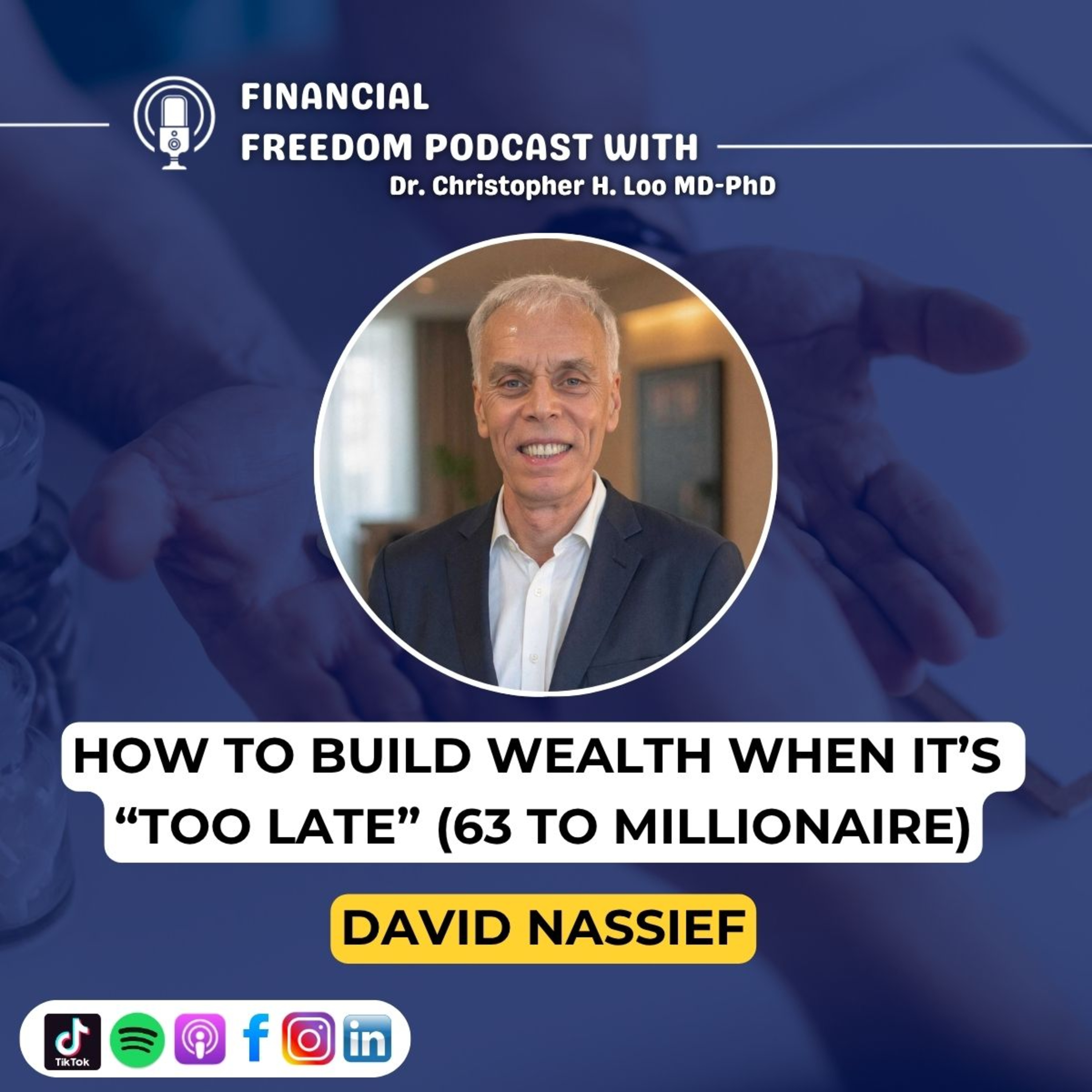
🔥 Fired at 63… Millionaire at 69 | David Nassief
About this episode
🚨 DISCLAIMER: This content is for educational purposes only and should not be considered investment advice. The results discussed have not been independently vetted, and any claims made by the guest have not been verified. The views expressed by the guest do not necessarily reflect those of the host or this show.
To book a PREMIUM spot on the Podcast: https://www.drchrisloomdphd.com/_paylink/AZpgR_7f
Book a 1-on-1 coaching call: https://www.drchrisloomdphd.com/booking-calendar/introductory-session
Subscribe to our email list: https://financial-freedom-podcast-with-dr-loo.kit.com/
email [email protected] with "Podcast freebie" to book a coveted FREE guest spot on the show.
📝 How to build wealth is the question most high-income professionals are asking—and in this episode, David Nassief reveals the simple, repeatable system that helped him go from nearly broke at 63 to building a seven-figure portfolio in just six years. 💰
If you're searching for how to build wealth but feel stuck, behind, or unsure where to start, this episode speaks directly to you. Most people believe that earning more money automatically leads to financial security—but as David explains, making money and building wealth are completely different skill sets.
In this conversation, David Nassief shares how he rebuilt his financial life from scratch using a clear, disciplined approach centered around low cost index funds, passive investing, and a set it and forget it investing strategy. His framework is designed for real people—especially high earners—who want simplicity, clarity, and results.
💡 What You’ll Learn:
- Why high income doesn’t guarantee wealth
- How to implement a wealth building strategy that actually works
- The power of index fund investing for long-term growth
- How to think differently during market downturns
- Why most people fail due to emotional investing
- How to build momentum toward financial independence
- The mindset shift required for true financial freedom
🧠 Why David Nassief’s Strategy Works
If you’ve ever asked yourself:
- “Am I actually building wealth—or just earning income?”
- “What happens if my income disappears?”
- “Is it too late for me to fix this?”
This episode provides direct answers, practical strategies, and a clear path forward based on real-world experience.
David’s approach cuts through the noise of complicated financial advice and focuses on:
- long term investing strategy over short-term speculation
- consistent contributions + disciplined habits
- leveraging market downturns instead of fearing them
- building a simple system that removes emotional decision-making
This episode helps you stop guessing—and start building wealth with clarity and confidence.
⏱️ TIMESTAMPS (17:18 TOTAL)
00:00 – Disclaimer (Important Financial Context)
00:20 – Narrative Hook: Fired at 63, Financial Reality
02:00 – Podcast Intro + Guest Introduction
02:40 – Losing His Job & Starting Over
04:00 – Turning Point: Learning to Build Wealth
05:00 – The “Wealth Compass” Concept
06:30 – Simple Investing Strategy (Index Funds)
07:20 – Midroll: Income vs Structure Insight
08:00 – Market Downturn Strategy (Buy vs Panic)
09:00 – Handling Fear, Failure & No Backup Plan
10:30 – What He Would Do Earlier
11:30 – High Income vs Wealth (Eye-Opening Stats)
13:00 – Avoiding Comparison & Staying Focused
14:00 – Wealth Compass Framework Explained
15:30 – Final Advice + Peace of Mind
16:20 – Outro + Leverage Strategy Message
17:18 – End
🔖 HASHTAGS
#HowToBuildWealth #FinancialFreedom #Investing #WealthBuilding #PassiveIncome #IndexFunds #FinancialIndependence #MoneyMindset #RetirementPlanning #PersonalFinance
Financial Freedom for Physicians, Copyright 2026
Get every episode summarized
Each time Financial Freedom Podcast with Dr. Christopher H. Loo, MD-PhD publishes, we email you a written briefing from the transcript — the topics, who appeared, and any specific claims, with the ad reads skipped.
Email me new episodesFree for 3 shows. No card needed.
Hosts & guests
Transcript ready
389 searchable segments. Every word is indexed and playable.
Full transcript
Financial Freedom Podcast with Dr. Christopher H. Loo, MD-PhD — 🔥 Fired at 63… Millionaire at 69 | David Nassief. Machine-transcribed; use the interactive transcript above to jump the player to any line.
Before we begin, quick disclaimer. Nothing in this episode should be considered investment advice. Results discuss have not been independently vetted, any claims made by the guests have not been verified. The content is for educational purposes only. These expressed by the guests do not reflect those of the host or the show. Imagine this for a second. You did everything right your entire life. You worked hard, climbed the ladder, earned six feet years, you told yourself I'm doing well, I'm on track. And then one day, at 63 years old, you get fired, no warning, no backup plan, and when you sit down and run the numbers, you realize something terrifying. You're only a couple years away from being broke. That's the moment today's guest, David Nassif, found himself in. And here's the part that should make all of us pause. David wasn't responsible, he wasn't reckless, he did what most hired owners do.
He made good money, but he didn't realize, and what most people don't realize until it's too late, is that making money and building wealth are two completely different skills. In fact, most people, especially high income professionals, are unknowingly walking in financial surveys, thinking they're moving forward when they're actually ending up right where they started. But David made a decision in that moment. No backup plan, no safety net, and over the next six years, he went from nearly broke to building a seven-figure portfolio and true financial freedom. Not by chasing trends, not by taking massive risks, but by following a simple, repeatable system that almost nobody talks about. So if you've ever wondered, am I actually on track, or am I just getting by, what would happen if my income disappeared tomorrow? Or is it already too late for me to fix this? This episode might completely change the way you think about money. So let's dive in. Hey guys, welcome to an episode of the Financial Freedom Podcast.
Today's guest is David Nassif from Arizona. He was fired at 63, nearly broke, and he became a millionaire by 69, safely. We're going to hear his story, turn around, really happy to have him on. David, welcome. Thanks, Chris. Excited to be here with you in your audience. Share your story. We'll dive into the questions. Well, it all happened when I was 63. I got fired after 18 years with the same company. I would not wish that day. Anyway, when I did the math, it was brutal. If we drained all of our savings, all of our retirement, we would be broke by 65. I'm thinking, who's going to hire me at my age? The hardest part was driving home. Thinking, how am I going to tell my wife, Mary? We didn't marry for 30 years. She did not deserve the mess I just threw our family into. After two months of dead-end job searching, I did not want to go back to the corporate world. They didn't want me back. My interview is none of them actually worked out. I decided I'd take a huge risk. I went to work as an independent sales agent on straight commission. No salary, no safety net, no benefits. The first month for brutal call calls, working mistakes, I heard more
nose than I'd ever heard in my life, that too much period. Looking back, all that rejection, all that resistance I was getting, I believe it was giving me the mental muscles I needed to bust through that dark period of my life. Because after 10 months of grinding, I had an incredible milestone. I was suddenly making more money than my good paying corporate six-figure salary. For a moment, I thought, we made it, but then I realized, we haven't made anything. I've been making decent money. Most of the 40 years previous, look where I got me. I was on the edge of a financial cliff, and I said, I need to learn better how to invest. I need to better how to build wealth. It couldn't waste time with a bunch of investment theories. I dug down myself, read 21 books, listened to 13 podcasts consistently on financial planning, blogs, newsletters, every time I got a good idea, I'd put on a piece of paper, kept filling up that paper. When it was overflowing, I took out the least effective and kept the good ones, it kept getting more refined. It was a Senate and forget it approach. I did not have time. I had to run my company. Six years later, I did what I thought was impossible.
From terrified of being broke to a seven-figure portfolio and a real financial freedom, I now know it is never too late to rewrite your story. If I can pull it off, starting as late as 63, anybody can with the right direction. I truly believe that. Your story reminded me a lot of the doctors approaching this cliff. They know that healthcare is broken, they can get laid off at any point. What were some of the things you did that accelerated? Did you become a millionaire over a six-year period or the things that gave you an age leverage? Let me just tell you the story about what inspired the whole thing, but I'll tell you how it works. Scientists at the Max Planck Institute did an experiment. They put people in the center of a dense German force and they told them, walk on a straight line to the edge. These were confident people, but when the clouds covered the sun and they lost their point of reference, the GPS tracking showed they were gradually starting to walk in circular motion. Some of them were ending up right back where they began, yet every one of them was absolutely convinced they were walking in a perfectly straight line.
That was me for 40 years. Working hard, thought I was doing the right thing, ultimately ending up right where I started. I said to myself, I need a simple one-page compass to keep me straight because shiny object or a hot tip and I was off to the races and another direction. I was going in circles, I didn't realize what I was doing. It made all the difference. I doubled my portfolio three times in a six-year period. Most financial experts would say, Dave, that's impossible to do that. Let me explain. I wasn't day training. I wasn't chasing crypto. I was doing something so boring. My approach was simple. The crazy part of it was when the market was down, I was thrilled. When other people were panic and unsettling, I was buying more shares of discount prices. My limit of regret was the market wasn't down more than that six-year period. I didn't even better. But here's what surprise me was the math. There's a thing called the rule of 72. It says that if you are getting a 10% return, your money will double every 7.2 years or roughly every 86 months. Once I've developed my compass, my first double occurred in 30 months.
The second one, 13 months, the third, 29 months for an average of 24 months, way less than half the expected 86 month time period. But the secret wasn't the return. I was doing three simple things that I hadn't figured out 40 years previously. I got serious. I was saving a good percent of my income. I knew my time was short. Secondly, I was getting in the right investments. For me, low-cost index funds, super cheap, and I only went to one of them as every stock in the United States, public-ish rated, and the other fund is every stock outside the United States. So for me to go broke, to go to zero, the entire economic world system would have to collapse to zero. I feel pretty good. I can sleep at night. There's not a high risk approach. I used market volatility to work for me instead of against me. I was caught in this trap of buy high and sell low, because that's just the psychology of how the weird we people think, it's funny, if you were to go to the department store and they had a sale, 50% off, you wouldn't say, hey, no, I'm not paying a 50%. I want a full retail. No one does that. But yet, on the stock market, we all panic, oh, 50% off. We don't want to buy it.
Then we want to get, so I got my mind in the right thinking. I was able to go my wealth twice as fast with half the risk compared to how I've been doing it 40 years. If this episode is making you rethink how your income is structured, that's intentional. Information doesn't create freedom. Structure does. At the end of this episode, I'm going to show you how to diagnose whether you're building leverage or just scaling complexity. Let's get back into it. During times April of last year, even this year, market has been quite frankly poor performance. What do you do when you were in this situation you bought and your portfolio is down? How did you handle that? It's weird, because of the education, Benjamin Franklin said, education acknowledges the best investment. It was that way with me. Once I understood the market, once I understood buying low, instead of buying high, I actually was through every morning. I don't listen to the news, the cable news financial stuff. I would never take advice.
They're crazy. They don't know what they're talking. Half the time they're wrong, half the time they're not with them. But I loved it. Just watch it. I like to see what the market's doing. I love their stories about the different companies. Once I understood it, when the market was down, I had the best breakfast that morning, because I was so thrilled. When I buy this month, I only bought once or twice a month, because I didn't market time at all. I tried that and it wasn't nightmare. Stop marketing. I look at it as sale prices. I'm happy right now. A lot of people are down about the market. I am so happy. I just opened stays down. As long as I'm in a buying mode, once I retire, maybe I might think you will be a little bit different. It's like I'm buying it. I'm happy. I want it to stay down. Do you handle this fact that you are 63, fired, no income, no prospects, and you have to make it up? How did you handle that? A lot of people, they see themselves, they're like, it's hopeless. How did you view that situation? I'll be honest with you. My first two months, I was those people who said it's hopeless. How am I going to recover? I'm 63. They fired me. It was like, you are no value to us anymore.
Companies I was in with were saying the same thing. For two months, I was like, wow, this is not working. I could be another statistic. Then I got mad. My family, my wife doesn't deserve this. I'm going to make this work somehow. When I did this, started my own company, it was miserable those first few months, but I just says, there's no plan B. I didn't have a backup plan. I'm glad I didn't. I didn't have the option I had to make this work. I look back on it now, and I am so grateful I got fired. My life is so much better financially. I should send a fruit basket and a thank you letter to those people that fired me, because I didn't have the guts to quit. I should have quit eight years before I was with the company 18 years. Who in their late 50s making six figures just quit. So you don't do that. You're a net case. So I couldn't do it. They gave me the push I needed out of the company. I can feel sorry for myself. I can play the victim role or I can fight. I'm going to fight. My wife is worth it. I'm not going to let this happen to us. Looking back, what are some of the things you wish you had done while in your corporate job to soften this landing of getting fired at 63?
Let me say, I'm grateful what happened that way. If I wasn't desperate, I wouldn't be where I am today. I needed that inspiration. Looking back, if I was a normal person, I would have done my wealth compass. It's nine trail markers. I would have just thought on that thing and stayed on it. If I had done that at my 50s, forget the 20s and 30s, I would have been just fine. What I did in six years with my compass is more than I did 40 years before that. That's what I wish I did. I wish somebody else had thought of the compass and got a hold of it. And I just followed it. It's a step by step process. I made it for the non-financial person to be able to use it. People in two mental states that you are where you are today, you implemented over six years, you were able to pull yourself out. A lot of people get bitter or angry at the past. If I had done this, if I had started in my 30s or 20s, how do you handle that? With gratitude, I am just so grateful where I met my first three doubles. My last double was the seven figure double. It happened in 28 months. I'm on my fifth double. It's going to put me numbers that I've never seen before.
Growth is exponential. Once you get the market kicking, in the beginning, my contributions were being the big part. Now, the market has taken over and it's really grown for me. A lot of people have this misunderstanding about high income people. You have a lot of listeners who are high income. I was high income most of my 40 years, you never know it at 63. Let me share with you some interesting stats that will help people understand this. The NBA, an average player, makes over $10 million a year. But five years after retirement, 60% of them are broke according to the Netflix documentary broke. The NFL is even worse. After two years of retirement, 78% of them are either bankrupt or in serious financial stress, according to sports illustrated, 25% of medical doctors in their 60s have not gotten beyond a six figure net worth. They've made a third of a million dollars most of their life. Here they are in their 60s and don't even have a seven figure situation. Here they are to Dale Schroeder, a basketball-loving carpenter who made modest to below average income his entire life. He chose to live on less of the earned and invests a difference wisely.
He ended up with a $3 million portfolio. That's more than the most NBA and NFL players making their $10 million. Here's what I found out after I did my compass and woke up after 40 years of being asleep, making money is different than building wealth. I thought because I was a six figure earn a good portion of my life, I knew all about money. I knew how to make money, but I didn't know how to build wealth. Basketball players and footballers, I knew how to make money. Most of them are terrible at building wealth. Dale Schroeder allows me to make you money, but it was a master at building wealth. Two separate skill sets. One does not mean at all. You have the other one. They're completely different, I discovered it. The hard way. I love how you distinguish between rich and wealth. We call them Henry's. They basically spend all their money and all of them save their invests. Henry's high income, not yet rich. One of my clients the other day, he was talking about how the market's down economy's bad, oil prices, then he's looking at Elon Musk is going to take a SpaceX public looking at the billionaires and watching the politicians make money.
How do you handle comparison trap? I truly believe that comparison is a thief of joy. I decided I'm only going to carry myself to me. I could look and say, man, if I had this system, when I was in my 20s, I'd probably have a hundred million dollars at this point. I don't think that way. I am so grateful for what I got. I'm sure there are people doing much better than me, people who are worse than me. I don't care. I don't get involved. I don't want that to drain my brain. That's why I like my investment approach of the Senate and forget it, deal. I don't have to worry. If he starts another company, I'll own a piece of it because part of my portfolio is everything. I don't have to use energy to do that. Thanks for the energy. To generating the income I need to pour even more money into the market in a super safe way. That's where I like to focus my energy. I cannot control the market. I can't control anything. That's stuff. I can't control my ability to have a shovel to keep putting it into the market in a super safe way. That has proven so much more successful for me than worried about everyone else's situation if I cannot control it. Rapping up a lot of people are having trouble finding jobs, getting laid off.
What's wrong with conventional thinking these days? Let me show you quickly. I'm going to give this to all your listeners who are free. I have a one-page wealth company that has nine trail markers. If everybody would, where am I at on these nine trail markers? Maybe I have a career problem or income as an issue right now. Maybe I'm a doctor. I income is great, but I have a debt issue with credit cards or maybe I have a wealth building issue. Pick up where you're at on this list and go forward. This will get you the most direct path to financial freedom. The other side is five North Star principals. Have you ever had a situation where you were doing something right and then you got distracted by the shiny object or the hot tip. This keeps you pulled you back so you don't do that. Saying you're on this step, the wealth accumulation, you go, I'm on more details. Go to chapter six. This is the ground game. Go to chapter six in the book. It will give you the details. Turn right here. Turn left here. Take it right at the light. This is a 30,000 foot view. This is the ground game right here. You bring those two together. It gets rid of so much noise. You have to clear path. It gives you peace. And my mind isn't full of, oh, this is going on. I got direction of peace.
That's all about peace of mind. How can people connect with you and get that one sheet, check out your book and connect with you? Go to my website. What you're going to see is download your free one page, one cup of this is one piece of paper. It's not complicated. Look at it. If you like it, you can get a link to the Amazon book. That's my site. It's very inexpensive. They go hand in hand. I got a free blog. Free stuff. My company had a record your last year. I'm not doing this for money. I was in the dark storm and I did know what was going to happen. I was handed a lifeline by inspiration through this compass. I feel like the ultimate selfishness is not to share it. That's all I'm here for. To share the compass. Hopefully other people won't be 63 and waking up. It'd be much better if you're 53 or 43 or even 33 like that. Thank you so much for sharing your inspirational story and message. Thank you Chris. It's been a pleasure being here with you today. Let's zoom out. If you're a physician, founder or high-income professional and you feel like you're working harder every year, but not structurally freer, you're not alone. The mistake is an effort.
It's architecture. This show exists to help you convert expertise into scalable leverage faster and with fewer expensive mistakes. Here's the diagnostic I mentioned before. If your income requires your constant presence, if your capital isn't compounding outside your profession, if your highest value talent is doing low-value tasks, you don't have a growth problem. You have a leverage design problem. And if you want to fix it with clarity instead of guesswork, I offer a limited number of one-on-one leverage strategy sessions each month. We audit your income model, capital deployment, authority positioning and structural bottlenecks and design your highest return move. If you're serious about compressing years into months, the link to apply is below.
More episodes
More from Financial Freedom Podcast with Dr. Christopher H. Loo, MD-PhD

📈 Making $500K But Still Not Financially Free? | Mike Milligan
Financial Freedom Podcast with Dr. Christopher H. Loo, MD-PhD

🎙️ The Healthcare System Missed Her Disease Until Her Lung Collapsed | Aaliyah...
Financial Freedom Podcast with Dr. Christopher H. Loo, MD-PhD

📌 Sponsored Episode: Can Algorithmic Trading Protect Your Portfolio? | Jeff Sek...
Financial Freedom Podcast with Dr. Christopher H. Loo, MD-PhD

🎯 The Dangerous Lies Behind Every Addiction: Success, Gambling, Alcohol, Drugs,...
Financial Freedom Podcast with Dr. Christopher H. Loo, MD-PhD