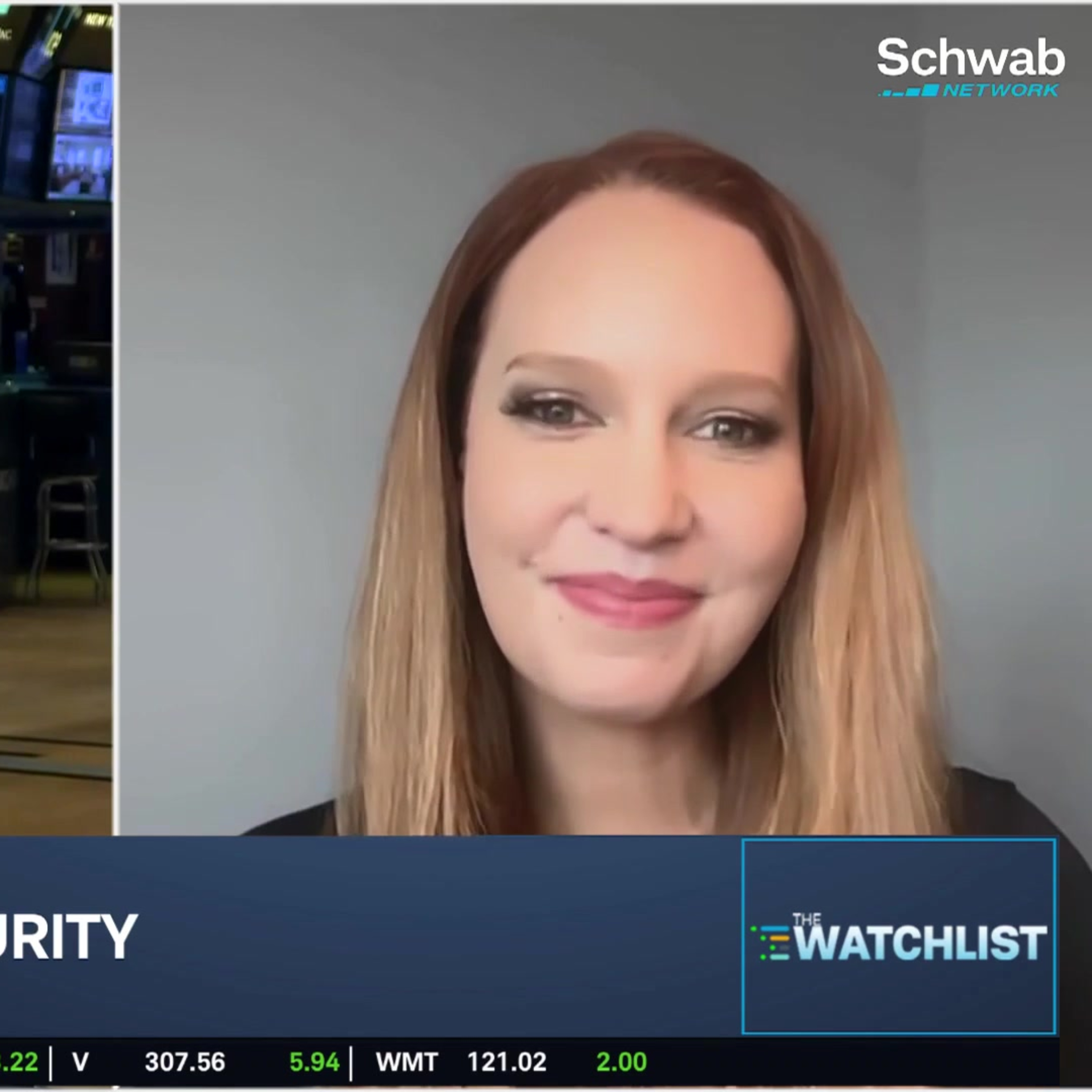
Fighting AI with AI: PANW Chief SIO Talks Cybersecurity & Adjusting to Cyberattacks
About this episode
How AI is being used in cybersecurity risks are the prime focus for Palo Alto Networks (PANW), says the company's chief security intelligence officer, Wendi Whitmore. She explains how those behind cybersecurity threats are weaponizing AI and ways Palo Alto fends off digital attacks. According to Wendi, compromised identity is the biggest risk to cyberattack victims.
======== Schwab Network ========
Empowering every investor and trader, every market day.
Options involve risks and are not suitable for all investors. Before trading, read the Options Disclosure Document. http://bit.ly/2v9tH6D
Subscribe to the Market Minute newsletter - https://schwabnetwork.com/subscribe
Download the iOS app - https://apps.apple.com/us/app/schwab-network/id1460719185
Download the Amazon Fire Tv App - https://www.amazon.com/TD-Ameritrade-Network/dp/B07KRD76C7
Watch on Sling - https://watch.sling.com/1/asset/191928615bd8d47686f94682aefaa007/watch
Watch on Vizio - https://www.vizio.com/en/watchfreeplus-explore
Watch on DistroTV - https://www.distro.tv/live/schwab-network/
Follow us on X – https://twitter.com/schwabnetwork
Follow us on Facebook – https://www.facebook.com/schwabnetwork
Follow us on LinkedIn - https://www.linkedin.com/company/schwab-network/
About Schwab Network - https://schwabnetwork.com/about
Get every episode summarized
Each time Schwab Network publishes, we email you a written briefing from the transcript — the topics, who appeared, and any specific claims, with the ad reads skipped.
Email me new episodesFree for 3 shows. No card needed.
Hosts & guests

Transcript ready
215 searchable segments. Every word is indexed and playable.
Full transcript
Schwab Network — Fighting AI with AI: PANW Chief SIO Talks Cybersecurity & Adjusting to Cyberattacks. Machine-transcribed; use the interactive transcript above to jump the player to any line.
Thousands of people descend on the RSA conference every year, discussing the state of cyber security. Joining me now for insight into where things stand in 2026. We want to welcome out Wendy Whitmore, Chief Security Intelligence Officer Palo Alto Network. Wendy, thank you so much for joining us today. So RSA kicking off today in San Francisco. Cyber security is, of course, top of mind for many executives. There's the question of the proliferation of attacks. Cyber attacks getting more sophisticated. What protection should look like in 2026? When you think about all of these things, what are the top themes that you're hearing so far? It's a busy day and it's no doubt going to be a busy week here at RSA. So, top of mind for everyone is AI. And how is AI impacting attacks? And then certainly what kind of solutions are being built? That will allow organizations to stop the effective use of AI. In our own investigations at Unit 42,
we see now a 400% year-over-year increase in speed. So in under 40 seconds, attackers are getting inside a network, stealing data and removing it. And that's an incredible amount of speed. And what that means when we look at AI and how that plays into it is we can't have manual defenses. We have to detect and respond and fight at machine speed just the way the attackers are operating. So you have to fight AI with AI. Is that what you're saying? Absolutely. Okay, so let me ask you this, because you mentioned the 400% increase in speed, the under 40 seconds attacks are happening. How, so it's happening as you're mentioning with AI, right? You say attacks or AI is being weaponized. Tell me a little bit more about what needs to happen in order to prevent that, you know, that's playing the use of AI in this instance. Absolutely. So I think there's really two parts to the way we look at AI.
And so one, there is cybersecurity for AI and AI for cybersecurity. And I think that the latter having AI in cybersecurity that allows us to detect faster, to take huge volumes of data and make it more manageable. So just within our own Palo Alto Network Suck, every day, we actually identify over 30 billion attacks per day. But with the use of automation in AI, we are now able to dwindle that to one manual attack that we need a human to identify per day. The part of this equation, though, that gets talked about less and really I think is a huge opportunity for cybersecurity is having cybersecurity for AI. So what do we mean by that? We mean solutions that enable organizations throughout the world to use AI safely in their environment to make sure that there's not issues like prompt injection, to make sure that attackers aren't doing bad things and misusing these capabilities. That organizations are implementing
because they want to be innovative and they want to build the next generation of solutions. Cybersecurity is really the key to making sure that we can all implement and innovate safely. Tell me a little bit about how, like, the risk factors. Your data shows that nearly half of all attacks involve browser-based activities. So if I'm just searching the web for something, say a recipe, and you say that these routine web sessions remain a massive vulnerability. Tell me a little bit more about that and how companies and individuals can kind of work in a better way to prevent that. I'm glad that you asked that. So in our investigations, we see that almost half, so 48% of the attacks were investigating, involve the browser. And if you think about your great example of searching for a recipe, you're probably not just going to some search engine. You're probably using an AI companion to ask them, what's the best recipe? Or, hey, how can I make this recipe even better?
And you're doing that through the browser. And that's really where the modern workforce has moved and so these attacks are becoming more and more prominent in the browser. Due to AI, that's only going to increase. So having secure browsing capabilities that enable us to identify when something goes wrong, maybe when an attacker is trying to leverage prompt injection within the browser, then we need to be able to stop that at scale. And those are the kind of solutions that we're building so that we can ensure that organizations are using browsers and conducting activity safely. So I have to admit, sometimes I do say, like, make a mashup of these recipes. Like, I like this one and I like this one. How should I do this as a mashup? So that is beyond just doing a search of a recipe. That's a fair point. Let's talk about identity as a new battleground windy. So you say that identity plays a role in about 90% of incidents. Why has identity become the primary target it seems?
Yeah. It's so critical to making attack successful. So if we look at today's attacks, you're not having an attacker break in. They're logging in using valid credentials. If I want to attack your organization and I have access to your credentials, then I'm going to use those. And so what we need to be able to detect is when those are used in a manner that's not safe. By someone who shouldn't have access to them. And that really creates an opportunity for us to detect at much larger scale to be able to do that quickly. Because the win is not that these attacks never happen or that one account doesn't get compromised. The win is that we detect it incredibly quickly. We respond rapidly and we prevent it from spreading within an environment. Is there such a thing as and you're probably going to kill me for asking this question too much protection? Because I think about, you know, when I log on at work, I have to go through different layers to get in. And, you know, one platform of security than another one.
And then, you know, you have to change your password. In some cases, once a month, some cases every three months. Is there such a thing as too much protection? You're probably going to say no, Wendy. But go ahead. Well, I would say no to too much protection. But I think what you're really asking is you're just giving examples of trying to get your job done. And sometimes security can be seen as a deterrent to that. It takes longer to accomplish this task. And that's certainly something that Palo Alto Networks, we are adamant about, right? These solutions have to be seamless. We have to be integrated in so that security doesn't become a blocker to doing business. But that allows innovation to occur even more rapidly. And then you and all of your co-workers feel even more confident about the tasks that you're accomplishing on a day-to-day basis. Okay. Yes. They essentially reduce the friction because that's the challenge. You just want to get your job done and you want to get it done with speed. So, you know, adds a layer of time. Let's talk about what leaders should do now. Obviously, leaders come to the conference.
They want to know what they need to prioritize in terms of protection, especially given the proliferation of attacks and how sophisticated they're becoming. So what should be top of mind for leaders in their approach? Well, I'm going to quote your comment earlier, which is essentially fighting machines with machine speed. And we need to be able to do that at a large scale. So implementing AI, making sure that we're doing that safely. Every security leader that's here is under pressure from their co-workers and their organization and to be able to innovate faster to use tools more rapidly. And security is often seen as the team of no, right? The NO. And they take the fun out of the organization. I think now there's an opportunity for every CISO, for every CIO, to be the ones who really lead the charge of innovation in the organization, and be bringing back after this conference, bringing back to their organizations, new solutions, and understanding of what all the leaders in the market and the new companies out there are doing
to make their lives easier. And Wendy, what solutions are you? I mean, I know this conference is one where companies bring their solutions, their questions and their solutions to the table. So what solutions are it's Palo Alto doing to differentiate this year? Yeah, we're bringing new capabilities to the browser. So you mentioned earlier just the challenges with web browsing. We've announced that. We're going to be announcing additional capabilities on our products tomorrow. And so pretty exciting innovation coming out in terms of how we can make organizations more secure as they're implementing AI in their organizations and making sure that we can continue to fuel that innovation through the use of security technology. Thank you, Wendy. That's Wendy Whitmore, Chief Security Intelligence Officer of Palo Alto Networks. I pray you have a productive conference.
More episodes
More from Schwab Network

Stock Market Today: ORCL & ADBE Earnings, AEO Plunges Near 52-Week Low
Schwab Network

Thursday's Final Takeaways: Crude Taps $103 & PPI Hotter than Expected
Schwab Network

Balancing High-Conviction AI With High-Dividend Diversification
Schwab Network

EARNINGS PANEL: ORCL, ADBE
Schwab Network