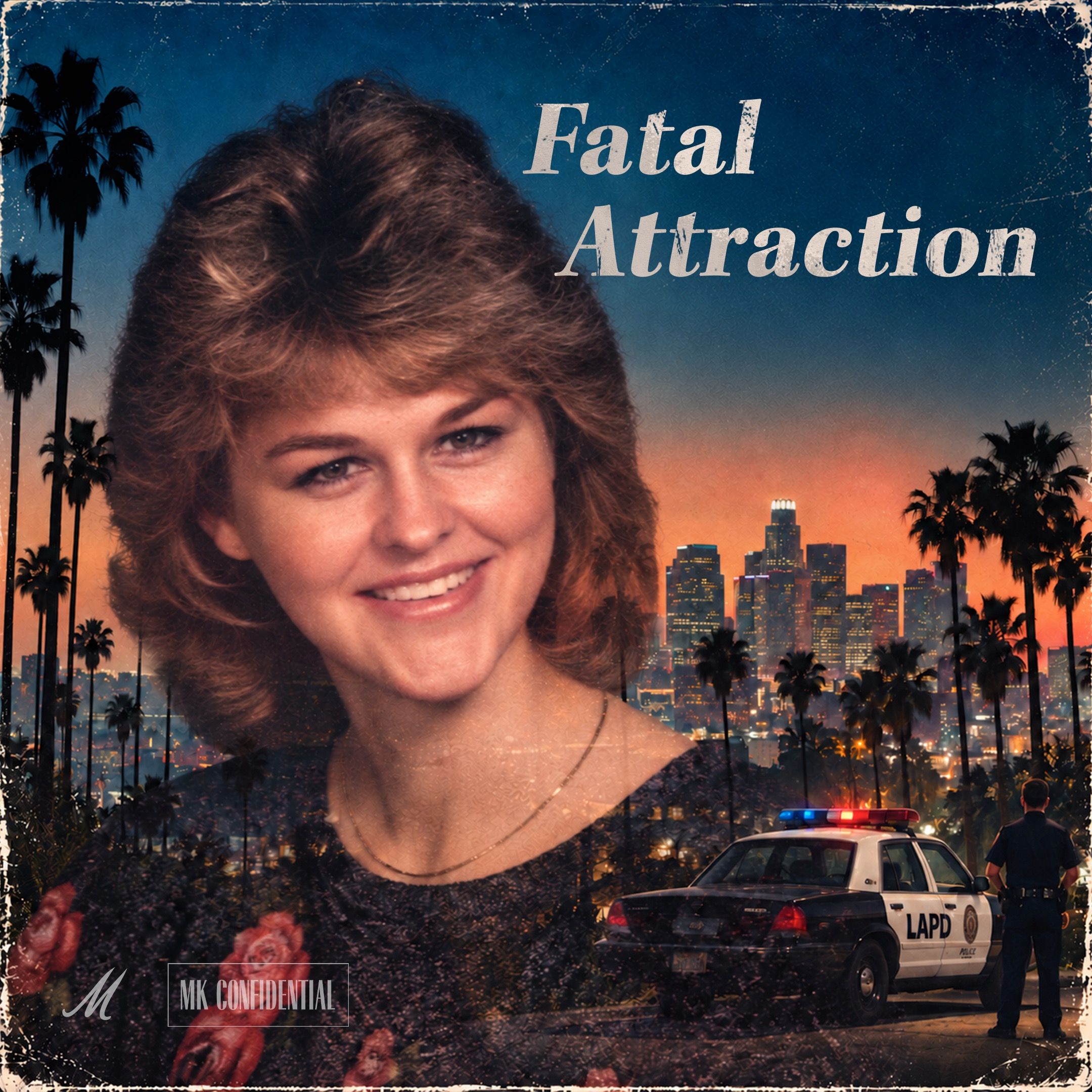
Fatal Attraction: Nineteen Years in a Freezer — Ep. 2 | MK Confidential
About this episode
“MK Confidential” picks up nineteen years after Sherri Rasmussen's murder, when a rookie crime lab analyst picks up a cold case that seems simple: one blood type, one stain, an easy match. Instead, Jennifer Francis finds a bite mark swab that no one can locate — not the LAPD, not the coroner's office, not even the property log. She tracks down the man who sealed it in 1986, and asks him not to forget about her.
Megyn traces the two decades in between: a parking ticket handed to grieving parents who offered to pay for DNA testing themselves, a box of critical evidence signed out in 1993 and never seen again, and a detective who closes the file with one sentence: no additional leads. Then, in 2005, the bite swab turns up in a freezer, and the DNA inside it belongs to a woman. Four years later, a detective reading the case notices a bloody fingerprint on stereo equipment, and the burglary theory falls apart in his hands.
By the end, investigators have a name — and she has a badge number. This is Episode 2 of the Sherri Rasmussen story.
Home Title Lock: Go to https://hometitlelock.com/megyn and use promo code MEGYN to get a FREE title history report and a FREE TRIAL of their Triple Lock Protection
Lean: Discover why LEAN is becoming the choice for real weight‑loss results—shop now at https://TAKELEAN.com use code KELLY
Follow The Megyn Kelly Show on all social platforms:
YouTube: https://www.youtube.com/MegynKelly
Twitter: https://Twitter.com/MegynKellyShow
Instagram: https://Instagram.com/MegynKellyShow
Facebook: https://Facebook.com/MegynKellyShow
Find out more information at: https://www.devilmaycaremedia.com/megynkellyshow
Hosted by Simplecast, an AdsWizz company. See pcm.adswizz.com for information about our collection and use of personal data for advertising.
Get every episode summarized
Each time The Megyn Kelly Show publishes, we email you a written briefing from the transcript — the topics, who appeared, and any specific claims, with the ad reads skipped.
Email me new episodesFree for 3 shows. No card needed.
Hosts & guests
Transcript ready
418 searchable segments. Every word is indexed and playable.
Full transcript
The Megyn Kelly Show — Fatal Attraction: Nineteen Years in a Freezer — Ep. 2 | MK Confidential. Machine-transcribed; use the interactive transcript above to jump the player to any line.
In the fall of 2004, a fledgling criminalist named Jennifer Francis gets to pick her next case from a stack on a colleague's desk. She has just been clear to perform DNA analysis on her own. The stack holds DNA requests from detectives all over the Los Angeles Police Department. Jennifer is the newest analyst in the unit and the only one without a backlog. She goes through the stack looking for something simple. She finds a request on a 1986 murder in Venise, a nurse. The detective who submitted it wrote that the victim's blood type was O and that type A blood had been recovered inside her home. Blood that could not have been hers. Jennifer reads that and thinks this one is easy. Pick a type A stain, pull the suspects profile, run it against the national database, compare it to the victim. Close the file. She takes the Sherry Rasmussen case.
The request Jennifer picked up has been waiting for more than a year. Cliff Shepard, a cold case detective, submitted it on September 19, 2003, 17 years after the murder. Shepard works in a unit the LAPD created in 2001 to go back through murders the city never solved between 6 and 9,000 of them. Detectives spent a year just cutting that list down to the ones that still had evidence someone could test. Sherry Rasmussen's case made that list because of one line in a report from 1986. Years later, Detective Shepard pointed it out to date line. I saw that a bite swab had been collected by the coroner's office. It's okay with that swab, there should be a DNA. Shepard attached two documents to his request. Detective Lyle Mayer's follow-up report from 1986 and the property log, meaning every item the LAPD booked into evidence in Sherry's case.
The property log contains 29 items. The bite marks swab is not one of them. So Cliff Shepard goes looking. The coroner's office tells him they do not have it. I checked with our evidence room, they didn't have it. I looked at our property reports, it's not booked. How could that happen? In competence. That outlawed? Yes. In 2003, Shepard takes a yellow highlighter to the sentence in Mayer's report describing the bite swab and writes a note in the margin asking where it is. It is that handwritten note that newbie criminalist Jennifer Francis finds when she picks up the Sherry Residence in case for DNA analysis and reads Shepard's request. Jennifer calls Shepard herself and asks whether she can see some crime-seeing photographs. It's a normal request. Shepard offers her the murder book instead. This is not normal. A murder book is the complete case file. There is only that one binder. It's irreplaceable.
Detectives usually stay while an analyst reads it and then take it back. But Shepard tells Jennifer to keep it as long as she needs. A few days later, she comes back from lunch and it is sitting on the center table of the lab. A blue, three-ring binder. Jennifer shows a coworker, check it out. She says a real-life murder book. Then she starts reading it. Inside, Jennifer finds a security report from Glendale Adventist Medical Center, a hospital where Sherry Residence worked. It describes a nurse Sherry turned down for a promotion. It says the hospital disciplined that nurse and her boyfriend, too, a doctor after they made harassing phone calls to Sherry. By December 22, 2004, Jennifer has finished testing the items Shepard submitted for DNA analysis. Every sample comes back as belonging to Sherry Rasmussen. Three weeks of work, and all Jennifer has, is the DNA profile of a woman everyone already knows is dead.
Frustrated, she thinks about the bite mark she has seen mentioned in this murder book, but not in the case's property log. If any evidence in this case carries the killer's DNA, it is that swab. People do not bite themselves. Jennifer goes back to LAPD property, which contains the 29 items listed on the log, and checks out the sexual assault kit from 1986. There are swabs and slides inside, but not one is labeled bite mark. Tracking down evidence is a detective's job. Francis is a civilian scientist with no contacts at the coroner's office, but she calls anyway because that's where evidence like this might be. A woman answers, Jennifer introduces herself, says she's calling from the LAPD crime lab, and reads off the coroner's case number. She is looking for a bite mark swab. The woman puts her on hold.
Ten seconds later, she comes back on and says there is no evidence booked under that number. Jennifer hangs up, wondering whether the woman typed a digit wrong. She calls the coroner's office again the next day, hoping someone else picks up. A man answers, and tells her the same thing. Nothing here. Jennifer considers calling a third time, hoping to reach someone who remembers how evidence was stored before everything went into a computer. One of the other criminalists tells her to stop. You're done, she says. You don't want to get the reputation of being a pain in the ass. You're brand new with this, you've already called twice. Jennifer knows, she's probably right. So she goes back to Mayer's 1986 report and reads it one more time, looking for anything she's missed. And she finds a name, a man from the coroner's office who collected the swab in the first place. Senior criminalist Lloyd Mahaney.
Jennifer does the math, almost 19 years. What are the odds this man is still on the job? She calls the coroner's office and asks for Lloyd Mahaney by name. He picks up. Jennifer asks him one question. If you swabbed a bite mark in 1986, what would you have called it? Mahaney says, bite mark swab. Jennifer tells him nobody can find it. The coroner's office says they don't have it and neither does the LAPD. Mahaney is not surprised. When the coroner's office moved to computers, some of the old cases never made it in. To find something from 1986, you would have to pull the coroner's evidence log on microfiche. It would be a big job and Mahaney is leaving on vacation. Then Lloyd Mahaney tells her this. We would never get rid of a bite mark swab.
We don't keep clothing forever, but a bite mark swab? We would not throw that away. Jennifer tells him there's no rush. Just see if he can find it when he gets back. Before they hang up, she says one more thing. Don't forget about me Lloyd. Lloyd Mahaney sealed that envelope at six minutes past two in the morning on February 25, 1986, and sent it downstairs into a freezer. The bite mark swab has been there ever since, almost 19 years. It isn't gone. It is still there somewhere, but no one can find it. I'm Megan Kelly and this is MK Confidential. AI can clone your voice, forge your signature, even create fake documents that fool experts, and criminals are using these tools right now to potentially steal from you. How? It's called TitleFroad. Your property records are public by law.
Your name, address, even your signature. It's all sitting in a database anyone can access. A cyber scammer can pull your records, use AI to forge a transfer document, file it with your county and on paper. They are the new legal owner of your property. Then they can borrow against your equity or even sell your property long before you realize anything is even wrong. But let me tell you about home title lock. They monitor your properties title 24-7, alert you of any changes, and if you are a victim, their team of restoration experts will spend up to $1 million restoring your title. So once the last time you checked your title records, you can do it today. Use our promo code Megan at hometitelock.com to get a free title history report plus a free trial of $1 million triple lock protection. So you can make sure you are not already a victim. That's hometitelock.com promo code Megan or use the link in the description.
Let's go back to 1986 and what the LA police department was doing while that envelope sat untouched in the coroner's freezer. It is April 10th, 7 weeks after Sherry Rasmussen was killed. Two blocks from Sherry's condo, a woman named Lisa Ravali, comes home to find two men inside her apartment. One runs past her and out the door. The other points a gun at her, backs away, and disappears out the door. Detective Lyle Mayer hears about it the next morning. Ravali walks him through her place. It is laid out almost exactly like Sherry's and the burglars had stacked her stereo equipment by the door. To Mayer, the resemblance is enough. He connects the two cases. Years later, retired LAPD homicide detective Rob Bubb tells Dateline why it was not a stretch to call the two cases related. No, not at all. Not with the proximity, the time of day, and basically the same MO. Mayer calls a press conference and brings composite sketches of two men.
We have obtained fingerprints in the crimes. We are of the opinion at this point that the suspects may be illegal aliens. Nobody has ever charged in the burglary from April 10th. Mayer would say years later that his detectives arrested around 20 people and ran every one of their fingerprints against the crime scene. None of them matched. On April 7th, 1987, one year and six weeks after Sherry's murder, Lyle Mayer files a progress report on the Rasmussen investigation. Its conclusion is one sentence. No additional leads have developed in this case. In Tucson, Sherry's parents, Nells, and Loretta Rasmussen keep pushing. In October 1986, they put up a $10,000 reward and fly to Los Angeles for a press conference. The LA Times runs Sherry's photograph beside composite sketches of the two men police believe killed her.
Local radio picks it up, so does the evening news. A year later, in November 1987, Nells and Loretta do it again. Another press conference, another round of coverage. The reward leads nowhere. Loretta telephones the Van Aai's detectives many times over the years. The calls are brief and she often comes away feeling like the detectives just want her off the phone. In August 1990, Nells writes to the television program America's Most Wanted, but we feel this case has not been thoroughly investigated and we would appreciate any help in this matter. The letter produces nothing. Nells keeps going anyway. Years later, Connie remembers to NBC how relentless her father became. As a father, he had felt a responsibility to protect her. And the only way that in her death, he could protect her was to find out who killed her. She would constantly re-disect the information that we knew.
In 1991, Lyle Mayor retires from the LA Police Department and Sherry's case passes to whoever is running the homicide desk in Van Aai's. Around 1992, Sherry's longtime friend, Donna Robinson, tells the family she has a relative who can arrange an exciting new analysis called DNA testing. Sometime in 1992 or 1993, Nells and Loretta fly to Los Angeles with their daughter Connie and drive to Van Aai's station to ask the LAPD about DNA tests of the evidence in Sherry's case. The Rasmussen's remember it this way. Nells goes in and asks the officer at the front desk where they should park. Anywhere on the street outside, the officer says, Loretta had called ahead and made an appointment. Upstairs, the three of them are put in a small room and left there. It looks like the kind of room where police interview suspects. They wait for more than an hour.
They had expected to meet with Lyle Mayor. Instead, the detective who finally comes in is someone they have never seen before. His name is Steve Fisk. Mayor has retired. Fisk tells them and he has taken over Sherry's case. Fisk sets a thin folder on the table between them. It stays closed. He never opens it and never takes a note. Connie looks at that folder and thinks, if the LAPD were working my sister's case, it would be thicker than that. What do you want to know? He asks. His family asks about the fingerprints from Sherry's case. Have they been run through the FBI database? Fisk tells them they're still working on it. By this time, Sherry has been dead more than six years. Fisk tells them it is a cold case with no leads. And that if anything changes, he'll let them know. Then Nells asks him a question. Have you run the DNA?
Fisk tells him DNA testing is expensive. And that the LAPD's budget cannot cover it in Sherry's case. Nells says, fine, I'll pay for it. I even have a person who would do it. Fisk tells him that would do no good. They have no suspect and he says they need one before they can run DNA. The detective asks whether Nells is still suspicious of John Rutton. Nells says he does not believe his son-in-law killed Sherry. However, he does believe John knows something that he's holding back something. Nells points to the closed folder on the interrogation room table and tells Fisk that what matters is already in there in the LAPD's own records. Fisk does not even look at it. Connie gets the distinct sense that he wants her and her family to leave. After less than an hour, they do. They did meet with us, but it was also more of a show.
They walk out of the Van Ayes police station to find a parking ticket on their windshield. Nells goes back inside and says the police told him to park there. He is met with an instruction that he will have to pay it anyway. After meeting with Fisk, the Raspacins call Sherry's friend Donna and tell her the police turned down Nells' offer to pay for DNA testing. Donna's memory is the only record outside of the family that the conversation with LAPD ever happened at all. There is no reference to the meeting in the LAPD murder book. The next entries in the case log come in October 1993 when detectives run latent or barely visible fingerprints from the crime scene against databases in California and other Western states. No hits. They also pull lists of nearby police interactions and state prison parolees from around the time Sherry was murdered. These two will come up empty. Then on October 11th, a detective named Phil Morret goes to the LA County Coroner's office
and signs out the trace or transfer evidence from Sherry's case. This is the evidence that the coroner's criminalist Lloyd Mahaney collected. The night Sherry died. There are two teams that collect evidence at an LA murder scene. One is the coroner's office. They collect the body and everything touching it. In Sherry's case, this includes fibers found on her robe and loose hairs from her neck. The LAPD has its own team of criminalists in its scientific investigations division. They collect the evidence that is not directly touching the body. Bullet casings, fingerprints, blood stains on the walls, that sort of thing. That evidence was booked into LAPD property. One day Jennifer Francis will test it and find only Sherry's DNA. The trace evidence from the body went into the coroner's property room the morning after Sherry died. At this point in our story, it has sat undisturbed for seven years.
At 12.25pm, for reasons unknown, Morit signs out all of that coroner's trace evidence. From there, it vanishes. There is no record that this evidence was ever returned to the coroner. No record of what happened to it at all. Some of the most critical evidence in the case, which could positively ID a suspect, gets checked out and is never returned. No one knows where it went. It simply disappears. There is no mention of any of this in the murder book. In fact, there's no entry for anything from October 11th. Years later, detectives working Sherry's case show Morit the signature from the County coroner's office. He confirms that it is his, but tells them he does not remember picking up the evidence, nor ever even working the rest of the case. And yet, there is one piece of evidence that Morit left behind at the coroner.
It is hidden away in a basement freezer, and its label is fading. It would be tough to find one tiny, cigar-sized test tube that will remain hidden for another 12 years. The bite marks swab from Sherry's left arm. It is still in the freezer, where it has been since the morning after the murder, seven years ago. Everybody's talking about weight loss injections because the results can be so dramatic. They work by lowering blood sugar and reducing appetite. But what if you're looking to lose weight but are not interested in painful weekly injections, especially when you hear about some of those intense side effects? Well, that's why doctors created a weight loss supplement called lean, and the results could be remarkable. Lean says the studied ingredients in their product have been shown to lower your blood sugar, burn fat by converting it into energy, and curb your appetite and cravings, so you are not as hungry. But listen, lean is not for the casual diet or with only a few pounds to lose. The doctors at Brickhouse Nutrition created lean for frustrated dieters who have 10 or more pounds to lose.
You could get started with 20% off and free rush shipping, adding lean to your healthy diet and exercise plan. Visit TakeLean.com and enter Kelly for your discount. That's promo code Kelly at TakeLean.com. Fast forward now to January 2005, and criminalist Jennifer Francis, the new DNA analyst looking for her next task. Here's the phone ring in the LAPD Crime Lab. She picks up. It's been a week since she spoke with Lloyd Mahaney about the bite mark and asked him not to forget about her. The call is from a supervisor at the LA County Coroner's office. We found your bite mark swab. He and his team had just spent six hours in the freezer hunting for it. Jennifer calls Detective Shepherd from the cold case unit with the news. We found the swab. Shepherd asks why they missed it when he asked, and Jennifer tells him about the new fangled computer system. When the swab arrives in mid-January, she sees another reason, and why it took several hours in the cold to find.
The evidence envelope is in rough shape, worn by years of being shuffled around the freezer as other evidence was crammed in and out around it. Mahaney's handwriting on Sherry's name is so faded, Jennifer can barely read it to confirm. There is a hole in the top right corner of the envelope. The red cap of the plastic sample tube peeks out. At some point it pierced clean through the envelope right where Mahaney had written the case number. What remains of it is illegible. Bite mark swabs are filed by case number with no legible case number on the envelope finding the swab required a bit of detective work of its own. But the tape sealing the envelope is intact. The tube is intact, and so are the two swabs inside. So in January 27th, 2005, Jennifer Francis puts a sample of cells from the swab under a microscope. It looks like saliva. This is a good sign.
She starts the sample through DNA analysis. As the computer runs, it draws the profile as a row of peaks across her screen. It draws big tall spikes, meaning the sample is strong, another good sign. The whole process takes 30 minutes. The profile reaches the sex marker, the part that shows whether the DNA came from a man or a woman. X, Y or X, X. Jennifer expects a male result. She remembers the investigators prevailing theory from the murder book about two burglars. Besides that, most murders are committed by men. She stares at the computer screen, waiting. And X, Y, reading would cause the line to peak again. It stays flat. Jennifer looks at the flat line. Wait. The first thought is, Sherry. Is the computer showing Sherry's DNA? Maybe the bite broke the skin, and the swab picked up some of Sherry's blood.
That would explain a female result. When the computer finishes, Jennifer takes the final profile and puts it side by side with Sherry's. They do not match. There is another woman's DNA in the bite mark from Sherry's arm. A woman bit Sherry Rasmussen. Jennifer has read the murder book, and her mind goes straight to the nurse from the Hospital Security Report, the one who harassed Sherry after missing out on a promotion. However, Jennifer does not suggest this idea, even as a theory. She is expected to stay in her lane as a criminalist. Analyze the evidence, let detectives come up with the theories, and so she does. On February 8, 2005, Jennifer sends her report to Detective Shepherd. The result catches him off guard. She called me and said, hey, this is an unknown female's DNA. That is not what I was expecting. But the surprise does not change his basic theory of the crime.
Shepherd now looks for a male female burglary team. The violence at the scene still makes him think a man had to be involved. He explained that reasoning to date line in 2020. I believed that, okay, there's a woman, and then there's a man. That Sherry had been clubbed from behind, knocked down or unconscious, and then somebody stood over her and shot her. Jennifer does not understand why Shepherd fixates on a burglary in light of this new DNA evidence. She thinks the personal motive is at least worth a look, but it's Shepherd's case, and she is only a criminalist. No arrest follows. No suspect is identified. Jennifer moves on to other cases. Sherry's case goes quiet again. Fast forward three years to March 2008. Van Aes homicide where Sherry's case started more than two decades earlier is moving offices.
Someone plunks a box of files next to Jim Nudol's desk. Nudol is a three-year homicide detective. He has spent all three of those years in Van Aes. He is not thrilled to see this box. Two detectives are about to retire, and Nudol's wife is eight and a half months pregnant. He's taking time off next month, trying to button up loose ends before the baby comes. He's also got no idea who left the box beside his desk. Inside it are two faded blue binders. Murder books from cases waiting to be solved. Nudol came up under an old-fashioned supervisor who believed that reading old unsolved cases is the best way to learn. So Nudol has read, and he has learned. He does not recognize the books in his newly acquired file box. Catherine Brailey killed in Van Aes in 1988. The other, Sherry Rasmussen, 1986. Jim Nudol has tried his hand at investigating exactly one cold case.
The murder of a biker and bookie who went by Sid the Squid. He read the murder book, spoke to witnesses, and eventually arrived at a final suspect, a fellow biker, who beat Sid the Squid to death over money. However, Nudol hit a brick wall at the DA's office. He had only circumstantial evidence connecting his suspect to the murder. Nothing physical. He presented his case and the DA turned it down. No arrest, no charges. The blue book goes back with the others, unsolved. Jim comes away convinced that solving a cold case requires physical evidence, no matter how compelling the argument a detective makes. A homicide unit moves locations. He drops the box on the empty desk next to his own in the new office space. His baby comes. He takes his leave and returns and tackles other cases. The box sits there undisturbed for nearly a year. Super Bowl Sunday, 2009.
The Pittsburgh Steelers beat the Arizona Cardinals 27-23 on a touchdown with 35 seconds left. Nudol watches with a house full of friends and a fridge full of beer. Nudol later describes that Sunday to NBC's Dateline. Super Bowl Sunday is like a holiday to me, so we were having a good time and we were up late. The next morning is Monday, February 2. Nudol comes in tired and a little worse for the wear as he later tells NBC. We come in early, old dark 30, and I was tired. It was the perfect day to have cup of coffee and do some reading. Nudol gets coffee and opens the four-volume Rasmussen murder book. He reads about a 29-year-old nurse fighting for her life inside her own home. Shots fired upstairs, a struggle over the gun. They fight their way downstairs, a vase breaks, Sherry is hit again. Someone bites down hard enough on her arm to leave a full set of teeth marks and then three bullets to the chest.
And somewhere in the middle of volume one, Jim stops. The stereo components stacked by the front door. The stack, the original detectives had read as evidence of a burglary had blood on them. He tells Dateline NBC this was a turning point. For me everything changed with that blood and that stereo equipment. If there was blood on the stereo components, the components were moved after someone, likely Sherry was bleeding. To Nudol that means the stack by the front door was built after the fight, not before it. She's dead or dying. And if you wanted that stereo equipment, you had every opportunity in the world to walk out the door with it. Why stack it and leave it? At that point you start to draw the conclusion that murder was the main goal, not the burglary. Then Nudol turns a page and finds a four-year-old lab report. It has Jennifer Francis' name on it. He keeps reading.
The major DNA profile from the bite marks swab is female. Sherry Rasmussen is excluded as the source. Nudol reads it twice. Then it hits him. Oh shit. Not only do I have DNA, I've got female DNA. We had a woman responsible or involved with this crime. The female DNA profile had been uploaded to the FBI's national database in 2005 after Jennifer Francis found and processed it, but was never matched to anyone. The detectives will have to build a list of female suspects themselves. Nudol tells Dateline that suddenly, 23 years after the murder, this cold case seemed solvable. Once you debunk the burglary theory and you have a female DNA profile, now this case becomes manageable. Now it becomes a matter of time. Within days, Nudol calls the crime lab about the DNA work from 2005.
Jennifer Francis calls him back that same day. They have never spoken before. Each is trying to figure out how much the other knows. One of the first things she tells him is detective? I'm not telling you how to do your job, but I don't think this was a burglary. Nudol has taken it back. He thinks, I know that, but how do you know that? Jennifer does not tell him, not yet. Fueled by the female DNA discovery, Jim Nudol, his supervisor Rob Bubb and two other vani's detectives start Sherry Rasmussen's case over from scratch. Whoever this killer is, she bit Sherry Rasmussen hard enough to leave tooth marks and saliva on her arm. So the question is no longer which burglars were inside the condo, but rather who were the women in Sherry's life? Women she knew well enough that if one rang her doorbell, she might open the door. Nudol is determined to find out.
The next day, February 10th, he calls John Rutton. Nudol asks him, were there any women in your past that Sherry had a problem with? John gives him a name. Stephanie Lazarus. John says he was involved with Stephanie for years before he married Sherry. On and off, he says. He says that Stephanie joined the Los Angeles Police Department before he ever met Sherry. And as far as John knows, she still works for the department. Nudol turns to another detective in the room. He tells Dateline he will never forget what happened next. I turn it when the members are a unit and I said check an aim for me in the directory. And he access the LAPD directory and explaining me that she was currently a detective in the LAPD. Stephanie Lazarus, commercial crimes division, Parker Center, Los Angeles Police Department Headquarters, downtown. Nudol understands immediately. This case has changed.
Total we're not in Kansas anymore. I'm Megan Kelly. Next time on MK Confidential, four Van Eyes detectives must decide what to do when their murder suspect is one of their own.
More episodes
More from The Megyn Kelly Show

Fatal Attraction: The Book Is Never Closed — Ep. 4 | MK Confidential
The Megyn Kelly Show

Remembering September 11 25 Years Later: The Heroes and Bravery, and the Moments...
The Megyn Kelly Show

Vance Takes RNC Stage, Charlie Kirk Honored, 25 Years Since 9/11 Terror Attack:...
The Megyn Kelly Show

Fatal Attraction: "It’s Been a Million Years Ago" — Ep. 3 | MK Confidential
The Megyn Kelly Show