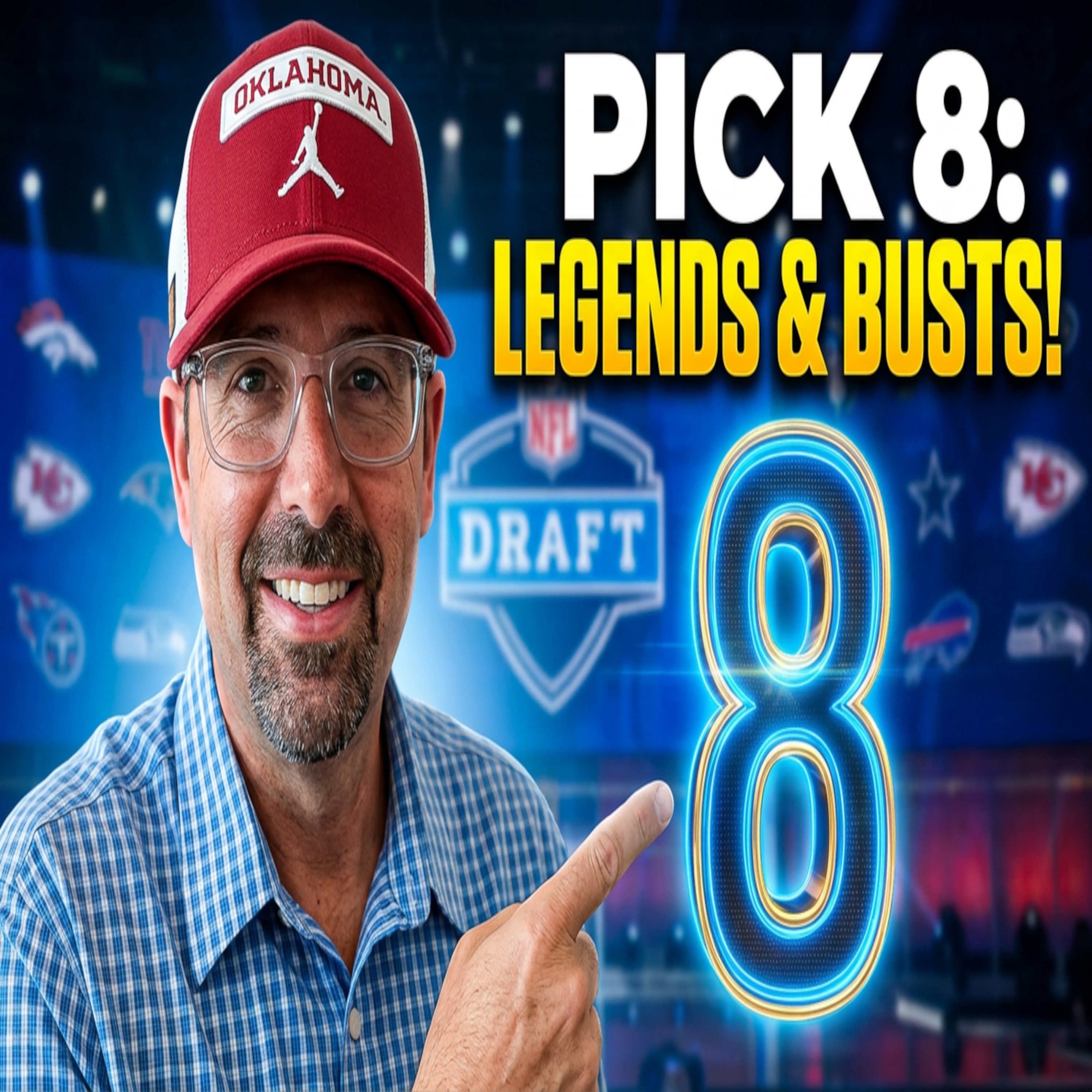
Exploring the Impact of the Eighth Overall NFL Draft Pick
About this episode
The eighth overall pick in the NFL Draft serves as a poignant focal point in the annals of football history, encapsulating a myriad of celebrated careers and intriguing narratives. Today, we embark upon an exhaustive exploration of this pivotal selection, guided by the insights of Ed Cleese, as we dissect the myriad successes and failures associated with this esteemed position. From Hall of Fame legends to notable disappointments, the eighth pick has indelibly shaped the trajectory of numerous franchises and has often been a harbinger of transformative eras within the sport. Our discourse will traverse the rich tapestry of historical and contemporary players, illuminating trends that have emerged over the decades, while also considering the present implications for upcoming drafts. Join us in this comprehensive examination as we delve into the legacies forged by past selections and their enduring impact on the game we revere.
Don't forget to check out and subscribe to the Pigskin Dispatch YouTube channel for additional content and the regular Football History Minute Shorts.
Miss our football by the day of the year podcasts, well, don't, because they can still be found at the Pigskin Dispatch website.
Do you want more football history? Test your Gridiron Knowledge, we feed you Daily with our new FREE activity, The Pigskin Trivia Drive.
Grab a copy of our latest book, "Marooned," on the 1925 Pottsville Maroons NFL franchise saga.
*OR* Grab a copy of our book on Western Pennsylvania football history, "World's Greatest Gridiron Team" on the 1903 Franklin All-Stars
Drop us a line at PigskinDispatch@gmail .com and check out and subscribe to the Pigskin Dispatch YouTube channel.
Contact us directly at [email protected]
Miss our football by the day of the year podcasts, well, don't because they can still be found at the Pigskin Dispatch website.
Get every episode summarized
Each time Sports History Network publishes, we email you a written briefing from the transcript — the topics, who appeared, and any specific claims, with the ad reads skipped.
Email me new episodesFree for 3 shows. No card needed.
Transcript ready
445 searchable segments. Every word is indexed and playable.
Full transcript
Sports History Network — Exploring the Impact of the Eighth Overall NFL Draft Pick. Machine-transcribed; use the interactive transcript above to jump the player to any line.
Our parents and of the total sports recall podcast here to give you some advice for Mother's Day. When you hear the name Sterling, you might think of a classic shave, but this Mother's Day, we're looking at the bigger picture. This year, treat Mom to the luxury she deserves with Sterling's full line of personal care items. We're talking about more than just so. We're talking about rich body lotions, nourishing lip balms, and essential oils that turn any room into a sanctuary. From their handmade bath soaps to their long-lasting shampoo and conditioner bars, Sterling uses natural ingredients like shea butter and tallow for a quality you can feel. Give her an artisan experience this Mother's Day by heading to sterlingsoap.com. That's ST-I-R-L-I-N-G-Soap.com. Here there's something really special about the 8th overall draft pick in the NFL's Ultimate Wild Card Pick. From the Hall of Fame Legends to some of the biggest What Ifs in Gridiron History, the
number 8 spot has shaped dynasties and defined eras. Today, we're diving into the deep archives with Ed Cleese to break down the hits, the misses, and the fascinating trends of the history of the 8th pick in the NFL draft. Welcome to the Pig Pen. You're in Pixie and Dispatch's 32-day cycle of looking at every first round draft pick with Ed Cleese. He's up now. Bring us to history, Ed. Hey, Darren, how are you? I'm doing great, Ed. Today's episode, we are talking about slot number 8, another top 10 pick, and what do you have to say about the number 8 pick in the NFL draft's history? Well, we've talked about it, Darren, and it sounds like we're kind of marking the 13th pick as where it all started to change. That's kind of like where we started to say, okay, now we see we've stepped up in class, and that has been consistent, like 13, 12, 11, 10, not all really good, kind of almost a little bit, each one's a little bit stronger than the one before, or at least close. And then this is the first one. This is not a bad group. It's just a very good group, but this, I would say this 8th pick doesn't quite stack
up to the past five picks or so. But it's still a solid group, but maybe mildly disappointing from what I was expecting. But still, we got some good names here. Yeah, it's kind of an interesting pick, you know, even when we go into this week's draft, we're going to be talking about trading back from this pick. And even with the top 10, sometimes these drafts don't have all the caliber of players that some other drafts do, and maybe there's not 10 players that people find to be first around worthy, let's say. Of course. Like you said, there's some gold and apples here in a group that have been found. So let's talk about who your honorable mentions are and all that on the top, since 1980. Yeah, as you know, I always kind of like to start recent. And I would say recently, very recently, the rookie of the year last year was the 8th pick in the draft. And that would be 10 Macmillan for the Panthers.
So we've got some real life history, very recent. And then kind of this kind of stuck out. The Falcons had the 8th pick in the draft three years in a row. And so they took, and it's kind of funny. They went running back, or receiver running back quarterback. So the three main skill positions that took Drake London, who I'd say is good, you know, for sure, good player, Bijan Robinson, who looks to be a great player. And then the big one for them is Pennix, a quarterback who is, you know, on the fence, you know, with a little bit of a down arrow because of the injury history, which is significant. So if he doesn't work out, that it kind of makes the other two, may not matter as much. So but that was kind of interesting that those teams all, that one team took those three positions three years in a row. Yeah, it's kind of neat, you know, if they have any kind of luck like the Cowboys did, these could be those three picks, and number eight in a row could be like their triplets, you know, if they take off and have become strongly off and some performers were so
that they are already. Right. And then then we then we move on to quarterbacks. We always like to look at the quarterbacks, only two have been taken here since 1980. We had one real bus, unfortunately, for the Titans, that would be Jake Locker taken in 2011, who did really nothing in his career. And then the year, the very next year, the dolphins took Ryan Taneyhill at the eighth overall pick. And it's kind of ironic. He actually winds up having his better years in Tennessee with the Titans kind of after they had given up on on Walker. And Taneyhill, you know, that's one of those interesting ones. I think you'd ultimately say he was not worth the eighth pick in the draft. I don't think that's what the team, the team, certainly not the team that drafted him was hoping for, but he also was nowhere near a bust. So he had a nice career, you know, he was a pretty good quarterback. He had some decent seasons. I think he was one of those guys that you felt could only take you so far, but certainly it wasn't bad.
And kind of in that no man's land, when we're judging whether a pick worked out or not. Yeah, he's definitely an interesting player to talk about, you know, he wasn't very popular when they did pick a meath, but I think he did all right for himself in his NFL career. Yeah, he did just fine. He did just fine. And then there's a few guys that didn't do just fine. And you know, not any nothing massive here, but we did have a couple of defensive ends that flamed out in the, for their teams, Derek Harvey was taken in 2008 by the Jags and he had eight career sacks. Jamal Anderson was taken by the Falcons, not that Jamal Anderson, not the dirty bird running back Jamal Anderson. There was a defensive end, Jamal Anderson also taken by the Falcons in 2007, and he had seven and a half career sacks, which obviously for drafting a guy at number eight to get sacks. And he gets you seven in his career, and that's not good. David Terrell was a ride receiver taken by the Bears in 2001, who only had 128 career
catches and fewer than 10 touchdowns. And then one guy I really didn't remember at all the Eagles took a running back named Michael Hadex in 1983. His best season in the league was 311 yards Russian, and he had three career touchdowns. So those were a couple of guys, a few guys that really stuck out as not working out for their teams. Unlike Danny Hill, I think you'd say those guys were busts. Yeah, when you don't have the stats and you can only show maybe even a half of a season of what's expected for your career, not yet real good numbers. Let's take a break for a moment to tell you about a new product so that you can take and put your football knowledge that we feed you each and every day to the test. It is the Pigskin trivia drive on PigskinJustBatch.com. You're the quarterback. Call the shots, choose your play, grind it out with a run, pick up steady gains on a short pass or risk it all with a long pass for a massive chunk of yardage. It says in just a quiz, it's a march for glory.
It's the Pigskin trivia drive. Remember, when the huddles over, when you pick your play, the faster you answer, the more yards you gain. Hesitation is the enemy of the end zone. Keep those chains moving. Cross that yellow line to reset your downs and earn a critical audible. Back on a tough defensive look, use those audibles to strip away two wrong answers and find your open receiver. Watch the play clock you've got just 25 seconds to make the read. Take too long, and it's a five yard penalty for delay a game. It's game action. In this stadium, your brain is the engine, but the clock is the opponent. The mission is simple. Squares many touchdowns as possible in five minutes, and when the clock hits zero, your score hits the global leaderboard. Are you a bench warmer or a Hall of Famer? Step up to the line. Your drive starts now on PigskinDispatch.com. The trivia drive. Don't let your football history knowledge go to waste. Try the Pigskin trivia drive on PigskinDispatch.com, and now let's get back into our program. Yeah, but we've got some really good honorable mentions.
One guy that I really like, I'm a little partial too, is in 2004. The Falcons took the Angelo Hall, I corner D-Hall, and he wound up with the red skins. He was a bit of a polarizing player for the red skins within the fan base. Whenever the corner gets beat, it's very obvious, right? And he did have a tendency to sometimes get roasted, he took some chances, and sometimes he'd give up the big play, but he was a big playmaker. He had a, I think it was a four interception game on J-Cutler in Chicago, one he took to the house. So he was a real big playmaker, he showed up on a lot of big games, I really liked him. Another defensive back would be Roy Williams from OU, played for the Cowboys. He got off to like a rocket launcher start, and it looked like he's going to be a star safety. And then it just kind of leveled out, and I think with him was especially in college, he was that like hybrid linebacker almost. He's one of the best college defensive players I've ever seen. He was unbelievable in college, and he kind of played that safety linebacker thing, and
I think in the NFL, maybe he just didn't quite have the athleticism to be that long-time safety. Even though his career did start pretty well, and he wanted to have a decent run there. You're going to remember, in 2000, your Steelers took Plexico, Plexco Burris, who had another polarizing career with some off-field issues, then was a Super Bowl hero for the Giants, the Tall, Lanky, Rangy, receiver, James Ferrier, also was drafted in this spot, played for the Jets and Steelers. And my last cut was Joey Galloway, receiver taken in 95 by the Seahawks. He played a really long time, like a lot longer than I remember, and he never had that one big year. I don't think he made any pro bowls or anything like that, but he was always a deep threat. He was always part of whoever he played for as offense, like in that sort of like burner roll, that take the top off the defense roll, and he did it very well for a very long time. I can't believe you didn't take Potsy into your top five.
James Ferrier is my guy, man. You love Potsy, huh? Yeah, yeah. Yeah. Actually, I interviewed Dick LeBoe a couple of years ago, and he had a book out, and he was talking, the three of you guys that did the four words were Paul Amalo, Harrison, and Ferrier. And he asked me to turn the interview, because you know why I chose those three to do my forward. I said, they're all outstanding players. He goes, they were two of them were defensive player a year, and Ferrier should have been defensive player a year, and you're Ray Lewis got it. So he was a little bit of a Ray Lewis's name, but a little shade back at the, at the Ravens at the same time. I like it. I like it. Yeah, Ferrier was a nice player, for sure. Yeah. All right. So who did make your top five? Well, we're going to start with number five, and that is a guy that's still playing, and that is Christian McCaffrey, taken in 2017 by the Panthers. And he is one of those, he actually, if you look at his numbers, Darren, he's not necessary, especially when we factor in the shorter life span for running backs, he's not necessarily
trending to be on some of those all-time lists because of the injuries, but I test and just watching football, he is a game changer. And I think anybody that watches these games feels that, knows it. I'm sure defensive coordinators feel it and know it. He is, you know, such a threat in both the run and the pass. He's between the tackles, he's tough, he can bust it outside. He's a phenomenal athlete. He's probably what he's, this is tough to say, but I would list him probably pretty high up there in the all-time running back athletes we've ever seen, you know, just his ability to affect everything on the field. And he's got certainly has a chance still to move up the list, if he can stay healthy and continue to produce it, the level he does when he is healthy. Yeah, he is a weapon, and he is, you know, he's fearless. He will, you know, he's not a big guy. That's probably some of the injury problems he has, but he will stick his nose in there
with the big boys and, you know, run between the A gaps and the B gaps all day long with the best of them. And you really got to hand it to that guy because he's giving up probably over a hundred some pounds to some of the defenders. He's a star. Yeah, certainly is. Good pick. All right, so who's number four? Number four is a guy that was a star, but nobody really remembers him as that. And it's a guy that I kind of stumped for over the years. Number four, I've got Leslie O'Neill, taken in 1986, defensive end by the Chargers. He was the defensive rookie of the year in 1986. And then he missed his entire second season, and he only had one start in his third season. So he had this great rookie year that was kind of gone for two years due to injury. And as we've seen that era, we saw a lot of guys careers and early due to injury, but his did not because then he came back super strong. He wound up in six out of seven years that followed.
He had 12 and a half or more sacks in each of those seasons. That was six probals in an era where probals mattered in the one year he didn't in those six out of 70 had nine and a half. So he's right there for me, and we talked about John Abraham many episodes ago, a guy that's really high up there on the all time sack list. He's in the top 15 as well, Leslie O'Neill. And again, much like Abraham, Abraham and O'Neill are the two guys in this large group. If you look at the all time sack leaders that are not in the hall of thing. And Abraham is a guy that I think some people kind of stumped for a little bit because he's still somewhat recent, whereas now Leslie O'Neill has been out for, you know, 30 years now. He hasn't played. So I don't think anybody remembers him. You know, he wasn't, you know, chargers, they were not great in that era. They did go to the Super Bowl in 94. He was on that team. But you know, I think he's a forgotten guy, but was a heck of a player and a really sort
of an all time edge russer. Yeah, there's a bunch of those guys that are from that, you know, even before the Leslie O'Neill that there were just great pass russers from the defense align that are not in the hall of fame. You know, the LC Greenwoods, Quad Humphreys, you know, there's a handful of them that probably in the same category. They're probably, you know, in sacks that count before 1980, but there's, there's, if you go on pro football reference, then you have like the unofficial list that goes next to the official list, living to tried to piece it together, but it is unofficial. Yeah, they had one of my guests end up selling him that John Turnney of really, yeah, pro football journal. I watched all the game film as much as he could get from like 1950 something on and counted sacks and put them in there. So they're unofficial, but I trust what John does because he does really good work. That is dedication. And yeah, he, that was his life things and he ended up selling those stats over to pro
football. Oh, different. Yeah. So, so they're pretty accurate, but yeah, definitely a good pick for Leslie O'Neill. So who's number three number three is a guy that's in the hall thing and he was a running mate to a guy that we had number one on our list several fix ago and that's Mike Munchack, a guard for the oilers taken in 1982. He basically had a parallel career with Bruce Matthews. He did not play as long as Matthews. Munchack was more like the 80s. I think he played into the 90s just a little bit or as Matthews played two decades in the league, which is why we'll rank Matthews ahead of Munchack. But basically, you had a Hall of Fame guard on the left side. You had a Hall of Fame guard on the right side, all through the 1980s for the oilers. So you had this incredible interior align. He made nine pro balls. He made two all pro teams. He was only all decade team in the 80s, not much else to say other than he was a Hall of Fame guard right there with another one right beside him.
Yeah, and a great offensive line coach to a leader on his career for a mobile NFL team. So yeah, good selection there. Who's next? Let's stick with the oil line. Number two, we've got Willie Roof taken in 1993 by the Saints. Now, how about this Darren? He is on two all decade teams. He made it for both 90s and the 2000s, and it was two different teams as well. Everybody remembers his nine years in New Orleans, and then he had four years in Kansas City. He was injured his last year in New Orleans and didn't make any all pro teams or anything, but he was first team all pro or second team all pro in his three years in Kansas City. Or four years, I'm sorry, in Kansas City. So he a little bit of a resurgence there was essentially just as dominant in Kansas City as he was in New Orleans. I very much remember him, you know, it's not often that an offensive lineman sticks out to sort of a casual fan, but I kind of feel like in the 90s, everybody knew that Willie
Roof was like a big deal, and was like this awesome player on these not so awesome teams. Like a lot of people, you know, talked him up a little bit, and to back that up, he only played in three career playoff games through his all things, so he's never on very good teams, but he was a really, really, really good offensive tackle. And he has his gold jacket. Yeah. Definitely a big man and a big gold jacket to put on just like my jacks were, so yeah, great, great selection there. All right. So who's your top pick? Number one, man, talk about legend and just when you think of football, I just think this is one of those guys that pops in my head, especially for my age and my era, I would say if growing up, and that is Ronnie Lot, who is number one on this list drafted in 1981, by the 49ers, and we're going to talk about kind of where I kind of rank him in a minute, but we'll go through this stuff. First of all, he was on all four of the Super Bowl teams that paralleled with Montana.
In a lot of ways, he and Montana were there almost the exact same time. Montana was there a little bit before, and I think Lot stayed a little bit after, you know, but they basically overlap the entire 80s together. So yeah, this quarterback of the offense, and they had the quarterback of the defense essentially, he was first team all pro in his rookie year. He led the league in interceptions twice. He led the league in tackles once, 63 career interceptions, 20 postseason games. He has the most interceptions in postseason history, something that really, really sticks out and really sets him apart for me. He was drafted as a corner. He played his first four seasons in the league as a corner, and then they decided that he was such a ballhawker. They just wanted him and such a hitter. They wanted him to roam a little more. So they changed his position mid-career, and he wanted being just as good if not better of a safety than he was a corner. He was a Hall of Fame corner, and he was a Hall of Fame safety all at the same time.
He was a dominant player on a dominant team. That wasn't always, you know, defense wasn't their mantra, obviously, in the 80s. It was more of the offense, the West Coast offense. They were very good on defense, and he was the standout, for sure. So previously, we have talked about three other safeties on our list. I think two were number one on our list, and one was number two. And that would be Steve Atwater, Troy Palomalu, and Ed Reid. So I got to thinking, so previously, I'd said, okay, I've got Reid, just a little bit ahead, Palomalu, and I had Palomalu, a little bit ahead of Atwater. And now I got a lot, a little bit ahead of all of them. Just a little bit, and maybe it's a little bit of bias from when I grew up. But I think he just affected the games. Just a little, a tad bit more, and he did so much winning, that Ronnie lot's the legend. I think you boil it down. I said, I thought Ed Reid was in the running for best safety ever.
Palomalu's in the conversation, but I think our winner is Ronnie lot. Yeah, anybody that can be in the middle of a game and have them take part of his finger off and go back into the game, that's one tough ombre that you want to run your team. You go do some research on that, I think that has been very romanticized over the years, it sounds like. Like, a lot doesn't tell it quite as romantically as other people do, or that, I hope that could happen. I think it went from like an off-season thing that they decided to, like, it happened in the middle of the game, amputated as a finger. So it sounds like there's been some lore around that over the years, but he did a funny quote. He said, when they took the tape off, he said, my pinkie looks like ET's head. I kind of like that. Yeah. Yeah, phone home, right? Yeah. There you go. Another great 80s reference from a great 80s player. He was very good at the end of his career with the Raiders and then the Jets still. He did finish with the Raiders and Jets. He was not a lifelong 49er.
And you said that you had three. I think you may even have a fourth one. And I think you had Rod Woodson who had a, yeah, I know I like to forget about him being safe. He was got, he shifted at the end of his career where a lot was closer to the beginning. Yeah. Yeah, but probably that's why somebody had the idea to do it because of what was done with Ronnie Lane. Maybe. Maybe. Perhaps. That is, I mean, that's a great top five you had three of our six Hall of Famers that were taken. You just mentioned and there, but one guy that I'm not sure that I remember you mentioning though, but Rokon Smith was also taken this and I think he's got a potential. His career is, you know, great with Chicago's great with the Ravens. He might be wearing a gold jacket someday because he's definitely a good player too. We had three other Hall of Famers that were outside your 1980 segment that you're talking about.
Larry Zonko was taken by the Dolphins in 1968 in one of their first drafts. Lance Allworth was taken by the 49ers in 1962, we ended up going over to the AFL playing with the chargers, but he was in the NFL draft that year. And Jim Parker of the Baltimore Colts was taken Hall of Fame tackle 1957. So it's been some great players, you know, all the way through the 90 years of the drafts since 1937. That takes us to our most popular position. If you're wondering, hey, what's somebody going to draft this year? Well, chances are, tackle will be taken because that has been the most popular position drafted at that number eight spot. And our draft fact of the day, this is kind of an interesting one. It says that since 1999, a normal draft has been about 250 to 260 players. The draft with the most players taken was 1976 when 487 selections were made by only
28 teams. Of course, they had 17 rounds, I believe that year. Seattle and Tampa Bay were expansion teams that year. They Tampa got the number one picks. Seattle got the number two picked. I think it was a coin flip. And then rounds two through five, they also got an extra pick each of those expansion teams at the end of the round. So took them up to 487 by far the most of any NFL draft. The 1976 draft was a final one with have 17 rounds. It was reduced to 12 rounds in 77 in the early 90s down to seven rounds as we know it today. And it didn't help the Bucks very much because they started on 26. Right. Yeah. And Seattle didn't do too bad. Right. They were like at least mediocre to a decent team. So yeah. So interesting drafts out of the day and that sort of wraps up our day eight coverage in our slot eight and the great history we talked about here today.
Ed, we'd love to have you come back tomorrow and talk about the seventh spot in overall NFL drafts. We'll see you tomorrow, Darren. That's all the football history we have today. Folks, join us back tomorrow for more of your football history. We'd invite you to check out our website, pigskindispatch.com. Not only to see the daily football history, but to experience positive football with our many articles on the good people of the game, as well as our own football comic strip, Fleetmarks Comics. Pigskindispatch.com is also on social media outlets, Facebook, Twitter, Instagram, and don't forget the pigskindispatch YouTube channel to get all of your positive football news and history. Special thanks to the talents of Mike and Jim Monroe, as well as Jason Nuff for letting us use their music during our podcast. This podcast is part of the Sports History Network, your headquarters, but yes, the year of the famous sport. You can learn more at sportshistorynumber.com.
Good iron, just an egg. Hello Sports History Network listeners. I'm Greg St. James, and I'm inviting you to take a journey with me across the Pacific with Gridiron Japan Radio. I'm joined by a powerhouse team to bring you the best of football here in the land of the rising sun. We've got John Gunning of Insights for Japan and the Japan Times, Star International and X-Leigh quarterback Aaron Ellis, and we're thrilled to welcome the new duo from the newly relaunched from the 55-yard line podcast, which is now Gridiron America Radio, co-host Dave Salinski and Mike Tachik. We've covered the Japanese X-Leigh as well as the college game and interview the players and coaches who are making a splash here on the far side of the world. Subscribe today and help us celebrate the global game.
More episodes
More from Sports History Network

Arthur Ashe's Historic Win, Theft in Munich, and the beginning of 'Spygate' - Th...
Sports History Network
Predictions Unveiled: Who Will Prevail in This Week’s NFL Matchups?
Sports History Network
The Autumn Ritual- CFL, NFL, CFB and Fantasy
Sports History Network
172: Charlie Conerly - NFL
Sports History Network