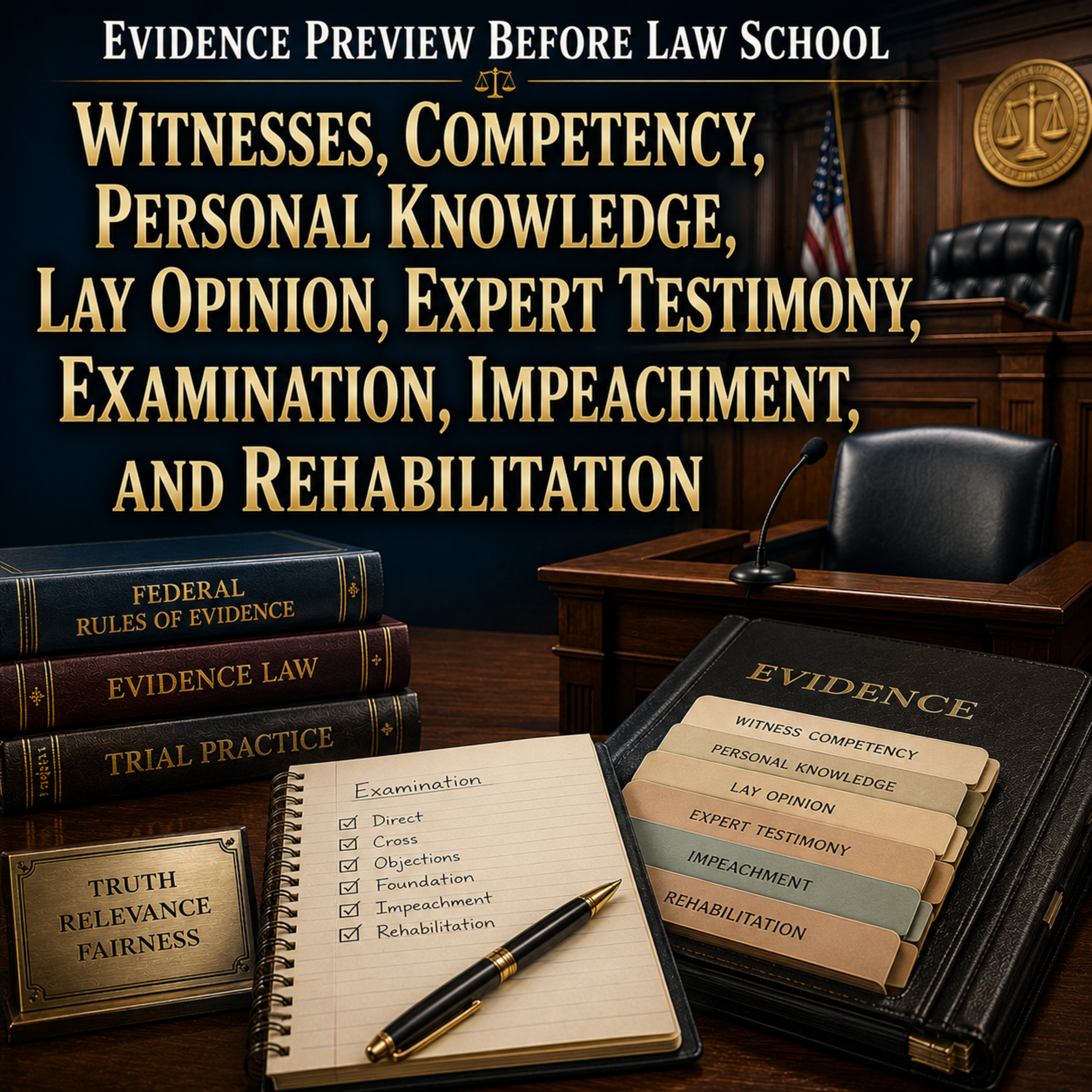
Evidence Preview: Witnesses, Competency, Personal Knowledge, Lay Opinion, Expert Testimony, Examination, Impeachment, and Rehabilitation
About this episode
▶ Click Here to Master Evidence Foundations
▬▬▬▬▬▬▬▬▬▬
EPISODE SUMMARY
Witness testimony is built on foundation and tested through credibility. Under the Federal Rules, every person is competent to testify unless a rule provides otherwise. Competency is a low threshold. Weak memory, interest, age, criminal history, or bias usually affects credibility, not admissibility.
A lay witness must have personal knowledge. The witness may testify to matters perceived through the witness’s own senses but may not ordinarily speculate or repeat rumor. The witness must also take an oath or affirmation to testify truthfully.
Lay opinion is admissible when rationally based on perception, helpful, and not based on specialized knowledge. Expert testimony requires specialized knowledge that helps the factfinder, sufficient facts or data, reliable principles and methods, and reliable application. The judge serves as gatekeeper over expert reliability.
Direct examination generally uses non-leading questions. Cross-examination usually permits leading questions. Redirect responds to matters raised on cross. The court controls the mode and order of questioning.
Refreshing recollection allows a witness to consult an item to revive present memory. Recorded recollection is a hearsay exception used when the witness cannot recall fully and accurately despite a record made or adopted when the matter was fresh.
Impeachment attacks credibility. Major methods include bias, prior inconsistent statement, character for untruthfulness, prior conviction, specific acts probative of truthfulness, sensory or mental defect, and contradiction. Rehabilitation repairs credibility after impeachment through explanation, truthful-character evidence after attack, prior consistent statements where allowed, and redirect examination.
The central lesson is that witness evidence depends on foundation and credibility. The Evidence student must know how testimony enters, how it is attacked, and how it is repaired.
Get every episode summarized
Each time Law School publishes, we email you a written briefing from the transcript — the topics, who appeared, and any specific claims, with the ad reads skipped.
Email me new episodesFree for 3 shows. No card needed.
Hosts & guests
No transcript yet
This episode has not been transcribed. Request it and it moves to the front of the queue.
More episodes
More from Law School

Constitutional Structure: Federal Judicial Power — Judicial Review, Article III,...
Law School

Property Fall Build: Mortgages, Foreclosure, Priority, Fixtures, Water Rights, S...
Law School

Property Fall Build: Covenants, Equitable Servitudes, Common-Interest Communitie...
Law School

Property Fall Build: Adverse Possession and Easements — Hostile Possession, Tack...
Law School