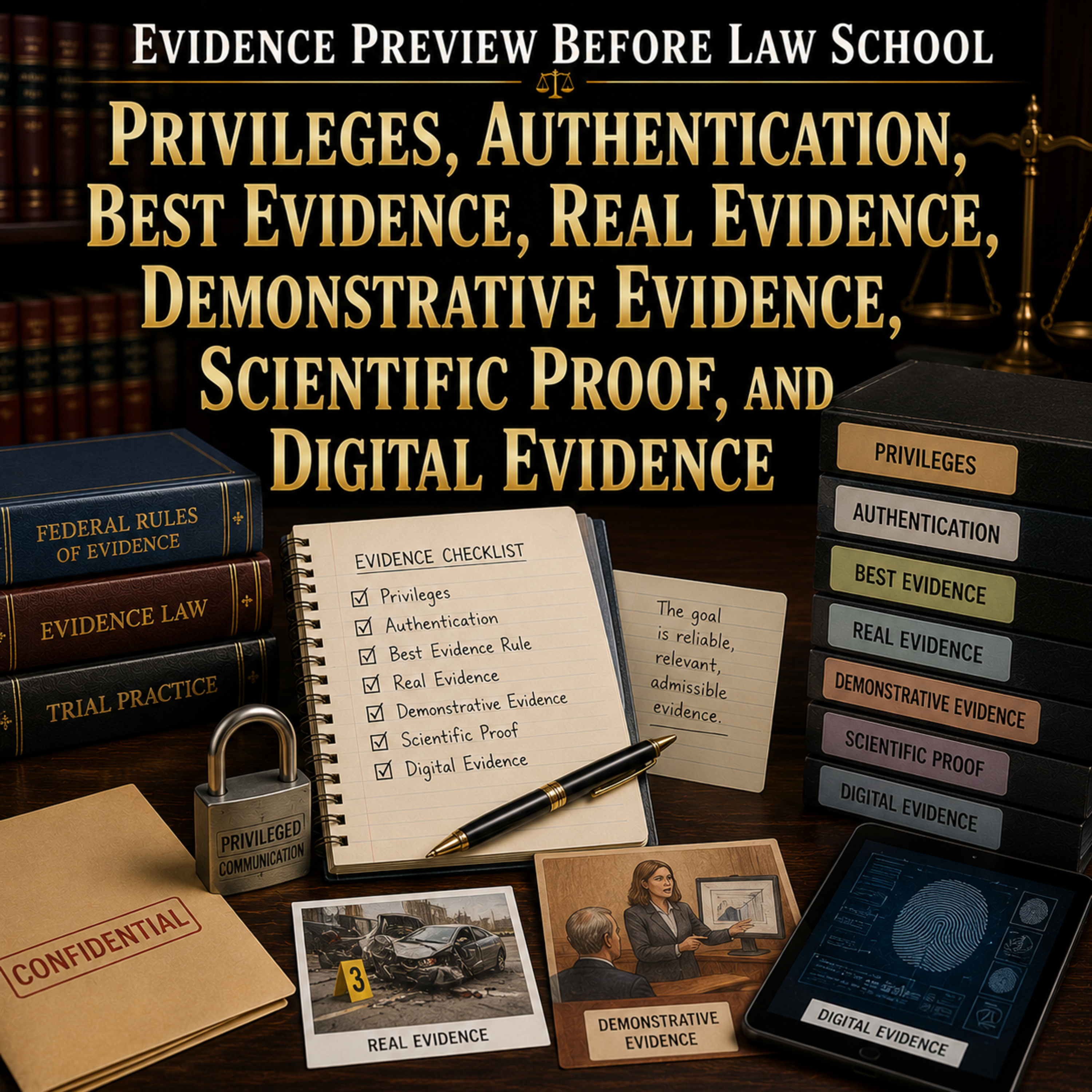
Evidence Preview: Privileges, Authentication, Best Evidence, Real Evidence, Demonstrative Evidence, Scientific Proof, and Digital Evidence
About this episode
▶ Click Here to Master Evidence Foundations
▬▬▬▬▬▬▬▬▬▬
EPISODE SUMMARY
Privileges exclude relevant evidence to protect important relationships and constitutional values. Attorney-client privilege protects confidential communications for legal advice, but not underlying facts, and may be lost through waiver or the crime-fraud exception. Work product protects materials prepared in anticipation of litigation, especially opinion work product. Marital privileges, psychotherapist-patient privilege, clergy privilege, government privileges, informant privilege, and self-incrimination protections may also apply.
Authentication requires evidence sufficient to support a finding that the item is what the proponent claims. Methods include witness testimony, distinctive characteristics, handwriting, voice identification, chain of custody, public records, system evidence, and digital metadata. Self-authenticating documents require no extrinsic authenticity proof but may still raise other objections.
The original-writing rule applies when a party seeks to prove the content of a writing, recording, or photograph. Originals are generally required, duplicates are usually acceptable, and secondary evidence may be allowed when originals are unavailable without bad faith or for other recognized reasons.
Real evidence is the actual physical item involved in the case. Demonstrative evidence illustrates testimony or admitted proof. Illustrative aids help the factfinder understand evidence or argument but must be controlled to avoid confusion or unfair prejudice.
Scientific and technical proof often requires expert foundation and reliability screening. Digital evidence requires special attention to authorship, integrity, metadata, screenshots, system reliability, hearsay, and best-evidence concerns. AI-generated evidence and deepfakes make authentication and reliability especially important.
The central lesson is foundation. Evidence does not become admissible merely because it is useful or dramatic. The proponent must show that the item is genuine, legally usable, properly supported, and not barred by privilege, policy, or reliability rules.
Get every episode summarized
Each time Law School publishes, we email you a written briefing from the transcript — the topics, who appeared, and any specific claims, with the ad reads skipped.
Email me new episodesFree for 3 shows. No card needed.
Hosts & guests
No transcript yet
This episode has not been transcribed. Request it and it moves to the front of the queue.
More episodes
More from Law School

Constitutional Structure: Federal Judicial Power — Judicial Review, Article III,...
Law School

Property Fall Build: Mortgages, Foreclosure, Priority, Fixtures, Water Rights, S...
Law School

Property Fall Build: Covenants, Equitable Servitudes, Common-Interest Communitie...
Law School

Property Fall Build: Adverse Possession and Easements — Hostile Possession, Tack...
Law School