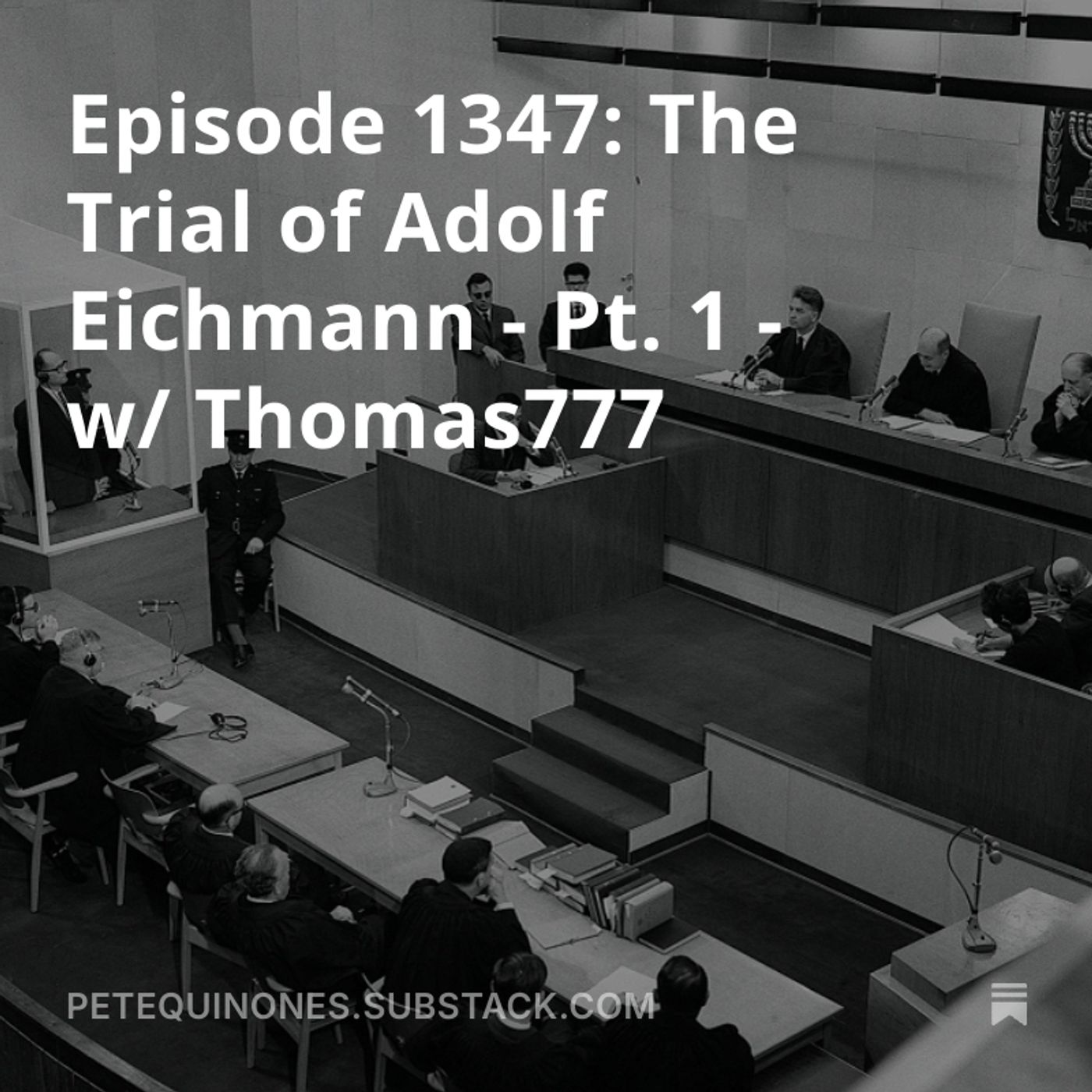
Episode 1347: The Trial of Adolf Eichmann - Pt. 1 - w/ Thomas777
About this episode
PG-13
Thomas777 is a revisionist historian and a fiction writer.
Thomas begins a short series on the trial of Adolf Eichmann.
Radio Free Chicago - T777 and J Burden
Thomas777 Merchandise
Thomas' Buy Me a Coffee
Thomas' Book "Steelstorm Pt. 1"
Thomas' Book "Steelstorm Pt. 2"
Thomas' Website
Thomas on Twitter
Thomas' CashApp - $7homas777
Pete and Thomas777 'At the Movies'
Support Pete on His Website
Pete's Patreon
Pete's Substack
Pete's Subscribestar
Pete's GUMROAD
Pete's Venmo
Pete's Buy Me a Coffee
Pete on Facebook
Pete on Twitter
Become a supporter of this podcast: https://www.spreaker.com/podcast/the-pete-quinones-show--6071361/support.
Get every episode summarized
Each time The Pete Quiñones Show publishes, we email you a written briefing from the transcript — the topics, who appeared, and any specific claims, with the ad reads skipped.
Email me new episodesFree for 3 shows. No card needed.
Hosts & guests

Transcript ready
760 searchable segments. Every word is indexed and playable.
Full transcript
The Pete Quiñones Show — Episode 1347: The Trial of Adolf Eichmann - Pt. 1 - w/ Thomas777. Machine-transcribed; use the interactive transcript above to jump the player to any line.
Every day, excessive delays and denials from big insurers keep patients from accessing the care they need. And when care is urgent, these delays can be disastrous. These practices cost billions in wasteful spending, driving up costs for American families. But while big insurers put up barriers, America's hospitals and health systems are in your corner. Navigating endless reviews and appeals to get you the care you need when you need it most. It's time to curb these harmful practices and put the focus back on patients. Brought to you by the Coalition to Strength in America's Health Care. Here at the Zebra, research shows the average person would rather endure a root canal than search for auto and home insurance. Just try to relax. Or be trapped in a car for eight hours with toddlers on a sugar high. Or remove a nest of irate hornets. That's why the Zebra searches for you, comparing over 100 insurance companies to find savings no one else can. Compare today at the zebra.com. We do the searching you to the saving. I think I'll wait inside.
If you want to get this show early, head on over to the Peak Kinyona Show dot com. There you can choose from where you wish to support me. Now listen very carefully. I've had some people ask me about this even though I think on the last ad I stated it pretty clearly. If you want an RSS feed, you're going to have to subscribe to your sub-stack or through Patreon. You can also subscribe on my website, which is right there, Gumroad, and what's the other
one? Subscribe star. If you do that, you will get access to the audio file. Head on over to the Peak Kinyona Show dot com. You'll see all the ways that you can support me there. I just want to thank everyone. It's because of you that I can put out the amount of material that I do. I can do what I'm doing with Dr. Johnson on 200 years together and everything else, the things with Thomas and I are doing together on continental philosophy. It's all because of you and yeah, I'll never be able to thank you enough. Thank you. The Peak Kinyona Show dot com. Everything's there. I want to welcome everyone back to the Peak Kinyona Show. Thomas is back. We're going to take a little bit of a detour as we do very often to talk about a subject that's been at the forefront of Thomas's mind recently, the what a quote, trial of Adolf
Eichmann. So Thomas, take it away. Please. Yeah, it's an important subject matter. It's not just a question of trivia. It's relevant to people who are into the Third Reich and revisionism. I came up because I was talking to Burton and he was talking about how odd it is that not just formal representatives of Leacood, but apologists were Israel, all in sundry and even people weren't Jewish. They speak of Israel as being synonymous with the Jews as a people. And they talk about Israel as being the formal instantation of the Jewish people at international law. And that's not just a colloquialism or some odd convention that developed over time for
ideological reasons. It's very much coded into the world system. And a lot of things are put to the test with the trial of Adolf Eichmann, including the sort of special dispensations Israel has at international law. And it also had the force of solidifying and establishing his precedent for all time. This anti-fascist convention where my people would be held into court for allegedly having been involved in what's declared to be criminal acts in the service of the acts as powers. And there was weird intrigues around Eichmann and his apprehension. And he was something of an odd target.
You know, to be clear, and Hannah Orrent gets into this, her book Eichmann and Jerusalem is a mixed bag. And the one that's very critical of Israel, and it's not, and it's blank of a fuel to observe due process. But in the other, there's some weak spots of it and it was very much written for a mass audience. And it was very much written according to the Convention of Political Correctness of that time, which was the early 1960s. Ever people who think political correctness just appeared one day in 1990 or something they don't understand this country, it was around before any of us were born. And I judge it particularly contrary to her book The Origins of Centilitarianism, which is a really great book. And the title is misleading, that's actually not what it's about at all. You know, and it very much has to do with the deep sociology of how and why such a profound
amity developed between the Jewish minority in Europe and European people, particularly as the nation-state deteriorated in favor of supernatural structures, you know, as a superpower era emerged. And that's an important point that's not well understood, particularly in America, even by historians or somewhat critical of mainstream narratives. The meaning of the Third Reich was that it was a pan-European tendency. The whole point of it was to create a new order whereby Europe became a superpower. And that process that gave rise to, you know, the establishment of the Third Reich and the Soviet Union, and that, you know, in historical capacities, allowed the United States to
marshal its resources into an incredible degree of power projection, aside from the scene, that was the proximate cause of this horrendous violence that, to be clear, emerged from both sides, you know, between Jews and Germans, you know, Jews and Russians, and ultimately, you know, Zionists turned their violent attentions to Dar-L-Islam and the ethnic cleansing of Palestinians. And that's actually a very much an urgent, old-tea point that Hanna rent made, and that's no surprise, because, you know, she was a hightier accolade just like Ernst Nolte was, you know, and they absolutely crossed paths. How close or they were, you know, it is questionable.
I don't believe they were completely friendly, but they definitely shared a pistolmological assumption of the things. But that's, that's why this is important, and you'd understand the present situation. You've got to understand the Eichmann trial as precedent, because the international military tribunal that committed at Nuremberg, that, that still has the configuration of the global regime's legal order. That was only finally fully realized in 1989, but the Eichmann trial that established the special dispensations and, you know, exclusive privileges of the Jewish state within
that system, and that's not what understood. Not a lot was, well, understood that Eichmann, either, obviously, they needed some sort of figure to burn in proverbial effigy, and because they're outside of, you know, men have served as general officers in the Vermacht of often SS, there wasn't, you know, the national social leadership didn't really exist anymore, they'd been executed or they died. So deciding Eichmann, they, what they hung on him, the label was, he's the quote, architect of the Holocaust, that's really, really strange for all kinds of reasons, not the least of which Eichmann was a fairly irrelevant person. He, he was a young guy, you know, when the war ended, he was only about 40, or he just
turned 41, he was born March 19th, 1906, he, his final rank was Oberstirmbunfjö, which was the SS equivalent of a lieutenant colonel in the NATO rank system. That base, he was a policeman, and his, he served the RSHJ, which was the right security at Hamth, the right main security office, he ended up becoming the chief of department 4B4, which was Jewish affairs. He'd come up initially through the SD and the security police as being assigned to, spying
on Freemasons and fraternal organizations that were considered to be subversive, which again was a pretty middleing detail, and he was some sort of logistics subon. He could, that was a real strong suit, and that's what's remarkable about him. He had a genius for a logistical planning and crunching the numbers in his head that entailed moving mass amounts of human beings and material as needed, and under conditions of, you know, war, peace, time, and burying degrees of mobilization. And that owes to the, the Holocaust narrative, places of premium on, well, these, this moving around of populations at massive scale, these people were being delivered to their doom.
And I think the subon was delivering them to their death on mass. So that part of it makes sense with this idea that he was this important personage in the German Reich is totally off base and just odd. When you really need care, you need 24-7 access to a care team, not a maze of paperwork from a third party. Every day, America's hospitals and health systems show up for you, navigating healthcare and fuel overwhelming, but you can count on real doctors, real nurses, real people, providing quality around the clock care when you need it most, there in your corner, in communities across America, your neighbors, your lifelines, right beside you holding your hand and helping find answers. That's what putting patients first actually means. Learn more at strengthinhealthcare.org, brought to you by the Coalition to Strength in America's Healthcare. Here at the zebra, research shows the average person would rather endure a root canal than search for auto and home insurance. Just try to relax. Or be trapped in a car for eight hours with toddlers on a sugar high. Or remove a nest of irate hornets.
That's why the zebra searches for you, comparing over 100 insurance companies to find savings no one else can. Compare today at the zebra.com. We do the searching you to the saving. I think I'll wait inside. Re-chalk. Still aiming. While they figure it out, I fire up Chamba Casino. I can spin anywhere, anytime, and there's always a new social casino game every week. Spins happen way faster than that shot. Play now at chambacasino.com. Let's chamba. Sponsored by Chamba Casino. No purchase necessary. VGW Group Board, where prohibited by law, 21 plus terms and conditions apply. But to understand what is a rank would have been, or I mean his cloud or relative power within the executive of the other like, you know, Himmler was under Heinrich Muller.
Who can't even notice Gestapo Muller? Who is the head of the Gestapo? Gestapo Muller served directly under Rhinard Hydrick, who was chief of the SD and the chief of the RSHA, and after he was murdered, Ernst Kaltenbrenner came to the role. Hydrick and then we were Kaltenbrenner, served under Himmler. Himmler technically was second only to Hitler because he was the right sphere SS, but Hitler and Himmler were not close. They weren't friends. They didn't socialize. They seldom saw each other. They didn't associate socially. Himmler is a bit of a loose cannon who Hitler viewed as being radically dedicated to the cause. He was an old fighter. He'd been at Munich in 1923. He'd come up through Ram's free core. So his credentials spoke for themselves in terms of his willingness to sacrifice for the party, but there wasn't a personal relationship between Hitler and Himmler.
This idea that this idea of Eichmann was some approximate to the fear or head, great power that doesn't make any sense, that'd be like taking some kind of random career homely and security man and declaring that he's the actual power behind Donald Trump or something. I'm just for context, it doesn't really make any sense. What I believe happened with Eichmann, and this is pretty well substantiated by this point by people who want to dig into a record, Eichmann, after the war, like a lot of people who'd serve the Axis powers and not just Germans, but Italians, Croix, Japanese, Slowbox, you know, all manner of people. They found a new home in Latin America, particularly Argentina, but Argentina also is a very European
coded place culturally. And the Peron government was very friendly to national socialists, as was the Strassener government. So after the war, Eichmann, just by virtue of his membership in the SS and particularly the RSHA, meant that he would be a wanted man, but it wasn't really a pride, he wasn't really anybody's radar for years. Then what happened was there's the publication of what came to be known as the Eichmann papers. Now this came about because in Argentina, there's a man named Wilhelm Sassen, who came to know Eichmann, and he also probably came to know Mengele personally. Mengele is a lot more sympathetic of a figure than Eichmann, in my opinion, because he Mengele literally got transformed into this horror movie monster by propaganda, it's
totally, totally bizarre. And Mengele drowned when he was swimming as an elderly man, and his identity wasn't confirmed for some years, but he escaped the vengeance of the Jewish state and of the Justice Department's OSI, but I'm sure he didn't have a happy wife, where he was living out his twilight years, but the deal with Wilhelm Sassen, Wilhelm Sassen was a Flemish national socialist, and from Holland. And he joined the Waffen SS as a work correspondent, and as a Dutch language propagandist on behalf of the NSDAP, and he was on deck with documenting a lot of anti-partisan action.
So he witnessed some pre-severe stuff, and he may have participated in a direct action capacity. You know, I'm talking about mass shootings and non-combatants, and the kind of stuff that was common to the Ostfront on both sides. But Sassen, he was an incredibly shady guy, and he was almost certainly some kind of intelligence asset for the Bundesrepublic, or British intelligence, or the CIA. You know, he probably did this for cynical reasons. It's hard to imagine a man like him having any principles. But what Sassen did was, he, I think when he was kind of a naive person, he was almost a autistic bottle of accounts. Sassen befriended Eichmann, and he said, I want to help you to draft your memoirs, because
you were an important man who was witness to history, and you know, we needed to set the record straight. So what was produced was this 600 pages of documents, which is mostly conversations between Sassen and Eichmann, about the war years, about the structure of the SS on the SD side, and the RSAJ side, which at that point was little known. There wasn't much written about it, and the men who served the organization were very secretive about it. And within the pages of this testimonial Eichmann's system pretty incriminating stuff, but not of the sort that people might think. And what Sassen did was, he proceeded to sell these pages to a life magazine, obviously
without Eichmann's knowledge. And then subsequently, what's, you know, what lands like a bomb in English-speaking media markets, and the front page of life magazine is this picture of Eichmann in his SS uniform, and in bold letters, the interview with the devil, the architect of the Holocaust. And so suddenly Eichmann is on people's radar. And Sassen, all but just closed exactly where Eichmann lived. And to be clear, Eichmann, to his credit, he was still married to his wife, you know, who he'd brought with him. He actually had a young child, you know, who'd arrived late in life, you know, and he was working some sort of office job. I think he was working as an accountant for some small machine firm or something.
You know, and living in the Buenos Aires suburbs, just kind of minding his own business. You know, I mean, he was living under an alias, but it's not like he was under deep cover or something. And when this kind of entered the public mind, you know, very suddenly, the question became, why is this man free? Why isn't he facing justice? You know, this, this man is the most evil person alive. He was the architect of the Holocaust. You know, so very quickly, this became a priority of them's side to capture him and avail him to a show trial, but first and foremost, to interrogate him and sort of fill in the
gaps of what they wanted to know. And during the Cold War, and you know, all information of this sort was valuable, even though it might not seem so to a layman. But also, if you're somebody engaged with the historical process, whether as a secret policeman or an intelligence agent or a military man, or just a, and nobody kind of documentarian like me, this is a valuable score, a person like Ithman. Every day, excessive delays and denials from big insurers keep patients from accessing the care they need. And when care is urgent, these delays can be disastrous. These practices cost billions in wasteful spending, driving up costs for American families. But while big insurers put up barriers, America's hospitals and health systems are in your corner, navigating endless reviews and appeals to get you the care you need when you need
it most. It's time to curb these harmful practices and put the focus back on patients, brought to you by the Coalition to Strength in America's Health Care. Tyler Reddick here from 2311 Racing, another checkered flag for the books. Time to celebrate with Jamba. Jump in at JambaCasino.com. Let's Jamba. No purchase necessary. BTW Group. Boy, we're prohibited by law. CCNC. 21 Plus. Sponsored by JambaCasino. At the UPS store, reinsure your small viz stand out with a variety of high quality paper stock options, banners, posters for shores and more. Most locations are independently owned. Product services pricing and hours of operation may vary. See center for details. The UPS store. Be unstoppable. Coming to your local store today and get your print on. And what's interesting is Simon Viesenthal, who was proven, said to be a total liar. I'm not talking about what he alleged about events in World War II, although that obviously wasn't credible either. But he made a whole career out of making up stories about being involved in capturing
these third right figures. And he claimed that he located a like man that's complete nonsense. He, Viesenthal was that was that nobody who built a career on bullshit and presenting himself as some sort of a Frederick force like novel character. You know, this was completely confedulated. And like I said, too, Ickman wasn't really hiding number one and number two such that he was under light cover. That was all over by the time Sauson sold his testimony to life magazine. So on the evening of May 11th, 1960, Ickman, you know, is on his way home from work like any other night.
And he gets grabbed by massage operatives, you know, thrown into a car, subdued with some kind of drug, you know, nine days later, he's been flown to Israel. And thrown in a jail cell and a veil due interrogation for the next 11 months. And on April 11, 1961, he found himself in district court in Jerusalem being arraigned on 15 pounds, including the allegation that together with co-conspirators, he committed crimes against the Jewish people, as well as crimes against humanity, war crimes, and the usual litany of charges that for a solid day at the International Military Tribunal, a decade and a half prior,
but what was significant and what was novel was this claim that Ickman had offended against the Jewish people as a people. And that Israel was the de jure representative at an international law of the Jewish people as an ethno, as a confessional and sectarian community. And as a matter of law, this problematic and interestingly, a lot of these Jewish organizations in America and the Buddhist Republic in the UK, this wasn't the case, but a lot of these American Jewish NGOs said, wait, wait, wait a minute. You know, the government in Tel Aviv isn't the representative of all Jewish people. It's not the way we want to proceed, and that's probably not even legally cognizable.
You know, this idea that to be clear to the claim of the Jewish state in this context, it wasn't that the government in Tel Aviv is the representative of Jewish people in the Nation of Israel. The claim was that it literally was the representative of the Jewish people as the Jewish people on this planet, whatever their nation of origin, whatever language they speak. And if you would specifically intend to harm the Jews as a people, offend against them, their legal representative as a matter of law is the Jewish state. And they can stand in for the Jewish diaspora as a matter of law. And like Bern and I were talking about, this is why when these, you know, it's not just
who echoes at Mark Levin or extremists, bigots like Dershowitz, when these people claim that if you're attacking the Jewish state, you're engaged in anti-Semitism, that's not just a colloquialism or a polemical device. They're saying as a matter of law, if you're opposing the Jewish state, you're opposing the Jewish people, and if you're opposing the Jewish people, you're doing it out of some kind of insidious prejudice because the reason why this arrangement exists and why they're permitted these defensive structures that whack precedent and comparable iterations with respect to other populations is because the Jewish people uniquely susceptible to violence from others. So there's a whole set of epistemic priors, and I'm not often with legitimacy of this perspective because it's insane.
But the reason why these polemicists invoke that conceptual vocabulary is for this reason. And there's an important understand. World opinion, I mean obviously excluding the East block, but during the Cold War, it was the opinion of the free world that is what was considered valid precedent, and then when the wall came down, obviously that became what was precedent, everybody in the free world as it was called, I mean, there were objections here and there, particularly among some carelessly significant personages, but there wasn't some formal protest from the bond government or from the London government or from Washington or something, so that's just what stood, you know, I can pled not guilty to each count, but he qualified it, he said,
I'm not guilty in the sense of the indictment. And interestingly, the judge didn't initially question him what he meant by that. Ikeman's lawyer abiding the same convention as Nuremberg and the thought trial, Ikeman was allowed to select council of his choice and the Israeli government paid him for his time and flew him out there, but that's really a due process ended, just like at Nuremberg, but Ikeman's lawyer was a man named Robert Servatus who was native to Cologne and he was a heavy hitter, but when he explained to the court later when the court asked what your client mean by this, Servatus said, Ikeman feels guilty before God, but not before
the law, and whatever Ikeman did, or whatever he ordered, first of all, Servatus said, Ikeman didn't murder anybody, Ikeman's never murdered a Jewish person or a non-Jewish person or any person, so he objected on substantive grounds to Ikeman being accused of murder. If you wanted to accuse him of conspiracy, fine, we'll fight that charge, but produce one instance, produce any inculcatory evidence, documentary or direct testimony or anything else of Ikeman murdering anybody, and interestingly, the prosecutors tried to do that and they couldn't. What they came up with was during the occupation of what's now Serbia and parts of Bosnia and Herzegovina, a body of what was the NDH, Ikeman as an SD man, it was within his
purview to be responsible that leaves another, you know, at least in the capacity of, at least in the advisory capacity, how to handle anti-partisan efforts. When you really need care, you need 24-7 access to a care team, not a maze of paperwork from a third party. Every day, America's hospitals and health systems show up for you, navigating healthcare can feel overwhelming, but you can count on real doctors, real nurses, real people, providing quality around the clock care when you need it most, they're in your corner, in communities across America, your neighbors, your lifelines, right beside you holding your hand and helping find answers. That's what putting patients first actually means. Learn more at strengthinhealthcare.org, brought to you by the Coalition to Strengthen America's Health Care. Tyler Reddick here from 2311 Racing. Victory Lane? Yeah, it's even better with Chamba
by my side. Race to ChambaCasino.com, let's Chamba. No purchase necessary, BTW Group, voidware prohibited by law, CTNCs, 21 Plus, sponsored by ChambaCasino. Hi, this is Alex Cantrowitz, I'm the host of Big Technology Podcast, a long time reporter and an on-air contributor to CNBC. And if you're like me, you're trying to figure out how artificial intelligence is changing the business world and our lives. So each week on Big Technology, I bring on key actors from companies building AI tech and outsiders trying to influence it. Asking where this is all going, they come from places like Nvidia, Microsoft, Amazon and plenty more. So if you want to be smart with your wallet, your career choices, and meetings with your colleagues and at dinner parties, listen to Big Technology Podcast forever, you get your podcasts. So there's a memo that I commend signed off on incident into the minutes of a meeting where he suggested continuing a policy of decimation where for every German soldier killed,
hostages would be murdered. You know, the hostages in the incident case would be ethnic serbs and Jews who were presumed to be sympathetic to the Chetniks and the Communists. And that was what they came up with saying, see, like men was capable of murder, at least capable of it, which was trivial in the context. Not just because of the gravity of what they were alleging, but, you know, it suggests a real, it suggests that even within the arbitrary parameters of the court in Jerusalem, where the show trial was being held in the purest sense, the Servantist was a serious guy. He attacked where he could and he made the prosecution
of foolishly could. But to bring it back, Ikeman's position was that anything he did or didn't do in his role as an Oberstumbefee of the SS serving the SD and the RSHA, these were acts of state. So, healing him into court for murder and grounds of acts of state would be like healing Curtis Lemay into court and charging him with 100,000 counts of murder for firebombing Tokyo. And as Servantist said, Mr. Ikeman is here because he committed acts for which
you are decorated if you win and you go to the gallows if you lose, which was true, which is why as well, this sort of narrative of the fancy conference becomes so relevant, that wasn't particularly emphasized here, but what was is very interesting. And I can get into that. In terms of the evidence presented both, um, direct, particularly direct testimony, but the way that the International Military Tribunal 15 years before had gotten around this challenge was, as I think we discussed in earlier episodes, they alleged, well, this wasn't a normal government. And these weren't acts committed pursuant to exigencies of war. This was a criminal
conspiracy. And from inception, the raison d'être of the German Reich was to murder the Jewish race. And that's really the only reason it existed. And the fancy conference was the formalization of that intended purpose, manifest as a conspiracy by key actors in the executive branch of the National Socialist Party State. That's an incredibly species argument. And in a normal court, I don't even think it would be admissible. Generally, I'm not going to bore everybody with evidentiary rules and the nuances. Generally, it criminal law. And there are, I'm saying generally, because there's nuances every state, and then there's the federal system too. But generally, what is admissible is evidence of plan, motive, design, intro, aspects that relate to intent.
And that removes it from being categorically treated as propensity evidence, which is almost always excluded. But to extrapolate that convention and say, well, there is this meeting and this meeting is demonstrative of the fact that the cordiological purpose of a state government was to carry out a criminal act at massive scale, going to do nothing beyond malice and perverse moral frailty. You know, like I said, I can't, it's hard for me to put myself in the position of a judge, because I really don't have any respect
for judges. And I agree with what Oliver Wendell Holmes Jr. said. Judges rendered decisions based on the political climate and a little else. At the same time, I'd be curious as to how an argument like that would be structured, assuming it was, you know, an issue of first impression. I'd probably let it pass, but I've got sympathy for the double. You know, but that's, you know, this is highly significant. It's not, it's not just a question of lawyer ball and word games. And I think his trial was a show trial
in two cents. It was a show trial in the obvious sense in that it was ideological theater that passed off as jurisprudence. But also, this was the days of nascent international news. You know, so people weren't seeing live what was happening in Jerusalem because in 1961, there weren't these satellite feeds that facilitated that wasn't perfected yet. And then a few years later, when it was, it was an art, it was process. It was Elvis's Aloha from Hawaii. That was one of the first mass broadcasts, satellite events, all of this planet. But on the evening news, people were seeing footage from I come in on trial and legal experts were weighing in on what was happening. You know, and that's
substantially, that's a whole different animal than going to the movie theater in 1947 and saying movie to a news clips of, you know, there were five seconds long of Herman Gehring on the stand. You can't even hear his testimony. There's just, you know, a voiceover as it were offering color commentary. So there was the Jerusalem court, it had a tougher road to hoe. And also, Eichmann was the only defendant on deck. He couldn't, the bait and switch wasn't possible whereby, you know, if the prosecuting attorney was bested on, you know, by a witness, they could shift their attention to a weaker link and the proverbial chain.
I mean, the link was possible at Nuremberg and was when we had to talk on stuff. You know, so there was that too. And also, the social engineering regime had, I mean, yeah, a lot of new deal propaganda had had an incredibly toxic effect and already. And American public opinion had been substantially warped. But this process hadn't really come to fruition yet. And there was a lot of people who, either owned a social prejudice or because they were politically sophisticated, didn't particularly like Jews, didn't like the state of Israel, didn't think particularly considering that the Cold War was absolutely raging then that World War II was some great thing. So, there was something of a delicate menu way here. And back then, unlike today,
Zionist propaganda was pretty sophisticated. It wasn't, you didn't have a noxious idiot, like Mark Levin running around acting like some dystermic caricature. Every day, excessive delays and denials from big insurance keep patients from accessing the care they need. And when care is urgent, these delays can be disastrous. These practices cost billions in wasteful spending, driving up costs for American families. But while big insurers put up barriers, America's hospitals and health systems are in your corner, navigating endless reviews and appeals to get you the care you need when you need it most. It's time to curb these harmful practices and put the focus back on patients. Brought to you by the Coalition to Strength in America's Health Care. No purchase necessary, VGW Group Void were prohibited by law, CTs and Cs,
21 plus sponsored by Chamba Casino. Subscribe to Cool Stuff Daily Now because the future is happening fast and it's way too fun to miss.
I mean, they look ethnic, but they don't look particularly alien. It was very clear that who they selected to be on camera, things like that. Obviously, they were trying to telegraph, see these are people like you. They're respectable white people who share the same habits you do. They just have a different religion. We still suffer that today. Oh, sure. There's a white man who went to school in the United States. Oh, no, of course, but a guy like Mark Levin doesn't exactly relate to middle America well or make Jews look good. Yeah, I mean like this. I mean, that was my point. Like back then, some guy before working for the EGC or the ADL even, or some guy or some lady, you know, who was deciding who from the nested it would appear on the five o'clock news,
they'd been mortified if some guy like Mark Levin was acting like that. You know, that's what I meant. Yeah, the sort of cycling of elites from the Jewish state to America and the deep interdependence there. You know, I mean, we're talking about deer deer with the fellas. Like, why, why are IDF people training, you know, the Minneapolis police department? You know, I mean, stuff like that. It's really very, very on the nose, but I and what's interesting too, this I'll bring it back. This is truly tangential, but you know, the on the nose, I see what you did there. That was actually, I didn't actually intend that as a double entendre, but since, yeah, I'll take credit for it as far. But, um, Ariel Sharon, I believe he was an oriental Jew. His family was from Palestine. You know, he
wasn't an Ashkenazim or a, a Suffolk theme. Ed He, he was one of these guys from Brighton Beach. You know, who moved a Jewish state after plan D had, uh, had had a genocide. The, the coveted territory, and that was comparatively rare. At least among the core of what became the political culture, the Zionist state. You, there weren't a lot of those guys, and I find that interesting. Most of that, I can't remember, he might have had a similar background, but it's the exception, you know, I just find that kind of thing interesting. Most people would probably find that appropriate with nothing, but in any event, I come in had, he had more support than people might think.
You know, again, I come in the man, he didn't come out specifically, he villained us, he came off as kind of nerdy, and almost a character of the meticulous German. But you know, he, at the same time, he didn't come off as particularly sympathetic or charismatic, either. There was a very well-renowned French attorney, Ramone, and Ramone, and Geoffrey. I'm probably butchering that pronunciation, but he was a really interesting guy, and he was a true advocate in the sense that it's supposed to characterize the man who sit at bars, defense counsel. He defended a bunch of, there was a right-wing fascist militia in France.
That was, some of these guys were on the side of the Reich. Some of them weren't. They were sort of like, their ideology was sort of like the action in front, say, had been under Morse, but obviously the action in front, say, they'd never direct the action capability. But these guys, these guys are real bomb throwers, and I mean, basically they were at odds with the Reich and the allies, obviously, but some of them are, you know, national socialists. Geoffrey came to the defense of these guys and defended many of them pro bono, and he made the case, the court of world opinion, which is an important point, not just in terms of the due process of his clients in the era, but as a matter of historical fact, there was
no Vichy France. There was France. The government in Vichy was the government of France. The time had mass support. The goal had no support. And this idea that the time with some client of Adolf Hitler, you want to know how many times the time that Adolf Hitler was. And, but for our purposes, I mean, there's a discussion another day, I've written some about that, but I don't even ever discussed it on your platforms. But Geoffrey, that was the crux of his defense, was not just of these fascist partisans, and the, you know, prior to the, prior to the ascendancy of the Patan government, I think of legislation to Germany, but the guys who served the Patan regime, you know, you can't
bring these guys up on charges for treason when they were serving the government of France at war. That's perverse as a matter of law, and this idea that there's a man in exile in De Gaulle who nobody ever heard of, who is quite literally a client of a foreign power declaring himself to be the rightful president of France, you know, that's absurd. And Geoffrey was respected as one of the preeminent legal minds in Europe, and he'd actually sat in an advisory capacity on the Allied Control Council during the Nuremberg trials and subsequent. His own point was there wasn't, there was another personal or subject matter jurisdiction over Eichmann. These are either state of Israel, and he said even if there was, the Israel had a claim
to jurisdiction, the correct way to proceed according to convention, and I mean, an international law can ever become pulsary because that's a logical fallacy among other things. But convention is the source of legitimacy, particularly we're talking about penal jeopardy, where, you know, somebody's on trial for their life, but also just in terms of due process with respect to any court's authority, you know, the correct protocol would have been to appeal to Argentina for extradition. And the Israeli rebuttal was that, well, Argentina famously refuses to extradite people.
Okay, well, why is Israel have jurisdiction over the man of the subject matter anyway? There was no Jewish state between 933 and 945, and a state, first of all, you can't be held liable for committing crimes against an ethnic group or a race. Even if that were possible, Israel isn't the representative of Jewish people for all time. And finally, venue matters. The alleged offenses were committed in Poland and Belarus and Ukraine and Russia. You know, why, why is an Ikeman being hailed in the court in Poland? You know, none of this is precedented.
None of this can be rationalized by appeal to precedent or common sense. You know, and finally, Jeffrey didn't emphasize this as strongly as Ikeman's counsel did, but Jeffrey said, do we really want to start talking about where the exit state doctrine ends and where liability for homicide begins when, you know, the Israeli state was founded quite literally in mass ethnic cleansing. The U.S. Department of Justice has proffered the equivalent of an amicus curate on behalf of the Jerusalem court or respect their prosecution of Ikeman when this is the same government
that being an ISIS government that waged nuclear war against Japanese civilians. You know, that raises some questions that people probably don't want to address in these terms. But again, the rebuttal was an appeal to conceptual prejudices and epistemic priors about the unique and vulnerable situation of the Jewish people and the existential threats they face based on immutable traits that they possess and irrational animosity that culminates in homicidal pogroms periodically.
There's a whole series of assumptions one must accept in order to consider the Israeli case for jurisdiction over Ikeman to be legitimate, but again, the Ikeman trial was the litmus test of these things and that's why it's significant. And arguably, in discrete terms with respect to the fortunes of the Jewish state, it's absolutely more significant than the Nuremberg trials. Obviously, the former facilitated the latter, but this is basically the appeal. This is what's being relied upon. What do you hear about the special status of the Jewish state or the right to exist of a Jewish state? This is what it's relying upon.
So I assume people who are into my content don't do things like ask questions like, why does this matter? Because you wouldn't be interested in this as a terror if you had those sorts of objections to it. But if anybody is on deck harbors those concerns, well, this is why it matters, okay? This is why it's contextually significant and very concrete capacities, not just as some sort of curiosity. And that goes to show too, I can't imagine, I mean, these days you wouldn't find a man
who had the kind of prestige of just free taking such a position, contrary to the Jewish state. I mean, you'll find Europeans who, to their credit, they'll attack the Jewish state for, you know, it's racialism and it's hostility to other populations and the categorical violence that it avails them to. But that's mostly framed as a matter of appeal to Nuremberg logic or the purported hypocrisy of the Jewish state. It's really sort of a token of objection. I mean, don't get me wrong. I'm not going to be down on people if they're standing up for our comrades in Palestine or Iran or anywhere else.
But I think you know what I mean, it's a fundamentally different scope and character and the motivations are different. When you really need care, you need 24-7 access to a care team, not a maze of paperwork from a third party. Every day, America's hospitals and health systems show up for you, navigating healthcare can feel overwhelming, but you can count on real doctors, real nurses, real people, providing quality around the clock care when you need it most, they're in your corner. In communities across America, your neighbors, your lifelines, right beside you holding your hand and helping find answers, that's what putting patients first actually means. Learn more at strengthinhealthcare.org, brought to you by the Coalition to Strength in America's Healthcare. Tyler Reddick here from 2311 Racing, another checkered flag for the books. Time to celebrate with Chamba. Jump in at chambacacino.com, let's chamba. No purchase necessary, BTW Group, voidware prohibited by law, CCNC, 21 plus, sponsored by ChambaCacino. Hi, this is Alex Cantrowitz.
I'm the host of Big Technology podcast, a long time reporter and an on-air contributor to CNBC. And if you're like me, you're trying to figure out how artificial intelligence is changing the business world and our lives. So each week on Big Technology, I bring on key actors from companies building AI tech and outsiders trying to influence it, asking where this is all going, to come from places like Nvidia, Microsoft, Amazon, and plenty more. So if you want to be smart with your wallet, your career choices, and meetings with your colleagues and at dinner parties, listen to Big Technology podcast wherever you get your podcasts. The, the prosecution also, they had, they had a problem because initially what they were relying upon, they were relying upon the direct testimony of people who had been in German
concentration camps. And this testimony was contradictory, relative to the factual record, witnesses were concentrating on each other. There were people testifying about things such as gas chambers at Ravensbrook or Dhakao. And even then, even within the narratives that were extant and considered to be historical as well as legal precedent, it was stipulated that there weren't gas chambers at Ravensbrook and things. Obviously, two, there's the white elephant in the room. If there's a witness declaring, I was a, I was a death camp inmate, and this is what I come in was directing. Well, if you were a death camp inmate, how are you here? I mean, I, it was the most, it encompassed death camp ever.
So the prosecution was charged with calling witnesses who'd served in the SS and SD, the most prominent of whom were pretty obviously intelligence assets or double agents. To testify, you know, Contra-Ikman and seek to establish liability based on things like the unsubscruped actions they themselves have participated in. And these guys just, you know, they've been a similar, they've been a similar litany
of these sorts of witnesses called to testify against Rudolf Hoys, who's the common out of Auschwitz-Birkenau, and it was the same kind of thing, you know, I, these the most evil men who ever lived in their liars, but you've got to trust them and relevant to this testimony. And this is honestly where a lot of these strange claims come from, the claims specifically, you know, Hitler, Hitler demanded that we reduce the population of slabs to 30 million. Not a single person has ever said that, written that, alleged that, other than this bizarre turncodes and probable double agent who testified against Ikman and somehow, despite admitting to participating in the murders of tens of thousands of people was never invited for any of these things.
You know, and that, this is one example, because it's yet parroted all the time on social media, although it'll be something bit with conservatives and like, well, you, you're saying it's okay to exterminate slabs, you, you anti-white horrible man, who says that? Some, some guy who's a paid witness against, against, against the Ikman, some guy who, you know, was on the payroll of a, a secret intelligence service while he was a serving officer in the SD, you know, who is saying these things? And you're just, you're just both accept this at face value or something. And it's not just boomers either, I know people might just wait and I'll be like, oh, that's just boomer people. I'm not talking about like 30-year-old guys, you know, better. And when I challenge them on these, on these grounds, they'll say, first they'll say I'm an idiot, then they'll say, quote, everybody knows this.
And it, what does that mean? Who's everybody? And what do they know? You know, so in the Rod is deep. And in some ways, as I said, at least in the present conditions, that being, you know, life during wartime, you know, talking ahead of the sun, I'm not being late of it. It's horrible that our Iranian comrades under assault, but they will prevail. But it's still, it's not all a situation, not being flippant about it. But that's why I wanted to focus on Ithman, because I think many people don't know this, because why would they? I mean, I know about it, because this is my, this is why I do my life, these are my research concentrations. But I need to go another episode on this, because I want to get into the case of achieving this Ithman. And then we can return to a regular scheduled programming, if that's what we're getting.
Sure. I think one of the, the special dispensation for, for the Jewish people is, you know, I'm, I'm no fan of Chris Christie, but I think he's like legitimately a funny guy. And he's also a man so fat that his last name, he's his first name. But he, he tells the story about how the, the Kushner family, how he became the enemy of the Kushner family and it kept him out of the Trump administration. And the thing in that story that, that I just, I will never forget, I'll take to the grave is when he's, Jared Kushner telling Chris Christie that these charges you had brought up on my father, they shouldn't have been handled legally. You should have brought them to the rabbis. Yeah. That's absurd.
It's election fraud. Yeah. Yeah. Yeah. You're talking about, you're talking about some minor tax issue or something. Yeah. Election fraud. There was a tax issue, um, extortion for, I mean, no, I, that's why I mean, I mean, I feel criminality. It wasn't just, you know, coping the books a little bit like, unfortunately, it's kind of the norm, you know? Yeah. I, I, I kind of, if people, you know, taxation and stuff like that, I have a tendency to be like, eh, is it really a crime? But, um, you know, these, these other things that are just, um, when you hear the whole story of what Kushner did, it's pretty fucking diabolical and they, they want this, they want this just. Yeah. Yeah. And you're just supposed to overlook it like, what, you know, like, you know, like I said in the Jeffrey Epstein files, you know, the, what the goiom live in the real world. Yeah. Exactly. Um, well, no, that's why I like that film. People I know with Al Pacino, you know, Robert Redford directed it and it is actually a really
subversive movie and they made a lot of people mad, they got very limited distribution, but I remember when it came out and like, Pacino would start as the merchant of Venice around the same time. And Al Pacino was awesome, unlike, unlike Faggot Retardo, Robert the Neuro, um, like Pacino actually is an amazing actor, but he, he played Shylock, um, in the merchant of Venice. You know, there was a, there was kind of a mini Shakespeare revival in the very early 2000s. As I'm sure you remember, so Pacino is like, Carlite, he, or, you know, making movies, anti-submitted movies. But yeah, I highly recommend people I know it's a slow burn, but it's, um, it's really compelling. You know, that was, uh, just after, there was, there was a month after 9-11 and, um, people who were asking difficult questions to be delicate about it, we're absolutely being
drowned out in this kind of sea of war fever and outrage and mourning, but there were fractures appearing in the facade, let me put it that way. Alrighty. So we'll, uh, get a part two ready for this and, um, I will remind everybody go, go to Thomas's work, go to his sub stack, Thomas and I have started streaming every Thursday afternoon at one o'clock, send one o'clock central, the real, the real time zone. And, uh, yeah, well, and, uh, go to Thomas the sub stack, real Thomas 777.substack.com. And, Thomas 777.com, the T is a 7 and you can connect to him there and, um, yeah, find him on substacks, probably the best way to get in touch with him. Yeah, I mean, yeah, thank you, buddy. Alright, thanks Thomas, appreciate it.
Every day, excessive delays and denials from big insurance keep patients from accessing the care they need, and when care is urgent, these delays can be disastrous. These practices cost billions in wasteful spending, driving up costs for American families, but while big insurance put up barriers, America's hospitals and health systems are in your corner, navigating endless reviews and appeals to get you the care you need when you need it most. It's time to curb these harmful practices and put the focus back on patients, brought to you by the Coalition to Strength in America's Health Care. Bubble Wall is here from 2311 Racing. You know what's slower than a pace car waiting at the car wash.
That's when I fire up Chamba Casino. It turns those slow minutes into fast fun. With new games every week, you'll never get bored. Next time you're stuck in the slow lane, speed up with Chamba, play now at ChambaCasino.com. Let's Chamba. Sponsored by Chamba Casino, no purchase necessary, VGW GroupFord, where prohibited by law, 21 plus terms and conditions apply. Hi, this is Alex Cantrowitz. I'm the host of Big Technology podcast, a long time reporter and an on-air contributor to CNBC. And if you're like me, you're trying to figure out how artificial intelligence is changing the business world and our lives. So each week on Big Technology, I bring on key actors from companies building AI tech and outsiders trying to influence it, asking where this is all going. They come from places like Nvidia, Microsoft, Amazon and plenty more. So if you want to be smart with your wallet, your career choices, and meetings with your colleagues and at dinner parties, listen to Big Technology podcast wherever you get your podcasts.
More episodes
More from The Pete Quiñones Show

Reading Léon Degrelle's 'The Burning Souls' w/ Thomas777
The Pete Quiñones Show

The Spanish Civil War w/ Thomas777 - Complete
The Pete Quiñones Show

Reading Ivan Ilyin's 'On Resistance to Evil by Force' w/ Dr. Matthew Raphael Joh...
The Pete Quiñones Show

The Complete Nixon and Watergate Series - w/ Thomas777
The Pete Quiñones Show