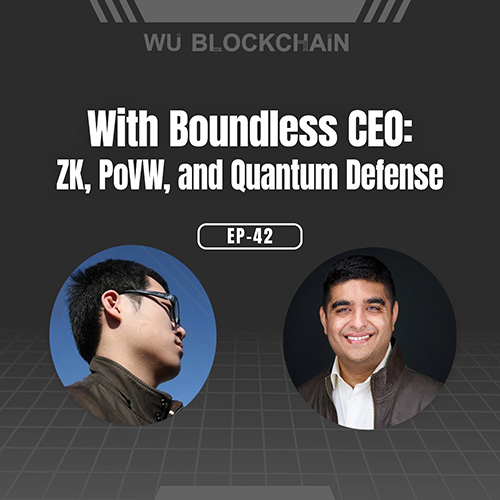
EP-42 With Boundless CEO: ZK, PoVW, and Quantum Defense
About this episode
This episode of the Wu Blockchain podcast features an interview with Boundless CEO Shiv Shankar and RISC Zero Head of Global Marketing Tina Liu, focusing on the Boundless mainnet, the step-change in ZK proof performance, and token economics. Boundless, introduced by RISC Zero, is The Verifiable Compute Layer built in Rust. It provides a componentized stack that simplifies ZK integration, performing computation off-chain while using ZKPs on-chain for cross-chain interactions, batching proofs from heterogeneous systems to reduce on-chain verification costs and improve developer efficiency.
Key takeaways: ZK has moved from a "research topic" to mass production, with applications compressing Ethereum block-level (single-block) proofs to ~12 seconds. Boundless achieved decentralization on day one, distributing rewards by contribution via Proof of Verifiable Work (PoVW)—emphasizing "more work, more pay" and non-forgability—to avoid single-point oligopolies. During the public test phase, the mainnet exhibited a Jevons effect: lower costs expanded usage. The project positions itself as the operations and distribution layer for ZK compute, expanding demand through collaborations with Stellar, Base, and EigenLayer. It also stresses the post-quantum advantages of ZK—especially the STARK family—and counters compute monopolies with open bidding and a cloud price cap.
Text summary: Link
Timeline:
00:00 Why can Ethereum block-level proofs be compressed to ~12 seconds?
03:46 How to balance high-yield narratives with token stability?
04:15 Why insist on day-one decentralization?
04:47 How does PoVW measure contribution and prevent forged work? Why call it an evolution of PoW?
08:34 How does borderless mining attract new classes of compute providers?
09:28 Why did a misunderstanding arise around the Kaito airdrop?
11:02 Demand-side uplift driven by partner networks
16:19 Cost-down applications for extreme workloads
19:17 When proof costs fall, the Jevons effect emerges
20:24 How do ZK and AI combine?
25:07 How to address quantum threats?
27:08 How to prevent compute oligopolies?
29:06 What are the strategies for China and Korea?
37:26 Pathways for government–public chain cooperation on post-quantum security
38:22 Closing & next steps
在小宇宙查看该单集文稿
Get every episode summarized
Each time WuBlockchain Podcast publishes, we email you a written briefing from the transcript — the topics, who appeared, and any specific claims, with the ad reads skipped.
Email me new episodesFree for 3 shows. No card needed.
No transcript yet
This episode has not been transcribed. Request it and it moves to the front of the queue.
More episodes
More from WuBlockchain Podcast

EP-53 Sui's Bet on Payments, Stablecoins, and AI Agents
WuBlockchain Podcast

Vitalik on Ethereum's Role in the AI Agent Era
WuBlockchain Podcast

Arthur Hayes in Vegas: War & Credit May Push Bitcoin Higher
WuBlockchain Podcast

Vitalik in HK: Where Ethereum Is Headed in the Next 5 Years
WuBlockchain Podcast