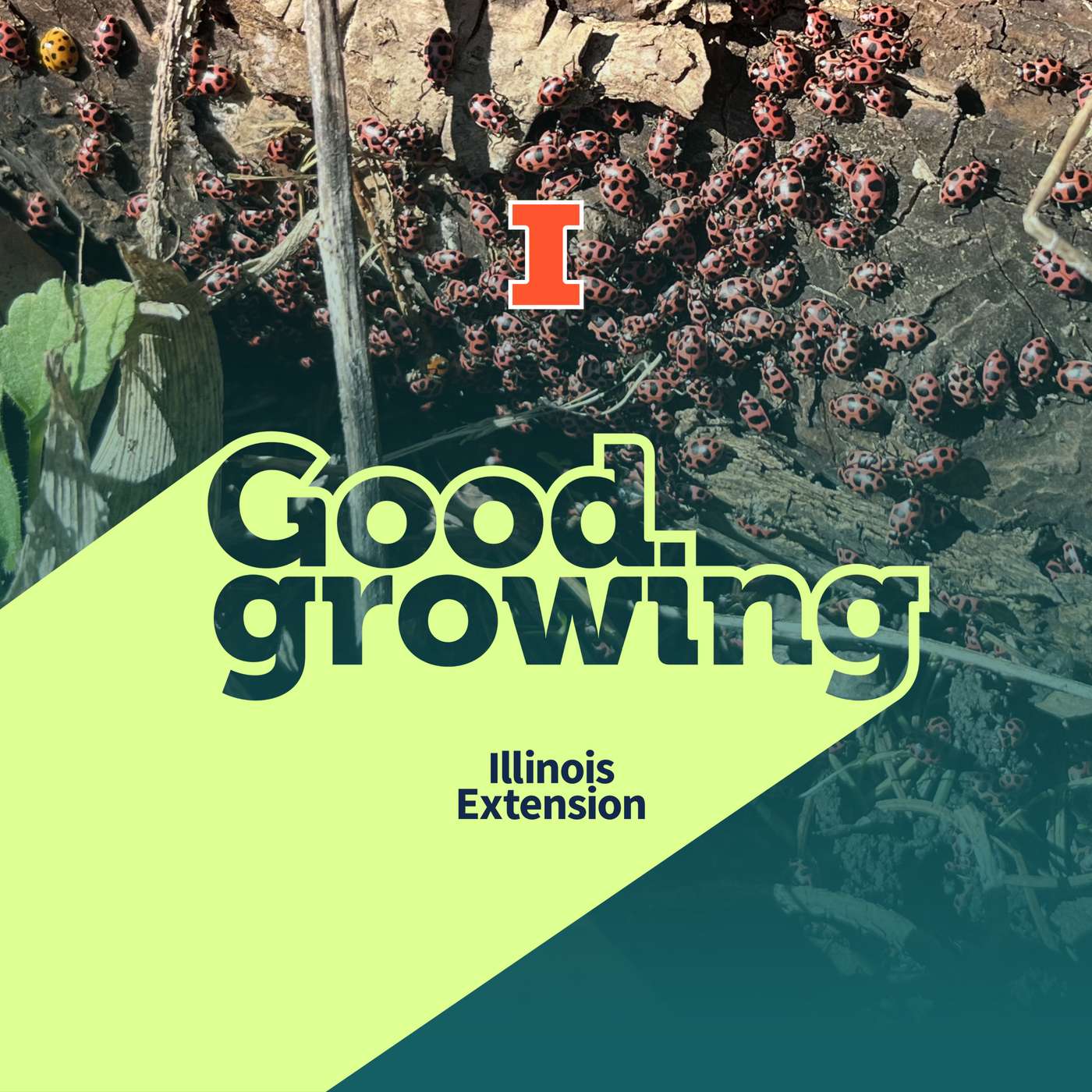
Ep. 265 Insects in the fall and what we can do to help them | #GoodGrowing
About this episode
As summer gives way to fall, insects are busy preparing for winter in a variety of ways. Tune in to this week’s Good Growing Podcast as we explore which insects migrate, which stay put, and how they survive the cold months ahead. Plus, learn what gardeners can do this fall, from leaving leaves to delaying cleanup, to help support beneficial insects in the landscape.
Watch us on YouTube: https://youtu.be/zDhAISO3wlA
Skip to what you want to know:
03:24 – What insects are we seeing more of in fall?
11:35 – How do insects survive the winter months?
24:27 – Creating overwinter habitat for insects
37:16 – Fall landscape clean-up with insects in mind
44:28 – Should we clean up vegetable gardens?
47:08 – Insects coming indoors in the fall
53:44 – Wrap-up, what’s up next week, and goodbye!
Insects on the move – dragonfly migration
Migratory Insects of North America
How do insects survive cold weather?
Removing autumn leaves in residential yards reduces the spring emergence of overwintering insects
Evolutionary impacts of winter climate change on insects
Contact us!
Chris Enroth: [email protected]
Ken Johnson: [email protected]
Emily Swihart: [email protected]
Check out the Good Growing Blog: https://go.illinois.edu/goodgrowing
Subscribe to the weekly Good Growing email: https://go.illinois.edu/goodgrowingsubscribe
Any products or companies mentioned during the podcast are in no way a promotion or endorsement of these products or companies.
Barnyard Bash: freesfx.co.uk
--
You can find us on most podcast platforms.
iTunes - https://podcasts.apple.com/us/podcast/good-growing/id1446630377
Tunein - https://tunein.com/podcasts/Gardening/Good-Growing-p1187964/
Spotify - https://open.spotify.com/show/202u3siWExE1tTqrVgtmCR
Vurbl - https://vurbl.com/station/good-growing-4pljnNlUtyG/
Listen notes - https://www.listennotes.com/podcasts/good-growing-chris-enroth-cHLPMWpvEOG/
Ivy - https://ivy.fm/podcast/good-growing-167902
Castbox - https://castbox.fm/channel/Good-Growing-id4302614?country=us
Get every episode summarized
Each time Good Growing publishes, we email you a written briefing from the transcript — the topics, who appeared, and any specific claims, with the ad reads skipped.
Email me new episodesFree for 3 shows. No card needed.
Hosts & guests
Transcript ready
671 searchable segments. Every word is indexed and playable.
Full transcript
Good Growing — Ep. 265 Insects in the fall and what we can do to help them | #GoodGrowing. Machine-transcribed; use the interactive transcript above to jump the player to any line.
Welcome to The Good Growing Podcast. I am Chris N. Roth, Portugal Gedigator with University of Illinois Extension. I'm going to get from Maccom, Illinois, and we have got a great show for you today. The days are getting shorter, the nights longer. The insects are still around. We're going to talk about some of these fall insects. The good and the bad too. But you know I'm not doing this by myself. I'm joined as always every single week by Ken Jotson. Portugal Gedigator in Jacksonville, Illinois. Hey Ken. Hello Chris. Let's say all insects are good. Some are just misunderstood. I love they. That's another good growing t-shirt right there. We could have a, we could probably write a song with that lyric right there. You just made up too. So I love it. I mean, probably say the same thing about plants, but they're not as cool. That's true. That's true. Insects are fascinating. Yes.
But you know, we're also joined as always every single week by Portugal Gedigator. Emily's Why Heart in Myland, Illinois. Emily, hello. Hi guys. Ken, you're just, you just have the best lines. So I appreciate you for that. And Chris, I believe you are a guitarist at heart. And so we could have a little, a little band situation here. No? Yes. This will be a fun topic. You know, we don't talk about insects enough, maybe in some opinions. And so this will be a fun one to some opinions. I agree. We, we could always talk about it more. Insects, I think are fascinating. And I think why we do talk about them. They're everywhere. They're all over this planet. There's more insects than there are anything else. And people are scared of them. A lot of people are afraid of insects. And so the more we can talk about them, the better understanding. Maybe we can create understanding breeds familiarity,
which can breed maybe not fear, hopefully. Yeah. I will say like I kind of brought this to the, to the group here for a conversation is I, I am not an entomologist. I am one of those people. Even honestly before I came to Accenture, I was aware of insects. Didn't love them. Just kind of like avoided. Didn't hate them. Wasn't afraid like, understood that they're part of the healthy ecosystem. Accepted that. Just fine. But I didn't pay any attention to them. And honestly, until I met Mr Johnson here. And I now attend to you like, pictures of different things jokingly saying I'm angry that you're making me look at bugs. But like it's, it's so fascinating. Once you start to see, you know, and pay attention to the abundance of diversity and how they are really contributing to these ecosystems we steward and oftentimes really love. It's so great. So can I do hope you know that I am kidding? What? I'm so angry.
I'm angry that I'm down here looking at this insect. Because I'm not. I am appreciative. And so today, hopefully we can build some appreciation. Text there is nothing but anger. It's that little face with the red. That's like real red. That's me. I'm not angry gifs. Yeah. Well, I mean, fall is kind of a time where we tend to see maybe not more insects, maybe more of certain types of insects. I will just maybe kick off and say, you know, I was on the back porch yesterday and I saw several like bald-faced hornets. So these are the kind of the hornets. They have black bodies with white markings on their face and their abdomen. I don't really see those in the summer. They're around. But it's when we get into this time of your late summer early fall, they really seem to really pop more. I don't know. Do you guys see tend to see like wasps or hornets more often this time of year?
Yeah, they seem. I think a lot of that's because you've got you've got these nest that have been growing all year. So you know, they're kind of hitting the peak population now. And we think about what's going on landscape. A lot of our flowering plants are pretty much done for the year. You know, not a lot of people are planting golden rod and aster's and stuff and a lot of landscapes. So we've got fewer food sources for the adults because the adults are feeding on nectar. So they're a lot of time to seem around people more often because they're looking for food. And things like that. Yeah, I will observe them more on the flowers in my landscape. So that mountain mint, you know, that I love so much when it was blooming. Had a whole lot of wasps. I did notice that golden rod, very popular. And it's interesting. I wish you observe the different seasons and so. Yeah, the wasps. I also do see those orb weaver spiders. I love watching those like form really cool elaborate webs. I was like, do on them in the morning. And I just think that that's a really lovely aesthetic.
I also appreciate that I can see the webs and then I don't walk through them. Because I live off putting. But I honestly don't know much about them though. I don't know kind of you have any fun facts. Chris, you do. I just know that they're there and appreciate looking at them. Fun fact, they make for great free Halloween decoration. Especially this time of year. I highly recommend orb weaver webs and to avoid the fake Halloween decorative spider web stuff. Because the U of I vet school routinely post the animals and wildlife that get caught up in those fake spider webs that we people tend to put out once we get in October. So try to avoid those. Embrace the spider webs naturally occurring on your house. One of the cobwebs inside your house. Those two adds character.
I'm going to call your wives since you've they agree. Oh, completely opposite thinking. My wife, she actually was knocking cobwebs off of the front porch. And I was like, stop doing that. Who cares if like the delivery driver gets a face full of orb weaver? She's like, can't have cobwebs all over the house like this. But as she was walking towards me, she had probably a silver dollar sized orb weaver on her shoulder. I just very calmly said, hey, hang on, let me grab that for you. I pulled it off her shoulder and then showed it to her. And then she was like, this is why it's why I knocked him down. How excited was she about that? She was not excited. I mean, the opposite of excited. I think you call it angry. I don't know. The new emotion that she just discovered. I just figured that one out. Yeah. I'll say one more thing like so. Another insect I'm observing a lot more of and we can get into why I am seeing more of this.
Dragonflies. I'm seeing even at my son. He's a pretty enthusiastic outdoor kid. He loves like nature and like all the things like he would be excited to have an orb weaver on him. He would probably want to keep it and you know all those things. Even commented that he was seeing all of the dragonflies flying around last night. Like in mass and so that's a fun phenomenon that we get to experience. Kind of played summer early fall over year because they are migrating. Do you guys have a bunch of dragonflies? We have a little different landscapes that we're living in. Do you get that over my pasture? I just see them all over the place. A couple of years ago we had a bunch moving through our yard in mid-late September. So we'll see if this year they're coming through or not. I got a fun dragonfly fact for you. From a prehistoric perspective they're one of the first animals to take flight.
I can see that. Yep. Can't you? Doesn't that make sense? Yeah. Yep. That's neat. I will share that with my son. He will really love that too because he was a dinosaur. A dinosaur kid. Now he's an outdoor kid. I eat chicken too. But insects, I think they're around with the dinosaurs. So yeah. Very cool. Okay. Anything else? Caterpillars? We do see more caterpillars in the fall. Kind of just. Maybe related to spiders. The people are like, what are all those spiders doing in my trees? And they're like, oh, that's actually fall webworm. So I am seeing a lot of that right now. Fall webworm occurs on the tips of branches usually. There's also eastern tent caterpillar which you would usually see earlier in the year. They occur in like the crutches of tree branches.
So I think you can. Can you get two generations of eastern tent caterpillar? Is that possible? I don't see them. I'm not sure. I don't know if it's up to me. Yeah. I don't know. Even early spring in a late fall. I don't know if that would impact them at all. But by anyway, seeing a lot of the fall webworm. I also have been driving around. And I don't know if this I haven't like gone up to verify. I've seen a lot of honey locusts that have appeared to have a lot of feeding damage. So that would be mimosa webworm. But I I literally just saw this yesterday. I was just driving. I was like, saw one honey locusts. Whoa, that half that tree's been eaten. And I saw another honey locusts like, oh, that tree's been eaten too. So I need to like drive by slower and verify like mimosa webworm. Are you here? Yeah. We've got, um,
Oh, I'm John and Mike on the weed now. Low growing prostate and kind of succulent. Red stems green leaves yellow for sliders. First line for sliders. So we got we got some of that. You'll control in our watermelon patch out at our lookman garden. So I've been pulling that in a lot of white lines. Thanks, moth caterpillars on their big. Big juicy ones getting ready to pupate. So seen a lot more. It was over a lot of those caterpillars. They are getting ready to pupate if they're going to overwinter. It's pupa and things like that. So sort of seeing them on the move a little bit more. Holy bears. The woolly bears. Yeah. Yeah. They're moving though because they're like, they're leaving kind of where they feed and they're going to where they overwinter. Right? Like they're next stage of that life cycle. Yeah. Whether they overwinter as caterpillars as larvae or they're going to pupate. A lot of times they're pupating in the soil leaf litter. They have their moving.
A lot of them moving to a protected area or to dig underground to do overwinter. Well, I think that's a good transition. Unless we have another insect we want to mention that we're seeing a lot of. I think that's a good transition into kind of what different insects like, can I high level? What do they do to survive winter? So winter is hard on a lot of us. The temperature drops food resources become more limited. Water is a limited resource food is limited resource in the temperature. Plus dryness. So there's kind of all these like factors, environmental factors that insects and others need to prepare to either survive, not survive, but make sure the next generation continues or leave. Right?
There's kind of like somehow survive yourself. Have the next generation be prepared to survive it or just give it up and die. And there's new ones in there. So like, right, I'm not missing any. Let's talk about each of those kind of in a little more detail. So what about the ones that do what I wish to do, which is just go. Just go to a warmer climate, sometimes much warmer, sometimes just a little bit warmer, but a migration. So can you want to talk about, like, who's migrating, kind of where they're migrating to, what that looks like and what we might be observing? Yes, here in Illinois, Midwest, I guess, north, eastern or northern part of the US, eastern US. I think monarchs, leaving in the West Coast, monarchs, kind of the classic example that were there migrating from Canada, the Midwest down to Mexico, so they're basically
avoiding freezing temperatures by leaving the area. But there's other things that you mentioned, dragonflies. Green darn are dragonflies. I think finalists, there's like 14, 15 different species of dragonflies that'll migrate. But for like the green darn or some of them will migrate, usually starting August, mid-August, in further north, and then when you get out of Illinois, they're leaving or starting to show up September, October, time frame, as when they're moving out of Illinois. And they're going down to the Gulf Coast, Mexico, in the case of like green darners, sometimes there are resident populations, so they will stay in more northern areas, the overwinner as niads, the larvae, the larval stage for a insect with incomplete menomorphicists. So they hang out in water by as a water, and then they will, so their life cycle is much longer than they're staying around, multiple months, like nine months, something like that, whereas if it's one of the migrating, it's a couple months, so they get down to the Gulf Coast,
the lay their eggs, and the new generation will come up and stuff like that. And there's actually a list somewhere from Texas, but together with lists, there's like 70 some insects in North America that will migrate, and we can include a link to that. So there's some mentioned, a bunch of different dragonflies, a couple different species of grass hoppers, large milkweed bug, which we see on feeding on milkweed pods and stuff like that, is one that will potentially migrate. Some leaf hoppers, so potato leaf hopper, maybe when people are familiar with that's even the spring they're getting blown up from southern parts of the U.S., and we get that hopper burn sometimes on trees that can look like herbicide damage, or some of that, the feeding damage that I think is in the spring. Some aphids, some beetles that will, and then a whole bunch of different types of butterflies in addition to, and Maws in addition to monarchs, we'll also do some migrations.
I mean, it's an effective strategy, you know, you don't have to do any adaptation, you don't have to kind of worry about, and we'll talk about this next, which is like the variability of our winters, you know, and how sometimes, you know, Christina alluded to, like sometimes we have early springs and late falls, and like that affects anybody that's staying here. You know, there's dryness, maybe that could affect some of those migrating insects, you know, in different kind of climate patterns elsewhere, but not the freezing temperatures, not the cold, so. What about the one? Oh, go ahead. I say, well, like monarchs, so if you get into that food availability, you know, with monarchs, you know, we've got the big bush to plant more milkweed for the caterpillars, but if you're not planting any foaming plants along migration route, it's kind of a dead end, so you got to have, you got to have the food resources for those things, migrating out of the area too. Yeah, that's an excellent point, and a lot of them are nectar feeding.
Um, but, um, the grasshoppers, what do I, what I just mentioned, we're watching dragonflies. Wow, that was painful guys, sorry about that. Um, they are, they're eating insects when they're flying around, you know, so having habitat for kind of just like a robust habitat, not just a couple of flowering plants, like this is that argument, and this is the reasoning for having a diverse landscape that's supporting a whole food web. Um, so anyways, okay, so anything that's staying here, there's different strategies, so some of the adults over winter, sometimes it is different, different stages of their life cycle, not just adults, sometimes it's eggs, pupa, larvae, you know, depending on the species, um, who wants to talk about what that might look like in some factors, I know there's just, there's some different factors that go into their survival and the different strategies.
We can maybe break this down, talk about some of the studies we read for this. So I think there's two, if we're gonna stick around, there's kind of two ways they're gonna do this, they're gonna be freeze tolerant or freeze avoidance, so with freeze tolerant, they are, you know, creating chemicals in their bodies, basically they're trying to control the way they're, they're gonna freeze, they're trying to control the way they freeze, so it's nucleation points, pumping water out of cells, basically they don't want the cells, it's a freeze because they'll burst, so they're trying to control where the body is freezing and how quickly it does that. Um, and that, and when that happens, like I think they can tolerate temperatures down below negative 40, so this is a very successful way to do this, not a whole lot, most insects, though, are gonna be more the freeze avoidance, so they're making like, anti-freeze chemicals in their bodies to reduce their, their freezing points. So, for example, a lot of Japanese beetles, it's called super cooling point, their super cooling point is 19 degrees Fahrenheit,
mammal ash borer is negative 13 degrees Fahrenheit, cobbling moth is negative 10 degrees Fahrenheit, so they can basically lower the temperature, which they freeze, they will eventually freeze if they get cold enough, but they can lower that. And then, for these, well, all these insects, they're gonna be looking for protected locations to do this, that's gonna moderate the temperature compared to being out exposed for the most part. Can we just repeat that real quick? Because I think that is such a key point to our mythbusting thing, we can, we can mythbust it now, which is that like, sometimes a really cold winter will decrease insect populations, and you just mentioned a few insects that I think most of us would agree we would like to not have, you know, have, have, have an abundance every year. So, so Japanese beetles, 19 degrees, if we get colder than 19 degrees, many winters for sustained
length of time, and so that would reason that that takes care of the problem, yes, but we've all lived and, and know that that's not it. So, you said, in addition to this, they are seeking shelter and protection from elements, and so that kind of adds another layer of protection to their overwintering strategy, that it's gonna moderate their, the temperature fluctuations in their environment, or keep them around that 19 degrees, yes. Yeah, so we have a Japanese beetles, they're overwintering as larvae underground, and they can burrow down into the ground, what is it? 8, 12 inches, something like that, so they can get down below, you know, we can have polar vortex come through, or it's negative 20, mayor temperature, but that under the soil, if you have any snow, that's gonna be further insulation, it's probably not gonna get that cold, unless it's gonna be really cold for a really long bare soil situation, I would say it's
typical winter we're not getting cold enough, in Illinois, and most of them in West, where it's gonna kill them. Same thing with animal ash, where those larvae are, in the trees under the, in that cambium layer, so it's not quite as much protection, but they're still protected, what was the US Forest Service was at zero degrees Fahrenheit, 5% of the insects will die, so even though they're super cooling points in negative 13, you're still gonna have some die regardless, 34% die at negative at negative 10 degrees Fahrenheit, negative 20 degrees Fahrenheit, 79% die, and a negative 30 degrees Fahrenheit, 98% die, but you're still gonna have a little bit of that insulation under the bark of the tree, so air temperature is, you know, negative 10 degrees, if it's not gonna be negative 10 for an extended really long period of time, where that cold can penetrate that tree, it's probably not getting that cold underneath the bark or in the soil, any of that. Okay, well that will save some people some phone calls this winter to extension.
My family members talking to you. Okay, so I guess we talk like what do the adults do, so you just talked about larvae. So that just depends on the insect. I'm trying to think I won off the time I had that would be an adult. Pink lady beetle? Yep, yeah, so the native pink lady, be the other, when I found them like under tree bark and wood piles, things like that, you find them in there, so each individual species is gonna overwinter, if they're overwintering in an area, different way. So it could be like you said, egg, larval stage, as a pupa, as a pre-pupa, or as an adult, so it just depends on the species that you're looking at as to how they're gonna right out the winter, so to speak. Okay, an interesting thing I learned about caterpillars, especially the spiny ones, like the moths, when they go into their pupa, their cocoon,
a lot of times their spines will become part of their that outer covering of that cocoon, so if you have a spiny caterpillar that has like venom, you know, they sting, it gives you a rash or something when you touch them, that also still happens over the winter when they're in their cocoon. So when you find a little moth cocoon in the winter time and it's all fuzzy, doesn't mean it's safe to pick it up, so just just a word to the warn, wait, I said that wrong, warning to the world. I don't know how to talk, it's a podcast, I forgot how to talk. Don't pick up fuzzy caterpillars. I was I wasn't asked how did you learn that? Was this a literary review or was this an experience we had? It's from a read this on an apology podcast, read it, listen to it, guys, hold on. Can you got to hold this together? I'm not going to be helping
help much either. It's fuzzy pick it up with your non-dominant hand. That's my if you feel the urge to pick it up because you're non-dominant hand. Yes, there you go. Or a glove. That would work. But you got to find out what's going to happen, like how do you know? Maybe it's maybe it's perfectly fine. Well, well, the bears are typically not going to bother your skin. Okay, let's move on. All right. Anything else we want to say about how I started use for overwintering because I do want to talk about, can you mention some that are less desirable, but there's a lot of the beneficial insects. And part of the reason I brought this to you all to learn about is because we spend a lot of time talking about beneficial insects and helping pollinators. We have a whole pollinator week in June that we celebrate. We do programming on how to help rear beneficial insects throughout the growing season. But now we're heading into another
season. There are still things we can do and strategies that they have developed that we can also help enhance or at minimum not hurt with some of our landscape management practices. And so I kind of want to make sure that we get into that before we get too far along here. So folks have takeaways. Can you kind of already mentioned it where they're they're overwintering in the soil. So we're all going to leave our soil. Do we? That was a joke. Of course, we're leaving our soil. But should we, like for trees, I'm saying like we got to water the trees, you know, like that's going to help the root systems develop going to help moderate soil temperatures going to, you know, be a water resource at least until that ground freezes, you know, before winter and then after winter it's going to be available right away for those tree roots. Like the same applies for insects with
that temperature moderation, right? And so a moist soil is going to help insects more. Is that a good assumption? Yeah, it's going to retain that heat a little better than if it's really dry that, like that cool cool temperatures will be able to penetrate deeper and angrier soil than a a well-wattered moist soil. And we can't control it, but snow has an insulating effect as well. I know, you know, same with the tree roots like we like to have snow on the ground because that does help moderate that fluctuation. I'm going to keep that water from evaporating even in the winter months out of that soil. So we'd like to have snow and it's beneficial and it can be pretty. This fall though, we can also leave things, we couldn't, you're sent a couple of interesting studies for us to read that looked at leaf removal. We're going to be dealing with leaves here
coming up in the fall. We get a lot of questions about what do we do with them? Do we chop them up? Do we leave them on the landscape? Like they're going to smother my grass? What do I do? Do I bag them up and ship them off? Do I? You know, like there's a lot of options. Today we're talking about insects. What do we know from that perspective? If that is one of our landscape objectives, keeping habitat for insects over winter, what do we do? Yeah, so the paper we were looking at is removing autumn leaves and residential yards, reduces the spring emergence of overwintering insects. So this came out last February. Now this is done in Maryland. So basically what they did is they went to, I think they had what 20 different yards and they went to the first year and then they had a low maintenance area, high maintenance area that removed leaves from each of those areas and left an area where the leaves were let retained and they looked at the number of insects that emerged from those areas the following
spring. So just from the abstract here, overall leaf removal decreased the abundance of emerging arthropods so that they looked at spiders. This is insects and spiders by 17% with some tax and more negatively affected. Maws and butterflies were reduced 45% beetles 24% and spiders at the 67%. They also looked at parasitic wasps and flies. They were also declined but not quite to the extent. And then depending on the type of species that were emerging, so if you removed all the leaf litter, you had different types of insects emerging. So which makes sense to you, a lot of the the leaf mining insects, maws and stuff like that, remove the leaves. We don't have them anymore. So we talk about pest control. That may be a good thing if you don't want those leaf mining insects. But it kind of changed what species were emerging. The ones where they had just grass,
majority of those insects that were emerging for the maws and butterflies were ones that overwintered in thatch or were feeding on grass, which makes sense. So I did have a question for you, though, can if there's no statistical difference between the high maintenance and the low maintenance, one of the factors of the study was all the yards selected none had been using insecticides, like lawn insecticides. Correct. So I mean that might play a difference in a two if you are shifting from more of a high maintenance lawn where you are using things like grub control and stuff like that. And now you're just going to cut that all out. There might be a difference in those two different maintenance regimens. I think they did no fertilizers, no pesticides. They can isolate only the presence that we use but they get into part of the discussion.
So some of the reasons they put in here for why the high maintenance areas sometimes had more, or it just as many insects as the low maintenance, which would be kind of counterintuitive to what you would think a lot of times. Part of what they said is that the scarcity of leaf resources in high maintenance areas might create a more attractive location for those insects when they're wandering in the larval phase. So you've got an area with no leaves so they're going to move into that so you're drawing them into this area which could have been why they were seeing that among some other reasons as well. So there's some reasons why they think that may have happened that you need to do some more. More research is needed to find out why exactly that was. So the selection process for these yards, I was really excited as I started reading. The
methodology was they had over a hundred respondents when they asked for people to volunteer their yards. And I was like, that's amazing. And then I kept reading and they selected 20 and then eventually was like seven dropped out of a portion of it. So it is a limited study. I don't mean to bring that up to be like, well, this is invalid because it's absolutely not. It's just like there is more, it brings up really interesting questions. There needs to be some replicated studies. And I imagine that was probably because of funding limitations, time and resource limitations really would narrow down that pool. But I think yeah, it's second year half of them dropped out. So in the early 10, the second year. Yeah. So the volunteer me heard. I throw that out too. I like if anyone knows of like a community science project that's along these lines, let us know. I think people would be interested in providing the data.
Yeah. Yeah. It also kind of goes into the paper that I found, which is talking about climate change and like the evolutionary impacts of winter climate change on insects. And so you know kind of made the point that the climate is changing and evolving, essentially having our winters have a more substantial temperature change than our summers. And that can affect the overwintering populations of insects as well. There's more to be said about that. There's different. I'm trying to like summarize it where and this please jump in if I'm misunderstanding this. You have a much better understanding than I did. But the couple of things that I found fascinating where there's the phenological changes that also affect overwintering of insects, especially ones that are doing it as
adults or in those later stages. So I would tend my logic goes that a warmer winter, we would not have that as many kill, you know, that as much loss from cold temperatures for overwintering insects. Like that's a good thing. But in some cases when we have these fluctuations that can break down some of those, they almost like their metabolism starts speeding up when it gets warmer. And so then they're using energy resources that they had reserved either for when they actually do emerge in the spring or I'm just sustained their life through the entire winter. So when that temperature starts warming up, they're using energy resources and it may, depending on the winter, might be a detriment to their survival even if they make it through winter because they don't have feeding mouth parts and so they can't, you know, regain any of that energy loss to complete, you know, a breeding cycle or they just don't have enough access to nectar in the
early part of the season. So, you know, planting those early, early blooming plants can be a benefit to so many of these insects. Kind of a, I like to think of it as like extending our winter care for these insects. My planting was like really early blooming spring plants, but they're limited plant pallet for sure. It just like, I had not thought about that. Like we talk about it from a like a turf grass perspective, I get that question a lot. It's like, oh, do I water my grass in the in the summer months or not? And it's, my answer is along the lines of, if you're going to do it, it needs to be consistent. So you're not depleting those resources, that energy reserve, and stressing the turf grass. That's all I thought of when I was reading this. We're like, that's the same principle. Well, we can't control as much of the temperature in the winter. So just involving condition of our changing climate. Do you have anything to add? I, that was probably just
the most basic summary. It was a fascinating read. I could just read it to you guys. I'm going to do that. Sure. Let's go for it. How many pages was it? A couple. Now, I, I will equate it to something that happened to me this very morning. For some reason, our smoke alarm went off at 4.30. And I don't, we couldn't figure out why. But you, we got woken up, disrupted our sleep. Man, I have been out of sorts all day. Imagine if you're an insect, like you are supposed to be in your, your diapause state, your hibernation state, or, you know, or you're in a, a pupa and all of a sudden, the temperature changes and you spin that energy to, to emerge, to reach your adult form. The same thing happens to plants too. I see this with like garlic. We get these like super warm stretches in the winter. And we get these stunted garlic
bulbs because they're like growing. And then they get hit by the frost. And then they're growing. And then they get hit by the frost. So, um, yeah, it, it messes you up. And what, in reading that, that paper, they, they talk about how it's just kind of, we have a more unstable jet stream. Because we have less stratified layers between the cold poles and the warmer equator. We just, it, it's just, it's become less of a layer cake. It's become more homogenous. And now the jet stream, just to get to go, we, we all up and down. And so we get these wild fluctuations in weather. And then your smoke alarm goes off at 4.30 in the morning. Okay. So, what do we do? Can we just summarize what we do? We kind of cover quite a bit here. And I, I'm still new to the world of insects. Like I just, I have so much to learn. And so like, can, can you just like
break it down? Like bullet point for me, what I'm doing this fall, I do want to provide habitat in my landscape. And I'm confused about what do I do with the leaves? Still a little bit based on this survey, you know, this research. Can I move them? Can I leave? Should I leave them? Can I, you know, and so that's the tree leaves. What do I do in the landscape beds as well? And then we'll, it's good to the vegetable garden, but that's a lot, I treat that separate. So, let's get there then. So yeah, so in the, I guess in the landscape ideally, you believe in the leaves. But we live in, we don't live in the, the ideal world. So I'm like, if you have turf and you have a heavy layer of leaves on there, you're going to smother your turf and kill it. So, you know, in areas where you've got to refresh that you want to keep alive, you break that, ideally, move it to an out of the way area. Don't bag it up and put it, you know, have the city or or burn it or whatever. Out of the way area, so if things are in there, they do have the potential to
you'll write out the winter and emerge in the spring. If you've got a, a light layer of leaves on your grass, on your turf, you know, you can leave that. If you can still see the turf, it's, there's probably enough light's going to get in there. It's going to survive as long as it's not matting down. So, you know, out of the way areas, you know, landscape beds, you can leave that stuff, again, as long as you don't have like a two, three foot layer of leaves, it's going to smother stuff. You can leave that stuff, stuff a little winter and then you can clean it up, come spring, if need be. So, if it all possible, leave it. If not in your little more high maintenance areas, areas where you want turf, remove it, but if you can, leave it on site in a out of the way area instead of moving it off site to be composted or burned. If we're only looking at insects, not only worried about the insects, that's what we want to do. Okay, I can handle that. Also, do you promise to kill my turf grass?
Yeah, we have enough on there. It'll kill it. Just kidding. This is an ongoing battle. It's okay. What about in like the ornamental bed? I do have a lot of native plants. We haven't touched on this overwintering in the stems or, you know, like, so we've talked about this a bit in the past, but and we could probably go into it a little bit more if you want. We have time. What about stem stem stem stem stem stem. Nesting Wow. Guys. Stem nesting. Did your smoke alarm go off in the morning too? My brain is just like malfunctioning. Wow. Stem nesting brilliant. Okay. What about those insects? So we got some bees and some wasps that'll nest in stem flower socks, usually. Those are howl flower socks. So they'll do in the spring.
You know, they'll lay their eggs in there. They'll provision those, those nest, those individual cells with pollen and stuff. Larvies will feed on it. These are their overwintering as larvae or pupa, but they're going to overwinter in those stems. So if you want those bees around, you got to leave those stems and they'll emerge come spring. So usually when we're talking about clean up, we're talking about native plants, you don't need to really do anything in the fall. Just leave it be, you know, they're, you get the stem nesters, there's things all the eggs on, on leaves or maybe overwinter at the base of plants. Similar to that you wouldn't leave litter. There are insects overwintering in various spots in these native plantings as well. So usually they're kind of the typical recommendation is don't do any cleanup until soil temperatures reach 50 degrees. By then, you know, in theory, most of as emerged in this paper we talked about, they were still catching stuff well past 50 degree soil temperature. So maybe that should be adjusted. But typical recommendation is whenever you put your tomatoes outside, that's when you can
clean up your native plants. And even then you're not, you know, cutting them down to the ground typically, you're leaving those flower stalks behind so things can utilize them again. And if you are removing that stuff again out of the way area in landscape, if you can brush pile or something like that so that if there is stuff in there they have the potential to emerge. If you've got a giant brush pile, it's, you know, 10 feet wide and 5 feet tall, stuff in the middle is probably not getting out. But if you've got a smaller brush pile, things should be able to do in theory, emerge from there. I'm glad you mentioned about putting it out of the way because you know, you take your cleaning up your landscape when you're planting tomatoes. That's late in the season for a lot of people. That's going to be a hard aesthetic to tolerate. And so I appreciate you offering that kind of plan B option for moving them out of the way. A lot of this is
is your how much messiness you can tolerate in your your aesthetic, what your aesthetics went to me. And what maybe your city or I want to association will allow as well. So I mean, if you could leave like a 24 inch cut, stand the flowers, if you could leave that stubble there for a year's time. And then in that second year, I mean, that would be a, I think a really good resource for a lot of insects because they would, you know, if we're cleaning up this fall or not cleaning up next year, they'll emerge, they'll utilize those stems. We leave them in place until the following year. I mean, we could do create a long-term investment plan for these insects. And so yeah, just if you can leave that stubble there, but I know a lot of people they'll they'll chop it and they'll just drop it wherever it is. So they'll chop and drop.
Pretty mulch. I also read, I've been learning more about stem diameter size. It's interesting. The one study that I'd like read more in depth was it was a specific species of B. And they went from like four millimeters up to eight millimeters. And it said that the B could utilize stem diameters of all that whole range, but they found that larger, more robust individuals are emerging from the larger millimeter stem probably maybe because they could just provision them with more. They said more space. There's more to learn there, I think. Oh, future show can. The nebulae. Do we talk about vegetable gardens? Oh yeah, what do I do there? So that's a vegetable gardens is probably the one area where you do want to, well, maybe more than one area, but is one area you probably want to clean up well, especially if you've
had pest problems. If we talk about, a lot of this stuff is overwintering on plant material, diseases do the same thing. Anything about your most your tomato diseases that are overwintering on tomato plants on the plant material left behind. So cleaning that stuff up, you can help remove some of those pest populations, reduce that disease, innoculum in your garden. So that I would say that's one of the exceptions to the rule of don't clean up in the fall would be to have vegetable gardens. So you're not setting yourself up for problems next year. But if you don't care if you're lancere eaten or have disease, that could wait till the spring to if you really wanted it. Ideally in the fall, clean that up. Yeah, you're very, very, very, sorry, great. That's just going to talk about mentions quash bug, quash fine borer. Hate him. Hate him. They are the worst. Just I do do the cleanup in the garden.
And I do the crop rotation and these still still find me almost every year. Yet, but crop rotation, you know, that's another strategy to help with disease pressure and inside pressure. But sometimes we just don't have enough space. And so cleanliness and lancere and the vegetable garden is a good option. What do we do with that? When we just put it to the side, when we do that leaf litter, you mentioned this in the tomatoes, but let's bring it back up. Oh, they're plant debris in the garden. Yeah. Well, lady, if you don't have a lot of disease or pests, I mean, you could in theory compost that. But a lot of times we're not getting our compost hot enough. I would include myself in that, not actively turning it and stuff that doesn't get hot enough or it's going to kill disease. A lot of these insects. So you could bury it, yard waste it, burn it if you're able to. I'd really get it out of the garden as far away from the garden as you can. Make it a little more.
Make things have to work for it to get to your plants. Yes, thank you for going back to that. But yeah, I do make a point to clean up the garden every year because that is I still have problems. This is not a guarantee, folks, but it does help you prepare. Okay, now can we talk about going indoors? And because there's things coming in, I live in an old farmhouse. And it's not as sealed up tight as I think maybe new construction is. And so I get little, I get new pets. I try to think of them as little pets every year. Like why? What? Why are they coming into my home? I do all the things we've talked about. I leave the leaf debris. I don't do much with the perennial bed. Like, what can? Why? If you're cold, they're cold. I know.
So live on the earth. There it is. We got it in their press. I was just waiting for it. So some of the ones we commonly get complaints about are going to be the multi-colored Asian lady beetle. Bromarmade stink books. These are both introduced species. So they're looking for areas to overwinter with multi-colored Asian lady beetle. Malb is some people call it. There are a lot of times you find them. If you're out in the country, you kind of isolated structures. There's nothing else around there. Attracted to that south side of the building, which is warm. A lot of times they're going to under the siding. That's where they want to overwinter. They don't want to be in your house because they're not going to go dormant. It's not cool enough in there. You don't have anything for them to eat. So eventually they're going to die. They really want to be kind of under that siding or something like that. You've got things, you know, middle-of-peed spiders make it inside. They're looking for somewhere to overwinter. If you're bringing plants inside, there's a good chance you're bringing stuff in with those as well.
So most of this stuff isn't going to, it may survive, but they're probably not going to reproduce inside for a lot of the stuff. A lot of them aren't going to even survive because our homes are in the winter homes are really dry. Probably not a whole lot for them to eat, depending on what it is. So, yeah, it's just the seal-up cracks and crevices which again, as you're sitting on depending on your house, make sure you don't have holes and screens. Make sure you're getting into fall, or you're starting to open up your house with cooler temperatures. Make sure they're not getting in that way. Make sure your door sweeps and stuff aren't broken so they can't crawl underneath the doors. The seal around the door, things like that. So, you're probably never going to keep everything out, but you can reduce the number of things getting in and just embrace them. Give them, just embrace them. Just know that you're sharing your home with something wonderful.
Yes, sink bugs and lady beetles. I take a different approach where I just understand what they're doing and I just add it to the cleaning list. Right? Just understand. I don't worry about it. I have a hard time preventing it. Appreciate nature for what it is and then invite them with the vacuum to leave. Not a normal vacuum. That's a perfect vacuum. We empty that canister real quick. I think a really good solution. You just leave that house and go get into a brand new house. Because when we used to be inundated with sink bugs, we got new windows and that cut down on them substantially. Now, that is a significant investment. And I'm also speaking kind of tongue and cheek, go get a new house. But still, it is what Ken just said. Seal your cracks and crevices. And for us, it was we need a new windows because they were
rotting out of the house. We noticed them by the windows. It just is, there's more seams there. And so, living in an old farmhouse, we do notice them by the doors in the windows. It's easiest entry point. Our previous house was relatively new construction. I was only a couple, like five years old. And we did not have issues with that. Luckily, I grew up in an old farmhouse. So I did know what that meant when we moved. And I love it. I'm not writing on old farmhouses. I love them. But they come with character, which is why I love them. And sometimes that character is living in migratory indoors in the winter or in the fall months. So we repets. Repets. I know some people spend all this money on all these pets. And like I just, I get them for free. Lucky me. It's cheaper than the Labrador. Don't have to feed them. Yes.
Okay. Anything else, Ken, that you wanted to remind us of? Touch on before we wrap here? Um, see, I don't, I think the beginning don't be in a hurry to clean up in the fall. It's okay to leave it. I'll write you a note if you need one. I'm saying doctor Ken. Got that sloppy handwriting and everything. We can just should come up with an official letter giving people permission not to clean up their yards. That would be amazing. Put it on a sign that we could put up. That's like your habitat sign. Instead of just a permission letter, I like that. Like a prescription pad. Good. Another thing. Oh, this is good. Okay. Well, thank you. Can I appreciate all of your wisdom and really for sharing your passion of insects? It's not everybody's. I'm getting there. It's really fun to learn about these
critters that aren't our foundational to our ecosystem. Like I like having all of the things that they benefit, um, you know, flowers and songbirds and wildlife and so I might as well learn and appreciate the hard workers of the insect world. So thank you. Yeah. If you want, if you want birds still clean up your yard. So they have caterpillars to eat. There you go. Look at that. We too. What about snakes? Leave them. They're good too. Okay. Just more permission not to clean my yard. Okay. Well, that was a lot of great information about fall insects. Oh, sweet, the good. A couple of the ones that we don't necessarily want hanging around our homes and our vegetable gardens. The Good Growing Podcasts production of University of Illinois Extension edited this week by Ken Johnson. Emily, thanks so much for hanging out with us today and bringing this great idea, talking about, you know, insects later in the season. You know, we always think about them in the spring when they
start showing up, but now that we're used to them, you know, let's give them another little nod as they get ready for winter. Oh, it's my pleasure as always and yeah, I just appreciate your wisdom. You both of you are really just wealth of knowledge like everybody on the podcast knows that and I'm learning with this and so I appreciate you giving me this space to ask these silly kind of questions. They're not silly to me and you don't treat them like that. I know community members have them. You know, this is an important topic and I really appreciate the time today. I'll revisit this podcast more often than than other ones, I'm sure. And Ken, thank you so much. I mean, we could be a silly podcast. We'll have to take ourselves too seriously. So I like, I like silliness, but but thank you Ken for for entertaining all of our our serious and silliness that we bring every week. Silliness is good. Yes, thank you both. Another good discussion and remember,
if you're cold, they're cold, let them inside. We need to make a t-shirt. And let's do this again next week. Oh, we shall do this again next week. Is it time to plant spring bulbs? Oh my gosh, I think it is. We'll be talking about spring bulbs, but maybe not the most common ones that you're familiar with. We'll be talking about some of the minor spring bulbs. Well listeners, thank you for doing us a duet best and that is listening or if you watched us on YouTube watching. And as always, keep on growing. University of Illinois Extension
More episodes
More from Good Growing

Ep. 264 Goldenrod for every garden | #GoodGrowing
Good Growing

Ep. 263 It's Not a Disease! Common Tomato Fruit Problems You Can't Spray Away |...
Good Growing

Ep. 262 Growing orchids at home: Easier than you think | #GoodGrowing
Good Growing

Ep. 261 Horticultural rules of thumb | #GoodGrowing
Good Growing