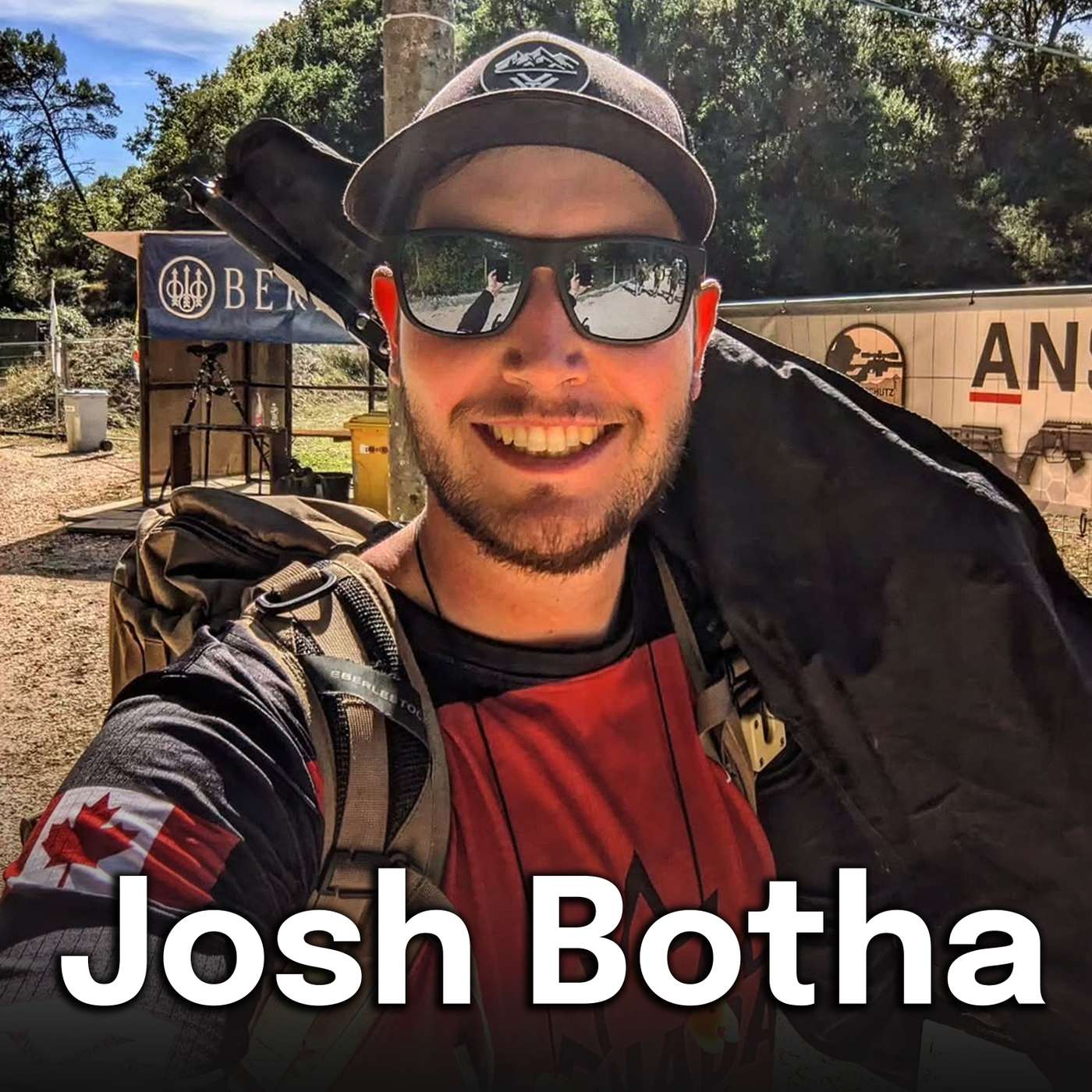
Ep. 181: "The Old Version of Yourself Has to Die" | Josh Botha
About this episode
Josh Botha showed up to his first precision rifle match with a blind-magazine .204 Ruger and no idea what he was doing. A decade later, he's a four-time Team Canada World Championship competitor, senior designer at MDT (Modular Driven Technologies), founder of the BC Precision Rifle League, and the man behind North Star Precision Training.
In this episode, Josh shares his journey from South Africa to England to BC, how archery led him into the precision rifle world, what it's really like inside MDT's culture, and the massive news about MDT acquiring Lone Peak Arms. We dig into the mental game of competitive shooting, the NRL Hunter format, wind reading, barriers to entry for new PRS shooters, the role of faith in business and life, and why one person stepping up can change everything.
🎁 This month we're giving away a SAI Mini Red Dot to an active Outpost listener - Silvercore Club members, activate the Outpost in your member portal to enter!
🔗 Connect with Josh:
- Instagram: https://www.instagram.com/jbotha_/
- North Star Precision Training: [email protected] and https://www.instagram.com/northstarprecision/
- BC Precision Rifle League: https://www.instagram.com/bcprecisionrifle/
- MDT Sporting Goods: https://www.instagram.com/mdttac21/
Optics - https://armament.com/
Ammo - https://www.norma-ammunition.com/
_____
Silvercore Club - https://bit.ly/2RiREb4
Online Training - https://bit.ly/3nJKx7U
Other Training & Services - https://bit.ly/3vw6kSU
Merchandise - https://bit.ly/3ecyvk9
Blog Page - https://bit.ly/3nEHs8W
Host Instagram - @Bader.Trav https://www.instagram.com/bader.trav
Silvercore Instagram - @SilvercoreOutdoors https://www.instagram.com/silvercoreoutdoors
____
Timestamps:
0:00 Intro & SAI Mini Red Dot Giveaway
1:30 Meet Josh Botha: Competitive Shooter & MDT Designer
2:16 Knocking Over Josh's Rifle at a PRS Match
4:24 Growing Up in South Africa & Moving to England
7:00 Family Moves to Canada: Landing on Canada Day 2006
8:33 BC as the Best of South Africa and England Combined
10:00 From BCIT Mechanical Engineering to "Pretensioneer"
11:55 MDT's People-First Culture and Hiring Philosophy
13:16 MDT's Origin Story: From Rooster33 to Martin's Vision
14:28 MDT Acquires Lone Peak Arms: What It Means
16:50 Passion vs. Career: Drawing the Line
18:48 How Archery Led Josh Into Precision Rifle
21:00 First PRS Match: A .204 Ruger and No Idea
22:00 The BC Sniper Match & Why the PRS Community Is Different
27:00 PRS Attracts "Weird Gear Math Nerds" — And That's Great
28:00 The Mental Game: Almost All of It Is Mental Now
29:13 Conscious Competence to Subconscious Mastery
30:06 Wind Reading: The Great Equalizer
30:50 Barriers to Entry: Cost, Fear & PRS .22 Matches
33:50 Launching North Star Precision Training
37:00 Training Venues & The BC Long Range Problem
38:00 Biggest Mistakes New Precision Rifle Shooters Make
39:27 Dealing with Match Pressure & First-Stage Jitters
41:00 NRL Hunter: The Most Fun Match Format Explained
46:00 Gear vs. Skill: LRF Binos, Tripods & Weight Limits
48:03 MDT's Content & Media Strategy: Becoming a Media Company
52:00 Education as Marketing: Magpul, Glock & MDT
54:50 AI in the Firearms Industry: Spanish & French YouTube Channels
57:37 Suppressors: Will MDT Get In the Game?
59:00 Fighting for Suppressor Legalization in Canada
1:02:49 The Power of One Person to Create Change
1:07:55 Leveraging Mentors & Asking for Help
1:08:46 Faith at MDT: A Quiet But Real Foundation
1:11:05 Josh's Faith Journey & Losing His Mom
1:13:29 A Transformative Six Months: Growth Through Trials
1:16:27 What's Next: 4th World Championship & Rimfire in Lithuania
1:19:00 Building a World Championship Rimfire Rig
1:20:14 Product Design: When "Done" Meets "Perfect"
1:23:21 MDT's Most Popular Products (Magazines & Chamber Flags)
1:24:38 CAPRA: The Canadian Precision Rifle Association Board
1:26:39 Addressing Conflict of Interest Criticism
1:30:28 Growth of PRS in Canada: From 75 Members to National Teams
1:32:12 Where to Find Josh & Final Thoughts
Get every episode summarized
Each time The Silvercore Podcast with Travis Bader publishes, we email you a written briefing from the transcript — the topics, who appeared, and any specific claims, with the ad reads skipped.
Email me new episodesFree for 3 shows. No card needed.
Hosts & guests

Transcript ready
2,158 searchable segments. Every word is indexed and playable.
Full transcript
The Silvercore Podcast with Travis Bader — Ep. 181: "The Old Version of Yourself Has to Die" | Josh Botha. Machine-transcribed; use the interactive transcript above to jump the player to any line.
If you're serious about quality ammunition and quality optics, I highly recommend checking out Norma ammunition, so I use and love it, works amazing in my rifles. The Armament Technology, they make SAI optics in tangent theta, the world's best optics. If you would like to win your own SAI mini red dot site, you're unlucky. We're giving one away this month and it's going to be free for a Silverport club member. All you have to do is go into your club member portal, click on the link for the outpost and set that up in any podcast player that you have, and it'll show on our side that you're activated. And what we'll do is we're going to go through and take a look at all of the active outpost
listeners and at the end of the month, they're going to get this SAI mini red dot site. If you're not a member, just go to Silverport.ca, you can sign up easily there. Membership has its privileges. Now without further ado, let's get on with this podcast. Some men compete at the highest level. Some men design the tools others compete with. Today's guest does both. He stepped into the world of precision rifle competitions in 2015 and built himself into one of Canada's top PRS shooters. He's represented team Canada on the world stage and helped shape the direction of the sport nationally. At the same time, he serves as senior designer and team lead at modular driven technology sporting goods, leading the development of chassis system and accessories trusted by shooters around the world. He founded the BC precision rifle league. He directs matches. He sits on the board of the Canadian precision rifle association and he helps select the very athletes he competes alongside.
Welcome to the Silverport podcast, Josh Botha. Thank you for having Travis. What an intro. It's crazy. He only took me five times to get through that one. I don't know. It's so hard. I don't think I have that many accomplishments, but I appreciate it, man. Thank you. Never have I ever. Knock somebody's rifle over onto the concrete to top it off at a PRS match, aside from your rifle. Yes. That's a fair point. It got fully dropped. I forgot about that. Oh, man. You know, if you want to challenge, shoot a PRS match and bring your son with you and make sure that he's on your squad together and you're helping with all of his dope and getting them on. Sure things are good. He put his rifle upright by yours. I'm like, don't put it there in the way it's you're going to knock his over and I grab it. What do I do? Completely, my fault. I knock over your rifle. Well, to be fair, I, you know, I completely like this. I can't remember you talking right now, but to be fair, the bipod just slipped and I think
is what happened. I think my bipod wasn't very loosely on my dovetail and it just went off and then the whole gun was gone. Yes. Well, you know, fair, fair. What I was impressed by was twofold. Number one, you're reaction to that because like I remember when I'm on, I was at the Justice Institute range and I just got this brand new 50 millimeter lens. It was a pro series, L series, whatever Canon lens and one of my instructors brought the targets back and hit the tripod and thing broken. It was split right at the ring and he says, you know, there's a flash of, I'm going to kill you. He says, but you quickly composed yourself. I never got a flash of, I'm going to kill you. You're like, okay, well, let's just put a couple rounds through this thing and see where it's at. And you're like, yeah, shooting fine. No harm, no foul. We're good to go. So I was impressed twofold. Number one, your reaction, the common to pressure. And number two, the durability of your setup that someone can just dump the whole thing on the concrete.
And you're like, yep, good to go, let's keep going. That poor gun, that one, all of my poor competition rifles get abused a little bit, right? They all kind of get beat up. They all kind of get banged up like, it's, this is why we check zeros. Yes. Partially because we don't trust the TSA and partially because you just have to go and just verify your stuff's good, right? So you, you got an interesting background. You were, you were born over in South Africa. I think we're talking earlier, you had a little bit of a stint in England and then over to Canada. Tell me about that. Yeah. I mean, Mr. Worldwide over here a little bit. I, yeah, I was, my dad is South African. He's from South Africa. He lived there for 40 years and that's where I was born, me and my brother were born down in Port Elizabeth, which now has a new name that I can't pronounce unfortunately. Fair enough. But yeah, that's where I'm from down near Cape Town on the Western Cape and grew up there for a little while and my parents decided there was time for a better life and then to kind of get out of the bit of a messy situation that was going on in South Africa in the late
90s and early 2000s. Yeah, we moved to England where my mom's from and I grew up there and actually last year when I was there for the World Championships, I went to the little tiny village I went to school and it was insane. Cool. Like, I could walk, there was a cricket match going on. I was walking in the summertime end-to-end in the village, a little pub people were out. I was like, man, this is insane. I haven't been here in 20 years. That's so cool. But yeah, no. Did anyone remember you? Did you have anyone that you could? Well, actually, yes. So I stopped by the church at the very end of the village as places called church eaten. It literally is so small, it has a church, a pub, and a post office and that's it. There's no stores. There's nothing. It's just a little tiny farm community and cricket pitch and that's it. So I went into the church, I parked and I walked over and there was these old ladies run around and they're like, hey, can you help us lift something? We need a strong dude to come help us. I was like, oh, yeah, no worries. I walked over and they're like, that's something suck you. Yeah, right? And they're cleaning out the church and they're getting rid of all this stuff and they're just netting away and they're like, what are you doing here? Like, A, you sound like an American and what are you doing here? And I told them my story and it turns out they knew friends of ours and the Grimshaw
is a family we grew up with. And they were like, holy crap. What are you doing here? Like, this is amazing. This is crazy. I got to talk to these old ladies and they were so sweet. They kept giving me all these flyers and all these things and I was like, this is awesome. That's pretty cool. I always like how they, you know, over in England, they got such a small little island. So many people yet, they still have wild spaces and you can still get out and I like how they're, you know, even their, their version of red, neck, hillbillies. They still got all the necessities basically in walking distance and some people they got their favorite pub and they, that's the pub they go to from. Most people. Right. Right. And that's it. Right from drinking age or maybe even before for the rest of their life and that's their social center and their church is right down the road and they've got, I think that's pretty, pretty neat how that's all set up. Yeah. And so I kind of grew up in the West Midlands, which is sort of central England. Okay. Birmingham kind of area. Okay. A little south end place near Stafford and yeah, that was my, that was my childhood kind of growing up in the, in the, in the wild a little bit, but it's still England, right? So I had a pellet gun and I, I got into some trouble, you know, hanging out the window
shooting pigeons and stuff like that. Of course. Well, they're regulated over there, aren't they pellet guns? Well, it's kind of like here, right? Anything under 500 feet per second, they don't really care too much, right? So we shot them in the backyard and things, but shooting and hunting and archery, all of that stuff wasn't really, it wasn't an option, right? But. And that's the other thing they got going. They have sound moderators. Right. And we call suppressors or silences. They call moderators because it's got a better ring to it, I guess, more palatable. Right. And they make a mandatory. You got to have this. Exactly. Yeah. So yeah, I mean, going from there, my dad, he went on a fishing trip to Vancouver Island in 2005. Tell him love. Fell in love. Literally. He got, he got here. The punt lich up in like up near Campbell River, fell in love with the place and he was like, how are we moving? Right. How are we getting here? Seriously. Yep. And that was about 18 years ago now. Holder you when that move happened? 11. And I had never been here. I had never. We were excited. We were like, I don't want to go. I've had my friends over here. Well, I didn't want to go.
And I assumed that Canada was flat and had Eskimos and Iglus and Huskies and that was all I got. Well, basically does, right? Right. Yeah, basically. For anyone outside of Canada, that's what Canada is. Man, we had no idea. Don't like sleds and yeah. We landed on Canada today, 2006 is when we got here. Cool. Yep. And that was that transition. I mean, it was great, right? You know, we grew up in England, but coming here, you've got freedom, right? You can go and explore the woods. You can go dirt biking whenever you want, you can go camping wherever you want. Like, it was just, it was awesome, right? Everything we wanted to do in England and everything we wanted to do growing up, we kind of just got to do, right? Yeah. And my parents always said that like the best mix of South Africa and the best mix of England is kind of BC. You got the wicked biodiversity where like the serengeti of the North here in British Columbia. Right. You know, people do like to complain about the lack of freedom and the, the rules that are coming down and I, and I get it, you know, I understand it, but, you know, comparative to other places, we still, there's still room for us to be able to do things and 100%.
It's an interesting one to navigate, but yeah, it's, I think you made a good decision. A wise choice coming over here. Yeah. I mean, I've traveled quite a bit since being here. Yeah. And every time I go somewhere, I'm like, oh man, I'd be really cool to live somewhere else, right? And every time I go somewhere, there's always this long list of pros and cons, right? And it's really hard to be BC in my opinion. I really, really, really like it here. Where's the last few places you've traveled to? A couple of weeks ago, I was down in Arizona. I mean, I've spent time recently in the UK, being to Italy, France, I've been kind of all over the Western US for a little bit. Matches have taken me around the world. And that's all for matches? Oh, yeah. Well, mostly, not all of them. So okay. So you came over here to 11, then you finished off your schooling, and you've got, do you have a design background or is that something you learned on the job as you? Right. Yeah. So my dad, even from when I was little, he kind of always steered me towards an engineering degree. He was kind of like, well, it's how Africans are either dentist, doctors, or engineers.
Sure. Okay. Well, I'm not really good at like medical stuff. So that's, maybe that's how I look over at engineering. And that was always kind of the, the, the path, and he's sort of in a technical sales role. So he kind of, he kind of structured my path a little bit there. Okay. And yeah, I went through school, kind of did all the STEM classes, did all the physics and science and math and all that stuff, not that I loved it, but it's what I did. Sure. Yeah, I went through BCIT here in Burnaby, and I did mechanical engineering. And in all honesty, I'm not a great student. I am a, you and me both. I wish I could do a lot of this over right now, and knowing what I know now, do it again, but you know, as 18, 20 year old, like no one could tell you anything, right? So, I hear you. So did you get a, engineers to get that iron ring or something, do they? Yeah, they do. And I don't have one. No. I am not a true engineer, Travis. Oh, you never finished it? No. So I'm a, I'm a two year diploma technologist, technically. And what I like to say is, Disney's got imagine, or yeah, they got Imagineers and MBT. You got Predenginers and that, that's me.
I've never heard that before. Predenginer. That, that would be me. I'm, yeah, two, two year diploma and everything else is just on the job. I don't know. I think a lot of people mistake education with intelligence and just having the right accolades behind your name doesn't necessarily mean you're the best person for the job. And that's something that I've noticed at MDT is that they seem to go and they attract a certain type of person, right? And from an outsider looking in, it looks like they're willing to take a risk on people who look like they'll be a good performer, who'll fit in with the team well. And there seems to be a very big team atmosphere. Right. Is that, is that in a correct outsider looking in opinion? A hundred percent. Yeah. No. MDT, I mean, it's so cliche, right? I think every big business says this, but MDT is legitimately, extremely people focused. Everybody says it. I know. But I think top down, like you know Martin, you know our own ship, you know our management structure, the actual people who run MDT and make the big decisions, MDT are legitimately
really good humans. And they're really people first, right? And they want to make sure like, yeah, okay, we're making awesome stuff. We make legendary products that we talk about all these core values, but like a really big part of hiring at MDT is, is this person going to fit in? Is this person actually part of the, like will they fit into the company culture? Are they going to be good for the company and actually, you know, push it further forward because they're interested, they're excited, they're passionate, right? Yes, on paper, anyone can be, have an amazing resume. And you know, that might get them really far in some careers, but at MDT, it's like, no, we want to make sure that the people we hire are honest, solid, like good people who are really excited about what they're doing because they're doing something cool, right? Like it's a, it's a fun place to work, right? And if you're kind of losing that, that perspective and you kind of lose that focus, then, you're just there as a job, right? And it's like, you're not going to be doing your best at something that's like, oh, I'm just here for a nine to five, right? I remember watching MDT in the very early days. I think it was, what was the name, rooster 33 or something?
Lasso Clementis had a, a, a user name called, like rooster 33, something like that. Right. On CGM. Right. And, you know, talented machinist and had this idea, he was trying all these different things. Actually, he would bring parts and pieces by in the rental house that I had in South Surrey, White Rock area, which I was renting because it had a big, about a quarter acre there, but had a big shop on it. And so I would do the parkourizing for him. So I watched as the very first iterations, and then when Martin got involved, holy crow, things just skyrocketed, right? He took a good idea, and he brought with him his background and his expertise. And so it's really interesting watching the progression. And then you guys moved into the States, and then you're into a new, more and more States. And I just got a text from Martin a couple of days ago, I was over in Huatuco, and it's
got a little bit of a burn. It's kind of wearing off now. But there's an action company, you guys just purchased. Yep. Yeah, low-peak arms. That's a big one we've been kind of quite about for a little while now, we're not quite about it anymore. So we're really, really excited about that coming online. No kidding. So, I mean, I get it from a Canadian perspective, having a, and making an action, making a firearm, something that's going to be regulated, it doesn't make a lot of sense for most Canadian businesses, but for a company that's multinational, and in the States, I totally get it. Right. I mean, the unregulated pieces, as you're starting off, like the chassis and the scope rails and the rings and all the other stuff, of which I have lots. And the bags, like you guys purchased a bag company, and I mean, I love it. That's my go-to hunting super lightweight, you got one of your little bags here.
Yes. How's that going to change things now for MDT? Yeah, and so this is a conversation I've had quite a lot since the news broke, is like this is a big departure, right? Like we've gone from being an actor, or certain accessories, aftermarket support company, to now we are a fire manufacturer. Right. That's huge, right? And we have, since I've worked at MDT, the mandate has been, no, we are not producing farms, we're not producing guns, we're, this is not what we're doing with accessories. And now we're saying, okay, we'll do both. And that's huge, that's a massive step, but it really just leads to our growth plans, right? MDT, as you know, with Martin, he like, he doesn't sit still, right? He's always doing something. We've joked recently that we coined the moniker, the MDT is actually just Martin doing things. Which is so true. I'm going to use that one. He's always doing something. Sure. And it's one of the things that makes him so great, I think, of what he does. And yeah, this is now going to help us grow into different markets and to different subsections.
And it'll help us achieve different things that we've just never been able to do before. And I think it's really exciting. And Loan Peak is an awesome company, right? We've been working for them, or with them for years, not for them. Great guys, really good ownership, they've got, again, owned by like really solid good dudes, right? They're part of the community, they're out at matches, they're supporting shooters. You know, there's a fairly big team down there, right? They've got a machine shop. It is a big step for us. Well, that seems to be part of the whole MDT ethos as well, is we don't just say we do. We don't just, we put our money where our mouth is. And a lot of your people, you're out there at the matches. You're out there at all the matches. You're directing the matches, right? That's interesting, like that's a, you know, everyone says, don't make your passion, your job. Right. Right. But somehow it seems to be working over here. You have to be so careful, right? I talk to this, I talk about this with people in the industry quite a lot, right? Because yeah, don't make your passion, your job, don't make your hobby, your job, unless
you really are kind of crazy. Sure. In which case, do it, but be careful, like where do those lines start and stop, right? And you have to be so, like, personally, for me, when I go home, I don't listen to anything purest. I don't look at anything purest. I like, I just completely dissociate, right? My social media is just wall-to-wall guns, but like ARs and like pistols and like something completely different, trucks and just like outdoor stuff, right? I'm like, I don't even want to think about PRS when I'm not actually at work, and when I'm in a mattress, I'm like, okay, you have to be, you have to really draw that line and say, where is, where does this start and stop, right? Because if you don't, then your life becomes just your job. Yeah. And that's hugely problematic. Yeah, I know what that's like when that's all you do, you're dreaming, you're sleeping, you wake up, you have ideas that you're dreaming about, it's, yeah, no, you need to have, you need to have those boundaries. It's important. Exactly. And that's a really good segue to something else, but I think we're going to hold off
on that one. Okay. But I do want to talk about PRS, so did you try any other sort of like Ypsick or PPC or pistol shooting competitive stuff or multi-gun or if you tried any of these other sports sports? I've done a little bit of like tactical pistol, I've done a little bit of other type of shooting disciplines, but what actually got to be into this, believe it or not, was archery. Okay. Yeah, I started shooting archery years ago, my dad and I took a course over here in Bernabé at a local bow shop and there was, yeah, yeah, yeah, yeah, yeah, down in the basement there. Yeah. We took a course down there with them. Years, probably, man, this would have been 2012 or something, 2011. We took a course and we got hooked. We loved it. We thought it was awesome. And he was so, I don't know where this came from, he has like ADD, random hobbies all over the map, right? So he went out and immediately bought the first compound he could find and he got so super into it. And then that kind of rest was history, right? We went out and shot 3D competitions up here at Ridgedale and we shot a couple different
flatland ones, shot down in Toasson a bunch, or sorry, down here in South Surrey. Yeah. Yeah. We got really an archery and then I went to go work at an outdoor store in Langley, wholesale sports as the archery, like bow counter guy. And I ended up becoming competition to Bournemouth's archery, actually, at the end of the day. But yeah, I mean, a lot of people would come and see me and need bozeery strung or stuff rebuild. And I got really into it and like super tech nerd, right? Right. And everything about the bow and how it worked and how to rebuild these things from scratch. And yeah, archery is really what got me into it and I was at the archery counter one day. And at one point I was managing both archery and the gun counter at wholesale and I had a guy come up to me. His name was Paul. And he was like, Hey, I'm looking for prizes. We're running this match out here in Chilliwack. You guys be interested in dough days. I'm like, Oh, yeah, let me talk to Richard. We'll figure it out. We'll see what we can do. And then he was like, Well, do you want to come and shoot it? And I was like, Well, I've got like a two or four Ruger, like, varmic gun. Like, what am I going to do with that? He's like, Oh, just show up, right? You'll be fine. No worry about it.
Just bring a partner and you guys will figure it out. And that's exactly what happened, actually, is I had no idea what the heck I was doing. I was a left-handed shooter shooting a blind magazine two or four Ruger with four rounds for the fixed 10 power on it. My buddy, Mike, you probably met him. Big Sasquatch looking guy. He and I went out and he shot his venerable old 2 2 3 and we had literally no idea what we were doing. And how'd you do? Terrible. Yeah. But the rest was history. I mean, I fell in love with it. I was like, I can't keep doing this crap. So what is it that means you fall in love with it? The competitive aspect and hitting stuff at distance. I was like, I don't know how I did this bad. Well, I did know how I did this bad. The gun was not set up for this and I had no idea what I was doing. And then I was like, OK, well, people are obviously hitting stuff consistently at 600 meters. How do I do that? What do I need to do to do that? And I think this is a really interesting point at the very beginning of a lot of people's like precision rifle journey is they try it.
They don't understand it. And then for some people, it's like, well, I have to understand it. I have to figure this out. And others are just like, I don't really care. I'm going to go back to shooting trash for 20 yards, right? I hear you. And it's a really interesting divergence with people where some people are like, I have to figure this out. Right. And then they just chase it. Like, it's a rabbit hole. And others are just like, I do not care. I just, whatever. Who cares? Yeah, you know, I remember shooting the British Columbia sniper match and I was thinking my early 20s and I got my first 308. It was, I got it from a gun show in Kamloops and it was no, I think it was a P17 action and it didn't go bang. Right. But it had a great big clunky, home-brew stock that looked like the person maybe had tried to acurise it because of that JB Weld and had a big thick after-market barrel on them. Like, oh, barrels have no idea who made the thing. But if I can get this thing shooting, then, then we'll be okay. So I went out to the range, but headspace the whole thing up because it wasn't headspace straight. Right.
Fix it up to, it would go shooting a few days before the match, went out to the range and mission there to try and get it all sighted in with weaver rings and base and then a Bushnell banner, I think it was, but a head mill dot on this thing and so that was cool. I really, that was going to make or break it for me. And this guy Ed Begg comes over and he's like, Trav just, I know Ed, I've never dropped a gun before, but if I put a scratch in this thing, there's no way I can afford it. This gun cost me $100. I got to go and bang, I'm going to use my gun. Thanks very much. I appreciate the offer. He's like, hey, whatever. Offers on the table. Right. He kind of him, right? Yeah. And then went in and shot the match and the same sort of thing from everybody else. I mean, it was very different. And I actually did well. I did well on that match. That's awesome.
Which was surprising. Right. I think it was second place out of civilian shooters and yeah, it wasn't too bad. For just getting the same going and I found a couple things. Number one, the mindset, the mental, you know what, I forget, I can do this, right? And just keep plugging in that data, it helped me a lot because I could see other people who are good rigs and they're well-complished in their practice. But you could see them beating themselves up at every shot that they missed. And I'm like, I had what they call the sports illustrated complex, like, or the sports illustrated curse. It's like, you're on the cover of sports illustrated, right? It's a curse. Of course you go. I mean, if you're on the cover, you're at the pinnacle. There's only one place where you go is down. I was at the dead bottom, right? I'd never competed before. Like, the pressure just wasn't there, right? I had this. It ever was looking at my gun and laughing, right? And all of a sudden, that was a huge, helpful thing.
The other thing I noticed was the type of competitor that they had there. Here I used my kit. Oh, you don't need this. Here, you should try holding a little bit this on this moving target. I'm like, we're competitors. This is very different from, let's say, an Ipsich match, or where it's one by people know in the rule book and people zipper up, like, I found it very welcoming. And of course, now, PRS is out there. And it's the same type of person that I do in these matches, very welcoming. And ego, I don't know, I'm sure people coming with ego, but by and large, I see it left at the door. Typically, yeah. I mean, we were just shooting down two weekends ago in Arizona, and one of the team MDT shooters out of shooting with his name is Patty Young's, awesome dude. We were out having dinner one night, and he's just like, he said something that really stuck with me, he's like, all problems eventually have a way of working themselves out. And we were talking about something completely different, but it's so true, right? It's, and problematic people in this community kind of just work themselves out, right?
People who get caught cheating, people who are just terrible to be around, people who have just a big ego, and like, you don't want to hang out with them, right? I think when you're at the pinnacle and you're, you know, squal'd one at the finale, and you're trying to win the whole thing, yeah, you've got to have an ego. You have to be there with the confidence that you're trying to win. Yeah. But the other 99.9% of us, it's a fun time, right? It's got to be a hobby. It has to be a good time. And yeah, it's, it's a really weird individual sport that is community based. Yeah. You know, that's, that's a good way of putting it, too, because gun owners are individuals at heart, right? Right. Right. And it, there are social aspects, like if you're a shotgunner, that's a pretty social sport, right? Go shoot sporting clays and everyone's yapping in between, and like precision rifle shooting, what you get in your bubble, right? Right? Had Charles Hathcock talking about that, right? Right. Like, you're in your own little world and your zone and everything else out, and it's probably at the far extreme of the individual side. Right. But for some reason, there's a, there's an openness to the people that are in there,
which is what draws me back for the few matches that I've ever done. Yeah. No, it's, it's a really weird little niche community, right? And everybody and it has a very similar mindset. Like I think gun owners in general have a, uh, mostly similar mindset, but like PIRS, it draws a very specific individual who's like a weird gear, math nerd, but also just kind of wants to hang out with their buddies and the woods, and it's definitely like a little bit autistic for sure. Totally. Totally. Just a touch of the kisses. Yeah. You got to have a touch of it, right? But like we enjoy hanging out with each other and I think that's what keeps drawing everyone back, right? Because I was talking to Chad Heckler down in Texas as well, who, I mean, Chad is an extremely accomplished shooter, right? He used one the, uh, AG cup. He is the world champion through eight shooter right now, like amazing dude. And he was like, we just keep doing the same thing every time. He's like, we go to these matches. We fly there. We all hang out on Friday. We kind of talk a little bit. We shoot two days. We're upset at ourselves if we leave. And then we just do it again. Yeah. So there's something nice to the regularity of all of that, right? Sure. But like we keep, I mean, it's kind of insanity, right?
We keep expecting different results or we keep training for something a little bit different or trying something a little bit different. Like it's definitely, uh, it attracts a funny, a funny group of people, but definitely a good group. I hear you. I hear you. Yeah. So how much of preparation for this is mental for you and how much is actual going out there and putting around sound range? Almost all of it's mental now. Yeah. So little of it in my opinion now is actually the, the reloading, the practice, the, um, training. It's, I met that like 10,000 hour mark, right? Like I've done this so many times that most of it, I'm not even thinking about, right? And I remember early days and he's been, you know, he's been a, he's been a guest in your podcast with Ryan Stacey, like the whole subconscious thought, right? And Keith and Linda talk about this and, you know, there's a lot of really good examples of just like subconscious, constant repetition, right? And I didn't really get it at the time and I was like, okay, yeah, no, I can't understand that. Now I'm at that point where I'm just like, I seriously could not tell you what I'm doing my hands. Like I, they're just doing something. Yeah.
I think, uh, you know, talk with Ryan about that, the, the way that he said it that really made it sink into me was like you drove here, right? Right. Like when you first started driving, you're thinking about everything. You're thinking about the pressure or the break, your hands on the wheel and what the person on the left and the right is doing like, did you think about all of that stuff? Does he drove in? No. Because you're doing it subconsciously. You've done it enough that all of that subconscious and now your mind can be on different things. Right. Okay. Yeah. Got it. That makes sense. Yeah. Yeah. Yeah. I know, um, on the modern day sniper podcast a couple of years ago, they had a really good, uh, walkthrough of things where they said, you've got, uh, conscious incompetency, right? Which is like, you don't know what's going on and you don't know why. Yeah. That's where you start and it's like, okay, I'm trying to figure this out, right? Yeah. Yeah. Yeah. Yeah. Yeah. Yeah. Yeah. Yeah. And then you kind of switch into your subconscious, right? So like once you built that up when you're not having to think about it, but then you go to subconscious incompetency. And it's like, okay, well, I'm not thinking about it, but I'm still doing it wrong for somebody
switching back, right? And you kind of get in that weird, weird middle ground. And eventually once you get so good at doing something, it becomes second nature, then you've got that subconscious competency. And that's really the pinnacle of what we're all trying to achieve with basically all of it, right? Sure. Until you get to wind reading. And then that messes you up. Tell me about it. Yeah. Wind, I don't know if I'm ever going to be a master wind reader at any, like sometimes I look at it and I read it and I get it, right? Other times I look and I think I'm bang on and it's so off. Yeah. Wind is the great equalizer. I think it always will be, right? Yeah. I will say the biggest thing for reading wind is just watch a ton of other people shooting the wind. Just what? You have that luxury? Exactly. On a match of watching the other people. All right. So that, or just like I've taken so many new shooters out into, you know, areas that I know really well, I know what the wind's going to be doing there. I know I've seen the wind currents enough. And you just watch them put millions of rounds on range. It's like, okay, cool. Now I can kind of see what to look for, right? But that's a little, a little tidbit right there.
Have you ever get the chance to just go watch a bunch of people shoot rounds on range? Go do that. So barriers to entry. People are going to look at this and say, holy crow, look at how much gear. Look at how expensive this is, right? And to that, I would say, yes, it's expensive, but it doesn't have to be, you don't have to start there. I mean, with those PRS-22 matches, you go on with a TCA-22, a lot of different aftermarket accessories. I think MBT makes some stuff. And you can find something that's inexpensive and you can start building up more and more. If you want to rebarrel the thing, I mean, Ryan, IBI over there, right? And you can do it little by little. But I think the other big barrier to entry would be fear. People come in and they, they don't want to look stupid, right? They don't know what to expect. They don't, why am I going to put myself in this, I'm going to quote, air quotes, competition. And when I say competition, like, yeah, it's a competition and people take it seriously.
But in the same breath, there's people that go out there and they've got all the gear and they've got all this stuff and they consistently rank in the middle of the low area because they just out there having fun, right? They just want to hang out with their buddies, right? They just want to hang out with their buddies, right? And it's, it's not competitive in that way. And even the top competitors, like yourself and like Ryan, like others out there, they're like, oh, you should, you want to try my gun or here's a wind reading or have you tried this? But from the training side, for somebody who wants to feel comfortable, what options does somebody have? Great segue, Travis. I'm having you throughout that. Yeah. So in all honesty, I started the BC PRL in 2018 and that was born out of me shooting matches and traveling to shoot matches. And I was like, well, why aren't we doing this in BC? I bet you could do this in BC. And it's grown, right? And it's been amazing. It's been such a fun journey. And it was literally like, can I do this? Why is no one else doing this? And at the time, that's when the BCRA was kind of dying with sniper matches, right?
Like things were really starting to fall off. And there was just really nothing in BC. So I was like, okay, well, I don't want to shoot F class. I don't want to go shoot, you know, TR type rifles. Like, well, I've got to do something, right? So the BC PRL has been a really cool launching pad for so many different things we've just wanted to try, right? It's been super fun. And it's, I mean, obviously as part of MDT, I've been lucky to be able to have the backing there and the allowance to just go grow the sport. But I routinely get the question, well, who's like, can someone teach me? Can someone help me? Right. Can someone, how do I get started? Right? That is the number one question I get. And I'm like, well, you can watch this video or you can listen to this podcast or you can go to the range, right? And that's a constant question we get. And I have to keep telling people, why don't you come out to a match, right? I'll give you, we have a loaner rifle. Come out and try it. And then, you know, like you said, a lot of people are fearful. A lot of people get in their heads and they're like, well, is there like a qualifier, like the case qualifier? Do I have to do something like that? Right. And we have nothing, right? It's just like, you can literally just show up with whatever you have and come shoot it. Just be safe. Right. Don't point to the people. Make sure it's on this point in a good direction.
Figures off-triggered until we wanted to go bang. Exactly. And let's have fun. Yeah, exactly, right? Oh, well, like, what are we shooting off of, like, what's the time limit, like, right? And so that's why I started North Star precision training. Yes. That's why I gave it a go. And this is something I literally started in the airport while I was slung down to Dallas. And it's been something that's been on my heart for a little while. Something I know I've wanted to do. And I kind of have been just doing this for a couple years. I've been taking a bunch of new shooters out. I have been meeting them where they are. And that's really what I want to emphasize with North Star is that I don't really care what your skill level is. Right? If you're a brand new shooter who just went and bought an RPR and a, you know, a four-text venom and you just want to go out and shoot it, okay, cool man, let's figure that out, right? Yeah. If you're a mid-pack shooter who comes out every weekend and, you know, is having fun with your buddies, be like, okay, well, I can crack the top 10. I can crack the top five. Cool. Let's figure that out, right? Yeah. And I bet you can, right? It won't take you as much as you think it'll take you. And that's why I started North Star. So it's something it's fresh right now.
It's just on its infancy. I haven't done a whole lot with it just yet, but I, I, I, I've got some ambition for it to grow. Okay. I'm treating it as if basically I'm a personal trainer, right? You are going to the gym, you've got goals, you know what you want to do. How do I get there? You hire someone like me, right? So I'm coming out. I'm meeting you with you where you are. If you don't understand your chestroll, let's just go through your chestroll. Right. If you don't know what dope is, let's just go have a coffee and let's go to talk about these things. But if you want to go to the range, okay, cool. We'll go to the range. We'll figure this out. The paper drills at 50 or 100 yards in fire, send a fire. If you want to do a whole afternoon course and you want to go up and we're going to go shoot steel amounts, cool. Okay. Let's go to that. If you want to focus on wind rating, what do you want to learn? Let's focus on that. Very cool. And then let's build a training platform and a training plan on how we're going to make you sustain that. So it's not some of your forget. So you're thinking more one on one or small groups sort of thing? Yeah. I'm kind of focusing on the one on run right now. So most of the stuff I've been doing has been mostly one on one and then like little groups. When you get too many people, I mean, as you will know, too many people versus one instructor,
it becomes a lot. And then you can't spread your efforts as evenly, right? That's it. So. But it comes cost prohibitive as well for an individual. Like if you have to rent a range or if you're going out into the mountains, you might be burning your shooting spot, too, all of a sudden by taking people out and yeah. So that I'm already, it's already burned. It's gone. I mean, I've got a couple different, and I mean, in all honesty, like we don't have a good long range range here in BC, right? There's nothing. There is no, we don't have a K&M, we don't have a Gravestone, we don't have a Cameo, we don't have these premiere shooting events where we go, oh, cool, we got steel out to 1200 yards, right? We have to go to Crownland, we have to go to somewhere where it's public, right? So unfortunately, yes, this is going to burn shooting spots. It's going to happen. They're kind of already burned, right? Most of these spots that are secretive and they're really cool, they're gone. You can see them when they start getting burned, because all the garbage starts showing up. Yep. But we also do have access to a couple of different private venues. So actually, where we run a bunch of matches, there are some ranges and there are some
private land, right? So we've got an amazing training venue that I do want to talk to you about later as well, up in merit where we run our pro series match. We've got 20 stages set up there, or 18 stages set up there, pretty much year around, we've got steel up on the hills, and we can do a full day or multi-day course up there if we want to. There are instructors, other pro series shooters that can come out and help with that. So that's kind of what I'm building to. How cool would that be? Yeah. And that takes a pressure off, so they'd be training, learning, but it's just like a learner's match. Right. Yeah, exactly. So we could do anything from like a PR one, like this is how you shoot a thousand yards, all the way up to, hey, this is exactly how we would shoot this stage and walk you through stage planning, right? Walk you through from, hey, I'm showing up with my bananas. What am I doing? How to actually execute the stage and get a good score? What do you find the biggest thing for most new shooters is that can help, like, say, get them from not consistently hitting their target to hit their target?
It's hard to isolate exactly one thing, because everyone kind of does something slightly different wrong. I will say one of the biggest mistakes that a lot of new shooters, there's two really big mistakes that new shooters don't do, and they don't even think about doing it until they're there. One is they don't watch any rounds go down range, right? They don't have any glass. They don't have binos. They don't have a spotter. And so they're just kind of wandering around behind the line, like getting their stuff together, and then when it's their time to shoot, they're like, okay, where's the target again? What am I looking at kind of thing? Right. And they haven't seen a single round miss or hit, right? So they don't know what the winds doing. They don't know what the vegetation looks like. They don't know, you know, they haven't observed any of that. So that's a really big, actually, I had this conversation with a new shooter yesterday. Okay. She was like, okay, well, what do I need to do? Like what gear do I need in order to immediately kind of advance? And I was like, you need some binos in the tripod, right? Right. Let's get you going with that just so you can see what's happening down range. And then the other really big thing that a lot of new shooters do, and I'm going to say new shooters, but this is all shooters, and myself included, is accepting crappy positions. So when you're in the prone, that's not really a big problem. As long as you're behind your gun, it's kind of fine.
Sure. But when you put your bag down and you get you into your kneeling or standing or some kind of weird position, you put your gun on it. Don't accept a bad position. Don't have a bad MPA, right? And that, I think, is one of the biggest culprits because when people do not see where they hit, they do not see where they missed. And when you say, hey, what's your correction going to be? They have literally no idea. That's a really good point. Yep. How do you deal with the pressure of a match? Yeah, everyone's a little bit different on that one. Yeah, but I want to know how you do it. I mean, you said it earlier, like I'm kind of a cool cucumber. I've got a calm head. So that definitely helps me a lot. I don't necessarily get nervous often. One of the things I used to really struggle with was first round or first stage jitters. And I would come off the stage and every now and then still I come off the stage. I'm just shaking, right? And I'm freaking out. And so I trained that out. I every time I went to the range, every time I pulled out my rifle, I didn't zero it. I didn't unless it was, you know, not zeroed. I would run a mock stage and I would put myself on time and I would just start running through
stages, right? Interesting. And that's actually something I had to train out. But pressure is always going to be there. And it only ramps up, right? You know, I've shot three World Cups now and I'm about to shoot my fourth this year. And I plan to shoot a fifth year after. It only ramps up when you, when you compete at a high level, right? It only gets worse. And you, you don't necessarily train for that until you're in it. Do you hunt? Not as much as I would like to. I used to do more. I'm, I'm honestly quite a bad hunter. Fair enough. I mean, hey, you and me both, right? Sometimes I get lucky. I just like being outside, right? The, and a lot of people talk about buck fever. And that's kind of like first, first stage jitters sort of thing is I've been working all this time. There's absolutely nothing big lull and something's coming up. I've never done one, but I think there's what PRS hunter matches too, right? Yeah. Well, okay. So right now we have NRL hunter, NRL hunter. Okay. And that is honestly the most fun match to shoot.
If you're ever going to shoot one match, go and shoot an NRL hunter match. That or go shoot like an old school field style like sniper team match. Okay. So talk me through this. What does it look like? So PRS is it's becoming more and more like the Ipsick or the USPRA or like these sort of like regimented type shooting disciplines, right? Where everyone goes to see the stage ahead of time. You've got a minute 45. You've got a shoot 12 shots. You got to move, move, move, run, run, run, right? NRL hunter is kind of the exact opposite vibe. And it's it's so much more fun. So your gun has to be a hunting weight. So like 16 pounds or an under or 12 pounds and under, which is still heavy for a hunting rifle. I'm sure it is. You have to shoot basically a six five creed more or above. Okay. They've got power factor limits and stuff like that. You can run a really hot 25 create and make it work, but there's there's recoil. You have to absorb and everything's completely blind. And so that's what I think is the really cool aspect of it. It's the great equalizer. So you start down the hill somewhere. You're just standing there hanging out with your buddies.
Everyone's just kind of chilling air pro out and you've got a little placard sitting there on a fence post. And it says, oh, there's two coyotes. You have to shoot them in two positions left to right. You're like, okay, cool. And that's all you get. And they maybe have a picture of the coyote. Okay. And and then you the arrow comes down and sees you and says, okay, hey, you guys ready? And you either shoot by yourself in four minutes or as a team and two or sorry, six minutes. Okay. And I would absolutely, if you have a buddy that you're good friends, and will remain good friends with after a terrible performance, go shoot as a team. It's helpful, is it? It's helpful, but it's so much fun. Just yelling at each other, just nattering back and forth. And anyway, so you've got four or six minutes, depending on if you're single or as a team. And you run up the hill and you're panting and you're breathing hard and you show up there. And there's a little bit of tape and there's a little bit of tape over here. And then there's some flags on the ground telling you where to look. Okay. And so you have to find the targets. You got to range them and you got to engage them in four minutes, which doesn't sound like it's a hard thing to do. Well, finding targets can be difficult. Exactly. Finding targets is usually the hardest part for people. And I have shot hunter stages where I've literally never fired around.
And it's brutal and it kills your confidence. And the worst part actually is we were in California years ago. I found the targets with like a minute and a half to go. I went prone, couldn't see him. I was like, okay, what am I doing now? So I got back up and I couldn't find him again. I'm like, what is going on? And it was so, so frustrating. But anural hunter is so different. And it's such a departure from everything else that kind of currently exists right now. And it trains that like, in my opinion, the sort of pure like marksmanship skills, right? Can I go into an unknown situation? Can I find my target? Can I ethically identify my target, right? Can I decide which words landmark? Can I range it well? Can I make sure it's actually the right range of skyline, right? There's all these different things. And then the easy part really is the shooting part, right? Once you can see it and you know it. The distance and our, so if you're doing it with a team, your buddy can spot for you and talk you in. Yeah. So I shoot a lot with Ryan McLean. He shows a bunch of our videos and stuff like that. So he and I shot his teams quite a lot last year. And we were pretty successful actually.
And so what the roles are is he'll be the first shooter. I'll be the spotter. I've got younger eyes and I'm better at finding targets. And he's technically a better shooter than I am. So he'll get there. Technically. Now I will say, I will say tech tech, like his fundamentals are probably stronger than mine. And I think he's a better trigger puller than I am. And I'm, you know, I will, I will own that. Yeah, fair enough. And, and so he'll set up and he'll be trying to build this weird position, deploy the triple pull, deploy the tripod, all the, you know, goofiness, right? And I'm sitting there looking around and when I find something, I'll, you know, point it out to him and I'll call it out and he'll get on a scope and look at it. I'll get on his by-ones and look at it. And we work back and forth. And our roles have told us that we are the most talkative team. And we're just constantly talking to each other. It's yapping about something or another. Talking to their roles, talking to each other, just yapping. And, and so the idea is that, okay, within two, three minutes, you know, first shooter set up, they've got their rounds down range, impacts, impacts. You get more points for a first round impact, less rounds for, or less points for a second round impact. So encouraging, you know, at the ethical shot kind of thing.
Sure. And then you switch. And typically the ideal workflow is two minutes, find your targets, two minutes, first shooter, two minutes, second shooter. Usually it's three-ish minutes, find your targets and get set up. One minute, first shooter. And then just drag race for the last guy. So what about, like, some SIGs got those laser range finders that can talk to this scope. That probably wouldn't be allowed in something like this. What did it? Oh, it's allowed. Okay. It's allowed. It's just, you're not necessarily saving a lot of time. Okay. And I mean, those scopes are a little heavy as well. So making weight with it gets you, gets a little trick. And then same thing with, like, a weapons mount a laser range finder. You could put that on your scope, but then you're adding, like, a pound to your gun, right? So you're going to be, you got to be pretty careful with weight limits and things. So the way we always run is just, I would have the laser range finding by nose. And he just had Swarrow, and I'll pierce just for, like, finding targets. And yeah, I would range them all. And we, if you're going to shoot a team, you basically have to run the exact same bullet, right?
The same bullet, same speeds. Makes sense. You have to have the same dope. Because if one guy's running a 300 norm and the other guy's running a six five creed, you're going to be in trouble, right? So, um, you've got to have really close ballistics, but, um, yeah, I mean, it's a super fun environment. And as hunters, it actually brings a lot of people out there. And it's, you know, you see guys show up with their 30 odd six or two, seven, or seven mil REM mags and just come try a match, right? And it's just so much fun to see those guys because they just want to learn, right? And they want to try shooting their hunting gear, right? And just find weaknesses in hunting gear. And it's so much fun. I like that. And like you're saying, like being able to spot these things is going to be a huge part of it. So that's a, that's a bit of an equalizer, too, for the people who come out with all the flash kit, right? Well, maybe, maybe the other team that doesn't have the flash kit can, can spot them quicker. Well, that's a thing, right? It's not really a gear race. It's just how good are you at doing these things, right? And it's more like efficiencies with gear than it is the fanciest caliber or the longest barrel or whatever, right? It's a, it is such a different departure. And they're usually in like beautiful places, right?
Like actual, like hunting locations. That's cool. Yeah. That is cool. I think there's one that's held up in Squamish or Pemberton, is it? No, we used to run some matches up in Pemberton. But yeah, the closest NRL Hunter match, well, from, from here, we had one in Krambrook, actually, and it was amazing. That wasn't like at some resort. Pretty much. Yeah. Yeah, yeah. There's a, there's a father and son duo Tyler and Chase and Chase is actually on our pro team now, the son. And they, they want to ranch out there, guest ranches. It's one of Canada's, if not Canada's number one dude ranch, like it's, it's phenomenal. It is one of the coolest places. And they're not running a match this year, unfortunately, but there are some matches down in Washington state as well, Washington, Oregon, Idaho. And they're, if you have the chance, I would highly, highly, highly recommend doing it. Okay. Well, you guys are killing it on a social media front, too. Thank you. I think that's the content that you're putting out. It reminds me of the guy I went to school with and wrote a book called social bull and got
the thing published and he's, I remember back in the day and he's when real estate agents were driving around and filming themselves in the car. It was the driving talk thing. And he's doing this and he's giving away all this great advice. And I'm like, what are you doing? Like people aren't going to pay you. They're not going to come and see you. If you're giving this all the way, it's a knock drive. You got to backwards. They're going to come to you because you're the expert. You have all the information. And I see that with MDT, the amount of information, the amount of quality content that you guys keep putting out is, it's impressive in Ryan's and a lot of that, too. Yeah. Yeah. I mean, he's, well, two things. So one of the very first departures for MDT was, I remember being in a meeting forever ago now, but Martin said we're not in the business of educating people, which I understand what he said at the time. And I was like, yeah, I know that kind of makes sense. Like we're not, right? We're in accessories. We're an aftermarket company, right? Social media was part of our advertising, but it wasn't our business at that point, right? And there was a fairly big switch where we said, actually, no, like, if we're going to
do this, we're going to do it the legendary way, right? We're going to make the best content we can and advertise, but also teach people, right? And yeah, so Ryan's a huge part of this. You know, he came on as like a testing manager, project manager, kind of guy. And now he's, who knows what the heck Ryan does anymore. He's a special project kind of guy, right? Just off doing marketing stuff and, yeah, and we, we have some just awesome opportunities to go and film amazing stuff all over the place and just get to explore, right? I mean, that's one of the really cool things with MDT is this guy's kind of the limit, right? It's like, can we do this? I don't know. We're going to figure it out. I get people contact me, show them me an MDT video and they're like, do you know where this is, Trap? You know where this place is? I'm like, I want to shoot here. I'm like, you have got a pretty strong idea. I know where it is, but why don't you ask them, right? It's, yeah. I bet you there's people who go there, like you watch these guys who can just look at the, the fescue, they look at the, the, the fully it's in the, they're able to pinpoint where you are in the map. I bet you there's people who watch your video specifically to try and find where you guys
are shooting at. Yeah. Yeah. And that's still one of the things like we have a, you know, there's a couple of crown lots spots we use and there's not honestly that much to shoot around here. So it's like, okay, it is what it is, but we've started renting ranges, right? Or like going to a match and then staying there a couple of days and just hanging out the property, doing a bunch of videos, right? So that's why you'll see like, there'll be a string of videos from like recently we've done war rifles down at the Geysley Range in Pennsylvania. Tons of videos just came out of there because it's like, okay, last fall, we were down there for like a week, right? Cool. They've been at another venue not too long ago, so there's going to be a whole string of videos from like one venue for the, you know, for the next little foreseeable future, right? And it's cool as well. We get the pro team involved, right? We get these shooters come in from all over the place. They get to be part of the videos. Like it's, it's awesome how much we spend on media now. And I think we've got something like five full-time video guys in house or something. Like it's just crazy. I think it's important, you know, I remember when I, this used to be the office where everyone worked out of and then ended up a friend of mine, he owns the Range Langley and he's like, Travis, I've been watching this guy called Gary Vaynerchuk and he says, everyone's got
to be a media company. I'm like, who the hell is this Gary Vaynerchuk guy, right? And I get in, I look at him and I'm like, I don't know if I like this guy, swearing all the time and watch a couple more clips. I'm like, oh, he makes a point and watch a few more. I'm like, okay, I get where he's coming from and then it's like, okay, let's do it. So I went, got a new office, turned this whole thing into our production studio for podcasts and everything else just jumped headfirst into the waters and I think, I think I talked about this with Martin when he was on too, but I remember a Magpul back of the day. And they were one of the first companies that started putting out professional, properly film training videos and even then, like, trying to market gun stuff and gun accessories was tough because magazines wouldn't do a lot with social media and where it was wouldn't allow it. However, education's different and they're not saying buy or stuff, right? They're saying, here's how you can shoot faster and shoot more accurately and they just
will happen to be running all of their own stuff, right? And people will equate that with, well, geez, if I have that, I can do this. And I thought that was just a brilliant way to market. Yeah. I'd say with Glock, when Glock came out, trying to get people to understand this new Tupperware handgun, the plastic fantastic, right? Right. What do they do? I mean, they're pennies to make. They're cheap to make those guns, but the massive marketing campaign to educate people as to why they're good and they make quality stuff. Same as you guys. I see that as the smartest way for a company to really propel itself forward, give away all the secrets, be of absolute value to the people, have, what is it, legendurism? Yeah. You guys have your internal thing. That's the thing. Mark, I think Martin's actually, I think he trademarked the word of legendurism. Yeah. He loves doing stuff like that. He actually tried to trademark pretensioneer for me and I was like, oh man, we got clothes. Pretensioner. Yeah. He's got a buddy who went and trademarked Microsoft because he's like, I'm going to go
in. Yeah. Okay. Yeah. He's like, I'm going to start my own microbrewery, an SAUFT, south is like beverage or something in German or Austria, and so I'm going to have a microbrewery. He didn't do as well as that, Mike Rowe kid did. They got the lawyers on him and Microsoft's like, no, no, no, we're in the beer industry. Let me just cozy for a beer with him once I went back and forth, but that's 80 HD and entrepreneurism and all the rest, right? Yeah. Sometimes it works, sometimes it doesn't. But I mean, that kind of, like you touched on their legendurism, right? It's like, if we're going to do it, we're just going to do it the best possible way we can do it, right? And that was one of the cool things with the media. And like, you know, you go to matches, you go to events, you go to trade shows, right? And people are like, I love the guy, the videos you guys are doing, it's like, yeah, it's paying off, right? Like, there's, it took a while for us to get there. And I mean, you know this, right? Like creating podcasts and creating content, right? Like, you got to start small or you got to start somewhere, right? Some of our early videos are rough.
It's like, what are you doing? Well, there's what has that other expression done is better than perfect. Right. And it sets that balance because you want to have the most perfect thing out there. But maybe you just say, this is iteration one and we get it out and we go, and this is the most best thing we're doing at this time with our resources and our knowledge and experience. Right. That's, how's AI going to change the game here? Well, so actually, it's funny. You mentioned that because now we have a, you can look at this on YouTube. We have a Spanish and a French YouTube channel, which is hilarious because it's just this exact same video is the exact same people, but AI has taken their voices and just made it French or made it Spanish. Oh, that's all we have. So we have Mexican and we have Lik Lane. Lik Lane. Yeah. And it's super funny to watch them because it's like, you're speaking. It sounds like you, but you're speaking Spanish are they doing well? Are they hitting? Yeah, it's actually really good. Yeah. I mean, I think the, I think the Spanish channel is actually doing better than the, than the French channel. But yeah, I mean, it's, it's reaching new audiences, right?
And it's, it's engaging new, new audiences we might not have had before, right? Or they wouldn't have stumbled upon it. But what AI will do to the content? Who knows who knows? I mean, I know we've, I think we did a one video of like AI versus a Castro kind of thing, right? Okay. You know, there's, there's all these kind of things. But one, I believe it was the Castro. I actually don't think I watched the video. Okay, okay. But I think it was the Castro. But I think it showed that the AI was actually kind of close, right? Yeah. And I mean, we had like a AI chat bottle on the website for a little while. And we had this whole push for like using AI for like reloading until we were like, oh, no, this is actually dangerous. Hold on. Don't do this. Like a lot of the charge rates were pretty high. We're like, okay, hold on. Let's maybe like, let's back this one off. I think AI could be pretty useful for people emailing in and saying, I've got this right and it's helpful. What do you have for that? And it gets, it's as long as you're upfront, right? And you're not like trying to say that this is you, right? This is your own person on board. But I know some companies that do that and it never seems to go well.
It will be like that AI research I was telling me about earlier. Yeah, right. Oh, Jim Shawke. So go scratch that. That's right. You're in the middle of the podcast. I'm like, hey, how could you lie to me? You're so convincing. You said it's so, like you were so confident when you said it. And I asked you 10 different ways and you kept coming back and doubling down. I mean, that's the thing, right? Like we, we use AI on the design side and more of like, you know, process and report writing and something like that, right? But I, we went through this whole thing a little while ago and someone said that you have to treat it like it's a grad student or a co-op or something, right? It's like, it knows enough to be dangerous, but you have to tell it everything in almost extreme detail to get what you want. You do and you have to have really harsh guardrails and then you have to check back because it'll push those guardrails and push the boundaries on it. Yeah, we're just not there, right? I mean, I think AI is really cool. And I think that it's going to, to revolutionize a lot of stuff. I think we're trying to put AI in too many things right now. Like a smartphone with AI and cameras with AI and scopes with AI.
It's like, okay, cool. I guess, but like, do we need that? Like, is that actually making your life better? Yeah. What are the suppressors? Is that something you guys have thought about? Yes, it's absolutely something we've thought about. It definitely is a rabbit hole we've kind of gone down and a couple of different avenues over the years. Being a Canadian company definitely makes that harder, right? I mean, there's the IP transfer back and forth. Itar restricted stuff. And then, you know, until Idaho Falls, we didn't have any US manufacturing. So now that we have US manufacturing, it's a bit of a different story. But I was actually walking around shot-shot this year with Martin. We ran to each other in the basement. We were both kind of on our own little walks. And he said, since January 1st, and at the time this was like January 21st, in the US, there was something like 160 new suppressor companies registered. Crazy. Crazy. And it's because of, you know, the laws with the ATF have changed. Taxed after change, lead times have changed. And it's still got the tax tab. Just there's no money behind it. Exactly. And it's like a four day turn on kind of thing. Okay. Everybody in their dog is making a suppressor.
Yeah, I could see that. You know, there's a company, one of Europe's largest companies, reached out to me a while back and said, you know, we've worked with other people in different countries and we've provided them information as to how they moved from a restrictive standpoint to a permissive standpoint where they allow it. Sometimes it's a wording, sometimes it's stats and blah, blah, blah. Do you want to help us? Do you want to work with this? I'm like, shit, I mean, it's not like I don't have enough things on the plate. Right. Let's go. Yeah, let's do it. So they're providing information and I'm playing with AI as the best strategies forward because it's a political route, which I don't have a ton of experience with. Right. Well, we'll see. We'll push those things in Canada because realistically it doesn't make sense in Canada for their current laws and a lot of other countries have figured that out. And the states are figuring that out and we'll see what happens. But that's going to be a long play down the road if anything ever does come from that one. That's awesome though. I mean, good on you for fighting the good fight. I mean, I really don't think there is enough people, like, I think a lot of Canadians
complain and moan and, you know, go on and say, oh, like you said earlier, right? Like, oh, the laws are getting so much worse than this and that and that. But no one's doing anything about it, right? The amount of people doing something about what they're upset about is a tiny drop in the bucket as compared to people who are actually just complaining. Yeah, I agree. And, you know, everyone's waiting for somebody else to do it and they'll say, oh, we got your back right behind you and then things go sideways and you look behind you and there's nobody there. You're all in your own. Yeah. But I think of, like Daniel Belofsky, he's an individual from Ontario, he's an accountant by trade. So, analytical and meticulous and you can just kind of picture the type of person that was with requirement for an individual to belong to a gun club or range and to get an authorization to transport it or get their restricted license renewed and we worked with him. So, club member, of course, we did that specifically to fight that policy, which is being treated by law, like it was a law and we were, we've been very successful with that and changing
that. But he, single handedly, went up against the chief firearms officer, went to court and pushed a whole thing through and at some point, he's kind of shy. But at some point, I'd like to get him on the podcast and talk about that because the power of one person to be able to affect change. But he did, is he won in court, the justice or judge said, look at chief firearms officer, you guys have to issue them, they're authorization to transport in their new license and you can't make a requirement to belong to a gun club or range. And they said, okay, no problem. So, he leaves and he says, okay, so where's my, where's my license? He said, oh, you just give me a range membership or club membership and I'll issue it. He said, but the judge said, right? So that force him to have to go back into court and he lost on appeal. But the byproduct of that was, they didn't want it appealed further and the province changed how they handled that whole thing, one person, right? And that has an effect across the other provinces.
Same thing of like in Nova Scotia, they started enacting some very restrictive laws and New Brunswick is like, oh, yeah, we're going to do the same thing because they do it. I honestly do believe that some of the Eastern provinces are used as a testing ground for unfavorable policy. Like if we look at this, I'm going to go air broke, the buy back, where do they start this, right? And there's Eastern provinces are heavily subsidized in anyways. So it can go two ways. You can have people go and push something, which maybe it's got best intentions, maybe it doesn't. And I'm looking at it probably from a bias perspective, right? And then other provinces just start picking it up and doing the exact same thing and they claim what do they call it, normative process. And mind you, when they tried putting restrictions on a club over in New Brunswick, the club fought the CFO said, but Nova Scotia does it and they're like, is that the only thing you're basing
it on? Right. Right? That's super important there is the power of one and just one person deciding, hey, I'm just going to do this thing or I'm going to fight this thing or I'm going to, whatever it is, right? I think that is so critically important because I think a lot of people don't understand like how important they could actually be or how change making they could be, right? And I had this when I started the BC parallel, I was like, why isn't anyone else doing this? So I just started doing it, right? And I think if more people just kind of did that, it would be a different place, right? This would be a different country. This would be a different world. It would be. And I'm going to, I'm willing to bet that when you started BC parallel, it probably seemed like a daunting task. But if you look back on it right now, you're like, yeah, I could recreate that in the heartbeat. Yeah. I wish I'd done a bunch of stuff differently. Right. Totally. Yeah. But it's like, I was just some guy, right? Yeah. It was 2018. I would have been like 23 years old. Right? And it means like, okay, cool. Like, you know, no one's telling me, no, I haven't got permission from anyone. I'm just going to go do this, right?
Like, what's the worst that could happen? And I mean, I think that's maybe a mindset thing, right? I don't like anyone's not everybody's built that way, but there's a ton of people that I think are and just aren't utilizing that, right? I think a lot of people are afraid. I think a lot of people just say it's hard to do something you've never done before. You don't want to go in there and fail. Oh, but look at all these things I got to lose. What if they will raid my house because I'm pushing in the wrong way or I piss the wrong person off or whatever it might be? And what I try really hard with this podcast to explain to people and help them realize the level of personal agency that each and every person has. And now with AI, holy crow, set up an AI project folder, input, whatever laws, whatever things you want. I want to talk to my MP. I want to talk to my MLA, right? And here's what I want to achieve. I want you to look at it as if your defense counsel, as if your crown counsel, as if you're a master negotiator, as if you're a civil servant. Like what's what are their concerns going to be, right? And then you can start drafting something and then you can tweak it and look and send
it off. You get something back, plug it back into AI. Okay. Where's my exposure? What are they really trying to say here? And it's one way to help keep the hotheadedness out and keep things organized and in direction. So I think if people are listening to this and they're like, man, I really want to start up my own precision rifle league in my state or in my province. Yeah. That's personally what I would do because then it's all easy. It's organized. You have a process to go forward with or if you want to affect change for laws or whatever it might be. Right. Or I mean, like I think another important thing there as well is like, there's a lot of resources, right? You know, I think in 2012, 2015, like when a lot of precision rifle was like, I'm just taking it back to the rifle for what I know. But when that was all really new, like, there wasn't a lot of people to talk to, right? There was a lot of people to ask questions to. And so when I started, I just called the guys who were running the Alberta matches and I was like, what do I do? Right? How do I do this? How do I get started? I didn't know that. I just got, you know, a friend of a friend kind of thing. But now, like, I mean, there's videos on this, right? There are, there's so much resources and there's so much, you know, if you want to run
a precision rifle match, or if you want to run a league, right, there are so many people that are willing to help you. But yeah, if you want to affect change, if you want to go to government, you know, sure, absolutely. AI is a great tool. And also you can just reach out to people, right? I like that. I like that one a lot because a lot of people miss, like the fastest shortcut to doing what you want to do is reach out to people who've already done it. Right. Look for mentors who are better at it than you and you're going to be able to shortcut your, your way through it. I remember when I was in grade 11 and we had to do a book report on Shula's Joe by W.P. Cancella of which field of dreams was based off of and in typical style. I did nothing until the very last minute. And then I'm like, wait a minute, this guy's a local off there. Maybe I can track him down. He's out in hope. And so I look it up. No, now he's moved down to South Surian. I was able to smooth him down to South Surian White Rock area and call him up. He's got a voice recording. Oh, I'm I'm out in wherever he was. Florida or Hawaii and some work is I can't get them on the beach. And then he left his forwarding number.
That was my whole book report down right there. I got an A on it and it took me like the night before and how did I do it? Because I just called the author up and I bet you you had the best report too. Like your teacher is probably like blown away. He's always baseball metaphors. Yeah, I try to fly what over a left field are you or you know, like he just love this bucket. He loved to like, look at you can call him yourself. Here's his phone number, right? That's awesome. And and in fact, it was his girlfriend. He picked up. It wasn't his wife and all these different things. The bio in the back is outdated or wrong. And that calling somebody else up who actually knows. Yeah, well, it's, you know, it's, you know, it's the experience built on the shoulders of giants, right? You know, leveraging those who have gone before you, right? And there, this is, I think this is just a metaphor for life, right? There's so much to be gained by just shutting up, listening and every now and then ask a question, right? And I, and I, I think that part of why I've become successful is because of exactly this, right? Yes, I've been lucky in a lot of aspects.
And I've had a lot of times where I've just kind of been in the right place at the right time. But knowing when to just listen to someone who's gone there and they're giving you free advice is invaluable. Isn't it funny? The harder you work, the luckier you get. Yeah, yeah, I mean, absolutely. There's a, there is definitely something to that. I'm not sure I really believe in luck, but I do believe in being able to capitalize on opportunities and being able to recognize them when you see them and create them for yourself by how you comport yourself, by the circles that you want to run in. And you talk about shoulders of giants. There's something interesting I found about MDT that I don't think it's talked about very much, but I notice that there seems to be a faith-based culture behind the company. It's not in your face, but I pick it up in interactions and I pick it up in different ways. Yeah, tell me about this. Yeah, it's not, I mean, it's not something we're shy about. Sure. And you're not pumping it down people's throat. No, exactly.
I mean, you know, every, every year we send out Christmas cards and we put scripture in there. You know, we, we make posts and we put scripture in there. And it's, it's something we're proud of and it's definitely something that's part of the organization. And it's not everybody, right? I mean, everybody has their own backgrounds and everybody has their own, you know, walks of life. And it's not a prerequisite for working there at by any means. I'll tell you that. But yeah, I mean, I think that's, I'm going to go and be a little bit biased here right now. But I think that that's part of what makes MDT kind of incredible is the characters and the faith that a lot of us share and a lot of us practice is what part of what makes MDT's management and MDT's people really just solidly good humans, right? And I'm not saying that you have to be a Christian to be just a solid, a good human. I'm just saying that I think that that's a really important aspect of why we are where we are is living out some of those values and living all of those values and making sure that, you know,
when we're doing something, we're doing it for the right reasons. You know, we're not just out here to make money. You mean, obviously, that's part of it, but we want to build the best product. Why do we want to build the best product? Well, to help people to shoot better or to help them train better or to help them achieve their job, right? I mean, you know, there's, there's so many aspects to what we do. And, yeah, I mean, faith, faith is absolutely a, a, a big part of why MDT, I think is so successful. I, from an outsider perspective, I'd say I'd agree with that. You know, everyone talks about how diversity is our strength, right? I haven't seen that. I haven't seen a football team get together and say, everyone do your own thing, right? This is all going to work out. We're going to be stronger because you're all doing something else. If people are singing from the same song sheet, if they have a shared understanding and faith can provide, you know, there's lots of face out there and most of them will come right back to the same core values. And being able to operate from a shared understanding is, I think, a, a position of strength.
How was faith a big part of your life prior to MDT? Yeah. So I mean, I grew up in a Christian household. My mom was, was very Christian and that definitely had some impacts. If I was growing up, you know, we couldn't play Pokemon. We couldn't watch a bunch of scary movies around Halloween time and stuff like that. But is Pokemon anti-Christian? I don't know. I don't know. I mean, she has to try to ban little plastic toy guns for me and look on that worked out completely backfire. Yeah, right? So yeah, now I grew up in a in a Christian household, but the one thing I really respect about my mom and the way she brought us up is exactly the same thing that you just said where it was never forced on us. It was never something that was like, okay, this is the way it's going to be and there's no other choice, right? And my dad, you know, he's a believer, but he's not very, I wouldn't say he's like, he doesn't actively go to church every weekend and all that stuff. But it was one of those things that, you know, we were encouraged to have a relationship with the Lord, right? And to have and to be open with our faith, but it was never, it was never forced on us, right? And it was never, and I think as a modern Christian, that's very important, right?
I think that the dogmatic, like, you have to do this. You have to do this. This is, you know, if you don't do this, you're sinning kind of thing. I think that's a really negative light on a lot of faith, right? And the religions that get really beat down a lot are usually those ones that are extremely dogmatic and extremely conservative, right? So yeah, I was brought up in a Christian household and my mom passed away a couple of years ago. I went through a really rough time and I got really angry, you know, in all honesty, and I got really frustrated and I blamed the Lord for a lot of things and I straight a lot. And I went through a really dark time and just recently, I've kind of come back, I've come full circle. And, you know, a lot of things that my mom taught me when I was little and a lot of things that, you know, words I heard, but never really heard kind of thing and songs I listened to, but never really thought about. Like, they're starting to really reflect a lot differently. And, you know, I know she would be really proud of where I am now.
And my faith journey has been, has been incredible. And, you know, we kind of talked about luck a little bit earlier and I really do believe that there's been so much that happened the last six months of my life that is completely inexplicable that some could call it luck. And I've just, I've, at this point, I believe it's just God's plan. I think I'm supposed to be where I am because it's the plan he's got for me. Did you want to talk about what's happened the last six months? I don't want to go to too much detail. But, yeah, ever since the, ever since the World Championship that was last August, I've just had a pretty transformative experience, just had a major end to one relationship in a beginning of another and really understanding that sometimes you have to have the old versions of yourself die to grow. And sometimes it's just really important to go through the trials because it shows you the parts of yourself that you just don't need right or parts of yourself that you thought you needed and you thought you clung on to but really that's not what's important.
And yeah, it's been, it's been a hard, a hard winner. I think people who know me well have no kind of what I've been going through, but it's been really good. It's been, it's been super illuminating and I've been surrounded by the tourist friends, right? People who I know are, are really good and it's, it's been, it's been an interesting transformation. Let's say that, well, I'm happy to hear that, I am happy to hear that and, you know, the parts that you then need to die, I mean, that's never an easy process and it's not supposed to be an easy process. And I think when you take it from that perspective, it makes it easier to appreciate when things are hard. That's something beneficial will come out of it, right? I know get friend of mine, Jay Spudney talks about, he's been open about, he's a sniper with the British Army and talk about PTSD and mental health issues on the rest and he's a good firefighter and now a guide, high ranking mountain guide.
And he says, you know, I just liken it to when you're in the mountains and the storms coming in and you put your shelter and it's just beating it down and you get the worst sleep ever and it's just, it feels like it's never going to end. I just have to remind myself that the best blue bird days on the mountain often come after that storm, right? And the same thing applies in his life and interesting. Yeah, yeah, I was on a plane a little while ago and for whatever reason I was looking out and it was early, I've taken so many stupid 5 a.m. flights out of Seattle. I probably like seven or eight of them in a row. It's for whatever reason I just keep doing that flight and I was flying down and I was looking at the window and the thing that kept coming to mind was like the darkest, the night is darkest before the dawn and it really, really stuck with me. And it's one of those things that's, I've heard a lot of interesting things over the last little while, but that one, that one stuck and I was like, you know what? When it's dawn and when it's daytime, man, I'm going to be happy. Well, that's a very perspective because then you, when you're in it and it's dark and things are bad, it feels like forever and it feels like it's never going to, it's overwhelming and knowing that maybe, maybe not today, maybe not tomorrow, but it's going to get better.
I think helps a lot. What's the future for you? There's a lot. There's a lot. I mean, I think the next little while, there's a lot of shooting going on right now. There's a lot of competing. So I'm currently on the run up to my fourth consecutive world championships. I'm going to shoot that one in Texas for Team Canada with a 308. I'm on the limited team again. So this whole year, I'm shooting 308. I'm traveling around the country shooting 308. Well, it's not great. It works. What do you like shooting usually? You're six dashers. I shoot six dashers, yeah. So going to a 308 is a lot more bullet mass and a lot more recoil and a lot less wind forgiveness. Kind of like shooting a hyped up 22 is what I feel like. So yeah, I mean, shooting is going to be a big one. I'm doing, I'm learning a bunch of stuff right now. Stuff I wish I had learned last time I had done the Center for World Championships. So the goal this year is to get Canada on the podium for limited division to get us up there.
We have a strong team. We have a bunch of really good guys. Personally, I'd love to get an individual medal, but a team medal would be awesome to get us on the top three. PRS, I mean, you know, it's fun. I'm not necessarily too worried about where I end up in the season this year. I'm just really focused on the world championships and then qualifying for the following year. We're going to have the World Rimfire Championship in Lithuania. Holy crap, have you ever been there before? Never been in Lithuania. No, me neither. Yeah, nope. So adventure. That will be an adventure for sure. So the first Rimfire World Championship took me to Italy. The second one's taken me to the UK and then this one in Lithuania. So I'm in the running for the team. I've got some pretty good results, so I'm pretty happy about that. The goal is to qualify. And then honestly, after that, I don't know. I don't know where I don't know where shooting is going to take me. I'm cognizant of the fact that I'm not going to do this forever. I know that I'm not going to compete at this level forever. I know that at some point I definitely will slow down and I need to slow down.
But it's win, right? It's always the question of win. So I think that the next two years are going to be really heavy on shooting. And you know, transferring that knowledge training and working MBT and continuing to kind of grow there. And then after that, I might slow down on the international side and focus more locally. So what are you running for your Rimfire? I run a fully custom crazy looking gun. It's a Xermat Arms Remix. It's a 700 footprint. It's got an IBI barrel on it as all my guns do. I just put a vortex razor gin three on there. So the scope's worth more than most people's total guns. ACC Elite just got put on there as well. The build's actually really cool. I just finished it up recently. It's got a crazy paint scheme on it. So yeah, it was actually a really weird experience putting that gun together because it was the first time in, I can't even remember how long, that I had taken a chassis out of the box, like true proper retail packaging that I had fully designed.
Oh, that's cool. It was kind of surreal experience, right? Like I took it out and I looked at everything. I was like, yeah, I did this, right? This is not like this is ACC number of whatever X amount of 1000 that are being produced. But I have the very first prototype, which is on my other gun. That is so cool. Yeah, and it was a weird one being like, okay, I'm going to put all these things together and just stuff that I've made over the years, right? To make my world championship contending gun go shoot, right? And it was a cool, like almost imposter syndrome moment, right? Yeah, I kind of just been like, I made this. So you sure? Me? Like, cool, yeah, I guess. Yeah, it's a fully built custom 22. And it looks like a lot of other piers guns you're going to see out there. Fair enough. Yeah. So when you're developing these chassis and you're coming up with design features and stuff, are you basically there? Do you think like, hey, this is this is 100% and then now it's going to be, we'll just tweak this little gear, it'll change this radius over here.
Oh, yeah, absolutely. I mean, we showed a chassis, it shall show this year, the DRT, which is sort of a brainchild of mine from a couple of years ago. And now to see it's a real thing is incredible. It's amazing. But at Shot Show, we were ready to hit the go button, start the CNC machines going, right? We found a problem. I'm like, okay, well, we should go fix this, right? So now it's delayed. And that is by far the most frustrating part of product development, right? Is when you think you're done and you're like, okay, we're 85% the way, 90% the way there, whatever, right? And then you find something's like, okay, now we have to go fix that, right? Now we have to go and understand that. And that's the super frustrating part. And as someone admittedly, I am a, I'm sometimes a good enough person, right? I don't, I'm not perfect. That is better than perfect. Right, exactly. Don is better than perfect. I lean that way a little bit more than perfection. And a lot of the engineers in the office are like, no, perfection, right? Right. That's the reason why it is. That's not me. Yeah. So knowing when to say, okay, we're good and this is good enough is a constant battle.
I get stuck in that perfection loop too. And even when it's perfect, I go back and I look at this stuff, I'm like, what the hell was I thinking? That's not perfect. How do I leave all this stuff in? Yeah, no, I mean, it's, you're never ever going to be perfect. And sometimes you call it too early too, right? And so, okay, maybe we shouldn't have done that when we did, right? So, yeah, it is a tricky one. But that's the cool thing with building competition products or hunting products or just products that are getting used out in the real world, is that you just talk to the end users, right? Right. And you send them something or you run something by them, right? And you say, okay, well, what do you think about this, right? How do you feel about this? And having those open conversations, right? Like, none of this is designed in a vacuum. Everything MDT does is out, you know, we test it with our team. We test it with employees. We test it with people, right? I think there are other companies that really struggle with that where their test bed is so small and so restricted. Right. And you see them do things like, well, why'd they do that, right? And it becomes pretty obvious pretty quick. So, yeah, nothing we do is in a vacuum. In some cases, it's almost too many opinions.
Well, that can be hard because everyone's got an idea of what they want. Yeah. People will be upset. Well, you didn't take my opinion into account and you just start like putting them all on a list and be like, okay, this one's the way it is the highest. This is where we're starting. Yeah, 100%. I mean, you know, ultimately we want to make the best product possible, right? Mm-hmm. But for who? And when? Well, everyone's going to be different. Exactly. Yeah. So you have to sort of aggregate that out and say, okay, well, if we did this, would, you know, was it a good thing or a bad thing? Okay, now we did these three things. Are those all good things? Okay, well, number two is, okay, maybe gather it at that one, right? So it's a very hard, it's, that's one of the trickiest things about being a product developer and product designer is that you have to really believe in the thing that you're making. Mm-hmm. But be willing to say, you know what? It's just not going to get it all all the time. So what's the most popular products that people purchase from MDT? Magazines. Is there really? Yeah, I would say magazines is probably like skew wise the thing that we sell the most because I mean, they're essentially consumable, right? It's one of those things that people just buy and buy and buy and buy. Okay. I think that the magazines and also like the funniest answers chamber flags,
all right? I think we read more chamber flags than anything else. I got a bunch of you cheaper flags, right? Yeah. But no, I'd say like, I think magazines like buy volume or the thing that we do the most. Mm-hmm. And then yeah, we do a ton of chases. Just it's really cool. Like seeing the numbers is like, man, this is insane, right? Wow. You would think at some point in the market would just get saturated. People just keep buying stuff, right? People keep building guns, right? People want to keep doing things. And I think there's an aspect of people wanting to customize, wanting to make it their own, right? Wanting to change the look or the feel. Sure. And I think that's why they'll never slow down. Yeah. It's like people will get themselves an Air 15 and they're like, now they're a gunsmith. Well, you're a parts assembly. You're putting things back and forth, right? Or maybe an armor we can call you. Right. But it's fun. I think your toys are grown up, right? Then they can put all this different stuff and try it out and see how it works. It's adult Lego, right? Adult Lego. There you go. So is there anything that we haven't talked about that we should be talking about?
I think we covered a lot of it, honestly. Yeah. We haven't talked too much about Capra as the board. C-A-P-R-A. You can tell me about that. Yeah. I mean, that's another thing that, in all honesty, kind of started with like, hey, can we do this? Yeah. And I think that there's some misconceptions about what we do. And some conflict of interest people perceive that we have. I just kind of wanted to clear a little bit about that. So there is a board of five of us. We're spread across three of us are in BC currently. We have cart. So there's myself. There's Ryan McLean. There's Dave Garriani. We're all here in BC. Carly from Apex Optics. She's in Alberta, obviously. And then we've got Yannick, who's over in the East Coast. He's in... I can never remember the actual town, but it's somewhere in Quebec, somewhere in French. Sure, sure. Yeah. And so we make up the board of directors for the Canadian Precision Rifle Association. But when it started, it was literally just Ryan McLean. They reached out to him and they said, hey, could you run the Canadian Army? He's like, I guess so.
And he called me and he's like, hey, I need someone to help me out. And at the time, he was in Ontario, I was in BC. And I was like, yeah, sure. Why not? Right? Like, let's see where this goes. And so he and I have been on the board the longest. And at this point, I think we're getting ready to give up our positions and get voted. And you know, go for a new cycle, which is fine, as it should be. Right. But we've helped grow the sport, right? We've helped build the sport. And we've taken Canadian national teams now to four different, or we're going into our fourth World Cup. Crazy. But we are all shooters. By, by sort of default, we had to be shooters to ensure that we knew what we were doing, right? Ideally, we wouldn't be. Ideally, we would be retired guys who were just fuzz who kind of knew about the industry. But we're all active, right? Except for Carly. Carly is the only one who's sort of industry, but she doesn't really shoot. So the conflict people think is that you guys are selecting maybe lesser competitors to make you guys look good or what?
Well, routinely, we make the team, right? Oh, fair enough. Right. That's where the conflict comes in. So a lot of people have accused us, not a lot, but there's a vocal minority that have accused us of saying, well, we're rigging the results so that, you know, that we make the team, right? Or that, you know, we're doing something in the background so that we make the team, and we've been accused of not being transparent enough, and there's been all kinds of... Sounds like a loser talk to me, but hey, that's just my perspective. I don't know how we could have... I mean, there are some things, yes, early on, we could have been more transparent on maybe some of the qualifications and how we were doing that. But I believe we've been extremely fair. We've been extremely open, and we haven't hidden anything, right? It is extremely competitive in Canada right now to make the Canadian national teams. And a lot of people treat it almost like barely hockey, and they're like, oh, I want to be on the team, I'm just going to apply. Why am I not selected, right? It's like, you should... That's not fair. Yeah, exactly. Well, it's not supposed to be fair, right? No. We're trying to select the best athletes in Canada, right? For the men's team, there's 10 people. Well, actually, no, there's more. We've got production and stuff like that. But for Rimfart, there is 10 people in Canada, the top 10 shooters who are going to shoot an international level for their country, right?
We want to take absolutely the top 10 shooters, right? If you're shooting three matches a year, and they're all at your local gun club, and you're kind of mid-packed, you're not coming with. I'm sorry. And we've had to have some hard calls, and it is a thankless job. That is a... I believe it. It's not fun. It's kind of... I mean, I think the closest equipment I have to you, like, going to fight things in court, right? And trying to, like, change policy. It's like, we're trying to build things for the future, right? We're trying to help out. We're trying to establish an organization. I've done a bunch of work for, like, the nonprofit. I'm trying to figure out the qualities, right? And we've had a whole bunch of issues where we couldn't accept payments for, like, six months because we were a firearm company. Like, it's frustrating. And it's just something we do for free in our spare time. But we're also still shooters, right? So we're going to represent Canada. There is no bias there, right? We do things to actually legitimately bring in the best shooters. And we're going to open it up for voting at some point soon here. I don't... I personally don't really want to be on the board anymore.
It's a... It's a time suck, right? Yeah. And that's unfortunate, because I think you would probably... I think it's human nature for us to see the negative. Right. There's going to be a small vocal minority who's out there trying to tear your building down and make theirs look bigger. Right. And, you know, I had a friend come by the other day and say, oh, man, Travis, so many people in the community, and they're just rooting for you to win and looking at this. And I'm like, I'm looking at them like, okay, who are these people? Right? Because your mind gets stuck in those negative haters. Like, there's a small group of people out there. We're the largest in what we do in Canada. Right. But being the largest, you're going to have people throwing rocks from below. And sending anonymous emails off to government, and anonymous emails who grill a mail and all the rest. And that can sit in your head as, like, what the hell? What's going on? All I'm trying to do is help. I'm trying to drive this forward. So I can relate from that aspect.
And the only thing I guess I can say on that is, there's probably a lot more people who are behind you positively, than negatively, but it's hard to see when you're doing that. People, we wouldn't be in the position we are right now, with the efforts of people like yourself, and Ryan, and all the other people who are on that board. Yeah. And you're not perfect. There's going to be times that you make mistakes, but maybe someone else can step up and show how they can perfect it. Well, it's cool. I mean, like, since we started the Canadian Precision Reflex Association, we had one match in Ontario, one PRS pro series match, and we had probably in the neighborhood of maybe 50, maybe 75 registered PRS members in the whole of Canada, at the time when, you know, we started kind of getting this going. Now, we have five pro series matches. ours is a qualifier, so it's going to draw people from all over the place. Wow. We've got a Canadian region that was established to help the prairies grow,
and that was really in part by Carly. We've taken, again, four national teams. We fundraised probably at this point, 50 to $70,000, just to get these teams to travel around the world. Like, the growth, you know, you're saying, like, we were always focused on the negative, but like, look at the positives. It's crazy how far we've come, right? Just from like two, three to five of us, just kind of hanging out every now and then, and just making decisions and trying to do something. Wow. So it is huge, and it's amazing to see the growth, and it's really cool to see how far we've come when we look back at it. But there definitely needs to be that personal agency. We need to have those people step up. We need to say, okay, well, the five of us can't do this forever, right? Well, that's it. You need to have people help also grow the sport rather than just complain. I was asked to give a talk, video recorded talk, for a gun group for their AGM last year, and because I wasn't going to be able to be there in person, and basically, that was the crux, so I talk, that's trying to get across. These gun groups are great.
They do good work. But you know, who can do a lot more work, is if you step up and you do something, and use a gun group as a resource, but I think they were going to change these individual groups. They're not going to make all the change for you. The individual is going to need to step. So I had to say that very nicely. Well, also be the talker for the gun group, right? But it's, I believe strongly in it. I think that's an important takeaway. So if people want to get a hold of you, what do I got? Northstar precision training at gmail.com. Yep. And they can also follow you on Instagram. Yep. At NotStar. Yeah, initially I spelled it wrong, so that's on me. Yeah, so the training business, again, not a whole lot going on there right now, but Northstar precision training on Facebook on Instagram. You can find the BCPRL. We have a website. I think it's BCPrecisionReifoldleag.com about MailChimp at or.com or something like that. But yeah, we're on Facebook, Instagram.
And then personally, you'll find me everywhere. J-Botha or JoshBotha. I think on Instagram it's J-Botha, underscore. But yeah, check it out. I social media is a necessary. I don't love doing it, but it's definitely an important part of what we do. Yeah, you'll see me traveling around the world shooting guns all over the place. Hobo with a gun, basically. Yeah. Yeah. And instead of a bend oligasac, you're going to get all right full with the sack. There you go. Yeah, I've got my tripod over my shoulder. You're going to get to go. So I'm going to actually put links in the description. So people don't have to remember all this. Look into the description. It's going to be there on YouTube. It's going to be on the podcast. Yeah. Josh, thank you so much for being on this podcast. I really enjoyed the chat. Yeah, thank you so much for having the chat with us. I really appreciate it. Thank you.
More episodes
More from The Silvercore Podcast with Travis Bader

Ep. 180: The Outpost
The Silvercore Podcast with Travis Bader

Ep. 179: Melt Your Face Off Hot Wing Challenge | The Wild Kitchen x Silvercore
The Silvercore Podcast with Travis Bader

Ep. 178: Why Training Fails Under Stress | Chris Butler on Perception, Video Evi...
The Silvercore Podcast with Travis Bader

Ep. 177: SBS Special Forces Veteran on Violence, Awareness, and Self Protection
The Silvercore Podcast with Travis Bader