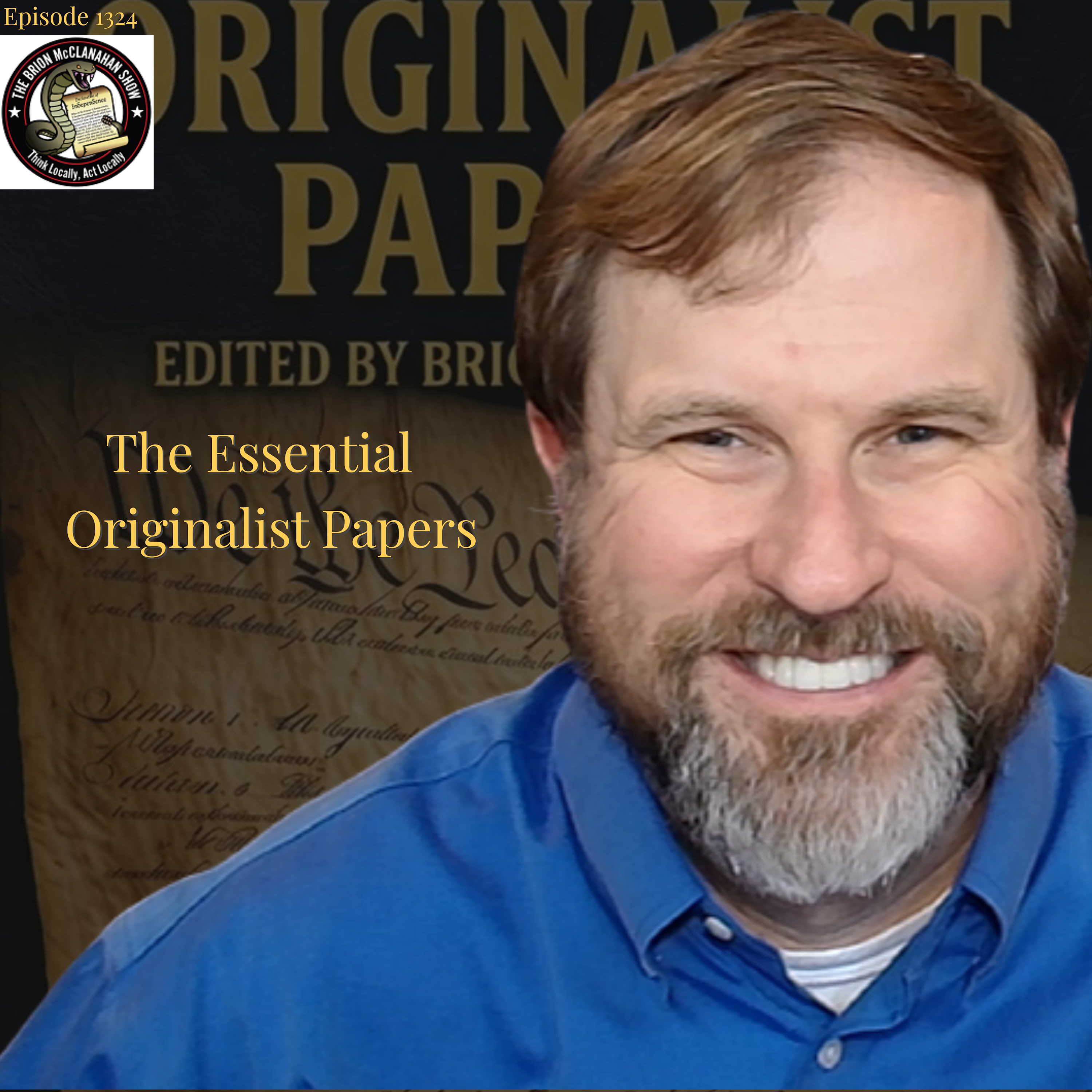
About this episode
The Brion McClanahan Show is made possible by:
Forget the Federalist. Get the Originalist.
https://mcclanahanacademy.com
https://patreon.com/thebrionmcclanahanshow
https://brionmcclanahan.com/support
http://learntruehistory.com
Get every episode summarized
Each time The Brion McClanahan Show publishes, we email you a written briefing from the transcript — the topics, who appeared, and any specific claims, with the ad reads skipped.
Email me new episodesFree for 3 shows. No card needed.
Hosts & guests
Transcript ready
647 searchable segments. Every word is indexed and playable.
Full transcript
The Brion McClanahan Show — Ep. 1324: The Essential Originalist Papers. Machine-transcribed; use the interactive transcript above to jump the player to any line.
For the first time ever, Yamavar Resort and Casino at San Manuel is giving away a new Rolex watch for every Club Serrano card deer. Play with your Club Serrano card and on September 20th, you could be one of five winners of a Rolex watch. Plus, all winners will advance to the finale at Palm's Casino Resort Las Vegas for a chance to take home a rarity. The second Mustang Dark Horse ever produced on September 26th. Two properties. Six winners. Only at Yamavar Resort and Casino, your California to Vegas connection. Details at Yamavar.com must be 21 or older to enter participate. Please gamble responsibly. There is so much NFL on ESPN right now. Monday night football. Plus pregame and postgame. NFL live. NFL prime time. Everything you need to stay on top of every game every week. Unbelievable. And now NFL Network is on the ESPN app. More football. More coverage. More ways to watch. Football's on. All season long on ESPN and streaming on the ESPN app.
PlannedHandAcademy.com is your gateway to a real history education. Go to McLeanHandAcademy.com. Use the coupon code podcast and take 25% off every class every day at McLeanHandAcademy. Get a real history education. I'll see you in class. If you like this podcast and you want it without advertisements, head over to patreon.com and become a member of the Brian McLean Henshover 10 bucks a month. You get all the podcast ad free including video and you also get a special Q&A podcast. I'm only going to answer your questions, your listener generated episodes through those Q&A. So head over to patreon.com. Get this podcast ad free. No ads, not even things like this. And you really do help support the Brian McLean Henshover with really cool stuff on the backend. The essential originalist papers is 77 public documents in favor of ratification of the constitution. It is the book if you want to understand originalism.
Get it wherever books are sold online, I guarantee you'll love it. I've got a new book out called The Essential Originalist Papers and we're talking about it today on this episode of the Brian McLean Henshover. It's time to think locally and act locally. Welcome to the Brian McLean Henshover. Welcome back to the Brian McLean Henshover. Glad to be back on the program. Glad to be here. Alright, kicking off the week. Like I said, with a discussion of my new book. Of course, this is Constitution Week. We've got Constitution Day on Thursday this week and so I'll have something to say about that too and I'm going to focus on the Constitution all week and one way or another. But I want to talk about a new book that I put out. Now I haven't had a book release since 2021 and that was the Jeffersonian tradition, a collection of essays I'd written and put into a paperback form.
And in the meantime, right from 2021 to 2026 over the last five years, I've produced a lot of classes at McLean Henshover and so I've taken a break from writing books. In fact, the last contracted book I had was 2017. So it's been nearly a decade since I've done something like that. But I've had two books out 2020 and 2021 of essays and things that I've written. But it's been five years since then and so I thought, well, I produced a class entitled the originalist papers at McLean Henshover Academy. It's a four-part class. It covers 100 essays in favor of the ratification of the Constitution. And in that class, I included all of the reading material that I cover, all 100 essays. And I wrote introductions to all of them, right? All 100 essays. And so I've written for a long time to actually produce a book that went with that, that it was a collection of those essays.
But I realized in the process it was going to take a pretty hefty book or a multi-volume book to do it. So I thought, okay, well, what if I just included or what if I just created a book of the most important ones, right? The ones that I think are essential in understanding original intent, which is what this book is. So you've got 77 essays. If you think the Federalist papers are 85 essays. And original, I thought, well, maybe 85 would be a good number. But again, that was shading into a situation where the book was going to be just too long for publication. So I trimmed it down to 77. And these are the 77. Most important essays in favor of ratification of the Constitution. Now if you've listened to this show for any period of time, you'll understand what I mean by that. But for those that haven't, maybe you're a newer listener of the show and you haven't heard me talk about it much. If you want to understand original intent, if you want to understand the Constitution, you have to go back to the ratification debates.
My founding father's guide to the Constitution focuses entirely on that. It's all about the ratification debates. I do talk about the Philadelphia Convention too and looking at what they said there. But really, if we're going to find meaning, we have to go to the ratification. So what happens is rather interesting. We have the Philadelphia Convention meet from May to September of 1787. And in that time, a draft is written and then signed, September 171787. And of course, as per the Constitution, Article 7, it has to be sent to the states for ratifications. This thing goes out. The Congress sends it out. The states get it. They call conventions. And we have these ratification conventions. So in that period of time before we can get nine states to ratify the document, there is a public discussion of meaning. It really begins in earnest in October of 1787. Then carries forward around the time that you get Virginia and New York ratifying the
convention or ratifying the Constitution, excuse me, 1788. There was some discussion a little bit after that point. But... Yamavap Resortant Casino, it's San Manuel is bringing the biggest laughs to the stage. Break taboos with Ali Wang on August 28th and 29th. Enjoy Ralph Barbosis, Dry Humor on September 18th and 19th. And don't miss Nikki Glazer's unapologetic comedy November 19th. Tickets on sale now at Yamavaptheater.com. Only at Yamavap Resortant Casino, celebrating its 40th anniversary. You in must be 21 to enter. Bonjour, Compadre, it's the... Why slide Nikoshinga in her? How do I negotiate so many great travel deals? My greatest gadget. The priceline app, it's got hotel deals, flight deals, rental car deals, all of those deals in a bundle, deals, game day deals, concert trip deals, no one deals more deals than priceline. Hold your horses, there's more. The applet you filter hotels by neighborhood, vibe, star level and amenities like pools and
spas and beach friends. Wait, I'm not done. Stop cutting me up. Once you get Virginia and New York and of course they weren't the required states. There was already, you know, New Hampshire had already come in. But once you get those required states and nine states to ratify it, it's really a moot point then because the constitution goes into effect. Now of course there were two states that did not ratify the document until after the first congress met that would be North Carolina and Rhode Island. So they were essentially independent countries and they were treated as such. They weren't part of the United States government. They had their own state governance. They were not members of the United States. But these public pronunciations of meaning, right? And I mentioned State House yard speech by James Wilson in October of 1787. There's actually in this book, I start with an essay by Tench Cox entitled an American
citizen. That was produced before the State House yard speech. Now both Tench Cox and James Wilson are from Pennsylvania. And then the third essay is an essay by Plataio Webster. So three first essays are from Philadelphia or Pennsylvania. As they start discussing the meaning of this document. And that's because Philadelphia and was the center of course where the constitution is drafted. But then it became the center of the ratification process. Now Delaware ratified the document before Pennsylvania did. But Delaware being only three counties, small state, didn't have much of an impact. But Pennsylvania would. And everyone knew that Pennsylvania was going to be important because it did have a pretty viable anti constitution faction in Pennsylvania. They were actually called the Constitutionalists.
And their opponents were the Republicans. Interestingly enough, that's what they called themselves there. I mean, we, these names, you know, that are often thrown around that we have federalists and anti federalists. So they didn't really call themselves that in Pennsylvania that other names. And these names actually went back to a period of time before we had the constitution drafted in 1787. Pennsylvania is an interesting place when it comes to politics. And there was a lot of violence in Pennsylvania about the constitution. There were riots. There were forcibly dragging people into their seats. All kinds of things happened in this period of time because people in Pennsylvania, there was a large segment of the population. Suspicious of the constitution. They looked at it as a power grab by the, by the Republicans or we were reality of the federalists or the centralizers. It's a power grab by the eastern part of the state. People like James Wilson, who nobody really trusted in the western part of the state.
And they thought, of course, by having this thing ratified, we were going to get a different type of political economy in Pennsylvania, ultimately through the vehicle of the constitution. And I'm actually going to talk about, you know, two of those essays in a little bit, the first two, the one by Tench Cox and the one by James Wilson. I'm going to talk about them just a little bit. But this was, you know, a big deal. So we get Pennsylvania. Then we get in this book, then we have three essays by Alexander Hamilton and the federalists. I don't start with Federalist one. I don't cover the first six Federalist essays. I start with Federalist number seven by Hamilton, of course, because I've selected the ones that are most important for original meaning. Notice I don't have anything by John Jay in this. And there's a lot of people that cite John Jay and they like John Jay, particularly nationalist because he says a lot of things that would, you know, fall in line with kind of the, the nationalist perspective.
But that particular perspective was not popular. John Jay was not someone who really spoke for the majority of Americans in 1787. And nobody knew, of course, who was writing the Federalist. As I mentioned in my introductions to these various essays, the Federalist were potentially not even that important. I mean, New York only ratified the Constitution in 1788 by a few less than a handful of votes. Hamilton was a one man army trying to negotiate ratification, but really New York was again very suspicious. So the Federalist, even though it's often cited all the time by proponents of the document and various things, was not really that important when it came to ratification in terms of persuasion. Now, because of who did write in it, Madison, Hamilton, of course, Jay, who would later serve as Chief Justice of the Supreme Court, is taken on a much greater importance after
the fact. Hamilton being future secretary of the Treasury, Madison, of course, who he became Secretary of State, President of the United States. Remember the House of Representatives? You know, again, John Jay, Chief Justice of the Supreme Court. So because of the status of these people after the fact, it has much more meaning than I think it should. So really what you see in this book or a number of essays written by people who don't have that kind of status and maybe some forgotten individuals, you know, James Wilson is not really that well known, but James Wilson was the Supreme Court Justice also. Now, Tench Cox and Webster really did nothing. I mean, they had various positions in the Federal Government. Nothing that was noteworthy, but still very important in Pennsylvania. So I include people in this collection of essays that are not household names, but important for ratification in their own states. So Hamilton, of course, New York, Cox, Wilson, Webster, and Pennsylvania.
essay number seven is by Roger Sherman, a countryman too. So this is a series of essays that I pulled a countryman out of number two. Roger Sherman was arguably the most important member of one of the most important members of Congress. He was known as the Atlas Thomas Jefferson. I have wonderful things to say about Roger Sherman, but everybody trusted Roger Sherman. And during the Philadelphia Convention, he in many ways negotiated the three fist compromise. Roger Sherman was the one who kind of put together the salines between Connecticut and South Carolina that got the thing across the finish line. And Sherman wrote in favor of the Constitution. So he's a powerful figure in Connecticut. Everybody like Roger Sherman. He is a states, writes New Englander. He believes strongly in federalism as what you'll see in these essays is a central theme for originalism and ratification. Federalism is the core of the US Constitution.
No federalism, no constitution. It's key in understanding that. No federalism, no constitution. If you get anything else out of this, understand that if we didn't have a federal republic, we don't get a constitution. So if there's any threat of centralization of power, consolidation, as they called it, nationalism, a national government, if there was any belief that that's what we were getting, we wouldn't have gotten the constitution. So you've got this country men essay by Roger Sherman. Good essay. Then we get to James Madison. I do cover Federalist number 10 in the book. One of the more important essays in the Federalist papers. Madison, of course, who he was, really needs no introduction. We've got some more James Wilson. And then we have the 10th essay is by Oliver Ellsworth. Now I've got a couple of the essays in this Land Holder series, which is what Ellsworth wrote. I've got number four and six in that series.
Oliver Ellsworth also served on the United States Supreme Court. What's really interesting about Ellsworth is that he was from Connecticut, but he was also a secessionist. He's one of the individuals that pulled aside John Taylor of Caroline in 1794 and said, hey, John, I mean, this thing gonna work. Let's get out. We knew England wants out. So here is a man who wrote in favor of the ratification of the constitution saying secession is legal. And essence, that's what he's doing. This is another important understanding of this. Anyone that runs around and says secession is illegal or treason or anything else doesn't understand the founding generation because they wouldn't really have said that. I've also got another speech by Ellsworth later on before the Connecticut ratifying convention. But Ellsworth was a major figure that nobody knows much about. And of course, I introduce him to you in these essays. I also have a speech before the Pennsylvania ratifying convention by Thomas McKean again,
not a household name, but an important factor in Pennsylvania. I cover Federalist 23, 24, 28, 32 and 33 by Hamilton. So you've got several more. In fact, there's more by Hamilton later on the book. But you've got several Federalist essays. I sprinkled them in. This is all in chronological order. As it's going through, you can kind of see we start in September of 1787, essentially. And then we move through chronologically to the last essay as we get to the North Carolina ratifying convention. But that's the chronology behind these essays all in order. So you can kind of go, all right, well, here's this, here's this, here's this. Again, I thought about producing all of them, putting all of this stuff out there because it's really interesting, but in terms of space and multi-volume work and things like that, one volume was, I thought, enough. I mentioned the speech by Oliver L'sworth, but right behind that is speech by, speeches
by Samuel Huntington in Oliver Wollcott in the Connecticut ratifying convention. Both major players in Connecticut politics, both in favor of ratification. What's really interesting about Wollcott speech in L'sworth talked about this too, but they all talked about the states checking the checking unconstitutional federal overreach. New England was really worried about this. And I think that's something that's often lost in all of these discussions centering on the Constitution. But when we think about the most important parts of this, it really was opposition to federal overreach. People were concerned about the federal government taking too much power, the new general government, as they called it, the general government or central government, having too much power, so how do you check that? Is it going to be through the courts? Which there was some discussion about that? Or is it going to be the states? And there was some discussion about that too.
It really wasn't conclusively settled on who would do that. Now later in just a minute, I'll talk about John Marshall, who's also in this book, which I just had a class on selling a class on John Marshall. It's still there if you want to buy it. It's had a sale on that class. And how important John Marshall is for the future of the United States, unfortunately. But Marshall is included in this book too because he does speak at the Virginia Rannifying Convention. For the first time ever, Yamavar Resort and Casino at San Manuel is giving away a new Rolex watch for every club Serrano Card tier. Play with your club Serrano Card and on September 20th, you could be one of five winners of a Rolex watch. Plus, all winners will advance to the finale at Palm's Casino Resort Las Vegas for a chance to take home a rarity. The second Mustang Dark Horse ever produced on September 26th. Two properties, six winners. Only at Yamavar Resort and Casino, your California to Vegas connection. Details at Yamavar.com must be 21 or older to enter, participate.
Please gamble responsibly. Do you hear that? That's sound right. That means that summer is officially here. It means that grown adults just sprint into the street for a frozen dessert shaped like a cartoon. But this summer, Mint Mobile has a better treat. Every plan, including unlimited, is $15 a month. And unlike ice cream, it won't drip down your wrist or look nothing like the picture. Does anyone have any cash? Give it a try at MintMobile.com slash switch. A front payment of $45 for three months, $90 for six months or $180 for 12 month plan required $15 a month equivalent to Texas and P's extra. New customer offer for initial plan term only greater than 50 gigabytes. Me slow and network is busy. See terms. The 23rd selection is a speech by Fisher Ames before the Massachusetts ratifying convention. Fisher Ames, one of my most favorite individuals in New England. It's kind of was just a character. I've actually got a couple of Fisher Ames in here. So you get a little bit more of Fisher Ames, but Fisher Ames was very much interested in
state powers. In fact, by the early 19th century, he's writing these essays, these political essays and opposition to the Jefferson administration, where he is essentially calling for New England to secede from the Union again. He doesn't think New England should be in a, he considers to be a dangerous situation for that section against, you know, Virginia power. And so when you think about, you know, again, the Constitution and this long deraille, as we could often say, of the sectional conflict, it begins long before we get to the 1860s. And it's always about power. Why did New England want to secede? Well, because they didn't control the government. And so the people that run around and say, well, the South left because of our election, New England threatened to do it over and over again. They never pulled it off because they didn't have the guts. But they threatened to do it over and over again. It was always about an election. I mean, they threatened to do it when Jefferson was elected through Congress in 1800.
They certainly wanted out. I mean, this Hamilton's working behind the scenes to try to prevent that from happening, but they wanted out. They thought, I mean, it's over. If Jefferson wins, we want out. This is why they wanted to give the election to Aaron Burr and Hamilton saying, look, you know, I know everybody hates Jefferson. And for good reason, I mean, his mind, Jefferson was not going to be good, but if you think he's bad, way too you get Aaron Burr, he's going to be even worse. And so that didn't really persuade the New Englander so much, but it did persuade some other Federalists to switch their votes in favor of Thomas Jefferson with some guarantees. James Byrd was a central in that of Delaware. But you know, Delaware was not part of this New England's recession movement. It's not even in New England. It's further south and much of the south. It's not part of that. And so, you know, there was this New England centered view and quest for power. What really happens is that New England sectionalism becomes New England nationalism.
New England sectionalism becomes New England nationalism. That takes time. It moves on. But they're always sectionalists. They're always interested in New England first. New England foremost. Massachusetts ratifying convention. You had a lot of discussion about being in a union with slave owners. They did bring it up. They didn't like that. They didn't like the fact that we didn't have annual elections. There are all kinds of things that were centered on Massachusetts view of the world. And they were not comfortable. A lot of them, you know, this is where Elbridge Gary was. You know, John, I'm sorry, Sam Adams, John Hancock. They were all very suspicious of this new government. I mean, look, those guys wanted to ensure we had a bill of rights because they thought this new central authority was going to abuse power. So very strong anti-constitution sentiment in Massachusetts. And so these speeches in favor of it are trying to lay people's fears about this. And they're saying over and over again, Thomas Dawes, who's also in this group, that section 28, chapter 28, where I include that, you know, James Bowdoin, who's same thing.
All these guys are trying to persuade these wavering delegates that no, no, no, this isn't going to be bad at all. We're going to make sure that we have real federalism. But in that way, I mean, because we have real federalism, the South is not going to have any impact on us. The South is not going to do anything to hurt Massachusetts. It's going to be South Carolina or Georgia or North Carolina or Virginia. And it's not going to control us. The federalism was the core of acceptance of this document. You have to have federalist people with a lower case F who believe that South Carolina can be South Carolina and Massachusetts can be Massachusetts. And I think South Carolina in many ways upheld their end of the bargain. The Massachusetts did not long term. Got a couple more essays by James Madison, essay, you know, selection 30 and 32, as a federalist number 42 and 44. But in the middle of that, I've got one of my favorite essays in the entire book. It's an essay by Tench Cox and it's entitled A Freeman.
I've got two of them, Freeman one and Freeman two. One is chapter 31, one is chapter 36. And if to me, these two essays boil down the real crux of the debate into terms that make it very easy to understand what's going on here. A Freeman one and a Freeman two talk about the powers of the general government visa v the states. It's it's tremendous, right? And I think that if we want to understand the original constitution, you can if you say, tell me two essays that get into this. It'll be a Freeman one and a Freeman two. A Freeman one and a Freeman two 100% because it says Tench Cox and these essays and I said I was going to talk about Tench Cox and I'll go swing back to James Wilson in a minute once I get through the table of contents.
Tench Cox explained in both of these essays that these are the powers of central government has or and basically essentially does not have right. It cannot do these things. These are the powers of states can do which the central government cannot do. So in other words, what we really have are very strong states that handle just about everything in your everyday lives. The central government is essentially confined to two things, commerce and defense and by commerce, he meant international regulation of trade because this is how everybody in this period of time thought about the powers of the central government. It didn't have the kind of authority that it has now. If it did, no one would have favored ratification of the constitution. That was the argument of the anti-federalists or what in many cases are the real federalists. These are people that wanted a real federal government, a government that did not control the everyday lives of the citizens from the center.
The states handled most of the important things in American society. This is a Pennsylvania. This is what Americans overall thought. This was not something that just came out of thin air that was invented in the middle of the 19th century by a bunch of hot-headed southerners. This is how everybody understood the document in 1788 and 1787 and 1789. That's why these essays are essential. That's why I say they're the essential, originalist papers. We have the federalist papers. These are the originalist papers because it's not just the federalist which is in this collection, but it's also these others. You're not going to get tenchox in a collection of the federalists. You're going to get Madison, Hamilton and Jay. That's it. Maybe sometimes you'll see some collections, has some other stuff in it, but not this stuff. Then of course I do have four straight essays by Madison, 44, 45, 46, and 47, and then
Freeman too. The 37th selection in the book is by Alexander Conti Hanson, I. He's from Maryland. Any important actor in the early federal republic and his essay is interesting. Again, a virtual unknown. Most people have never heard of Alexander Conti Hanson. What are you going to know who he is after you go ahead and get this book and get to chapter 37? You're going to find out about Alexander Conti Hanson. You're going to have here what he had to say on the Constitution itself. It's an interesting essay and I wanted to include it for that. In fact, it's one of the longer essays in the book. It's about 40 pages of remarks on the Constitution. Most of these essays are pretty short. In reality, the essays by Madison, Hamilton, are not long essays. Most of the speeches are not long speeches.
This one though is a longer essay. During that, you've got a couple of selections by Madison, Federalist 48 and 51. Then you have a Freeman 3 by Tench Cox again in this Freeman series. You've got a couple of essays, three essays, in fact, by James Iardell of North Carolina. James Iardell is one of the more important figures in American politics. Again, Supreme Court justice. He had a lot of things to say about the Constitution. I've got Marcus 1, 2, and 4 in this document in this collection of essays. You need to know who James Iardell is. The other one, of course, would be William Richardson, Davey of North Carolina. But I also have a selection by Archibald McLean of North Carolina. There's a lot of North Carolina here. Of course, Hugh Wameson, who was the individual that stood up and said, hey, look, slaves are rational people. We need to count slaves as one whole person towards representation in Congress.
So you've got some really interesting figures in North Carolina without question. I've got a few more essays by Hamilton at this point, 59 and 60. Then Federalist 62 by James Madison and Federalist 69 by Alexander Hamilton. Federalist 69 is one of my favorites because in that particular essay, Hamilton goes through the powers of the executive and how it's not like the British king. It's far less powerful than a king. Now can you imagine what Hamilton would say about that today? I don't think there's any question. The presidency in the United States has more power than the king of Great Britain ever had in 1776, at least, I mean, in practice, and particularly by the 1780s. But Hamilton is arguing that Federalist 69, this is not going to be an elected monarchy because that was the great fear. That was the great fear.
Let's see. I've got the next five essays or by John Dickinson of Pennsylvania, Slash Delaware. These are from his Fabius collection, his Fabius 1, 2, 3, 4 and 8. Again, great essays. John Dickinson is, this is who Emmy Bradford often focused on when he talked about ratification. John Dickinson because he was very rational, very conservative. This is a man that, like Roger Sherman, was thought to be a level headed. And Dickinson favored ratification. What's really interesting though is once ratification was accomplished, and once we got into the politics of the 18th century, nearly 19th century, John Dickinson switched sides and no longer considered himself to be a federalist. He eventually became a Democratic Republican because again, he argues for a constitution that the nationalists don't want, the consolidationists don't want, and they push the constitution in a different direction once they get power.
These five essays by John Dickinson are fantastic, in my opinion, for explaining his positions on the constitution. Then I include six essays by Hamilton, Federalist 78, 80, 81, 82, 84 and 85. And a few of these are the most cited essays by or two of these. They're cited essays by the United States Supreme Court to this day. They cite them all the time because essentially what Hamilton does here is create an environment of what we would call judicial supremacy. So that is key to understanding this notion of supremacy, judicial supremacy. The Supreme Court to this day still cites these essays and the Federalist. But you'll notice we still have a lot more to do. That's only through chapter 60. There are still 17 items left in this book and they're all speeches before ratification conventions. These are things that you don't often get when you go out and you get, you know, we're
going to get the Federalist. You don't get the speeches that were just as important because they're there to persuade wavering delegates that this constitution is going to be okay. That we need to ratify this thing. And so I start with, of course, the Virginia ratifying convention. I have a number of speeches in the Virginia ratifying convention. In fact, from chapter 61 to 70, we covered the Virginia ratifying convention. People like Evan Randolph, who of course famously refused to sign the document in Philadelphia, but then later came back and favored it. And one of the biggest reasons is I point out is because, well, Randolph thought that Virginia would succeed from the union. He thought that Virginia was going to be independent if they didn't ratify the Constitution and everybody knew that. And George Washington was afraid of the same thing. He thought we can't go this alone. So even though he thought there was defects in the Constitution, it was preferable to being independent because he wasn't sure if anybody would side with Virginia or not. So you've got a couple of speeches by Rand three speeches actually by Randolph.
You've got a speech by Edmund Pendleton, who was, of course, a pretty important player in Virginia politics. You've got a speech, three speeches by George Nicholas, who was a major figure in ratification and a speech by Francis Corbin, along with James Madison and John Marshall. Now notice I only have one speech from James Madison in the Virginia ratifying convention. You've got a lot of Madison other places. So I didn't feel like I needed to include him here. There wasn't, wasn't much more he said in this convention that he didn't say somewhere else and one of the Federalists. But that speech by John Marshall is vital because that speech by John Marshall will let you into his mind and what we're going to get with the Supreme Court once Marshall becomes Chief Justice. And it certainly is judicial review, judicial supremacy. These kind of things. Now he didn't really hint at judicial supremacy so much. He certainly said we're going to get judicial review. But he does say in this speech that we would have essentially co-equal courts, coordinate
courts. No one is going to, no court is going to be stronger than the other courts. That's not the way it worked. This Marshall got in office and on the bench. But it certainly is the way that it should have worked if we had followed ratification and originalism. For the first time ever, Yamaha Resort and Casino at San Manuel is giving away a new Rolex watch for every club Serrano card deer. Play with your club Serrano card and on September 20th you could be one of five winners of a Rolex watch. Plus all winners will advance to the finale at Palm's Casino Resort Las Vegas for a chance to take home a rarity. The second Mustang dark horse ever produced on September 26th. Two properties, six winners only at Yamaha Resort and Casino. Your California to Vegas connection details at Yamaha.com must be 21 or older to enter participate. Please gamble responsibly. The last several essays in the book, 71 to 77 are all speeches before the North Carolina ratifying convention. Sorry, one for the New York, excuse me. They back up here. Three speeches for New York convention. I was getting ahead of myself. 21 to 73, one by Hamilton or two by Hamilton.
Sorry, one by J. So I bring in some John J near the end because he was very much involved in pushing the Constitution past the finish line in New York. Though Hamilton in many ways was kind of a one man wrecking crew for the pro-constitution people in New York. And then of course, from 74 to 77, I've got speeches by William Richardson, Davey, who I mentioned before, James Ardell and Archeabal McLean again in terms of speeches in favor of ratification in North Carolina. So this is a really cool book. You've got stuff here that you won't find really anywhere else unless you can go out and buy some very expensive volumes of some things. So it's accessible. Some of these speeches, you know, you could get them, I mean, all of this is in public domain, but you got to know where to look. And I've collected it all here for you with introductions to all these things to try to get you interested in what originalism means.
It is a long book. It's 786 pages of material. But if you read all this stuff, you're going to have a much better understanding of the Constitution, the original Constitution, as ratified than what we're getting from the dobes in the Supreme Court in Congress and everywhere else today, who have certainly a political agenda in what it means. So look, I hope you get the book. You can get it on Kindle, you can get on paperback, eventually, hopefully I'll have it on hardback. I haven't done that yet, but you can get it on a couple of platforms. I'm not sure. Let me look as I am recording this, and see if it's at Barnes and Noble.com. Yet sometimes they carry my books over there. Actually, it's theirs. You want to go to Barnes and Noble. You can go to Barnes and Noble and you can get this collection of papers there as well.
If you don't want to buy from Amazon, so it's out there as well. At Barnes and Noble, probably books a million too. I mean, I didn't look, but it's probably available in all three of those major, major publishing houses or I should say not publishing houses. I should say online retailers, excuse me, available in all those online retailers, you can get that. So get the essential original papers. You'll have a great understanding of the Constitution as ratified. Again, this is Madison's voice. The Constitution is what the ratifier said it was. Not textualism, not the ruminations of Supreme Court justices. That's the Constitution we go to. Not even the fiddle of the convention. The ratifiers gave it its life and vitality. So that's why I collect these essays together. It's not just the Federalist. You get some other cool stuff in there by people who aren't well-known, but who are important in their states. All of them were important in their state ratification conventions or in the ratification process. So you need to know them too.
All right. See you next time for the Brian McLean. I'll see you then.
More episodes
More from The Brion McClanahan Show

Ep. 1325: Should We Scrap The Constitution?
The Brion McClanahan Show

Ep. 1323: A Repubic If You Can Keep It
The Brion McClanahan Show

Ep. 1322: The Best Medicine for a Sick Conservative Mind
The Brion McClanahan Show

Ep. 1321: Vlogging Through Fake History?
The Brion McClanahan Show