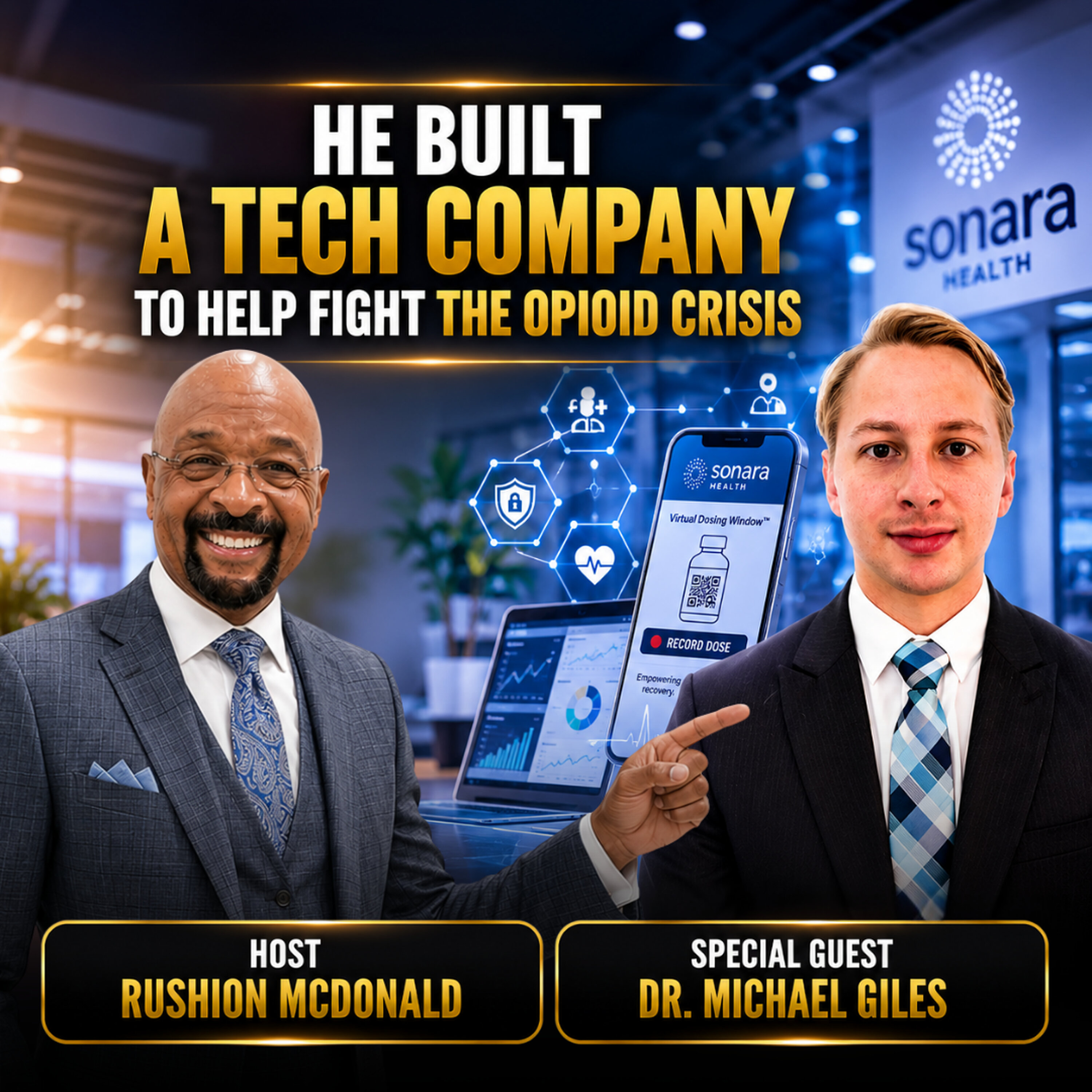
Entrepreneur: He's making it easier for people with Opioid Use Disorder to commit to their methadone treatment program.
About this episode
Listen and subscribe to Money Making Conversations on iHeartRadio, Apple Podcasts, Spotify, www.moneymakingconversations.com/subscribe/ or wherever you listen to podcasts. New Money Making Conversations episodes drop daily. I want to alert you, so you don’t miss out on expert analysis and insider perspectives from my guests who provide tips that can help you uplift the community, improve your financial planning, motivation, or advice on how to be a successful entrepreneur. Keep winning!
Two-time Emmy and three-time NAACP Image Award-winning, television Executive Producer Rushion McDonald, interviewed Dr. Michael Giles.
A psychiatrist and healthcare entrepreneur who founded Sonara Health, a technology platform designed to improve treatment access and retention for people suffering from opioid use disorder (OUD). Drawing on his experience working in opioid treatment programs (OTPs), Dr. Giles developed a digital solution that allows patients receiving methadone treatment to demonstrate medication compliance remotely, reducing the burden of daily clinic visits.
The discussion focuses on opioid addiction, methadone treatment, patient-provider trust, healthcare innovation, and how technology can improve outcomes for individuals struggling with substance use disorders.
Purpose of the Interview
The purpose of the interview was to:
- Raise awareness about opioid use disorder.
- Explain how methadone treatment works.
- Discuss barriers faced by patients receiving opioid treatment.
- Introduce Sonara Health's digital monitoring platform.
- Showcase healthcare innovation that improves patient outcomes.
- Highlight entrepreneurship that creates social impact.
- Explore how technology can increase treatment retention and recovery opportunities.
Key Takeaways
1. Opioid Addiction Continues to Devastate Communities
Dr. Giles emphasized that opioid use disorder remains a major public health crisis affecting:
- Individuals
- Families
- Communities
- Healthcare systems
The consequences extend beyond addiction itself and often include:
- Overdose deaths
- Family disruption
- Economic hardship
- Community instability
Key Point: Opioid addiction remains one of the most significant public health challenges in America.
2. Methadone Is an Effective Treatment
Methadone is commonly used to help individuals manage opioid dependence.
The medication helps:
- Reduce withdrawal symptoms
- Stabilize patients
- Lower relapse rates
- Decrease overdose risk
However, treatment often requires strict supervision.
Key Point: Methadone can be life-saving when appropriately administered.
3. Traditional Methadone Programs Can Be Burdensome
A major challenge discussed during the interview is the requirement that many patients visit clinics daily.
This creates difficulties for people who:
- Work full-time
- Attend school
- Raise children
- Lack transportation
- Live far from treatment centers
Daily clinic visits can become obstacles to maintaining normal life responsibilities.
Key Point: Recovery should fit into a person's life rather than make rebuilding life more difficult.
4. Sonara Health Was Born From a Practical Problem
The idea for Sonara Health emerged during Dr. Giles' psychiatry residency.
While working in an opioid treatment program, he noticed that physicians often hesitated to provide take-home methadone doses because they lacked confidence that medications would be used correctly.
This revealed a core issue:
Lack of Patient-Provider Trust
Dr. Giles realized technology could help bridge that gap.
5. Technology Can Strengthen Trust
Sonara Health's platform allows patients to verify medication use remotely.
The process includes:
- Accessing the application.
- Scanning a medication-specific QR code.
- Recording themselves taking the medication.
- Securely transmitting the information to their treatment team.
This provides accountability while reducing unnecessary clinic visits.
Key Point: Better information creates greater trust between patients and providers.
6. Patients Gain Greater Freedom
One of the biggest benefits of Sonara Health is the increased independence it provides.
Patients can spend less time:
- Driving to clinics
- Waiting in lines
- Rearranging work schedules
- Managing transportation challenges
Instead, they can focus on:
- Employment
- Education
- Family responsibilities
- Long-term recovery
Key Point: Convenience can improve treatment adherence and quality of life.
7. The Pilot Program Challenged Expectations
Dr. Giles shared that one of Sonara's earliest pilot programs took place in San Francisco's Tenderloin district, an area heavily affected by substance use and homelessness.
Initially, he questioned whether patients in such difficult circumstances would consistently use the technology.
Instead, participants exceeded expectations.
The experience reinforced a critical lesson:
People often succeed when given the tools and opportunity to demonstrate responsibility.
8. Opioid Addiction Is Not Limited to One Community
The interview addressed common misconceptions about opioid addiction.
While many people associate the crisis with rural America, Dr. Giles explained that opioid use disorder affects communities across the nation, including:
- Urban centers
- Suburban neighborhoods
- Rural regions
Cities like:
- San Francisco
- Seattle
- Various regions across the Midwest and Appalachia
have all been significantly impacted.
Key Point: Opioid addiction crosses geographic, economic, and social boundaries.
9. Fentanyl Has Changed the Crisis
One of the most important educational moments involved fentanyl.
Dr. Giles explained that:
- Fentanyl is far more potent than traditional opioids.
- Extremely small amounts can be fatal.
- It has become a primary driver of overdose deaths.
Because dosage differences can be measured in tiny quantities, users may unknowingly consume deadly amounts.
Key Point: Fentanyl's potency significantly increases overdose risk.
10. Patient Privacy Is Protected
Given the sensitive nature of treatment data, privacy is a central concern.
Dr. Giles emphasized that:
- Information is stored securely.
- Data is used strictly for treatment purposes.
- Patient records are not used for advertising.
- Access is restricted to authorized healthcare personnel and patients.
Key Point: Patient confidentiality remains a core priority.
11. Treatment Retention Saves Lives
One of the interview's most sobering insights was the importance of staying in treatment.
Dr. Giles noted that patients who leave treatment prematurely face dramatically elevated risks of overdose.
According to the discussion:
- Many patients leave treatment within the first 60 days.
- Early dropout significantly increases overdose risk.
This makes retention one of the most critical goals in addiction medicine.
Key Point: Remaining engaged in treatment can be life-saving.
12. Healthcare Innovation Can Create Social Impact
Although Sonara Health is a business, Dr. Giles views it as a mission-driven solution.
The company creates value by helping:
- Patients remain in treatment
- Providers monitor adherence
- Clinics improve retention
- Communities reduce addiction-related harm
The interview highlighted entrepreneurship focused on solving meaningful social problems.
How Sonara Health Works
Patient Process
- Receive take-home methadone doses.
- Open the Sonara Health application.
- Scan the medication container QR code.
- Record medication administration.
- Submit verification securely.
Average Time Required
Approximately:
72 seconds per recorded dose
Compared with hours that may be spent traveling to and from treatment clinics.
Future Growth Plans
Dr. Giles shared plans to expand beyond medication verification.
Future capabilities may include:
- Patient messaging
- Virtual counseling
- Treatment coordination
- Remote intake processes
- Expanded patient engagement tools
The goal is to create a more comprehensive digital treatment experience.
Memorable Quotes
Dr. Michael Giles
"The problem we were trying to solve was patient-provider trust."
"Patients shattered my expectations."
"All they needed was an opportunity to prove themselves."
"Patients gain freedom."
"Most patients drop out of treatment within the first 60 days."
"Right now, our focus is helping people stay in treatment."
Rushion McDonald
"There are businesses that change communities."
"You saw a problem and turned it into a solution."
"This is entrepreneurship that saves lives."
"People deserve a chance to get on with their lives."
Overall Message
Dr. Michael Giles demonstrates how healthcare innovation can address both medical and social challenges. Through Sonara Health, he developed a technology-driven solution that helps people with opioid use disorder remain engaged in treatment while reclaiming their independence and daily routines. The interview highlights the power of entrepreneurship rooted in compassion, showing how solving a specific problem can create meaningful change for patients, families, healthcare providers, and entire communities.
#STRAW
#SHMS
Money Making Conversations Master Class with Rushion McDonald is America's premier entrepreneurship, business leadership, financial literacy, and wealth-building podcast featuring successful entrepreneurs, executives, founders, celebrities, and industry experts sharing actionable insights for professional and financial success.
Business Podcast
Entrepreneurship
Small Business
Business Growth
Financial Literacy
Wealth Building
Black Entrepreneurs
Minority Business
Leadership
Executive Leadership
Business Funding
Marketing Strategies
Personal Development
Startup Advice
Sales Training
CEO Interviews
Founder Stories
Professional Development
Economic Empowerment
Business Success
Networking
Brand Building
Innovation
How to start a business
Small business funding
Entrepreneur success stories
Business leadership podcast
Wealth building strategies
Black entrepreneur podcast
Minority business development
Marketing for small businesses
Business growth strategies
Startup funding opportunities
Executive leadership training
Financial literacy education
Success mindset podcast
See omnystudio.com/listener for privacy information.
Get every episode summarized
Each time Money Making Conversations Master Class publishes, we email you a written briefing from the transcript — the topics, who appeared, and any specific claims, with the ad reads skipped.
Email me new episodesFree for 3 shows. No card needed.
Hosts & guests
No transcript yet
This episode has not been transcribed. Request it and it moves to the front of the queue.
More episodes
More from Money Making Conversations Master Class

Solar Power: Abioduni turned a one-person vehicle wrap business into a commercia...
Money Making Conversations Master Class

Motivation: Smith highlights how preparation, education, mindset, and adaptabili...
Money Making Conversations Master Class

Career Advice: Alicia breaks down artificial intelligence into practical, hands-...
Money Making Conversations Master Class

Mentoring: Dr. Glynis shared how mentorship and networking have shaped her caree...
Money Making Conversations Master Class