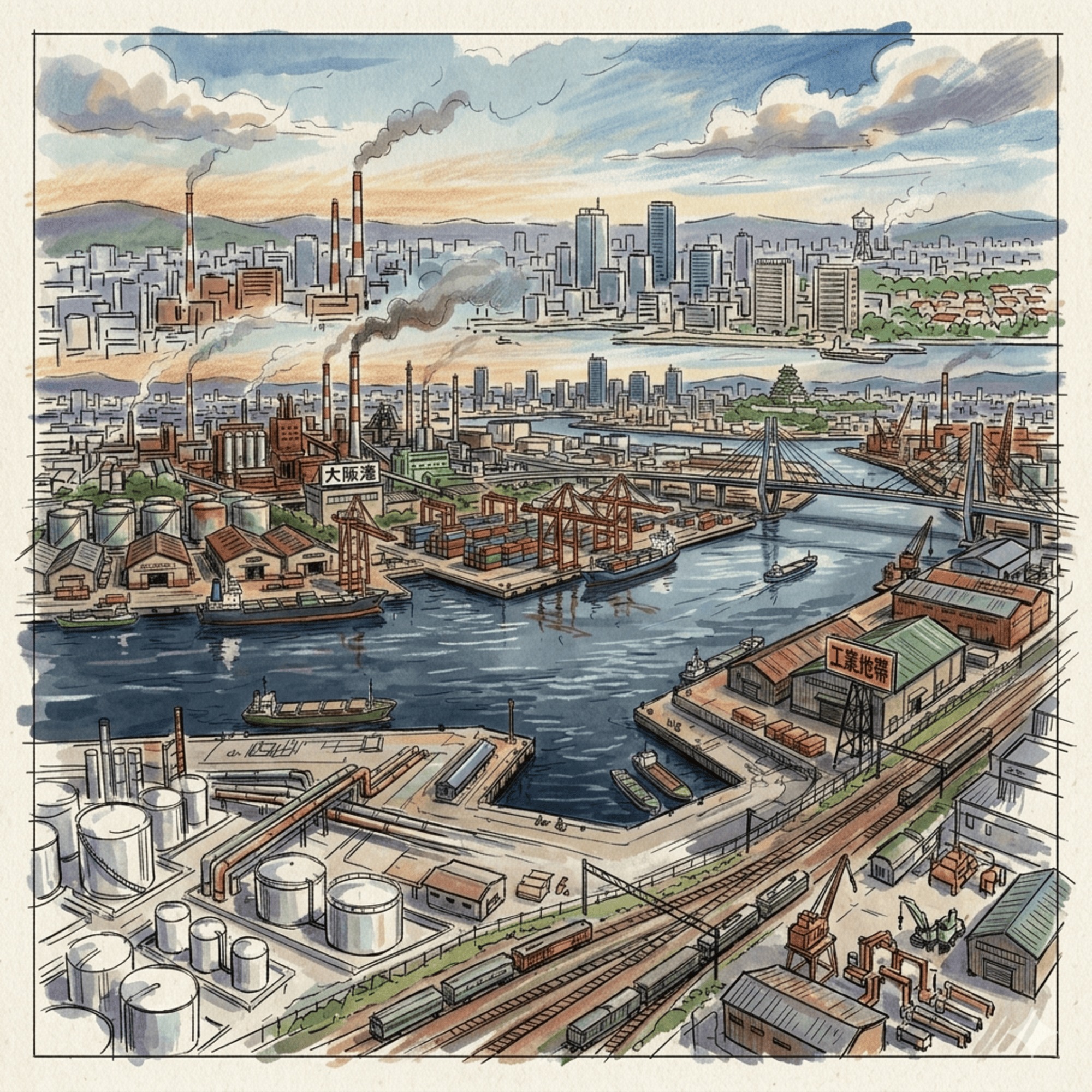
(ENG) Transformation of Osaka Industrial Zone
About this episode
This research report examines the historical evolution of the Sumiyoshi and Taisho districts in Osaka, focusing on the transformation of their waterfronts from sacred gateways to industrial powerhouses. While Sumiyoshi is portrayed as an ancient spiritual hub for maritime protection and international diplomacy, Taisho is analyzed as a modern frontier defined by capitalist expansion and the rise of the textile and shipbuilding industries. The text highlights how the "Oriental Manchester" emerged through technological revolutions like electric lighting, which introduced rigorous 24-hour labor disciplines. Crucially, the sources document the marginalized narratives of Okinawa and Korean migrants who faced social exclusion while performing the dangerous physical labor that fueled Osaka’s growth. By linking ancient religious rituals with modern labor struggles, the report illustrates a complex social landscape where industrial success and ethnic diversity intersect. Today, these historical layers survive through physical monuments, traditional festivals, and the enduring cultural identity of these diverse waterfront communities.
The Unwritten Pages of Yesterday 細 聽 長 風 說 舊 河
Get every episode summarized
Each time Historical Travel Stories💕旅行の歷史故事 publishes, we email you a written briefing from the transcript — the topics, who appeared, and any specific claims, with the ad reads skipped.
Email me new episodesFree for 3 shows. No card needed.
Hosts & guests
Transcript ready
212 searchable segments. Every word is indexed and playable.
Full transcript
Historical Travel Stories💕旅行の歷史故事 — (ENG) Transformation of Osaka Industrial Zone. Machine-transcribed; use the interactive transcript above to jump the player to any line.
Imagine standing on the waterfront of Osaka, Japan. You've got the sea breeze hitting you, the smell of salt mixed with city exhaust. Right, just that classic harbor smell. Exactly. And to most tourists walking by, it's just water, concrete, maybe a few rusted grains in the distance and a nice view of a sprawling metropolis. Yeah. But what if I told you that the water you're looking at was actually a dividing line, a literal physical boundary between the realm of ancient sea gods and a gritty, grueling modern industrial empire. It completely shifts your perspective. You know, you stop looking at those canals and bay areas is just basic infrastructure and you start reading them as an archive. The water holds the history, which is a wild way to look at a waterfront. And that brings us to our mission for today's deep dive. We are looking at a truly fascinating historical research report focused on the Sumiyoshi and Taisho industrial areas of Osaka. It's a fantastic set of sources. It really is. Today, we are going to uncover five incredible hidden historical stories buried in this waterfront. We'll explore the hidden gems you can actually
still visit today and reflect on what this all means for how we view the modern cities we travel to. And it's a brilliant set of sources because it refuses to be just a standard tourist brochure. It digs deep into the social transformations, the migrations and the raw power dynamics of the area. I mean, it doesn't shy away from the mud. Okay, let's unpack this because there is this central tension established right from the start of the research. We have Sumiyoshi, which represents this sacred ancient maritime power. And right next to it, geographically connected, we have Taisho, which is this modern grueling industrial engine. How did these two fit together? The connecting thread is the water itself, but the way that water is perceived and utilized changes completely depending on where you stand in time. Also, well, in the ancient world of Sumiyoshi, the water was quite literally a sacred element. It was something you prayed to, something you navigated with absolute reverence because respecting it meant life or death. But as we move geographically and chronologically into the Taisho era,
the water transforms into industrial water. It becomes a tool. A utility meant to power mills, built timber ponds and drive canal systems. The sacred becomes secularized into raw horsepower. That transition is mind blowing. And it brings us right into our first story. We're going all the way back to the third century. The sources focus on Sumiyoshi Taisha. Now, I saw a mention of Sumino no Tsu in the notes linked to this shrine. Was this place a religious site or was it a working port? It was both. And that's what makes it so unique. It was Japan's oldest international port. Long before Osaka was a massive political center, this specific spot was the absolute front line of Japan's contact with the Asian continent. Oh wow. Yeah, it was the official departure and return point for imperial envoy sailing to the Sui and Tang Dynasty in China. Let's pause on that because sailing to China in the third century or even the seventh century wasn't exactly a luxury cruise. Why were they making that journey? It was essentially a quest for cultural and technological survival. They were
sailing to the mainland to bring back advanced writing systems, Buddhist texts, new forms of government administration, and advanced silk weaving. The essentials for a growing state. Exactly. But to get those things, you had to cross the East China Sea and what were essentially large wooden robots with sales. Which was a terrifying gamble. The research points out there was a 33% mortality rate for these voyages. One in three people just didn't come back. Yeah, it's brutal. They didn't have magnetic compasses. They certainly didn't have weather satellites. So who do you trust to lead that fleet? You trust the Sumori clan. The sources mentioned them heavily. Who were they? Their name literally translates to those who protect the port. They were the highest ranking priests at Sumiyoshi Taisha. But to think of them just as religious figures is a mistake. They were the ultimate maritime technologists of their day. Technologists think of them almost like a modern tech giant holding a proprietary algorithm. They held a total closely guarded monopoly on navigation techniques and continental
intelligence. So the priest is literally the captain. Quite literally. The head priest of the Sumori clan would actually board the flagship of the envoy fleet as the envoy priest. He acted as the ultimate navigator. They relied on the three sea gods enshrined at Sumiyoshi. And those were. Historical research suggests that these gods actually represented the three stars of Orion's built. So picture this priest standing at the bow of a wooden ship pitching in the waves using the stars for celestial navigation combined with an incredibly deep knowledge of the summer and autumn monsoons holding the lives of the entire diplomatic mission in his hands. That is cinematic. And if you're visiting Osaka today, you can actually go see where this happened. The original port is technically gone because the coastline moved over the centuries. But you can visit the Husoigawa, which is the physical remnant of that ancient inland. And while you're there, you absolutely must see the Sordihashi, the famous arched bridge. What's beautiful about this bridge is that it wasn't built by standard carpenters. It was built by shipwrites using shipbuilding
techniques. Oh, that makes so much sense. Has this extreme steep curve. When that curve reflects in the water below, it creates a perfect circle. For the ancients, that circle symbolize the physical and spiritual boundary between the sacred domain and the mortal realm. You're walking over a literal portal. Why is a fantastic hidden gem? But let's fast forward a bit to our second story. We're moving to the Ido period, roughly the 17th and 19th centuries. Osaka is booming. It's known as the kitchen of Japan, thanks to these massive shipping routes called the Katama Blooning. What's fascinating here is how that ancient maritime religion we just talked about evolved to serve early capitalism. When you go to Sumioshi, Taisha today, you'll see over 600 massive stone lanterns lining the ground. Six hundred. Yeah. But these weren't just simple religious offerings. As the sources reveal, this was essentially an ancient corporate directory and a nationwide credit school system. Wait, a credit score? Like a 17th century Yelp review. Very much like that. Or like buying the naming rights to a modern sports stadium. The size of the lantern you donated,
its premium location on the shrine grounds, the deeply carved inscription of your business name, it all proved your financial stability and trustworthiness to other merchants visiting from across Japan. So it was a massive flex. Absolutely. If you could afford a massive stone lantern, you were clearly a safe bet for a business contract. I have to ask, who had the biggest lantern? Who were the ancient tech billionaires of Ado Japan? It was the dried sardine merchants. They funded a towering nine meter giant of a lantern. Dried sardines, not gold, not silk, but sardines. Sardines. Because dried sardines shipped down from Hokkaido were the most crucial agricultural fertilizer in Japan at the time. They literally fueled the agricultural revolution that fed the entire nation's booming population. These fertilizer merchants had immense, unparalleled economic power. And they proved it to everyone by dropping a nine meter stone monolith at the most important maritime shrine in the country. And these lanterns actually had a practical use too,
right? They weren't just for showing off. Right, they were literal lighthouses. At night, the candlelight burning in these hundreds of stone lanterns would guide the cargo heavy ships safely into the river mill. It was this perfect, elegant fusion of theology, optical science, and hard-nosed logistics. For anyone walking through the shrine grounds today, keep an eye out for the toy wholesaler lantern. Our sources note that this Pacific lantern has been painstakingly restored five times since 1762. It just proves the long-term legacy and the fierce pride of these businesses. Yeah, that continuity is incredible. And definitely check out the restored lighthouse in Sumiyoshi Park. It's a great visual of where that ancient logistics network actually hit land. It's the perfect bridge because those lanterns providing that physical guiding light set the stage for the industrial behemoth Osaka was about to become. Which is a brilliant transition into our third story. And here's where it's really interesting. We moved geographically into the Tisho Ward and chronologically to 1883. Enter a man named Eichi Shibusawa, often called
the father of Japanese capitalism. He sets up the Osaka spinning company in an area called Singenia. This was a monumental shift. Prior to this, the Meiji government had tried and completely failed to build profitable state-run textile mills. Shibusawa figured out how to make it work, and it came down to a massive technological leap, the introduction of the carbon filament light bulb. So we go from the guiding light of stone lanterns to the harsh light of the factory bulb. How exactly does a light bulb revolutionize a textile mill? It changes the fundamental concept of time. Before the light bulb, factories relied on oil lamps, which were huge fire hazards around cotton dust, and they were too dim to work by safely. That sounds incredibly dangerous. It was. So when the sun went down, the factory had to stop. The carbon filament light bulb severed that reliance on the sun. It allowed the Osaka spinning company to introduce 24-hour day-and-night shifts. It's hard to imagine how shocking that must have been for people living nearby. It was alien. Locals would gather outside just to stare at it. They marveled at the constant
never-ending glow pouring out of the red brick factory windows, illuminating the smoke in the night sky. They called it the sleepless city. But the sources paint a pretty grim picture of what was happening inside that glow, don't they? They do. The sleepless city was an absolute economic triumph for the investors, but it relied heavily on a brutal new discipline. The factory floor was heavily staffed by female workers and later immigrant laborers. They were pushed to the absolute physical limit. Yeah, the human cost was staggering. In this new system, human bodies were treated as mere extensions of the looms and spindles. The natural, agricultural rhythm of the sun was violently replaced by the relentless artificial rhythm of the factory bill. You worked until your shift ended, regardless of the time of day. It's a sobering reality behind what gets called an economic miracle, and you can trace this exact footprint today. The original factory was destroyed in the 1945 air raids, but you can visit the monument standing in Sanginia Park. Even better, the Tysho
Ward offers official industrial heritage tours. I highly recommend those. Me too. You can literally walk the streets and see how this capitalist revolution shaped the very layout of the neighborhood. And you have to remember, the physical factory might be gone, but the massive demographic shifts at Trigger changed the DNA of Osaka forever. Because to feed those machines running 24-7, the city needed people, desperate people, which launches us into the 1920s and our fourth story. This era saw a massive influx of immigrants to the Tysho Ward arriving from Okinawa. They were fleeing a devastating economic collapse back home, an agricultural crisis notoriously known in the sources as Psycat Hell. What exactly does that term mean? Because it sounds terrifying. It is terrifying. Following World War I, the bottom fell out of the sugar market, which devastated Okinawa's economy. People were literally starving. It got so bad that they were forced to forage for Psycat plants just to survive. And those are toxic, right? Highly toxic. If you don't ferment and wash it over and over again through a very long labor intensive process, eating it will
cause severe neurological damage or death. People were so hungry they were eating improperly prepared Psycads and dying. That was Psycat Hell. Unbelievable. So they flee that horror. They arrive in Osaka looking for work in these booming factories. And what happens? They step into intense hostility. The sources describe severe housing discrimination. Landlords across the city put up signs explicitly stating no re-UQNs refusing to rent any rooms to Okinawan immigrants. So they have no money. They're shut out of the housing market. Where do they go? They were forced to settle in an area known in the Okinawan dialect as Kubengwa, which translates to hollow or depression. It wasn't a metaphor. It was a physical depression in the land. They had to build makeshift shacks in flood-prone, subsea-level swamps right along the Kamales and Timberpons of Taisho. The sensory details in the report are just hard to read. You have to imagine the smell of stagnant water, the dampness creeping into everything. And when the typhoons hit, those swamps would flood
completely. The research notes that residents literally had to climb out of their shacks and live on floating logs in the Timberpons just to survive the rising waters. It's a bleak picture. Yet what truly stands out in the research isn't just the suffering. It's the incredible defiant resilience. In the face of all this exclusion, they build fierce mutual aid groups. They pooled whatever meager wages they had. They took care of each other. Exactly. But more importantly, they refused to let their culture wash away in that swamp. They would gather right there on the Timberpons amidst the logs in the mud and play their traditional sanction music. I love that image so much. Plucking string instruments on the very water that was trying to drown them. And that resilience paid off because the cultures survived. For anyone visiting Osaka, you have to go to the Harau Shoten Guy shopping street. Oh, definitely. It is recognized today as the most authentic little Okinawa in Japan. You can find traditional Awamori liquor, Okinawan citrus. If you time your trip right, you can see massive Isodans festivals perading through the streets. The community turned a history of literal marginalization into a vibrant badge of
pride. It's a powerful testament to how communities can reclaim a space that was initially designed to contain and hide them. Which flows right into our fifth and final historical narrative. We're staying in the early 1920s, specifically 1922. This is the year the Kimigayo Maru Fairy Route opens. This route connected Jeju Island directly to Osaka. And it brought a massive wave of Zenichi Korean laborers into the city's industrial machine. And just to clarify that term for our listeners, Zenichi refers to ethnic Koreans who have long term or permanent residency in Japan, many of whom trace their families arrival back to this specific colonial era. And when they arrived in Osaka, they were pushed to the absolute bottom of the industrial ladder. Now, it's really important we mentioned something here. The sources highlight a major historical debate about this migration. Right. The debate over whether this was forced mobilization by the colonial government or voluntary migration driven by economics. Exactly. And we are absolutely not taking a side on
that politically charged issue today. No, not at all. We're just impartially reporting what's in this research report to convey the historical tensions. And regardless of how they arrived, the map the researchers drew shows incredibly tough conditions. These laborers were given what the sources called the 3D jobs, birdie, dangerous, and demeaning. What did that actually look like on the ground or I guess on the water picture those timber ponds we mentioned earlier, but as a workplace, you have workers out there balancing on giant wet floating pieces of imported timber. They had nothing but long metal hooks to guide tons of wood into the mills. That sounds like a disaster waiting to happen. It was incredibly perilous. One slip on a wet log meant risking drowning or being instantly crushed between tons of moving wood. On top of that, you had the Nikoyon or day laborers. Their job was to dredge the thick toxic mud out of the canals by hand to keep the industrial waterways deep enough for the cargo ships. It's the invisible labor that built the modern city.
The city literally rests on their backs. But here's the tourist took. The hidden gem you can experience today to connect with this story. You can actually ride the city run fairies that criss-cross these very canals. There are eight of them like the Okiaikami fairy and they are completely free to ride. And understanding the history we just talked about changes that whole fairy ride. You might wonder why a city offers free boat rides. It's because these fairy routes were originally established precisely because these marginalized laborers, the Okinawan and Korean workers, were so impoverished they couldn't afford to pay a toll to cross the water to get to the factories. Riding them today, gliding past those rusted cranes in the old Stone Canal walls, it's such a visceral physical way to experience this labor history. You were literally riding in their wake. It's an experience you just can't get from reading a plaque or a textbook. You feel the scale of the water they had to cross every single day. So we've covered sacred star navigators reading the monsoons. Nine meter credit score lanterns funded by dried sardines, the sleepless light
bulb city, the resilience of little Okinawa and the grueling labor on the timber ponds. So what does this all mean? If we connect this to the bigger picture, the Osaka waterfront isn't just a geographical boundary. It's a layered map of power. Over centuries, we see power shift from vertical priests communicating upward with the sea gods to guarantee safe passage to horizontal. The modern industrialists controlling the horizontal spread of time, machinery, and human labor across the factory floor. It's like Osaka was this internal frontier. It boasted the absolute most advanced tech of its day, whether that was massive trade ships or the carbon filament light bulbs. But all of that innovation was built directly on the backs of marginalized invisible communities living in the swamps. It forces us to redefine what progress looks like and more importantly, who actually pays the physical price for it. And that's exactly what I want you to take away from this. The next time you travel, the next time you enjoy a city's incredible food scene, or take a free ferry ride, or marvel at a towering illuminated skyline, stop and ask yourself,
who is invisible labor and whose ancient beliefs are buried in the wet foundations beneath your feet. This raises an important question, something the researchers touch on regarding the modern landscape we see today. In the 1970s, the city government finally filled in the Cuban Guaswamps. They raised the land to modernize the area and prevent those devastating typhoons from flooding the homes. On paper, it was a necessary life-saving infrastructure project, but it effectively erased the physical evidence of the immigrant suffering. So the question is, when a city paves over the physical scars of poverty to clean up its image and protect its people, does it also accidentally erase the memory of the incredible human resilience and resistance that happened right there in the mud? Wow, that is a heavy essential thought to carry with you on your next trip. It makes you look at smooth pavement in a whole new way. Keep looking beneath the surface, everyone. Thank you so much for joining us on this deep dive. We'll catch you next time.
More episodes
More from Historical Travel Stories💕旅行の歷史故事

JPN-数千年にわたる神聖な地理と文化にまたがるロンドンのタワー・ブリッジ
Historical Travel Stories💕旅行の歷史故事

FRA-Le Tower Bridge de Londres embrasse des millénaires de géographie sacrée et...
Historical Travel Stories💕旅行の歷史故事

SPA-El Tower Bridge de Londres abarca milenios de geografía sagrada y cultura.
Historical Travel Stories💕旅行の歷史故事

ENG-London’s Tower Bridge Spans Millennia of Sacred Geography and Culture
Historical Travel Stories💕旅行の歷史故事