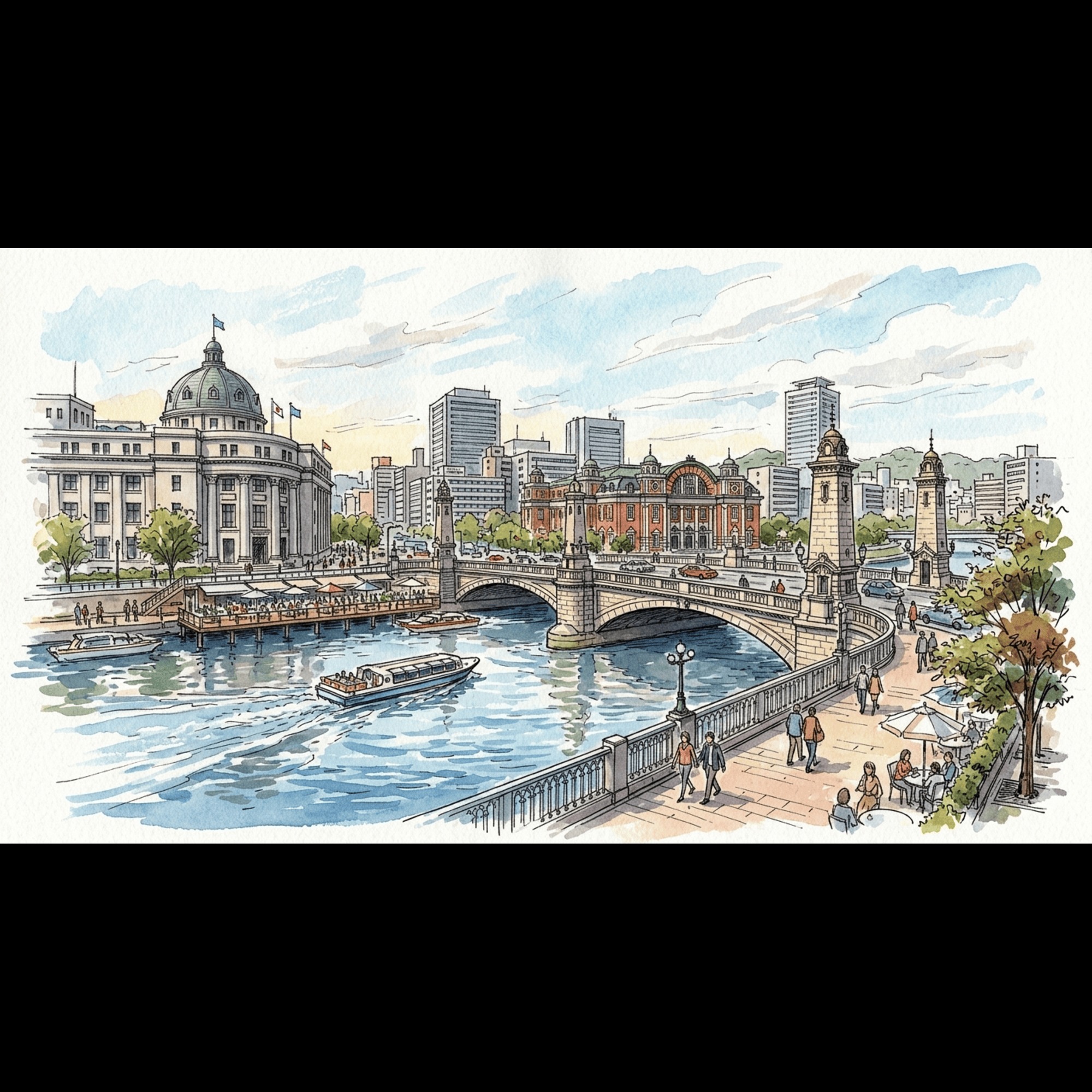
(ENG) the historical and cultural evolution of Kitahama, Osaka
About this episode
The provided text outlines the historical and cultural evolution of Kitahama, Osaka, tracing its development from an Edo-period trading post to a cornerstone of modern Japanese finance and industry. It highlights five pivotal narratives, including the 1875 Osaka Conference that shaped the nation's early constitutional government and the establishment of the Osaka Securities Exchange by pioneer Godai Tomoatsu. Architectural transformations are also examined, specifically how Western-style buildings and the specialized pharmaceutical district of Doshomachi reflect Japan’s rapid modernization and global integration. Furthermore, the sources explore the persistence of traditional spirituality, noting how small shrines remain integrated within the contemporary corporate landscape. Collectively, these accounts illustrate a broader pattern of economic transition and cultural layering that defines Osaka’s identity as a commercial powerhouse.
The Unwritten Pages of Yesterday 細 聽 長 風 說 舊 河
Get every episode summarized
Each time Historical Travel Stories💕旅行の歷史故事 publishes, we email you a written briefing from the transcript — the topics, who appeared, and any specific claims, with the ad reads skipped.
Email me new episodesFree for 3 shows. No card needed.
Hosts & guests
Transcript ready
329 searchable segments. Every word is indexed and playable.
Full transcript
Historical Travel Stories💕旅行の歷史故事 — (ENG) the historical and cultural evolution of Kitahama, Osaka. Machine-transcribed; use the interactive transcript above to jump the player to any line.
Imagine for a second that you are standing in the middle of a city, okay, you look around and honestly it looks a little bit gray It's it's efficient. It's serious and it is very quiet. Right. You're surrounded by these towering glass skyscrapers Endless asphalt and you see all these serious people in expensive suits checking their watches They're rushing to their next meeting the classic corporate scene exactly to the naked eye It looks like the definition of a generic modern financial district. I mean you could be in London You could be in New York or maybe Hong Kong, but you aren't in any of those places. You're actually standing in Kita, Hama, Osaka Right, and if you just judge a book by its cover Kita, Hama seems well a bit sterile It's the business hub. It's where the money lives. Yeah, that's the facade But if we peel back just one or two layers of that modern veneer You realize that you aren't just standing in a business district. You are standing in the literal engine room Where a feudal society transformed itself into a modern superpower
That is the perfect way to frame it because looking at those glass towers You would never guess that this specific grid of streets is actually a master of disguise a master of disguise I like that. It really is it holds the scars and frankly the trophies of Japan's most explosive era Now that is a big claim We're talking about this shift from samurai swords to stock options happening in this one specific neighborhood Essentially, yes, and that is exactly our mission for this deep dive go lay it out for us We aren't just going to recite dates and names like a textbook We're going on a virtual tour of sorts We're looking for hidden gems physical spots you can actually visit today in Kita, Hama and we're connecting them to the high stakes And honestly sometimes dangerous historical stories that happen right there I love this concept. It's like time travel, but you can still get a really good cup of coffee while you do it So we're using a really interesting stack of research titled Osaka Kita, Hama research as our map today And it covers five specific narratives ranging from political intrigue inside a high-end restaurant to the origins of the pharmaceutical industry
And what really stands out to me in this research is the continuity You see Osaka is historically the merchant city right very distinct from Tokyo exactly Tokyo was the political capital But in the Edo period Kita, Hama was the center of the rice trade and you have to remember in feudal Japan Rice wasn't just food. It was money. It was currency. It was the absolute standard by which wealth was measured So Kita, Hama was effectively the Federal Reserve and the grainery rolled into one So it basically has money in its DNA deeply, but the drama really starts when that DNA has to mutate Okay, when the Meiji Restoration hits in the late 1860s Japan decides to modernize He's to stop thinking in rice start thinking in cash credit and laws and that friction that painful pivot happened right here on these streets So let's start walking our first stop on this tour isn't a bank and it's not a government office It's a restaurant. Yes, now usually when we talk about history We're talking about battlefields or palaces
Why are we starting at a dinner table? Because in Japan the real decisions often happen at the Ryote traditional high-end restaurants We're talking about a place called Kagaro Kita, Hama, Haunton a guy row Yes, and it is actually still operating in Kita, Hama one comb today So you can go there right now order a traditional Kiseki meal and sit in the exact same room where history happened You can though might cost you a pretty penny today. Yeah, but we need to transport you back to early 1875 The mood back then wasn't about enjoying the food right the Meiji government the young revolutionaries who had just overthrown the show gun They were in a complete meltdown meltdown how because I always picture the Meiji Restoration is this smooth inevitable March toward modernity not at all. It was messy chaotic and very violent By 1875 the government was fracturing. There was a massive bitter split over foreign policy Specifically a debate called Sikon Arne That's the debate over whether to invade Korea right and the Taiwan expedition was tied up in that era too
Precisely it absolutely tore the leadership apart. Yeah key figures like Saigo Takamori had already left in a huff Then you had leaders like Kido Takayoshi and itagaki Taisuke Effectively quitting the government. Why did they quit because they felt the power was too concentrated in the hands of just a few oligarchs The government was unstable and there were serious whiskers of civil war right So this is that moment where the revolutionary band is breaking up so to speak the band was breaking up and the instruments were about to be used as weapons They desperately needed a neutral ground to bring everyone back to the table before the country collapsed entirely and Tokyo was just too hot too Political exactly. So they chose Osaka and specifically they chose the private discrete rooms of Kagairo And this event became known as the Osaka Conference of 1875 correct and it wasn't just a single dinner This was a grueling month-long negotiation held between January and February Wow a month picture the giants of Japanese history
Hokubo Toshimichi who was the pragmatic strong man Ito hero Bumi the future prime minister and the dissenters Kido and Itagaki They were all in this room probably drinking sake arguing until late in the night definitely Trying to stitch the country back together. That is a lot of ego in one room What was the actual sticking point? Was it just personal beef or was it really about how the country should be run? It was highly structural Itagaki and Kido wanted a constitution. They wanted a clear separation of powers They argued that you couldn't run a modern nation with just a handful of guys from Setsuma and Choshu making all the rules behind closed doors So what came out of this month-long dinner party? Did they just agree to disagree? No, they reached a monumental compromise. They agreed to establish the Genroon which was an early form of a Senate Okay, and the Daishinin which was the Supreme Court They also agreed to create an assembly of local governors Wait, so the concept of the Supreme Court in Japan was basically born in a restaurant effectively yes
This is what historians call the germination of constitutionalism in Japan That's incredible. It was the moment the oligarchy admitted okay. We can't just rule by force anymore. We need a system Now scholars debate how sincere this actually was Some say oh Kubo just did it to shut the others up and consolidate his own power Right trying to appease the opposition, but regardless of the intent it set the trajectory It did it set the path toward the Meiji constitution It's fascinating to think about that fragility. We look back and think history is inevitable But in that room it could have gone either way. They could have flipped the table and gone back to war Absolutely, and when you visit Kagairo today, that is the hidden gem aspect You aren't just looking at a menu or a beautiful garden. Yeah, you're looking at the site where the rule of law was negotiated over cups of tea It's a striking reminder that political stability is often just a fragile agreement between people in a room Okay, so we've saved the government from collapse But a stable government needs money. It certainly does and that brings us to our next stop
We're walking down the street to the Osaka exchange building Yes, also in Kira-Hama one-chon You really can't miss it It has this magnificent white circular entrance almost like a temple Yeah, and standing right in front is a very prominent statue of a man looking dignified and perhaps a little stern I've seen photos of the statue. He's wearing the full Meiji era frot coat. Who is he? That is good-eyed Tamotsu If Osaka has a father figure for its modern economy, it is him To understand why he's standing there guarding the exchange we have to go back to that DNA We talked about earlier. The rice standard In the Edo period this exact area was home to the famous rice markets Diamios the feudal lords from all over Japan would ship their rice here to be stored in giant warehouses Right, and Minijins would trade tickets for this rice It was essentially the world's first futures market So Osaka was already doing highly sophisticated finance just with grain instead of digital numbers Exactly. They were trading derivatives before Wall Street even existed
But when the Meiji era hit the rice standard collapsed. Right the currency became the yen. Yes Government bonds were issued. Mm-hmm. You needed a modern way to raise capital for these new things called joint stock companies And that's where Godai steps in Godai was a visionary He realized that the merchant class of Osaka was brilliant at trading rice But they were clueless about modern corporate structures. You must have been terrified of it They were he basically had to drag them kicking and screaming into modern capitalism He pushed relentlessly for the founding of the Osaka stock exchange in 1878 and where do they build it? Smack to have on top of the old gold and rice exchange sites I find that continuity so interesting the physical location didn't change at all the activity the trading didn't really change They just swap the asset rice out stocks in it represents the economic transition of the entire nation Concentrated in one city block. It's a huge shift in value systems Yeah, however, there is a weird little mystery here that the research highlights
A blank spot in history actually we know the stock exchange opened in 1878 We know Godai was the driving force But the actual trading records from those very first days. Yeah, they are largely missing really You would think a stock exchange would be obsessive about records. That's the whole point of an exchange You would think so But you have to imagine the chaos of the moment. This was a completely new system They were figuring out the rules of the game while they were playing it. Wow There's a theory among historians that it was just so chaotic a wild mix of old rice trading habits colliding with new western regulations That the record keeping just couldn't keep up. I love the image of that Samurai turned traders shouting orders trying to figure out what a dividend is while Godai watches from the balcony Hoping the whole thing doesn't implode it was the wild west But it worked and looking at that statue today You're looking at the man who plugged OSaka into the global financial grid speaking of the global grid Let's cross the street Because if the stock exchange represents the function of a new economy the building right across from it represents the look
Ah, you're talking about the ketahama retro building. That's the one It stands out like a sore thumb in a good way You have all these massive modern glass skyscrapers and then tucked right in between them Is this cute brick building with a giant teapot sign out front Cute is definitely the modern reaction, but when it was built in 1912 it was intended to be Very imposing it looks British like something you'd see in London or Glasgow That is spot on it is built in the Glasgow style and that is not a coincidence This building was originally constructed for a securities brokerage firm Wait a brokerage firm in a tea house Well, it's a tea house now, but back then why would a Japanese broker build a british style office to look the part Exactly, it's about signaling in the magey and taisho eras. There's an obsession with progress looking western If you wanted to be taken seriously as a global player you had to look the part right the west was the center of the financial world So you built in brick and stone you imported the aesthetic to import the legitimacy
So it was architectural diplomacy like trust us with your money We have bricks just like you do precisely. It's what experts call cultural layering They didn't just tear down Japanese culture They layered this western aesthetic on top of it to survive and signal legitimacy in a new geopolitical reality That makes a lot of sense But the most amazing thing about this building is simply that it is still there Because osaka was bombed heavily in world war two right this flattened and then whatever survived the war Usually got bulldozed in the 1980s bubble economy to build more high rises right the real estate boom Yes But this little brick building survived the B-29s in the real estate developers. How did it pull that off adaptation It stopped trying to be a financial building it transitioned into a commercial and cultural space It was registered as a tangible cultural property and now it serves British tea and cake There is something poetic about that The traders are gone the screaming is gone But the building survived by becoming a place of leisure
It challenges the idea that modernization always means destroying the old to build the new Sometimes the old survives by changing his job description It became a cultural asset rather than a financial one Okay, we've done politics, we've done finance, we've done architecture Let's move to something that hits a bit closer to well the body We're heading to Doshimachi Yes, just a short walk away from Kitahama Doshimachi is known as the medicine town and if you think the stock exchange has deep roots Doshimachi goes back even further We were talking about the early Edo period around the 1620s to 1640s So almost 400 years ago that is a very long time for a district to keep one single identity It is a remarkable path dependence The Tokugawa Shogunate was obsessed with control They authorize a guild system here called Yaku Shunakama What did that guild actually do? Basically, a merchant named Kanishi Kichiman set up a system where all raw medicine Coming into or moving through Japan had to be inspected and distributed through this specific district
That is a massive monopoly It was an absolute chokehold on the industry But what it did was centralize expertise in a way we rarely see If you were a doctor, a pharmacist or a wholesaler You had to come to Doshimachi It became the Silicon Valley of herbs and powders And what blows my mind is that this isn't just a fun fact from history books This is still true today, right? That is the best part Walk down Doshimachi today and look the company names on those sleek office buildings Takeda Shinoji Mitsubishi Tanabe Huge names These are titans of the global pharmaceutical industry And they are still headquartered or have their roots or museums On the exact same street where their ancestors were inspecting dried roots 400 years ago It's literally a company town that survived the fall of the samurai The opening of the country, two world wars, and the internet age It beautifully illustrates the path dependence of an economy It shows that once a cluster of knowledge is formed by a feudal decision It is incredibly sticky
It's hard to move Yeah, that expertise just builds on itself layer by layer Exactly But there is another layer here that I find fascinating Right in the middle of these skyscrapers is a shrine The Sikuni Kona Shrine? Yes It's dedicated to the deity of medicine and agriculture And it's not just a tourist spot You will see employees from these massive science-based pharmaceutical companies stopping by to pay their respects That seems like a contradiction to a lot of people You have people developing cutting edge mRNA vaccines or cancer treatments And they are praying to a shinto god for success It seems contradictory to the Western mind, perhaps But in Japan, modern doesn't necessarily mean secular It's that layering concept again The science didn't replace the spirituality It just sat down next to it Which actually leads us perfectly to our final hidden gem The hidden shrines of Kitahama We've been talking about big buildings and famous events But there is something much quieter happening in the corners of this district
Exactly If you walk through the district and remember this is the ultra-modern financial hub You will find tiny, unobtrusive shrines tucked into the strangest places Like where? In the corner of a parking lot In the shadow of a skyscraper courtyard Sometimes even on the roof of an office building I have actually seen this You'll see a guy in a really sharp suit Clearly rushing to a meeting Right But he stops for three seconds, bows, claps And then just keeps running That is the continuation of the merchant's prayer In the Edo period, merchants prayed for their ships to survive storms And for the shipping routes to be safe Today, the ships are supply chains And the storms are market volatility But the anxiety is exactly the same Exactly, it's a really humanizing cultural insight We tend to think of finance as this cold, rational machine Algorithms and spreadsheets If you're a man Right But this challenges the view of Osaka as a purely secular transactional city It reveals a deep spiritual resilience underneath
Modernization didn't erase the human need for a safety blanket It didn't, it just built skyscrapers around the metaphysical insurance Yeah People still need that reassurance Whether they're trading rice tickets or tech stocks So, we've walked the tour We've seen the restaurant that birthed to the courts The exchange that replaced rice with stocks The retro building that used architecture as diplomacy The medicine town that never moved And the shrines that handle the anxiety of it all What is the big picture here? What does Kitahama tell us about Japan? If I had to synthesize it into a meta-analysis It's defined by two words Transformation and layering Transformation and layering, break that down for me We'll look at the timeline It moved from a feudal hub with rice and medicine guilds To a modernization hub with stocks and western buildings And finally to a global financial center But through all that the history didn't vanish In many cities, history is put in a museum It's behind glass You look at it, you read a plaque and you move on But the meaningful reflection here is that in Kitahama the history is functional
It's still going to work every morning That's very true The restaurant is still serving food The exchange is still trading The medicine town is still selling drugs Exactly, it's not a ruin It's a machine that has been running for 400 years The parts have been upgraded Wood turned to brick, brick turned to glass Rice turned to data But the function of the machine hasn't changed It is still the engine room That is a really powerful way to look at a city It's not just about what the buildings look like It's about what the land itself is doing Precisely And imagine standing in front of that retro building Looking across at the stock exchange And just knowing that beneath your feet Is the memory of the Edo rice markets The layers are all right there Before we wrap up though I want to leave the listener with one thought that stood out to me from the research We've talked a lot about the big names today Go die, Okubo, the merchant princes The people with statues The great men of history Right But our source material points out a historical graphical gap We know what the elites were doing
But we don't really know much about the common clerks Or the workers who actually powered this massive transition That's so true The transition to modernization Wasn't just powered by guys and top hats making deals at rio tees It was powered by thousands of invisible workers The tea servers The rickshaw pullers The junior clerks filing the messy paperwork at the exchange And there are daily lives that are largely lost to us They aren't The people who didn't get a statue So when you visit Kitahama Stand in front of that statue of Go die But then look past him Look at the empty space on the sidewalk Wonder about the invisible stories Imagine the thousands of people rushing by in 1878 Terrified, excited and exhausted Trying to build a new world Their stories are the ones that really powered the engine A very humbling and important perspective to end on For everyone listening Next time you're walking through your own city Try to look for those functional layers Don't just look at the architecture Ask yourself what the street has been doing for the last three centuries
Thank you for joining us on this deep dive into the layers of Osaka It's been quite a journey It certainly has Thanks for having me Keep looking for those hidden layers And we'll catch you on the next deep dive
More episodes
More from Historical Travel Stories💕旅行の歷史故事

JPN-数千年にわたる神聖な地理と文化にまたがるロンドンのタワー・ブリッジ
Historical Travel Stories💕旅行の歷史故事

FRA-Le Tower Bridge de Londres embrasse des millénaires de géographie sacrée et...
Historical Travel Stories💕旅行の歷史故事

SPA-El Tower Bridge de Londres abarca milenios de geografía sagrada y cultura.
Historical Travel Stories💕旅行の歷史故事

ENG-London’s Tower Bridge Spans Millennia of Sacred Geography and Culture
Historical Travel Stories💕旅行の歷史故事