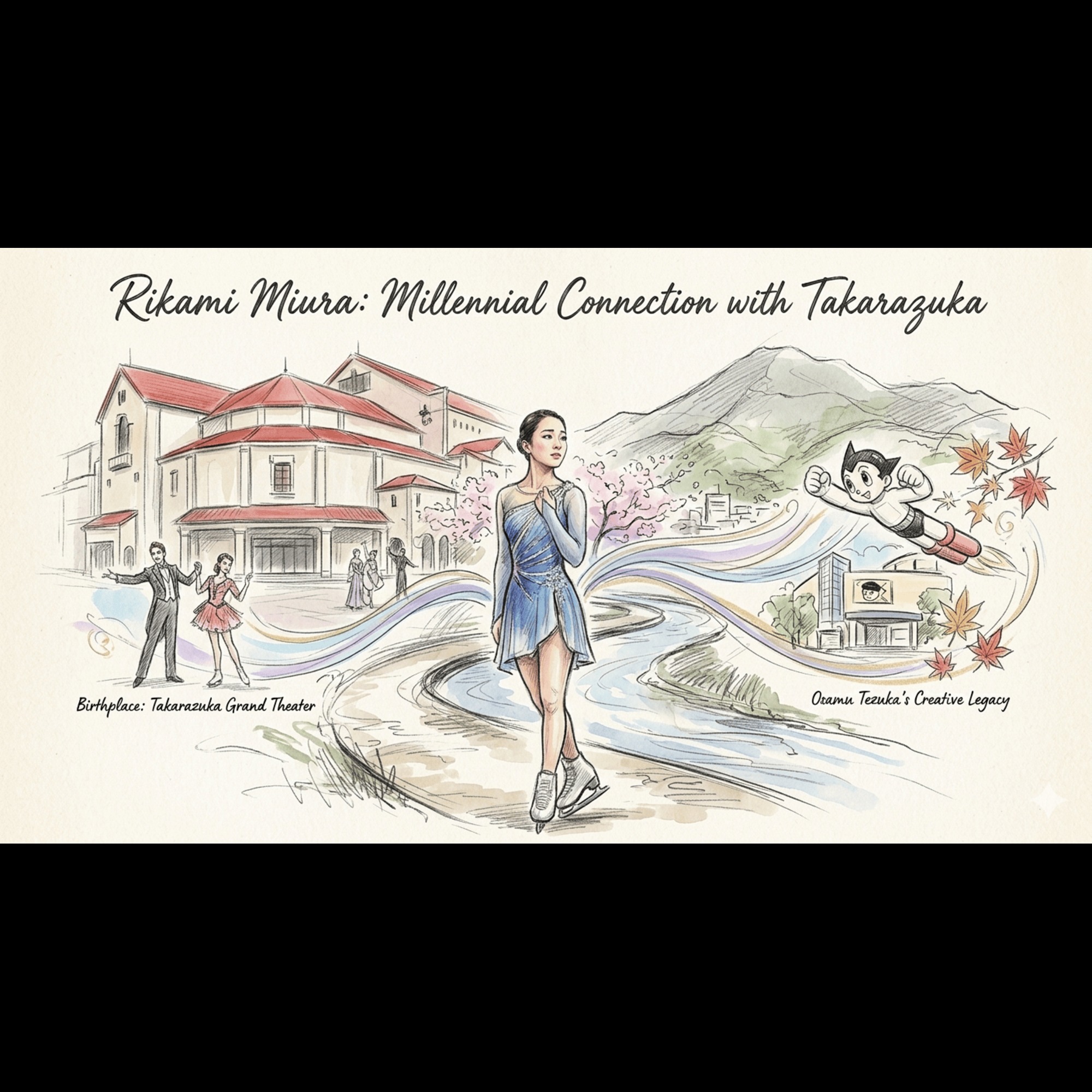
(ENG) Rikami Miura's Millennial Connection with Takarazuka
About this episode
This text explores the layered history and unique cultural identity of Takarazuka City, Japan, through a series of five interconnected historical narratives. It traces the city's evolution from ancient burial mounds that promised good fortune to its modern status as a cradle of artistic and athletic excellence. Key milestones include the transformation of a failed swimming pool into the world-renowned Takarazuka Revue and the natural environment's role in inspiring manga legend Osamu Tezuka. The sources also highlight the spiritual significance of the Kiyoshikojin Seishoji Temple and the sophisticated Hanshin-kan Modernism that defines the local architecture. Ultimately, the report argues that this "spirit of place" directly fuels the resilience and grace of figures like Olympic skater Riku Miura.
The Unwritten Pages of Yesterday 細 聽 長 風 說 舊 河
Get every episode summarized
Each time Historical Travel Stories💕旅行の歷史故事 publishes, we email you a written briefing from the transcript — the topics, who appeared, and any specific claims, with the ad reads skipped.
Email me new episodesFree for 3 shows. No card needed.
Hosts & guests
Transcript ready
740 searchable segments. Every word is indexed and playable.
Full transcript
Historical Travel Stories💕旅行の歷史故事 — (ENG) Rikami Miura's Millennial Connection with Takarazuka. Machine-transcribed; use the interactive transcript above to jump the player to any line.
I want you to picture a moment in time. It's 2026. Right. And the world is watching the Malang Cortino Winter Olympics. The tension in the arena is, it's absolutely electric. Oh, I can imagine. You can hear that sharp cutting sound of blades on the ice, the collective held breath of the crowd, and then just this massive eruption of cheers. Because Japanese figure skater, Rikumiura, just captured pier skating gold. Exactly. She's gliding across the rank with this, this really extraordinary, almost unbelievable mix of raw, athletic power, classical elegance, and deep, unshakable resilience. Yeah. But to truly understand how she forged that winning combination, we actually have to leave the ice rink entirely. We do. We have to travel back over 1,000 years to her hometown. A city built on top of ancient tombs, spectacularly failed swimming pools, and an incredibly unique, layered history. It is quite the journey, because you know, when most people hear the name of her hometown, Takarazuka City, their minds immediately jump to one very specific,
very glamorous image. The theater, right. Exactly. The world famous, all female, Takarazuka review. But looking at the academic report we are diving into today. Which is titled, Takarazuka Historical Research and Local Spirit, by the way. Yes. Looking at that, we quickly realize that the theater is really just the tip of the iceberg. The history beneath it is what truly shapes the people who come from there. Completely agree. And that is our mission for today's deep dive. We are going to unpack the incredible, almost cinematic historical stories about Takarazuka City hidden in this research. You can be fun. We'll point out some amazing hidden tourist gems connected to these tales. Perfect for your next trip, if you're listening. And we're going to reflect on this fascinating concept called Genius Lochi. Which basically means the spirit of place. Right. We want to see how a city's literal and metaphorical bedrock actually shapes the exceptional people who grow up walking its streets. Okay, let's unpack this. I was looking at the origin of the city's name
and it literally translates to treasure mound. Yes, it does. But looking at the geography mentioned in the report, these mounds were actually ancient tombs. How does a landscape of death become associated with treasure? That is exactly where this concept of layered history begins. If we connect this to the bigger picture, Takarazuka is a profoundly rare example of a place that doesn't just pave over its past to build the future. It absorbs it. Exactly. It continually absorbs and transforms it. To answer your question about the name, we actually have to go back to the Kofu and Period. So that's roughly the third to seventh centuries? Right. Because of its location where the Muko River flood plains meet the hills, Takarazuka was considered prime real estate. For burial grounds? Yes. For the burial grounds of ancient rulers, we're talking massive, imposing earth and mounds built to project immense power. And tombs are inherently terrifying, right? For especially ancient ones. I mean, they're literal monuments to dead rulers who had absolute unquestioned power
over the populist. Precisely. Take the Nakiyama Shon Kofun, for example. Oh, yeah. The report highlighted that one. Right. It's a tomb from the mid-seventh century and it's incredibly rare because it's octagonal. Eight-sided. Yeah. In ancient Japan, an eight-sided structure was an architectural privilege, reserved almost exclusively for the absolute highest tier of royalty. Like emperors. Exactly. So initially, these were highly intimidating symbols. But here is where that what researchers call the meaning flip happens. The meaning flip? Yeah. Fast forward to the year 1701. The Tokogawa Shogunate is in power. And a geographer named Kishio Kata compiles a text called the Setsuyu Gundam. Okay. He records a local myth that shows how the everyday people had fundamentally changed the narrative of their own landscape. Over generations, locals began to believe that if you picked up items near these ancient burial mounds, it would actually bring you happiness and good luck. That's wild. So they completely stripped away the fear. They took monuments meant to intimidate them
and turned them into sites of profound luck. Exactly. And from a psychological standpoint, this creates a deep-seated resilience within the culture of the city. It establishes this subconscious environment where the past, no matter how intimidating, is safely contained and transformed into something positive. So when Rikamura talks in interviews about the piece of mine, her hometown gives her... She is drawing on a thousand-year-old tradition, a tradition of finding safety and treasure in what used to be a landscape of fear. What blows my mind is that you can actually go there today and see this layering for yourself. Like if you're visiting, you don't have to go to some remote roped-off museum field. Not at all. You can walk right into a modern, residential neighborhood and suddenly boom, you're standing at the ruins of the seventh century, octagonal Nakayama Shouman tomb. Right between people's houses. Yes. And furthermore, the report notes that most tourists walking toward the famous Takazuka Grand Theatre have absolutely no idea what's under their feet. They are quite literally stepping over more
than 200 buried ancient tombs beneath the city streets. It's the ultimate paradox. Building a modern city globally famous for dreams and happiness directly atop ancient burial grounds. It really is. But that idea of transforming something intimidating or even a massive failure into something wonderful feels like a recurring pattern in the city's DNA. It does. Because reading about the industrialist Ikizo Kobayashi in 1910, the guy essentially builds a train line to nowhere, right? He did. Kobayashi started a suburban railway line but he had a major problem. No passengers. The destination was completely desolate. It was just a boring riverbed. He desperately needed a reason for people from the bustling city of Osaka to buy train tickets and ride all the way out to Takazuka. So what does he do? In 1912, he decides to go spectacularly big. He builds paradise. Paradise. Yeah, that was the name. It was a massive, gorgeous, renaissance-style red brick building designed to house Japan's
very first indoor heated pool. And the report says it was a 100-sudo pool. Just to clarify for anyone trying to picture this, that's about 3,500 square feet. Right. That is a massive aquatic center for 1912. Incredibly ambitious. He was trying to completely redefine leisure culture in Japan. He wanted to move people away from traditional public bathhouses and introduce them to a glamorous western-style aquatic spectacle. Here's where it gets really interesting. The reality was a colossal, unmitigated disaster. Yeah, total disaster. The technology just wasn't there yet to support his vision. Since they had no dehumidifiers, all that warm moisture from the heated pool rose up, condensed on the cold ceiling, and constantly drip freezing water back down onto the guests. Not exactly relaxing. Right, and during the harsh winters, nobody wanted anything to do with it. In his 1920 diary, Kobayashi literally refers to the whole venture as a great failure. He did, he was very blunt about it. Wait, I have to jump in here because his solution is wild to me.
He has a freezing, dripping disaster of a building, and his big fix is to just drain the water and throw some wooden floorboards over the empty basin. Yeah, that was the plan. How was that considered a stroke of genius, and not just a desperate, last-ditch pivot to avoid bankruptcy? Oh, it was absolutely a desperate pivot, but that is exactly what makes it a textbook example of what the report calls catalytic failure. Catalytic failure. Yes, any ordinary businessman would have demolished the building, cut his losses and sold the scrap. Kobayashi didn't. He repurposed it. He looked at that miserable, dripping pool, and completely re-imagined the space. Once he laid those solid floorboards right over the empty basin in 1914, he formed a troop of 16 young girls to perform a theatrical version of the Peach Boy legend. Called Dumbaraco, right? Exactly, on that makeshift stage. Out of a spectacularly failed swimming pool, the legendary Takarizuka review was born. It's just incredible. He took an empty basin of failure and filled it with theater. What's fascinating here is the profound metaphor.
Converting liquid water into a solid stage. And think about the psychological blueprint that leaves on a city. Ah, so. Kobayashi took an environment that was physically hostile and converted it into a stage for high art. When we look at an Olympic skater like Rikamura, the connection isn't just that she skates on ice while they had a pool. The real connection is the psychology of the pivot. Mura operates in a freezing, unforgiving environment, where a single mistake or injury can be a spectacular failure. But she adapts. Exactly. Just like Kobayashi, she takes that unforgiving environment relies on the city's blueprint of resilience and executes a highly choreographed, emotionally resonant art form. It's the exact same creative alchemy. If you're walking into the Takarizuka Grand Theater or the Takarizuka Hotel today, you really feel that alchemy. You do. And here is a hidden gem that will completely change how you experience those buildings. When you're stepping on those plush, impeccably vacuumed, elegant carpets,
take a moment to look down. Because you're standing on history. Literally. You're standing over the footprint of that disastrously cold, rippy swimming pool. You are walking on a monument to brilliant failure. It proves that the physical space remembers. The architecture changes, but the genius Lossi remains. It really does. In speaking of how these unique environments shape creative minds, that same theater went on to heavily influence one of Japan's most legendary artists. Oh, yes. It's fascinating how that theater became the heartbeat of the city. And it didn't just impact athletes. It literally shaped the godfather of modern Japanese pop culture. It's quite the story. Story number three brings us to 1933. A five-year-old boy moves to the Gotanyama area of Takarizuka. He spends his youth running through the rich pristine forest there obsessively collecting insects. He even creates his own incredibly detailed hand-drawn bug encyclopedia. Yeah. That little boy was Osamu Tazuka who would grow up to become the undisputed god of manga.
What the research points out about Tazuka's upbringing in Takarizuka is the intense duality he was exposed to. It acted as a massive creative incubator. Right, because on one hand, up in the Gotanyama woods, he was immersed in raw, unfiltered biology. The brutal and beautiful cycle of life, death, and nature. This environment directly inspired the profound ecological themes in his famous work, Kimba the White Lion. Right, but then right down the hill, he is absorbing the exact opposite. Pure artificiality. Yes. He was heavily exposed to the highly artificial, glittering, glamorous performances of the Takarizuka review, specifically the Otoko Yaku. The female actresses who specialize in playing male roles. Exactly. Yeah. It was this stylized, gender-bending theatricality that inspired the gender-ambiguous protagonist of his groundbreaking manga, Princess Knight. For a young creative mind, learning to hold those two contrasting truth at the same time is incredibly powerful. The juxtaposition of raw, untamed nature with extreme,
deliberate artificiality is what gives Takarizuka its unique aesthetic signature. It's quite a mix. It is. And for Tizuka, this duality instilled a deep respect for what the research is called The Weight of Life. It provided a philosophical foundation for the entire postwar manga industry. He learned that art could be both an exploration of profound biological truths and the glittering artificial spectacle all at once. If you want to tap into that specific creative energy on your next visit, you have to go hunting for the ruins of the Neko Jinta or the Cat Shrine in the Gutanyama area. Which actually features in Tizuka's works. It does. And then, head straight to the Tizuka Osamu Memorial Hall. Don't just browse the comics, make sure to find the intricate diorama of the 1940s Takarizuka Skyline. That diorama is fantastic. It lets you see the exact geographical duality Tizuka experienced as a kid, if visually perfectly captures how the wild forest bleed right into the theatrical city center. It's a perfect visual representation of the city's layered history.
But as the report notes, it isn't just art and nature that overlap in Takarizuka. It is also the sacred and the secular. Speaking of holding two contrasting ideas at the same time, let's talk about the Northern Hills. Yes, the temple. Up there sits the Kiyoshikou Jun Suchouji temple. This place is old, founded in 896 AD by Emperor Uda. It is dedicated to Kojin, who is the god of fire and the hearth. For centuries, people have gone there to pray for very worldly things. Money, good business, warding off bad luck, superworldly everyday stuff. But then the 37th head priest, Koki Sakamoto, does something completely out of left field to mix this everyday faith with high art. He does. In the mid-20th century, pre-Sakamoto makes a fascinating decision. He begins aggressively collecting the works of Tomeoka Tessai. Okay, for those who might not be familiar, who was Tessai? Tessai is widely considered Japan's last great literati painter. Literati painters were essentially scholars who created highly expressive philosophical brush paintings. Right. They cared more about capturing the spirit
of a subject than perfect technical realism. The temple eventually amassed over 2,000 of Tessai's works, building an entire museum for them right there on the temple grounds. This raises an important question. How do those two worlds coexist? You have crowds of people praying for promotion at work right next to these incredibly esoteric, transcendent brush paintings that are striving for a completely different spiritual plan. The research explains that this temple perfectly captures the balance of the sacred and the secular in the city. You have the rough, intense curification of the fire god combined with this eccentric pursuit of high art. It's a striking contrast. Together, they represent a collective, civic consciousness. The idea that you can only achieve perfection through intense hardship and purification. Ah, I see where this is going. Right. When an athlete like Mira is putting herself through grueling repetitive training sessions, falling on the ice and getting back up, she is tapping into that exact same local ritual of purification
through fire and striving. And to really feel that ritual yourself, you have to walk the dragon's road. It's a 1.2 kilometer approach up to the temple. And it is lined with shops dripping with that nostalgic mid 20th century Shoah era charm. It's a beautiful walk. But the absolute must-do when you get to the temple is observing a custom called Yaku Yuki Hibashi. You bring large metal fire tongs to the temple and you offer them up to symbolically pinch away your bad luck in your worldly troubles. That's amazing. It's such a tactile, physical way to interact with faith. It is a very deliberate physical action to create psychological clarity. And that pursuit of clarity along with an overarching elegance really defines our final historical layer. Which is the era of Hanshin-Kan modernism. It's exactly. Let's set the scene for the late 19th and early 20th centuries. Osaka was rapidly industrializing, becoming choked with pollution and earning the nickname the Smoke City. So people wanted out. Exactly. Wealthy locals started fleeing the smog to find fresh air
and they looked west toward the beautiful Muko River in Takarazuka. In 1926, an architect named Masaharu Kazuka built the Takarazuka hotel right on the riverbank. Picture Red Ruse, gorgeous arched windows, grand classical sweeping staircases. It was the absolute peak of modern, elegant, sophisticated living. What we are analyzing here is the production of space. The architects and residents were deliberately grafting western ideals of leisure and classical beauty onto pristine Japanese nature. Blending the two again. Right. It created a highly structured refined atmosphere. And when we look at Rikumir on the ice today, we see the direct result of that environment. The elegance. The strict classical almost hotel-like elegance combined with rigorous punishing physical training. Is it direct inheritance from this 1920s modernist movement? It established a distinct graceful character that people even started calling Takarazuka-esque. If you want to experience that 1926 glamour today,
you're in luck. The hotel is actually relocated and rebuilt in 2020 right next to the grand theater. They perfectly replicated those original arched windows and grand chandeliers. But the real hidden gem isn't the building itself. It's the ground outside. Take a walk along the Muko river and look at the sand. Yes, the white granite. It is lined with this beautiful white granite sand. That bright, crisp white stone is literally what forms the refreshing, clean color palette for the entire city's aesthetic. It is the geological bedrock literally dictating the color of the culture above it. Okay, so we've covered ancient tombs turning into treasure, a freezing pool transforming into a legendary theater, the godfather of manga, catching bugs, fire tongs, pinching away bad luck, and the crisp white sand of a modernist hotel. Quite the lit. So what does this all mean? How do we take all these fascinating disparate threads and actually weave them into a single 2026 Olympic gold medal? The report synthesizes this brilliantly by outlining five historical moves
of the city's genius loci, its spirit of place that have directly shaped an athlete like Mura. Let's walk through how they overlap. First, there is frontier transformation and resilience. Just as the city historically turned terrifying ancient tombs into hills of treasure, and just as it painstakingly rebuilt after the devastating 1995 ancient earthquake. Mura has absorbed a culture that teaches her to turn severe sports injuries and setbacks into a resilient, unshakeable piece of mind. Right. And that leads directly into the second mode, which is catalytic failure. Taking that miserable, freezing indoor pool, draining it, and using the empty basin to build a theatrical empire. So it's almost like the muscle memory of the city is to turn a mistake into a masterpiece. Exactly. Mura takes that exact same concept, pivoting gracefully from a literal or metaphorical slip on the ice and channels it into executing higher. Mace total sense. The third mode is gender tension and strength. The Tucker-Azoca review is famous for its male role aesthetic, where women portray powerful, stylized masculinity.
Growing up in a culture that explicitly celebrates female athletic strength and theatrical power gave Mura the toughness to completely defy the traditional fragile female stereotypes that are often associated with pair skating. Spawn, the fourth mode is religious layering and ritual. The intense precision, focus, and dedication required to win Olympic gold doesn't just come from a coach. It mirrors the exact physical rituals of the city. Yes. It's the same focused intention as bringing those metal fire tongs to the temple to meticulously tinge away bad luck. And finally, the fifth mode ties it all together. Modernist elegance. The classical grace and perfectly postured aesthetic that Mura displays on the ice isn't just choreography she learned last year. No, it is the inherited cultural DNA of the 1926 Tucker-Azoca hotel era. It is a full century of Tucker-Azoca-esque elegance channeled into a single flawless athletic routine. It is just mind blowing. It really reminds us that a gold metal isn't just one by muscles, good coaching,
and early morning practice. Not at all. Sometimes a champion is slowly forged by the water, the forests, the fire, and the very stones of a hometown over the course of a thousand years. Rikumira wasn't just skating for her city. She was skating with the weight and the power of its entire history beneath her blades. Beautifully put, we've seen how the invisible layered history of a city its ancient tombs, drained pools, and white granite can silently dictate the trajectory of a modern athlete's life. Yeah. It makes you wonder, what forgotten failures, hidden monuments, or ancient rituals are buried beneath the concrete of your hometown. And how are those invisible layers secretly scripting the story of your life right now without you even realizing it? That is such a fantastic provocative thought to leave on. Thank you so much for joining us on this deep dive into Tucker-Azoca's layered history. Keep looking closely at your surroundings. Keep uncovering the hidden gems around you. And most importantly, keep questioning the ground beneath your feet. Keep questioning the ground
beneath your feet. Keep questioning the ground beneath your feet.
More episodes
More from Historical Travel Stories💕旅行の歷史故事

JPN-数千年にわたる神聖な地理と文化にまたがるロンドンのタワー・ブリッジ
Historical Travel Stories💕旅行の歷史故事

FRA-Le Tower Bridge de Londres embrasse des millénaires de géographie sacrée et...
Historical Travel Stories💕旅行の歷史故事

SPA-El Tower Bridge de Londres abarca milenios de geografía sagrada y cultura.
Historical Travel Stories💕旅行の歷史故事

ENG-London’s Tower Bridge Spans Millennia of Sacred Geography and Culture
Historical Travel Stories💕旅行の歷史故事